

India Surfactants Market Research Report: Forecast (2026-2032)
By Type (Anionic Surfactants, Nonionic Surfactants, Cationic Surfactants, Amphoteric Surfactants, Others), By End-User (Home Care, Personal Care and Cosmetics, Industrial and Insti ... tutional Cleaning, Textiles and Leather, Agrochemicals, Paints, Coatings, Adhesives and Construction Chemicals, Plastics, Elastomers and Polymerization, Oil and Gas, Pharmaceuticals and Food Processing, Others), and others Read more
- Chemicals
- Aug 2026
- Pages 145
- Report Format: PDF, Excel, PPT
India Surfactants Market
Projected 7.09% CAGR from 2026 to 2032
Study Period
2026-2032
Market Size (2026)
USD 1.81 Billion
Market Size (2032)
USD 2.73 Billion
Base Year
2025
Projected CAGR
7.09%
Leading Segments
By Type: Anionic Surfactants
India Surfactants Market Key Takeaways
- The market is estimated at USD 1.69 billion in 2025 and USD 1.81 billion in 2026, reaching USD 2.73 billion by 2032 with a 7.09% CAGR during 2026-32.
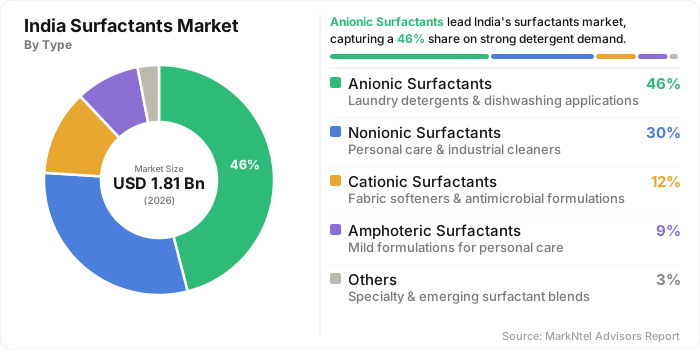
- Anionic surfactants lead by type, accounting for an estimated 46% share in 2026.
- Home care leads by end-use industry, with an estimated 34% market share in 2026.
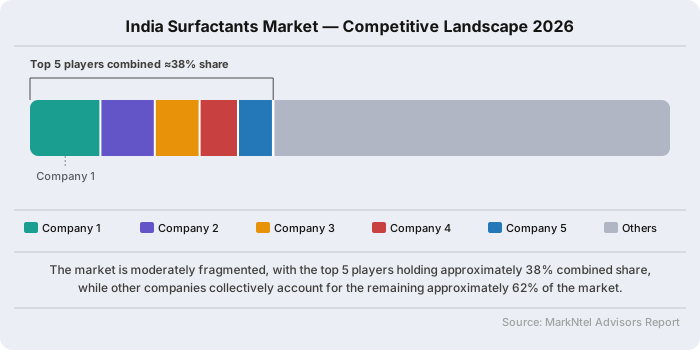
- The market is fragmented, with the top five companies collectively accounting for an estimated 38% share in 2026.
India Surfactants Market Size and Outlook
The India Surfactants Market was valued at an estimated USD 1.69 billion in 2025 and is projected to reach USD 1.81 billion in 2026. It is forecast to expand at a CAGR of around 7.09% during 2026–2032, reaching nearly USD 2.73 billion by 2032.
Demand is supported by recurring consumption across consumer and industrial formulations. India’s beauty and personal care sector is projected to expand at a CAGR of 14.29% through 2032, indicating sustained formulation activity in a major surfactant-consuming industry. In parallel, the Ministry of Statistics & Programme Implementation’s June 2026 Index of Industrial Production (IIP) release reported that textile and rubber and plastics output increased by 14.3% and 11.9%, respectively, during Q1 FY2026–27 compared with the corresponding period a year earlier. These sector-level gains are supporting demand for surfactants across wetting, emulsification, dispersion, cleaning, and polymer-processing applications, while also encouraging manufacturers to adopt concentrated, multifunctional, and performance-oriented formulations.
Looking ahead to 2032, market revenue growth is expected to be driven by a combination of expanding end-use consumption and increasing adoption of higher-value mild, multifunctional, application-specific, and bio-based surfactant systems. At the supply level, domestic capacity expansion and closer technical collaboration between surfactant manufacturers and formulators are expected to improve product availability and reduce qualification and development timelines. Nevertheless, volatility in palm- and petrochemical-derived feedstock prices, currency-sensitive imports, price competition in high-volume product categories, and lengthy customer-approval processes are likely to limit the pace of expansion. Consequently, the forecast reflects sustained volume growth, selective pass-through of input-cost increases, and gradual improvement in product mix rather than broad-based pricing growth.
India Surfactants Market Key Indicators
- Department of Chemicals and Petrochemicals data show India produced 467,000 metric tons of linear alkyl benzene in FY2024–25, with capacity utilization of 79.6%. This substantial domestic base supports anionic surfactant manufacturing, although available capacity headroom and petroleum-linked feedstock exposure keep supplier realizations sensitive to operating rates and input costs.
- The Ministry of Textiles reported that textile exports increased 2.1% in FY2025–26. Continued export expansion indicates sustained processing activity across spinning, weaving, dyeing and finishing chains, supporting requirements for wetting agents, emulsifiers, detergents, dispersants and softening systems used throughout textile preparation and treatment.
- The Commerce Ministry reported that pharmaceutical exports grew 9.4% to reach USD 30.47 billion in FY2024–25, while India ranked third globally by production volume and shipped medicines to over 200 markets. This manufacturing scale sustains requirements for pharmaceutical-grade solubilizers, emulsifiers and processing aids, although purity and qualification requirements limit the addressable supplier base.
- The Ministry of Petroleum and Natural Gas reported that around 674 wells were drilled during FY2025–26, while five new hydrocarbon discoveries were made and seven discoveries were monetized. This sustained exploration and field-development activity supports specialized demand for drilling emulsifiers, wetting agents, foam-control formulations and enhanced-recovery surfactant systems.
India Surfactants Market Scope
| Category | Segments |
|---|---|
| By Type | Anionic Surfactants, Nonionic Surfactants, Cationic Surfactants, Amphoteric Surfactants, Others |
| By End-User | Home Care, Personal Care and Cosmetics, Industrial and Institutional Cleaning, Textiles and Leather, Agrochemicals, Paints, Coatings, Adhesives and Construction Chemicals, Plastics, Elastomers and Polymerization, Oil and Gas, Pharmaceuticals and Food Processing, Others |
India Surfactants Market Growth Drivers
Expanding Home and Personal Care Consumption Broadens Recurring Surfactant Demand
Home and personal care products generate recurring surfactant demand because cleansing, foaming, emulsification and soil-removal functions are required across detergents, dishwashing liquids, surface cleaners, soaps, shampoos and body washes. Increasing consumption raises throughput, while expansion into liquid and application-specific formats increases formulation complexity and supports blended or higher-performance surfactants. India’s home and personal care consumption grew 7.5% in Q2 2025: rural FMCG volumes increased 8.4%, compared with 4.6% in urban markets, widening the demand base beyond cities and supporting both affordable mass formulations and specialized urban products.
Recent market activity demonstrates how this consumption translates into additional formulations. In August 2026, Godrej Consumer Products reported 12% growth in home care and 11% growth in personal care during Q1 FY2027. The company also launched Godrej Rizz liquid dishwash in selected states, describing the category as growing at a double-digit rate while household penetration remained in the mid-teens. The launch creates new requirements for grease removal, foam control, mildness, viscosity and fragrance compatibility rather than merely replacing an existing powder product. As manufacturers expand liquid-cleaner adoption across states and price points, recurring demand should increase for anionic, amphoteric and nonionic surfactants, supporting market volume and value through 2032.
Recent Trends
Fermentation-Derived Biosurfactants Move Toward Commercial Supply
India’s surfactant market is beginning to shift from broad sustainability claims toward ingredients with verifiable renewable origin, biodegradability and lifecycle attributes. The Ecomark Rules notified in September 2024 created an updated environmental-labelling framework covering soaps and detergents, cosmetics and other categories. Certification considers factors including resource efficiency, recyclability, biodegradability and reduced environmental impact. This framework gives downstream manufacturers a basis for substantiating environmental claims and encourages formulators to evaluate bio-based and fermentation-derived surfactants alongside petrochemical and oleochemical alternatives.
Commercial activity now indicates movement beyond laboratory development. In July 2026, Godrej Chemicals launched SLNOVA, a sophorolipid biosurfactant platform produced from renewable feedstocks through fermentation technology. The platform entered commercial-scale supply with two variants targeting personal care, home care and industrial cleaning formulations and providing functions including wetting, emulsification, dispersion and solubilization. The launch expands domestic access to biotechnology-derived surfactants and creates opportunities for higher-value ingredients combining functionality with biodegradable positioning. Adoption is nevertheless expected to proceed through partial substitution and hybrid systems because formulators must validate cost, stability, compatibility and performance against conventional products. Through 2032, this transition should strengthen the bio-based segment and increase competition around traceability, application support and verified environmental performance rather than renewable-source claims alone.
India Surfactants Market Opportunities and Challenges
Feedstock Volatility Constrains Margins While Driving Domestic Processing Expansion
Volatility in surfactant feedstocks constrains surfactant manufacturers in India, because fatty alcohols, fatty acids, vegetable-oil derivatives and ethylene oxide influence the cost and availability of anionic, nonionic and specialty formulations. The FAO Vegetable Oil Price Index reached 195.7 points in July 2026, increasing 2.0% monthly to its highest level since June 2022 as palm and soybean-oil prices strengthened. Rapid input movements can compress margins on fixed-price contracts, complicate inventory planning and delay price-sensitive customer reformulations. Smaller manufacturers face pressure because they have less purchasing leverage, feedstock flexibility and ability to absorb cost increases.
Domestic processing expansion creates an opportunity to improve availability and retain value locally. During the quarter ending March 31, 2026, Rossari Biotech subsidiary Unitop Chemicals commissioned the remaining 15,000 metric tons per year of ethoxylation capacity at Dahej in Gujarat, increasing its ethoxylation capacity to 66,000 metric tons annually. Domestic ethoxylation capability can support local production of nonionic surfactants and customized derivatives while shortening lead times for home care, personal care and industrial customers. Suppliers combining processing scale with secured multi-origin inputs, application support and flexible contracts can offer continuity. Through 2032, these capabilities should create revenue opportunities from customized formulations and longer-term supply agreements rather than reliance on commodity volume growth.
Segmentation Insights
Anionic Surfactants Lead Through High-Volume Detergency and Broad Formulation Use, Accounting for an Estimated 46% Market Share in 2026
Anionic surfactants lead because they combine strong detergency, foaming and soil-removal performance with established manufacturing economics across high-volume applications. LABSA anchors powder detergents and multipurpose cleaners, while SLES, SLS and alpha-olefin sulfonates extend the category into dishwashing liquids, shampoos, hand cleansers, textile processing and industrial formulations. Their compatibility with builders, fragrances and other surfactants allows formulators to adjust cost and performance without replacing the cleansing system. This breadth keeps anionic consumption ahead of more application-specific cationic and amphoteric chemistries.
The dependence of India’s detergent base on anionic chemistry became visible in April 2026, when the Gujarat Small Scale Detergent Manufacturers’ Association reported that around 80% of approximately 850 registered small and medium detergent units had stopped operating amid a sharp increase in LABSA prices. The disruption demonstrates LABSA’s central formulation role in soap manufacturing. Anionic surfactants should retain leadership through 2032 as affordable detergents expand beyond cities. However, amphoteric and nonionic products are expected to grow faster from smaller bases as liquid cleaners, mild personal care and low-foam industrial processes require greater compatibility and performance differentiation. Based on type, the India surfactants industry is segmented into:
- Anionic Surfactants
- Nonionic Surfactants
- Cationic Surfactants
- Amphoteric Surfactants
- Others
Home Care Leads Through Recurring, Mass-Market Consumption, Accounting for an Estimated 34% Market Share in 2026
Home care leads end-use demand because surfactants are indispensable to products purchased frequently across nearly every income group. Laundry detergents account for substantial formulation volumes, while dishwashing products, floor cleaners, toilet cleaners and multipurpose surface cleaners broaden consumption across household tasks. These formulations use cost-efficient anionics for detergency and foaming, supplemented by nonionics or amphoterics to improve grease removal, compatibility and mildness. The combination of large pack volumes, nationwide distribution and recurring replenishment gives home care a wider consumption base than specialized industrial applications.
Household Care maintained double-digit underlying volume growth during the September 2025 quarter, while dishwash bars recorded high-single-digit volume growth and liquids outperformed. Home care should remain the largest end-use industry through 2032 as branded detergents penetrate further beyond cities and consumers shift toward liquid and task-specific cleaners. Personal Care and Cosmetics is nevertheless expected to expand faster from a smaller base as formulators adopt milder and multifunctional surfactant systems. Based on end-use industry, the market is segmented into:
- Home Care
- Personal Care and Cosmetics
- Industrial and Institutional Cleaning
- Textiles and Leather
- Agrochemicals
- Paints, Coatings, Adhesives and Construction Chemicals
- Plastics, Elastomers and Polymerization
- Oil and Gas
- Pharmaceuticals and Food Processing
- Others
India Surfactants Market Competitive Landscape
The India surfactants market is fragmented, with top five companies holding 38% market share in 2026. The top five companies in the market are Galaxy Surfactants Ltd., Godrej Industries Limited, Rossari Biotech Ltd., Aarti Surfactants Ltd. and Fineotex Chemical Ltd.
Key Companies in the India Surfactants Industry
- Aarti Surfactants Limited
- Anshika Polysurf Limited
- BASF India Limited
- Clariant IGL Specialty Chemicals Private Limited
- Croda India Company Private Limited
- Fineotex Chemical Limited
- Galaxy Surfactants Limited
- Godrej Industries Limited
- Harcros Chemicals Inc.
- Matangi Industries LLP
- Rossari Biotech Limited
- Stepan India Private Limited
- Supreme Surfactants Private Limited
- Syensqo India
- Ultramarine & Pigments Limited
- Others
India Surfactants Industry News and Recent Developments
August 2025 | Fineotex Commences Ambernath Facility with 15,000-Metric-Ton First Phase
Fineotex Chemical commenced operations at a new manufacturing facility in Ambernath, Maharashtra. Developed with an investment of approximately USD 6.9 million, the first phase added 15,000 metric tons of annual production capacity. The facility expands the company’s domestic specialty-performance-chemical manufacturing footprint.
Impact analysis: The operating capacity can improve supply availability for textile processing, home care and institutional-cleaning formulators. Additional domestic output also gives Fineotex greater flexibility to serve growing orders, shorten replenishment cycles and compete for customers seeking customized, locally manufactured performance chemicals.
July 2025 | Godrej Announces 30,000-Metric-Ton Primary-Surfactant Expansion
Godrej Industries Limited announced a chemicals expansion program exceeding USD 87.6 million over the following several years, with a target to reach USD 1 billion in annual revenue by 2030. Projects already initiated included a planned 30,000-metric-ton annual addition in primary surfactants, alongside 35,000 metric tons in fatty alcohols and 21,000 metric tons in specialty chemicals. The company also targeted 75% renewable-energy usage across its operations.
Impact analysis: Simultaneously expanding surfactants and upstream fatty-alcohol capacity can improve feedstock integration and supply security. The program could increase competitive pressure on scale, product availability and operating efficiency while supporting larger domestic and export customer requirements.
June 2025 | Aarti Surfactants Advances Multi-Site Capex Program
Care Ratings reported that Aarti Surfactants Limited was undertaking an approximately USD 9.9 million capital-expenditure program over two years to expand products across its Pithampur and Silvassa facilities. Around USD 7.0 million of debt had been tied up for this expansion, with the larger Pithampur component expected within 24 months and Silvassa expenditure within 12 months.
Impact analysis: The multi-site program can expand Aarti’s ability to serve high-volume home and personal-care customers while supporting new-product commercialization. Distributed capacity also improves production flexibility and intensifies competition among India’s larger domestic surfactant suppliers.
Frequently Asked Questions
- Market Segmentation
- Introduction
- Product Definition
- Research Process
- Assumptions
- Executive Summary
- India Surfactants Market Formulation and Customer Qualification Analysis
- India Surfactants Market Policies, Regulations, and Product Standards
- India Surfactants Market Trends & Developments
- India Surfactants Market Dynamics
- Growth Factors
- Challenges
- India Surfactants Market Hotspot & Opportunities
- India Surfactants Market Outlook, 2022-2032
- Market Size & Outlook
- By Revenues (USD Million)
- By Quantity Sold (Thousand Tons)
- Market Segmentation & Outlook
- By Type- Market Size & Forecast 2022-2032, USD Million & Thousand Tons
- Anionic Surfactants
- Nonionic Surfactants
- Cationic Surfactants
- Amphoteric Surfactants
- Others
- By End-User- Market Size & Forecast 2022-2032, USD Million & Thousand Tons
- Home Care
- Personal Care and Cosmetics
- Industrial and Institutional Cleaning
- Textiles and Leather
- Agrochemicals
- Paints, Coatings, Adhesives and Construction Chemicals
- Plastics, Elastomers and Polymerization
- Oil and Gas
- Pharmaceuticals and Food Processing
- Others
- By Region- Market Size & Forecast 2022-2032, USD Million & Thousand Tons
- North
- East
- South
- West
- Central
- By Company
- Competition Characteristics
- Market Share & Analysis
- By Type- Market Size & Forecast 2022-2032, USD Million & Thousand Tons
- Market Size & Outlook
- India Anionic Surfactants Market Outlook, 2022-2032
- Market Size & Outlook
- By Revenues (USD Million)
- By Quantity Sold (Thousand Tons)
- Market Segmentation & Outlook
- By End-User- Market Size & Forecast 2022-2032, USD Million & Thousand Tons
- By Region- Market Size & Forecast 2022-2032, USD Million & Thousand Tons
- Market Size & Outlook
- India Nonionic Surfactants Market Outlook, 2022-2032
- Market Size & Outlook
- By Revenues (USD Million)
- By Quantity Sold (Thousand Tons)
- Market Segmentation & Outlook
- By End-User- Market Size & Forecast 2022-2032, USD Million & Thousand Tons
- By Region- Market Size & Forecast 2022-2032, USD Million & Thousand Tons
- Market Size & Outlook
- India Cationic Surfactants Market Outlook, 2022-2032
- Market Size & Outlook
- By Revenues (USD Million)
- By Quantity Sold (Thousand Tons)
- Market Segmentation & Outlook
- By End-User- Market Size & Forecast 2022-2032, USD Million & Thousand Tons
- By Region- Market Size & Forecast 2022-2032, USD Million & Thousand Tons
- Market Size & Outlook
- India Amphoteric Surfactants Market Outlook, 2022-2032
- Market Size & Outlook
- By Revenues (USD Million)
- By Quantity Sold (Thousand Tons)
- Market Segmentation & Outlook
- By End-User- Market Size & Forecast 2022-2032, USD Million & Thousand Tons
- By Region- Market Size & Forecast 2022-2032, USD Million & Thousand Tons
- Market Size & Outlook
- India Surfactants Market Key Strategic Imperatives for Success & Growth
- Competitive Outlook
- Company Profiles
- Aarti Surfactants Limited
- Business Description
- Product Portfolio
- Collaborations & Alliances
- Recent Developments
- Financial Details
- Others
- Anshika Polysurf Limited
- Business Description
- Product Portfolio
- Collaborations & Alliances
- Recent Developments
- Financial Details
- Others
- BASF India Limited
- Business Description
- Product Portfolio
- Collaborations & Alliances
- Recent Developments
- Financial Details
- Others
- Clariant IGL Specialty Chemicals Private Limited
- Business Description
- Product Portfolio
- Collaborations & Alliances
- Recent Developments
- Financial Details
- Others
- Croda India Company Private Limited
- Business Description
- Product Portfolio
- Collaborations & Alliances
- Recent Developments
- Financial Details
- Others
- Fineotex Chemical Limited
- Business Description
- Product Portfolio
- Collaborations & Alliances
- Recent Developments
- Financial Details
- Others
- Galaxy Surfactants Limited
- Business Description
- Product Portfolio
- Collaborations & Alliances
- Recent Developments
- Financial Details
- Others
- Godrej Industries Limited
- Business Description
- Product Portfolio
- Collaborations & Alliances
- Recent Developments
- Financial Details
- Others
- Harcros Chemicals Inc.
- Business Description
- Product Portfolio
- Collaborations & Alliances
- Recent Developments
- Financial Details
- Others
- Matangi Industries LLP
- Business Description
- Product Portfolio
- Collaborations & Alliances
- Recent Developments
- Financial Details
- Others
- Rossari Biotech Limited
- Business Description
- Product Portfolio
- Collaborations & Alliances
- Recent Developments
- Financial Details
- Others
- Stepan India Private Limited
- Business Description
- Product Portfolio
- Collaborations & Alliances
- Recent Developments
- Financial Details
- Others
- Supreme Surfactants Private Limited
- Business Description
- Product Portfolio
- Collaborations & Alliances
- Recent Developments
- Financial Details
- Others
- Syensqo India
- Business Description
- Product Portfolio
- Collaborations & Alliances
- Recent Developments
- Financial Details
- Others
- Ultramarine & Pigments Limited
- Business Description
- Product Portfolio
- Collaborations & Alliances
- Recent Developments
- Financial Details
- Others
- Others
- Aarti Surfactants Limited
- Company Profiles
- Disclaimer
MarkNtel Advisors follows a robust and iterative research methodology designed to ensure maximum accuracy and minimize deviation in market estimates and forecasts. Our approach combines both bottom-up and top-down techniques to effectively segment and quantify various aspects of the market. A consistent feature across all our research reports is data triangulation, which examines the market from three distinct perspectives to validate findings. Key components of our research process include:
1. Scope & Research Design At the outset, MarkNtel Advisors define the research objectives and formulate pertinent questions. This phase involves determining the type of research—qualitative or quantitative—and designing a methodology that outlines data collection methods, target demographics, and analytical tools. They also establish timelines and budgets to ensure the research aligns with client goals.
2. Sample Selection and Data Collection In this stage, the firm identifies the target audience and determines the appropriate sample size to ensure representativeness. They employ various sampling methods, such as random or stratified sampling, based on the research objectives. Data collection is carried out using tools like surveys, interviews, and observations, ensuring the gathered data is reliable and relevant.
3. Data Analysis and Validation Once data is collected, MarkNtel Advisors undertake a rigorous analysis process. This includes cleaning the data to remove inconsistencies, employing statistical software for quantitative analysis, and thematic analysis for qualitative data. Validation steps are taken to ensure the accuracy and reliability of the findings, minimizing biases and errors.

4. Data Forecast and FinalizationThe final phase involves forecasting future market trends based on the analyzed data. MarkNtel Advisors utilize predictive modeling and time series analysis to anticipate market behaviors. The insights are then compiled into comprehensive reports, featuring visual aids like charts and graphs, and include strategic recommendations to inform client decision-making
We offer flexible licensing options to cater to varying organizational needs. Choose the pricing pack that best suits your requirements:
Buy Now Inquire Before Buying
 Request Customization
 Talk to our Consultant







