

Vietnam Software as a Service Market Research Report: Forecast (2026-2032)
By Deployment (Public Cloud, Private Cloud, Hybrid Cloud), By Organization Size (Small & Medium-Sized Enterprises, Large Enterprises), By Business Application (Customer Relationshi ... p Management (CRM), Human Resource Management (HRM), Enterprise Resource Planning (ERP), Operations and Manufacturing (O&M), Supply Chain Management (SCM), Content, Collaboration, & Communication, BI & Analytics, Others), By End Users (BFSI, Healthcare, Telecom & ICT, Government & Public Sector, Manufacturing, Education, Transportation & Logistics, Others), and others Read more
- ICT & Electronics
- Jul 2026
- Pages 145
- Report Format: PDF, Excel, PPT
Vietnam Software as a Service Market
Projected 12.95% CAGR from 2026 to 2032
Study Period
2026-2032
Market Size (2026)
USD 241.7 Million
Market Size (2032)
USD 502 Million
Base Year
2025
Projected CAGR
12.95%
Leading Segments
By Deployment: Public Cloud
Vietnam Software as a Service Market Key Takeaways
- The Vietnam software as a service market size is valued at around USD 214 million in 2025 and is projected to reach USD 502 million by 2032 from USD 241.7 million in 2026.
- The estimated CAGR from 2026 to 2032 is around 12.95%, indicating strong growth.
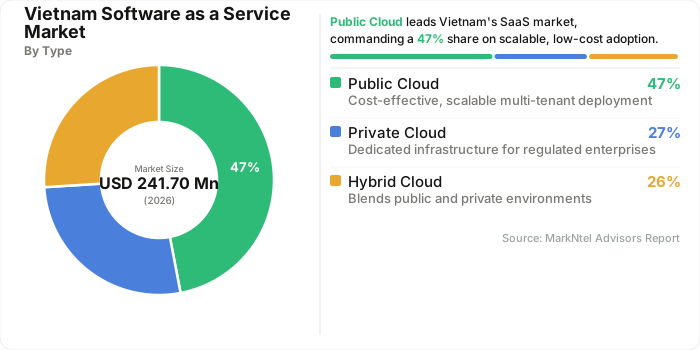
- By deployment, the public cloud segment holds the largest market share, around 47% in 2026.
- By end user, the BFSI segment holds the largest market share, around 26% in 2026.
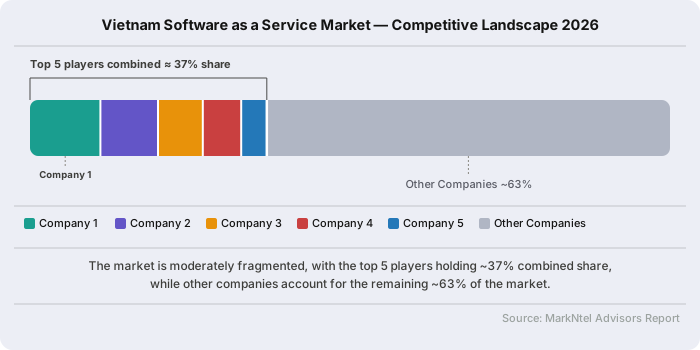
- The market is fragmented, with the top five companies collectively accounting for approximately 37% of the market share in 2026.
Vietnam Software as a Service Market Size and Outlook
The software as a service industry in Vietnam was valued at USD 214 million in 2025 and is currently standing at USD 241.7 million in 2026. The industry is projected to grow to USD 502 million by 2032, showcasing a CAGR of around 12.95% during the forecast period, i.e., 2026–32.
The market is witnessing strong growth as businesses increasingly shift from on-premises software to cloud-based subscription platforms to improve productivity, scalability, and operational flexibility. Demand is expanding across banking, manufacturing, retail, healthcare, education, logistics, and government services as organizations digitalize core business functions. This transition is being reinforced by Vietnam's rapidly expanding digital economy, which contributed equivalent to around USD 72 billion in 2025, highlighting the country's accelerating reliance on digital technologies.
Enterprise readiness for SaaS adoption continues to strengthen through improving digital infrastructure, growing technology investment, and rising artificial intelligence adoption. Vietnam recorded nearly 80 million internet users in 2025, representing 79% of the population, creating a large connected base for cloud-delivered software. The country's innovation ecosystem is also advancing, reaching its highest ever position of 50th in the 2026 global startup ecosystem index. According to AWS research released in 2025, AI adoption among Vietnamese businesses reached 18% and expanded 39% year on year, supporting increasing demand for intelligent SaaS applications as organizations modernize business operations.
Government reforms implemented during 2025 and effective from 2026 have significantly strengthened the operating environment for software providers. The Personal Data Protection Law,2025, established Vietnam's first statutory framework governing personal data, increasing confidence in cloud adoption while creating greater demand for secure and compliant SaaS solutions. The law on the digital technology industry introduced incentives for research, AI development, and digital technology innovation, while updated e-invoicing regulations expanded digital compliance requirements across businesses.
Alongside the government's target of providing every adult with a digital identity, payment account, and access to online public services by 2026, these initiatives are creating a robust foundation for sustained enterprise software adoption across Vietnam.
Vietnam Software as a Service Market Key Indicators
- Enterprise digital activities generated an estimated USD 72.1 billion in economic value during 2025, contributing roughly 14.02% of Vietnam's GDP, underscoring the country's rapid digitalization and expanding demand for cloud delivered enterprise software.
- The country's core digital sectors produced nearly USD 43.3 billion in 2025, accounting for 8.42% of GDP and more than 60% of the overall digital economy, reflecting deeper enterprise investment in technology-driven business operations.
- By 2025, Vietnam's online population had reached approximately 80 million users, equivalent to 79% of residents, while mobile subscriptions exceeded the population at 164% penetration, creating a highly connected environment for SaaS adoption.
- Artificial intelligence adoption continued to accelerate in 2025, with 18% of businesses already deploying AI solutions, marking a 39% annual increase and reinforcing enterprise demand for intelligent, AI-enabled software platforms.
- Domestic data center infrastructure continued to expand, with 104 MW of operational capacity recorded in 2025, providing greater local cloud hosting capability and strengthening the foundation for enterprise SaaS deployment across Vietnam.
Vietnam Software as a Service Market Scope
| Category | Segments |
|---|---|
| By Deployment | Public Cloud, Private Cloud, Hybrid Cloud |
| By Organization Size | Small & Medium-Sized Enterprises, Large Enterprises |
| By Business Application | Customer Relationship Management (CRM), Human Resource Management (HRM), Enterprise Resource Planning (ERP), Operations and Manufacturing (O&M), Supply Chain Management (SCM), Content, Collaboration, & Communication, BI & Analytics, Others |
| By End Users | BFSI, Healthcare, Telecom & ICT, Government & Public Sector, Manufacturing, Education, Transportation & Logistics, Others |
Vietnam Software as a Service Market Growth Drivers
National Digital Transformation Strategy Accelerating Enterprise Cloud Adoption
Vietnam's national digital transformation strategy for 2026 to 2030 is creating sustained demand for SaaS solutions by expanding cloud adoption across both the public and private sectors. Approved in 2026, the strategy aims to fully digitalize administrative records and administrative procedure results by 2030 while identifying cloud computing, artificial intelligence, and data as priority pillars of the digital ecosystem. The government also plans to expand public procurement and regulatory sandboxes, encouraging wider adoption of digital solutions and creating early commercial opportunities for software providers.
The strategy is reinforced by the SME digital transformation plan, approved in 2026, which targets support for at least 500,000 small and medium-sized enterprises through digital platforms including cloud services, electronic contracts, and digital signatures. Complementing this initiative, Decree 20/2026 introduces tax incentives that lower digital transformation costs, while reforms allowing up to 100% foreign ownership of data center operations are strengthening cloud infrastructure and expanding enterprise access to scalable SaaS solutions across Vietnam.
Recent Trends
AI Native SaaS Platforms Transforming Enterprise Software
Artificial intelligence is rapidly becoming a defining technology trend in the market as software providers integrate generative AI, intelligent copilots, workflow automation, and predictive analytics into enterprise applications. Rather than functioning solely as productivity tools, modern SaaS platforms are evolving into AI native business systems capable of automating customer support, financial reporting, human resource management, sales forecasting, document processing, and enterprise decision making. This shift is enabling organizations to improve operational efficiency while reducing manual workloads and accelerating digital transformation initiatives across multiple industries.
Global and domestic software providers are accelerating AI integration to strengthen their enterprise offerings. During 2025 and 2026, Microsoft expanded Copilot capabilities across Microsoft 365 and Dynamics 365, SAP enhanced its Joule AI assistant across enterprise applications, Oracle introduced AI Agents within Oracle Fusion Cloud Applications, Salesforce expanded its Agentforce autonomous AI platform, and Zoho continued enhancing its Zia AI assistant across business software. Vietnamese software developers are also embedding AI into ERP, accounting, CRM, HRM, and business management platforms to improve automation and decision support.
As enterprise AI adoption continues to increase, AI native SaaS platforms are expected to become a key competitive differentiator in Vietnam's evolving software ecosystem.
Vietnam Software as a Service Market Challenges and Opportunities
Escalating Cybersecurity Risks Driving Demand for Secure and Compliant SaaS Solutions
Cybersecurity threats remain a significant challenge for the market as enterprises migrate larger volumes of sensitive business data to cloud environments. Although the number of cyberattacks declined in 2025, more sophisticated attack methods increased their impact, with 52.30% of government agencies and businesses reporting actual damage. During the third quarter of 2025, more than 502 million enterprise data records were exposed, over 6.5 million personal accounts were compromised, and more than 547,000 DDoS attacks were recorded, reflecting the growing complexity of AI-assisted cyber threats.
These risks are further amplified by the rapid rise in online fraud, with the Ministry of Public Security reporting more than 1,500 online scam cases within the first eight Months of 2025, resulting in losses exceeding USD 60.8 million. As cybersecurity oversight has shifted to the Ministry of Public Security, software vendors are facing higher compliance expectations while enterprises are becoming increasingly cautious about adopting cloud platforms that lack robust security capabilities.
The growing cybersecurity threat landscape is simultaneously creating significant opportunities for software providers offering integrated security capabilities. By 2026, 51.65% of organizations had deployed or were operating a security operations center, while 76.35% had implemented data backup systems, reflecting rising enterprise investment in cyber resilience. In parallel, 76% of organizations conducted cybersecurity awareness training in 2025, indicating stronger organizational focus on secure digital operations.
As security becomes a core software purchasing criterion rather than an optional feature, demand is rising for SaaS platforms with embedded threat detection, identity management, encryption, backup, and compliance capabilities. The national data center has also established higher cybersecurity and operational standards, creating favorable conditions for compliant cloud and software providers to differentiate through secure, locally hosted solutions that align with Vietnam's evolving regulatory environment.
Segmentation Insights
Public Cloud Segment Leading SaaS Deployment Through Scalability and Cost Efficiency
Public cloud dominates the Vietnam software as a service industry with approximately 47% market share, primarily driven by its scalability, lower infrastructure investment requirements, and strong alignment with Vietnam’s digital transformation initiatives. The deployment model enables enterprises, especially small and medium-sized businesses, to adopt SaaS solutions through flexible subscription-based models without significant capital expenditure on hardware, maintenance, and IT infrastructure management.
Public cloud platforms are increasingly adopted across business functions, including enterprise resource planning, human resource management, e-invoicing, customer relationship management, and digital identity verification systems. The growing implementation of cloud-first strategies, nationwide 5G expansion, and digital infrastructure modernization have further strengthened public cloud adoption by improving connectivity, reliability, and accessibility for organizations across Vietnam.
Government initiatives are also accelerating the transition toward public cloud environments. In June 2025, the approval of Decision 1121/QĐ-TTg established a national action plan for advancing cloud computing adoption between 2025 and 2030, targeting cloud migration across government agencies, state-owned enterprises, and a significant portion of private businesses. These developments position public cloud as a core component of Vietnam’s digital infrastructure ecosystem.
The combination of operational flexibility, rapid deployment capabilities, regulatory support, and continuous technology upgrades is expected to maintain public cloud’s leadership position in Vietnam’s SaaS market throughout the forecast period. Based on deployment, the market is further bifurcated into:
- Public Cloud
- Private Cloud
- Hybrid Cloud
BFSI Sector Dominating SaaS Adoption Through Digital Finance Transformation
BFSI represents the largest end-user segment in the Vietnam software as a service industry with approximately 26% share, driven by rapid digital banking adoption, increasing transaction volumes, and the sector’s requirement for secure, scalable, and efficient technology infrastructure. Financial institutions across Vietnam are increasingly deploying SaaS platforms to modernize operations, improve customer experience, and optimize processes including digital payments, customer onboarding, lending, fraud detection, and risk management.
The growing shift toward digital financial services has accelerated SaaS adoption across banks and insurance companies. More than 75% of banking transactions in Vietnam were conducted through digital channels as of 2024, increasing the need for cloud-based solutions capable of supporting real-time processing, analytics, cybersecurity, and seamless integration with fintech ecosystems.
SaaS platforms enable BFSI organizations to reduce dependence on expensive on-premise infrastructure while improving operational agility, disaster recovery capabilities, and compliance management. The expansion of e KYC systems, mobile banking platforms, embedded finance solutions, and digital payment ecosystems is further strengthening demand for SaaS based applications.
Regulatory initiatives from financial authorities supporting digital banking transformation are also encouraging institutions to adopt cloud-enabled technology frameworks. As a result, BFSI continues to remain the leading SaaS end-user segment, leveraging cloud solutions to enhance efficiency, regulatory compliance, and competitiveness in Vietnam’s evolving financial services ecosystem. Based on end users, the market is further bifurcated into:
- BFSI
- Healthcare
- Telecom & ICT
- Government & Public Sector
- Manufacturing
- Education
- Transportation & Logistics
- Others
Vietnam Software as a Service Industry Competitive Analysis
The market is fragmented, with competition shared among domestic SaaS providers, global enterprise software vendors, cloud platform companies, and business application developers. Major participants include Base Enterprise Joint Stock Company, MISA Joint Stock Company, FPT Software Company Limited, Microsoft Vietnam Company Limited, and SAP Vietnam Co., Ltd. The top five players collectively account for approximately 37% of the Vietnam software as a service market.
Key Companies in the Vietnam Software as a Service Market
- Base Enterprise Joint Stock Company
- MISA Joint Stock Company
- FPT Software Company Limited
- CMC Corporation
- VNG Corporation
- Microsoft Vietnam Company Limited
- SAP Vietnam Co., Ltd.
- Oracle Vietnam Pte Ltd.
- Salesforce, Inc.
- Zoho Corporation Pvt. Ltd.
Vietnam Software as a Service Industry News and Recent Developments
2025: 1Office Transitions to AI-as-a-Service Model with Launch of 1Office Next Platform
1Office officially repositioned itself from a traditional SaaS provider to an AI-as-a-Service (AIaaS) company with the launch of its new platform 1Office Next at events held in Ho Chi Minh City and Hà Nội. The transformation was supported by a USD 3 million funding round led by Redbadge Pacific, enabling the company to integrate low code development, AI agents, and automation capabilities into its enterprise management solutions.
Impact Analysis: The strategic shift highlights the growing evolution of the Vietnam Software as a Service Market toward AI enabled enterprise solutions and automation driven platforms. The move is expected to intensify competition among SaaS providers, accelerate AI adoption across businesses, and encourage further investments in intelligent workflow management, low code technologies, and enterprise digital transformation solutions in Vietnam.
2025: SAP Launches Vietnam R&D Hub with USD 175 Million Investment to Expand Enterprise Software Innovation
SAP announced the establishment of SAP Labs Vietnam, supported by an investment of approximately USD 175 million, to strengthen software product development and research capabilities in Southeast Asia. The new research and development hub will focus on advancing enterprise software solutions, accelerating AI driven innovation, and enhancing Vietnam’s role in SAP’s global engineering network for next generation digital technologies.
Impact Analysis: The investment reflects the increasing importance of Vietnam as a strategic software development and innovation hub within the Asia Pacific region. The expansion is expected to strengthen the Vietnam Software as a Service Market by promoting enterprise technology development, increasing AI integration, attracting skilled technology talent, and encouraging global software companies to establish regional research and development capabilities.
Frequently Asked Questions
- Market Segmentation
- Introduction
- Product Definition
- Research Process
- Assumptions
- Executive Summary
- Vietnam Software as a Service Market Policies, Regulations, and Product Standards
- Vietnam Software as a Service Market Trends & Developments
- Vietnam Software as a Service Market Dynamics
- Growth Factors
- Challenges
- Vietnam Software as a Service Market Hotspot & Opportunities
- Vietnam Software as a Service Market Outlook, 2022-2032
- Market Size & Outlook
- By Revenues (USD Million)
- Market Segmentation & Outlook
- By Deployment - Market Size & Forecast 2022-2032, USD Million
- Public Cloud
- Private Cloud
- Hybrid Cloud
- By Organization Size- Market Size & Forecast 2022-2032, USD Million
- Small & Medium-Sized Enterprises
- Large Enterprises
- By Business Application - Market Size & Forecast 2022-2032, USD Million
- Customer Relationship Management (CRM)
- Human Resource Management (HRM)
- Enterprise Resource Planning (ERP)
- Operations and Manufacturing (O&M)
- Supply Chain Management (SCM)
- Content, Collaboration, & Communication
- BI & Analytics
- Others
- By End Users - Market Size & Forecast 2022-2032, USD Million
- BFSI
- Healthcare
- Telecom & ICT
- Government & Public Sector
- Manufacturing
- Education
- Transportation & Logistics
- Others
- By Region- Market Size & Forecast 2022-2032, USD Million
- North
- South
- Central
- By Company
- Competition Characteristics
- Market Share & Analysis
- By Deployment - Market Size & Forecast 2022-2032, USD Million
- Market Size & Outlook
- Vietnam Public Cloud Market Outlook, 2022-2032
- Market Size & Outlook
- By Revenues (USD Million)
- Market Segmentation & Outlook
- By Deployment - Market Size & Forecast 2022-2032, USD Million
- By Organization Size- Market Size & Forecast 2022-2032, USD Million
- By Business Application - Market Size & Forecast 2022-2032, USD Million
- By End Users - Market Size & Forecast 2022-2032, USD Million
- By Region- Market Size & Forecast 2022-2032, USD Million
- Market Size & Outlook
- Vietnam Private Cloud Market Outlook, 2022-2032
- Market Size & Outlook
- By Revenues (USD Million)
- Market Segmentation & Outlook
- By Deployment - Market Size & Forecast 2022-2032, USD Million
- By Organization Size- Market Size & Forecast 2022-2032, USD Million
- By Business Application - Market Size & Forecast 2022-2032, USD Million
- By End Users - Market Size & Forecast 2022-2032, USD Million
- By Region- Market Size & Forecast 2022-2032, USD Million
- Market Size & Outlook
- Vietnam Hybrid Cloud Market Outlook, 2022-2032
- Market Size & Outlook
- By Revenues (USD Million)
- Market Segmentation & Outlook
- By Deployment - Market Size & Forecast 2022-2032, USD Million
- By Organization Size- Market Size & Forecast 2022-2032, USD Million
- By Business Application - Market Size & Forecast 2022-2032, USD Million
- By End Users - Market Size & Forecast 2022-2032, USD Million
- By Region- Market Size & Forecast 2022-2032, USD Million
- Market Size & Outlook
- Vietnam Software as a Service Market Key Strategic Imperatives for Success & Growth
- Competitive Outlook
- Company Profiles
- Base Enterprise Joint Stock Company
- Business Description
- Product Portfolio
- Collaborations & Alliances
- Recent Developments
- Financial Details
- Others
- MISA Joint Stock Company
- Business Description
- Product Portfolio
- Collaborations & Alliances
- Recent Developments
- Financial Details
- Others
- FPT Software Company Limited
- Business Description
- Product Portfolio
- Collaborations & Alliances
- Recent Developments
- Financial Details
- Others
- CMC Corporation
- Business Description
- Product Portfolio
- Collaborations & Alliances
- Recent Developments
- Financial Details
- Others
- VNG Corporation
- Business Description
- Product Portfolio
- Collaborations & Alliances
- Recent Developments
- Financial Details
- Others
- Microsoft Vietnam Company Limited
- Business Description
- Product Portfolio
- Collaborations & Alliances
- Recent Developments
- Financial Details
- Others
- SAP Vietnam Co., Ltd
- Business Description
- Product Portfolio
- Collaborations & Alliances
- Recent Developments
- Financial Details
- Others
- Oracle Vietnam Pte Ltd
- Business Description
- Product Portfolio
- Collaborations & Alliances
- Recent Developments
- Financial Details
- Others
- Salesforce, Inc.
- Business Description
- Product Portfolio
- Collaborations & Alliances
- Recent Developments
- Financial Details
- Others
- Zoho Corporation Pvt. Ltd.
- Business Description
- Product Portfolio
- Collaborations & Alliances
- Recent Developments
- Financial Details
- Others
- Base Enterprise Joint Stock Company
- Company Profiles
- Disclaimer
MarkNtel Advisors follows a robust and iterative research methodology designed to ensure maximum accuracy and minimize deviation in market estimates and forecasts. Our approach combines both bottom-up and top-down techniques to effectively segment and quantify various aspects of the market. A consistent feature across all our research reports is data triangulation, which examines the market from three distinct perspectives to validate findings. Key components of our research process include:
1. Scope & Research Design At the outset, MarkNtel Advisors define the research objectives and formulate pertinent questions. This phase involves determining the type of research—qualitative or quantitative—and designing a methodology that outlines data collection methods, target demographics, and analytical tools. They also establish timelines and budgets to ensure the research aligns with client goals.
2. Sample Selection and Data Collection In this stage, the firm identifies the target audience and determines the appropriate sample size to ensure representativeness. They employ various sampling methods, such as random or stratified sampling, based on the research objectives. Data collection is carried out using tools like surveys, interviews, and observations, ensuring the gathered data is reliable and relevant.
3. Data Analysis and Validation Once data is collected, MarkNtel Advisors undertake a rigorous analysis process. This includes cleaning the data to remove inconsistencies, employing statistical software for quantitative analysis, and thematic analysis for qualitative data. Validation steps are taken to ensure the accuracy and reliability of the findings, minimizing biases and errors.

4. Data Forecast and FinalizationThe final phase involves forecasting future market trends based on the analyzed data. MarkNtel Advisors utilize predictive modeling and time series analysis to anticipate market behaviors. The insights are then compiled into comprehensive reports, featuring visual aids like charts and graphs, and include strategic recommendations to inform client decision-making
We offer flexible licensing options to cater to varying organizational needs. Choose the pricing pack that best suits your requirements:
Buy Now Inquire Before Buying
 Request Customization
 Talk to our Consultant







