Global Space Cybersecurity Market Research Report: Forecast (2026-2032)
Space Cybersecurity Market - By Type (Network Security, Content Security, Cloud Security, Application Security, Others), By Offerings- (Solutions, Systems), By Deployment (On-Pr ... emise, Cloud), By Platform- (Satellites, Launch Vehicles, Ground Stations, Spaceports & Launch Facilities, Command & Control Centers, Others), By End User- (Military & Defense, Government Space Agencies, Commercial Satellite Operators, Telecom & Broadcasting Companies, Aviation & Maritime Sector, Satellite Manufacturers & Launch Providers, Research Institutes & Universities, Others), and others Read more
- ICT & Electronics
- Dec 2025
- Pages 450
- Report Format: PDF, Excel, PPT
Global Space Cybersecurity Market
Projected 10.24% CAGR from 2026 to 2032
Study Period
2026-2032
Market Size (2026)
USD 5.75 Billion
Market Size (2032)
USD 10.32 Billion
Largest Region
North America
Projected CAGR
10.24%
Leading Segments
By End User: Military & Defense
Global Space Cybersecurity Market Report Key Takeaways:
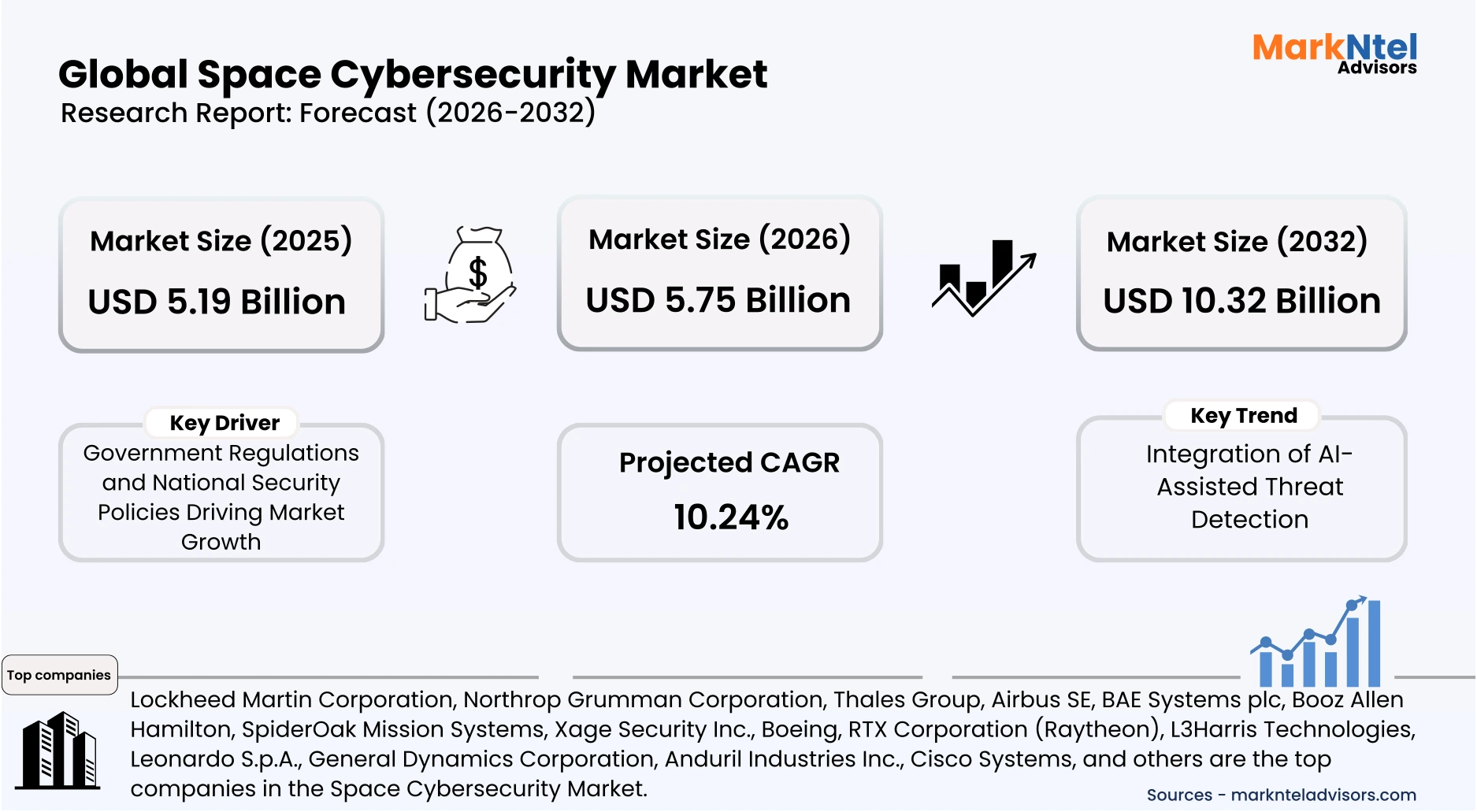
- Market size is valued at around USD5.19 billion in 2025 and is projected to grow from USD5.75 billion in 2026 to USD10.32 billion by 2032. The estimated CAGR from 2026 to 2032 is around 10.24%, indicating strong growth.
- North America leads the Space Cybersecurity Market by holding a market share of about 56% in 2026. The United States is expected to grow at a CAGR of about 14% during 2026-32.
- By Offerings, Solutions represented a significant market share of about 74% in the Global Space Cybersecurity Market in 2026. Whereas, Cloud Security with Solutions is set to grow at a CAGR of 17% during 2026-2032.
- By End User, the Military & Defense segment represented a major market share of about 42% in 2026. Meanwhile, the government agencies like NASA, ESA, etc., segment is projected to grow at a CAGR of about 10% during 2026-32.
- Leading Space Cybersecurity companies are Lockheed Martin Corporation, Northrop Grumman Corporation, Thales Group, Airbus SE, BAE Systems plc, Booz Allen Hamilton, SpiderOak Mission Systems, Xage Security Inc., Boeing, RTX Corporation (Raytheon), L3Harris Technologies, Leonardo S.p.A., General Dynamics Corporation, Anduril Industries Inc., Cisco Systems, and others.
Market Insights & Analysis: Global Space Cybersecurity Market (2026-32):
The Global Space Cybersecurity Market size is valued at around USD5.19 billion in 2025 and is projected to grow from USD5.75 billion to USD10.32 billion by 2032. Along with this, the market is estimated to grow at a CAGR of around 10.24% during the forecast period, i.e., 2026-32.
The Global Space Cybersecurity Market is expanding quickly as satellite activity accelerates. With over 11,500 operational satellites recorded in 2024 and thousands more planned for launch, securing command links, navigation signals, and ground networks has become central for every major end user.
Additionally, government agencies remain the largest investors. For instance, in 2024 alone, a historic 259 launches placed 2,695 satellites and 2,172 tons of payload into orbit, with the United States accounting for 65% of global launch activity. This unprecedented growth in orbital assets has significantly widened the attack surface, making cyber protection a core operational priority for governments and commercial operators.
Likewise, the European Union is strengthening secure satellite communications through its IRIS² Secure Connectivity Programme, backed by a dedicated USD2.60 billion budget for 2023–2027 under Regulation (EU) 2023/588. This investment focuses on building a resilient, cyber-secure satellite network for government, defense, and critical infrastructure communications across Europe. Several Asia–Pacific governments, including Japan and India, increased space-security spending in 2024–25 budgets, with Japan setting aside over USD 660 million specifically for secure satellite operations and encrypted data-relay systems.
Moreover, aviation end users are also boosting investments. For reference, after widespread GPS jamming affecting multiple regions in 2023–2024, global aviation authorities launched programs to strengthen satellite-based navigation infrastructure. The U.S. FAA expanded funding for GPS resilience and alternative positioning systems, while European air-navigation providers invested in protected EGNOS upgrades to maintain safe flight operations.
Furthermore, research institutes and scientific agencies are contributing through mission-level funding. For instance, ESA, JAXA, and NASA collectively invested billions of dollars in 2024 into deep-space communication upgrades, secure telemetry systems, and cyber-hardened science data centers to protect planetary-mission streams. These factors are significantly contributing to the market growth.
Global Space Cybersecurity Market Recent Developments:
- 2024: Booz Allen Ventures invested in Starfish Space to advance next-generation satellite servicing and orbital sustainability technologies. The investment supports the development of capabilities such as satellite life extension and end-of-life disposal, aimed at enhancing the resilience and long-term sustainability of space infrastructure for government and commercial missions.
- 2025: Xage continues deploying its zero-trust identity-first cybersecurity solutions with the U.S. Space Force to protect critical space assets and ground systems against unauthorized access and cyber threats.
Global Space Cybersecurity Market Scope:
| Category | Segments |
|---|---|
| By Type | Network Security, Content Security, Cloud Security, Application Security, Others), |
| By Offerings | Solutions, Systems), |
| By Deployment | On-Premise,Cloud), |
| By Platform | Satellites, Launch Vehicles, Ground Stations, Spaceports & Launch Facilities, Command & Control Centers, Others), |
| By End User | Military & Defense, Government Space Agencies, Commercial Satellite Operators, Telecom & Broadcasting Companies, Aviation & Maritime Sector, Satellite Manufacturers & Launch Providers, Research Institutes & Universities, Others), and others |
Global Space Cybersecurity Market Driver:
Government Regulations and National Security Policies Driving Market Growth
Government regulations and national security directives are increasingly driving demand for advanced space cybersecurity solutions and systems. For reference, Japan’s Space Security Initiative (2023) introduced mandatory requirements for government-linked satellites to adopt quantum-resistant encryption, zero-trust access controls, and continuous cyber monitoring, prompting new investments in secure spacecraft software and encrypted communication links. Similarly, South Korea’s Basic Plan for Space Security (2023) requires reconnaissance and KPS navigation satellites to integrate cyber-intrusion detection tools and hardened ground–space communication systems, creating sustained demand for secure satellite processors and protected uplink architectures.
In June 2024, the U.S. Cybersecurity and Infrastructure Security Agency (CISA) issued the “Space Systems Security and Resilience Landscape: Zero Trust in the Space Environment,” laying out how zero-trust principles should be applied to protect space assets and ground infrastructures against cyber threats, directing satellite operators to adopt stronger authentication tools, encrypted command links, and continuous monitoring, pushing agencies and commercial providers to procure intrusion-detection systems, secure modems, and hardened communication architectures.
Also, NASA’s adoption of the NIST Risk Management Framework for all spacecraft requires mission teams to implement formal vulnerability assessments and cyber-resilience tools before launch, directly increasing demand for secure-by-design satellite subsystems.
Moreover, China’s national space strategy also places strong emphasis on space information security, with significant funding under the China Satellite Network Group’s large constellation plans and ongoing investment in secure TT&C (tracking, telemetry, and command) infrastructure.
Global Space Cybersecurity Market Trend:
Integration of AI-Assisted Threat Detection
AI adoption is accelerating across the global space cybersecurity landscape as operators confront increasingly sophisticated cyber threats and rapidly expanding satellite networks. In 2025, Lockheed Martin introduced AI tools using multi-agent reinforcement learning to map cyber vulnerabilities and simulate adversarial behavior across mission systems, strengthening predictive cyber defense. In a separate development, Lockheed Martin partnered with Google Public Sector (2025) to integrate generative AI into secure defense infrastructure, enhancing automated cyber analysis and mission assurance for different industries, including the space industry.
Moreover, government agencies are adopting similar approaches. For instance, NASA’s 2025 AI Strategy formally incorporates AI-enabled cybersecurity to safeguard spacecraft and mission systems, and in December 2025, AI models, launched by California-based start-up AISLE, identified and helped remediate a vulnerability affecting NASA spacecraft communication software, fixing in four days an issue undetected for three years. This innovation is actively transforming this market significantly.
Global Space Cybersecurity Market Challenges:
High Implementation Costs & Production Complexities
Designing secure-by-design space systems significantly raises manufacturers’ costs and program complexity. Modern protections, including radiation-hardened secure processors, hardware roots-of-trust, encrypted transponders, and on-board intrusion detection, add both unit cost and integration time. For instance, the long-running Space Based Infrared System (SBIRS) program’s lifecycle cost escalated from roughly USD5.2 billion at the outset to about USD20 billion in 2020, illustrating how added requirements and technical risk are inflating budgets.
Moreover, Deloitte’s Silent Shield on-orbit IDS (2025) and SpiderOak’s zero-trust encryptor awards demonstrate that developing, testing, and launching dedicated cyber payloads requires specialized R&D and procurement investment. These factors raise per-satellite manufacturing, testing, and sustainment costs, squeezing margins and slowing secure-by-design adoption, especially for smaller manufacturers without government co-funding.
Global Space Cybersecurity Market (2026-32) Segmentation Analysis:
The Global Space Cybersecurity Market Report and Forecast 2026-2032 offers a detailed analysis of the market based on the following segments:
Based on Offerings:
- Solutions
- Systems
The deployment of cybersecurity solutions in the global space sector is increasing rapidly by accounting for about 74% market share, as satellites and ground systems face more frequent and sophisticated cyber threats. Operators now integrate security technologies directly into mission architectures, enabling continuous protection across on-orbit assets, ground stations, and communication networks, instead of full-fledged systems.
Recently, in 2025, Deloitte launched its Silent Shield cyber-intrusion detection payload, placing it on-orbit to monitor satellite behavior and identify abnormal activity in real time. This marks one of the first operational attempts to embed intrusion detection directly aboard a spacecraft, strengthening autonomous defense capabilities in space.
Similarly, SpiderOak’s Zero-Trust Encryptor, selected by the U.S. Space Development Agency in 2025, is being deployed across proliferated low-Earth orbit (pLEO) constellations. This solution secures both satellite-to-satellite and satellite-to-ground communications using a zero-trust framework, reflecting a major shift toward identity-based, distributed cyber protection for large constellations.
Based on End User
- Military & Defense
- Government Space Agencies
- Commercial Satellite Operators
- Telecom & Broadcasting Companies
- Aviation & Maritime Sector
- Satellite Manufacturers & Launch Providers
- Research Institutes & Universities
- Others
The Military & Defense segment dominates this market by holding a market share of about 42%. Real-world conflict has demonstrated that space systems have become active fronts in modern warfare and geopolitical competition. During the Russia–Ukraine war, Russian-linked cyber operators targeted satellite communications networks, most notably through the Viasat KA-SAT attack on 24 February 2022, which disrupted thousands of broadband modems and impaired military and government communications at the onset of the invasion.
These incidents collectively prompted NATO and allied militaries to accelerate the cyber-hardening of their space architectures. For reference, Europe has responded with major funding commitments. The European Space Agency’s 2025 budget was raised to nearly USD23.9 billion to strengthen secure and resilient space infrastructure, while Germany committed USD37.8 billion by 2030 toward defense-oriented space capabilities that require embedded cybersecurity.
Moreover, across Asia, India’s Defence Space Agency is deploying a 52-satellite military surveillance constellation, significantly expanding the cyber-protection requirements of its space and ground segments, while Japan has increased participation in allied defense technology initiatives with explicit space-cybersecurity priorities. These factors are contributing to the dominance of this segment in this market.
Global Space Cybersecurity Market (2026-32): Regional Projection
North America dominates this market largely, accounting for nearly 56% share of the entire global market. Moreover, in the regional market, the United States is projected to grow at a steady CAGR of around 14% during 2026-32 because the United States operates the world’s most advanced and expansive space infrastructure, which requires continuous cyber protection. For instance, the U.S. Department of Defense requested approximately USD29–30 billion for space programs in 2025, reflecting one of the largest national investments in securing military satellites, space-based communications, and command systems. Additionally, NASA’s civil space activities generated USD75.6 billion in economic output in 2023, demonstrating the scale of the region’s commercial and governmental space ecosystem that depends on cyber-resilient operations.
Moreover, North America is also home to the world’s largest commercial satellite operators. For instance, SpaceX’s Starlink constellation exceeded 10,000 operational satellites by early 2025, creating one of the most cyber-relevant infrastructures on Earth due to the volume of data it transmits and the critical services it supports. Thus, the United States is the largest national space economy globally, reinforcing its structural leadership in upstream and downstream space services that rely on advanced cybersecurity.
Gain a Competitive Edge with Our Global Space Cybersecurity Market Report
- Global Space Cybersecurity Market Report by MarkNtel Advisors provides a detailed & thorough analysis of market size & share, growth rate, competitive landscape, and key players. This comprehensive analysis helps businesses gain a holistic understanding of the market dynamics & make informed decisions.
- This report also highlights current market trends & future projections, allowing businesses to identify emerging opportunities & potential challenges. By understanding market forecasts, companies can align their strategies & stay ahead of the competition.
- Global Space Cybersecurity Market Report aids in assessing & mitigating risks associated with entering or operating in the market. By understanding market dynamics, regulatory frameworks, and potential challenges, businesses can develop strategies to minimize risks & optimize their operations.
*Reports Delivery Format - Market research studies from MarkNtel Advisors are offered in PDF, Excel and PowerPoint formats. Within 24 hours of the payment being successfully received, the report will be sent to your email address.
Frequently Asked Questions
- Market Segmentation
- Introduction
- Product Definition
- Research Process
- Assumptions
- Executive Summary
- Global Space Cybersecurity Market Policies, Regulations, Standards
- Global Space Cybersecurity Market Trends & Development
- Global Space Cybersecurity Market Dynamics
- Growth Drivers
- Challenges
- Trends
- Opportunities
- Global Space Cybersecurity Market Hotspot & Opportunities
- Global Space Cybersecurity Market Outlook, 2022-2032F
- Market Size & Analysis
- By Revenue (USD Million)
- Market Share & Analysis
- By Type (USD Million)
- Network Security
- Content Security
- Cloud Security
- Application Security
- Others
- By Offerings- (USD Million)
- Solutions
- Systems
- By Deployment- (USD Million)
- On-Premise
- Cloud
- By Platform- (USD Million)
- Satellites
- Launch Vehicles
- Ground Stations
- Spaceports & Launch Facilities
- Command & Control Centers
- Others
- By End User- (USD Million)
- Military & Defense
- Government Space Agencies
- Commercial Satellite Operators
- Telecom & Broadcasting Companies
- Aviation & Maritime Sector
- Satellite Manufacturers & Launch Providers
- Research Institutes & Universities
- Others
- By Region
- North America
- South America
- Europe
- Middle East & Africa
- Asia-Pacific
- By Company
- Competition Characteristics
- Market Share & Analysis
- By Type (USD Million)
- Market Size & Analysis
- North America Space Cybersecurity Market Outlook, 2022-2032F
- Market Size & Analysis
- By Revenue (USD Million)
- Market Share & Analysis
- By Type- (USD Million)
- By Offerings- (USD Million)
- By Deployment- (USD Million)
- By Platform- (USD Million)
- By End User- (USD Million)
- By Country
- The US
- Canada
- Mexico
- The US Space Cybersecurity Market Outlook, 2022-2032F
- Market Size & Analysis
- By Revenue (USD Million)
- Market Share & Analysis
- By Type- (USD Million)
- By Offerings- (USD Million)
- By Deployment- (USD Million)
- By Platform- (USD Million)
- By End User- (USD Million)
- Market Size & Analysis
- Canada Space Cybersecurity Market Outlook, 2022-2032F
- Market Size & Analysis
- By Revenue (USD Million)
- Market Share & Analysis
- By Type- (USD Million)
- By Offerings- (USD Million)
- By Deployment- (USD Million)
- By Platform- (USD Million)
- By End User- (USD Million)
- Market Size & Analysis
- Mexico Space Cybersecurity Market Outlook, 2022-2032F
- Market Size & Analysis
- By Revenue (USD Million)
- Market Share & Analysis
- By Type- (USD Million)
- By Offerings- (USD Million)
- By Deployment- (USD Million)
- By Platform- (USD Million)
- By End User- (USD Million)
- Market Size & Analysis
- Market Size & Analysis
- South America Space Cybersecurity Market Outlook, 2022-2032F
- Market Size & Analysis
- By Revenue (USD Million)
- Market Size & Analysis
- Market Share & Analysis
- By Type- (USD Million)
- By Offerings- (USD Million)
- By Deployment- (USD Million)
- By Platform- (USD Million)
- By End User- (USD Million)
- By Country
- Brazil
- Argentina
- Rest of South America
- Brazil Space Cybersecurity Market Outlook, 2022-2032F
- Market Size & Analysis
- By Revenue (USD Million)
- Market Share & Analysis
- By Type- (USD Million)
- By Offerings- (USD Million)
- By Deployment- (USD Million)
- By Platform- (USD Million)
- By End User- (USD Million)
- Market Size & Analysis
- Argentina Space Cybersecurity Market Outlook, 2022-2032F
- Market Size & Analysis
- By Revenue (USD Million)
- Market Share & Analysis
- By Type- (USD Million)
- By Offerings- (USD Million)
- By Deployment- (USD Million)
- By Platform- (USD Million)
- By End User- (USD Million)
- Market Size & Analysis
- Europe Space Cybersecurity Market Outlook, 2022-2032F
- Market Size & Analysis
- By Revenue (USD Million)
- Market Share & Analysis
- By Type- (USD Million)
- By Offerings- (USD Million)
- By Deployment- (USD Million)
- By Platform- (USD Million)
- By End User- (USD Million)
- By Country
- The UK
- Italy
- Germany
- France
- Spain
- Russia
- Ukraine
- Rest of Europe
- The UK Space Cybersecurity Market Outlook, 2022-2032F
- Market Size & Analysis
- By Revenue (USD Million)
- Market Share & Analysis
- By Type- (USD Million)
- By Offerings- (USD Million)
- By Deployment- (USD Million)
- By Platform- (USD Million)
- By End User- (USD Million)
- Market Size & Analysis
- Italy Space Cybersecurity Market Outlook, 2022-2032F
- Market Size & Analysis
- By Revenue (USD Million)
- Market Share & Analysis
- By Type- (USD Million)
- By Offerings- (USD Million)
- By Deployment- (USD Million)
- By Platform- (USD Million)
- By End User- (USD Million)
- Market Size & Analysis
- Germany Space Cybersecurity Market Outlook, 2022-2032F
- Market Size & Analysis
- By Revenue (USD Million)
- Market Share & Analysis
- By Type- (USD Million)
- By Offerings- (USD Million)
- By Deployment- (USD Million)
- By Platform- (USD Million)
- By End User- (USD Million)
- Market Size & Analysis
- France Space Cybersecurity Market Outlook, 2022-2032F
- Market Size & Analysis
- By Revenue (USD Million)
- Market Share & Analysis
- By Type- (USD Million)
- By Offerings- (USD Million)
- By Deployment- (USD Million)
- By Platform- (USD Million)
- By End User- (USD Million)
- Market Size & Analysis
- Spain Space Cybersecurity Market Outlook, 2022-2032F
- Market Size & Analysis
- By Revenue (USD Million)
- Market Share & Analysis
- By Type- (USD Million)
- By Offerings- (USD Million)
- By Deployment- (USD Million)
- By Platform- (USD Million)
- By End User- (USD Million)
- Market Size & Analysis
- Russia Space Cybersecurity Market Outlook, 2022-2032F
- Market Size & Analysis
- By Revenue (USD Million)
- Market Share & Analysis
- By Type- (USD Million)
- By Offerings- (USD Million)
- By Deployment- (USD Million)
- By Platform- (USD Million)
- By End User- (USD Million)
- Market Size & Analysis
- Ukraine Space Cybersecurity Market Outlook, 2022-2032F
- Market Size & Analysis
- By Revenue (USD Million)
- Market Share & Analysis
- By Type- (USD Million)
- By Offerings- (USD Million)
- By Deployment- (USD Million)
- By Platform- (USD Million)
- By End User- (USD Million)
- Market Size & Analysis
- Market Size & Analysis
- Middle East & Africa Space Cybersecurity Market Outlook, 2022-2032F
- Market Size & Analysis
- By Revenue (USD Million)
- Market Size & Analysis
- Market Share & Analysis
- By Type- (USD Million)
- By Offerings- (USD Million)
- By Deployment- (USD Million)
- By Platform- (USD Million)
- By End User- (USD Million)
- By Country
- Saudi Arabia
- UAE
- Israel
- South Africa
- Rest of Middle East & Africa
- Saudi Arabia Space Cybersecurity Market Outlook, 2022-2032F
- Market Size & Analysis
- By Revenue (USD Million)
- Market Share & Analysis
- By Type- (USD Million)
- By Offerings- (USD Million)
- By Deployment- (USD Million)
- By Platform- (USD Million)
- By End User- (USD Million)
- Market Size & Analysis
- UAE Space Cybersecurity Market Outlook, 2022-2032F
- Market Size & Analysis
- By Revenue (USD Million)
- Market Share & Analysis
- By Type- (USD Million)
- By Offerings- (USD Million)
- By Deployment- (USD Million)
- By Platform- (USD Million)
- By End User- (USD Million)
- Market Size & Analysis
- Israel Space Cybersecurity Market Outlook, 2022-2032F
- Market Size & Analysis
- By Revenue (USD Million)
- Market Share & Analysis
- By Type- (USD Million)
- By Offerings- (USD Million)
- By Deployment- (USD Million)
- By Platform- (USD Million)
- By End User- (USD Million)
- Market Size & Analysis
- South Africa Space Cybersecurity Market Outlook, 2022-2032F
- Market Size & Analysis
- By Revenue (USD Million)
- Market Share & Analysis
- By Type- (USD Million)
- By Offerings- (USD Million)
- By Deployment- (USD Million)
- By Platform- (USD Million)
- By End User- (USD Million)
- Market Size & Analysis
- Asia-Pacific Space Cybersecurity Market Outlook, 2022-2032F
- Market Size & Analysis
- By Revenue (USD Million)
- Market Size & Analysis
- Market Share & Analysis
- By Type- (USD Million)
- By Offerings- (USD Million)
- By Deployment- (USD Million)
- By Platform- (USD Million)
- By End User- (USD Million)
- By Country
- China
- Japan
- India
- South Korea
- Malaysia
- Australia
- Singapore
- China Space Cybersecurity Market Outlook, 2022-2032F
- Market Size & Analysis
- By Revenue (USD Million)
- Market Share & Analysis
- By Type- (USD Million)
- By Offerings- (USD Million)
- By Deployment- (USD Million)
- By Platform- (USD Million)
- By End User- (USD Million)
- Market Size & Analysis
- Japan Space Cybersecurity Market Outlook, 2022-2032F
- Market Size & Analysis
- By Revenue (USD Million)
- Market Share & Analysis
- By Type- (USD Million)
- By Offerings- (USD Million)
- By Deployment- (USD Million)
- By Platform- (USD Million)
- By End User- (USD Million)
- Market Size & Analysis
- India Space Cybersecurity Market Outlook, 2022-2032F
- Market Size & Analysis
- By Revenue (USD Million)
- Market Share & Analysis
- By Type- (USD Million)
- By Offerings- (USD Million)
- By Deployment- (USD Million)
- By Platform- (USD Million)
- By End User- (USD Million)
- Market Size & Analysis
- South Korea Space Cybersecurity Market Outlook, 2022-2032F
- Market Size & Analysis
- By Revenue (USD Million)
- Market Share & Analysis
- By Type- (USD Million)
- By Offerings- (USD Million)
- By Deployment- (USD Million)
- By Platform- (USD Million)
- By End User- (USD Million)
- Market Size & Analysis
- Malaysia Space Cybersecurity Market Outlook, 2022-2032F
- Market Size & Analysis
- By Revenue (USD Million)
- Market Share & Analysis
- By Type- (USD Million)
- By Offerings- (USD Million)
- By Deployment- (USD Million)
- By Platform- (USD Million)
- By End User- (USD Million)
- Market Size & Analysis
- Australia Space Cybersecurity Market Outlook, 2022-2032F
- Market Size & Analysis
- By Revenue (USD Million)
- Market Share & Analysis
- By Type- (USD Million)
- By Offerings- (USD Million)
- By Deployment- (USD Million)
- By Platform- (USD Million)
- By End User- (USD Million)
- Market Size & Analysis
- Singapore Space Cybersecurity Market Outlook, 2022-2032F
- Market Size & Analysis
- By Revenue (USD Million)
- Market Share & Analysis
- By Type- (USD Million)
- By Offerings- (USD Million)
- By Deployment- (USD Million)
- By Platform- (USD Million)
- By End User- (USD Million)
- Market Size & Analysis
- Global Space Cybersecurity Market Key Strategic Imperatives for Success & Growth
- Competition Outlook
- Company Profiles
- Lockheed Martin Corporation
- Business Description
- Product Portfolio
- Strategic Alliances or Partnerships
- Recent Developments
- Financial Details
- Others
- Northrop Grumman Corporation
- Business Description
- Product Portfolio
- Strategic Alliances or Partnerships
- Recent Developments
- Financial Details
- Others
- Thales Group
- Business Description
- Product Portfolio
- Strategic Alliances or Partnerships
- Recent Developments
- Financial Details
- Others
- Airbus SE
- Business Description
- Product Portfolio
- Strategic Alliances or Partnerships
- Recent Developments
- Financial Details
- Others
- BAE Systems plc
- Business Description
- Product Portfolio
- Strategic Alliances or Partnerships
- Recent Developments
- Financial Details
- Others
- Booz Allen Hamilton
- Business Description
- Product Portfolio
- Strategic Alliances or Partnerships
- Recent Developments
- Financial Details
- Others
- SpiderOak Mission Systems
- Business Description
- Product Portfolio
- Strategic Alliances or Partnerships
- Recent Developments
- Financial Details
- Others
- Xage Security, Inc.
- Business Description
- Product Portfolio
- Strategic Alliances or Partnerships
- Recent Developments
- Financial Details
- Others
- Boeing
- Business Description
- Product Portfolio
- Strategic Alliances or Partnerships
- Recent Developments
- Financial Details
- Others
- RTX Corporation (Raytheon)
- Business Description
- Product Portfolio
- Strategic Alliances or Partnerships
- Recent Developments
- Financial Details
- Others
- L3Harris Technologies
- Business Description
- Product Portfolio
- Strategic Alliances or Partnerships
- Recent Developments
- Financial Details
- Others
- Leonardo S.p.A.
- Business Description
- Product Portfolio
- Strategic Alliances or Partnerships
- Recent Developments
- Financial Details
- Others
- General Dynamics Corporation
- Business Description
- Product Portfolio
- Strategic Alliances or Partnerships
- Recent Developments
- Financial Details
- Others
- Anduril Industries, Inc.
- Business Description
- Product Portfolio
- Strategic Alliances or Partnerships
- Recent Developments
- Financial Details
- Others
- Cisco Systems
- Business Description
- Product Portfolio
- Strategic Alliances or Partnerships
- Recent Developments
- Financial Details
- Others
- Others
- Lockheed Martin Corporation
- Company Profiles
- Disclaimer
MarkNtel Advisors follows a robust and iterative research methodology designed to ensure maximum accuracy and minimize deviation in market estimates and forecasts. Our approach combines both bottom-up and top-down techniques to effectively segment and quantify various aspects of the market. A consistent feature across all our research reports is data triangulation, which examines the market from three distinct perspectives to validate findings. Key components of our research process include:
1. Scope & Research Design At the outset, MarkNtel Advisors define the research objectives and formulate pertinent questions. This phase involves determining the type of research—qualitative or quantitative—and designing a methodology that outlines data collection methods, target demographics, and analytical tools. They also establish timelines and budgets to ensure the research aligns with client goals.
2. Sample Selection and Data Collection In this stage, the firm identifies the target audience and determines the appropriate sample size to ensure representativeness. They employ various sampling methods, such as random or stratified sampling, based on the research objectives. Data collection is carried out using tools like surveys, interviews, and observations, ensuring the gathered data is reliable and relevant.
3. Data Analysis and Validation Once data is collected, MarkNtel Advisors undertake a rigorous analysis process. This includes cleaning the data to remove inconsistencies, employing statistical software for quantitative analysis, and thematic analysis for qualitative data. Validation steps are taken to ensure the accuracy and reliability of the findings, minimizing biases and errors.

4. Data Forecast and FinalizationThe final phase involves forecasting future market trends based on the analyzed data. MarkNtel Advisors utilize predictive modeling and time series analysis to anticipate market behaviors. The insights are then compiled into comprehensive reports, featuring visual aids like charts and graphs, and include strategic recommendations to inform client decision-making
We offer flexible licensing options to cater to varying organizational needs. Choose the pricing pack that best suits your requirements:
Buy Now Inquire Before Buying
 Request Customization
 Talk to our Consultant