

Singapore Smart Water Management Market Research Report: Trends & Forecast (2026-2032)
By Offerings (Water Meters (Standard water meters, AMR/AMR+ meters, AMI meters), Solutions (Enterprise Asset Management, Analytics and Data Management, Cybersecurity and Network Se ... curity, Advanced Pressure Management, Mobile Workforce Management, Network Management, Customer Information System and Billing, Leak Detection, Others), Services (Professional Services, Managed Services)), By Application (Water Pipeline Monitoring & Leak Detection, Smart Water Metering & Consumption Management, Water Quality Monitoring, Wastewater Monitoring, Flood & Stormwater Management, Smart Irrigation Management), By End User (Residential, Commercial, Industrial), and others Read more
- Environment
- Jul 2026
- Pages 140
- Report Format: PDF, Excel, PPT
Singapore Smart Water Management Market
Projected 14.0% CAGR from 2026 to 2032
Study Period
2026-2032
Market Size (2026)
USD 133 Million
Market Size (2032)
USD 292 Million
Base Year
2025
Projected CAGR
14.0%
Leading Segments
By Offering Type: • Water Meters
Singapore Smart Water Management Market Key Takeaways
- The Singapore smart water management market was valued at USD 118 Million in 2025 and is projected to grow from USD 133 Million in 2026 to USD 292 Million by 2032.
- The industry is projected to witness steady growth at a CAGR of 14.0% during 2026–2032.
- By offering, the solutions segment dominates the market with an estimated 48.7% share in 2026.
- By end user, the commercial & industrial segment leads the market with approximately 68.5% share in 2026.
- The market is moderately fragmented, with the top five companies accounting for approximately 40.0% share in 2026.
Singapore Smart Water Management Market Size & Outlook
The smart water management market in Singapore is estimated at USD 133 Million in 2026 and is projected to reach approximately USD 292 Million by 2032, registering a CAGR of around 14.0% during 2026–2032.
Market expansion is supported by Singapore’s increasing investment in digital water infrastructure, including smart metering, IoT-enabled monitoring, AI-based analytics, and automated utility management platforms. The growing focus on water resilience and operational optimization is accelerating the adoption of advanced smart water technologies across municipal and industrial applications.
According to the Singapore Economic Development Board (EDB), Singapore secured USD 13.5 billion in Fixed Asset Investment (FAI) commitments during 2024, reflecting continued expansion of advanced manufacturing, electronics, and technology-intensive industries. These industrial developments are increasing demand for intelligent water management systems that enable real-time monitoring, resource optimization, and efficient process control. The rising requirement for reliable industrial water infrastructure is strengthening opportunities for smart meters, analytics platforms, and digital utility solutions.
The growing importance of water reuse and circular water management is further supporting market development. According to the World Bank, potable and industrial water reuse could increase eightfold by 2040, unlocking up to USD 340 billion in potential global investment opportunities. This shift toward water recycling and resource efficiency is encouraging adoption of digital monitoring, predictive analytics, and automated control systems to improve the performance of advanced water treatment and reuse operations.
Singapore’s transition toward a digitally enabled water ecosystem is creating long-term growth opportunities for smart water technology providers. PUB, Singapore’s National Water Agency, continues to integrate digital capabilities across water operations through advanced monitoring, data analytics, and intelligent infrastructure management approaches. The increasing deployment of AI-driven optimization, cybersecurity enabled networks, and predictive asset management solutions is expected to strengthen the adoption of smart water management technologies throughout the forecast period.
Singapore Smart Water Management Market Key Indicators
- PUB has deployed more than 300,000 smart water meters across residential and non-residential premises, enabling automated meter reading, remote monitoring, and early leak detection. The nationwide rollout continues to strengthen demand for Advanced Metering Infrastructure (AMI), IoT connectivity, meter data management platforms, and cloud-based analytics across smart water management ecosystem.
- According to the GreenGov.SG FY2024 Report, public sector water consumption declined to 32.9 billion litres, while the Water Efficiency Index (WEI) improved by 8.1% year-on-year to 55.9 litres per person per day. The improvement reflects the increasing adoption of digital monitoring, automated water management systems, and data-driven conservation technologies across government facilities.
- Based on data from PUB, Singapore consumes approximately 440 million gallons of water per day, with the non-domestic sector accounting for nearly 55% of total water demand. The high industrial share of water consumption is driving investments in smart metering, industrial water monitoring, predictive analytics, and digital asset management solutions to improve operational efficiency and water resource optimization.
- As per the PUB's Annual and Sustainability Report 2024/25, non-domestic potable water sales increased to 213.7 million cubic metres in 2024, compared with 209.3 million cubic metres in 2023. Rising water demand from commercial and industrial users is encouraging wider deployment of real-time monitoring, advanced metering infrastructure (AMI), leak detection systems, and AI-enabled water network management technologies to improve system performance and demand forecasting.
Singapore Smart Water Management Market Scope
| Category | Segments |
|---|---|
| By Offerings | Water Meters (Standard water meters, AMR/AMR+ meters, AMI meters), Solutions (Enterprise Asset Management, Analytics and Data Management, Cybersecurity and Network Security, Advanced Pressure Management, Mobile Workforce Management, Network Management, Customer Information System and Billing, Leak Detection, Others), Services (Professional Services, Managed Services |
| By Application | Water Pipeline Monitoring & Leak Detection, Smart Water Metering & Consumption Management, Water Quality Monitoring, Wastewater Monitoring, Flood & Stormwater Management, Smart Irrigation Management |
| By End User | Residential, Commercial, Industrial |
Singapore Smart Water Management Market Growth Driver
Escalating Water Resource Constraints Accelerate Smart Water Investments
According to the UN-Water Progress on Level of Water Stress – 2024 Update, five out of eleven global regions experience water stress levels exceeding 25%, including two regions categorized as highly water-stressed and one facing critical water stress. The growing pressure on freshwater resources is accelerating investments in smart water infrastructure, enabling utilities to deploy intelligent monitoring, digital asset optimization, and advanced network management solutions that enhance water-use efficiency and strengthen long-term supply resilience.
According to PUB's Annual and Sustainability Report 2024/25, Singapore's total water demand is projected to almost double by 2065, driven by continued industrialization and economic growth. The long-term demand outlook is encouraging sustained investments in intelligent water networks, AI-enabled operational monitoring, and predictive asset management platforms to optimize water distribution, improve system reliability, and support the nation's long-term water security and sustainability objectives.
Recent Trends
AI and IoT Integration is Transforming Intelligent Water Utility Operations
Singapore continues to strengthen its smart water ecosystem through the integration of artificial intelligence (AI) and Internet of Things (IoT) technologies across critical utility infrastructure. According to the Government Technology Agency of Singapore (GovTech), the Smart Nation Sensor Platform (SNSP) has expanded to support more than 100,000 sensors deployed across the country, providing real-time environmental and infrastructure data. The growing sensor ecosystem is accelerating the adoption of AIoT water solutions and edge water analytics for intelligent monitoring and operational optimization.
The trend is further reinforced by PUB's launch of the fourth Global Innovation Challenge (GIC4) in March 2024, which introduced four innovation challenge statements focused on AI-assisted inspection of the Deep Tunnel Sewerage System (DTSS), automated assessment of underground pumping mains, robotic cleaning of water reclamation facilities, and digital inspection technologies. The initiative is expanding the deployment of predictive water intelligence and AI-driven asset management, enabling utilities to improve infrastructure reliability, maintenance productivity, and lifecycle performance across Singapore's smart water network.
Singapore Smart Water Management Market Opportunities and Challenges
Cybersecurity Risks Create Opportunities for Secure Water Infrastructure
According to the Cyber Security Agency of Singapore (CSA), the Singapore Cyber Landscape 2024 reported 89 incidents in 2024, representing a 31% increase from 68 incidents in 2023, while Critical Information Infrastructure (CII) remains a national cybersecurity priority. As Singapore expands connected sensors, cloud platforms, SCADA systems, and IoT-enabled utility networks, the increasing cyber threat landscape is intensifying the need to secure operational technology (OT) environments. This is driving investments in OT cybersecurity, secure SCADA architectures, and resilient digital water infrastructure to safeguard critical water operations.
The growing cybersecurity focus is creating significant opportunities for advanced digital security solutions. In October 2024, Schneider Electric introduced EcoStruxure™ Hybrid DCS, integrating cybersecurity-by-design, secure industrial automation, and centralized operational management for critical infrastructure operators. The platform enhances protection across connected industrial assets while improving operational visibility and system resilience. Such innovations are accelerating the adoption of industrial IoT security and critical infrastructure cybersecurity solutions, enabling Singapore's water utilities to strengthen cyber resilience as digital water infrastructure continues to expand.
Segmentation Insights
Software-Led Utility Intelligence Positions Solutions as the Largest Revenue Contributor
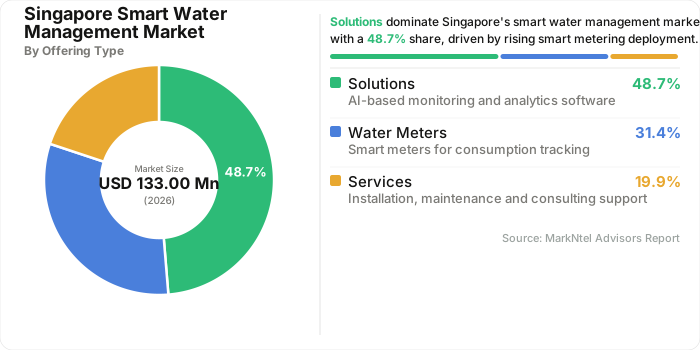
Solutions segment dominates the industry, accounting for 48.7% of the Singapore smart water management industry in 2026, supported by increasing investments in utility digitalization and data-driven operational management. Growing adoption of enterprise asset management, network management, leak detection platforms, and advanced analytics enables utilities to improve asset reliability, optimize maintenance scheduling, and enhance operational efficiency. The rising deployment of water utility software and digital asset management platforms continues to strengthen the segment's revenue contribution across Singapore's smart water ecosystem.
The segment continues to benefit from Singapore's expanding digital utility capabilities. According to PUB's Annual and Sustainability Report 2024/25, PUB's Integrated Operations Centre (IOC) continuously consolidates operational data from waterworks, reclamation plants, pumping stations, and distribution assets into a centralized monitoring platform to support real-time decision-making and predictive operations. The increasing use of centralized analytics and intelligent operational platforms is accelerating demand for utility analytics software and enterprise water management solutions, reinforcing the Solutions segment's leading market position. By Offering Type, the industry is segmented into:
- Water Meters
- Solutions
- Services
Industrial Water Digitalization Drives End-User Market Leadership
The Industrial segment is estimated to account for 46.8% of the Singapore smart water management market in 2026, driven by the expansion of semiconductor, electronics, pharmaceutical, biomedical, and precision engineering industries that require continuous water quality monitoring and intelligent utility management. According to the Singapore Economic Development Board (EDB), Singapore secured approximately USD 10.1 billion in Fixed Asset Investment (FAI) commitments in 2024, with advanced manufacturing remaining the largest investment contributor. The continued growth of high-value industries is accelerating demand for industrial water automation and smart process water management solutions to improve operational efficiency, resource optimization, and regulatory compliance.
The segment is further supported by large-scale industrial capacity expansion. In September 2024, Micron Technology commenced construction of its second advanced memory fabrication facility in Singapore with an investment of approximately USD 7 billion. The facility will rely on highly automated utility infrastructure, including intelligent water monitoring, advanced metering, and real-time process control systems to manage ultrapure water consumption efficiently. Such investments continue to strengthen the adoption of digital industrial water solutions and AI-enabled utility management, reinforcing the Industrial segment's leadership in the Singapore smart water management market. Based on end-user, the industry is segmented into:
- Residential
- Commercial
- Industrial
Singapore Smart Water Management Market Competitive Analysis
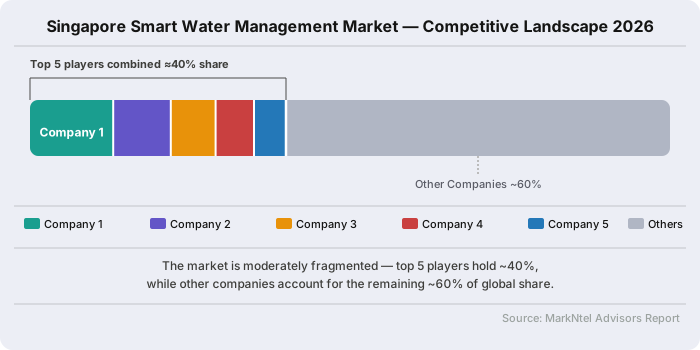
The Singapore smart water management industry is moderately fragmented, with the top five companies collectively accounting for approximately 40.0% of the market in 2026. Competition is driven by expertise in smart metering, AI-enabled utility software, IoT-enabled monitoring, and intelligent asset management, while the remaining market is distributed among regional technology providers, engineering firms, and specialized digital water solution vendors.
Top Companies in the Singapore Smart Water Management Market
- Xylem Inc.
- Schneider Electric SE
- Siemens AG
- SUEZ International SAS
- Itron Inc.
- ABB Ltd.
- Oracle Corporation (Oracle Utilities)
- Kamstrup A/S
- Diehl Metering GmbH
- Badger Meter, Inc.
Singapore Smart Water Management Industry News and Recent Developments
June 2024: SUEZ Expands Digital Water Partnership with PUB Through Smart Water Grid Analytics Platform
SUEZ announced in June 2024 that it secured new water contracts in Asia, including a partnership with PUB to support the deployment and maintenance of a Smart Water Grid Analytics Platform based on its AQUADVANCED® Water Networks solution. The platform integrates real-time network monitoring, hydraulic analysis, and predictive analytics capabilities to improve water distribution management, detect abnormal operating conditions, and support data-driven decision-making across complex water networks.
Impact Analysis: The development strengthens demand for digital water network management, AI-enabled operational analytics, and predictive utility platforms within Singapore’s smart water management market. The adoption of advanced analytics platforms enables utilities to improve network visibility, optimize maintenance activities, and enhance operational efficiency. The project also reinforces Singapore’s position as a regional hub for smart water innovation and encourages technology providers to develop scalable digital solutions for urban water systems.
March 2024: PUB Launches Global Innovation Challenge to Accelerate AI and Robotics Adoption in Water Infrastructure
PUB, Singapore’s National Water Agency, launched the fourth edition of its Global Innovation Challenge (GIC4) in March 2024 to accelerate the development and deployment of advanced digital technologies for water infrastructure. The initiative invited global technology providers and research organizations to develop solutions across four focus areas, including AI-assisted inspection of the Deep Tunnel Sewerage System (DTSS), automated condition assessment of underground pumping mains, robotic cleaning of water reclamation facilities, and advanced sensing technologies. The program strengthens Singapore’s focus on artificial intelligence, robotics, and automation for next-generation water infrastructure management.
Impact Analysis: The initiative is expected to accelerate adoption of AI-driven water analytics, predictive maintenance platforms, robotic inspection systems, and intelligent asset management solutions across Singapore’s water sector. By encouraging technology commercialization, the program creates opportunities for digital water solution providers to support PUB’s transition toward more automated, data-driven, and resilient utility operations while improving asset lifecycle management and reducing dependence on manual inspection processes.
Frequently Asked Questions
- Market Segmentation
- Introduction
- Product Definition
- Research Process
- Assumptions
- Executive Summary
- Singapore Smart Water Management Market Policies, Regulations, and Product Standards
- Singapore Smart Water Management Market Trends & Developments
- Singapore Smart Water Management Market Dynamics
- Growth Factors
- Challenges
- Singapore Smart Water Management Market Hotspot & Opportunities
- Singapore Smart Water Management Market Outlook, 2022-2032F
- Market Size & Outlook
- By Revenues (USD Million)
- Market Segmentation & Outlook
- By Offerings- Market Size & Forecast 2022-2032, USD Million
- Water Meters
- Standard water meters
- AMR/AMR+ meters
- AMI meters
- Solutions
- Enterprise Asset Management
- Analytics and Data Management
- Cybersecurity and Network Security
- Advanced Pressure Management
- Mobile Workforce Management
- Network Management
- Customer Information System and Billing
- Leak Detection
- Others
- Services
- Professional Services
- Managed Services
- Water Meters
- By Application- Market Size & Forecast 2022-2032, USD Million
- Water Pipeline Monitoring & Leak Detection
- Smart Water Metering & Consumption Management
- Water Quality Monitoring
- Wastewater Monitoring
- Flood & Stormwater Management
- Smart Irrigation Management
- By End User- Market Size & Forecast 2022-2032, USD Million
- Residential
- Commercial
- Industrial
- By Region- Market Size & Forecast 2022-2032, USD Million
- Central
- East
- North
- North-East
- West
- By Company
- Competition Characteristics
- Market Share & Analysis
- By Offerings- Market Size & Forecast 2022-2032, USD Million
- Market Size & Outlook
- Central Singapore Smart Water Management Market Outlook, 2022-2032
- Market Size & Outlook
- By Revenues (USD Million)
- Market Segmentation & Outlook
- By Offerings- Market Size & Forecast 2022-2032, USD Million
- By Application- Market Size & Forecast 2022-2032, USD Million
- By End User- Market Size & Forecast 2022-2032, USD Million
- Market Size & Outlook
- East Singapore Smart Water Management Market Outlook, 2022-2032
- Market Size & Outlook
- By Revenues (USD Million)
- Market Segmentation & Outlook
- By Offerings- Market Size & Forecast 2022-2032, USD Million
- By Application- Market Size & Forecast 2022-2032, USD Million
- By End User- Market Size & Forecast 2022-2032, USD Million
- Market Size & Outlook
- North Singapore Smart Water Management Market Outlook, 2022-2032
- Market Size & Outlook
- By Revenues (USD Million)
- Market Segmentation & Outlook
- By Offerings- Market Size & Forecast 2022-2032, USD Million
- By Application- Market Size & Forecast 2022-2032, USD Million
- By End User- Market Size & Forecast 2022-2032, USD Million
- Market Size & Outlook
- North-East Singapore Smart Water Management Market Outlook, 2022-2032
- Market Size & Outlook
- By Revenues (USD Million)
- Market Segmentation & Outlook
- By Offerings- Market Size & Forecast 2022-2032, USD Million
- By Application- Market Size & Forecast 2022-2032, USD Million
- By End User- Market Size & Forecast 2022-2032, USD Million
- Market Size & Outlook
- West Singapore Smart Water Management Market Outlook, 2022-2032
- Market Size & Outlook
- By Revenues (USD Million)
- Market Segmentation & Outlook
- By Offerings- Market Size & Forecast 2022-2032, USD Million
- By Application- Market Size & Forecast 2022-2032, USD Million
- By End User- Market Size & Forecast 2022-2032, USD Million
- Market Size & Outlook
- Singapore Smart Water Management Market Key Strategic Imperatives for Success & Growth
- Competitive Outlook
- Company Profiles
- Xylem Inc.
- Business Description
- Product Portfolio
- Collaborations & Alliances
- Recent Developments
- Financial Details
- Others
- Itron, Inc.
- Business Description
- Product Portfolio
- Collaborations & Alliances
- Recent Developments
- Financial Details
- Others
- Schneider Electric SE
- Business Description
- Product Portfolio
- Collaborations & Alliances
- Recent Developments
- Financial Details
- Others
- Siemens Aktiengesellschaft (Siemens AG)
- Business Description
- Product Portfolio
- Collaborations & Alliances
- Recent Developments
- Financial Details
- Others
- SUEZ International SAS
- Business Description
- Product Portfolio
- Collaborations & Alliances
- Recent Developments
- Financial Details
- Others
- ABB Ltd
- Business Description
- Product Portfolio
- Collaborations & Alliances
- Recent Developments
- Financial Details
- Others
- Kamstrup A/S
- Business Description
- Product Portfolio
- Collaborations & Alliances
- Recent Developments
- Financial Details
- Others
- Badger Meter, Inc.
- Business Description
- Product Portfolio
- Collaborations & Alliances
- Recent Developments
- Financial Details
- Others
- Diehl Metering GmbH
- Business Description
- Product Portfolio
- Collaborations & Alliances
- Recent Developments
- Financial Details
- Others
- Oracle Corporation
- Business Description
- Product Portfolio
- Collaborations & Alliances
- Recent Developments
- Financial Details
- Others
- Honeywell International Inc.
- Business Description
- Product Portfolio
- Collaborations & Alliances
- Recent Developments
- Financial Details
- Others
- Xylem Inc.
- Company Profiles
- Disclaimer
MarkNtel Advisors follows a robust and iterative research methodology designed to ensure maximum accuracy and minimize deviation in market estimates and forecasts. Our approach combines both bottom-up and top-down techniques to effectively segment and quantify various aspects of the market. A consistent feature across all our research reports is data triangulation, which examines the market from three distinct perspectives to validate findings. Key components of our research process include:
1. Scope & Research Design At the outset, MarkNtel Advisors define the research objectives and formulate pertinent questions. This phase involves determining the type of research—qualitative or quantitative—and designing a methodology that outlines data collection methods, target demographics, and analytical tools. They also establish timelines and budgets to ensure the research aligns with client goals.
2. Sample Selection and Data Collection In this stage, the firm identifies the target audience and determines the appropriate sample size to ensure representativeness. They employ various sampling methods, such as random or stratified sampling, based on the research objectives. Data collection is carried out using tools like surveys, interviews, and observations, ensuring the gathered data is reliable and relevant.
3. Data Analysis and Validation Once data is collected, MarkNtel Advisors undertake a rigorous analysis process. This includes cleaning the data to remove inconsistencies, employing statistical software for quantitative analysis, and thematic analysis for qualitative data. Validation steps are taken to ensure the accuracy and reliability of the findings, minimizing biases and errors.

4. Data Forecast and FinalizationThe final phase involves forecasting future market trends based on the analyzed data. MarkNtel Advisors utilize predictive modeling and time series analysis to anticipate market behaviors. The insights are then compiled into comprehensive reports, featuring visual aids like charts and graphs, and include strategic recommendations to inform client decision-making
We offer flexible licensing options to cater to varying organizational needs. Choose the pricing pack that best suits your requirements:
Buy Now Inquire Before Buying
 Request Customization
 Talk to our Consultant







