

Saudi Arabia Fluid & Lubricants for Electric Vehicles Market Research Report: Growth Drivers & Forecast (2026-2032)
By Product Type (Engine Oil, Greases, Heat Transfer Fluids, Coolants, Other Fluids), By Demand Type (OEM, Aftermarket), By Vehicle Type (Passenger EVs, Commercial EVs, Two/Three-Wh ... eelers), By Propulsion Type (Battery Electric Vehicles (BEVs), Hybrid Electric Vehicles (HEVs), Plug-in Hybrid Electric Vehicles (PHEVs)), and others Read more
- Automotive
- Mar 2026
- Pages 170
- Report Format: PDF, Excel, PPT
Saudi Arabia Fluid & Lubricants for Electric Vehicles Market
Projected 30.52% CAGR from 2026 to 2032
Study Period
2026-2032
Market Size (2026)
USD 4.57 Million
Market Size (2032)
USD 22.58 Million
Base Year
2025
Projected CAGR
30.52%
Leading Segments
By Propulsion Type: Battery Electric Vehicles (BEVs)
Saudi Arabia Fluid & Lubricants for Electric Vehicles Market Report Key Takeaways:
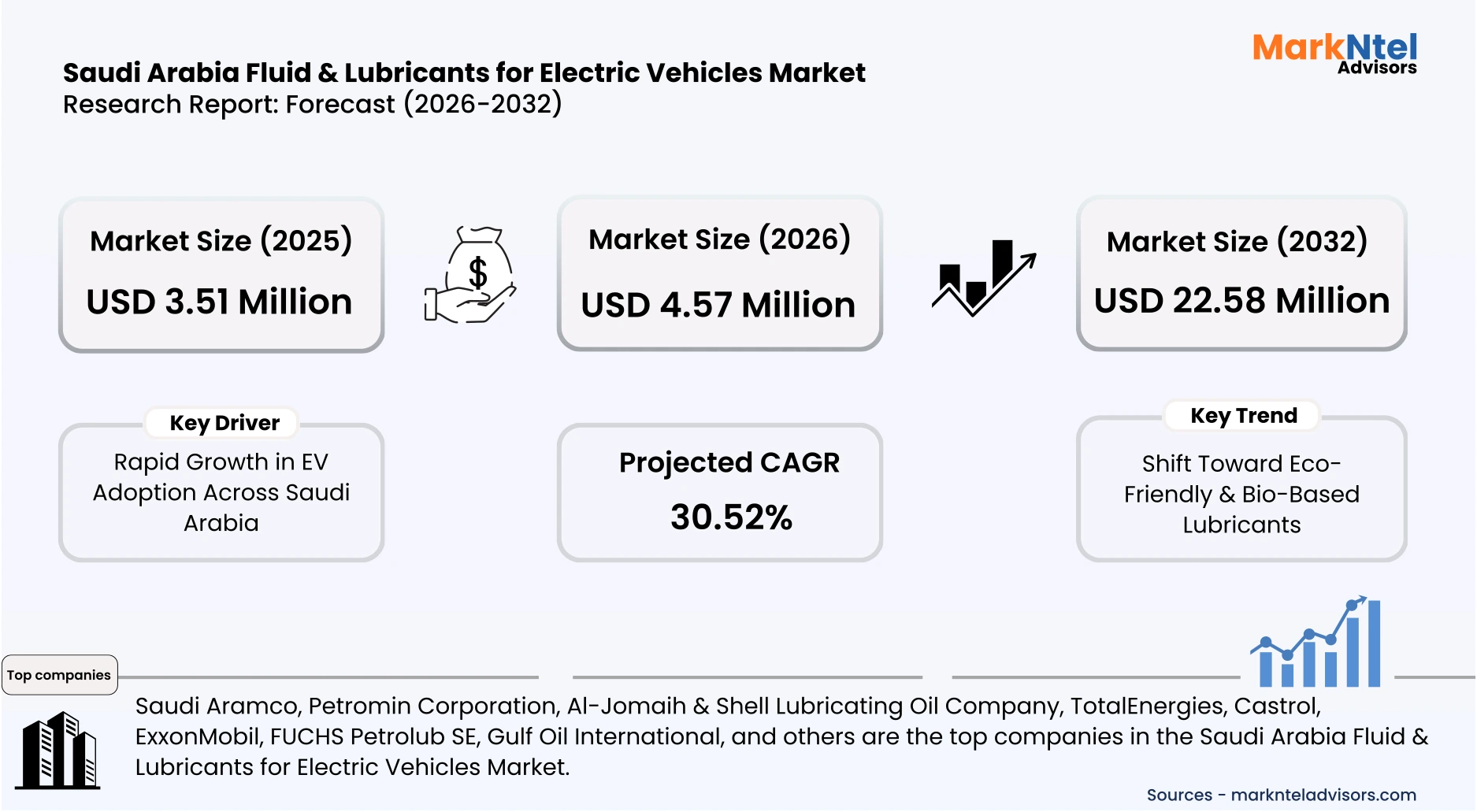
- The Saudi Arabia Fluid & Lubricants for Electric Vehicles Market size was valued at around USD 3.51 million in 2025 and is projected grow from USD 4.57 million in 2026 to USD 22.58 million by 2032, exhibiting a CAGR of 30.52% during the forecast period.
- The Central Region holds the largest market share of about 42% in the Saudi Arabia Fluid & Lubricants for Electric Vehicles Market in 2026.
- By Product Type, the coolants segment represented a significant share of about 45% in the Saudi Arabia Fluid & Lubricants for Electric Vehicles Market in 2026.
- By Propulsion Type, the Battery Electric Vehicles (BEVs) segment presented a significant share of about 65% in the Saudi Arabia Fluid & Lubricants for Electric Vehicles Market in 2026.
- Leading Fluid & Lubricants for Electric Vehicles companies in Saudi Arabia are Saudi Aramco, Petromin Corporation, Al-Jomaih & Shell Lubricating Oil Company, TotalEnergies, Castrol, ExxonMobil, FUCHS Petrolub SE, Gulf Oil International, and Others.
Market Insights & Analysis: Saudi Arabia Fluid & Lubricants for Electric Vehicles Market (2026-32):
The Saudi Arabia Fluid & Lubricants for Electric Vehicles Market size was valued at around USD 3.51 million in 2025 and is projected grow from USD 4.57 million in 2026 to USD 22.58 million by 2032, exhibiting a CAGR of 30.52% during the forecast period, i.e., 2026-32.
Saudi Arabia’s Fluid & Lubricants for Electric Vehicles market has developed alongside accelerating transport electrification and broader economic diversification. According to the World Bank, the Kingdom’s non-oil sector expansion has strengthened consumer purchasing power, supporting vehicle affordability and technology adoption. The United Nations projects continued population growth and urban concentration through 2030, particularly in major metropolitan areas, increasing vehicle density and mobility demand. Furthermore, Tesla’s official launch in Saudi Arabia in 2025, including the introduction of the Model 3 and Model Y, reflects rising consumer interest, with nearly half of Saudi citizens reportedly considering an EV purchase, strengthening long-term residential demand potential.
Regulatory and energy transition initiatives continue to reinforce market expansion. Saudi Arabia’s Ministry of Energy is advancing renewable power capacity under the National Renewable Energy Program, improving grid sustainability, and supporting the long-term viability of electric transport. Greater electricity reliability enhances EV utilization rates, directly increasing lifecycle demand for battery coolants and e-drive lubricants. As charging infrastructure expands nationally, higher vehicle usage intensity structurally elevates consumption of specialized thermal management fluids across residential and commercial segments. Additionally, XCharge’s partnership with Electromin to deploy battery-integrated GridLink fast-charging systems delivering nearly 200kW DC output while requiring minimal grid input is accelerating resilient charging infrastructure rollout across commercial and remote locations, further supporting EV adoption and associated fluid demand.
Industrial policy and international partnerships further underpin supply-side growth. In 2024, Saudi Arabia’s Ministry of Investment signed a USD 5.6 billion agreement with Chinese EV manufacturer Human Horizons to collaborate on vehicle development and manufacturing, signaling large-scale BEV ecosystem expansion . The entry of Chinese EV models into the Middle East is expected to enhance price competitiveness and improve accessibility for mass-market consumers. These developments strengthen factory-fill lubricant demand while fostering localized distribution and servicing networks across institutional and fleet operators.
Looking forward, demographic expansion, infrastructure scaling, and sustained policy alignment toward zero-emission mobility are expected to maintain market momentum. Institutional fleet electrification programs and corporate sustainability commitments will anchor baseline consumption levels, while residential adoption gradually increases as charging access improves. Growing vehicle utilization will continue to drive recurring demand for advanced cooling and dielectric fluids. Supported by economic stability, regulatory continuity, and industrial collaboration, Saudi Arabia’s EV fluids and lubricants market is positioned for steady, structurally grounded growth over the medium to long term.
Saudi Arabia Fluid & Lubricants for Electric Vehicles Market Recent Developments:
- 2025 : Shell Lubricants launched its EV-Plus Thermal Fluid, a high-performance immersion cooling solution designed to support ultra-fast charging. The electrically non-conductive fluid enables charging from 10% to 80% in under 10 minutes while maintaining battery safety and lifespan. By improving heat transfer and reducing thermal stress, it enhances thermal management efficiency in battery electric vehicles.
- 2025 : ExxonMobil highlighted its ongoing development of synthetic base oils, lubricants, and thermal management fluids designed to improve efficiency and range for electric vehicles — including products that regulate battery, electronic, and electric motor temperature to enhance performance and component life.
Saudi Arabia Fluid & Lubricants for Electric Vehicles Market Scope:
| Category | Segments |
|---|---|
| By Product Type | (Engine Oil, Greases, Heat Transfer Fluids, Coolants, Other Fluids), |
| By Demand Type | (OEM, Aftermarket), |
| By Vehicle Type | (Passenger EVs, Commercial EVs, Two/Three-Wheelers), |
| By Propulsion Type | (Battery Electric Vehicles (BEVs), Hybrid Electric Vehicles (HEVs), Plug-in Hybrid Electric Vehicles (PHEVs)), |
Saudi Arabia Fluid & Lubricants for Electric Vehicles Market Driver:
Rapid Growth in EV Adoption Across Saudi Arabia
The most influential structural driver of Saudi Arabia’s EV fluid and lubricants market is the rapid expansion of electric vehicle adoption under Vision 2030. In 2025, the Saudi government reaffirmed its target of converting 30% of vehicles in Riyadh to electric by 2030, supported by regulatory reforms and infrastructure mandates announced by the Ministry of Energy and the Royal Commission for Riyadh City . The Public Investment Fund continues to finance domestic EV production through Ceer and expanded capacity at Lucid Motors’ King Abdullah Economic City facility . These initiatives collectively represent systemic electrification rather than short-term promotional incentives.
This policy-led expansion is measurably increasing EV penetration across major urban centers, particularly Riyadh and Jeddah, where charging infrastructure deployment accelerated in 2025 under national mobility programs. According to the International Energy Agency, EV sales in the Middle East rose sharply in 2024 and 2025, with Saudi Arabia accounting for a growing share due to state-backed manufacturing and import facilitation policies. Tesla’s official market entry in Saudi Arabia in 2025 further expanded vehicle availability and consumer access. Rising vehicle registrations directly increase demand for battery coolants, e-axle lubricants, and specialized greases required in BEVs.
Unlike pricing-driven growth, EV adoption structurally expands market volume because each additional vehicle adds recurring lifetime demand for thermal management and drivetrain fluids. Domestic production scale-up reduces import dependency and supports higher annual vehicle output, reinforcing factory-fill lubricant requirements. Public fleet electrification initiatives, including municipal transport and corporate mobility transitions announced in 2025, are creating bulk procurement demand for EV-compatible fluids. As EV parc size grows year over year, cumulative servicing needs expand proportionally, ensuring sustained volumetric growth in Saudi Arabia’s EV fluids and lubricants market.
Saudi Arabia Fluid & Lubricants for Electric Vehicles Market Trend:
Shift Toward Eco-Friendly & Bio-Based Lubricants
The transition toward eco-friendly and bio-based lubricants has emerged as a defining structural trend reshaping Saudi Arabia’s EV fluids and lubricants market. This shift is closely aligned with the Kingdom’s sustainability agenda under Vision 2030 and the Saudi Green Initiative, both of which emphasize emission reduction and industrial decarbonization. In 2025, the Ministry of Energy reaffirmed its commitment to achieving net-zero emissions by 2060, reinforcing the adoption of cleaner industrial inputs across sectors . As electric mobility expands nationwide, regulators and manufacturers are increasingly prioritizing lubricants with lower carbon intensity and improved biodegradability.
This transformation is driving significant changes across supply chains and product development strategies. Major industry participants, including Saudi Aramco and TotalEnergies, are advancing lower-emission base oils and high-performance synthetic formulations aligned with sustainability objectives. In 2025, TotalEnergies introduced its EV3R lubricant range formulated with premium regenerated base oils under its “Reduce, Reuse, Regenerate” concept, underscoring the industry’s shift toward circular and environmentally responsible solutions. Such innovations require upgraded blending technologies, alternative feedstocks, and enhanced lifecycle assessment practices.
The persistence of this trend is supported by long-term climate commitments and increasing ESG disclosure requirements among publicly listed companies in Saudi Arabia. As EV adoption accelerates, stakeholders are seeking to align electrification with broader environmental performance standards. Sustainable lubricants offer measurable lifecycle emission reductions while maintaining operational efficiency. Consequently, eco-friendly and bio-based lubricants are expected to remain a structural component of the Kingdom’s evolving EV fluids market.
Saudi Arabia Fluid & Lubricants for Electric Vehicles Market Opportunity:
Creation of Advanced Thermal Management Solutions
The development of advanced thermal management solutions represents a significant structural opportunity in Saudi Arabia’s EV fluids and lubricants market. This opportunity has emerged due to the combined impact of rising EV adoption, expanding fast-charging infrastructure, and the Kingdom’s extreme climatic conditions. Summer temperatures frequently exceeding 45°C increase battery heat exposure and accelerate degradation risks. These environmental and operational factors are intensifying the technical need for high-performance cooling and dielectric fluid technologies.
This opportunity translates directly into measurable demand because battery efficiency, safety, and lifecycle durability depend on effective thermal regulation. In 2025, Shell Lubricants unveiled its EV-Plus Thermal Fluid, a high-performance solution engineered to enhance heat transfer, reduce thermal stress, and enable ultra-fast charging. The commercial launch of this advanced technology demonstrates how next-generation cooling fluids are becoming critical to EV battery optimization. As fast-charging networks expand, each additional EV entering the Saudi fleet structurally increases recurring demand for specialized thermal management fluids.
The opportunity is particularly advantageous for new and emerging players, as innovation in dielectric formulations and immersion cooling technologies requires specialized R&D rather than legacy distribution scale. Smaller firms can differentiate through climate-adapted solutions tailored to high-temperature operating environments. Saudi Arabia’s industrial diversification initiatives further support technology partnerships and localized production. As EV penetration accelerates, scalable demand for advanced thermal fluids is expected to create sustainable growth pathways for agile market entrants.
Saudi Arabia Fluid & Lubricants for Electric Vehicles Market Challenge:
Lack of Standardized EV Fluid Specifications Across OEMs
The absence of standardized EV fluid specifications across original equipment manufacturers (OEMs) represents a significant structural barrier within the EV fluids and lubricants market. Unlike conventional internal combustion vehicles, EV architectures vary considerably in battery chemistry, cooling design, and e-drive configuration. As EV production expanded globally in 2025, major manufacturers continued adopting proprietary thermal management and dielectric fluid requirements tailored to specific systems. In 2024 industry report highlighted that no universally accepted EV fluid specifications or standardized test methods currently exist, unlike traditional engine oil frameworks.
This fragmentation materially increases formulation complexity, validation costs, and approval timelines for suppliers. Each OEM approval requires separate compatibility testing and durability validation under distinct technical requirements. The same industry analysis emphasized that the lack of harmonized standards creates uncertainty for formulators and slows cross-platform product scalability. Smaller players face disproportionate burdens, as limited R&D budgets constrain their ability to secure multiple OEM certifications simultaneously.
Without unified specifications, fluid manufacturers must maintain fragmented product portfolios, limiting economies of scale and operational efficiency. The absence of cross-industry alignment discourages investment in universal formulations and delays commercialization cycles. This structural complexity restricts competitive entry and slows broader market expansion. Until technical harmonization progresses, specification variability will continue to constrain scalability within the EV fluids market.
Saudi Arabia Fluid & Lubricants for Electric Vehicles Market (2026-32) Segmentation Analysis:
The Saudi Arabia Fluid & Lubricants for Electric Vehicles Market study of MarkNtel Advisors evaluates & highlights the major trends and influencing factors in each segment. It includes predictions for the period 2026–32 at the country level. Based on the analysis, the market has been further classified as;
Based on Product Type:
- Engine Oil
- Greases
- Heat Transfer Fluids
- Coolants
- Other Fluids
The coolants segment dominates the Saudi Arabia Fluid & Lubricants for Electric Vehicles Market, accounting for approximately 45% of total demand, primarily because effective thermal management is fundamental to EV battery safety, performance, and longevity. Lithium-ion batteries operate optimally within a narrow temperature band, and deviations can significantly reduce efficiency and accelerate degradation. Saudi Arabia’s summer temperatures frequently exceed 45°C, according to national meteorological records, increasing external thermal loads on battery packs and power electronics. Under such high ambient conditions, liquid-based cooling systems become essential rather than optional, structurally elevating coolant consumption relative to other EV fluid categories.
Infrastructure expansion further reinforces this dominance. The rollout of fast-charging networks across major cities such as Riyadh and Jeddah intensifies internal battery heat generation during high-power charging cycles. In 2025, Saudi Arabia’s Electric Vehicle Infrastructure Company (EVIQ), in collaboration with the National Housing Company, announced plans to deploy approximately 5,000 EV chargers nationwide by 2030 under Vision 2030 , accelerating fast-charging adoption across the Kingdom. Fast charging significantly increases thermal stress, necessitating advanced heat-transfer fluids capable of maintaining temperature stability. Unlike engine oils, which are largely eliminated in battery electric vehicles, coolants remain indispensable throughout the vehicle lifecycle, serving batteries, inverters, and electric motors.
Additionally, OEMs increasingly deploy integrated liquid thermal management architectures rather than air-cooled systems due to superior heat transport capacity and pack temperature uniformity. These technical configurations structurally anchor coolant demand in EV design specifications. As the operational EV fleet expands under Vision 2030 electrification initiatives, cumulative lifecycle demand for battery coolants continues to scale proportionally. The combination of climatic necessity, charging intensity, and system-wide application firmly positions coolants as the leading product segment in Saudi Arabia’s EV fluids market.
Based on Propulsion Type:
- Battery Electric Vehicles (BEVs)
- Hybrid Electric Vehicles (HEVs)
- Plug-in Hybrid Electric Vehicles (PHEVs)
The Battery Electric Vehicles (BEVs) segment dominates the Saudi Arabia Fluid & Lubricants for Electric Vehicles Market, accounting for approximately 65% of total demand, primarily because BEVs are technologically simpler and more aligned with the Kingdom’s expanding fast-charging ecosystem. Unlike hybrid electric vehicles (HEVs) and plug-in hybrids (PHEVs), BEVs operate entirely on battery-electric drivetrains, eliminating dual propulsion complexity and reducing reliance on combustion-engine infrastructure. As charging infrastructure density increases across major urban corridors, the practicality of full-electric mobility improves significantly relative to transitional hybrid models. In 2025, Saudi Arabia’s homegrown EV brand Ceer signed agreements worth USD 1.4 billion to develop a localized BEV manufacturing ecosystem at King Abdullah Economic City, reinforcing a large-scale commitment to fully electric vehicle production rather than hybrid platforms.
Cost structure and maintenance dynamics further reinforce BEV preference. BEVs have fewer moving parts compared to HEVs and PHEVs, resulting in lower long-term maintenance requirements and improved total cost of ownership. Fleet operators and corporate mobility programs increasingly prioritize operational efficiency and predictable servicing costs, which favor fully electric platforms. This demand shift increases the share of BEVs entering the national vehicle fleet.
From a fluid consumption perspective, BEVs structurally require higher volumes of specialized battery coolants, dielectric fluids, and e-drive lubricants, while hybrids split operating cycles between electric and combustion systems. This concentration of thermal management dependency increases fluid intensity per vehicle within BEV architectures. As BEV registrations expand, cumulative demand for EV-specific fluids scales proportionally, solidifying BEVs as the dominant propulsion segment in Saudi Arabia’s EV fluids and lubricants market.
Saudi Arabia Fluid & Lubricants for Electric Vehicles Market (2026-32): Regional Projection
The Central Region dominates the Saudi Arabia Fluid & Lubricants for Electric Vehicles Market, accounting for approximately 42% of total regional revenue, primarily because it serves as the administrative, economic, and mobility nucleus of the Kingdom. Riyadh, located within the Central Region, represents the largest concentration of population, government institutions, and corporate headquarters in Saudi Arabia. As the country’s primary decision-making and procurement hub, Riyadh leads in early EV adoption across government fleets, corporate mobility programs, and private consumers. This higher vehicle concentration structurally increases demand for EV-specific fluids, particularly battery coolants and e-drive lubricants.
Infrastructure density further reinforces this dominance. The Central Region has witnessed the accelerated rollout of public and semi-public charging stations, including fast-charging corridors linking key commercial zones. Charging availability directly supports BEV utilization, which in turn increases lifecycle demand for thermal management fluids. Additionally, Riyadh hosts a significant share of automotive service networks, dealerships, and fleet maintenance facilities, strengthening aftermarket fluid consumption relative to other regions. The concentration of commercial and governmental fleets amplifies recurring maintenance demand.
Economic centralization also contributes to higher purchasing power and faster technology adoption compared to peripheral regions. Corporate sustainability commitments and public-sector electrification initiatives are predominantly headquartered in Riyadh, accelerating EV procurement decisions. As fleet sizes expand and vehicle turnover increases, cumulative demand for specialized EV fluids scales proportionally. The convergence of population density, infrastructure leadership, and institutional electrification initiatives firmly positions the Central Region as the leading geographic contributor to Saudi Arabia’s EV fluids and lubricants market.
Gain a Competitive Edge with Our Saudi Arabia Fluid & Lubricants for Electric Vehicles Market Report:
- Saudi Arabia Fluid & Lubricants for Electric Vehicles Market Report by MarkNtel Advisors provides a detailed & thorough analysis of market size & share, growth rate, competitive landscape, and key players. This comprehensive analysis helps businesses gain a holistic understanding of the market dynamics & make informed decisions.
- This report also highlights current market trends & future projections, allowing businesses to identify emerging opportunities & potential challenges. By understanding market forecasts, companies can align their strategies & stay ahead of the competition.
- Saudi Arabia Fluid & Lubricants for Electric Vehicles Market Report aids in assessing & mitigating risks associated with entering or operating in the market. By understanding market dynamics, regulatory frameworks, and potential challenges, businesses can develop strategies to minimize risks & optimize their operations.
*Reports Delivery Format - Market research studies from MarkNtel Advisors are offered in PDF, Excel and PowerPoint formats. Within 24 hours of the payment being successfully received, the report will be sent to your email address.
Frequently Asked Questions
- Market Segmentation
- Introduction
- Product Definition
- Research Process
- Assumptions
- Executive Summary
- Saudi Arabia Fluid & Lubricants for Electric Vehicles Market Policies, Regulations, and Product Standards
- Saudi Arabia Fluid & Lubricants for Electric Vehicles Market Trends & Developments
- Saudi Arabia Fluid & Lubricants for Electric Vehicles Market Dynamics
- Growth Factors
- Challenges
- Saudi Arabia Fluid & Lubricants for Electric Vehicles Market Hotspot & Opportunities
- Saudi Arabia Fluid & Lubricants for Electric Vehicles Market Outlook, 2022-2032F
- Market Size & Outlook
- By Revenues (USD Million)
- By Volume (Million Liters)
- Market Share & Outlook
- By Product Type- Market Size & Forecast 2022-2032, USD Million & Million Liters
- Engine Oil
- Greases
- Heat Transfer Fluids
- Coolants
- Other Fluids
- By Demand Type- Market Size & Forecast 2022-2032, USD Million & Million Liters
- OEM
- Aftermarket
- By Vehicle Type- Market Size & Forecast 2022-2032, USD Million & Million Liters
- Passenger EVs
- Commercial EVs
- Two/Three-Wheelers
- By Propulsion Type- Market Size & Forecast 2022-2032, USD Million & Million Liters
- Battery Electric Vehicles (BEVs)
- Hybrid Electric Vehicles (HEVs)
- Plug-in Hybrid Electric Vehicles (PHEVs)
- By Region - Market Size & Forecast 2022-2032, USD Million & Million Liters
- Central Region
- Eastern Region
- Western Region
- Southern & Northern Region
- By Company
- Competition Characteristics
- Market Share & Analysis
- By Product Type- Market Size & Forecast 2022-2032, USD Million & Million Liters
- Market Size & Outlook
- Saudi Arabia Engine Oil Market Outlook, 2022-2032
- Market Size & Outlook
- By Revenues (USD Million)
- By Volume (Million Liters)
- Market Share & Outlook
- By Demand Type- Market Size & Forecast 2022-2032, USD Million & Million Liters
- By Vehicle Type- Market Size & Forecast 2022-2032, USD Million & Million Liters
- By Propulsion Type- Market Size & Forecast 2022-2032, USD Million & Million Liters
- By Region - Market Size & Forecast 2022-2032, USD Million & Million Liters
- Market Size & Outlook
- Saudi Arabia Greases Market Outlook, 2022-2032
- Market Size & Outlook
- By Revenues (USD Million)
- By Volume (Million Liters)
- Market Share & Outlook
- By Demand Type- Market Size & Forecast 2022-2032, USD Million & Million Liters
- By Vehicle Type- Market Size & Forecast 2022-2032, USD Million & Million Liters
- By Propulsion Type- Market Size & Forecast 2022-2032, USD Million & Million Liters
- By Region - Market Size & Forecast 2022-2032, USD Million & Million Liters
- Market Size & Outlook
- Saudi Arabia Heat Transfer Fluids Market Outlook, 2022-2032
- Market Size & Outlook
- By Revenues (USD Million)
- By Volume (Million Liters)
- Market Share & Outlook
- By Demand Type- Market Size & Forecast 2022-2032, USD Million & Million Liters
- By Vehicle Type- Market Size & Forecast 2022-2032, USD Million & Million Liters
- By Propulsion Type- Market Size & Forecast 2022-2032, USD Million & Million Liters
- By Region - Market Size & Forecast 2022-2032, USD Million & Million Liters
- Market Size & Outlook
- Saudi Arabia Coolants Market Outlook, 2022-2032
- Market Size & Outlook
- By Revenues (USD Million)
- By Volume (Million Liters)
- Market Share & Outlook
- By Demand Type- Market Size & Forecast 2022-2032, USD Million & Million Liters
- By Vehicle Type- Market Size & Forecast 2022-2032, USD Million & Million Liters
- By Propulsion Type- Market Size & Forecast 2022-2032, USD Million & Million Liters
- By Region - Market Size & Forecast 2022-2032, USD Million & Million Liters
- Market Size & Outlook
- Saudi Arabia Fluid & Lubricants for Electric Vehicles Market Key Strategic Imperatives for Success & Growth
- Competitive Outlook
- Company Profiles
- Saudi Aramco
- Business Description
- Product Portfolio
- Collaborations & Alliances
- Recent Developments
- Financial Details
- Others
- Petromin Corporation
- Business Description
- Product Portfolio
- Collaborations & Alliances
- Recent Developments
- Financial Details
- Others
- Al-Jomaih & Shell Lubricating Oil Company
- Business Description
- Product Portfolio
- Collaborations & Alliances
- Recent Developments
- Financial Details
- Others
- TotalEnergies
- Business Description
- Product Portfolio
- Collaborations & Alliances
- Recent Developments
- Financial Details
- Others
- Castrol
- Business Description
- Product Portfolio
- Collaborations & Alliances
- Recent Developments
- Financial Details
- Others
- ExxonMobil
- Business Description
- Product Portfolio
- Collaborations & Alliances
- Recent Developments
- Financial Details
- Others
- FUCHS Petrolub SE
- Business Description
- Product Portfolio
- Collaborations & Alliances
- Recent Developments
- Financial Details
- Others
- Gulf Oil International
- Business Description
- Product Portfolio
- Collaborations & Alliances
- Recent Developments
- Financial Details
- Others
- Others
- Business Description
- Product Portfolio
- Collaborations & Alliances
- Recent Developments
- Financial Details
- Others
- Saudi Aramco
- Company Profiles
- Disclaimer
MarkNtel Advisors follows a robust and iterative research methodology designed to ensure maximum accuracy and minimize deviation in market estimates and forecasts. Our approach combines both bottom-up and top-down techniques to effectively segment and quantify various aspects of the market. A consistent feature across all our research reports is data triangulation, which examines the market from three distinct perspectives to validate findings. Key components of our research process include:
1. Scope & Research Design At the outset, MarkNtel Advisors define the research objectives and formulate pertinent questions. This phase involves determining the type of research—qualitative or quantitative—and designing a methodology that outlines data collection methods, target demographics, and analytical tools. They also establish timelines and budgets to ensure the research aligns with client goals.
2. Sample Selection and Data Collection In this stage, the firm identifies the target audience and determines the appropriate sample size to ensure representativeness. They employ various sampling methods, such as random or stratified sampling, based on the research objectives. Data collection is carried out using tools like surveys, interviews, and observations, ensuring the gathered data is reliable and relevant.
3. Data Analysis and Validation Once data is collected, MarkNtel Advisors undertake a rigorous analysis process. This includes cleaning the data to remove inconsistencies, employing statistical software for quantitative analysis, and thematic analysis for qualitative data. Validation steps are taken to ensure the accuracy and reliability of the findings, minimizing biases and errors.

4. Data Forecast and FinalizationThe final phase involves forecasting future market trends based on the analyzed data. MarkNtel Advisors utilize predictive modeling and time series analysis to anticipate market behaviors. The insights are then compiled into comprehensive reports, featuring visual aids like charts and graphs, and include strategic recommendations to inform client decision-making
We offer flexible licensing options to cater to varying organizational needs. Choose the pricing pack that best suits your requirements:
Buy Now Inquire Before Buying
 Request Customization
 Talk to our Consultant







