Global Ready-to-Wear Designer Apparel Market Research Report: Forecast (2026-2032)
Ready-to-Wear Designer Apparel Market - By Product Type (Tops & T-Shirts, Dresses, Pants & Jeans, Skirts, Shorts, Suits, Blazers & Coats, Knitwear & Sweatshirts, Others), By End-Us ... er (Men Designer Apparel, Women Designer Apparel, Kids Designer Apparel), By Distribution Channel (Offline, Online), By Seasonal Type (Summer Wear Outfits, Winter Wear Outfits), By Price Range (Affordable / Entry-Level, Mid-Range / Premium, Luxury / High-End), and others Read more
- FMCG
- Mar 2026
- Pages 198
- Report Format: PDF, Excel, PPT
Global Ready-to-Wear Designer Apparel Market
Projected 3.9% CAGR from 2026 to 2032
Study Period
2026-2032
Market Size (2026)
USD 109.9 Billion
Market Size (2032)
USD 138.29 Billion
Largest Region
North America
Projected CAGR
3.9%
Leading Segments
By Seasonal Type: Summer Wear Outfits
Global Ready-to-Wear Designer Apparel Market Report Key Takeaways:
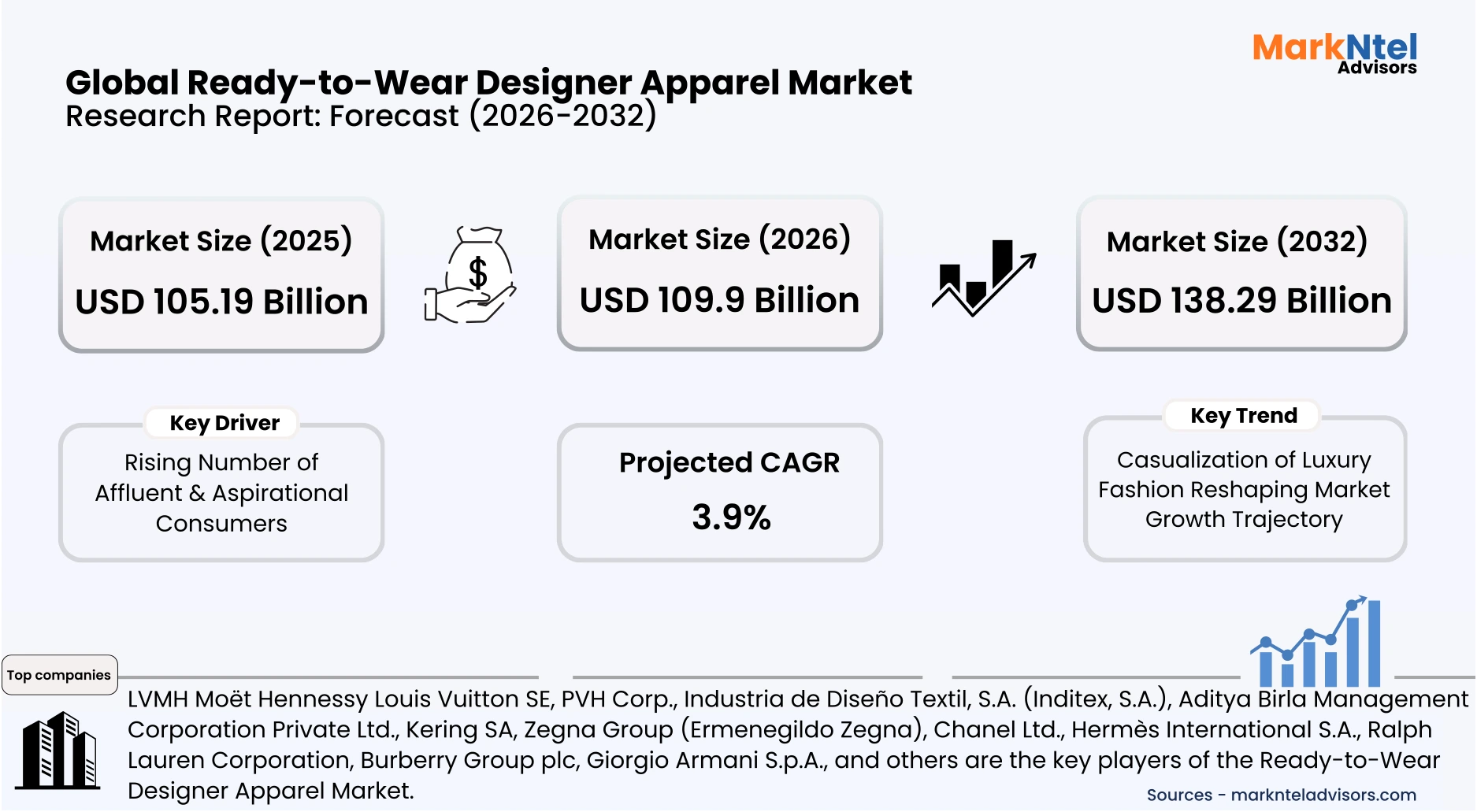
- The Global Ready-to-Wear Designer Apparel Market size was valued at around USD 105.19 billion in 2025 and is projected to grow from USD 109.9 billion in 2026 to USD 138.29 billion by 2032. The estimated CAGR from 2026 to 2032 is around 3.9%, indicating strong growth.
- By End-User, women designer apparel represented 66% of the Global Ready-to-Wear Designer Apparel Market size in 2026.
- By Seasonal Type, the summer wear outfits hold around 48% share of the Global Ready-to-Wear Designer Apparel Market in 2026.
- By Region, North America leads the Global Ready-to-Wear Designer Apparel Market with a substantial market share of around 33% in 2026.
- The leading companies in the Global Ready-to-Wear Designer Apparel Market are LVMH Moët Hennessy Louis Vuitton SE, PVH Corp., Industria de Diseño Textil, S.A. (Inditex, S.A.), Aditya Birla Management Corporation Private Ltd., Kering SA, Zegna Group (Ermenegildo Zegna), Chanel Ltd., Hermès International S.A., Ralph Lauren Corporation, Burberry Group plc, Giorgio Armani S.p.A., and others.
Market Insights & Analysis: Global Ready-to-Wear Designer Apparel Market (2026-2032):
The Global Ready-to-Wear Designer Apparel Market size was valued at around USD 105.19 billion in 2025 and is projected to grow from USD 109.9 billion in 2026 to USD 138.29 billion by 2032. Along with this, the market is estimated to grow at a CAGR of around 3.9% during the forecast period, i.e., 2026-32. The Global Ready-to-Wear Designer Apparel Market is positioned for steady growth between 2025 and 2032, supported by rising global wealth, shifting luxury consumption patterns, and evolving fashion preferences. In 2025, the world recorded 510,810 ultra-high-net-worth individuals, reflecting a 5.4% year-on-year increase, with a combined net worth of approximately USD 59.8 trillion. This expanding affluent base plays a critical role in sustaining demand for designer apparel, as UHNWIs alone spend nearly USD 290 billion annually on luxury goods, including fashion.
Macroeconomic and policy actions have further reinforced consumer confidence in key luxury markets. For instance, China’s 2024 stimulus measures, including interest-rate cuts and broader economic support, strengthened investor sentiment and encouraged discretionary spending on high-end goods, directly benefiting global designer apparel brands. As wealth concentration rises across Asia, North America, and parts of Europe, luxury ready-to-wear continues to gain traction as an accessible yet aspirational category.
At the same time, the definition of luxury fashion is evolving. Designer RTW is increasingly shaped by relaxed silhouettes, elevated basics, and comfort-driven aesthetics. This shift was clearly visible at Paris Fashion Week Fall–Winter 2025, where brands such as Sandro, Maje, and Claudie Pierlot highlighted refined denim, minimalist tailoring, and versatile everyday pieces. Such collections reflect changing consumer lifestyles that prioritize wearability without compromising craftsmanship.
Overall, rising affluence, supportive economic policies, and the continued casualization of luxury are expected to expand the global consumer base for designer RTW, strengthening the market’s long-term growth.
Global Ready-to-Wear Designer Apparel Market Recent Developments:
- 2025: The luxury sector saw a significant increase in discounting (up to ~40% of products) as years of price hikes dampened demand. Major houses, including LVMH, Kering, and Chanel, responded with reduced prices and strategic cost adjustments, impacting ready-to-wear sales and margins globally.
- May 2025: Independent women’s boutiques across the U.S. reported what actually sold in 2025, with stand-out ready-to-wear pieces reflecting consumer preference shifts toward versatile, accessible designer apparel over traditional luxury spectacle items.
Global Ready-to-Wear Designer Apparel Market Scope:
| Category | Segments |
|---|---|
| By Product Type | Tops & T-Shirts, Dresses, Pants & Jeans, Skirts, Shorts, Suits, Blazers & Coats, Knitwear & Sweatshirts, Others |
| By End-User | Offline, Online |
| By Seasonal Type | Summer Wear Outfits, Winter Wear Outfits |
| By Price Range | Affordable / Entry-Level, Mid-Range / Premium, Luxury / High-End), and others |
Global Ready-to-Wear Designer Apparel Market Drivers:
Rising Number of Affluent & Aspirational Consumers
The expansion of affluent and aspirational consumer groups is a primary driver of growth in the Global Ready-to-Wear (RTW) Designer Apparel Market. For instance, in 2025, 41.3 million high-net-worth individuals (HNWIs) worldwide held more than USD 1 million in investable assets, indicating a substantial base of wealthy consumers with discretionary spending power for luxury fashion purchases.
Wealth growth dynamics in 2025 further illustrate this trend. In the United States alone, over 379,000 new millionaires were created in 2024, averaging more than 1,000 new millionaires per day, propelling consumer wealth and potential luxury spending.
The affluent are not limited to traditional luxury markets; emerging economies such as China and India are increasingly influential. China now has millions of millionaires and billionaires, and its middle class continues to expand rapidly, forming a significant ready-to-wear consumer base.
Simultaneously, data highlights growing disposable income across global populations. World Bank classifications show a shift toward higher national income categories in numerous countries, reflecting rising per-capita incomes that enable broader participation in premium consumption.
In addition, this affluent expansion is expected to accelerate with projected wealth transfers totaling USD 83.5 trillion to younger generations by 2048, increasing the purchasing power and fashion engagement of Gen X, Millennials, and Gen Z.
Overall, the rising number of affluent and aspirational consumers, coupled with growing global wealth and disposable income, will sustain and expand demand for designer RTW apparel, underpinning long-term market growth.
Global Ready-to-Wear Designer Apparel Market Trends:
Casualization of Luxury Fashion Reshaping Market Growth Trajectory
The casualization of luxury fashion signifies a structural shift in consumer preferences where traditional high-end apparel is increasingly blended with everyday comfort-driven styles. For instance, in 2025, Louis Vuitton’s streetwear-infused collection was unveiled by Pharrell Williams at Paris Fashion Week. The showcase married luxury craftsmanship with streetwear elements like varsity jackets and sneakers, underlining a strategic pivot toward casual-oriented luxury that resonates with younger consumers.
Luxury brands are responding to changing lifestyles where consumers favor adaptable, versatile clothing over formal pieces. While formal couture once dominated, runway and retail focus now includes high-end sneakers, tailored joggers, and designer hoodies as staple offerings within ready-to-wear collections. These products blur boundaries between athleisure and premium wear, reflecting broader cultural shifts toward comfort and practicality. This trend is reinforced by surging demand for luxury sneakers and hybrid fashion staples (e.g., leather sneakers worn with both casual and elevated outfits) globally.
Beyond aesthetics, casualization reflects generational shifts. Younger buyers, particularly Millennials and Gen Z, exhibit more conservative luxury spending on everyday-relevant items than the traditionally exclusive couture market. Luxury houses such as Louis Vuitton, Balenciaga, and Celine have integrated casual silhouettes and streetwear references into core RTW lines to maintain relevance.
Overall, the casualization of luxury fashion is reshaping the designer apparel market by making luxury more accessible and lifestyle-centric. As comfort, versatility, and cultural expression increasingly guide purchasing decisions, this trend will continue to expand the reach and relevance of ready-to-wear designer offerings in 2025 and beyond.
Global Ready-to-Wear Designer Apparel Market Challenges:
Supply Chain Volatility & Higher Cost
Supply chain volatility and higher costs continue to pose a major challenge for the Ready-to-Wear (RTW) Designer Apparel Industry, directly affecting production timelines, sourcing strategies, and operating margins. Despite post-pandemic recovery, global trade flows remain uneven. The World Trade Organization (WTO) reported that global merchandise trade volume growth slowed to around 1.9% in 2024, reflecting lingering logistical disruptions and geopolitical uncertainties that carried into 2025, increasing lead-time unpredictability for fashion brands.
Raw material inflation further compounds the issue. According to the U.S. Department of Agriculture (USDA), cotton prices experienced sharp fluctuations during 2024–2025, driven by adverse weather conditions, supply constraints, and higher input costs, raising fabric procurement expenses for apparel manufacturers.
Transportation and energy costs remain another pressure point. The International Air Transport Association (IATA) reported that global air cargo rates stayed above pre-pandemic averages through 2024, largely due to fuel price volatility and limited capacity, increasing freight costs for designer brands reliant on fast global shipments.
Although infrastructure investments such as the U.S. Infrastructure Investment and Jobs Act aim to improve port and logistics efficiency over the long term, near-term cost volatility continues to challenge pricing stability and inventory planning for RTW designers.
Persistent supply chain disruptions and elevated input costs constrain profitability and operational flexibility, making cost control and sourcing resilience critical for sustaining growth in the global RTW designer apparel market.
Global Ready-to-Wear Designer Apparel Market (2026-32) Segmentation Analysis:
The Global Ready-to-Wear Designer Apparel Market Report and Forecast 2026-2032 offers a detailed analysis of the market based on the following segments:
Based on End-User:
- Men Designer Apparel
- Women Designer Apparel
- Kids Designer Apparel
The Women Designer Apparel segment dominates the Global Ready-to-Wear Designer Apparel Market with a 66% market share, driven by higher purchase frequency, broader product variety, and stronger fashion engagement compared to other consumer groups. Women’s designer apparel spans multiple categories, including dresses, tops, skirts, knitwear, and seasonal collections, resulting in repeat purchases across occasions such as workwear, casual wear, events, and festive dressing. Fashion cycles for women’s apparel are shorter, encouraging frequent wardrobe refreshes and faster adoption of new trends showcased at fashion weeks.
Additionally, women account for a larger share of discretionary spending on apparel, particularly in premium and luxury categories, where brand identity, craftsmanship, and design differentiation play a critical role. The increasing participation of women in the global workforce has further expanded demand for versatile, high-quality, ready-to-wear clothing suitable for both professional and social settings. Moreover, the rise of influencer-led fashion discovery and omnichannel retail experiences has amplified visibility and accessibility of women’s designer apparel, reinforcing its market leadership across both developed and emerging economies.
Based on Seasonal Type:
- Summer Wear Outfits
- Winter Wear Outfits
Summer Wear Outfits account for a leading 48% share of the global Ready-to-Wear Designer Apparel Market, supported by climatic demand patterns, lifestyle shifts, and extended seasonal usage across regions. Summer apparel, such as lightweight dresses, tops, shirts, skirts, and breathable fabrics, experiences consistently higher turnover due to longer warm-weather periods in key markets, including Asia-Pacific, the Middle East, Latin America, and parts of North America. Rising urbanization and travel activity have increased demand for comfortable, stylish summer clothing suited for work, leisure, and vacation wear. Designer brands also prioritize summer collections with frequent launches, resort wear lines, and seasonal capsules, driving higher sales volumes compared to winter apparel.
Additionally, summer outfits generally carry wider consumer appeal due to easier layering, flexible styling, and broader price accessibility. The growing preference for relaxed silhouettes and casual luxury has further strengthened summer wear’s dominance, making it a core revenue-generating segment for designer ready-to-wear brands globally.
Global Ready-to-Wear Designer Apparel Market (2026-32): Regional Projection
The Global Ready-to-Wear Designer Apparel Market is dominated by North America, holding around 33% market share. The region’s leadership is supported by high disposable incomes, a large base of affluent and aspirational consumers, and strong demand for premium and luxury fashion. Major urban centers such as New York, Los Angeles, Chicago, and Toronto act as fashion and retail hubs, hosting flagship stores, fashion weeks, and luxury shopping districts.
North America also benefits from a well-developed omnichannel retail ecosystem, where designer brands maintain strong physical store networks alongside advanced e-commerce platforms. The presence of globally influential brands such as Ralph Lauren, Calvin Klein, and Michael Kors further strengthens regional demand for ready-to-wear designer apparel. Additionally, consumers in the region show a high willingness to adopt evolving fashion trends, including casual luxury and season-less apparel, reinforcing regional dominance in global markets.
Gain a Competitive Edge with Our Global Ready-to-Wear Designer Apparel Market Report
- Global Ready-to-Wear Designer Apparel Market Report by MarkNtel Advisors provides a detailed & thorough analysis of market size & share, growth rate, competitive landscape, and key players. This comprehensive analysis helps businesses gain a holistic understanding of the market dynamics & make informed decisions.
- This report also highlights current market trends & future projections, allowing businesses to identify emerging opportunities & potential challenges. By understanding market forecasts, companies can align their strategies & stay ahead of the competition.
- Global Ready-to-Wear Designer Apparel Market Report aids in assessing & mitigating risks associated with entering or operating in the market. By understanding market dynamics, regulatory frameworks, and potential challenges, businesses can develop strategies to minimize risks & optimize their operations.
*Reports Delivery Format - Market research studies from MarkNtel Advisors are offered in PDF, Excel and PowerPoint formats. Within 24 hours of the payment being successfully received, the report will be sent to your email address.
Frequently Asked Questions
- Market Segmentation
- Introduction
- Product Definition
- Research Process
- Assumptions
- Executive Summary
- Global Ready-to-Wear Designer Apparel Market Policies, Regulations, Product Standards
- Global Ready-to-Wear Designer Apparel Market Trends & Development
- Global Ready-to-Wear Designer Apparel Market Dynamics
- Growth Drivers
- Challenges
- Global Ready-to-Wear Designer Apparel Market Hotspot & Opportunities
- Global Ready-to-Wear Designer Apparel Market Outlook, 2022-2032F
- Market Size & Analysis
- By Revenue (USD Million)
- Market Share & Analysis
- By Product Type- (USD Million)
- Tops & T-Shirts
- Dresses
- Pants & Jeans
- Skirts
- Shorts
- Suits, Blazers & Coats
- Knitwear & Sweatshirts
- Others
- By End-User- (USD Million)
- Men Designer Apparel
- Women Designer Apparel
- Kids Designer Apparel
- By Distribution Channel- (USD Million)
- Offline
- Online
- By Seasonal Type- (USD Million)
- Summer Wear Outfits
- Winter Wear Outfits
- By Price Range- (USD Million)
- Affordable / Entry-Level
- Mid-Range / Premium
- Luxury / High-End
- By Region
- North America
- South America
- Europe
- Middle East & Africa
- Asia-Pacific
- By Company
- Competition Characteristics
- Market Share & Analysis
- By Product Type- (USD Million)
- Market Size & Analysis
- North America Ready-to-Wear Designer Apparel Market Outlook, 2022-2032F
- Market Size & Analysis
- By Revenue (USD Million)
- Market Share & Analysis
- By Product Type- (USD Million)
- By End-User- (USD Million)
- By Distribution Channel- (USD Million)
- By Seasonal Type - (USD Million)
- By Price Range- (USD Million)
- By Country
- The US
- Canada
- Mexico
- The US Ready-to-Wear Designer Apparel Market Outlook, 2022-2032F
- Market Size & Analysis
- By Revenue (USD Million)
- Market Share & Analysis
- By Product Type- (USD Million)
- By End-User- (USD Million)
- By Distribution Channel- (USD Million)
- By Seasonal Type - (USD Million)
- By Price Range- (USD Million)
- Market Size & Analysis
- Canada Ready-to-Wear Designer Apparel Market Outlook, 2022-2032F
- Market Size & Analysis
- By Revenue (USD Million)
- Market Share & Analysis
- By Product Type- (USD Million)
- By End-User- (USD Million)
- By Distribution Channel- (USD Million)
- By Seasonal Type - (USD Million)
- By Price Range- (USD Million)
- Market Size & Analysis
- Mexico Ready-to-Wear Designer Apparel Market Outlook, 2022-2032F
- Market Size & Analysis
- By Revenue (USD Million)
- Market Share & Analysis
- By Product Type- (USD Million)
- By End-User- (USD Million)
- By Distribution Channel- (USD Million)
- By Seasonal Type - (USD Million)
- By Price Range- (USD Million)
- Market Size & Analysis
- Market Size & Analysis
- South America Ready-to-Wear Designer Apparel Market Outlook, 2022-2032F
- Market Size & Analysis
- By Revenue (USD Million)
- Market Share & Analysis
- By Product Type- (USD Million)
- By End-User- (USD Million)
- By Distribution Channel- (USD Million)
- By Seasonal Type - (USD Million)
- By Price Range- (USD Million)
- By Country
- Brazil
- Argentina
- Rest of South America
- Brazil Ready-to-Wear Designer Apparel Market Outlook, 2022-2032F
- Market Size & Analysis
- By Revenue (USD Million)
- Market Share & Analysis
- By Product Type- (USD Million)
- By End-User- (USD Million)
- By Distribution Channel- (USD Million)
- By Seasonal Type - (USD Million)
- By Price Range- (USD Million)
- Market Size & Analysis
- Argentina Ready-to-Wear Designer Apparel Market Outlook, 2022-2032F
- Market Size & Analysis
- By Revenue (USD Million)
- Market Share & Analysis
- By Product Type- (USD Million)
- By End-User- (USD Million)
- By Distribution Channel- (USD Million)
- By Seasonal Type - (USD Million)
- By Price Range- (USD Million)
- Market Size & Analysis
- Market Size & Analysis
- Europe Ready-to-Wear Designer Apparel Market Outlook, 2022-2032F
- Market Size & Analysis
- By Revenue (USD Million)
- Market Share & Analysis
- By Product Type- (USD Million)
- By End-User- (USD Million)
- By Distribution Channel- (USD Million)
- By Seasonal Type - (USD Million)
- By Price Range- (USD Million)
- By Country
- The UK
- Italy
- Germany
- France
- Spain
- BENELUX
- Rest of Europe
- The UK Ready-to-Wear Designer Apparel Market Outlook, 2022-2032F
- Market Size & Analysis
- By Revenue (USD Million)
- Market Share & Analysis
- By Product Type- (USD Million)
- By End-User- (USD Million)
- By Distribution Channel- (USD Million)
- By Seasonal Type - (USD Million)
- By Price Range- (USD Million)
- Market Size & Analysis
- Italy Ready-to-Wear Designer Apparel Market Outlook, 2022-2032F
- Market Size & Analysis
- By Revenue (USD Million)
- Market Share & Analysis
- By Product Type- (USD Million)
- By End-User- (USD Million)
- By Distribution Channel- (USD Million)
- By Seasonal Type - (USD Million)
- By Price Range- (USD Million)
- Market Size & Analysis
- Germany Ready-to-Wear Designer Apparel Market Outlook, 2022-2032F
- Market Size & Analysis
- By Revenue (USD Million)
- Market Share & Analysis
- By Product Type- (USD Million)
- By End-User- (USD Million)
- By Distribution Channel- (USD Million)
- By Seasonal Type - (USD Million)
- By Price Range- (USD Million)
- Market Size & Analysis
- France Ready-to-Wear Designer Apparel Market Outlook, 2022-2032F
- Market Size & Analysis
- By Revenue (USD Million)
- Market Share & Analysis
- By Product Type- (USD Million)
- By End-User- (USD Million)
- By Distribution Channel- (USD Million)
- By Seasonal Type - (USD Million)
- By Price Range- (USD Million)
- Market Size & Analysis
- Spain Ready-to-Wear Designer Apparel Market Outlook, 2022-2032F
- Market Size & Analysis
- By Revenue (USD Million)
- Market Share & Analysis
- By Product Type- (USD Million)
- By End-User- (USD Million)
- By Distribution Channel- (USD Million)
- By Seasonal Type - (USD Million)
- By Price Range- (USD Million)
- Market Size & Analysis
- BENELUX Ready-to-Wear Designer Apparel Market Outlook, 2022-2032F
- Market Size & Analysis
- By Revenue (USD Million)
- Market Share & Analysis
- By Product Type- (USD Million)
- By End-User- (USD Million)
- By Distribution Channel- (USD Million)
- By Seasonal Type - (USD Million)
- By Price Range- (USD Million)
- Market Size & Analysis
- Market Size & Analysis
- Middle East & Africa Ready-to-Wear Designer Apparel Market Outlook, 2022-2032F
- Market Size & Analysis
- By Revenue (USD Million)
- Market Share & Analysis
- By Connectivity- (USD Million)
- By Offering- (USD Million)
- By End User- (USD Million)
- By Country
- Saudi Arabia
- UAE
- South Africa
- Turkey
- Rest of Middle East & Africa
- Saudi Arabia Ready-to-Wear Designer Apparel Market Outlook, 2022-2032F
- Market Size & Analysis
- By Revenue (USD Million)
- Market Share & Analysis
- By Product Type- (USD Million)
- By End-User- (USD Million)
- By Distribution Channel- (USD Million)
- By Seasonal Type - (USD Million)
- By Price Range- (USD Million)
- Market Size & Analysis
- UAE Ready-to-Wear Designer Apparel Market Outlook, 2022-2032F
- Market Size & Analysis
- By Revenue (USD Million)
- Market Share & Analysis
- By Product Type- (USD Million)
- By End-User- (USD Million)
- By Distribution Channel- (USD Million)
- By Seasonal Type - (USD Million)
- By Price Range- (USD Million)
- Market Size & Analysis
- South Africa Ready-to-Wear Designer Apparel Market Outlook, 2022-2032F
- Market Size & Analysis
- By Revenue (USD Million)
- Market Share & Analysis
- By Product Type- (USD Million)
- By End-User- (USD Million)
- By Distribution Channel- (USD Million)
- By Seasonal Type - (USD Million)
- By Price Range- (USD Million)
- Market Size & Analysis
- Turkey Ready-to-Wear Designer Apparel Market Outlook, 2022-2032F
- Market Size & Analysis
- By Revenue (USD Million)
- Market Share & Analysis
- By Product Type- (USD Million)
- By End-User- (USD Million)
- By Distribution Channel- (USD Million)
- By Seasonal Type - (USD Million)
- By Price Range- (USD Million)
- Market Size & Analysis
- Market Size & Analysis
- Asia-Pacific Ready-to-Wear Designer Apparel Market Outlook, 2022-2032F
- Market Size & Analysis
- By Revenue (USD Million)
- Market Share & Analysis
- By Product Type- (USD Million)
- By End-User- (USD Million)
- By Distribution Channel- (USD Million)
- By Seasonal Type - (USD Million)
- By Price Range- (USD Million)
- By Country
- China
- Japan
- India
- South Korea
- Indonesia
- Singapore
- Thailand
- Vietnam
- Rest of APAC
- China Ready-to-Wear Designer Apparel Market Outlook, 2022-2032F
- Market Size & Analysis
- By Revenue (USD Million)
- Market Share & Analysis
- By Product Type- (USD Million)
- By End-User- (USD Million)
- By Distribution Channel- (USD Million)
- By Seasonal Type - (USD Million)
- By Price Range- (USD Million)
- Market Size & Analysis
- Japan Ready-to-Wear Designer Apparel Market Outlook, 2022-2032F
- Market Size & Analysis
- By Revenue (USD Million)
- Market Share & Analysis
- By Product Type- (USD Million)
- By End-User- (USD Million)
- By Distribution Channel- (USD Million)
- By Seasonal Type - (USD Million)
- By Price Range- (USD Million)
- Market Size & Analysis
- India Ready-to-Wear Designer Apparel Market Outlook, 2022-2032F
- Market Size & Analysis
- By Revenue (USD Million)
- Market Share & Analysis
- By Product Type- (USD Million)
- By End-User- (USD Million)
- By Distribution Channel- (USD Million)
- By Seasonal Type - (USD Million)
- By Price Range- (USD Million)
- Market Size & Analysis
- South Korea Ready-to-Wear Designer Apparel Market Outlook, 2022-2032F
- Market Size & Analysis
- By Revenue (USD Million)
- Market Share & Analysis
- By Product Type- (USD Million)
- By End-User- (USD Million)
- By Distribution Channel- (USD Million)
- By Seasonal Type - (USD Million)
- By Price Range- (USD Million)
- Market Size & Analysis
- Indonesia Ready-to-Wear Designer Apparel Market Outlook, 2022-2032F
- Market Size & Analysis
- By Revenue (USD Million)
- Market Share & Analysis
- By Product Type- (USD Million)
- By End-User- (USD Million)
- By Distribution Channel- (USD Million)
- By Seasonal Type - (USD Million)
- By Price Range- (USD Million)
- Market Size & Analysis
- Singapore Ready-to-Wear Designer Apparel Market Outlook, 2022-2032F
- Market Size & Analysis
- By Revenue (USD Million)
- Market Share & Analysis
- By Product Type- (USD Million)
- By End-User- (USD Million)
- By Distribution Channel- (USD Million)
- By Seasonal Type - (USD Million)
- By Price Range- (USD Million)
- Market Size & Analysis
- Thailand Ready-to-Wear Designer Apparel Market Outlook, 2022-2032F
- Market Size & Analysis
- By Revenue (USD Million)
- Market Share & Analysis
- By Product Type- (USD Million)
- By End-User- (USD Million)
- By Distribution Channel- (USD Million)
- By Seasonal Type - (USD Million)
- By Price Range- (USD Million)
- Market Size & Analysis
- Vietnam Ready-to-Wear Designer Apparel Market Outlook, 2022-2032F
- Market Size & Analysis
- By Revenue (USD Million)
- Market Share & Analysis
- By Product Type- (USD Million)
- By End-User- (USD Million)
- By Distribution Channel- (USD Million)
- By Seasonal Type - (USD Million)
- By Price Range- (USD Million)
- Market Size & Analysis
- Market Size & Analysis
- Global Ready-to-Wear Designer Apparel Market Key Strategic Imperatives for Success & Growth
- Competition Outlook
- Company Profiles
- LVMH Moët Hennessy Louis Vuitton SE
- Business Description
- Product Portfolio
- Strategic Alliances or Partnerships
- Recent Developments
- Financial Details
- Others
- PVH Corp.
- Business Description
- Product Portfolio
- Strategic Alliances or Partnerships
- Recent Developments
- Financial Details
- Others
- Industria de Diseño Textil, S.A. (Inditex, S.A.)
- Business Description
- Product Portfolio
- Strategic Alliances or Partnerships
- Recent Developments
- Financial Details
- Others
- Aditya Birla Management Corporation Private Ltd.
- Business Description
- Product Portfolio
- Strategic Alliances or Partnerships
- Recent Developments
- Financial Details
- Others
- Kering SA (Gucci, Saint Laurent, Balenciaga)
- Business Description
- Product Portfolio
- Strategic Alliances or Partnerships
- Recent Developments
- Financial Details
- Others
- Zegna Group (Ermenegildo Zegna)
- Business Description
- Product Portfolio
- Strategic Alliances or Partnerships
- Recent Developments
- Financial Details
- Others
- Chanel Ltd.
- Business Description
- Product Portfolio
- Strategic Alliances or Partnerships
- Recent Developments
- Financial Details
- Others
- Hermès International S.A.
- Business Description
- Product Portfolio
- Strategic Alliances or Partnerships
- Recent Developments
- Financial Details
- Others
- Ralph Lauren Corporation
- Business Description
- Product Portfolio
- Strategic Alliances or Partnerships
- Recent Developments
- Financial Details
- Others
- Burberry Group plc
- Business Description
- Product Portfolio
- Strategic Alliances or Partnerships
- Recent Developments
- Financial Details
- Others
- Giorgio Armani S.p.A.
- Business Description
- Product Portfolio
- Strategic Alliances or Partnerships
- Recent Developments
- Financial Details
- Others
- Others
- LVMH Moët Hennessy Louis Vuitton SE
- Company Profiles
- Disclaimer
MarkNtel Advisors follows a robust and iterative research methodology designed to ensure maximum accuracy and minimize deviation in market estimates and forecasts. Our approach combines both bottom-up and top-down techniques to effectively segment and quantify various aspects of the market. A consistent feature across all our research reports is data triangulation, which examines the market from three distinct perspectives to validate findings. Key components of our research process include:
1. Scope & Research Design At the outset, MarkNtel Advisors define the research objectives and formulate pertinent questions. This phase involves determining the type of research—qualitative or quantitative—and designing a methodology that outlines data collection methods, target demographics, and analytical tools. They also establish timelines and budgets to ensure the research aligns with client goals.
2. Sample Selection and Data Collection In this stage, the firm identifies the target audience and determines the appropriate sample size to ensure representativeness. They employ various sampling methods, such as random or stratified sampling, based on the research objectives. Data collection is carried out using tools like surveys, interviews, and observations, ensuring the gathered data is reliable and relevant.
3. Data Analysis and Validation Once data is collected, MarkNtel Advisors undertake a rigorous analysis process. This includes cleaning the data to remove inconsistencies, employing statistical software for quantitative analysis, and thematic analysis for qualitative data. Validation steps are taken to ensure the accuracy and reliability of the findings, minimizing biases and errors.

4. Data Forecast and FinalizationThe final phase involves forecasting future market trends based on the analyzed data. MarkNtel Advisors utilize predictive modeling and time series analysis to anticipate market behaviors. The insights are then compiled into comprehensive reports, featuring visual aids like charts and graphs, and include strategic recommendations to inform client decision-making
We offer flexible licensing options to cater to varying organizational needs. Choose the pricing pack that best suits your requirements:
Buy Now Inquire Before Buying
 Request Customization
 Talk to our Consultant