

Japan Heated Tobacco Products Market Research Report Forecast (2026-2032)
Japan Heated Tobacco Products Market - By Product Type (Stick, Leaf), By Device Type (Rechargeable, Non-Rechargeable), By Category (Regular, Flavored), By Distribution Channel ( ... Offline, Online), and others Read more
- FMCG
- Jan 2026
- Pages 135
- Report Format: PDF, Excel, PPT
Japan Heated Tobacco Products Market
Projected 9.08% CAGR from 2026 to 2032
Study Period
2026-2032
Market Size (2025)
USD 13.16 Billion
Market Size (2032)
USD 24.18 Billion
Base Year
2025
Projected CAGR
9.08%
Leading Segments
By Product Type: Stick
Japan Heated Tobacco Products Market Report Key Takeaways:
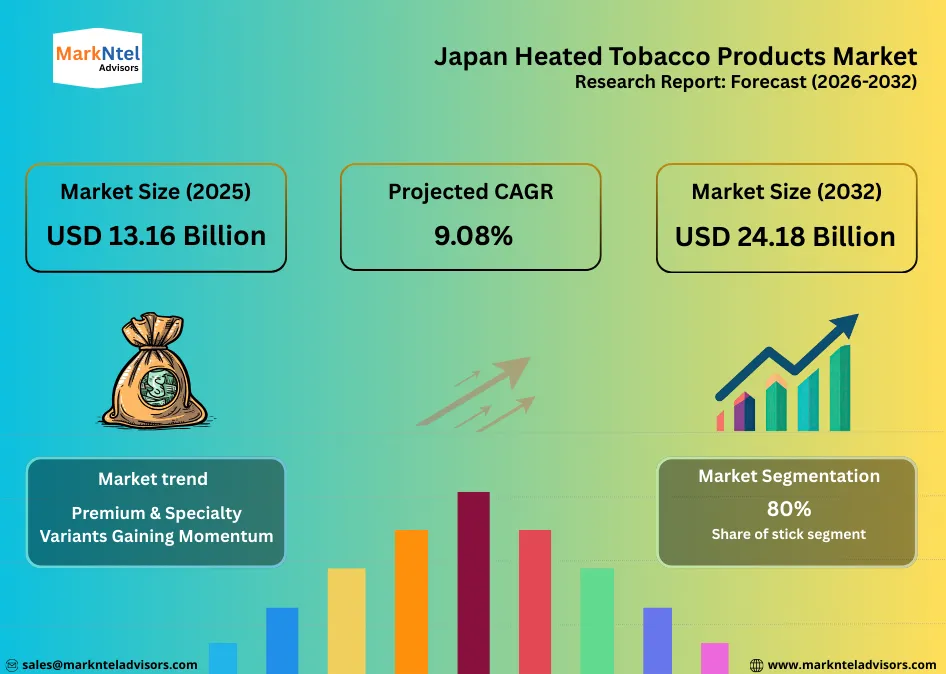
- The Japan Heated Tobacco Products Market size was valued at around USD 13.16 billion in 2025 and is projected to reach USD 24.18 billion by 2032. The estimated CAGR from 2026 to 2032 is around 9.08%, indicating strong growth.
- By Product Type, the stick represented 80% of the Japan Heated Tobacco Products Market size in 2025.
- The leading heated tobacco products companies are Philip Morris Japan Inc., British American Tobacco Japan, Japan Tobacco Inc., Imperial Brands Plc, KT&G Corporation, Altria Group, Inc., and others.
Market Insights & Analysis: Japan Heated Tobacco Products Market (2026- 2032):
The Japan Heated Tobacco Products Market size was valued at around USD 13.16 billion in 2025 and is projected to reach USD 24.18 billion by 2032. Along with this, the market is estimated to grow at a CAGR of around 9.08% during the forecast period, i.e., 2026-32. The Japan Heated Tobacco Products (HTP) market is expected to maintain steady growth, supported by structural shifts in consumer behavior and sustained innovation by major tobacco manufacturers. Government-backed health data show that Japan has experienced a significant decline in combustible cigarette use over the past decade, while heated tobacco adoption has increased in parallel. According to Japan’s National Health and Nutrition Survey under the Ministry of Health, Labor and Welfare, cigarette-only use fell to around 10 % of adults in 2022, while HTP users accounted for a growing share of tobacco consumption, indicating long-term substitution rather than short-term experimentation.
This transition is increasingly reinforced by demand for premium and specialty heated tobacco variants, as adult consumers seek differentiated taste profiles, refined designs, and exclusive offerings. For example, Philip Morris International’s limited-edition TEREA KIWAMI, launched in September 2025 for IQOS ILUMA devices and priced at approximately USD 4 per pack, reflects how premium positioning is being used to retain and upgrade existing users.
Moreover, long-term investment commitments further strengthen the outlook. Japan Tobacco International has announced plans to invest approximately USD 4.4 billion during 2025–2027 to expand heated tobacco R&D, commercialization, and global scale, with Japan remaining a core technology and innovation hub. These investments are expected to support next-generation devices, improved consumables, and broader international deployment.
Overall, declining cigarette use, growing acceptance of reduced-risk alternatives, premiumization, and sustained capital investment position the Japan HTP market for continued expansion and maturity through 2032, reinforcing its role as one of the world’s most advanced heated tobacco markets.
Japan Heated Tobacco Products Market Recent Developments:
- May 2025: Japan Tobacco Inc. introduced its next-generation heated tobacco device, Ploom AURA, and premium sticks EVO nationwide starting July 2025, enhancing product choice and technology for adult consumers in Japan’s mature HTP market.
- May 2025: British American Tobacco Japan announced a September 2025 nationwide rollout of its new heated tobacco product glo Hilo, priced around USD 25, after successful pilot sales, aiming to expand its market presence.
Japan Heated Tobacco Products Market Scope:
| Category | Segments |
|---|---|
| By Product Type | Stick, Leaf) |
| By Device Type | Rechargeable, Non-Rechargeable) |
| By Category | Regular, Flavored), By Distribution Channel (Offline, Online), and others |
Japan Heated Tobacco Products Market Drivers:
Shift to Reduced-Risk Alternatives
One of the strongest drivers of the Japan Heated Tobacco Products (HTP) market is adult smokers’ shift toward alternatives perceived as reduced-risk compared with combustible cigarettes. According to nationally representative tobacco survey data, the prevalence of current HTP use in Japan reached approximately 12.4% in 2023, making HTPs the second most common tobacco product after cigarettes (18.9%). This reflects that traditional smoking prevalence has declined steadily over the past decade, due in part to alternative products. Scientific assessments by Japan’s National Institute of Public Health highlight that emissions from heated tobacco products contain significantly lower levels of harmful constituents such as tobacco-specific nitrosamines and carbon monoxide compared with cigarette smoke, reinforcing consumer perception of reduced risk.
A recent development in 2025 shows that industry leaders like Philip Morris report that IQOS holds a dominant 80 % share of the HTP market in Japan, driven by smokers seeking less harmful alternatives.
Beyond 2025, investment in next-generation smoke-free technologies and regulatory frameworks that support harm-reduction assessment and innovation is expected to further strengthen the appeal of reduced-risk products.
Overall, as scientific evidence, rising prevalence, and technological adoption align, the shift toward reduced-risk alternatives will continue to propel demand for heated tobacco products and drive market expansion in Japan.
Japan Heated Tobacco Products Market Trends:
Premium & Specialty Variants Gaining Momentum
In the Japanese heated tobacco products industry, premium and specialty variants have emerged as a clear trend reflecting consumer demand for differentiated experiences and product sophistication. A strong example of this trend is the EVO premium tobacco stick series launched by Japan Tobacco Inc. (JT). In 2025, JT expanded its product line to include EVO sticks exclusively designed for its advanced Ploom AURA device, highlighting a focus on quality and tailored flavor profiles beyond basic offerings. EVO sticks are blended from high‑grade tobacco leaves and engineered to deliver richer taste and sensory satisfaction compared with standard products, reinforcing the “premium” positioning. A nationwide rollout began in July 2025, with starter kits priced around USD 21 and special introductory pricing at USD 10 in selected periods, demonstrating consumer appeal for higher‑end variants.
Moreover, tobacco product offerings continue to diversify. For example, in December 2025, JT released EVO Honey Lemon Crystal sticks, adding a distinct dual‑flavor citrus‑honey combination at USD 3.55 per pack, broadening the premium category in the heated tobacco segment. Concurrently, Philip Morris Japan expanded its TEREA product line with variants such as TEREA Icy Red at USD 3.40, revealing competition in specialty flavor development.
These developments occur within the regulatory context of Japan’s Health Promotion Act, which includes updated labeling and nicotine‑level requirements coming into force by 2025, influencing product innovation while staying compliant with national safety standards.
Overall, the growth of premium and specialty variants driven by technological upgrades, flavor innovation, and targeted pricing signals that consumers are seeking more personalized and high‑quality heated tobacco experiences, which will continue to stimulate market expansion in Japan.
Japan Heated Tobacco Products Market Challenges:
Growing Regulatory Scrutiny Hindering Market Growth
In Japan, regulatory scrutiny of heated tobacco products (HTPs) has intensified as authorities aim to align public health policy with global tobacco control standards. Under the amended Health Promotion Act, heated tobacco products are explicitly included in smoking bans, and their use is prohibited in schools, hospitals, government facilities, and other designated smoke-free zones. This has expanded compliance requirements for manufacturers and users alike.
Moreover, municipalities have moved to tighten locale-specific regulations. For example, Osaka City’s 2025 ordinance extended smoking bans, including for HTPs, to all outdoor public spaces, significantly restricting where adult consumers can legally use heated tobacco products in urban areas.
Nationally, Japan’s commitments under the WHO Framework Convention on Tobacco Control (FCTC) require comprehensive regulation of all tobacco products, including HTPs, and reinforce reporting and compliance obligations on product governance and marketing.
Public health research also informs regulation by questioning the health risk profiles of heated tobacco products relative to cigarettes. Government-aligned health bodies have called for careful oversight, emphasizing that HTPs may maintain nicotine dependence and that optimal regulation should treat them similarly to traditional tobacco until more definitive scientific evidence emerges.
These developments demonstrate how increasingly stringent legal frameworks and enforcement practices are emerging, posing compliance challenges for industry participants and creating potential constraints on market expansion if regulations further tighten.
Japan Heated Tobacco Products Market (2026-32) Segmentation Analysis:
The Japan Heated Tobacco Products Market Report and Forecast 2026-2032 offers a detailed analysis of the market based on the following segments:
Based on Product Type:
- Stick
- Leaf
The stick segment dominates the Japan Heated Tobacco Products market with around 80% share, making it the leading product type throughout the forecast period. This dominance is primarily driven by strong consumer familiarity and compatibility with widely used heated tobacco devices. Tobacco sticks are designed for precise temperature control, delivering consistent nicotine release and flavor without combustion, which aligns well with Japanese consumers’ preference for controlled and cleaner alternatives to cigarettes.
Additionally, major manufacturers have concentrated innovation around stick-based formats, offering a wide variety of premium, specialty, and capsule-based variants that enhance user experience and brand loyalty. The standardized size, ease of storage, and convenient availability across retail outlets further strengthen adoption. Regulatory clarity around stick-based heated tobacco, compared with loose-leaf alternatives, has also supported wider commercialization. As device ecosystems remain closely linked to proprietary stick formats, consumer switching costs remain high, reinforcing repeat purchases. Together, these factors position sticks as the most commercially viable and scalable product category in Japan’s heated tobacco market.
Based on Distribution Channel
- Offline
- Online
The offline distribution channel remains the leading sales route for heated tobacco products in Japan, accounting for the majority of total revenue. This leadership is largely supported by Japan’s dense network of convenience stores, tobacco specialty shops, and licensed retailers, which offer high visibility and immediate product access. Heated tobacco purchases often involve device–consumable ecosystems, and offline channels allow consumers to receive guidance on device usage, maintenance, and compatibility, building trust and encouraging repeat buying.
In addition, Japan’s strict age-verification requirements and tobacco sales regulations are more effectively enforced through physical retail formats, favoring offline sales over digital platforms. Promotional displays, limited-edition product availability, and impulse purchasing further contribute to strong offline performance. While online channels are expanding gradually, offline retail continues to dominate due to consumer habits, regulatory structure, and strong last-mile accessibility. As a result, offline distribution remains the backbone of heated tobacco sales in Japan.
Japan Heated Tobacco Products Market (2026-32): Regional Projection
The heated tobacco products market in Japan is dominated by major metropolitan and urban regions, particularly the Kanto region (Tokyo, Yokohama, Chiba, Saitama), followed by Kansai (Osaka, Kyoto, Kobe) and Chubu (Nagoya). These regions account for the highest consumption due to dense adult populations, higher disposable incomes, and stronger acceptance of alternative tobacco products. Tokyo, as Japan’s largest urban economy, leads the market owing to extensive convenience store networks, specialty tobacco shops, and early adoption of heated tobacco devices. Urban consumers in these regions show a greater preference for reduced-smell and smoke-free products, aligning with strict public smoking regulations.
Additionally, corporate offices and lifestyle-driven working populations in metropolitan areas favor heated tobacco for discreet usage. The dominance of these regions is further supported by robust product availability, frequent device upgrades, and targeted launches by leading manufacturers. As a result, metropolitan Japan continues to drive sales volume, innovation adoption, and overall market growth in the heated tobacco products sector.
Gain a Competitive Edge with Our Japan Heated Tobacco Products Market Report
- Japan Heated Tobacco Products Market Report by MarkNtel Advisors provides a detailed & thorough analysis of market size & share, growth rate, competitive landscape, and key players. This comprehensive analysis helps businesses gain a holistic understanding of the market dynamics & make informed decisions.
- This report also highlights current market trends & future projections, allowing businesses to identify emerging opportunities & potential challenges. By understanding market forecasts, companies can align their strategies & stay ahead of the competition.
- Japan Heated Tobacco Products Market Report aids in assessing & mitigating risks associated with entering or operating in the market. By understanding market dynamics, regulatory frameworks, and potential challenges, businesses can develop strategies to minimize risks & optimize their operations.
*Reports Delivery Format - Market research studies from MarkNtel Advisors are offered in PDF, Excel and PowerPoint formats. Within 24 hours of the payment being successfully received, the report will be sent to your email address.
Frequently Asked Questions
- Market Segmentation
- Introduction
- Product Definition
- Research Process
- Assumptions
- Executive Summary
- Japan Heated Tobacco Products Market Policies, Regulations, and Product Standards
- Japan Heated Tobacco Products Market Supply Chain Analysis
- Japan Heated Tobacco Products Market Trends & Developments
- Japan Heated Tobacco Products Market Dynamics
- Growth Drivers
- Challenges
- Japan Heated Tobacco Products Market Hotspot & Opportunities
- Japan Heated Tobacco Products Market Outlook, 2022-2032
- Market Size & Outlook
- By Revenues (USD Million)
- By Volume (Million Tons/ Million Sticks)
- Market Share & Outlook
- By Product Type- Market Size & Forecast 2022-2032F, USD Million
- Stick
- Leaf
- By Device Type - Market Size & Forecast 2022-2032F, USD Million
- Rechargeable
- Non-Rechargeable
- By Category- Market Size & Forecast 2022-2032F, USD Million
- Regular
- Flavored
- By Distribution Channel- Market Size & Forecast 2022-2032F, USD Million
- Offline
- Online
- By Region
- Hokkaido
- Tohoku
- Kanto
- Chubu
- Others
- By Company
- Company Revenue Shares
- Competitor Characteristics
- By Product Type- Market Size & Forecast 2022-2032F, USD Million
- Market Size & Outlook
- Japan Stick Heated Tobacco Products Market Outlook, 2022-2032
- Market Size & Analysis
- Market Revenues (USD Million)
- By Volume (Million Tons/ Million Sticks)
- Sticks Sold in Million
- Market Share & Analysis
- By Device Type- Market Size & Forecast 2022-2032, USD Million
- By Category- Market Size & Forecast 2022-2032, USD Million
- By Distribution Channel- Market Size & Forecast 2022-2032, USD Million
- Market Size & Analysis
- Japan Leaf Heated Tobacco Products Market Outlook, 2022-2032
- Market Size & Analysis
- Market Revenues (USD Million)
- By Volume (Million Tons/ Million Sticks)
- Market Share & Analysis
- By Device Type- Market Size & Forecast 2022-2032, USD Million
- By Category- Market Size & Forecast 2022-2032, USD Million
- By Distribution Channel- Market Size & Forecast 2022-2032, USD Million
- Market Size & Analysis
- Japan Heated Tobacco Products Market Key Strategic Imperatives for Success & Growth
- Competition Outlook
- Company Profiles
- Philip Morris Japan Inc.
- Business Description
- Product Portfolio
- Strategic Alliances or Partnerships
- Recent Developments
- Financial Details
- Others
- British American Tobacco Japan
- Business Description
- Product Portfolio
- Strategic Alliances or Partnerships
- Recent Developments
- Financial Details
- Others
- Japan Tobacco Inc.
- Business Description
- Product Portfolio
- Strategic Alliances or Partnerships
- Recent Developments
- Financial Details
- Others
- Imperial Brands Plc
- Business Description
- Product Portfolio
- Strategic Alliances or Partnerships
- Recent Developments
- Financial Details
- Others
- KT&G Corporation
- Business Description
- Product Portfolio
- Strategic Alliances or Partnerships
- Recent Developments
- Financial Details
- Others
- Altria Group, Inc.
- Business Description
- Product Portfolio
- Strategic Alliances or Partnerships
- Recent Developments
- Financial Details
- Others
- Others
- Philip Morris Japan Inc.
- Company Profiles
- Disclaimer
MarkNtel Advisors follows a robust and iterative research methodology designed to ensure maximum accuracy and minimize deviation in market estimates and forecasts. Our approach combines both bottom-up and top-down techniques to effectively segment and quantify various aspects of the market. A consistent feature across all our research reports is data triangulation, which examines the market from three distinct perspectives to validate findings. Key components of our research process include:
1. Scope & Research Design At the outset, MarkNtel Advisors define the research objectives and formulate pertinent questions. This phase involves determining the type of research—qualitative or quantitative—and designing a methodology that outlines data collection methods, target demographics, and analytical tools. They also establish timelines and budgets to ensure the research aligns with client goals.
2. Sample Selection and Data Collection In this stage, the firm identifies the target audience and determines the appropriate sample size to ensure representativeness. They employ various sampling methods, such as random or stratified sampling, based on the research objectives. Data collection is carried out using tools like surveys, interviews, and observations, ensuring the gathered data is reliable and relevant.
3. Data Analysis and Validation Once data is collected, MarkNtel Advisors undertake a rigorous analysis process. This includes cleaning the data to remove inconsistencies, employing statistical software for quantitative analysis, and thematic analysis for qualitative data. Validation steps are taken to ensure the accuracy and reliability of the findings, minimizing biases and errors.

4. Data Forecast and FinalizationThe final phase involves forecasting future market trends based on the analyzed data. MarkNtel Advisors utilize predictive modeling and time series analysis to anticipate market behaviors. The insights are then compiled into comprehensive reports, featuring visual aids like charts and graphs, and include strategic recommendations to inform client decision-making
We offer flexible licensing options to cater to varying organizational needs. Choose the pricing pack that best suits your requirements:
Buy Now Inquire Before Buying
 Request Customization
 Talk to our Consultant







