GCC Ultra-Premium Beauty & Personal Care Market Research Report: Forecast (2026-2032)
GCC Ultra-Premium Beauty & Personal Care Market - By Product Type (Skincare, Makeup, Fragrances, Haircare, Others), By Ingredient Type (Natural and Organic, Conventional/Synthetic) ... , By End-User (Women, Men, Teens), By Sales Channel (Exclusive Outlets, Department Stores, Online Retail), and others Read more
- FMCG
- Mar 2026
- Pages 165
- Report Format: PDF, Excel, PPT
GCC Ultra-Premium Beauty & Personal Care Market
Projected 10.99% CAGR from 2026 to 2032
Study Period
2026-2032
Market Size (2026)
USD 2.67 Billion
Market Size (2032)
USD 4.99 Billion
Base Year
2025
Projected CAGR
10.99%
Leading Segments
By Product Type: Skincare
GCC Ultra-Premium Beauty & Personal Care Market Report Key Takeaways:
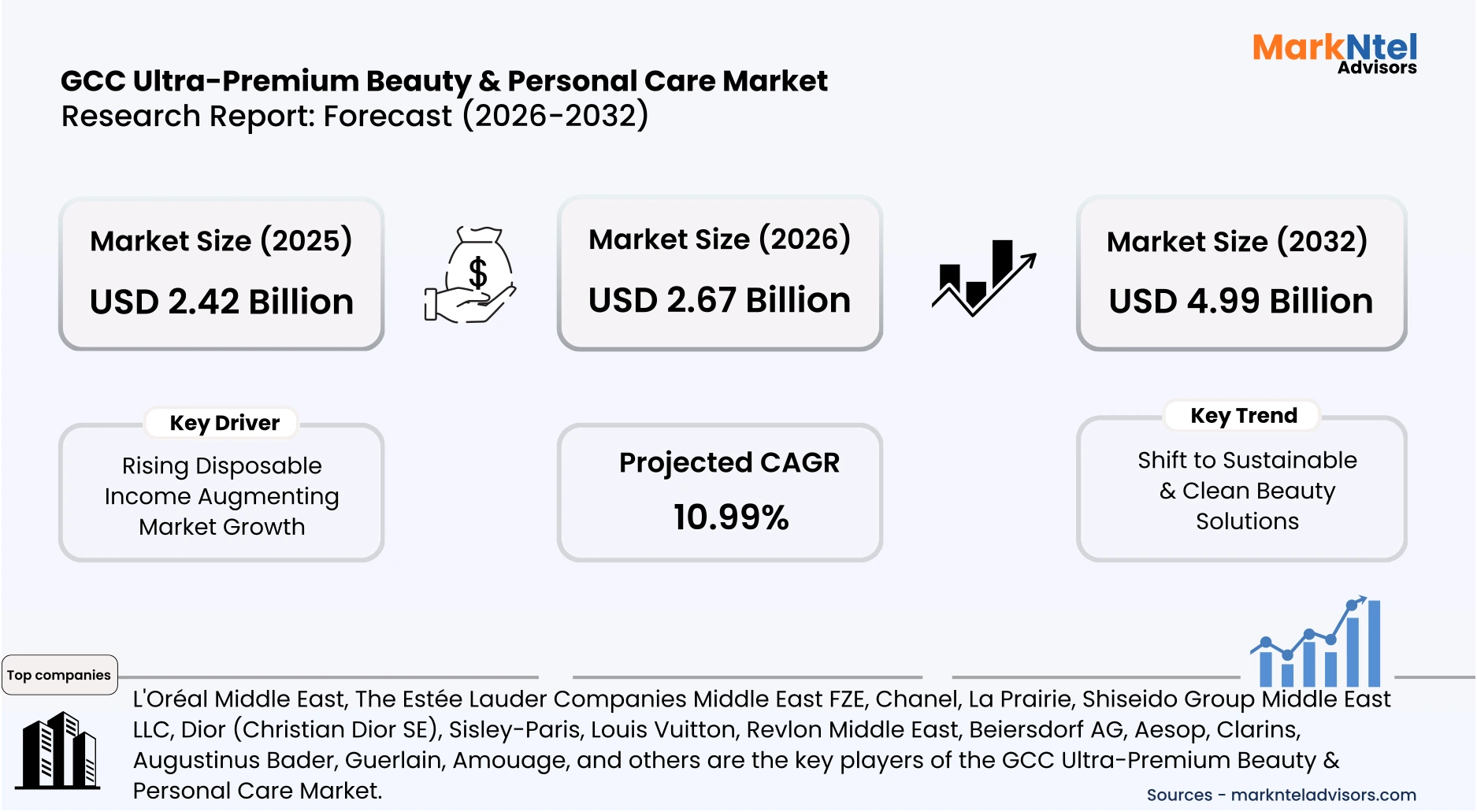
- Market size was valued at around USD 2.42 billion in 2025 and is projected grow from USD 2.67 billion in 2026 to USD 4.99 billion by 2032, exhibiting a CAGR of 10.99% during the forecast period.
- By Product Type, the skincare represented 28% of the GCC Ultra-Premium Beauty & Personal Care Market size in 2026.
- By Sales Channel, the exclusive outlets represented 67% of the GCC Ultra-Premium Beauty & Personal Care Market size in 2026.
- By Region, North America leads the GCC Ultra-Premium Beauty & Personal Care Market with a dominant 37% share in 2026.
- The leading companies are L'Oréal Middle East, The Estée Lauder Companies Middle East FZE, Chanel, La Prairie, Shiseido Group Middle East LLC, Dior (Christian Dior SE), Sisley-Paris, Louis Vuitton, Revlon Middle East, Beiersdorf AG, Aesop, Clarins, Augustinus Bader, Guerlain, Amouage, and others.
Market Insights & Analysis: GCC Ultra-Premium Beauty & Personal Care Market (2026- 2032):
The GCC Ultra-Premium Beauty & Personal Care Market size was valued at around USD 2.42 billion in 2025 and is projected grow from USD 2.67 billion in 2026 to USD 4.99 billion by 2032. Along with this, the market is estimated to grow at a CAGR of around 10.99% during the forecast period, i.e., 2026-32. The GCC Ultra-Premium Beauty & Personal Care Market is The GCC ultra-premium beauty and personal care market is entering a strong growth phase, supported by rising household purchasing power, evolving consumer preferences, and intensified retail activity across the region. Real household consumption in the GCC is projected to expand at an annual rate of 3.4% over the next five years, nearly double that of advanced economies, signaling sustained discretionary spending capacity. This economic momentum is translating directly into higher demand for premium skincare, fragrances, cosmetics, and specialized personal care products.
Retail expansion by international brands is reshaping market accessibility and competition. In 2025, e.l.f. Beauty launched across all 70 Sephora stores in the GCC, strengthening the premium cosmetics offering while widening consumer access to quality formulations. Similarly, MANSCAPED® entered the GCC retail space through a partnership with Monster Middle East, reflecting the growing appetite for high-end men’s grooming and personal care tools, a segment gaining rapid traction alongside traditional beauty categories.
Consumer behavior is also shifting decisively toward cleaner, safer, and ethically positioned products. In October 2025, reports highlighted increasing preference among Gulf consumers for cruelty-free, vegan, and non-toxic formulations, contributing to the expansion of the clean beauty segment within the region’s USD 2.6 billion personal care market. Regulatory oversight and heightened ingredient awareness are further reinforcing trust and premium positioning.
Moreover, the convergence of rising disposable income, expanding luxury retail networks, and sustained interest in clean, high-performance products is expected to keep the GCC ultra-premium beauty and personal care market on a resilient growth trajectory, with innovation and brand differentiation remaining central to competitive success.
GCC Ultra-Premium Beauty & Personal Care Market Recent Developments:
- May 2025: Beautyworld Saudi Arabia 2025 attracted 17,719 visitors from 71 countries, up 29.5% year-on-year, reinforcing Saudi Arabia’s position as a regional beauty hub. Exhibitors showcased global luxury brands and innovations in clean beauty and wellness, boosting B2B deals and distributor partnerships in ultra-premium segments.
- November 2025: Mass-to-premium brand e.l.f. Beauty launched across all 70 Sephora stores in the GCC, expanding access to quality cosmetics and boosting retail competition in the premium segment.
GCC Ultra-Premium Beauty & Personal Care Market Scope:
| Category | Segments |
|---|---|
| Product Type | (Skincare, Makeup, Fragrances, Haircare, Others), |
| Ingredient Type | (Natural and Organic, Conventional/Synthetic), |
| End-User | (Women, Men, Teens), |
| Sales Channel | (Exclusive Outlets, Department Stores, Online Retail), |
GCC Ultra-Premium Beauty & Personal Care Market Drivers:
Rising Disposable Income Augmenting Market Growth
A key driver of the GCC ultra-premium beauty & personal care market is the region’s high and rising disposable income, which increases consumer capacity to spend on premium and luxury products. The six GCC nations feature some of the highest GDP per capita levels globally, with Qatar and the UAE especially prominent; Qatar’s GDP per capita was about USD 71,568 in 2024, while the UAE stood near USD 49,550, both well above global averages. According to Statista’s consumption indicators, household disposable income per capita in the GCC is forecast at about USD 15.46k in 2025, reflecting substantial spending potential across member states.
Government and multilateral forecasts further support sustained economic growth. The World Bank projected 3.2% GCC economic expansion in 2025, with growth accelerating to 4.5% in 2026, underpinned by diversification beyond hydrocarbons and rising private consumption. Real household consumption is expected to continue rising at roughly 3.4% annually over the next five years, outpacing many advanced economies, which will bolster demand for discretionary and luxury goods.
Beyond 2025, continued economic diversification initiatives in Saudi Arabia’s Vision 2030, the UAE’s innovation-led strategies, and infrastructure investment are poised to elevate income levels further. This ongoing growth trajectory will expand household purchasing power and stimulate demand for ultra-premium beauty and personal care products.
In conclusion, rising disposable income increases consumer spending capacity, directly enabling greater uptake of high-end beauty offerings and driving sustained regional market growth.
GCC Ultra-Premium Beauty & Personal Care Market Trends:
Shift to Sustainable & Clean Beauty Solutions
A significant trend in the GCC ultra-premium beauty and personal care market is the shift toward sustainable and clean beauty, driven by evolving consumer expectations and regulatory support. In 2025, clean and conscious beauty, emphasizing eco-friendly formulations, ethical sourcing, and transparency, has moved from niche to mainstream in the region’s premium segment. At Beautyworld Middle East 2025, sustainability and clean innovations were core topics, with exhibitors highlighting responsible sourcing, ingredient transparency, and reduced-impact packaging as key differentiators, reflecting broader industry momentum.
Governments in the Gulf are reinforcing this direction. The UAE Cabinet has drafted a comprehensive regulatory framework for cosmetics and personal care products, which will enhance oversight and safety, indirectly encouraging cleaner formulations and compliance with global standards.
Additionally, regional cosmetic regulations such as those enforced by the Saudi Food and Drug Authority (SFDA) require strict adherence to ingredient safety and labeling, increasing accountability and making sustainable claims more credible.
Consumer behavior supports this transition. A growing number of GCC shoppers prioritize products that are free from harmful chemicals, respectful of environmental concerns, and ethically sourced, which is reshaping offerings from ultra-luxury brands.
In conclusion, the shift toward sustainable and clean beauty in the GCC is propelled by regulatory evolution and environmentally conscious consumers, making sustainability a core pillar of future product innovation and premium market growth.
GCC Ultra-Premium Beauty & Personal Care Market Challenges:
Regulatory & Compliance Complexities
Regulatory and compliance complexities remain a key challenge for the GCC ultra-premium beauty and personal care market, as brands must navigate country-specific approval processes alongside regional standards. In the United Arab Emirates, cosmetic and personal care products are required to comply with the Emirates Conformity Assessment Scheme (ECAS) administered by the Ministry of Industry and Advanced Technology. Products must undergo mandatory safety testing, documentation review, and bilingual (Arabic–English) labeling approval before market entry, increasing time-to-market and compliance costs for premium brands.
In Saudi Arabia, regulatory oversight is even more stringent. The Saudi Food and Drug Authority (SFDA) enforces compliance with updated Gulf cosmetic regulations, including strict controls on ingredient safety, product claims, and post-market surveillance. In 2025, SFDA formally approved updated Gulf technical regulations for cosmetics, requiring full conformity and allowing enforcement actions such as product withdrawals and financial penalties for non-compliance.
At a regional level, the Gulf Standardization Organization (GSO) mandates unified safety, labeling, and prohibited-substance standards under GSO 1943, applicable across all GCC countries. However, differences in national implementation timelines and enforcement procedures create additional compliance burdens for brands operating region-wide.
Together, these layered regulatory requirements increase operational complexity, raise certification and testing costs, and slow product launches, posing a significant barrier for ultra-premium brands seeking rapid and compliant expansion across the GCC.
GCC Ultra-Premium Beauty & Personal Care Market (2026-32) Segmentation Analysis:
The GCC Ultra-Premium Beauty & Personal Care Market Report and Forecast 2026-2032 offers a detailed analysis of the market based on the following segments:
Based on Product Type:
- Skincare
- Makeup
- Fragrances
- Haircare
- Others
Skincare holds the leading share in the GCC ultra-premium beauty and personal care market, accounting for 28%, driven by strong consumer emphasis on skin health, prevention, and long-term appearance enhancement. Harsh climatic conditions across the GCC, characterized by high temperatures, low humidity, and frequent sun exposure, have increased demand for premium moisturizers, sunscreens, anti-aging creams, and dermatologically advanced formulations. Affluent consumers in the region increasingly prefer high-performance skincare products that offer visible results, scientific backing, and luxury brand assurance.
Additionally, growing awareness around ingredient quality has pushed demand for premium formulations featuring actives such as peptides, hyaluronic acid, and botanical extracts. Skincare also benefits from higher repeat purchase rates compared to makeup and fragrances, as daily usage drives consistent demand. The rise of professional skincare routines, clinic-inspired products, and customized regimens further supports segment dominance. Together, climate-driven needs, strong brand loyalty, and frequent consumption cycles position skincare as the most dominant product category in the GCC ultra-premium beauty landscape.
Based on Sales Channel:
- Exclusive Outlets
- Brand Flagship Boutiques
- Authorized luxury multi-brand boutiques
- Department Stores
- Online Retail
Exclusive outlets dominate the GCC ultra-premium beauty & personal care market with a 67% share, reflecting the region’s strong preference for curated, brand-controlled retail experiences. Brand flagship boutiques and authorized luxury multi-brand stores play a critical role in reinforcing exclusivity, authenticity, and premium positioning, key factors influencing high-value beauty purchases. Consumers in the GCC place significant trust in physical retail environments that offer personalized consultations, trained beauty advisors, and access to full product portfolios, including limited editions and bespoke offerings.
Exclusive outlets also allow brands to maintain strict control over pricing, product presentation, and customer engagement, which is essential in the ultra-premium segment. High footfall in luxury malls and shopping destinations across the region further strengthens this channel’s performance. While online retail is growing, exclusive outlets remain the preferred channel for premium consumers seeking experiential shopping, professional guidance, and assured product authenticity, sustaining their leadership in overall market revenue.
GCC Ultra-Premium Beauty & Personal Care Market (2026-32): Regional Projection
The GCC ultra-premium beauty & personal care market is dominated by North America, holding 37% of total revenue, driven by the region’s strong global influence over luxury beauty innovation and branding. North America sets product quality, ingredient, and pricing benchmarks that shape premium positioning across GCC markets. Leading North American brands benefit from advanced research capabilities, dermatological credibility, and early adoption of clean, high-performance formulations that resonate with affluent GCC consumers. Established partnerships with regional distributors, luxury retailers, and duty-free operators further strengthen market penetration.
North America’s dominance is reinforced by leadership in personalized beauty, digital engagement, and omnichannel retail models increasingly replicated in GCC luxury malls. Consistent launches of premium skincare, fragrances, and grooming innovations continue to influence purchasing behavior across the GCC, positioning North America as the most impactful region in the ultra-premium beauty and personal care market globally recognized.
Gain a Competitive Edge with Our GCC Ultra-Premium Beauty & Personal Care Market Report
- GCC Ultra-Premium Beauty & Personal Care Market Report by MarkNtel Advisors provides a detailed & thorough analysis of market size & share, growth rate, competitive landscape, and key players. This comprehensive analysis helps businesses gain a holistic understanding of the market dynamics & make informed decisions.
- This report also highlights current market trends & future projections, allowing businesses to identify emerging opportunities & potential challenges. By understanding market forecasts, companies can align their strategies & stay ahead of the competition.
- GCC Ultra-Premium Beauty & Personal Care Market Report aids in assessing & mitigating risks associated with entering or operating in the market. By understanding market dynamics, regulatory frameworks, and potential challenges, businesses can develop strategies to minimize risks & optimize their operations.
Frequently Asked Questions
- Market Segmentation
- Introduction
- Product Definition
- Research Process
- Assumptions
- Executive Summary
- GCC Ultra-Premium Beauty & Personal Care Market Policies, Regulations, and Product Standards
- GCC Ultra-Premium Beauty & Personal Care Market Supply Chain Analysis
- GCC Ultra-Premium Beauty & Personal Care Market Trends & Developments
- GCC Ultra-Premium Beauty & Personal Care Market Dynamics
- Growth Drivers
- Challenges
- GCC Ultra-Premium Beauty & Personal Care Market Hotspot & Opportunities
- GCC Ultra-Premium Beauty & Personal Care Market Outlook, 2022-2032
- Market Size & Outlook
- By Revenues (USD Million)
- Market Share & Outlook
- By Product Type- Market Size & Forecast 2022-2032F, USD Million
- Skincare
- Makeup
- Fragrances
- Haircare
- Others
- By Ingredient Type- Market Size & Forecast 2022-2032F, USD Million
- Natural and Organic
- Conventional/Synthetic
- By End-User- Market Size & Forecast 2022-2032F, USD Million
- Women
- Men
- Teens
- By Sales Channel- Market Size & Forecast 2022-2032F, USD Million
- Exclusive Outlets
- Brand Flagship Boutiques
- Authorized luxury multi-brand boutiques
- Department Stores
- Online Retail
- Exclusive Outlets
- By Country
- Saudi Arabia
- UAE
- Qatar
- Kuwait
- Oman
- Bahrain
- By Company
- Company Revenue Shares
- Competitor Characteristics
- By Product Type- Market Size & Forecast 2022-2032F, USD Million
- Market Size & Outlook
- Saudi Arabia Ultra-Premium Beauty & Personal Care Market Outlook, 2022-2032
- Market Size & Analysis
- Market Share & Analysis
- By Product Type- Market Size & Forecast 2022-2032, USD Million
- By Ingredient Type- Market Size & Forecast 2022-2032, USD Million
- By End-User- Market Size & Forecast 2022-2032, USD Million
- By Sales Channel- Market Size & Forecast 2022-2032, USD Million
- UAE Ultra-Premium Beauty & Personal Care Market Outlook, 2022-2032
- Market Size & Analysis
- Market Revenues (USD Million)
- Market Share & Analysis
- By Product Type- Market Size & Forecast 2022-2032, USD Million
- By Ingredient Type- Market Size & Forecast 2022-2032, USD Million
- By End-User- Market Size & Forecast 2022-2032, USD Million
- By Sales Channel- Market Size & Forecast 2022-2032, USD Million
- Market Size & Analysis
- Qatar Ultra-Premium Beauty & Personal Care Market Outlook, 2022-2032
- Market Size & Analysis
- Market Revenues (USD Million)
- Market Share & Analysis
- By Product Type- Market Size & Forecast 2022-2032, USD Million
- By Ingredient Type- Market Size & Forecast 2022-2032, USD Million
- By End-User- Market Size & Forecast 2022-2032, USD Million
- By Sales Channel- Market Size & Forecast 2022-2032, USD Million
- Market Size & Analysis
- Kuwait Ultra-Premium Beauty & Personal Care Market Outlook, 2022-2032
- Market Size & Analysis
- Market Revenues (USD Million)
- Market Share & Analysis
- By Product Type- Market Size & Forecast 2022-2032, USD Million
- By Ingredient Type- Market Size & Forecast 2022-2032, USD Million
- By End-User- Market Size & Forecast 2022-2032, USD Million
- By Sales Channel- Market Size & Forecast 2022-2032, USD Million
- Market Size & Analysis
- Oman Ultra-Premium Beauty & Personal Care Market Outlook, 2022-2032
- Market Size & Analysis
- Market Revenues (USD Million)
- Market Share & Analysis
- By Product Type- Market Size & Forecast 2022-2032, USD Million
- By Ingredient Type- Market Size & Forecast 2022-2032, USD Million
- By End-User- Market Size & Forecast 2022-2032, USD Million
- By Sales Channel- Market Size & Forecast 2022-2032, USD Million
- Market Size & Analysis
- Bahrain Ultra-Premium Beauty & Personal Care Market Outlook, 2022-2032
- Market Size & Analysis
- Market Revenues (USD Million)
- Market Share & Analysis
- By Product Type- Market Size & Forecast 2022-2032, USD Million
- By Ingredient Type- Market Size & Forecast 2022-2032, USD Million
- By End-User- Market Size & Forecast 2022-2032, USD Million
- By Sales Channel- Market Size & Forecast 2022-2032, USD Million
- Market Size & Analysis
- GCC Ultra-Premium Beauty & Personal Care Market Key Strategic Imperatives for Success & Growth
- Competition Outlook
- Company Profiles
- L'Oréal Middle East
- Business Description
- Product Portfolio
- Strategic Alliances or Partnerships
- Recent Developments
- Financial Details
- Others
- The Estée Lauder Companies Middle East FZE
- Business Description
- Product Portfolio
- Strategic Alliances or Partnerships
- Recent Developments
- Financial Details
- Others
- Chanel
- Business Description
- Product Portfolio
- Strategic Alliances or Partnerships
- Recent Developments
- Financial Details
- Others
- La Prairie
- Business Description
- Product Portfolio
- Strategic Alliances or Partnerships
- Recent Developments
- Financial Details
- Others
- Shiseido Group Middle East LLC
- Business Description
- Product Portfolio
- Strategic Alliances or Partnerships
- Recent Developments
- Financial Details
- Others
- Dior (Christian Dior SE)
- Business Description
- Product Portfolio
- Strategic Alliances or Partnerships
- Recent Developments
- Financial Details
- Others
- Sisley-Paris
- Business Description
- Product Portfolio
- Strategic Alliances or Partnerships
- Recent Developments
- Financial Details
- Others
- Louis Vuitton
- Business Description
- Product Portfolio
- Strategic Alliances or Partnerships
- Recent Developments
- Financial Details
- Others
- Revlon Middle East
- Business Description
- Product Portfolio
- Strategic Alliances or Partnerships
- Recent Developments
- Financial Details
- Others
- Beiersdorf AG
- Business Description
- Product Portfolio
- Strategic Alliances or Partnerships
- Recent Developments
- Financial Details
- Others
- Aesop
- Business Description
- Product Portfolio
- Strategic Alliances or Partnerships
- Recent Developments
- Financial Details
- Others
- Clarins
- Business Description
- Product Portfolio
- Strategic Alliances or Partnerships
- Recent Developments
- Financial Details
- Others
- Augustinus Bader
- Business Description
- Product Portfolio
- Strategic Alliances or Partnerships
- Recent Developments
- Financial Details
- Others
- Guerlain
- Business Description
- Product Portfolio
- Strategic Alliances or Partnerships
- Recent Developments
- Financial Details
- Others
- Amouage
- Business Description
- Product Portfolio
- Strategic Alliances or Partnerships
- Recent Developments
- Financial Details
- Others
- Others
- Others
- L'Oréal Middle East
- Company Profiles
- Disclaimer
MarkNtel Advisors follows a robust and iterative research methodology designed to ensure maximum accuracy and minimize deviation in market estimates and forecasts. Our approach combines both bottom-up and top-down techniques to effectively segment and quantify various aspects of the market. A consistent feature across all our research reports is data triangulation, which examines the market from three distinct perspectives to validate findings. Key components of our research process include:
1. Scope & Research Design At the outset, MarkNtel Advisors define the research objectives and formulate pertinent questions. This phase involves determining the type of research—qualitative or quantitative—and designing a methodology that outlines data collection methods, target demographics, and analytical tools. They also establish timelines and budgets to ensure the research aligns with client goals.
2. Sample Selection and Data Collection In this stage, the firm identifies the target audience and determines the appropriate sample size to ensure representativeness. They employ various sampling methods, such as random or stratified sampling, based on the research objectives. Data collection is carried out using tools like surveys, interviews, and observations, ensuring the gathered data is reliable and relevant.
3. Data Analysis and Validation Once data is collected, MarkNtel Advisors undertake a rigorous analysis process. This includes cleaning the data to remove inconsistencies, employing statistical software for quantitative analysis, and thematic analysis for qualitative data. Validation steps are taken to ensure the accuracy and reliability of the findings, minimizing biases and errors.

4. Data Forecast and FinalizationThe final phase involves forecasting future market trends based on the analyzed data. MarkNtel Advisors utilize predictive modeling and time series analysis to anticipate market behaviors. The insights are then compiled into comprehensive reports, featuring visual aids like charts and graphs, and include strategic recommendations to inform client decision-making
We offer flexible licensing options to cater to varying organizational needs. Choose the pricing pack that best suits your requirements:
Buy Now Inquire Before Buying
 Request Customization
 Talk to our Consultant