

India Furniture Market Research Report: Size, Share, Trends & Forecast (2026-2032)
By Type (Indoor Furniture, Outdoor Furniture), By Material (Wood, Metal, Plastic & Polymer, Other Materials), By End user (Residential, Offices, Commercial & Retail, Hospitality), ... By Distribution Channel (Retail, Direct Sale), and others Read more
- FMCG
- Apr 2026
- Pages 120
- Report Format: PDF, Excel, PPT
India Furniture Market
Projected 5.91% CAGR from 2026 to 2032
Study Period
2026-2032
Market Size (2026)
USD 32.19 Billion
Market Size (2032)
USD 45.42 Billion
Base Year
2025
Projected CAGR
5.91%
Leading Segments
By Type: Indoor Furniture
India Furniture Market Report Key Takeaways:
- The India Furniture Market size was valued at USD 29.27 billion in 2025 and is projected to grow from USD 32.19 billion in 2026 to USD 45.42 billion by 2032, exhibiting a CAGR of 5.91% during the forecast period.
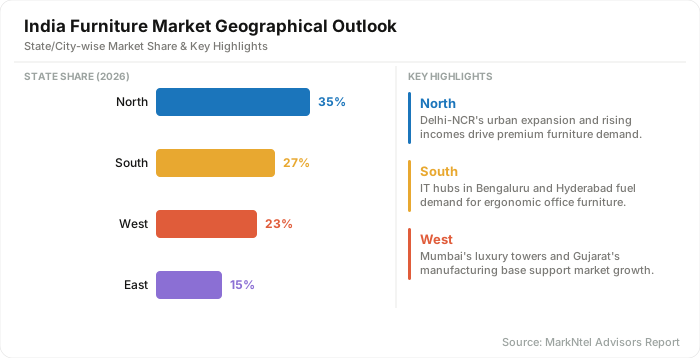
- North India is the leading region with a significant share of 35% in 2026.
- By Furniture type, the living room furniture (indoor furniture) segment represented a significant share of about 70% in the India Furniture Market in 2026.
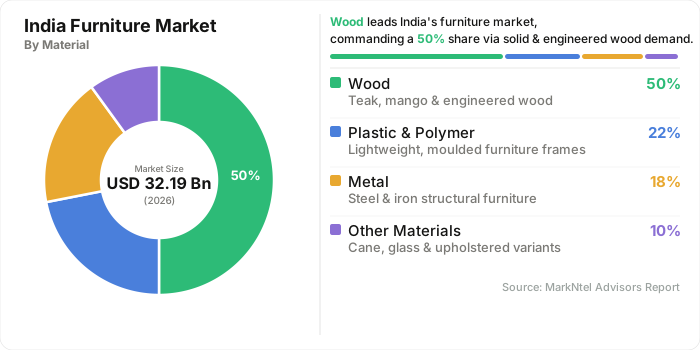
- By Material type, the wood segment represented a significant share of about 50% in the India Furniture Market in 2026.
Market Insights & Analysis: India Furniture Market (2026-32):
The India Furniture Market size was valued at USD 29.27 billion in 2025 and is projected to grow from USD 32.19 billion in 2026 to USD 45.42 billion by 2032, exhibiting a CAGR of 5.91% during the forecast period. i.e., 2026-32.
The India furniture market’s growth has been supported by the broader expansion of the country’s manufacturing and industrial output, which demonstrates sustained strength in official government statistics. Government data shows that the manufacturing sector’s Gross Value Added (GVA) expanded robustly in 2025‑26, with growth rates of 7.72% in Q1 and 9.13% in Q2, reflecting an increasingly productive industrial base. This momentum in manufacturing has contributed to greater production capacity and supply chain formalization , enabling ancillary sectors, including furniture manufacturing, to benefit from rising demand and improved production efficiencies. Urbanization and household formation patterns also reinforce this structural expansion in consumption demand, especially in major urban centers with expanding residential infrastructure.
Residential demand remains a central pillar of furniture market dynamics, with urban household consumption rising, as evidenced by the government’s latest Household Consumption Expenditure Survey. Official statistics indicate significant urban per capita consumption levels, indicating augmented discretionary spending capacity for goods such as furniture and household fittings. Urban migration patterns have been accompanied by increases in employment opportunities in cities, as reflected in the unincorporated sector’s employment surge to 128.1 million in 2025, which underpins disposable income growth and consumer spending trends. Moreover, shifts in workforce distribution toward urban manufacturing and services suggest sustained end‑user demand for durable household goods.
Policy support for manufacturing, infrastructure, and broader economic growth has created a conducive environment for furniture producers and suppliers to scale operations. The Union Budget 2026‑27 reiterated the government’s emphasis on expanding industrial ecosystems through targeted incentives and infrastructure investment, which indirectly benefits furniture supply chains by improving logistics, credit access, and technology adoption.
Looking forward, India’s strong economic growth orientation and rising middle-class consumption patterns point to continued expansion in furniture demand across residential and commercial end markets. As urban households increase, and as corporate and institutional facilities modernize workspaces, the furniture sector is positioned to benefit from durability‑oriented investments. Combined with ongoing manufacturing and infrastructure policy support, these factors provide a forward‑looking outlook of sustained demand and capacity enhancement through the mid‑2020s.
India Furniture Market Scope:
| Category | Segments |
|---|---|
| By Type | (Indoor Furniture, Outdoor Furniture), |
| By Material | (Wood, Metal, Plastic & Polymer, Other Materials), |
| By End user | (Residential, Offices, Commercial & Retail, Hospitality), |
| By Distribution Channel | (Retail, Direct Sale), |
India Furniture Market Driver:
Rapid Urbanization Coupled with Accelerated Housing Formation in India
India’s accelerated urbanization is a foundational driver of furniture market expansion, directly increasing demand through heightened residential space formation. The World Bank reports that India’s urban population share increased to 35% by 2024, w ith estimates indicating continued urban growth through the decade. Urban residents generally consume a broader range of household durable goods, including furniture, compared with rural populations, as urban housing units are more likely to be newly constructed or upgraded. This sustained influx of households into urban centers creates structural and recurring demand for furniture across diverse geographies.
India’s Pradhan Mantri Awas Yojana (PMAY) had, by early 2025, facilitated the sanctioned construction of over 12 million dwelling units, with accelerated delivery in urban regions. Each new or improved housing unit typically necessitates furniture purchases at the point of occupation or thereafter, creating a quantifiable linkage between housing formation and furniture demand. PMAY benefits include subsidized credit and incentives for formal housing uptake, which together increase disposable income available for durable household goods
Urbanization and housing growth are materially expanding market volume rather than merely affecting pricing or short‑term adoption because they drive structural increases in the number of households and living spaces. Unlike trends tied to seasonal or cyclical spending, urban household formation represents a fundamental rise in the base level of potential consumers entering the durable goods market. Increased household units require not only essential furniture but also ongoing replacement and upgrade cycles, supporting sustained volume growth. The cumulative effect of expanding urban housing stock is therefore directly correlated with broader and long‑term furniture market expansion, evidenced by both demographic shifts and government housing program implementation.
India Furniture Market Trend:
Digital and Omnichannel Retail Transformation
The India furniture market is experiencing a structural shift toward digital and omnichannel retailing, marked by a sustained expansion of online and hybrid purchasing models that are reshaping consumer behavior and industry operating models. Major international players, such as IKEA India, have publicly articulated plans to expand their online business, projecting that digital sales could contribute close to 40% of revenues by 2030 as part of an integrated omnichannel strategy. This reflects a broader consumer shift toward online discovery, research, and purchase of furniture and home furnishing products.
This trend has accelerated in recent years as consumers increasingly combine digital browsing with offline experience using online platforms for product exploration and offline stores for tactile evaluation, which is leading retailers to adopt omnichannel business models. Notably, companies like Urban Ladder have evolved from online‑only platforms to operate physical showrooms while maintaining digital sales channels, creating seamless purchase journeys across touchpoints. Such hybrid strategies are causing structural changes across the value chain, driving retailers to integrate inventory, logistics, and customer engagement systems across both online and physical networks.
The persistence of this trend is supported by enduring changes in consumer behavior, amplified by rising internet penetration, smartphone usage, and digital literacy. As furniture brands expand digital capabilities and refine omnichannel strategies, including online order fulfilment tied to last‑mile logistics partnerships and immersive digital tools, the sector is moving toward a long‑term model where online and offline channels coexist interdependently. Evidence of sustained investment by global and domestic players indicates that digital and omnichannel retailing will materially influence the long‑term evolution of India’s furniture market.
India Furniture Market Opportunity:
Open and Inclusive Digital Commerce Infrastructure
The most compelling market opportunity for new entrants in the India furniture market lies in leveraging the country’s expanding digital commerce infrastructure, which is lowering barriers to entry and enabling scalable market access. India’s flagship Digital India programme has dramatically expanded internet connectivity, affordable data access, and digital public infrastructure, lifting digital inclusion across urban and rural populations and enabling broader participation in online commerce beyond traditional retail channels. This structural expansion connects millions of potential furniture buyers and sellers via digital platforms in previously under‑served regions, creating a deepening base of demand.
A pivotal enabler of this opportunity is the Open Network for Digital Commerce (ONDC), a government‑led initiative designed to democratize e‑commerce by establishing an open, interoperable network that reduces reliance on dominant centralized platforms. ONDC lowers customer acquisition costs for sellers and expands discoverability by allowing MSMEs and local retailers to sell across multiple buyer applications without paying heavy commissions. Over 1.16 lakh retail sellers from 630+ cities and towns are actively live on the ONDC network, demonstrating real demand traction and scalable participation across geographies.
This opportunity is particularly advantageous for new and emerging furniture players because it enables them to compete on a level playing field with established e‑commerce brands. Smaller firms can leverage open digital infrastructure to reach wider customer bases, integrate logistics partners, and adopt digital transaction systems without incurring prohibitive upfront costs. As digital adoption continues to deepen alongside nationwide connectivity improvements, digital commerce platforms provide a structurally embedded growth avenue that supports competitive differentiation, geographic scaling, and customer acquisition at pace and scale.
India Furniture Market Challenge:
Fragmented Supply Chain & Infrastructure Inefficiencies
The India furniture market’s most consequential structural constraint is its fragmented supply chain and associated infrastructure inefficiencies, which impede cost competitiveness and scalable operations. Despite recent logistics reforms such as the National Logistics Policy and PM‑Gati Shakti, aiming to modernize transport and warehousing, logistics costs in India remain significant, estimated at 7.97% of GDP in 2023–24, with smaller firms disproportionately burdened by transportation and storage expenses. This fragmentation includes uneven last‑mile connectivity, limited modern warehousing outside metros, and coordination gaps across multiple modes of freight, which elongate delivery cycles and inflate expenses for bulky furniture products that require careful handling.
This structural inefficiency exists because the sector is transitioning from informal, local production toward organized, standardized manufacturing, but infrastructure development has lagged demand. Current market dynamics show that organized furniture firms face pervasive logistical costs and distribution challenges, especially when expanding into tier‑2 and tier‑3 cities, constraining uniform service quality and increasing time‑to‑market. The persistence of unorganized players with localized networks further undermines standardized logistics efficiencies, creating dual systems that reduce overall productivity.
Consequently, these supply chain and infrastructure limitations materially restrict expansion by elevating operating costs, discouraging investment in broader geographic distribution, slowing product delivery times, and diminishing adoption of formalized manufacturing practices, all of which stifle scalable market growth in India’s rapidly evolving furniture sector.
India Furniture Market (2026-32) Segmentation Analysis:
The India Furniture Market study of MarkNtel Advisors evaluates & highlights the major trends and influencing factors in each segment. It includes predictions for the period 2026–32 at the country level. Based on the analysis, the market has been further classified as;
Based on Type:
- Indoor Furniture
- Bedroom Furniture
- Dining Furniture
- Kitchen Furniture
- Living Room Furniture
- Office Furniture
- Outdoor Furniture
- Patio Furniture
- Rooftop Furniture
- Beachfront Furniture
The living room furniture under the indoor furniture segment maintains its leadership with a market share of 70% due to its high functional importance and strong aspirational value in Indian households. As the primary space for social interaction and guest hosting, consumers prioritize spending on sofas, TV units, and coffee tables over other categories. Increasing urbanization and compact housing designs have further accelerated demand for modular and multifunctional furniture. Additionally, rising disposable incomes and evolving lifestyle preferences are pushing consumers toward aesthetically coordinated living spaces, reinforcing consistent demand in this segment.
A clear industry example can be seen in the strategic expansion of organized players like Pepperfry, which heavily focus on living room categories through curated collections, customization options, and omnichannel retail models. These companies have invested in experience centers and digital visualization tools, enabling consumers to better conceptualize living room setups. Moreover, large retailers such as IKEA have entered the Indian market with a strong emphasis on affordable and modular living room solutions, indicating concentrated industry focus on this segment.
The market impact of this dominance is significant, as it drives higher revenue contribution and innovation within the overall furniture industry. Living room furniture commands higher average selling prices and faster design cycles, influencing supply chain priorities and material sourcing trends. It also accelerates the shift toward organized retail and branded offerings, while encouraging investments in logistics, customization, and digital platforms. As a result, this segment acts as a key growth engine shaping the competitive landscape of the India furniture market.
Based on Material:
- Wood
- Metal
- Plastic & Polymer
- Other Materials
Wood retains material leadership through entrenched cultural preferences, durability perceptions, and broad end‑use applicability across furniture categories, with a market share of 50%. In Indian households, wooden furniture is widely preferred for perceived longevity and resale value, a factor supported by consumer expenditure surveys showing an elevated share of wooden furniture purchases compared to alternatives. Wood’s prominence is further reinforced by retail assortments from major organized players, where core Home Furniture offerings predominantly use engineered or seasoned wood variants to balance cost and quality.
Infrastructure and investment flows also reinforce the wood material’s position; major logistics corridors around Delhi‑NCR and north Indian distribution hubs support the efficient movement of bulk wooden products, reducing damage risk and lowering freight costs relative to metal or plastic alternatives that may require different handling or customization.
Industry examples include Godrej Interio, which invested USD 36.14 million to expand its retail footprint and omnichannel capabilities in Delhi‑NCR , focusing heavily on wooden Home Furniture products. This investment improved distribution efficiency, enabled faster delivery to urban households, and increased the visibility and availability of wooden furniture, driving both consumer adoption and market penetration.
India Furniture Market (2026-32) Regional Analysis:
North India, particularly the Delhi National Capital Region (NCR), stands out as the largest and most dominant region in India’s furniture market due to structural economic strength and concentrated urbanization. Delhi‑NCR is among India’s top economic hubs, with a nominal GDP of approximately USD 272.6 billion and robust annual growth of around 9 %, supported by advanced services, commerce, and real‑estate sectors that generate high consumer purchasing power. The region’s elevated per‑capita income further underscores its economic capacity relative to national averages, enabling stronger demand for home and office furniture products.
North India also benefits from policy and infrastructural incentives that reinforce its market leadership. Government housing schemes and rapid urban expansion under central initiatives create consistent household formation, leading to sustained furniture demand in urban and peri‑urban areas. Major infrastructure investments in transport and logistics around Delhi‑NCR reduce supply chain costs, facilitating efficient distribution and retail operations compared to more fragmented markets elsewhere. Additionally, regulatory clarity in retail investment and warehouse development has enabled large international firms to prioritize the region for rollout.
Evidence of end‑user demand intensity and industry presence is reflected in how major global furniture players are structuring their India strategies. For example, IKEA has launched online deliveries across Delhi‑NCR and nearby cities, and opened its first city store in Delhi in 2025 , with plans for large format outlets in Gurugram and Noida, moves that underscore the region’s market attractiveness and consumer engagement levels.
India Furniture Market Competitive Analysis:
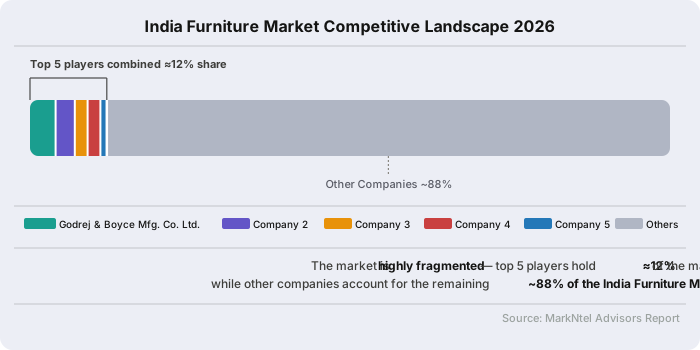
The India furniture market remains highly fragmented, with a large presence of unorganized and regional players alongside organized brands. The top five companies, including Godrej Interio, Nilkamal Limited, Durian Industries Limited, Featherlite Office Systems Private Limited, and Spacewood Furnishers Private Limited, collectively account for approximately 12% of the total market share.
Major Companies in the Market:
- Godrej Interio
- Nilkamal Limited
- Durian Industries Limited
- Zuari Furniture
- Featherlite Office Systems Private Limited
- Wipro Furniture Private Limited
- Damro Furniture Private Limited
- Evok
- Spacewood Furnishers Private Limited
- Cello World Private Limited
Gain a Competitive Edge with Our India Furniture Market Report:
- The India Furniture Market Report by MarkNtel Advisors provides a detailed & thorough analysis of market size & share, growth rate, competitive landscape, and key players. This comprehensive analysis helps businesses gain a holistic understanding of the market dynamics & make informed decisions.
- This report also highlights current market trends & future projections, allowing businesses to identify emerging opportunities & potential challenges. By understanding market forecasts, companies can align their strategies & stay ahead of the competition.
- The India Furniture Market Report aids in assessing & mitigating risks associated with entering or operating in the market. By understanding market dynamics, regulatory frameworks, and potential challenges, businesses can develop strategies to minimize risks & optimize their operations.
*Reports Delivery Format - Market research studies from MarkNtel Advisors are offered in PDF, Excel and PowerPoint formats. Within 24 hours of the payment being successfully received, the report will be sent to your email address.
Frequently Asked Questions
- Market Segmentation
- Introduction
- Product Definition
- Research Process
- Assumptions
- Executive Summary
- India Furniture Market Policies, Regulations, and Product Standards
- India Furniture Market Trends & Developments
- India Furniture Market Dynamics
- Growth Factors
- Challenges
- India Furniture Market Hotspot & Opportunities
- India Furniture Market Outlook, 2022-2032F
- Market Size & Outlook
- By Revenues (USD Million)
- Market Share & Outlook
- By Type- Market Size & Forecast 2022-2032, USD Million
- Indoor Furniture
- Bedroom Furniture
- Bed
- Wardrobes
- Dresser
- Nightstand
- Vanity Table
- Bedroom Bench
- Dining Furniture
- Dining Table
- Dining Chairs
- Dining Bench
- Buffet/Sideboard
- Bar Cabinet
- Kitchen Furniture
- Kitchen Cabinets
- Kitchen Island
- Breakfast Table
- Bar Stool
- Pantry Storage Units
- Living Room Furniture
- Sofa & Sectional
- Armchair
- Coffee Table
- TV Unit/Media Console
- Side Table
- Display Cabinet
- Office Furniture
- Office Desk
- Executive Table
- Office Chair
- Lounge Chair
- Bookshelf
- Filing Cabinets
- Bedroom Furniture
- Outdoor Furniture
- Patio Furniture
- Patio Dining Set
- Patio Chairs
- Patio Sofa
- Outdoor Coffee Table
- Swing Chair
- Rooftop Furniture
- Modular Outdoor Sofa
- High Bar Table
- Bar Stools
- Sun Lounger
- Fire Pit Seating
- Beachfront Furniture
- Sun Lounger
- Cabana Seating
- Outdoor Sofa Set
- Outdoor Dining Set
- Umbrella Table Set
- Others (Poolside, Deck)
- Patio Furniture
- Indoor Furniture
- By Material- Market Size & Forecast 2022-2032, USD Million
- Wood
- Metal
- Plastic & Polymer
- Other Materials
- By End user- Market Size & Forecast 2022-2032, USD Million
- Residential
- Offices
- Commercial & Retail
- Hospitality
- Others (Government Agencies, etc.)
- By Distribution Channel- Market Size & Forecast 2022-2032, USD Million
- Retail
- Home Centers
- Specialty Furniture Stores
- Online
- Other Distribution Channels
- Direct Sale
- Retail
- By Region- Market Size & Forecast 2022-2032, USD Million
- North
- National Capital Region (Delhi NCR)
- Uttar Pradesh
- Punjab
- Rajasthan
- South
- Karnataka
- Tamil Nadu
- Kerala
- East
- West Bengal
- Odisha
- West
- Maharashtra
- Gujarat
- Madhya Pradesh
- North
- By Company
- Competition Characteristics
- Market Share & Analysis
- By Type- Market Size & Forecast 2022-2032, USD Million
- Market Size & Outlook
- India Indoor Furniture Market Outlook, 2022-2032
- Market Size & Outlook
- By Revenues (USD Million)
- Market Share & Outlook
- By Material- Market Size & Forecast 2022-2032, USD Million
- By End user- Market Size & Forecast 2022-2032, USD Million
- By Distribution Channel- Market Size & Forecast 2022-2032, USD Million
- By Region- Market Size & Forecast 2022-2032, USD Million
- Market Size & Outlook
- India Outdoor Furniture Market Outlook, 2022-2032
- Market Size & Outlook
- By Revenues (USD Million)
- Market Share & Outlook
- By Material- Market Size & Forecast 2022-2032, USD Million
- By End user- Market Size & Forecast 2022-2032, USD Million
- By Distribution Channel- Market Size & Forecast 2022-2032, USD Million
- By Region- Market Size & Forecast 2022-2032, USD Million
- Market Size & Outlook
- India Furniture Market Key Strategic Imperatives for Success & Growth
- Competitive Outlook
- Company Profiles
- Godrej Interio
- Business Description
- Product Portfolio
- Collaborations & Alliances
- Recent Developments
- Financial Details
- Others
- Nilkamal Limited
- Business Description
- Product Portfolio
- Collaborations & Alliances
- Recent Developments
- Financial Details
- Others
- Durian Industries Limited
- Business Description
- Product Portfolio
- Collaborations & Alliances
- Recent Developments
- Financial Details
- Others
- Zuari Furniture
- Business Description
- Product Portfolio
- Collaborations & Alliances
- Recent Developments
- Financial Details
- Others
- Featherlite Office Systems Private Limited
- Business Description
- Product Portfolio
- Collaborations & Alliances
- Recent Developments
- Financial Details
- Others
- Wipro Furniture Private Limited
- Business Description
- Product Portfolio
- Collaborations & Alliances
- Recent Developments
- Financial Details
- Others
- Damro Furniture Private Limited
- Business Description
- Product Portfolio
- Collaborations & Alliances
- Recent Developments
- Financial Details
- Others
- Evok
- Business Description
- Product Portfolio
- Collaborations & Alliances
- Recent Developments
- Financial Details
- Others
- Spacewood Furnishers Private Limited
- Business Description
- Product Portfolio
- Collaborations & Alliances
- Recent Developments
- Financial Details
- Others
- Cello World Private Limited
- Business Description
- Product Portfolio
- Collaborations & Alliances
- Recent Developments
- Financial Details
- Others
- Godrej Interio
- Company Profiles
- Disclaimer
MarkNtel Advisors follows a robust and iterative research methodology designed to ensure maximum accuracy and minimize deviation in market estimates and forecasts. Our approach combines both bottom-up and top-down techniques to effectively segment and quantify various aspects of the market. A consistent feature across all our research reports is data triangulation, which examines the market from three distinct perspectives to validate findings. Key components of our research process include:
1. Scope & Research Design At the outset, MarkNtel Advisors define the research objectives and formulate pertinent questions. This phase involves determining the type of research—qualitative or quantitative—and designing a methodology that outlines data collection methods, target demographics, and analytical tools. They also establish timelines and budgets to ensure the research aligns with client goals.
2. Sample Selection and Data Collection In this stage, the firm identifies the target audience and determines the appropriate sample size to ensure representativeness. They employ various sampling methods, such as random or stratified sampling, based on the research objectives. Data collection is carried out using tools like surveys, interviews, and observations, ensuring the gathered data is reliable and relevant.
3. Data Analysis and Validation Once data is collected, MarkNtel Advisors undertake a rigorous analysis process. This includes cleaning the data to remove inconsistencies, employing statistical software for quantitative analysis, and thematic analysis for qualitative data. Validation steps are taken to ensure the accuracy and reliability of the findings, minimizing biases and errors.

4. Data Forecast and FinalizationThe final phase involves forecasting future market trends based on the analyzed data. MarkNtel Advisors utilize predictive modeling and time series analysis to anticipate market behaviors. The insights are then compiled into comprehensive reports, featuring visual aids like charts and graphs, and include strategic recommendations to inform client decision-making
We offer flexible licensing options to cater to varying organizational needs. Choose the pricing pack that best suits your requirements:
Buy Now Inquire Before Buying
 Request Customization
 Talk to our Consultant







