

Global Polyethylene Glycol Market Research Report: Trends & Forecast (2026-2032)
By Grade (Pharmaceutical Grade, Industrial Grade), By Form (Liquid, White Wax, Flakes / Powder), By Package Size (Drums, Bulk Containers, Glass Bottles), By End-Use Industry (Pharm ... aceutical, Cosmetics & Personal Care, Food & Beverage, Industrial),and others Read more
- Chemicals
- Mar 2026
- Pages 325
- Report Format: PDF, Excel, PPT
Global Polyethylene Glycol Market
Projected 5.92% CAGR from 2026 to 2032
Study Period
2026-2032
Market Size (2026)
USD 3.86 Billion
Market Size (2032)
USD 5.45 Billion
Largest Region
Asia-Pacific
Projected CAGR
5.92%
Leading Segments
By Form: Liquid
Global Polyethylene Glycol Market Report Key Takeaways:
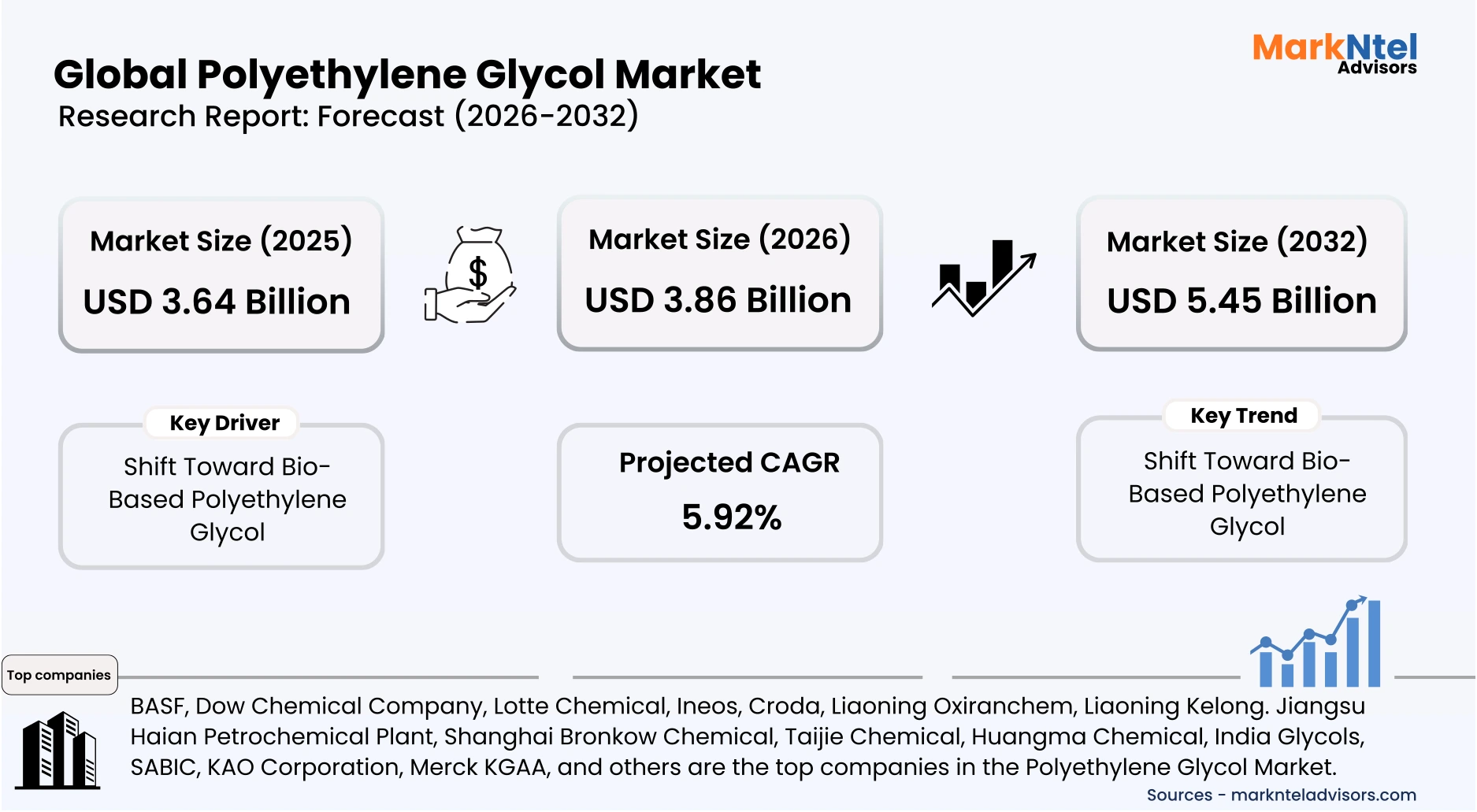
- The Global Polyethylene Glycol Market size was valued at around USD 3.64 billion in 2025 and is projected to grow from USD 3.86 billion in 2026 to USD 5.45 billion by 2032, exhibiting a CAGR of 5.92% during the forecast period.
- Asia-Pacific holds the largest market share of about 47.72% in the Global Polyethylene Glycol Market in 2026.
- By grade, the Pharmaceutical Grade segment seized a significant share of about 41% in the Global Polyethylene Glycol Market in 2026.
- By form, the Liquid segment captured a significant share of about 55% in the Global Polyethylene Glycol Market in 2026.
- Leading polyethylene glycol companies in the global market are BASF, Dow Chemical Company, Lotte Chemical, Ineos, Croda, Liaoning Oxiranchem, Liaoning Kelong. Jiangsu Haian Petrochemical Plant, Shanghai Bronkow Chemical, Taijie Chemical, Huangma Chemical, India Glycols, SABIC, KAO Corporation, Merck KGAA, NOF Corporation, SASOL, Oxiteno, and others.
Market Insights & Analysis: Global Polyethylene Glycol Market (2026-32):
The Global Polyethylene Glycol Market size was valued at around USD 3.64 billion in 2025 and is projected to grow from USD 3.86 billion in 2026 to USD 5.45 billion by 2032, exhibiting a CAGR of 5.92% during the forecast period, i.e., 2026-32.
The global polyethylene glycol (PEG) market has expanded steadily alongside the growth of pharmaceutical, chemical, and personal care manufacturing worldwide. PEG’s versatility as a solvent, stabilizer, and excipient has enabled its widespread adoption across multiple formulation processes. According to the World Health Organization, healthcare systems continue expanding access to essential medicines, increasing pharmaceutical production and supply chain activity. This structural rise in drug manufacturing has historically supported consistent demand for PEG in tablets, topical medicines, and injectable drug delivery systems.
Current market conditions show strong demand from pharmaceutical, cosmetics, and industrial end-user segments that rely on PEG for formulation stability and product performance. Pharmaceutical manufacturers widely use PEG as a carrier and solubilizing agent, while cosmetic producers employ it as an emulsifier and moisturizer in creams, lotions, and hygiene products. Reflecting this demand, Glenmark Pharmaceuticals launched Polyethylene Glycol 3350 Powder for Solution (17 g/capful) in the United States in March 2025, an over-the-counter laxative comparable to MiraLAX®, expanding PEG-based gastrointestinal treatments and demonstrating the continued pharmaceutical relevance of PEG formulations .
Government initiatives supporting domestic pharmaceutical manufacturing are also reinforcing PEG demand across major markets. According to the Ministry of Chemicals and Fertilizers (India), India’s Production Linked Incentive program encourages local manufacturing of pharmaceuticals and active pharmaceutical ingredients. Similarly, biotechnology and pharmaceutical innovation programs supported by the Organization for Economic Co-operation and Development promote research and industrial investment in advanced therapeutics. These policy frameworks stimulate drug manufacturing expansion, which increases demand for formulation materials such as PEG.
Looking forward, technological advancements in biotechnology and drug delivery systems are expected to further strengthen PEG demand globally. Research supported by the National Institutes of Health highlights the growing development of nanoparticle-based therapeutics and PEGylated drug delivery systems designed to improve treatment performance. At the same time, chemical manufacturers are investing in sustainable production technologies and bio-based polymer materials. These developments indicate that PEG will remain an essential material supporting innovation across pharmaceutical and specialty chemical industries.
Global Polyethylene Glycol Market Recent Developments:
- 2025 : BASF SE introduced Pluriol A 2400 I, a reactive polyethylene glycol designed for producing third-generation polycarboxylate ether superplasticizers used in concrete. The product improves concrete flow and durability while supporting sustainable construction formulations and a reliable European supply of PEG-based raw materials.
Global Polyethylene Glycol Market Scope:
| Category | Segments |
|---|---|
| By Grade | (Pharmaceutical Grade, Industrial Grade), |
| By Form | (Liquid, White Wax, Flakes / Powder), |
| By Package Size | (Drums, Bulk Containers, Glass Bottles), |
| By End-Use Industry | (Pharmaceutical, Cosmetics & Personal Care, Food & Beverage, Industrial), |
Global Polyethylene Glycol Market Driver:
Growing and Expanding Pharmaceutical Industry
The expanding pharmaceutical industry is the most influential driver supporting growth in the global polyethylene glycol (PEG) industry. PEG is widely used as an excipient, solvent, and stabilizer in tablets, topical formulations, injectables, and biologic drugs. Increasing healthcare demand and pharmaceutical innovation have intensified drug manufacturing globally. According to the World Health Organization, governments are strengthening medicine supply chains and expanding pharmaceutical production capacity to improve access to essential medicines worldwide.
This expansion is directly increasing demand for PEG because pharmaceutical formulations rely on stable excipients and solubilizing agents. The U.S. Food and Drug Administration reported that 50 novel drugs were approved in 2024, reflecting strong growth in new therapeutic development. Many modern drugs, including biologics and injectable therapies, require specialized formulation ingredients such as PEG to improve stability and bioavailability. As pharmaceutical companies continue expanding research pipelines and production volumes, consumption of PEG-based excipients increases proportionally across drug manufacturing facilities.
Government policies promoting domestic pharmaceutical manufacturing are further reinforcing this demand driver. India’s Production Linked Incentive program for pharmaceuticals and bulk drugs has attracted about USD 570 million in investments by 2025, according to the Ministry of Chemicals and Fertilizers (India). The initiative aims to strengthen local production of active pharmaceutical ingredients and drug intermediates. Such manufacturing expansion increases the need for formulation ingredients like PEG, thereby driving sustained demand growth across global pharmaceutical supply chains.
Global Polyethylene Glycol Market Trend:
Shift Toward Bio-Based Polyethylene Glycol
A significant structural trend shaping the polyethylene glycol (PEG) market is the shift toward bio-based PEG derived from renewable feedstocks such as plant-based ethylene oxide. This trend has accelerated as governments and industries intensify efforts to reduce reliance on fossil-based chemicals and lower carbon emissions. According to the International Energy Agency, global chemical producers are increasingly integrating renewable feedstocks to reduce lifecycle emissions across industrial supply chains. Such environmental pressures are encouraging chemical manufacturers to explore sustainable alternatives to conventional petrochemical-derived PEG.
Regulatory policies and sustainability initiatives introduced in recent years have reinforced this transition. The European Commission has expanded its Chemicals Strategy for Sustainability and circular economy policies through 2025 to encourage safer and more sustainable chemical production across the European Union. These regulatory frameworks promote the adoption of renewable raw materials and environmentally responsible manufacturing processes. As a result, chemical producers are investing in bio-based feedstocks and cleaner production technologies that support the development of renewable PEG derivatives.
The transition toward bio-based PEG is reshaping the industry’s value chain and long-term operating models. Renewable feedstock sourcing, green chemistry innovations, and sustainable manufacturing practices are becoming increasingly integrated into chemical production strategies. According to the United Nations Environment Programme, sustainable chemistry is a key component of global industrial decarbonization efforts. For example, SPECIFIC POLYMERS recently introduced new bio-based polyethylene glycol derivatives designed for applications such as hydrogels, UV-curable coatings, and 3D printing resins, demonstrating growing industry investment in renewable PEG technologies. As environmental regulations strengthen and corporate sustainability commitments expand, bio-based PEG production is expected to remain a persistent trend influencing future market development.
Global Polyethylene Glycol Market Opportunity:
Growing Applications in Nanomedicine and Targeted Drug Delivery
A major opportunity in the polyethylene glycol (PEG) market lies in the expanding use of PEG in nanomedicine and targeted drug delivery technologies. Advances in biotechnology and precision medicine have increased demand for materials that improve drug stability, solubility, and circulation time in the body. According to the National Institutes of Health, nanomedicine research has expanded significantly in recent years as nanoparticle-based therapies improve targeted treatment outcomes. PEG is widely used in nanoparticle coatings and PEGylation processes that enhance drug bioavailability and reduce immune responses.
This opportunity has emerged as governments and healthcare systems increase investment in advanced therapeutics and precision medicine programs. The U.S. Food and Drug Administration has continued to approve innovative biologics and complex drug delivery systems, reflecting the growing role of nanotechnology in pharmaceuticals. PEG-based materials are commonly used in lipid nanoparticles, hydrogels, and polymer carriers that deliver therapeutic molecules to specific tissues. A 2025 editorial in Nature Nanotechnology highlighted that polyethylene glycol remains a widely used coating polymer in nanomedicine because it extends nanoparticle circulation time and improves drug delivery performance. As clinical research expands and regulatory approvals increase, demand for specialized PEG derivatives used in drug delivery technologies is rising .
The opportunity is particularly favorable for new and emerging market entrants because nanomedicine applications require specialized PEG derivatives and functional polymers rather than high-volume commodity products. Smaller companies and research-driven manufacturers can compete by developing tailored PEG formulations designed for biomedical applications. According to the Organization for Economic Co-operation and Development, governments are expanding funding for biotechnology innovation and advanced therapeutic development. These programs create favorable conditions for emerging companies to develop novel PEG-based materials for next-generation drug delivery systems.
Global Polyethylene Glycol Market Challenge:
Availability of Alternative Surfactants and Polymer Excipients
Competition from alternative surfactants and polymer excipients represents a structural challenge for the polyethylene glycol (PEG) market. Pharmaceutical and chemical manufacturers increasingly evaluate substitutes such as poloxamers, polysorbates, and polypropylene glycol when formulating drugs, cosmetics, and industrial products. These alternatives are often selected to address formulation stability, safety concerns, or compatibility requirements. According to the U.S. Food and Drug Administration, excipient selection in drug formulations must meet strict safety and performance standards, encouraging manufacturers to consider multiple functional polymers during development.
Regulatory scrutiny has intensified the evaluation of PEG and similar excipients in pharmaceutical and cosmetic applications. The European Medicines Agency and the European Commission continue to assess excipient safety and impurities within the EU pharmaceutical regulatory framework. These assessments require manufacturers to demonstrate the safety, purity, and compatibility of excipients used in medicinal products. As a result, drug developers often explore alternative surfactants or polymers that provide similar functionality while addressing regulatory or formulation concerns.
This competitive landscape can slow PEG adoption and limit expansion into certain applications. When pharmaceutical companies redesign formulations or develop new therapies, they may select alternative excipients with established regulatory histories or specific functional advantages. According to the Organization for Economic Co-operation and Development, pharmaceutical innovation increasingly involves complex formulation strategies that incorporate diverse functional materials. Consequently, the availability of substitute polymers can constrain PEG demand growth and influence investment decisions across pharmaceutical and specialty chemical markets.
Global Polyethylene Glycol Market (2026-32) Segmentation Analysis:
The Global Polyethylene Glycol Market study of MarkNtel Advisors evaluates & highlights the major trends and influencing factors in each segment. It includes predictions for the period 2026–32 at the global level. Based on the analysis, the market has been further classified as;
Based on Grade:
- Pharmaceutical Grade
- Industrial Grade
Pharmaceutical grade dominates the Global Polyethylene Glycol (PEG) Market, accounting for approximately 41% of total demand, primarily because PEG is widely used as a critical excipient in drug formulations and advanced therapeutic delivery systems. According to the U.S. Food and Drug Administration, pharmaceutical excipients must meet stringent purity and safety standards to ensure compatibility with active pharmaceutical ingredients. PEG’s low toxicity, solubility, and stability make it suitable for applications such as laxatives, ointments, injectables, and tablet formulations. These functional advantages have led pharmaceutical manufacturers to rely heavily on pharmaceutical-grade PEG in both conventional and biologic drug production.
Expanding global pharmaceutical manufacturing capacity further reinforces this dominance. The World Health Organization reports that demand for medicines continues to increase as healthcare access expands and chronic disease prevalence rises across multiple regions. Pharmaceutical-grade PEG is commonly used in drug delivery systems, including PEGylated therapeutics that improve drug stability and circulation time in the body. As pharmaceutical companies scale production of biologics, vaccines, and specialty drugs, demand for high-purity PEG excipients grows proportionally across manufacturing facilities worldwide.
Regulatory compliance and quality assurance also strengthen the preference for pharmaceutical-grade PEG over industrial grades. Drug manufacturers must adhere to strict excipient quality guidelines outlined in pharmacopeias such as the United States Pharmacopeia and European regulatory frameworks. These standards require consistent purity, traceability, and validated safety profiles for materials used in medicinal products. Because pharmaceutical-grade PEG meets these requirements and has a long history of safe use in approved medications, it remains the most widely adopted grade in the global PEG market.
Based on Form:
- Liquid
- White Wax
- Flakes / Powder
The liquid segment dominates the Global Polyethylene Glycol (PEG) Market, accounting for approximately 55% of total demand, primarily because lower molecular weight PEG grades remain in liquid form and are extensively used as solvents and carriers in pharmaceutical and cosmetic formulations. The World Health Organization reports that global medicine consumption continues to increase as healthcare systems expand treatment access, creating higher demand for excipients capable of dissolving active pharmaceutical ingredients efficiently. Liquid PEG grades provide strong solubilizing capacity, enabling uniform dispersion of drug compounds in oral liquids, injectables, and topical formulations.
Another factor supporting liquid PEG dominance is its widespread use in high-volume personal care products. According to the European Commission's cosmetic ingredient database, polyethylene glycols are frequently used as emulsifiers, humectants, and viscosity-controlling agents in creams, lotions, and hair care products. These formulations require ingredients that blend easily with water and oils while maintaining a stable texture across different temperature conditions. Liquid PEG offers this formulation flexibility, allowing manufacturers to produce consistent large-scale batches of skincare and hygiene products.
Supply chain practicality also strengthens the preference for liquid PEG across global chemical production networks. Liquid materials can be stored in tanks, transferred through pipelines, and integrated into automated mixing systems without the melting or pre-processing steps required for wax or solid forms. According to the International Energy Agency, modern chemical manufacturing increasingly relies on continuous processing technologies to improve efficiency and reduce energy consumption. Because liquid PEG fits seamlessly into these streamlined production systems, it maintains the leading share among PEG forms worldwide.
Global Polyethylene Glycol Market (2026-32): Regional Projection
The Asia-Pacific region dominates the Global Polyethylene Glycol (PEG) Market, accounting for approximately 47.72% of total market value, primarily because it hosts some of the world’s largest pharmaceutical and chemical manufacturing bases. Countries such as China and India have rapidly expanded drug production capacity to meet both domestic healthcare demand and export markets. According to the United Nations Industrial Development Organization, Asia accounts for a substantial share of global manufacturing output, reflecting the region’s growing role as a hub for chemical and pharmaceutical production. This large industrial base significantly increases regional demand for PEG used in drug formulations, cosmetics, and industrial processing.
The region’s dominance is further reinforced by the rapid expansion of pharmaceutical production and healthcare manufacturing infrastructure. According to the Government of India – Ministry of Chemicals and Fertilizers, India has implemented production-linked incentive programs to strengthen domestic manufacturing of pharmaceuticals and active pharmaceutical ingredients. China also maintains one of the world’s largest pharmaceutical manufacturing sectors, supplying medicines and chemical intermediates to international markets. As PEG functions as an important excipient and processing material in drug manufacturing, the expansion of pharmaceutical output across the Asia-Pacific directly drives regional consumption.
Strong growth in cosmetics and personal care manufacturing also supports the region’s leading market share. According to the World Bank, the Asia-Pacific region contains several of the fastest-growing consumer markets, supported by rising urban populations and expanding middle-income households. These demographic and economic changes have increased demand for skincare, hair care, and hygiene products produced across China, South Korea, Japan, and Southeast Asia. Since PEG compounds are widely used as emulsifiers and moisturizers in these formulations, the scale of consumer product manufacturing in Asia-Pacific continues to sustain the region’s dominance in the global PEG market.
Gain a Competitive Edge with Our Global Polyethylene Glycol Market Report:
- Global Polyethylene Glycol Market Report by MarkNtel Advisors provides a detailed & thorough analysis of market size & share, growth rate, competitive landscape, and key players. This comprehensive analysis helps businesses gain a holistic understanding of the market dynamics & make informed decisions.
- This report also highlights current market trends & future projections, allowing businesses to identify emerging opportunities & potential challenges. By understanding market forecasts, companies can align their strategies & stay ahead of the competition.
- Global Polyethylene Glycol Market Report aids in assessing & mitigating risks associated with entering or operating in the market. By understanding market dynamics, regulatory frameworks, and potential challenges, businesses can develop strategies to minimize risks & optimize their operations.
*Reports Delivery Format - Market research studies from MarkNtel Advisors are offered in PDF, Excel and PowerPoint formats. Within 24 hours of the payment being successfully received, the report will be sent to your email address.
Frequently Asked Questions
- Market Segmentation
- Introduction
- Product Definition
- Research Process
- Assumptions
- Executive Summary
- Global Polyethylene Glycol Market Policies, Regulations, and Product Standards
- Global Polyethylene Glycol Market Trends & Developments
- Global Polyethylene Glycol Market Dynamics
- Growth Factors
- Challenges
- Global Polyethylene Glycol Market Hotspot & Opportunities
- Global Polyethylene Glycol Market Outlook, 2022-2032F
- Market Size & Outlook
- By Revenues (USD Million)
- By Volume (Kiloton)
- Market Share & Analysis
- By Grade- Market Size & Forecast 2022-2032, USD Million & Kiloton
- Pharmaceutical Grade
- Industrial Grade
- By Form- Market Size & Forecast 2022-2032, USD Million & Kiloton
- Liquid
- White Wax
- Flakes / Powder
- By Package Size- Market Size & Forecast 2022-2032, USD Million & Kiloton
- Drums
- Bulk Containers
- Glass Bottles
- By End-Use Industry- Market Size & Forecast 2022-2032, USD Million & Kiloton
- Pharmaceutical
- Cosmetics & Personal Care
- Food & Beverage
- Industrial
- By Region
- North America
- South America
- Europe
- The Middle East & Africa
- Asia Pacific
- By Company
- Competition Characteristics
- Market Share & Analysis
- By Grade- Market Size & Forecast 2022-2032, USD Million & Kiloton
- Market Size & Outlook
- North America Polyethylene Glycol Market Outlook, 2022-2032F
- Market Size & Outlook
- By Revenues (USD Million)
- By Volume (Kiloton)
- Market Share & Analysis
- By Grade- Market Size & Forecast 2022-2032, USD Million & Kiloton
- By Form- Market Size & Forecast 2022-2032, USD Million & Kiloton
- By Package Size- Market Size & Forecast 2022-2032, USD Million & Kiloton
- By End-Use Industry- Market Size & Forecast 2022-2032, USD Million & Kiloton
- By Country
- The US
- Canada
- Mexico
- Rest of North America
- The US Polyethylene Glycol Market Outlook, 2022-2032F
- Market Size & Outlook
- By Revenues (USD Million)
- By Volume (Kiloton)
- Market Share & Analysis
- By Grade- Market Size & Forecast 2022-2032, USD Million & Kiloton
- By Form- Market Size & Forecast 2022-2032, USD Million & Kiloton
- By Package Size- Market Size & Forecast 2022-2032, USD Million & Kiloton
- By End-Use Industry- Market Size & Forecast 2022-2032, USD Million & Kiloton
- Market Size & Outlook
- Canada Polyethylene Glycol Market Outlook, 2022-2032F
- Market Size & Outlook
- By Revenues (USD Million)
- By Volume (Kiloton)
- Market Share & Analysis
- By Grade- Market Size & Forecast 2022-2032, USD Million & Kiloton
- By Form- Market Size & Forecast 2022-2032, USD Million & Kiloton
- By Package Size- Market Size & Forecast 2022-2032, USD Million & Kiloton
- By End-Use Industry- Market Size & Forecast 2022-2032, USD Million & Kiloton
- Market Size & Outlook
- Mexico Polyethylene Glycol Market Outlook, 2022-2032F
- Market Size & Outlook
- By Revenues (USD Million)
- By Volume (Kiloton)
- Market Share & Analysis
- By Grade- Market Size & Forecast 2022-2032, USD Million & Kiloton
- By Form- Market Size & Forecast 2022-2032, USD Million & Kiloton
- By Package Size- Market Size & Forecast 2022-2032, USD Million & Kiloton
- By End-Use Industry- Market Size & Forecast 2022-2032, USD Million & Kiloton
- Market Size & Outlook
- Market Size & Outlook
- South America Polyethylene Glycol Market Outlook, 2022-2032F
- Market Size & Outlook
- By Revenues (USD Million)
- By Volume (Kiloton)
- Market Share & Analysis
- By Grade- Market Size & Forecast 2022-2032, USD Million & Kiloton
- By Form- Market Size & Forecast 2022-2032, USD Million & Kiloton
- By Package Size- Market Size & Forecast 2022-2032, USD Million & Kiloton
- By End-Use Industry- Market Size & Forecast 2022-2032, USD Million & Kiloton
- By Country
- Brazil
- Argentina
- Rest of South America
- Brazil Polyethylene Glycol Market Outlook, 2022-2032F
- Market Size & Outlook
- By Revenues (USD Million)
- By Volume (Kiloton)
- Market Share & Analysis
- By Grade- Market Size & Forecast 2022-2032, USD Million & Kiloton
- By Form- Market Size & Forecast 2022-2032, USD Million & Kiloton
- By Package Size- Market Size & Forecast 2022-2032, USD Million & Kiloton
- By End-Use Industry- Market Size & Forecast 2022-2032, USD Million & Kiloton
- Market Size & Outlook
- Argentina Polyethylene Glycol Market Outlook, 2022-2032F
- Market Size & Outlook
- By Revenues (USD Million)
- By Volume (Kiloton)
- Market Share & Analysis
- By Grade- Market Size & Forecast 2022-2032, USD Million & Kiloton
- By Form- Market Size & Forecast 2022-2032, USD Million & Kiloton
- By Package Size- Market Size & Forecast 2022-2032, USD Million & Kiloton
- By End-Use Industry- Market Size & Forecast 2022-2032, USD Million & Kiloton
- Market Size & Outlook
- Market Size & Outlook
- Europe Polyethylene Glycol Market Outlook, 2022-2032F
- Market Size & Outlook
- By Revenues (USD Million)
- By Volume (Kiloton)
- Market Share & Analysis
- By Grade- Market Size & Forecast 2022-2032, USD Million & Kiloton
- By Form- Market Size & Forecast 2022-2032, USD Million & Kiloton
- By Package Size- Market Size & Forecast 2022-2032, USD Million & Kiloton
- By End-Use Industry- Market Size & Forecast 2022-2032, USD Million & Kiloton
- By Country
- The UK
- Germany
- France
- Italy
- Switzerland
- BENELUX
- Rest of Europe
- The UK Polyethylene Glycol Market Outlook, 2022-2032F
- Market Size & Outlook
- By Revenues (USD Million)
- By Volume (Kiloton)
- Market Share & Analysis
- By Grade- Market Size & Forecast 2022-2032, USD Million & Kiloton
- By Form- Market Size & Forecast 2022-2032, USD Million & Kiloton
- By Package Size- Market Size & Forecast 2022-2032, USD Million & Kiloton
- By End-Use Industry- Market Size & Forecast 2022-2032, USD Million & Kiloton
- Market Size & Outlook
- Germany Polyethylene Glycol Market Outlook, 2022-2032F
- Market Size & Outlook
- By Revenues (USD Million)
- By Volume (Kiloton)
- Market Share & Analysis
- By Grade- Market Size & Forecast 2022-2032, USD Million & Kiloton
- By Form- Market Size & Forecast 2022-2032, USD Million & Kiloton
- By Package Size- Market Size & Forecast 2022-2032, USD Million & Kiloton
- By End-Use Industry- Market Size & Forecast 2022-2032, USD Million & Kiloton
- Market Size & Outlook
- France Polyethylene Glycol Market Outlook, 2022-2032F
- Market Size & Outlook
- By Revenues (USD Million)
- By Volume (Kiloton)
- Market Share & Analysis
- By Grade- Market Size & Forecast 2022-2032, USD Million & Kiloton
- By Form- Market Size & Forecast 2022-2032, USD Million & Kiloton
- By Package Size- Market Size & Forecast 2022-2032, USD Million & Kiloton
- By End-Use Industry- Market Size & Forecast 2022-2032, USD Million & Kiloton
- Market Size & Outlook
- Italy Polyethylene Glycol Market Outlook, 2022-2032F
- Market Size & Outlook
- By Revenues (USD Million)
- By Volume (Kiloton)
- Market Share & Analysis
- By Grade- Market Size & Forecast 2022-2032, USD Million & Kiloton
- By Form- Market Size & Forecast 2022-2032, USD Million & Kiloton
- By Package Size- Market Size & Forecast 2022-2032, USD Million & Kiloton
- By End-Use Industry- Market Size & Forecast 2022-2032, USD Million & Kiloton
- Market Size & Outlook
- Switzerland Polyethylene Glycol Market Outlook, 2022-2032F
- Market Size & Outlook
- By Revenues (USD Million)
- By Volume (Kiloton)
- Market Share & Analysis
- By Grade- Market Size & Forecast 2022-2032, USD Million & Kiloton
- By Form- Market Size & Forecast 2022-2032, USD Million & Kiloton
- By Package Size- Market Size & Forecast 2022-2032, USD Million & Kiloton
- By End-Use Industry- Market Size & Forecast 2022-2032, USD Million & Kiloton
- Market Size & Outlook
- BENELUX Polyethylene Glycol Market Outlook, 2022-2032F
- Market Size & Outlook
- By Revenues (USD Million)
- By Volume (Kiloton)
- Market Share & Analysis
- By Grade- Market Size & Forecast 2022-2032, USD Million & Kiloton
- By Form- Market Size & Forecast 2022-2032, USD Million & Kiloton
- By Package Size- Market Size & Forecast 2022-2032, USD Million & Kiloton
- By End-Use Industry- Market Size & Forecast 2022-2032, USD Million & Kiloton
- Market Size & Outlook
- Market Size & Outlook
- The Middle East & Africa Polyethylene Glycol Market Outlook, 2022-2032F
- Market Size & Outlook
- By Revenues (USD Million)
- By Volume (Kiloton)
- Market Share & Analysis
- By Grade- Market Size & Forecast 2022-2032, USD Million & Kiloton
- By Form- Market Size & Forecast 2022-2032, USD Million & Kiloton
- By Package Size- Market Size & Forecast 2022-2032, USD Million & Kiloton
- By End-Use Industry- Market Size & Forecast 2022-2032, USD Million & Kiloton
- By Country
- Saudi Arabia
- UAE
- Qatar
- Turkey
- Israel
- South Africa
- Egypt
- Rest of the Middle East & Africa
- Saudi Arabia Polyethylene Glycol Market Outlook, 2022-2032F
- Market Size & Outlook
- By Revenues (USD Million)
- By Volume (Kiloton)
- Market Share & Analysis
- By Grade- Market Size & Forecast 2022-2032, USD Million & Kiloton
- By Form- Market Size & Forecast 2022-2032, USD Million & Kiloton
- By Package Size- Market Size & Forecast 2022-2032, USD Million & Kiloton
- By End-Use Industry- Market Size & Forecast 2022-2032, USD Million & Kiloton
- Market Size & Outlook
- UAE Polyethylene Glycol Market Outlook, 2022-2032F
- Market Size & Outlook
- By Revenues (USD Million)
- By Volume (Kiloton)
- Market Share & Analysis
- By Grade- Market Size & Forecast 2022-2032, USD Million & Kiloton
- By Form- Market Size & Forecast 2022-2032, USD Million & Kiloton
- By Package Size- Market Size & Forecast 2022-2032, USD Million & Kiloton
- By End-Use Industry- Market Size & Forecast 2022-2032, USD Million & Kiloton
- Market Size & Outlook
- Qatar Polyethylene Glycol Market Outlook, 2022-2032F
- Market Size & Outlook
- By Revenues (USD Million)
- By Volume (Kiloton)
- Market Share & Analysis
- By Grade- Market Size & Forecast 2022-2032, USD Million & Kiloton
- By Form- Market Size & Forecast 2022-2032, USD Million & Kiloton
- By Package Size- Market Size & Forecast 2022-2032, USD Million & Kiloton
- By End-Use Industry- Market Size & Forecast 2022-2032, USD Million & Kiloton
- Market Size & Outlook
- Turkey Polyethylene Glycol Market Outlook, 2022-2032F
- Market Size & Outlook
- By Revenues (USD Million)
- By Volume (Kiloton)
- Market Share & Analysis
- By Grade- Market Size & Forecast 2022-2032, USD Million & Kiloton
- By Form- Market Size & Forecast 2022-2032, USD Million & Kiloton
- By Package Size- Market Size & Forecast 2022-2032, USD Million & Kiloton
- By End-Use Industry- Market Size & Forecast 2022-2032, USD Million & Kiloton
- Market Size & Outlook
- Israel Polyethylene Glycol Market Outlook, 2022-2032F
- Market Size & Outlook
- By Revenues (USD Million)
- By Volume (Kiloton)
- Market Share & Analysis
- By Grade- Market Size & Forecast 2022-2032, USD Million & Kiloton
- By Form- Market Size & Forecast 2022-2032, USD Million & Kiloton
- By Package Size- Market Size & Forecast 2022-2032, USD Million & Kiloton
- By End-Use Industry- Market Size & Forecast 2022-2032, USD Million & Kiloton
- Market Size & Outlook
- South Africa Polyethylene Glycol Market Outlook, 2022-2032F
- Market Size & Outlook
- By Revenues (USD Million)
- By Volume (Kiloton)
- Market Share & Analysis
- By Grade- Market Size & Forecast 2022-2032, USD Million & Kiloton
- By Form- Market Size & Forecast 2022-2032, USD Million & Kiloton
- By Package Size- Market Size & Forecast 2022-2032, USD Million & Kiloton
- By End-Use Industry- Market Size & Forecast 2022-2032, USD Million & Kiloton
- Market Size & Outlook
- Egypt Polyethylene Glycol Market Outlook, 2022-2032F
- Market Size & Outlook
- By Revenues (USD Million)
- By Volume (Kiloton)
- Market Share & Analysis
- By Grade- Market Size & Forecast 2022-2032, USD Million & Kiloton
- By Form- Market Size & Forecast 2022-2032, USD Million & Kiloton
- By Package Size- Market Size & Forecast 2022-2032, USD Million & Kiloton
- By End-Use Industry- Market Size & Forecast 2022-2032, USD Million & Kiloton
- Market Size & Outlook
- Market Size & Outlook
- Asia Pacific Polyethylene Glycol Market Outlook, 2022-2032F
- Market Size & Outlook
- By Revenues (USD Million)
- By Volume (Kiloton)
- Market Share & Analysis
- By Grade- Market Size & Forecast 2022-2032, USD Million & Kiloton
- By Form- Market Size & Forecast 2022-2032, USD Million & Kiloton
- By Package Size- Market Size & Forecast 2022-2032, USD Million & Kiloton
- By End-Use Industry- Market Size & Forecast 2022-2032, USD Million & Kiloton
- By Country
- China
- Japan
- India
- South Korea
- Indonesia
- Australia
- Singapore
- Vietnam
- Rest of Asia-Pacific
- China Polyethylene Glycol Market Outlook, 2022-2032F
- Market Size & Outlook
- By Revenues (USD Million)
- By Volume (Kiloton)
- Market Share & Analysis
- By Grade- Market Size & Forecast 2022-2032, USD Million & Kiloton
- By Form- Market Size & Forecast 2022-2032, USD Million & Kiloton
- By Package Size- Market Size & Forecast 2022-2032, USD Million & Kiloton
- By End-Use Industry- Market Size & Forecast 2022-2032, USD Million & Kiloton
- Market Size & Outlook
- Japan Polyethylene Glycol Market Outlook, 2022-2032F
- Market Size & Outlook
- By Revenues (USD Million)
- By Volume (Kiloton)
- Market Share & Analysis
- By Grade- Market Size & Forecast 2022-2032, USD Million & Kiloton
- By Form- Market Size & Forecast 2022-2032, USD Million & Kiloton
- By Package Size- Market Size & Forecast 2022-2032, USD Million & Kiloton
- By End-Use Industry- Market Size & Forecast 2022-2032, USD Million & Kiloton
- Market Size & Outlook
- India Polyethylene Glycol Market Outlook, 2022-2032F
- Market Size & Outlook
- By Revenues (USD Million)
- By Volume (Kiloton)
- Market Share & Analysis
- By Grade- Market Size & Forecast 2022-2032, USD Million & Kiloton
- By Form- Market Size & Forecast 2022-2032, USD Million & Kiloton
- By Package Size- Market Size & Forecast 2022-2032, USD Million & Kiloton
- By End-Use Industry- Market Size & Forecast 2022-2032, USD Million & Kiloton
- Market Size & Outlook
- South Korea Polyethylene Glycol Market Outlook, 2022-2032F
- Market Size & Outlook
- By Revenues (USD Million)
- By Volume (Kiloton)
- Market Share & Analysis
- By Grade- Market Size & Forecast 2022-2032, USD Million & Kiloton
- By Form- Market Size & Forecast 2022-2032, USD Million & Kiloton
- By Package Size- Market Size & Forecast 2022-2032, USD Million & Kiloton
- By End-Use Industry- Market Size & Forecast 2022-2032, USD Million & Kiloton
- Market Size & Outlook
- Indonesia Polyethylene Glycol Market Outlook, 2022-2032F
- Market Size & Outlook
- By Revenues (USD Million)
- By Volume (Kiloton)
- Market Share & Analysis
- By Grade- Market Size & Forecast 2022-2032, USD Million & Kiloton
- By Form- Market Size & Forecast 2022-2032, USD Million & Kiloton
- By Package Size- Market Size & Forecast 2022-2032, USD Million & Kiloton
- By End-Use Industry- Market Size & Forecast 2022-2032, USD Million & Kiloton
- Market Size & Outlook
- Australia Polyethylene Glycol Market Outlook, 2022-2032F
- Market Size & Outlook
- By Revenues (USD Million)
- By Volume (Kiloton)
- Market Share & Analysis
- By Grade- Market Size & Forecast 2022-2032, USD Million & Kiloton
- By Form- Market Size & Forecast 2022-2032, USD Million & Kiloton
- By Package Size- Market Size & Forecast 2022-2032, USD Million & Kiloton
- By End-Use Industry- Market Size & Forecast 2022-2032, USD Million & Kiloton
- Market Size & Outlook
- Singapore Polyethylene Glycol Market Outlook, 2022-2032F
- Market Size & Outlook
- By Revenues (USD Million)
- By Volume (Kiloton)
- Market Share & Analysis
- By Grade- Market Size & Forecast 2022-2032, USD Million & Kiloton
- By Form- Market Size & Forecast 2022-2032, USD Million & Kiloton
- By Package Size- Market Size & Forecast 2022-2032, USD Million & Kiloton
- By End-Use Industry- Market Size & Forecast 2022-2032, USD Million & Kiloton
- Market Size & Outlook
- Vietnam Polyethylene Glycol Market Outlook, 2022-2032F
- Market Size & Outlook
- By Revenues (USD Million)
- By Volume (Kiloton)
- Market Share & Analysis
- By Grade- Market Size & Forecast 2022-2032, USD Million & Kiloton
- By Form- Market Size & Forecast 2022-2032, USD Million & Kiloton
- By Package Size- Market Size & Forecast 2022-2032, USD Million & Kiloton
- By End-Use Industry- Market Size & Forecast 2022-2032, USD Million & Kiloton
- Market Size & Outlook
- Market Size & Outlook
- Global Polyethylene Glycol Market Key Strategic Imperatives for Success & Growth
- Competitive Outlook
- Company Profiles
- BASF
- Business Description
- Product Portfolio
- Collaborations & Alliances
- Recent Developments
- Financial Details
- Others
- Dow Chemical Company
- Business Description
- Product Portfolio
- Collaborations & Alliances
- Recent Developments
- Financial Details
- Others
- Lotte Chemical
- Business Description
- Product Portfolio
- Collaborations & Alliances
- Recent Developments
- Financial Details
- Others
- Ineos
- Business Description
- Product Portfolio
- Collaborations & Alliances
- Recent Developments
- Financial Details
- Others
- Croda
- Business Description
- Product Portfolio
- Collaborations & Alliances
- Recent Developments
- Financial Details
- Others
- Liaoning Oxiranchem
- Business Description
- Product Portfolio
- Collaborations & Alliances
- Recent Developments
- Financial Details
- Others
- Liaoning Kelong
- Business Description
- Product Portfolio
- Collaborations & Alliances
- Recent Developments
- Financial Details
- Others
- Jiangsu Haian Petrochemical Plant
- Business Description
- Product Portfolio
- Collaborations & Alliances
- Recent Developments
- Financial Details
- Others
- Shanghai Bronkow Chemical
- Business Description
- Product Portfolio
- Collaborations & Alliances
- Recent Developments
- Financial Details
- Others
- Taijie Chemical
- Business Description
- Product Portfolio
- Collaborations & Alliances
- Recent Developments
- Financial Details
- Others
- Huangma Chemical
- Business Description
- Product Portfolio
- Collaborations & Alliances
- Recent Developments
- Financial Details
- Others
- India Glycols
- Business Description
- Product Portfolio
- Collaborations & Alliances
- Recent Developments
- Financial Details
- Others
- SABIC
- Business Description
- Product Portfolio
- Collaborations & Alliances
- Recent Developments
- Financial Details
- Others
- KAO Corporation
- Business Description
- Product Portfolio
- Collaborations & Alliances
- Recent Developments
- Financial Details
- Others
- Merck KGAA
- Business Description
- Product Portfolio
- Collaborations & Alliances
- Recent Developments
- Financial Details
- Others
- NOF Corporation
- Business Description
- Product Portfolio
- Collaborations & Alliances
- Recent Developments
- Financial Details
- Others
- SASOL
- Business Description
- Product Portfolio
- Collaborations & Alliances
- Recent Developments
- Financial Details
- Others
- Oxiteno
- Business Description
- Product Portfolio
- Collaborations & Alliances
- Recent Developments
- Financial Details
- Others
- BASF
- Company Profiles
- Disclaimer
MarkNtel Advisors follows a robust and iterative research methodology designed to ensure maximum accuracy and minimize deviation in market estimates and forecasts. Our approach combines both bottom-up and top-down techniques to effectively segment and quantify various aspects of the market. A consistent feature across all our research reports is data triangulation, which examines the market from three distinct perspectives to validate findings. Key components of our research process include:
1. Scope & Research Design At the outset, MarkNtel Advisors define the research objectives and formulate pertinent questions. This phase involves determining the type of research—qualitative or quantitative—and designing a methodology that outlines data collection methods, target demographics, and analytical tools. They also establish timelines and budgets to ensure the research aligns with client goals.
2. Sample Selection and Data Collection In this stage, the firm identifies the target audience and determines the appropriate sample size to ensure representativeness. They employ various sampling methods, such as random or stratified sampling, based on the research objectives. Data collection is carried out using tools like surveys, interviews, and observations, ensuring the gathered data is reliable and relevant.
3. Data Analysis and Validation Once data is collected, MarkNtel Advisors undertake a rigorous analysis process. This includes cleaning the data to remove inconsistencies, employing statistical software for quantitative analysis, and thematic analysis for qualitative data. Validation steps are taken to ensure the accuracy and reliability of the findings, minimizing biases and errors.

4. Data Forecast and FinalizationThe final phase involves forecasting future market trends based on the analyzed data. MarkNtel Advisors utilize predictive modeling and time series analysis to anticipate market behaviors. The insights are then compiled into comprehensive reports, featuring visual aids like charts and graphs, and include strategic recommendations to inform client decision-making
We offer flexible licensing options to cater to varying organizational needs. Choose the pricing pack that best suits your requirements:
Buy Now Inquire Before Buying
 Request Customization
 Talk to our Consultant







