

Poland Healthcare Market Research Report: Growth Drivers & Forecast (2026-2032)
By Healthcare Expenditure Type (Public Healthcare Expenditure, Private Healthcare Expenditure, Out-of-Pocket Expenditure), By Pharmaceutical Segment (Prescription Drugs, Over-the-C ... ounter (OTC) Drugs, Generic Drugs, Branded Drugs, Biologics & Biosimilars), By Therapeutic Area (Cardiovascular Diseases, Oncology, Diabetes, Respiratory Diseases, Neurology, Infectious Diseases, Others), By Medical Device Type (Diagnostic Imaging Devices, Patient Monitoring Devices, Surgical Equipment, In-vitro Diagnostics, Orthopedic Devices, Cardiovascular Devices, Others), By Technology Type (Artificial Intelligence in Healthcare, Telemedicine & Remote Monitoring, Electronic Health Records (EHR), Healthcare Analytics, Robotic Surgery, Wearables & Health Apps), By Healthcare Workforce (Physicians, Nurses, Dentists, Allied Health Professionals), By Insurance Type (Public Health Insurance, Private Health Insurance), By Disease Category (Chronic Diseases, Infectious Diseases, Mental Health Disorders), By End User (Hospitals, Clinics, Diagnostic Centers / Laboratories, Ambulatory Surgical Centers, Home Healthcare, Research Institutes, Pharmacies, Others) Read more
- Healthcare
- Mar 2026
- Pages 160
- Report Format: PDF, Excel, PPT
Poland Healthcare Market
Projected 8.27% CAGR from 2026 to 2032
Study Period
2026-2032
Market Size (2026)
USD 68.75 Billion
Market Size (2032)
USD 110.73 Billion
Base Year
2025
Projected CAGR
8.27%
Leading Segments
By Therapeutic Area: Cardiovascular Diseases
Poland Healthcare Market Report Key Takeaways:
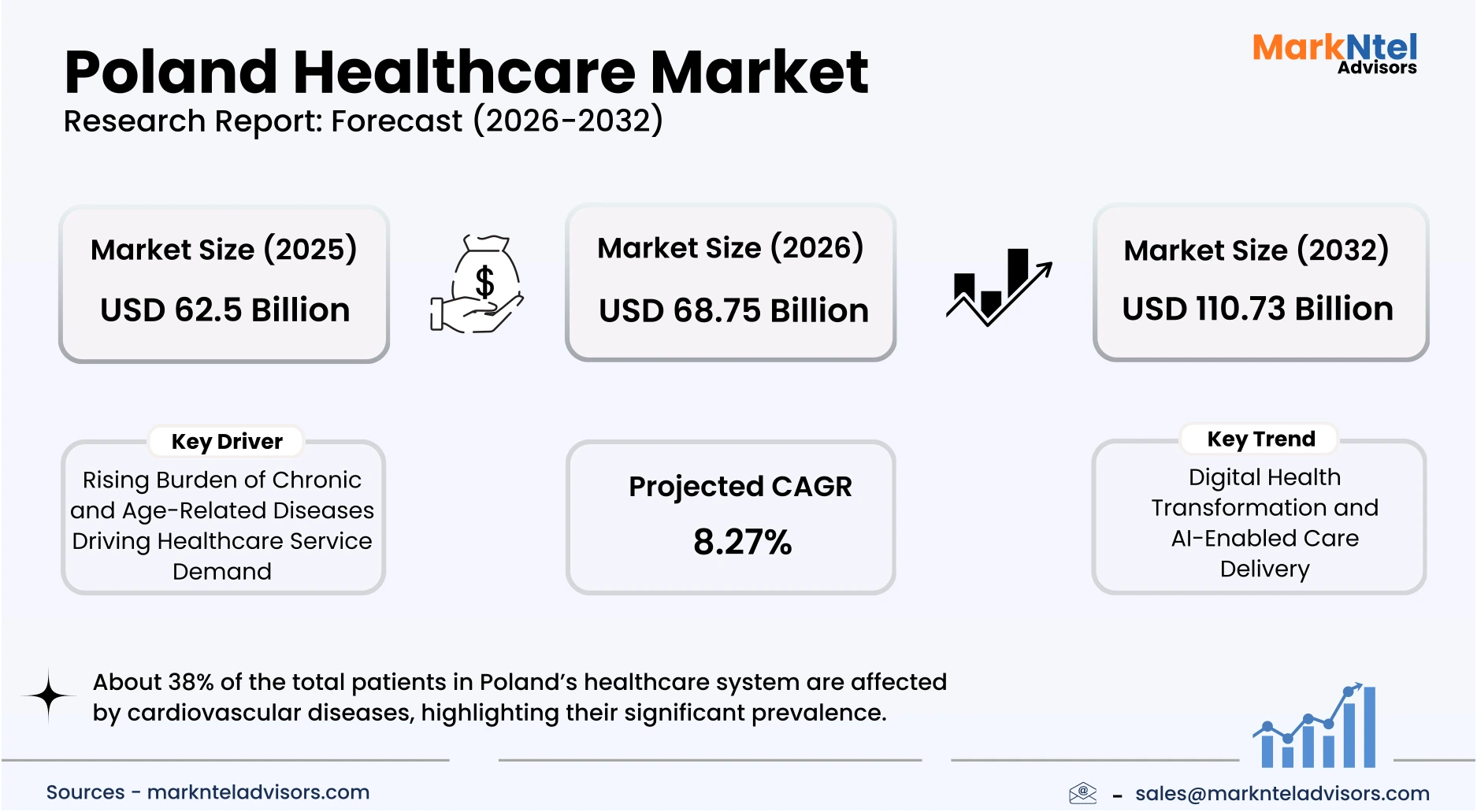
- The Poland Healthcare Market size was valued at USD 62.5 billion in 2025 and is projected to grow from USD 68.75 billion in 2026 to USD 110.73 billion by 2032, exhibiting a CAGR of 8.27% during the forecast period.
- About 38% of the total patients in Poland’s healthcare system are affected by cardiovascular diseases, highlighting their significant prevalence.
- Cancer is another common condition, affecting around 25% of the total patients in Poland’s healthcare system in 2026.
- Poland’s healthcare infrastructure includes around 888 general hospitals with nearly 160,000 hospital beds, along with more than 27,000 outpatient healthcare providers such as clinics, doctor practices, and dental practices, supported by a wide network of long-term care, rehabilitation, and residential medical facilities across the country.
Market Insights & Analysis: Poland Healthcare Market (2026-32):
The Poland Healthcare Market size was valued at USD 62.5 billion in 2025 and is projected to grow from USD 68.75 billion in 2026 to USD 110.73 billion by 2032, exhibiting a CAGR of 8.27% during the forecast period. i.e., 2026-32.
Poland’s healthcare sector has demonstrated a sustained growth trajectory supported by comprehensive public funding and broad population health coverage. Data from recent reports states that the country maintained 894 general hospitals with 161,207 total beds , reflecting a diversified network of inpatient care facilities that has gradually adjusted since past years. That year also saw an increasing trend in both outpatient consultations and patient admissions per capita, evidencing expanding service utilization across disease profiles. Poland’s hospital infrastructure remains a core foundation for care delivery to a population showing rising demands for complex and chronic disease management.
Digital technologies and innovation are increasingly influencing market dynamics, with healthcare IT platforms and AI integration shaping future growth pathways. National digital health infrastructures, including e-prescription and patient digital records platforms used by millions, now form the backbone of care coordination and data-driven planning. Digital transformation has accelerated in Polish healthcare: about 13.2 % of hospitals were using AI-based systems in 2024, more than double the share from the prior year, with applications concentrated in imaging diagnostics (CT/MRI). Additionally, around 16.2 % of medical facilities apply AI to clinical decision-making tasks, reflecting growing adoption for efficiency gains and improved diagnostic accuracy.
Epidemiological patterns in Poland indicate evolving demand drivers linked to demographic ageing and disease prevalence. Recent national clinical statistics show a significant share of patients seeking care for non‑communicable diseases such as cardiovascular disorders, oncological conditions, and metabolic syndromes, which are prevalent among older cohorts and exert sustained pressure on service capacity. Advanced diagnostic needs further give rise to growth in imaging and specialized pathology services, while long‑term care facilities are expanding to absorb rising chronic disease management volumes. Plan for Rare Diseases 2024–2025 allocates resources to expand expert centers, improve genomic diagnostics funding, and establish a national register to track such conditions. These efforts aim to enhance the detection and management of complex genetic and rare disorders.
Government policy frameworks and institutional reforms are actively supporting sector expansion and performance outcomes. Recent national health reforms enacted in 2025 provide new legal structures for hospital networks to transition services toward planned and recovery-oriented care models, enabling strategic institutional consolidation. These reforms link funding mechanisms with performance objectives across regions, while programs promoting coordinated primary care aim to strengthen service delivery across priority areas such as cardiology and endocrinology. Such policy actions, combined with sizable national recovery funds allocated to healthcare transformation, underpin a robust regulatory environment that will sustain market demand through 2032.
Poland Healthcare Market Scope:
| Category | Segments |
|---|---|
| By Healthcare Expenditure Type | (Public Healthcare Expenditure, Private Healthcare Expenditure, Out-of-Pocket Expenditure), |
| By Pharmaceutical Segment | (Prescription Drugs, Over-the-Counter (OTC) Drugs, Generic Drugs, Branded Drugs, Biologics & Biosimilars), |
| By Therapeutic Area | (Cardiovascular Diseases, Oncology, Diabetes, Respiratory Diseases, Neurology, Infectious Diseases, Others), |
| By Medical Device Type | (Diagnostic Imaging Devices, Patient Monitoring Devices, Surgical Equipment, In-vitro Diagnostics, Orthopedic Devices, Cardiovascular Devices, Others), |
| By Technology Type | (Artificial Intelligence in Healthcare, Telemedicine & Remote Monitoring, Electronic Health Records (EHR), Healthcare Analytics, Robotic Surgery, Wearables & Health Apps), |
| By Healthcare Workforce | (Physicians, Nurses, Dentists, Allied Health Professionals), |
| By Insurance Type | (Public Health Insurance, Private Health Insurance), |
| By Disease Category | (Chronic Diseases, Infectious Diseases, Mental Health Disorders), |
| By End User | (Hospitals, Clinics, Diagnostic Centers / Laboratories, Ambulatory Surgical Centers, Home Healthcare, Research Institutes, Pharmacies, Others) |
Poland Healthcare Market Driver:
Expansion of Public Healthcare Financing and Structural Investment Programs
The most influential driver accelerating growth in Poland’s healthcare sector is the sustained expansion of public healthcare financing supported by statutory spending reforms. Under legislation introduced by the Polish government, national health expenditure is required to reach 7% by 2027, strengthening long-term funding commitments for hospitals, diagnostics, and medical infrastructure. According to the OECD and Poland’s Ministry of Health, healthcare spending already exceeded USD 50 billion in 2024, reflecting continuous increases in allocations through the National Health Fund. This structural financing expansion has intensified in recent years as policymakers aim to address demographic ageing and rising chronic disease prevalence.
Higher public funding has translated directly into measurable increases in healthcare service utilization and infrastructure capacity across the country. Statistics Poland reported that more than 7 million patients were treated in general hospitals in 2023, while outpatient consultations exceeded 350 million visits, demonstrating the scale of demand supported by publicly financed care. Increased reimbursement for diagnostic services, oncology treatment pathways, and specialized care has stimulated greater service provision across both regional hospitals and tertiary institutions. Approximately USD 2.3 billion is allocated to modernise hospitals, including oncology and cardiac networks. Around USD 1.1 billion is dedicated to digital transformation, AI tools, and electronic medical record systems in hospitals.
Government-led investment programs further amplify this demand expansion by modernizing healthcare facilities and strengthening clinical capacity nationwide. Through the National Recovery and Resilience Plan, Poland has allocated billions of dollars for hospital modernization, digital health infrastructure, and advanced diagnostic equipment upgrades between 2025 and 2027. About USD 770 million has been awarded to hospitals to implement AI tools, digitise medical records, and expand healthcare IT systems .
These investments target improvements in surgical capacity, oncology treatment networks, and digital patient management platforms used by institutional healthcare providers. As a result, sustained public financing not only strengthens healthcare access but also generates continuous demand for healthcare services, technologies, and pharmaceutical products, reinforcing long-term market expansion through 2032.
Poland Healthcare Market Trend:
Rapid Adoption of AI-Enabled Diagnostics and Digital Health Infrastructure
A major structural trend reshaping Poland’s healthcare sector is the increasing adoption of artificial intelligence and digital health technologies in clinical diagnostics. National e-health platforms managed by the Centre for e-Health have enabled widespread use of electronic prescriptions, digital referrals, and patient health records across hospitals and outpatient clinics. This digital infrastructure has created the foundation for integrating AI-driven tools into diagnostic workflows. As healthcare providers seek faster and more accurate clinical decision-making, hospitals are progressively exploring AI applications in radiology, pathology, and patient data analytics.
Several Polish healthcare institutions have begun deploying AI-supported diagnostic technologies to enhance clinical efficiency. Researchers at AGH University of Science and Technology developed an AI radiology system tested at the University Hospital in Kraków to assist physicians in analysing CT and MRI scans. In parallel, hospitals in Warsaw and other regions are upgrading radiology information systems and imaging platforms with AI modules capable of automated image interpretation and tele-radiology integration. These developments illustrate the growing role of artificial intelligence in supporting diagnostic accuracy and improving patient workflow management.
The trend is expected to strengthen as government funding and academic research continue to accelerate healthcare digitalisation. Institutions such as the Medical University of Warsaw are conducting AI-driven oncology research to predict treatment outcomes using medical imaging data. Growing patient volumes and workforce shortages are also encouraging hospitals to adopt technologies that enhance diagnostic productivity. As digital infrastructure and AI capabilities expand, advanced data-driven healthcare solutions are becoming a core component of Poland’s healthcare system modernisation.
Poland Healthcare Market Opportunity:
Expansion of Biotechnology Innovation and Clinical Research Partnerships
A significant opportunity in Poland’s healthcare sector lies in the rapid expansion of biotechnology innovation and clinical research collaboration. The country has strengthened its life sciences ecosystem through research funding programs and partnerships between universities, hospitals, and pharmaceutical companies. Institutions such as the Medical University of Warsaw and other academic research centers are actively engaged in advanced biomedical research and clinical trials. Poland’s highly trained scientific workforce and established regulatory alignment with European Union pharmaceutical standards have increased the country’s attractiveness as a destination for drug development activities.
This opportunity has emerged as pharmaceutical companies seek cost-efficient and scientifically capable locations for conducting clinical trials and biomedical research. As demand for innovative therapies such as biologics and targeted oncology treatments expands, pharmaceutical firms are increasingly collaborating with regional research institutions. These partnerships generate growing demand for specialized biotechnology services, clinical data management, and translational research support.
The expanding clinical research environment presents a particularly strong entry opportunity for biotechnology startups and emerging life-science companies. For example, the pharmaceutical company AstraZeneca has made significant investments in Poland’s healthcare innovation ecosystem. The company invested USD 370 million in R&D and clinical trial activities in 2025 in Poland. It also invested USD 3-4 million to expand oncology diagnostics, rare disease screening, and AI-supported diagnostic systems.
The Polish government created the Medical Research Agency to strengthen biomedical innovation. The agency allocated USD 25 million to establish Clinical Research Support Centres across Poland. These centres aim to increase the number of clinical trials and improve access to innovative therapies for patients.
Smaller firms can focus on niche capabilities such as biomarker discovery, genomic analytics, or clinical data platforms without requiring large-scale pharmaceutical manufacturing infrastructure. Collaboration with academic hospitals and research universities allows startups to participate in drug development pipelines and international research projects. As Poland continues strengthening its biomedical innovation ecosystem, biotechnology enterprises are positioned to play an increasingly important role in supporting healthcare research and therapeutic development.
Poland Healthcare Market Challenge:
Workforce Shortages and Capacity Constraints in the Healthcare System
One of the most critical challenges limiting the growth of Poland’s healthcare sector is the persistent shortage of medical professionals, which constrains service capacity and healthcare accessibility. Poland has 3.9 practising physicians per 1,000 people, while the EU average is 4.3 per 1,000. Poland has 5.9 nurses per 1,000 people, significantly lower than the EU average of 8.5. These workforce gaps indicate structural capacity limitations in the healthcare system. Some non-urban areas in Poland have fewer than two doctors per 1,000 inhabitants.
The shortage has intensified due to population ageing and increased demand for chronic disease management. As healthcare utilisation continues to rise, hospitals and outpatient facilities face increasing pressure to deliver services with limited human resources.
The workforce constraint is already affecting operational performance across hospitals, diagnostic centres, and specialised care institutions. Reports from the European Commission indicate that staffing shortages contribute to longer waiting times for specialist consultations and surgical procedures in Poland. Limited availability of trained medical professionals also restricts the expansion of new healthcare facilities and specialised treatment centres. Medical training in Poland requires a six-year medical degree followed by a 13-month postgraduate internship and licensing exam, meaning workforce expansion takes many years to translate into active physicians.
As a result, healthcare providers often face operational bottlenecks that reduce patient throughput and slow the adoption of advanced treatment services.
This structural challenge materially restricts market expansion by increasing operational costs and limiting the scalability of healthcare services. To address the issue, the Ministry of Health of Poland has introduced workforce expansion initiatives, including increased medical school enrolment and programs encouraging physicians to work in underserved regions. However, training new healthcare professionals requires several years, meaning supply constraints will likely persist in the near term. Consequently, labour shortages remain a major barrier for healthcare providers seeking to expand capacity and meet growing patient demand.
Poland Healthcare Market Epidemiology Profile:
Cardiovascular Diseases:
Cardiovascular diseases remain the most widespread health condition in Poland. Around 4.3 million people in Poland were living with cardiovascular disease, with an incidence of 1,046 cases per 100,000 people. Cardiovascular diseases and cancer together account for over 60% of deaths in Poland. The high prevalence reflects demographic ageing and lifestyle patterns such as high salt consumption and smoking. As the population above 65 continues to expand, the demand for cardiology services has grown significantly. Consequently, cardiovascular treatment remains a central component of national healthcare planning.
New cardiovascular cases continue to rise annually due to growing metabolic disorders and sedentary lifestyles. Clinical data from national cardiology registries indicate a steady increase in diagnoses of ischemic heart disease and heart failure. 80,000 myocardial infarction cases occur annually in Poland. Early screening programs and improved diagnostic techn ologies have also increased case detection rates. This trend has expanded demand for cardiac imaging, interventional cardiology, and long-term disease management.
Cardiovascular diseases account for roughly 40–45% of total deaths in Poland, making them the leading cause of mortality. Despite improvements in treatment and emergency response systems, mortality remains relatively high compared with several Western European countries. Delayed diagnosis, lifestyle risk factors, and uneven healthcare access contribute to this burden. Reducing cardiovascular mortality remains a key objective of national public health strategies. Major risk factors include hypertension, tobacco consumption, obesity, physical inactivity, and high cholesterol levels. Dietary habits characterised by high salt and saturated fat intake also contribute to disease progression.
The cost burden includes hospitalisations, long-term medication therapy, rehabilitation, and outpatient cardiology services. Productivity losses due to disability and premature mortality further increase the economic impact. As a result, cardiovascular care continues to receive substantial funding and policy attention.
Although Poland maintains a large hospital network, access to specialised cardiology services varies across regions. Rural areas and smaller cities often experience shortages of cardiologists and advanced diagnostic facilities. Waiting times for specialised procedures may remain longer outside major urban centres. These disparities can affect timely treatment and long-term disease outcomes.
Treatment primarily includes pharmacological therapy, interventional cardiology procedures, and surgical interventions. Examples include statins, ACE inhibitors, beta-blockers, coronary angioplasty, and coronary artery bypass surgery. Study on the KOS-Zawał integrated cardiac care program in Poland: The program monitored over 218,000 patients after myocardial infarction or PCI/CABG. Coordinated post-acute care improved adherence to statin therapy and long-term cardiovascular treatment protocols.
Cardiac rehabilitation and long-term monitoring programs are also widely implemented. Advanced imaging and catheter-based procedures continue to improve treatment outcomes.
Cancer:
Cancer represents one of the most significant health burdens in Poland, with approximately 1.1 million people living with a cancer diagnosis, reflecting rising prevalence linked to demographic ageing and lifestyle risk factors. According to the Organisation for Economic Co-operation and Development and the European Commission, Lung, colorectal, prostate, and breast cancers are among the most frequently diagnosed malignancies. This growing patient population continues to drive strong demand for oncology services across hospitals and specialised cancer centres.
Cancer also represents the second leading cause of death in Poland, accounting for roughly 26–27% of total mortality, according to epidemiological studies published in the peer-reviewed journal MDPI using national health data. Tobacco consumption, obesity, environmental pollution, and population ageing remain major contributors to the rising disease burden. The economic impact is substantial, as treatment requires complex and long-term therapeutic pathways including surgery, radiation therapy, and advanced pharmacological treatments. Consequently, oncology continues to receive significant attention within national healthcare planning and investment strategies.
The treatment landscape in Poland increasingly incorporates modern oncology therapies supported by both domestic and multinational pharmaceutical companies. Firms such as Roche provide targeted therapies, immunotherapies, and molecular diagnostics used in precision oncology. Tiragolumab, developed by Roche, blocks the TIGIT immune checkpoint pathway, helping restore anti-tumour immune responses.
Multidisciplinary treatment approaches combining chemotherapy, radiation therapy, immunotherapy, and surgical oncology are widely practised in specialised cancer institutes. These technological advances, along with expanding screening programs and research collaborations, continue to strengthen the capacity of Poland’s healthcare system to manage rising oncology demand.
Gain a Competitive Edge with Our Poland Healthcare Market Report:
- The Poland Healthcare Market Report by MarkNtel Advisors provides a detailed & thorough analysis of market size & share, growth rate, competition, and key players. This comprehensive analysis helps businesses gain a holistic understanding of the market dynamics & make informed decisions.
- This report also highlights current market trends & future projections, allowing businesses to identify emerging opportunities & potential challenges. By understanding market forecasts, companies can align their strategies & stay ahead of the competition.
- The Poland Healthcare Market Report aids in assessing & mitigating risks associated with entering or operating in the market. By understanding market dynamics, regulatory frameworks, and potential challenges, businesses can develop strategies to minimize risks & optimize their operations.
*Reports Delivery Format - Market research studies from MarkNtel Advisors are offered in PDF, Excel and PowerPoint formats. Within 24 hours of the payment being successfully received, the report will be sent to your email address.
Frequently Asked Questions
- Introduction
- Executive Summary
- Key Insights
- Key Findings (2020–2024)
- Market Outlook Snapshot (2025–2032F)
- Strategic Imperatives
- Macro Environment Analysis
- Poland at a Glance
- Geographic Overview
- Political Structure
- Trade & Regional Alliances
- Others
- Demographic Profile (2020–2032F)
- Population Trends
- Age Structure
- Urban vs Rural Distribution
- Fertility Rate Trends
- Migration Trends
- Ethnic Composition
- Economic Profile (2020–2032F)
- GDP (Current & Constant USD)
- GDP by Sector
- Working Population & Labor Participation
- Per Capita Income & Purchasing Power
- Unemployment & Underemployment
- Inflation Rate & Healthcare Cost Impact
- Foreign Direct Investment Trends
- Country PESTLE Analysis
- Poland at a Glance
- Poland Healthcare Sector Analysis, 2026
- Healthcare System Overview
- Structure of Healthcare System
- Public vs Private Healthcare
- Governance & Regulatory Authorities
- Others
- Healthcare Ecosystem & Infrastructure (2020–2026)
- Healthcare Expenditure
- Healthcare Expenditure as % of GDP
- Per Capita Healthcare Expenditure
- Healthcare Facilities
- Number of Hospitals
- Number of Clinics
- Number of Pharmacies
- Number of Diagnostic Centres
- Public vs Private Distribution
- Bed Availability & Utilization
- Beds per 1,000 Population
- Beds Speciality
- Regional Disparities
- Healthcare Workforce
- Physicians per 1,000 Population
- Physicians by Speciality
- Nurses
- Dentists
- Allied Health Professionals
- Healthcare Expenditure
- Healthcare System Overview
- Health Outcomes & Public Health Indicators (2020–2026)
- Life Expectancy (Male vs Female)
- Infant Mortality Rate
- Maternal Mortality Ratio
- Immunisation Coverage Rates (Measles, DPT, HPV, COVID-19)
- Overall Disease Burden Trends
- Healthcare Reforms & Large-Scale Projects (2020-2026)
- Government Reforms
- Public-Private Partnerships
- Infrastructure Expansion Projects
- Private Sector Investments
- Others
- Insurance Framework
- Public Health Insurance Programs
- Private Health Insurance Market
- Insurance Penetration & Coverage Gaps
- Payer Landscape
- Reimbursement Models (FFS, Bundled, Value-Based Care)
- Claims Management & Transparency Issues
- Out-of-Pocket Expenditure Trends (2020-2026)
- Regulatory Environment (Healthcare Sector)
- Market Authorisation for Pharmaceuticals
- Market Authorisation for Medical Devices
- Licensing for Manufacturing, Import & Export
- Clinical Trial Regulations
- Intellectual Property & Patent Protection
- Advertising, Labeling & Packaging Regulations
- Pharmacy & Hospital Licensing Rules
- Others
- Market Dynamics & Technology
- Healthcare Market Dynamics
- Growth Drivers
- Challenges & Barriers
- Emerging Opportunities
- Value Chain Analysis
- Healthcare Technology Trends
- Digital Health Maturity
- Telemedicine & Remote Monitoring
- Artificial Intelligence & Machine Learning
- Health Apps & Wearables
- Robotic Surgery
- EHR, Data Interoperability & Cybersecurity
- Others
- Healthcare Market Dynamics
- Epidemiology Profile (By Age & By Gender) (2020–2032F)
- Chronic Diseases
- Cardiovascular Diseases
- Prevalence
- Incidence
- Mortality Rate
- Risk Factors
- Healthcare & Economic Burden
- Infrastructure Challenges
- Treatment Landscape
- Others
- Diabetes
- Prevalence
- Incidence
- Mortality Rate
- Risk Factors
- Healthcare & Economic Burden
- Infrastructure Challenges
- Treatment Landscape
- Others
- Cancer
- Prevalence
- Incidence
- Mortality Rate
- Risk Factors
- Healthcare & Economic Burden
- Infrastructure Challenges
- Treatment Landscape
- Others
- Chronic Respiratory Diseases
- Prevalence
- Incidence
- Mortality Rate
- Risk Factors
- Healthcare & Economic Burden
- Infrastructure Challenges
- Treatment Landscape
- Others
- Chronic Kidney Disease
- Prevalence
- Incidence
- Mortality Rate
- Risk Factors
- Healthcare & Economic Burden
- Infrastructure Challenges
- Treatment Landscape
- Others
- Cardiovascular Diseases
- Infectious Diseases
- Tuberculosis
- Prevalence
- Incidence
- Mortality Rate
- Risk Factors
- Healthcare & Economic Burden
- Infrastructure Challenges
- Treatment Landscape
- Others
- HIV
- Prevalence
- Incidence
- Mortality Rate
- Risk Factors
- Healthcare & Economic Burden
- Infrastructure Challenges
- Treatment Landscape
- Others
- Hepatitis
- Prevalence
- Incidence
- Mortality Rate
- Risk Factors
- Healthcare & Economic Burden
- Infrastructure Challenges
- Treatment Landscape
- Others
- Others
- Tuberculosis
- Mental Health
- Prevalence of Mental Health Disorders
- Suicide Rates & Trends
- Urban-Rural & Gender Disparities
- Infrastructure Gaps
- Economic & Social Burden
- Chronic Diseases
- Poland Healthcare System Stakeholders Analysis, 2026
- Poland Pharmaceutical Market Outlook (2020–2030F)
- Market Size & Growth
- Market Size (USD Million), 2020-2030F
- Market by Key Segments
- Prescription vs OTC
- Generics vs Branded
- Therapeutic Category Distribution
- Manufacturing Landscape
- Distribution & Supply Chain
- Major Distributors
- Major Suppliers
- Major Local and Multinational Players
- Fresenius SE & Co. KGaA
- Helios Kliniken GmbH
- Asklepios Kliniken
- Sana Kliniken AG
- Rhön-Klinikum AG
- Siemens Healthineers
- Schön Klinik SE
- Klinikum Stuttgart
- University Medical Centre Hamburg
- Charité – Universitätsmedizin
- Pharmaceutical sector (Top 5–10 companies, % market share)
- Imports & Exports (Value in USD Million) (2020-2026)
- Key Pharmaceutical Clusters (if there)
- Investments and R&D (2020-2026)
- Others
- Market Size & Growth
- Poland Medical Devices Market Outlook (2020–2030F)
- Market Size & Growth
- Market Size (USD Million), 2020-2030F
- Market by Key Segments
- By Device Type
- By Risk Class
- By End-User
- Manufacturing Landscape
- Distribution & Supply Chain
- Distributors
- Supply Chain
- Major Local and Multinational Players
- Fresenius SE & Co. KGaA
- Helios Kliniken GmbH
- Asklepios Kliniken
- Sana Kliniken AG
- Rhön-Klinikum AG
- Siemens Healthineers
- Schön Klinik SE
- Klinikum Stuttgart
- University Medical Centre Hamburg
- Charité – Universitätsmedizin
- Medical Devices Sector (Top 5–10 companies, % market share)
- Imports & Exports (Value in USD Million) (2020-2026)
- Key Medical Device Clusters (if there)
- Investments and R&D (2020-2026)
- Others
- Market Size & Growth
- Poland Pharmaceutical Market Outlook (2020–2030F)
- Poland Strategic & Investments in Healthcare Outlook (2025-2032F)
- High-Growth Segments
- Foreign Investment Opportunities
- Government Incentives & Ease of Doing Business
- Risk Assessment & Mitigation
- Trade Associations & Industry Bodies
- Pharmaceutical Associations
- Medical Device Associations
- Healthcare Provider Associations
- Regulatory & Standards Bodies
- Healthcare Trade Fairs & Conferences (2024–2026)
- National Healthcare Exhibitions
- Medical Technology Events
- Pharmaceutical Conferences
- Regional Latin America Events Relevant to Poland
- Impact of Global Health Events
- COVID-19 Impact (2020–2022)
- Post-Pandemic Recovery
- Emergency Preparedness Evolution
- Strategic Recommendations
- Market Entry Strategy
- Partnership Models
- Pricing Strategy
- Regulatory Navigation
- Disclaimer
MarkNtel Advisors follows a robust and iterative research methodology designed to ensure maximum accuracy and minimize deviation in market estimates and forecasts. Our approach combines both bottom-up and top-down techniques to effectively segment and quantify various aspects of the market. A consistent feature across all our research reports is data triangulation, which examines the market from three distinct perspectives to validate findings. Key components of our research process include:
1. Scope & Research Design At the outset, MarkNtel Advisors define the research objectives and formulate pertinent questions. This phase involves determining the type of research—qualitative or quantitative—and designing a methodology that outlines data collection methods, target demographics, and analytical tools. They also establish timelines and budgets to ensure the research aligns with client goals.
2. Sample Selection and Data Collection In this stage, the firm identifies the target audience and determines the appropriate sample size to ensure representativeness. They employ various sampling methods, such as random or stratified sampling, based on the research objectives. Data collection is carried out using tools like surveys, interviews, and observations, ensuring the gathered data is reliable and relevant.
3. Data Analysis and Validation Once data is collected, MarkNtel Advisors undertake a rigorous analysis process. This includes cleaning the data to remove inconsistencies, employing statistical software for quantitative analysis, and thematic analysis for qualitative data. Validation steps are taken to ensure the accuracy and reliability of the findings, minimizing biases and errors.

4. Data Forecast and FinalizationThe final phase involves forecasting future market trends based on the analyzed data. MarkNtel Advisors utilize predictive modeling and time series analysis to anticipate market behaviors. The insights are then compiled into comprehensive reports, featuring visual aids like charts and graphs, and include strategic recommendations to inform client decision-making
We offer flexible licensing options to cater to varying organizational needs. Choose the pricing pack that best suits your requirements:
Buy Now Inquire Before Buying
 Request Customization
 Talk to our Consultant







