

Mozambique Generator Market Research Report: Growth Drivers & Forecast (2026-2032)
By Power Rating (Upto 5 KVA, 6 KVA to 20 KVA, 21 KVA to 75 KVA, 76 KVA to 375 KVA, 376 KVA to 750 KVA, 751 KVA to 2000 KVA, Above 2000 KVA), By Application (Standby, Prime & Contin ... uous, Peak Shaving), By End User (Residential, Commercial Offices, Hospitality, Retail, Data Centers, Telecom, Oil & Gas, Government & Transport, Equipment Rental Companies, Mining, Defense), By Fuel Type (Diesel, Ethanol, Methane, Natural Gas, Gasoline, Hybrid (DG + Natural Gas), Others) Read more
- Energy
- Feb 2026
- Pages 135
- Report Format: PDF, Excel, PPT
Mozambique Generator Market
Projected 5.66% CAGR from 2026 to 2032
Study Period
2026-2032
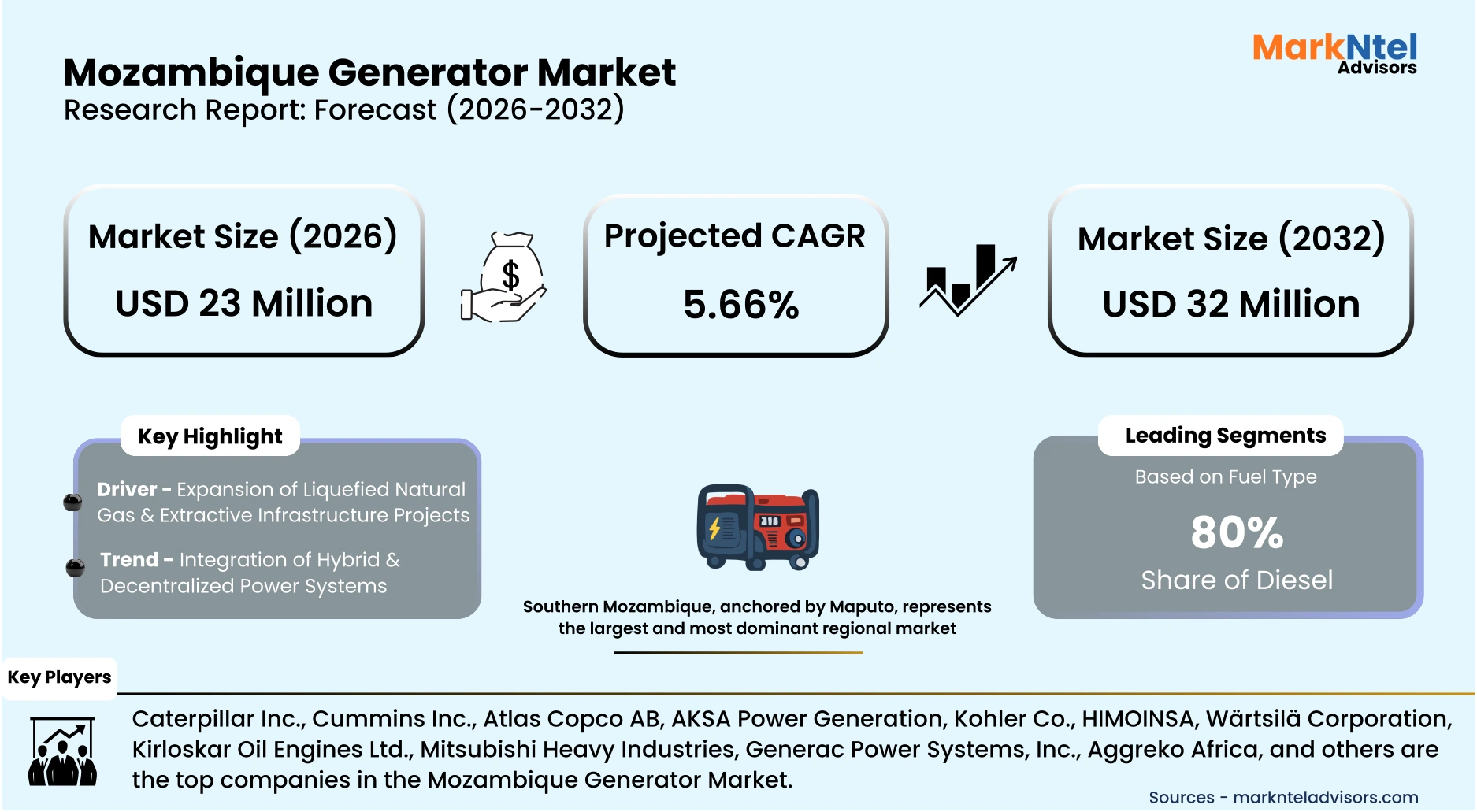
Market Size (2026)
USD 23 Million
Market Size (2032)
USD 32 Million
Base Year
2025
Projected CAGR
5.66%
Leading Segments
By Fuel Type: Diesel
Mozambique Generator Market Report Key Takeaways:
- The Mozambique Generator market size was valued at USD 22 million in 2025 and is projected to grow from USD 23 million in 2026 to USD 32 million by 2032, exhibiting a CAGR of 5.66% during the forecast period.
- South of Mozambique is the leading region with a significant share of 50% in 2026.
- By Application Type, the Standby segment represented a significant share of about 60% in the Mozambique Generator Market in 2026.
- By Fuel type, the diesel segment presented a significant share of about 80% in the Mozambique Generator Market in 2026.
- Leading Generator Companies in Mozambique are Caterpillar Inc., Cummins Inc., Atlas Copco AB, AKSA Power Generation, Kohler Co., HIMOINSA, Wärtsilä Corporation, Kirloskar Oil Engines Ltd., Mitsubishi Heavy Industries, Generac Power Systems, Inc., Aggreko Africa, and Others.
Market Insights & Analysis: Mozambique Generator Market (2026-32):
The Mozambique Generator market size was valued at USD 22 million in 2025 and is projected to grow from USD 23 million in 2026 to USD 32 million by 2032, exhibiting a CAGR of 5.66% during the forecast period. i.e, 2026-32.
Mozambique’s generator market continues to expand alongside structural economic development and power-sector reforms. The World Bank reported in 2025 that national electricity access surpassed 60%, reflecting rapid grid extension but also rising demand for reliable backup solutions in newly connected zones. Urban population growth, estimated by the United Nations in major cities, has intensified electricity consumption in residential and commercial clusters. As grid expansion stimulates appliance ownership and digital connectivity, standby generator adoption has increased to mitigate voltage instability and short-duration outages in expanding peri-urban districts.
Current market conditions are shaped by infrastructure modernization and industrial diversification. In 2025, the Government of Mozambique advanced transmission upgrades under the national utility Electricidade de Moçambique (EDM) to strengthen network reliability and regional interconnections. Parallel industrial activity in liquefied natural gas projects in Cabo Delgado and logistics operations at the Port of Maputo have elevated demand for medium-capacity gensets for operational continuity. Commercial offices, retail complexes, and hospitality facilities in Maputo increasingly deploy automated diesel backup systems to maintain service standards and digital payment operations during supply interruptions.
Policy frameworks are reinforcing structured power investment and indirectly sustaining generator demand. The government’s 2026 implementation phase of the Energy for All strategy prioritizes universal access by 2030, encouraging private participation and decentralized solutions. Fiscal measures within the national industrialization agenda promote local assembly and technical servicing capabilities, reducing equipment downtime and improving lifecycle efficiency. Institutional users, including healthcare facilities and educational campuses supported by multilateral financing programs, are procuring resilient backup systems to comply with updated safety and service continuity regulations.
Looking ahead, demographic expansion, extractive-sector investment, and cross-border electricity trade integration are expected to support stable medium-term growth in generator sales. The African Development Bank’s 2025 regional outlook highlights sustained capital inflows into southern African infrastructure corridors, benefiting Mozambique’s transport and energy linkages. Industrial parks and special economic zones under development are projected to stimulate additional prime-power installations for manufacturing clusters. Together, regulatory reforms, diversified end-user demand, and industrial capacity expansion provide a positive and structured outlook for Mozambique’s generator market through the remainder of the decade.
Mozambique Generator Market Scope:
| Category | Segments |
|---|---|
| By Power Rating | (Upto 5 KVA, 6 KVA to 20 KVA, 21 KVA to 75 KVA, 76 KVA to 375 KVA, 376 KVA to 750 KVA, 751 KVA to 2000 KVA, Above 2000 KVA), |
| By Application | (Standby, Prime & Continuous, Peak Shaving), |
| By End User | (Residential, Commercial Offices, Hospitality, Retail, Data Centers, Telecom, Oil & Gas, Government & Transport, Equipment Rental Companies, Mining, Defense), |
| By Fuel Type | (Diesel, Ethanol, Methane, Natural Gas, Gasoline, Hybrid (DG + Natural Gas), Others) |
Mozambique Generator Market Driver:
Expansion of Liquefied Natural Gas & Extractive Infrastructure Projects
The most influential structural driver of Mozambique’s generator market is the accelerated expansion of liquefied natural gas and extractive infrastructure projects. In 2025, TotalEnergies confirmed the phased resumption of its USD 20 billion Mozambique LNG development in Cabo Delgado, signaling renewed capital deployment and contractor mobilization. L arge-scale upstream and midstream operations require continuous onsite power for drilling, processing, accommodation camps, and logistics hubs. These facilities are often located in remote zones where grid connectivity remains limited or operational reliability cannot meet industrial standards.
The emergence of this driver intensified after security stabilization efforts and renewed international financing commitments restored investor confidence in northern Mozambique. According to the African Development Bank’s 2025 regional outlook, energy and extractive investments represent a significant share of capital inflows into the country. Industrial-scale LNG construction generates measurable demand for medium- and high-capacity diesel and gas generators to support engineering works, heavy machinery, and temporary site infrastructure. Unlike cyclical consumer demand, these projects create sustained multi-year procurement contracts for prime and standby power systems.
This driver materially expands market volume because each industrial site requires multiple generator units across varying capacities rather than single-point installations. Power demand at extraction and processing facilities runs continuously, increasing equipment turnover, maintenance cycles, and replacement needs. The scale of capital expenditure, combined with supplier agreements for backup redundancy, directly increases unit shipments rather than merely influencing pricing structures. As additional gas phases and mineral developments proceed through 2026 planning schedules, generator demand is expected to remain structurally anchored to Mozambique’s expanding resource sector.
Mozambique Generator Market Trend:
Integration of Hybrid & Decentralized Power Systems
A defining market trend in Mozambique’s generator sector is the integration of hybrid and decentralized power systems, combining diesel generators with solar and battery storage. In 2025, the World Bank approved additional financing under the ASCENT program to expand off-grid and mini-grid solutions across rural districts. These projects promote solar-based generation supported by backup diesel units to ensure reliability in low-density areas. The policy shift toward decentralized electrification has accelerated the deployment of hybrid configurations rather than standalone generator installations.
This trend is reshaping operational models across the value chain by encouraging engineering firms and equipment suppliers to bundle generators with photovoltaic panels and energy management systems. Electricidade de Moçambique’s rural electrification rollout increasingly incorporates mini-grid structures where diesel provides contingency supply during peak loads or low solar output. Telecom operators and health facilities supported by donor-funded electrification initiatives are adopting integrated systems to reduce fuel consumption and operational costs. As a result, generator demand is shifting toward smarter, fuel-optimized units compatible with hybrid controls.
Hybrid systems lower lifecycle emissions while preserving reliability, aligning with national sustainability targets and multilateral funding criteria. Continued public-private partnerships and concessional financing for decentralized grids are expected to institutionalize hybrid adoption. Consequently, generator manufacturers and distributors are adapting product portfolios to ensure compatibility with renewable-integrated power systems.
Mozambique Generator Market Opportunity:
Localized Assembly and After-Sales Service Expansion
A compelling opportunity in Mozambique’s generator market lies in localized assembly and after-sales service operations. In 2025, the Government of Mozambique reinforced its Industrial Policy and Competitiveness Strategy to promote domestic value addition and reduce import dependency in machinery and equipment segments . Simultaneously, customs modernization reforms under the Southern African Development Community trade facilitation framework have streamlined component imports while encouraging in-country finishing activities. These structural adjustments create favorable conditions for smaller entrants to establish semi-knocked-down assembly lines rather than rely solely on fully imported units.
This opportunity translates into tangible demand because industrial, telecom, and institutional users require rapid maintenance response and locally available spare parts to minimize downtime. At MMEC 2025, the Government announced aims to ensure that at least 30% of mineral resources are processed domestically by 2030, reinforcing legal reforms to deepen local industrial participation and value chains, consistently identifying electricity reliability and equipment servicing capacity as operational constraints. By positioning near high-demand corridors such as Maputo and Beira, new entrants can offer faster service agreements and tailored configurations suited to local voltage and load conditions. The ability to bundle installation, maintenance contracts, and operator training directly increases recurring revenue streams.
The model is particularly advantageous for emerging players because large multinational manufacturers typically centralize production outside the country. Smaller firms can leverage lower setup costs, workforce training programs supported by national technical institutes, and proximity to clients to differentiate through responsiveness. As public procurement guidelines increasingly emphasize service reliability and lifecycle efficiency, locally embedded providers gain competitive leverage. Consequently, localized assembly combined with technical servicing represents a scalable and defensible market entry pathway.
Mozambique Generator Market Challenge:
Import Dependence & Logistics Bottlenecks
A significant structural challenge in Mozambique’s generator market is the heavy dependence on imported equipment, combined with logistics and port capacity constraints. Recent World Bank assessments of trade and transport systems across Sub-Saharan Africa indicate that customs processing times and infrastructure gaps remain persistent constraints in several regional economies. These findings highlight broader structural inefficiencies in border management, port handling capacity, and inland transport connectivity that affect the movement of capital goods. While not country-specific, the regional analysis reflects common operational challenges faced by import-dependent markets affecting capital goods imports. Generators, engines, and spare parts are predominantly sourced from Europe and Asia, making the market highly sensitive to shipping schedules and border procedures. This structural reliance increases exposure to freight costs, transit disruptions, and administrative clearance timelines.
The operational impact is measurable across distributors and industrial end users who require predictable delivery schedules. Port congestion and inland transport limitations can extend delivery cycles, affecting project commissioning in construction, telecom, and industrial facilities. When installation timelines shift, contractors incur additional holding and labor costs, reducing operational efficiency. Smaller suppliers often face working capital pressure because inventory replenishment cycles are prolonged and tied to international shipment arrivals.
This constraint materially restricts market expansion by limiting rapid scalability and discouraging aggressive market entry. Businesses seeking immediate standby solutions may postpone purchases if equipment availability is uncertain. Large infrastructure and resource projects depend on synchronized equipment mobilization, and supply chain interruptions directly affect deployment timelines. Ongoing multi-billion-dollar logistics investments and Maputo Corridor upgrades highlight the existing capacity bottlenecks and the government’s recognition of the need for improved freight flow, indicating current constraints that affect imports of built-up equipment.
Mozambique Generator Market (2026-32) Segmentation Analysis:
The Mozambique Generator Market study of MarkNtel Advisors evaluates and highlights the major trends and influencing factors in each segment. It includes predictions for the period 2026–32 at the country level. Based on the analysis, the market has been further classified as follows:
Based on Application:
- Standby
- Prime & Continuous
- Peak Shaving
The Standby segment holds a dominant share in the Mozambique generator market with a market share of 60%, driven by persistent grid reliability gaps and voltage instability in expanding urban corridors. Although electrification rates have improved under national access programs, operational continuity remains critical for commercial and institutional facilities. Businesses in Maputo and Beira deploy automatic standby systems to prevent service interruptions affecting digital payments, cold storage, and data operations. This structural reliance ensures sustained baseline demand independent of seasonal or short-term fluctuations.
Government-led infrastructure expansion and public service modernization further reinforce standby adoption across healthcare, transport terminals, and administrative facilities. Regulatory requirements for uninterrupted power in hospitals and telecom towers necessitate backup redundancy systems. Private investment in office parks, retail centers, and hospitality facilities integrates standby gensets as part of mandatory risk mitigation planning. As service-sector growth accelerates, dependable backup solutions remain embedded within capital expenditure frameworks.
The segment’s leadership is sustained because standby units are installed across diverse end-user categories rather than concentrated in a single industry. Unlike prime systems tied to remote projects, standby demand is distributed nationwide across small enterprises and large institutions alike. Replacement cycles and maintenance contracts create recurring procurement activity. Consequently, the Stand-By segment maintains structural dominance through 2026–32 in Mozambique.
Based on Fuel Type:
- Diesel
- Ethanol
- Methane
- Natural Gas
- Gasoline
- Hybrid (DG + Natural Gas)
- Others
Diesel remains the leading fuel segment in Mozambique’s generator market with a market share of 80% due to established fuel distribution networks and compatibility with medium- and high-capacity installations. The country’s transport and logistics systems are already structured around diesel supply for heavy vehicles and industrial machinery. Although Mozambique increased national electricity access from 31% to 60% by 2024, consistent and uninterrupted supply remains a critical challenge across several regions. The country’s USD 6 billion power expansion initiative, grid expansion alone, does not immediately resolve reliability gaps or transmission constraints.
This means that businesses, healthcare facilities, telecom towers, and commercial establishments cannot depend solely on grid connectivity for operational continuity. Consequently, there is a sustained need for dependable standby and prime power solutions, particularly diesel generators, to mitigate outage risks and ensure uninterrupted service delivery. Fuel availability in both urban and remote zones strengthens diesel’s practical advantage.
Industrial and extractive projects require durable, high-output generators capable of sustained performance under variable load conditions. Diesel engines provide higher torque and reliability for construction sites, mining camps, and port operations. Financial institutions and public procurement agencies frequently favor diesel systems because of predictable maintenance structures and widespread technician familiarity. These operational characteristics reinforce procurement consistency across end-user segments.
The dominance persists because alternative fuels lack equivalent nationwide distribution or storage infrastructure. While hybrid and gas solutions are emerging, they remain project-specific and capital-intensive. Diesel units offer scalable capacity ranges suited to residential, commercial, and industrial applications.
Mozambique Generator Market (2026-32) Regional Analysis:
Southern Mozambique, anchored by Maputo, represents the largest and most dominant regional market with a market share of 50% due to its economic concentration and infrastructure intensity. Maputo represents a significantly larger share of Mozambique’s economic output relative to its population size, underscoring its structural economic dominance. Although the city accounts for only about 5.4% of the national population, it generates approximately 20.2% of the country’s GDP.
The capital concentrates the majority of corporate headquarters, financial services, trade operations, and manufacturing activities, making it the principal commercial and administrative hub of Mozambique. The Port of Maputo handled 30.9 million tons of cargo in 2024 and is undergoing expansion to roughly double container capacity by 2027, underlining its role as a key regional logistics hub, which handles the majority of Mozambique’s containerized and transit trade, strengthening industrial and logistics activity. High trade throughput directly increases demand for reliable backup and prime power solutions across warehouses, terminals, and processing facilities.
Maputo Province approved 68 investment projects totaling over USD 2 billion and hosts 1,086 manufacturing industries, cementing its status as the country’s principal industrial hub. Additionally, large-scale LNG-related logistics and financial services operations are coordinated through Maputo-based corporate headquarters, concentrating commercial electricity demand. Regulatory requirements for operational continuity in banking, telecom, and healthcare sectors further drive standby generator adoption in the region.
End-user demand is highly concentrated in southern Mozambique, where the majority of registered enterprises operate. Commercial real estate, retail centres, and hospitality facilities are primarily clustered in Maputo Province. This geographic clustering of businesses, trade infrastructure, and administrative institutions structurally positions Southern Mozambique as the leading regional generator market.
Gain a Competitive Edge with Our Mozambique Generator Market Report:
- The Mozambique Generator Market Report by MarkNtel Advisors provides a detailed & thorough analysis of market size & share, growth rate, competitive landscape, and key players. This comprehensive analysis helps businesses gain a holistic understanding of the market dynamics & make informed decisions.
- This report also highlights current market trends & future projections, allowing businesses to identify emerging opportunities & potential challenges. By understanding market forecasts, companies can align their strategies & stay ahead of the competition.
- The Mozambique Generator Market Report aids in assessing & mitigating risks associated with entering or operating in the market. By understanding market dynamics, regulatory frameworks, and potential challenges, businesses can develop strategies to minimise risks & optimize their operations.
*Reports Delivery Format - Market research studies from MarkNtel Advisors are offered in PDF, Excel and PowerPoint formats. Within 24 hours of the payment being successfully received, the report will be sent to your email address.
Frequently Asked Questions
- Market Segmentation
- Introduction
- Product Definition
- Research Process
- Assumptions
- Executive Summary
- Mozambique Generator Supply Chain Analysis
- Mozambique Generator Import-Export Analysis
- Mozambique Generator Market Trends & Developments
- Mozambique Generator Market Dynamics
- Drivers
- Challenges
- Mozambique Generator Market Hotspot & Opportunities
- Mozambique Generator Market Policies & Regulations
- Mozambique Generator Market Outlook, 2022-32F
- Market Size & Analysis
- By Revenues (USD Million)
- By Unit Sold (Thousand)
- Market Segmentation & Analysis
- By Power Rating- (USD Million & Thousand Units)
- Upto 5 KVA
- 6 KVA to 20 KVA
- 21 KVA to 75 KVA
- 76 KVA to 375 KVA
- 376 KVA to 750 KVA
- 751 KVA to 2000 KVA
- Above 2000 KVA
- By Application- (USD Million & Thousand Units)
- Standby
- Prime & Continuous
- Peak Shaving
- By End User- (USD Million & Thousand Units)
- Residential
- Commercial Offices
- Hospitality
- Retail
- Data Centers
- Telecom
- Oil & Gas
- Government & Transport
- Industrial (Manufacturing Facilities, Assembly Units, etc.)
- Equipment Rental Companies
- Mining
- Defense
- Others (Agriculture, Healthcare, Educational Institutes, etc.)
- By Fuel Type- (USD Million & Thousand Units)
- Diesel
- Ethanol
- Methane
- Natural Gas
- Gasoline
- Hybrid (DG + Natural Gas)
- Others
- By Competition
- Competition Characteristics
- Market Share of Top Companies
- By Power Rating- (USD Million & Thousand Units)
- Market Size & Analysis
- Mozambique Diesel Generator Market Outlook, 2022-32F
- Market Size & Analysis
- By Revenues (USD Million)
- By Unit Sold (Thousand)
- Market Segmentation & Analysis
- By Power Rating- (USD Million & Thousand Units)
- By End User- (USD Million & Thousand Units)
- By Application- (USD Million & Thousand Units)
- Market Size & Analysis
- Mozambique Ethanol Generator Market Outlook, 2022-32F
- Market Size & Analysis
- By Revenues (USD Million)
- By Unit Sold (Thousand)
- Market Segmentation & Analysis
- By Power Rating- (USD Million & Thousand Units)
- By End User- (USD Million & Thousand Units)
- By Application- (USD Million & Thousand Units)
- Market Size & Analysis
- Mozambique Methane Generator Market Outlook, 2022-32F
- Market Size & Analysis
- By Revenues (USD Million)
- By Unit Sold (Thousand)
- Market Segmentation & Analysis
- By Power Rating- (USD Million & Thousand Units)
- By End User- (USD Million & Thousand Units)
- By Application- (USD Million & Thousand Units)
- Market Size & Analysis
- Mozambique Natural Gas Generator Market Outlook, 2022-32F
- Market Size & Analysis
- By Revenues (USD Million)
- By Unit Sold (Thousand)
- Market Segmentation & Analysis
- By Power Rating- (USD Million & Thousand Units)
- By End User- (USD Million & Thousand Units)
- By Application- (USD Million & Thousand Units)
- Market Size & Analysis
- Mozambique Gasoline Generator Market Outlook, 2022-32F
- Market Size & Analysis
- By Revenues (USD Million)
- By Unit Sold (Thousand)
- Market Segmentation & Analysis
- By Power Rating- (USD Million & Thousand Units)
- By End User- (USD Million & Thousand Units)
- By Application- (USD Million & Thousand Units)
- Market Size & Analysis
- Mozambique Hybrid (DG + Natural Gas) Generator Market Outlook, 2022-32F
- Market Size & Analysis
- By Revenues (USD Million)
- By Unit Sold (Thousand)
- Market Segmentation & Analysis
- By Power Rating- (USD Million & Thousand Units)
- By End User- (USD Million & Thousand Units)
- By Application- (USD Million & Thousand Units)
- Market Size & Analysis
- Competitive Outlook
- Company Profiles
- Caterpillar Inc.
- Business Description
- Product Portfolio
- Strategic Alliances or Partnerships
- Recent Developments
- Financial Details
- Others
- Cummins Inc.
- Business Description
- Product Portfolio
- Strategic Alliances or Partnerships
- Recent Developments
- Financial Details
- Others
- Atlas Copco AB
- Business Description
- Product Portfolio
- Strategic Alliances or Partnerships
- Recent Developments
- Financial Details
- Others
- AKSA Power Generation
- Business Description
- Product Portfolio
- Strategic Alliances or Partnerships
- Recent Developments
- Financial Details
- Others
- Kohler Co.
- Business Description
- Product Portfolio
- Strategic Alliances or Partnerships
- Recent Developments
- Financial Details
- Others
- HIMOINSA
- Business Description
- Product Portfolio
- Strategic Alliances or Partnerships
- Recent Developments
- Financial Details
- Others
- Wärtsilä Corporation
- Business Description
- Product Portfolio
- Strategic Alliances or Partnerships
- Recent Developments
- Financial Details
- Others
- Kirloskar Oil Engines Ltd.
- Business Description
- Product Portfolio
- Strategic Alliances or Partnerships
- Recent Developments
- Financial Details
- Others
- Mitsubishi Heavy Industries
- Business Description
- Product Portfolio
- Strategic Alliances or Partnerships
- Recent Developments
- Financial Details
- Others
- Generac Power Systems, Inc.
- Business Description
- Product Portfolio
- Strategic Alliances or Partnerships
- Recent Developments
- Financial Details
- Others
- Aggreko Africa
- Business Description
- Product Portfolio
- Strategic Alliances or Partnerships
- Recent Developments
- Financial Details
- Others
- Others
- Caterpillar Inc.
- Company Profiles
- Disclaimer
MarkNtel Advisors follows a robust and iterative research methodology designed to ensure maximum accuracy and minimize deviation in market estimates and forecasts. Our approach combines both bottom-up and top-down techniques to effectively segment and quantify various aspects of the market. A consistent feature across all our research reports is data triangulation, which examines the market from three distinct perspectives to validate findings. Key components of our research process include:
1. Scope & Research Design At the outset, MarkNtel Advisors define the research objectives and formulate pertinent questions. This phase involves determining the type of research—qualitative or quantitative—and designing a methodology that outlines data collection methods, target demographics, and analytical tools. They also establish timelines and budgets to ensure the research aligns with client goals.
2. Sample Selection and Data Collection In this stage, the firm identifies the target audience and determines the appropriate sample size to ensure representativeness. They employ various sampling methods, such as random or stratified sampling, based on the research objectives. Data collection is carried out using tools like surveys, interviews, and observations, ensuring the gathered data is reliable and relevant.
3. Data Analysis and Validation Once data is collected, MarkNtel Advisors undertake a rigorous analysis process. This includes cleaning the data to remove inconsistencies, employing statistical software for quantitative analysis, and thematic analysis for qualitative data. Validation steps are taken to ensure the accuracy and reliability of the findings, minimizing biases and errors.

4. Data Forecast and FinalizationThe final phase involves forecasting future market trends based on the analyzed data. MarkNtel Advisors utilize predictive modeling and time series analysis to anticipate market behaviors. The insights are then compiled into comprehensive reports, featuring visual aids like charts and graphs, and include strategic recommendations to inform client decision-making
We offer flexible licensing options to cater to varying organizational needs. Choose the pricing pack that best suits your requirements:
Buy Now Inquire Before Buying
 Request Customization
 Talk to our Consultant







