

Middle East Precision Strike Missile Market Research Report: Growth Drivers & Forecast (2026-2032)
By Missile Type (Surface-to-Surface Missiles (Tactical Ballistic Missiles (TBM), Short-Range Ballistic Missiles (SRBM), Ground-Launched Cruise Missile), Air-to-Surface Missiles (AS ... M) (Stand-off Land Attack Missiles, Air-Launched Anti-Ship Missiles), Surface-to-Air Missiles (SAM) (Long-Range Air Defense Interceptors, Medium-Range Air Defense Systems, Terminal Defense / Anti-Ballistic Missiles), Anti-Ship Missiles (Naval Strike) (Ship-Launched Anti-Ship Missiles, Coastal Defense Missile Systems, Air-Launched Anti-Ship Missiles), Anti-Tank Guided Missiles (Man-Portable ATGM, Vehicle-Mounted ATGM)), By Range Category (Short Range (<300 km), Short-to-Medium Range (300–500 km), Medium Range (500–1,000 km), Intermediate Range (>1,000 km)), By Guidance Technology (GPS / GNSS Guided, Inertial Navigation System (INS), Electro-Optical / Imaging Infrared (EO/IIR), Radar Seeker Guided, Multi-Mode Seeker (GPS + INS + EO/IIR), AI-Enabled / Autonomous Targeting), By Launch Platform (Land-Based Launch Systems, Air-Based Launch Systems, Naval Launch Systems), By Warhead Type (High-Explosive (HE), Penetration / Bunker-buster, Anti-Ship, Anti-Radiation (SEAD/DEAD missions), Cluster / Sub-munition (declining but present), Multi-Role Smart Warheads), By End User (Military or Ground Forces, Air Force, Naval Forces, Strategic Missile Forces / Deterrence Commands), and others Read more
- Aerospace & Defense
- Feb 2026
- Pages 170
- Report Format: PDF, Excel, PPT
Middle East Precision Strike Missile Market
Projected 15.80% CAGR from 2026 to 2032
Study Period
2026-2032
Market Size (2026)
USD 0.68 Billion
Market Size (2032)
USD 1.89 Billion
Base Year
2025
Projected CAGR
15.80%
Leading Segments
By End User: Air Force
Middle East Precision Strike Missile Market Report Key Takeaways:
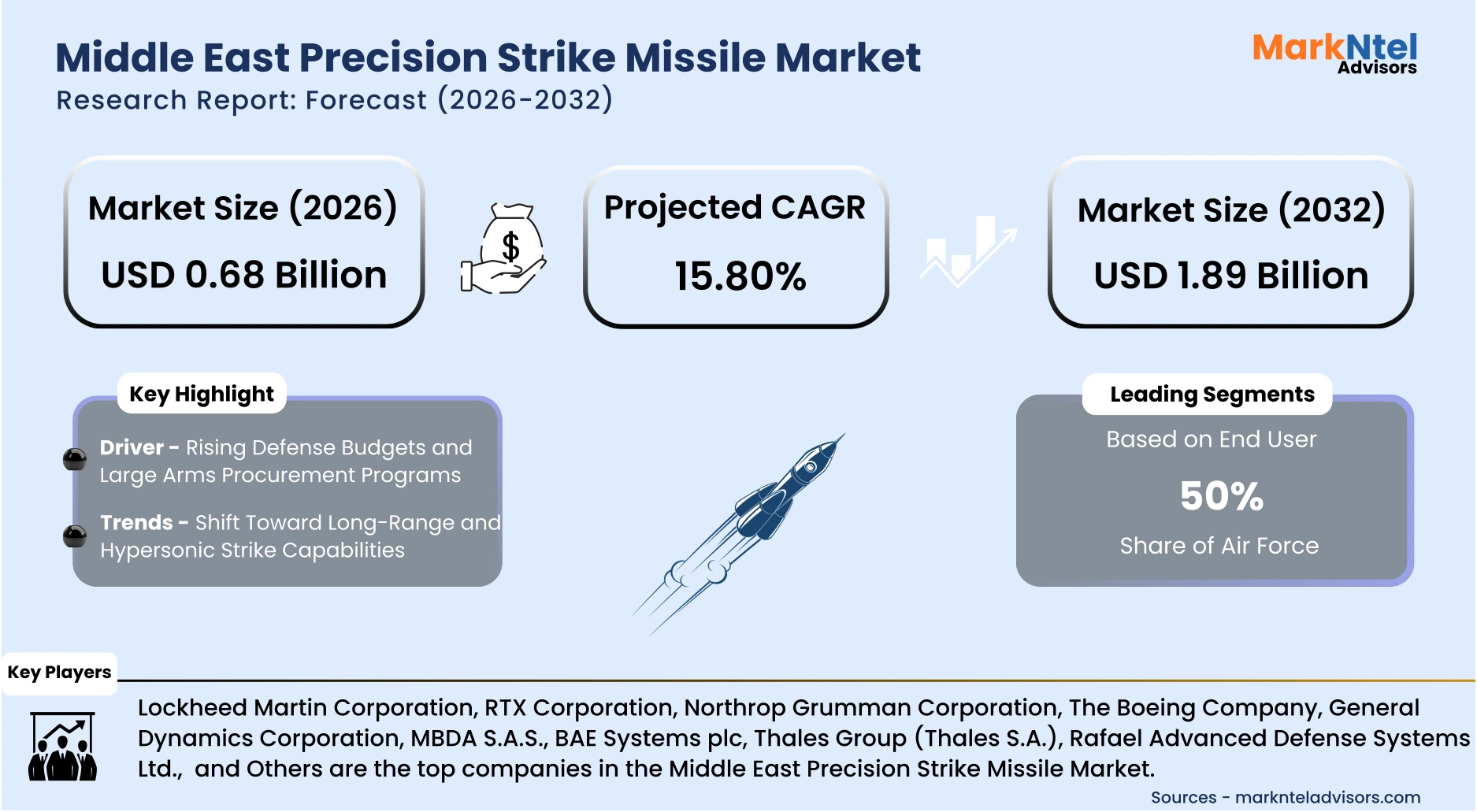
- Market size is estimated at USD 0.68 billion in 2026 and is projected to reach USD 1.89 billion by 2032. The estimated CAGR from 2026 to 2032 is around 15.80%, indicating strong growth.
- Israel holds the largest market share of about 27% in the Middle East Precision Strike Missile Market in 2026.
- By missile type, the air-to-surface missiles (ASM) segment represented a significant share of about 47% in the Middle East Precision Strike Missile Market in 2026.
- By end user, the air force segment presented a significant share of about 50% in the Middle East Precision Strike Missile Market in 2025.
- Leading precision strike missile companies in the Middle East Market are Lockheed Martin Corporation, RTX Corporation, Northrop Grumman Corporation, The Boeing Company, General Dynamics Corporation, MBDA S.A.S., BAE Systems plc, Thales Group (Thales S.A.), Rafael Advanced Defense Systems Ltd., Israel Aerospace Industries Ltd. (IAI), Elbit Systems Ltd., Kongsberg Defence & Aerospace AS, Saab AB, and Others.
Market Insights & Analysis: Middle East Precision Strike Missile Market (2026-32):
The Middle East Precision Strike Missile Market size is estimated at USD 0.68 billion in 2026 and is projected to reach USD 1.89 billion by 2032. Along with this, the market is estimated to grow at a CAGR of around 15.80% during the forecast period, i.e., 2026-32.
The Middle East Precision Strike Missile Market is projected to expand steadily, driven by rising defense budgets that are accelerating large-scale procurement, enabling the adoption of long-range and hypersonic strike capabilities, and fostering defense offsets and international joint ventures that strengthen regional production and partnerships.
Procurement momentum was strongly demonstrated at the International Defence Exhibition (IDEX) 2025, where the United Arab Emirates signed approximately USD 6.3 billion in defense contracts. A substantial portion of these agreements focused on advanced weapons systems and partnerships aimed at strengthening domestic production and supply-chain resilience. This reflects a clear strategic shift toward long-term capability development and reduced reliance on external suppliers.
Large-scale procurement programs continue to reinforce the central role of missile systems in regional defense planning. In 2024, Saudi Arabia ordered the Cheongung II air defense missile system valued at USD 3.2 billion, strengthening its medium-range interception layer and complementing existing missile defense networks .
Additionally, the U.S. approval of a USD 252 million sale of 220 AIM-9X Block II tactical missiles in October 2024 highlights ongoing replenishment and expansion of precision-guided weapon inventories. These purchases demonstrate sustained demand across both offensive and defensive missile capabilities.
Technological modernization is simultaneously reshaping long-term demand. In 2025, Iran unveiled the Qassem Bassir medium-range ballistic missile, reportedly designed with improved guidance, enhanced countermeasure resistance, and a range of approximately 1,200 km. Such developments are prompting regional governments to accelerate investment in advanced strike and layered defense systems capable of addressing increasingly sophisticated threats.
Industrial partnerships are further strengthening the market’s long-term outlook. The 2025 cooperation agreement between EDGE Group and Hanwha Aerospace aims to explore joint development and localized production of advanced air and missile defense technologies in the UAE. These collaborations are expanding the regional industrial base and enabling sustained procurement pipelines.
Forward-looking investment commitments reinforce long-term demand visibility. For example, Israel announced an additional USD 12.5 billion defense spending increase through 2026 to support urgent procurement and strengthen operational readiness .
Meanwhile, Saudi Arabia’s General Authority for Military Industries reported defense localization reaching 24.89% by 2024, demonstrating measurable progress toward long-term industrialization goals that will sustain procurement demand in the coming years.
Collectively, the combination of large-scale procurement, accelerating technological modernization, and expanding industrial partnerships is creating a strong and durable growth trajectory for the Middle East precision strike missile market over the coming decade.
Middle East Precision Strike Missile Market Recent Developments:
- 2026: The United States approved a potential USD 9 billion sale of Patriot missiles and related support to Saudi Arabia, reinforcing the kingdom’s air and missile defense capabilities amid heightened regional tensions. The deal highlights sustained demand for advanced precision-strike and interception systems across the Middle East.
- 2025: Israel has successfully completed testing of an upgraded David’s Sling missile defense system, marking a significant enhancement in its precision-strike and air-defense capabilities. The upgrade is designed to improve interception performance against advanced and long-range threats, reinforcing Israel’s layered missile defense architecture amid evolving regional security challenges.
Middle East Precision Strike Missile Market Scope:
| Category | Segments |
|---|---|
| By Missile Type | (Surface-to-Surface Missiles (Tactical Ballistic Missiles (TBM), Short-Range Ballistic Missiles (SRBM), Ground-Launched Cruise Missile), Air-to-Surface Missiles (ASM) (Stand-off Land Attack Missiles, Air-Launched Anti-Ship Missiles), Surface-to-Air Missiles (SAM) (Long-Range Air Defense Interceptors, Medium-Range Air Defense Systems, Terminal Defense / Anti-Ballistic Missiles), Anti-Ship Missiles (Naval Strike) (Ship-Launched Anti-Ship Missiles, Coastal Defense Missile Systems, Air-Launched Anti-Ship Missiles), Anti-Tank Guided Missiles (Man-Portable ATGM, Vehicle-Mounted ATGM)), |
| By Range Category | (Short Range (<300 km), Short-to-Medium Range (300–500 km), Medium Range (500–1,000 km), Intermediate Range (>1,000 km)), |
| By Guidance Technology | (GPS / GNSS Guided, Inertial Navigation System (INS), Electro-Optical / Imaging Infrared (EO/IIR), Radar Seeker Guided, Multi-Mode Seeker (GPS + INS + EO/IIR), AI-Enabled / Autonomous Targeting), |
| By Launch Platform | (Land-Based Launch Systems, Air-Based Launch Systems, Naval Launch Systems), |
| By Warhead Type | (High-Explosive (HE), Penetration / Bunker-buster, Anti-Ship, Anti-Radiation (SEAD/DEAD missions), Cluster / Sub-munition (declining but present), Multi-Role Smart Warheads), |
| By End User | (Military or Ground Forces, Air Force, Naval Forces, Strategic Missile Forces / Deterrence Commands), |
Middle East Precision Strike Missile Market Driver:
Rising Defense Budgets and Large Arms Procurement Programs
Sustained growth in military spending across the Middle East is significantly accelerating demand for precision strike missile systems as governments prioritize deterrence, modernization, and long-range strike readiness.
According to the Stockholm International Peace Research Institute (SIPRI), regional military expenditure reached USD 243 billion in 2024, representing a 15% increase from 2023 and the fastest annual rise in more than a decade. This surge reflects intensifying geopolitical tensions, the need to modernize armed forces, and growing emphasis on advanced precision-guided capabilities capable of addressing evolving security threats.
Saudi Arabia continues to anchor regional procurement demand. The Kingdom spent USD 75.8 billion on defense in 2024 and allocated approximately USD 78 billion in its 2025 national budget, accounting for 21% of total government expenditure and 7.19% of GDP. Under Vision 2030, the government aims to localize over 50% of defense spending by 2030, a policy expected to create long-term procurement pipelines for advanced missile systems and domestic production partnerships.
Israel has also expanded defense allocations amid heightened security challenges. Military spending reached USD 46.5 billion in 2024, while the proposed 2025 budget includes approximately USD 110 billion for defense, reflecting record-level investment in advanced strike capabilities and missile systems designed to strengthen deterrence and operational readiness.
Overall, rising defense budgets across major regional powers are generating sustained procurement pipelines for advanced missile technologies. This long-term financial commitment will continue to accelerate adoption and drive strong growth in the Middle East precision strike missile market.
Middle East Precision Strike Missile Market Trend:
Shift Toward Long-Range and Hypersonic Strike Capabilities
Military modernization across the Middle East is increasingly centered on long-range and hypersonic strike technologies as governments seek to counter high-speed maneuverable threats and enhance deep-strike precision capabilities.
Iran publicly unveiled the Fattah-1 hypersonic missile in 2023, claiming speeds of Mach 13–15 and a range of approximately 1,400 km, signaling a major leap in regional strike capabilities and accelerating competition in advanced missile technologies.
Operational developments have reinforced the urgency of this transition. Missile launches reported during 2024–2025 regional conflicts included claims of high-velocity missiles capable of traveling around 2,000 km within minutes, demonstrating the growing speed, reach, and maneuverability of modern strike systems. Such incidents have intensified demand for advanced precision-strike and missile-defense solutions, reshaping procurement strategies and driving new investment priorities among regional armed forces.
These developments are prompting defense planners to prioritize systems capable of penetrating sophisticated air-defense networks and executing rapid long-range missions. The shift is also encouraging greater investment in next-generation propulsion, guidance, and high-speed maneuverability technologies, reinforcing long-term modernization strategies across the region.
The growing emphasis on hypersonic and long-range strike capabilities is fundamentally transforming regional procurement priorities. This sustained technological shift is expected to drive continuous investment and accelerate demand for advanced precision strike missile systems in the Middle East.
Middle East Precision Strike Missile Market Opportunity:
Expansion of Defense Offsets and International Joint Ventures
Defense offset policies across the Middle East are evolving into a major entry pathway for new participants in the precision-strike missile ecosystem. Governments increasingly require foreign defense suppliers to transfer technology, build local manufacturing capacity, and integrate domestic firms into global supply chains.
In the United Arab Emirates, the Tawazun Economic Council’s offset framework continues to drive industrial partnerships and technology transfer initiatives that strengthen indigenous defense capabilities and reduce reliance on imports.
International joint ventures are expanding rapidly. In 2024, EDGE Group signed a cooperation agreement with Adani Defence & Aerospace to collaborate on missile and smart-weapons development, alongside plans for joint research, production, and lifecycle support facilities. This partnership reflects the growing role of cross-border industrial alliances in accelerating technology adoption and strengthening domestic production capacity.
Bilateral government agreements are reinforcing this trend. In 2025, Saudi Arabia and South Korea signed a quality-assurance cooperation agreement to deepen defense industrial collaboration and facilitate technology exchange, supporting future weapons development and localized manufacturing.
Expanding offset requirements and joint ventures are opening the regional defense ecosystem to new suppliers and technology partners. These collaborations will accelerate localization and sustain long-term demand for precision-strike missile technologies across the Middle East.
Middle East Precision Strike Missile Market Challenge:
High Development, Procurement, and Lifecycle Costs
The Middle East precision strike missile market faces a major structural constraint due to the exceptionally high cost of acquiring and sustaining advanced missile systems. In 2024, the U.S. State Department approved the sale of 300 Patriot MIM-104E GEM-T missiles to Saudi Arabia valued at USD 3.05 billion, illustrating the enormous upfront capital required for modern precision strike capabilities.
The same announcement highlighted an additional USD 2.25 billion THAAD missile package for the UAE, which included launch control stations, spare parts, and system integration support. Such agreements reveal how long-term maintenance, replenishment, and upgrades create recurring financial obligations for governments.
Procurement costs escalate further for advanced missile defense and strike systems. In 2024, the U.S. Defense Security Cooperation Agency approved a USD 15 billion THAAD system sale to Saudi Arabia, underscoring the massive capital investments needed for high-end missile defense infrastructure. These financial demands compete with national economic diversification and infrastructure spending priorities, especially for smaller regional defense budgets.
Overall, the extremely high cost of development, acquisition, and long-term sustainment significantly slows procurement timelines and limits adoption, acting as a major constraint on the expansion of the Middle East precision strike missile market.
Middle East Precision Strike Missile Market (2026-32) Segmentation Analysis:
The Middle East Precision Strike Missile Market study of MarkNtel Advisors evaluates & highlights the major trends and influencing factors in each segment. It includes predictions for the period 2026–32 at the regional level. Based on the analysis, the market has been further classified as;
Based on Missile Type:
- Surface-to-Surface Missiles
- Tactical Ballistic Missiles (TBM)
- Short-Range Ballistic Missiles (SRBM)
- Ground-Launched Cruise Missile
- Air-to-Surface Missiles (ASM)
- Stand-off Land Attack Missiles
- Air-Launched Anti-Ship Missiles
- Surface-to-Air Missiles (SAM)
- Long-Range Air Defense Interceptors
- Medium-Range Air Defense Systems
- Terminal Defense / Anti-Ballistic Missiles
- Anti-Ship Missiles (Naval Strike)
- Ship-Launched Anti-Ship Missiles
- Coastal Defense Missile Systems
- Air-Launched Anti-Ship Missiles
- Anti-Tank Guided Missiles
- Man-Portable ATGM
- Vehicle-Mounted ATGM
The air-to-surface missiles (ASM) segment dominates the Middle East Precision Strike Missile market, accounting for approximately 47% of market share, due to their central role in modern precision-strike doctrine and multi-domain warfare.
Air forces worldwide are prioritizing stand-off strike capabilities that allow combat aircraft to engage high-value targets from extended distances while remaining outside advanced enemy air-defense envelopes. This operational advantage has become increasingly critical as integrated air-defense systems grow more sophisticated and contested airspace becomes the norm in potential conflict zones.
The rapid modernization of fighter fleets and the expansion of fifth-generation and upgraded fourth-generation aircraft programs are further reinforcing demand. Platforms such as multirole fighters, strategic bombers, and maritime patrol aircraft rely heavily on stand-off land-attack and anti-ship missiles to perform deep-strike, suppression of enemy air defenses (SEAD), and maritime interdiction missions.
Technological advancements are also strengthening the segment’s leadership. Integration of advanced guidance systems, artificial intelligence-assisted targeting, network-centric warfare capabilities, and low-observable design features has significantly improved strike accuracy and survivability.
Rising geopolitical tensions, maritime security concerns, and the need for rapid power projection continue to drive procurement programs worldwide. As airpower remains a cornerstone of modern military strategy, Air-to-Surface Missiles are expected to retain their leading position within the missile market.
Based on End User:
- Military or Ground Forces
- Air Force
- Naval Forces
- Strategic Missile Forces / Deterrence Commands
The air force segment dominates the Middle East Precision Strike Missile market, holding around 50% market share, due to its central role in long-range strike, rapid response, and integrated air and missile defense operations.
Air forces across the region are prioritizing advanced air-launched precision weapons to maintain air superiority, strengthen deterrence, and ensure rapid strike capability across extended operational theaters.
Air forces require highly accurate stand-off strike weapons that enable engagement of targets from safe distances while minimizing operational risk. Modern combat aircraft are increasingly equipped with precision-guided air-to-surface missiles, long-range cruise missiles, and advanced air-to-air interceptors.
The expansion of multi-role fighter fleets further reinforces this dominance. Many Middle Eastern countries are investing in next-generation aircraft and upgrading existing platforms to carry advanced precision strike munitions. These modernization programs significantly expand the volume of air-launched missile procurement, as each aircraft requires large inventories of compatible weapons for training, deterrence, and operational readiness.
Air forces also play a critical role in layered missile defense through airborne early warning, interception, and integrated command systems. This dual role in both offensive strike and defensive interception continues to drive sustained procurement of precision missile systems, positioning the Air Force as the largest end-user segment in the Middle East precision strike missile market.
Middle East Precision Strike Missile Market (2026-32): Regional Projection
Israel dominates the Middle East Precision Strike Missile market with an estimated 27% share, underpinned by its highly integrated defense ecosystem, rapid innovation cycles, and persistent security imperatives.
The country has developed a uniquely agile model that tightly connects government research institutions, defense contractors, and operational military units, enabling faster transition from concept to deployment than most larger defense economies.
A major factor supporting Israel’s dominance is its longstanding investment in advanced missile defense and precision-strike technologies. Programs such as Arrow, David’s Sling, and Iron Dome have cultivated deep expertise in high-speed interception, propulsion, radar tracking, and guidance systems.
This accumulated knowledge directly strengthens hypersonic research, where maneuverability, speed, and real-time targeting are critical. Continuous real-world threat exposure also provides operational feedback that accelerates system refinement and performance validation.
Israel’s defense industry is characterized by strong export orientation and international collaboration. Companies such as Israel Aerospace Industries, Rafael Advanced Defense Systems, and Elbit Systems consistently partner with global allies, particularly the United States, to co-develop next-generation missile and propulsion technologies. These partnerships enhance funding access, technology sharing, and market reach.
Furthermore, Israel’s emphasis on artificial intelligence, advanced sensors, and miniaturized electronics enables the integration of hypersonic capabilities into broader multi-domain defense architectures.
This combination of innovation culture, operational urgency, and global collaboration positions Israel as a highly influential and technologically advanced player in the evolving hypersonic weapons domain.
Gain a Competitive Edge with Our Middle East Precision Strike Missile Market Report:
- Middle East Precision Strike Missile Market Report by MarkNtel Advisors provides a detailed & thorough analysis of market size & share, growth rate, competitive landscape, and key players. This comprehensive analysis helps businesses gain a holistic understanding of the market dynamics & make informed decisions.
- This report also highlights current market trends & future projections, allowing businesses to identify emerging opportunities & potential challenges. By understanding market forecasts, companies can align their strategies & stay ahead of the competition.
- Middle East Precision Strike Missile Market Report aids in assessing & mitigating risks associated with entering or operating in the market. By understanding market dynamics, regulatory frameworks, and potential challenges, businesses can develop strategies to minimize risks & optimize their operations.
*Reports Delivery Format - Market research studies from MarkNtel Advisors are offered in PDF, Excel and PowerPoint formats. Within 24 hours of the payment being successfully received, the report will be sent to your email address.
Frequently Asked Questions
- Market Segmentation
- Introduction
- Product Definition
- Research Process
- Assumptions
- Executive Summary
- Middle East Precision Strike Missile Market Policies, Regulations, and Product Standards
- Middle East Precision Strike Missile Market Trends & Developments
- Middle East Precision Strike Missile Market Dynamics
- Growth Factors
- Challenges
- Middle East Precision Strike Missile Market Hotspot & Opportunities
- Middle East Precision Strike Missile Market Outlook, 2022-2032F
- Market Size & Outlook
- By Revenues (USD Million)
- Market Share & Analysis
- By Missile Type- Market Size & Forecast 2022-2032, USD Million
- Surface-to-Surface Missiles
- Tactical Ballistic Missiles (TBM)
- Short-Range Ballistic Missiles (SRBM)
- Ground-Launched Cruise Missile
- Air-to-Surface Missiles (ASM)
- Stand-off Land Attack Missiles
- Air-Launched Anti-Ship Missiles
- Surface-to-Air Missiles (SAM)
- Long-Range Air Defense Interceptors
- Medium-Range Air Defense Systems
- Terminal Defense / Anti-Ballistic Missiles
- Anti-Ship Missiles (Naval Strike)
- Ship-Launched Anti-Ship Missiles
- Coastal Defense Missile Systems
- Air-Launched Anti-Ship Missiles
- Anti-Tank Guided Missiles
- Man-Portable ATGM
- Vehicle-Mounted ATGM
- Surface-to-Surface Missiles
- By Range Category- Market Size & Forecast 2022-2032, USD Million
- Short Range (<300 km)
- Short-to-Medium Range (300–500 km)
- Medium Range (500–1,000 km)
- Intermediate Range (>1,000 km)
- By Guidance Technology- Market Size & Forecast 2022-2032, USD Million
- GPS / GNSS Guided
- Inertial Navigation System (INS)
- Electro-Optical / Imaging Infrared (EO/IIR)
- Radar Seeker Guided
- Multi-Mode Seeker (GPS + INS + EO/IIR)
- AI-Enabled / Autonomous Targeting
- By Launch Platform- Market Size & Forecast 2022-2032, USD Million
- Land-Based Launch Systems
- Air-Based Launch Systems
- Naval Launch Systems
- By Warhead Type- Market Size & Forecast 2022-2032, USD Million
- High-Explosive (HE)
- Penetration / Bunker-buster
- Anti-Ship
- Anti-Radiation (SEAD/DEAD missions)
- Cluster / Sub-munition (declining but present)
- Multi-Role Smart Warheads
- By End User- Market Size & Forecast 2022-2032, USD Million
- Military or Ground Forces
- Air Force
- Naval Forces
- Strategic Missile Forces / Deterrence Commands
- By Country
- Saudi Arabia
- UAE
- Qatar
- Israel
- Turkey
- Egypt
- Rest of Middle East
- By Company
- Competition Characteristics
- Market Share & Analysis
- By Missile Type- Market Size & Forecast 2022-2032, USD Million
- Market Size & Outlook
- Saudi Arabia Precision Strike Missile Market Outlook, 2022-2032F
- Market Size & Outlook
- By Revenues (USD Million)
- Market Share & Analysis
- By Missile Type- Market Size & Forecast 2022-2032, USD Million
- By Range Category- Market Size & Forecast 2022-2032, USD Million
- By Guidance Technology- Market Size & Forecast 2022-2032, USD Million
- By Launch Platform- Market Size & Forecast 2022-2032, USD Million
- By Warhead Type- Market Size & Forecast 2022-2032, USD Million
- By End User- Market Size & Forecast 2022-2032, USD Million
- Market Size & Outlook
- UAE Precision Strike Missile Market Outlook, 2022-2032F
- Market Size & Outlook
- By Revenues (USD Million)
- Market Share & Analysis
- By Missile Type- Market Size & Forecast 2022-2032, USD Million
- By Range Category- Market Size & Forecast 2022-2032, USD Million
- By Guidance Technology- Market Size & Forecast 2022-2032, USD Million
- By Launch Platform- Market Size & Forecast 2022-2032, USD Million
- By Warhead Type- Market Size & Forecast 2022-2032, USD Million
- By End User- Market Size & Forecast 2022-2032, USD Million
- Market Size & Outlook
- Qatar Precision Strike Missile Market Outlook, 2022-2032F
- Market Size & Outlook
- By Revenues (USD Million)
- Market Share & Analysis
- By Missile Type- Market Size & Forecast 2022-2032, USD Million
- By Range Category- Market Size & Forecast 2022-2032, USD Million
- By Guidance Technology- Market Size & Forecast 2022-2032, USD Million
- By Launch Platform- Market Size & Forecast 2022-2032, USD Million
- By Warhead Type- Market Size & Forecast 2022-2032, USD Million
- By End User- Market Size & Forecast 2022-2032, USD Million
- Market Size & Outlook
- Israel Precision Strike Missile Market Outlook, 2022-2032F
- Market Size & Outlook
- By Revenues (USD Million)
- Market Share & Analysis
- By Missile Type- Market Size & Forecast 2022-2032, USD Million
- By Range Category- Market Size & Forecast 2022-2032, USD Million
- By Guidance Technology- Market Size & Forecast 2022-2032, USD Million
- By Launch Platform- Market Size & Forecast 2022-2032, USD Million
- By Warhead Type- Market Size & Forecast 2022-2032, USD Million
- By End User- Market Size & Forecast 2022-2032, USD Million
- Market Size & Outlook
- Turkey Precision Strike Missile Market Outlook, 2022-2032F
- Market Size & Outlook
- By Revenues (USD Million)
- Market Share & Analysis
- By Missile Type- Market Size & Forecast 2022-2032, USD Million
- By Range Category- Market Size & Forecast 2022-2032, USD Million
- By Guidance Technology- Market Size & Forecast 2022-2032, USD Million
- By Launch Platform- Market Size & Forecast 2022-2032, USD Million
- By Warhead Type- Market Size & Forecast 2022-2032, USD Million
- By End User- Market Size & Forecast 2022-2032, USD Million
- Market Size & Outlook
- Egypt Precision Strike Missile Market Outlook, 2022-2032F
- Market Size & Outlook
- By Revenues (USD Million)
- Market Share & Analysis
- By Missile Type- Market Size & Forecast 2022-2032, USD Million
- By Range Category- Market Size & Forecast 2022-2032, USD Million
- By Guidance Technology- Market Size & Forecast 2022-2032, USD Million
- By Launch Platform- Market Size & Forecast 2022-2032, USD Million
- By Warhead Type- Market Size & Forecast 2022-2032, USD Million
- By End User- Market Size & Forecast 2022-2032, USD Million
- Market Size & Outlook
- Middle East Precision Strike Missile Market Key Strategic Imperatives for Success & Growth
- Competitive Outlook
- Company Profiles
- Lockheed Martin Corporation
- Business Description
- Product Portfolio
- Collaborations & Alliances
- Recent Developments
- Financial Details
- Others
- RTX Corporation
- Business Description
- Product Portfolio
- Collaborations & Alliances
- Recent Developments
- Financial Details
- Others
- Northrop Grumman Corporation
- Business Description
- Product Portfolio
- Collaborations & Alliances
- Recent Developments
- Financial Details
- Others
- The Boeing Company
- Business Description
- Product Portfolio
- Collaborations & Alliances
- Recent Developments
- Financial Details
- Others
- General Dynamics Corporation
- Business Description
- Product Portfolio
- Collaborations & Alliances
- Recent Developments
- Financial Details
- Others
- MBDA S.A.S.
- Business Description
- Product Portfolio
- Collaborations & Alliances
- Recent Developments
- Financial Details
- Others
- BAE Systems plc
- Business Description
- Product Portfolio
- Collaborations & Alliances
- Recent Developments
- Financial Details
- Others
- Thales Group (Thales S.A.)
- Business Description
- Product Portfolio
- Collaborations & Alliances
- Recent Developments
- Financial Details
- Others
- Rafael Advanced Defense Systems Ltd.
- Business Description
- Product Portfolio
- Collaborations & Alliances
- Recent Developments
- Financial Details
- Others
- Israel Aerospace Industries Ltd. (IAI)
- Business Description
- Product Portfolio
- Collaborations & Alliances
- Recent Developments
- Financial Details
- Others
- Elbit Systems Ltd.
- Business Description
- Product Portfolio
- Collaborations & Alliances
- Recent Developments
- Financial Details
- Others
- Kongsberg Defence & Aerospace AS
- Business Description
- Product Portfolio
- Collaborations & Alliances
- Recent Developments
- Financial Details
- Others
- Saab AB
- Business Description
- Product Portfolio
- Collaborations & Alliances
- Recent Developments
- Financial Details
- Others
- Others
- Business Description
- Product Portfolio
- Collaborations & Alliances
- Recent Developments
- Financial Details
- Others
- Lockheed Martin Corporation
- Company Profiles
- Disclaimer
MarkNtel Advisors follows a robust and iterative research methodology designed to ensure maximum accuracy and minimize deviation in market estimates and forecasts. Our approach combines both bottom-up and top-down techniques to effectively segment and quantify various aspects of the market. A consistent feature across all our research reports is data triangulation, which examines the market from three distinct perspectives to validate findings. Key components of our research process include:
1. Scope & Research Design At the outset, MarkNtel Advisors define the research objectives and formulate pertinent questions. This phase involves determining the type of research—qualitative or quantitative—and designing a methodology that outlines data collection methods, target demographics, and analytical tools. They also establish timelines and budgets to ensure the research aligns with client goals.
2. Sample Selection and Data Collection In this stage, the firm identifies the target audience and determines the appropriate sample size to ensure representativeness. They employ various sampling methods, such as random or stratified sampling, based on the research objectives. Data collection is carried out using tools like surveys, interviews, and observations, ensuring the gathered data is reliable and relevant.
3. Data Analysis and Validation Once data is collected, MarkNtel Advisors undertake a rigorous analysis process. This includes cleaning the data to remove inconsistencies, employing statistical software for quantitative analysis, and thematic analysis for qualitative data. Validation steps are taken to ensure the accuracy and reliability of the findings, minimizing biases and errors.

4. Data Forecast and FinalizationThe final phase involves forecasting future market trends based on the analyzed data. MarkNtel Advisors utilize predictive modeling and time series analysis to anticipate market behaviors. The insights are then compiled into comprehensive reports, featuring visual aids like charts and graphs, and include strategic recommendations to inform client decision-making
We offer flexible licensing options to cater to varying organizational needs. Choose the pricing pack that best suits your requirements:
Buy Now Inquire Before Buying
 Request Customization
 Talk to our Consultant







