

Latin America Explosives Market Research Report: Trends & Forecast (2026-2032)
By Type (Ammonium Nitrate Fuel Oil (ANFO), Research Department Explosive (RDX), Trinitrotoluene (TNT), Pentaerythritol Tetranitrate (PETN), High Melting Explosive (HMX), Dynamit ... e, Others), By Application (Mining, Construction, Military, Demolition, Oil and Gas), By End-Use (Civil, Commercial, Defense, Others), and others Read more
- Chemicals
- Feb 2026
- Pages 170
- Report Format: PDF, Excel, PPT
Latin America Explosives Market
Projected 7.5% CAGR from 2026 to 2032
Study Period
2026-2032
Market Size (2025)
USD 1.09 Billion
Market Size (2032)
USD 2.78 Billion
Base Year
2025
Projected CAGR
7.5%
Leading Segments
By Type: ANFO
Latin America Explosives Market Report Key Takeaways:
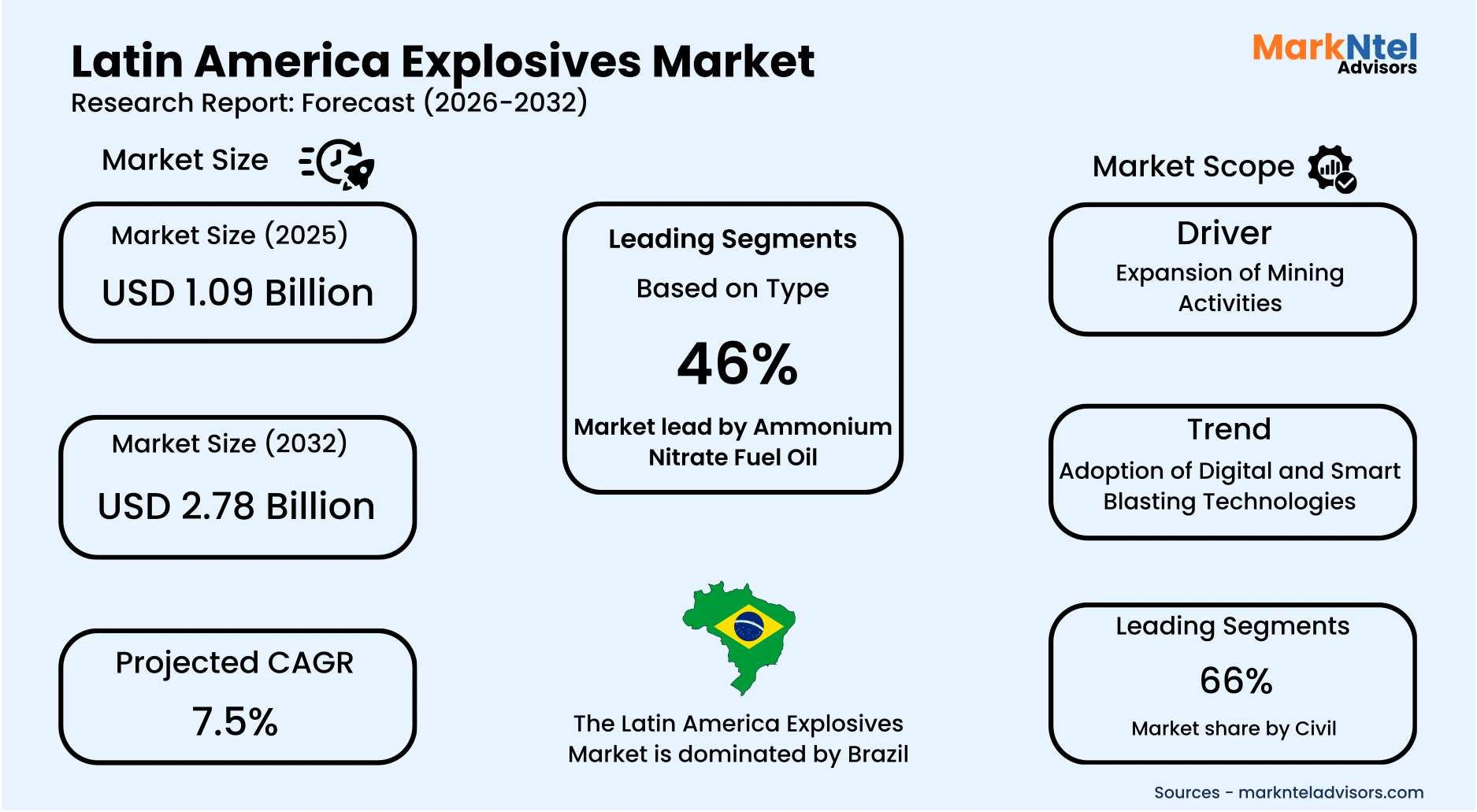
- Market size was valued at around USD 1.09 billion in 2025 and is projected to reach USD 2.78 billion by 2032. The estimated CAGR from 2026 to 2032 is around 7.5%, indicating strong growth.
- Brazil hold the largest market share of about 35% in the Latin America Explosives Market in 2025.
- By type, the ammonium nitrate fuel oil (ANFO) segment represented a significant share of about 46% in the Latin America Explosives Market in 2025.
- By end use, the civil segment presented a significant share of about 66% in the Latin America Explosives Market in 2025.
- Leading explosives companies in the Latin America Market are ENAEX S.A., Orica Limited, Dyno Nobel, MAXAM, Austin Powder Company, AEL Mining Services Ltd., EXSA S.A., Famesa Explosivos, EPC Groupe, and Others.
Market Insights & Analysis: Latin America Explosives Market (2026-32):
The Latin America Explosives Market size was valued at approximately USD 1.09 billion in 2025 and is projected to reach USD 2.78 billion by 2032. Along with this, the market is estimated to grow at a CAGR of around 7.5% during the forecast period, i.e., 2026-32.
The Explosives Market in Latin America is expected to witness steady growth over the coming years, primarily supported by expanding mining investments, and increasing demand for critical minerals essential for the global energy transition. The region’s strong mineral resource base, particularly copper and lithium, continues to attract multinational investments that require large-scale drilling and blasting activities, creating sustained demand for industrial explosives and initiation systems.
A major growth catalyst is the increasing pipeline of mining projects. For instance, Argentina approved incentives for a USD 2.7 billion lithium project developed by Rio Tinto under its Large Investment Incentive Regime to expand production capacity significantly . Similarly, a joint venture between BHP and Lundin Mining is considering increasing investment to approximately USD 800 million in Argentina’s Vicuña copper district, with production targeted around 2030. Such large-scale projects require extensive excavation and rock fragmentation, directly increasing long-term explosives consumption across construction and mining phases.
Additionally, the companies are increasingly focusing on digital and smart blasting solutions to improve precision, safety, and operational efficiency. In 2025, ENAEX S.A. showcased advanced technologies, including electronic initiation systems, monitoring radar, and digital blasting platforms at a major mining exhibition in Brazil, highlighting the industry’s shift toward data-driven blasting operations. Likewise, Orica Limited continued the rollout of its WebGen™ 200 wireless initiating system in 2025, enabling fully wireless detonation using magnetic signals, eliminating physical connections and improving safety in mining environments .
These technological developments align with broader mining modernization trends, where automation, remote operations, and digital mine planning are becoming essential for productivity optimization and regulatory compliance. As mining companies prioritize efficiency and sustainability, demand for advanced explosives products and services is expected to rise further.
Overall, increased mining investments, combined with the adoption of advanced blasting technologies, will significantly strengthen market expansion in the coming years. Long-term mineral demand and project pipelines position the region as a key growth hub for explosives manufacturers.
Latin America Explosives Market Recent Developments:
- 2025: MAXAM inaugurated a renewable ammonia production unit in 2025 to support low-carbon explosives manufacturing. The modular system produces ammonia using renewable electricity, reducing CO₂ emissions by up to 95%, and supports sustainable mining operations in regions including Latin America.
- 2025: Orica introduced its next-generation i-kon III electronic detonator and continued deployment of WebGen wireless blasting systems in 2025, enhancing blast precision, safety, and automation for mining operations globally, including Latin America. The systems support cost optimization for large-scale mining projects.
Latin America Explosives Market Scope:
| Category | Segments |
|---|---|
| By Type | (Ammonium Nitrate Fuel Oil (ANFO), Research Department Explosive (RDX), Trinitrotoluene (TNT), Pentaerythritol Tetranitrate (PETN), High Melting Explosive (HMX), Dynamite, Others), |
| By Application | (Mining, Construction, Military, Demolition, Oil and Gas), |
| By End-Use | (Civil, Commercial, Defense, Others), |
Latin America Explosives Market Driver:
Expansion of Mining Activities
The rapid expansion of mining activities across Latin America is a primary driver of the explosives market, supported by large-scale investments in copper, lithium, and critical minerals extraction. Government-backed project pipelines demonstrate strong long-term demand for blasting solutions used in drilling, quarrying, and ore fragmentation. For instance, Chile’s national mining authority (Cochilco) reported a mining investment portfolio of approximately USD 104.5 billion for 2025–2034, with nearly 89.8% allocated to copper projects, reflecting the region’s focus on large open-pit operations that heavily depend on industrial explosives .
Similarly, Latin America continues to dominate global mineral supply, with projections indicating the region could account for about 40.5% of global copper production by 2025, supported by new projects in Chile, Peru, and Mexico and steady production growth through 2030. The lithium sector is also expanding rapidly, particularly in Argentina and Brazil, with Argentina projected to become the world’s second-largest lithium producer by 2028, further increasing demand for blasting technologies in hard-rock mining operations.
Beyond 2025, future investments in energy-transition minerals, government permitting reforms, and exploration incentives are expected to unlock additional multi-billion-dollar mining projects across the region, directly boosting explosives consumption.
Consequently, increasing mineral production targets and long-term mining investments will significantly raise blasting requirements, ensuring sustained growth for the explosives market. The continued expansion of copper and lithium projects will act as a strong demand multiplier in the coming years.
Latin America Explosives Market Trend:
Adoption of Digital and Smart Blasting Technologies
The increasing adoption of digital and smart blasting technologies is emerging as a significant trend in the Latin America explosives market, driven by mining companies’ focus on safety, productivity, and environmental performance. Advanced electronic detonators provide up to 1,000 times greater timing accuracy compared to conventional systems, enabling precise energy control, improved fragmentation, and reduced vibration impact during blasting operations . This level of precision supports cost efficiency and operational optimization in large-scale mining projects.
Technological innovations such as wireless initiation systems are further transforming blasting practices. For instance, wireless electronic blasting technologies eliminate physical connections and allow remote detonation, reducing worker exposure to hazardous zones and improving safety outcomes. By 2025, such systems had achieved more than 10,000 successful blasts globally, demonstrating rapid industry adoption and reliability in mining environments .
Digital mine planning platforms are also gaining traction, integrating 3D mapping, positioning systems, and real-time monitoring to optimize blast design and execution. These solutions improve situational awareness and operational decision-making, particularly in large surface mining projects.
Overall, the shift toward automation and digitalization aligns with broader mining modernization initiatives across the region, where companies are investing in smart technologies to enhance productivity while meeting stricter safety and environmental regulations, thereby accelerating demand for advanced explosives solutions.
Latin America Explosives Market Opportunity:
Growth in Lithium and Critical Mineral Mining
The expansion of lithium and other critical mineral mining across Latin America presents a major opportunity for the explosives market, driven by rising global demand for electric vehicles, renewable energy storage, and advanced electronics. The International Energy Agency (IEA) projects that lithium demand could increase more than 40 times by 2040 under global net-zero emission scenarios, highlighting the long-term need for mining capacity expansion and associated blasting operations. This demand surge is encouraging governments to accelerate project approvals and attract foreign investment in mineral-rich regions.
For example, Argentina’s approval for lithium project developed by Rio Tinto under its Large Investment Incentive Regime, aiming to significantly expand lithium carbonate production capacity. The large-scale mining infrastructure required for this project will involve extensive drilling, rock fragmentation, and excavation activities, directly increasing explosives consumption in the region.
Additionally, the U.S. Geological Survey estimates Bolivia holds about 23 million metric tons of lithium resources, the largest globally, reinforcing the region’s long-term mining potential.
Overall, increasing investments and resource development in lithium and critical minerals will create sustained demand for blasting solutions, positioning the explosives market for strong future growth.
Latin America Explosives Market Challenge:
Strict Regulatory and Safety Requirements
One key challenge in the Latin America Explosives Market is the stringent regulatory framework and safety compliance requirements across the mining and construction industries. Governments in countries such as Brazil, Chile, and Peru impose strict licensing, storage, and transportation regulations for explosives due to safety and environmental risks. These regulations increase operational costs for manufacturers and distributors, delay project approvals, and create barriers for new market entrants. Additionally, compliance with hazardous material handling standards requires continuous monitoring, specialized workforce training, and infrastructure investment, which can limit adoption among smaller mining contractors.
For example, Chile implemented comprehensive chemical and hazardous substance regulations under Decree 57 to strengthen risk assessment, labeling, and handling requirements for chemical products, including explosive-related materials, to protect human health and the environment . This regulatory complexity continues to restrain market growth despite increasing demand from mining activities.
Latin America Explosives Market (2026-32) Segmentation Analysis:
The Latin America Explosives Market study of MarkNtel Advisors evaluates & highlights the major trends and influencing factors in each segment. It includes predictions for the period 2026–32 at the regional level. Based on the analysis, the market has been further classified as;
Based on Type:
-
- Ammonium Nitrate Fuel Oil (ANFO)
- Research Department Explosive (RDX)
- Trinitrotoluene (TNT)
- Pentaerythritol Tetranitrate (PETN)
- High Melting Explosive (HMX)
- Dynamite
- Others
- Ammonium Nitrate Fuel Oil (ANFO)
ANFO leads the explosives market with a 46% share due to its cost-effectiveness, ease of production, and suitability for large-scale blasting operations, particularly in mining and quarrying. It is widely preferred for open-pit mining because of its stable composition, relatively safe handling characteristics, and ability to deliver efficient rock fragmentation at lower operational costs compared to high-energy explosives such as RDX or HMX. ANFO’s compatibility with bulk loading systems and on-site mixing technologies further enhances its adoption, allowing mining companies to optimize logistics and reduce transportation risks.
Additionally, the availability of raw materials, especially ammonium nitrate fertilizers, supports large-volume manufacturing and consistent supply chains. The growing demand for minerals used in infrastructure, construction materials, and energy transition technologies further drives ANFO consumption. Its balance of performance, affordability, and scalability makes it the preferred choice for industrial applications, ensuring continued dominance in the explosives type segment over the forecast period.
Based on End Use:
- Civil
- Commercial
- Defense
- Others
The civil segment dominates the market with a 66% share, primarily due to the extensive use of explosives in mining, quarrying, infrastructure development, and large-scale construction activities. Civil applications require significant volumes of industrial explosives for rock fragmentation, tunneling, road construction, hydroelectric projects, and urban development. Governments across developing economies are investing heavily in transportation networks, energy infrastructure, and urban expansion, which increases demand for controlled blasting solutions.
Additionally, mining operations, particularly for minerals such as copper, lithium, gold, and iron ore, are categorized under civil industrial use, further strengthening segment dominance. Compared to defense applications, civil projects involve continuous and high-volume explosives consumption, creating sustained demand. The growth of renewable energy infrastructure, including dams, transmission corridors, and underground installations, also contributes to this segment’s expansion. As infrastructure modernization and resource extraction projects continue to increase globally, the civil segment is expected to maintain its leadership position due to its broad application scope and recurring consumption patterns.
Latin America Explosives Market (2026-32): Regional Projection
The Latin America Explosives Market is dominated by Brazil, accounting for approximately 35% of the regional market share. The country’s leadership is primarily driven by its large mining industry, extensive infrastructure development, and significant natural resource reserves, including iron ore, gold, and bauxite. Brazil hosts some of the world’s largest mining operations, particularly those led by companies such as Vale S.A., which require substantial volumes of industrial explosives for drilling and blasting activities.
Additionally, ongoing investments in transportation infrastructure, hydropower projects, and urban construction continue to support explosives consumption across civil and commercial applications. For example, large-scale mining operations in regions such as Minas Gerais and Pará rely heavily on bulk explosives for rock fragmentation and excavation processes. The presence of domestic manufacturing facilities, favorable mining policies, and continuous mineral exploration activities further strengthen Brazil’s market position. Moreover, the country’s expanding quarrying and construction sectors contribute to steady explosives demand, making Brazil the dominant contributor to the Latin America explosives market growth.
Gain a Competitive Edge with Our Latin America Explosives Market Report:
- Latin America Explosives Market Report by MarkNtel Advisors provides a detailed & thorough analysis of market size & share, growth rate, competitive landscape, and key players. This comprehensive analysis helps businesses gain a holistic understanding of the market dynamics & make informed decisions.
- This report also highlights current market trends & future projections, allowing businesses to identify emerging opportunities & potential challenges. By understanding market forecasts, companies can align their strategies & stay ahead of the competition.
- Latin America Explosives Market Report aids in assessing & mitigating risks associated with entering or operating in the market. By understanding market dynamics, regulatory frameworks, and potential challenges, businesses can develop strategies to minimize risks & optimize their operations.
*Reports Delivery Format - Market research studies from MarkNtel Advisors are offered in PDF, Excel and PowerPoint formats. Within 24 hours of the payment being successfully received, the report will be sent to your email address.
Frequently Asked Questions
- Market Segmentation
- Introduction
- Product Definition
- Research Process
- Assumptions
- Executive Summary
- Latin America Explosives Market Policies, Regulations, and Product Standards
- Latin America Explosives Market Supply Chain Analysis
- Latin America Explosives Market Import/Export Analysis
- Latin America Explosives Market Trends & Developments
- Latin America Explosives Market Dynamics
- Growth Drivers
- Challenges
- Latin America Explosives Market Hotspot & Opportunities
- Latin America Explosives Market Outlook, 2022-2032
- Market Size & Outlook
- By Revenues (USD Million)
- By Volume (Thousand Tons)
- Market Share & Outlook
- By Type- Market Size & Forecast 2022-2032F, USD Million
- Ammonium Nitrate Fuel Oil (ANFO)
- Research Department Explosive (RDX)
- Trinitrotoluene (TNT)
- Pentaerythritol Tetranitrate (PETN)
- High Melting Explosive (HMX)
- Dynamite
- Others
- By Application- Market Size & Forecast 2022-2032F, USD Million
- Mining
- Construction
- Military
- Demolition
- Oil and Gas
- By End-Use- Market Size & Forecast 2022-2032F, USD Million
- Civil
- Commercial
- Defense
- Others
- By Country
- Brazil
- Argentina
- Mexico
- Chile
- Colombia
- Rest of Latin America
- By Company
- Company Revenue Shares
- Competitor Characteristics
- By Type- Market Size & Forecast 2022-2032F, USD Million
- Market Size & Outlook
- Brazil Explosives Market Outlook, 2022-2032
- Market Size & Analysis
- Market Revenues (USD Million)
- By Volume (Thousand Tons)
- Market Share & Analysis
- By Type- Market Size & Forecast 2022-2032, USD Million
- By Application- Market Size & Forecast 2022-2032, USD Million
- By End-Use- Market Size & Forecast 2022-2032, USD Million
- Market Size & Analysis
- Argentina Explosives Market Outlook, 2022-2032
- Market Size & Analysis
- Market Revenues (USD Million)
- By Volume (Thousand Tons)
- Market Share & Analysis
- By Type- Market Size & Forecast 2022-2032, USD Million
- By Application- Market Size & Forecast 2022-2032, USD Million
- By End-Use- Market Size & Forecast 2022-2032, USD Million
- Market Size & Analysis
- Mexico Explosives Market Outlook, 2022-2032
- Market Size & Analysis
- Market Revenues (USD Million)
- By Volume (Thousand Tons)
- Market Share & Analysis
- By Type- Market Size & Forecast 2022-2032, USD Million
- By Application- Market Size & Forecast 2022-2032, USD Million
- By End-Use- Market Size & Forecast 2022-2032, USD Million
- Market Size & Analysis
- Chile Explosives Market Outlook, 2022-2032
- Market Size & Analysis
- Market Revenues (USD Million)
- By Volume (Thousand Tons)
- Market Share & Analysis
- By Type- Market Size & Forecast 2022-2032, USD Million
- By Application- Market Size & Forecast 2022-2032, USD Million
- By End-Use- Market Size & Forecast 2022-2032, USD Million
- Market Size & Analysis
- Colombia Explosives Market Outlook, 2022-2032
- Market Size & Analysis
- Market Revenues (USD Million)
- By Volume (Thousand Tons)
- Market Share & Analysis
- By Type- Market Size & Forecast 2022-2032, USD Million
- By Application- Market Size & Forecast 2022-2032, USD Million
- By End-Use- Market Size & Forecast 2022-2032, USD Million
- Market Size & Analysis
- Latin America Explosives Market Key Strategic Imperatives for Success & Growth
- Competition Outlook
- Company Profiles
- ENAEX S.A.
- Business Description
- Product Portfolio
- Strategic Alliances or Partnerships
- Recent Developments
- Financial Details
- Others
- Orica Limited
- Business Description
- Product Portfolio
- Strategic Alliances or Partnerships
- Recent Developments
- Financial Details
- Others
- Dyno Nobel
- Business Description
- Product Portfolio
- Strategic Alliances or Partnerships
- Recent Developments
- Financial Details
- Others
- MAXAM
- Business Description
- Product Portfolio
- Strategic Alliances or Partnerships
- Recent Developments
- Financial Details
- Others
- Austin Powder Company
- Business Description
- Product Portfolio
- Strategic Alliances or Partnerships
- Recent Developments
- Financial Details
- Others
- AEL Mining Services Ltd.
- Business Description
- Product Portfolio
- Strategic Alliances or Partnerships
- Recent Developments
- Financial Details
- Others
- EXSA S.A.
- Business Description
- Product Portfolio
- Strategic Alliances or Partnerships
- Recent Developments
- Financial Details
- Others
- Famesa Explosivos
- Business Description
- Product Portfolio
- Strategic Alliances or Partnerships
- Recent Developments
- Financial Details
- Others
- EPC Groupe
- Business Description
- Product Portfolio
- Strategic Alliances or Partnerships
- Recent Developments
- Financial Details
- Others
- Others
- ENAEX S.A.
- Company Profiles
- Disclaimer
MarkNtel Advisors follows a robust and iterative research methodology designed to ensure maximum accuracy and minimize deviation in market estimates and forecasts. Our approach combines both bottom-up and top-down techniques to effectively segment and quantify various aspects of the market. A consistent feature across all our research reports is data triangulation, which examines the market from three distinct perspectives to validate findings. Key components of our research process include:
1. Scope & Research Design At the outset, MarkNtel Advisors define the research objectives and formulate pertinent questions. This phase involves determining the type of research—qualitative or quantitative—and designing a methodology that outlines data collection methods, target demographics, and analytical tools. They also establish timelines and budgets to ensure the research aligns with client goals.
2. Sample Selection and Data Collection In this stage, the firm identifies the target audience and determines the appropriate sample size to ensure representativeness. They employ various sampling methods, such as random or stratified sampling, based on the research objectives. Data collection is carried out using tools like surveys, interviews, and observations, ensuring the gathered data is reliable and relevant.
3. Data Analysis and Validation Once data is collected, MarkNtel Advisors undertake a rigorous analysis process. This includes cleaning the data to remove inconsistencies, employing statistical software for quantitative analysis, and thematic analysis for qualitative data. Validation steps are taken to ensure the accuracy and reliability of the findings, minimizing biases and errors.

4. Data Forecast and FinalizationThe final phase involves forecasting future market trends based on the analyzed data. MarkNtel Advisors utilize predictive modeling and time series analysis to anticipate market behaviors. The insights are then compiled into comprehensive reports, featuring visual aids like charts and graphs, and include strategic recommendations to inform client decision-making
We offer flexible licensing options to cater to varying organizational needs. Choose the pricing pack that best suits your requirements:
Buy Now Inquire Before Buying
 Request Customization
 Talk to our Consultant







