

Africa Mosquito Repellent Market Research Report: Trends, Forecast & Opportunities (2026-2032)
By Product Type (Coils, Liquid Vaporizers, Aerosol Sprays, Topical Repellents, Repellent Mats, Wearable Repellents, Others), By Active Ingredient Type (Chemical-based, Plant-based) ... , By Distribution Channel (Offline Retail, Online Retail), By Application (Indoor Use, Outdoor Use), By End User (Adults, Children), and others Read more
- Chemicals
- Jun 2026
- Pages 275
- Report Format: PDF, Excel, PPT
Africa Mosquito Repellent Market
Projected 4.46% CAGR from 2026 to 2032
Study Period
2026-2032
Market Size (2026)
USD 1.17 Billion
Market Size (2032)
USD 1.52 Billion
Base Year
2025
Projected CAGR
4.46%
Leading Segments
By End User: Adults
Africa Mosquito Repellent Market Key Takeaways
- Africa mosquito repellent market size valued at USD 1.12 billion in 2025, projected to reach USD 1.52 billion by 2032 from USD 1.17 billion in 2026, at 4.46% CAGR during 2026-32.
- Nigeria leads regional demand, accounting for approximately 25% share in 2026.
- By product type, coils dominate the market, capturing nearly 35% share in 2026.
- Adults represent the largest end-user segment, contributing around 72% share in 2026.
- The competitive landscape remains moderately fragmented, with the top five players collectively holding nearly 47% share, reflecting a mix of global brands and strong regional competitors.
Africa Mosquito Repellent Market Size and Outlook
The Africa mosquito repellent market is projected to register a CAGR of 4.46% during 2026–2032, supported by the sustained demand for mosquito repellents in tropical regions, where climatic conditions and persistent disease exposure continue to reinforce stable and recurring consumption patterns across diverse population segments.
Large-scale public health interventions are significantly strengthening preventive healthcare penetration across Africa. In 2025, UNICEF, Sudan’s Federal Ministry of Health, and the Global Fund distributed nearly 16 million insecticide-treated bed nets, protecting around 28 million people from mosquito exposure. Additionally, the WHO-backed OPT-MVAC initiative expanded malaria vaccine implementation across 14 Central and West African countries, highlighting increasing integration of mosquito prevention solutions within national disease control frameworks and long-term public health strategies.
From a policy perspective, the WHO Regional Committee for Africa continues to advance the Global Vector Control Response 2017–2030, targeting a 40% reduction in vector-borne disease incidence. This strategic alignment is accelerating adoption across the mosquito control devices market while expanding access to household pest control products through institutional procurement and funding support, particularly in underserved regions where structured intervention programs remain critical for mosquito repellent demand.
Innovation trajectories across the region are increasingly shaped by spatial repellents, smart delivery formats, and plant-based formulations aligned with evolving regulatory and consumer expectations. These developments are reinforcing the anti-mosquito solutions industry, enabling scalable, long-lasting, and safer protection mechanisms.
In conclusion, the market outlook remains resilient and moderately growth-oriented, with the market projected to increase from USD 1.17 billion in 2026 to USD 1.52 billion by 2032, underpinned by coordinated public health initiatives, technological advancement, and consistent disease-driven demand dynamics.
Africa Mosquito Repellent Market Key Indicators
- Several African nations are experiencing sharp increases in outbreak frequency and severity. For instance, Zimbabwe reported over 115 malaria outbreaks in 2025 compared to only one outbreak in 2024, with deaths tripling year-on-year . Similarly, countries including Kenya, Senegal, Ethiopia, and Côte d’Ivoire have reported rising dengue transmission, indicating intensifying vector-borne disease spread across multiple regions.
- According to the African Leaders Malaria Alliance, approximately 1.3 billion individuals across Africa remain at risk of malaria infection. The region continues to experience high transmission intensity, with an estimated 192 cases per 1,000 at-risk individuals annually . This sustained exposure level underscores the persistent need for large-scale preventive measures and long-term mosquito control strategies.
- Africa’s urban population is expanding at approximately 3.5% annually, the fastest globally, with nearly 722 million people residing in urban areas as of 2026. This rapid expansion is increasing population density in informal settlements, where inadequate drainage and sanitation systems create favorable mosquito breeding conditions, thereby elevating exposure risks among urban populations.
- Children under five years of age account for nearly 75% of malaria-related deaths in the African region, with over half of fatalities concentrated in countries such as Nigeria, the Democratic Republic of the Congo, and Niger . This demographic vulnerability significantly increases the urgency for preventive interventions targeting households and community-level protection strategies.
- Africa continues to account for the highest share of global malaria incidence, with the World Health Organization reporting that the region represented nearly 95% of total malaria cases and deaths in 2024. This overwhelming disease burden highlights the continent’s sustained exposure to mosquito-borne infections and reinforces the critical importance of preventive interventions across both rural and urban populations.
Africa Mosquito Repellent Market Scope
| Category | Segments |
|---|---|
| By Product Type | Coils, Liquid Vaporizers, Aerosol Sprays, Topical Repellents, Repellent Mats, Wearable Repellents, Others |
| By Active Ingredient Type | Chemical-based, Plant-based |
| By Distribution Channel | Offline Retail, Online Retail |
| By Application | Indoor Use, Outdoor Use |
| By End User | Adults, Children |
Africa Mosquito Repellent Market Growth Drivers
Rising Prevalence of Mosquito-Borne Diseases
The Africa mosquito repellent demand is primarily driven by increasing disease prevalence of mosquito borne diseases in the region. Countries across Sub-Saharan Africa continue to face persistent malaria transmission, with outbreaks becoming more frequent and severe. The growing impact of dengue and malaria on repellent demand is reinforcing the need for preventive protection, particularly in densely populated and high-risk zones.
In 2024, Ethiopia recorded over 7.3 million malaria cases and more than 1,100 deaths, marking its most severe outbreak in seven years. Such large-scale outbreaks are accelerating national awareness campaigns and driving adoption of preventive measures. These developments highlight how recurring disease cycles are strengthening consumer reliance on repellents as essential protection tools rather than discretionary purchases.
Simultaneously, rising co-outbreaks of dengue, Zika, and chikungunya across West Africa are further amplifying demand. Burkina Faso alone accounted for nearly 74% of regional dengue cases, while Senegal and Mali experienced concurrent outbreaks . These multi-disease scenarios are increasing risk perception and encouraging continuous usage of mosquito prevention solutions across households.
Urbanization is further amplifying exposure, with increasing mosquito repellent usage in urban households due to poor sanitation and water stagnation. As cities expand rapidly, mosquito breeding conditions intensify, making repellents a critical component of everyday household protection strategies across the Africa mosquito repellent industry.
Recent Trends
Shift Toward Spatial and Smart Protection
The Africa mosquito repellent market is increasingly shifting toward advanced technologies such as spatial mosquito repellent devices, reflecting a transition from traditional coils and sprays to area-based protection systems. These solutions provide continuous protection in enclosed and semi-enclosed environments, aligning with growing demand for long-duration and low-maintenance mosquito control technologies.
A key example is the 2025 launch by SC Johnson of high-speed manufacturing for Guardian™ spatial repellents in Kenya. The facility is capable of producing approximately 20 million units annually, with each device offering protection for up to 12 months, demonstrating strong innovation in mosquito repellent formulations and delivery mechanisms.
In parallel, rising consumer awareness is driving demand for premium mosquito repellent products, particularly in urban markets where households prioritize safety, durability, and convenience. Products with controlled-release technology and extended efficacy are gaining traction among middle-income consumers seeking reliable protection solutions.
Additionally, the integration of automated and smart dispensing technologies is emerging gradually, indicating early-stage adoption of intelligent mosquito control systems. This evolution highlights a broader transformation within the Africa mosquito repellent industry, where innovation is increasingly focused on scalability, efficiency, and improved user experience.
Africa Mosquito Repellent Market Opportunities and Challenges
Regulatory Pressure Accelerating Bio- based Mosquito Repellent Innovation
The Africa mosquito repellent market is facing increasing regulatory pressure, particularly due to rising regulatory restrictions on DEET and other synthetic ingredients. In 2025, the East African Community introduced updated standards covering sprays, wipes, patches, and spatial repellents, emphasizing efficacy validation, ingredient safety, and labeling accuracy, thereby increasing compliance and reformulation costs for manufacturers.
These frameworks are also intensifying safety concerns of insect repellents, especially among households with children and health-conscious consumers. Manufacturers using conventional insecticides are facing growing scrutiny and higher testing requirements, creating barriers for smaller players and increasing operational complexity across multiple companies.
However, these constraints are driving bio-based mosquito repellent solutions, as companies shift toward plant-based and essential-oil formulations to meet regulatory expectations. Rising eco-friendly insect repellent demand is further supporting this transition, particularly in urban and premium consumer segments.
In 2025, Bonnie Bio launched the Kindness Co. natural mosquito repellent range in South Africa using essential oil-based, toxin-free formulations . The product aligns with evolving regulatory standards and rising consumer preference for safer alternatives, demonstrating how compliance pressures are directly accelerating bio-based innovation and reshaping product development strategies within the Africa mosquito repellent industry.
Segmentation Insights
Coils is Widely Used Mosquito Repellent Solutions
Mosquito coils account for approximately 35% of the Africa mosquito repellent landscape, underscoring their entrenched position within mass-market consumption patterns. Their dominance is primarily supported by cost efficiency, ease of distribution, and widespread accessibility across rural and peri-urban regions. As a core component of mosquito control solutions, coils remain integral to addressing high-frequency exposure in economically constrained environments with limited access to electricity.
The segment benefits from strong alignment with household mosquito repellent usage, particularly in densely populated areas where affordability outweighs preference for advanced formats. Unlike liquid vaporizers or aerosol sprays, coils provide a low-cost, non-electric alternative with extended burn duration, making them suitable for continuous overnight protection. This functional reliability continues to drive consistent adoption across informal settlements and underserved communities.
Despite increasing visibility of premium formats such as topical and wearable repellents, coils retain structural advantages driven by entrenched consumer habits and extensive retail penetration. While health considerations related to smoke emissions may gradually influence urban demand, the segment’s affordability and accessibility ensure sustained relevance, reinforcing its leadership within the broader household pest control products landscape. Segmentation is defined according to the following product type:
- Coils
- Liquid Vaporizers
- Aerosol Sprays
- Topical Repellents
- Repellent Mats
- Wearable Repellents
- Others
Adult Segment Drives Demand Across End User Verticals
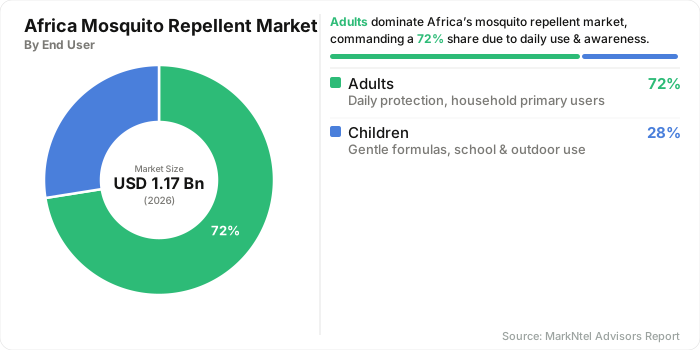
Adults account for approximately 72% of total demand within the Africa mosquito repellent industry, reflecting their central role in both product usage and purchasing decisions. This segment demonstrates the highest engagement with personal insect protection products, driven by increased mobility, occupational exposure, and responsibility for household-level mosquito prevention. As a result, adults remain the primary contributors to overall consumption volumes.
Sustained exposure across outdoor work environments, including agriculture, construction, and informal labor continues to elevate demand for insect bite prevention products among adult populations. In high-risk regions, consistent usage is essential to mitigate exposure to vector-borne diseases, reinforcing daily dependence on mosquito repellents. This pattern is further intensified in tropical climates, where year-round mosquito activity sustains continuous product utilization.
While the children segment holds critical public health importance, purchasing and usage decisions are largely mediated by adult consumers. Increasing awareness of pediatric protection is supporting niche product development; however, adult-oriented applications continue to dominate volume demand. Taken together, exposure intensity, economic responsibility, and broader application scenarios firmly position adults as the leading end-user segment within the Africa mosquito repellent sector. The study classifies major end-user segments:
- Adults
- Children
Africa Mosquito Repellent Market Geographical Outlook
Nigeria accounts for approximately 25% of total demand within the Africa Mosquito repellent Market, establishing it as the leading regional contributor. This dominance is primarily driven by the country’s significant disease burden and large population base, which together sustain high consumption levels of mosquito control solutions. As one of the most affected countries globally, Nigeria continues to exhibit strong demand across both institutional procurement channels and household-level usage.
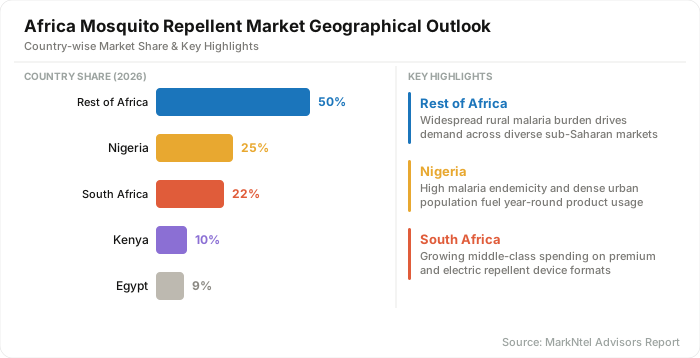
According to the World Health Organization, Nigeria was responsible for 31.9% of all malaria deaths in the WHO African Region in 2024, with nearly half of these fatalities occurring among children under five. This persistent public health challenge is reinforcing reliance on public health vector control solutions, including repellents and preventive interventions aimed at reducing infection risk among vulnerable populations.
The country’s tropical climate and prolonged rainy seasons further intensify mosquito breeding conditions, contributing to sustained year-round demand. Increasing urbanization, coupled with infrastructure gaps in sanitation and drainage, is accelerating mosquito repellent usage in urban households, particularly in high-density cities where exposure risk remains elevated and continuous protection is required.
Moreover, government-led initiatives and international funding programs are expanding accessibility of mosquito prevention products across underserved communities. These combined structural factors position Nigeria as a critical demand center, underpinning regional growth dynamics and reinforcing its strategic importance within the broader African mosquito repellent landscape.
Africa Mosquito Repellent Market Competitive Analysis
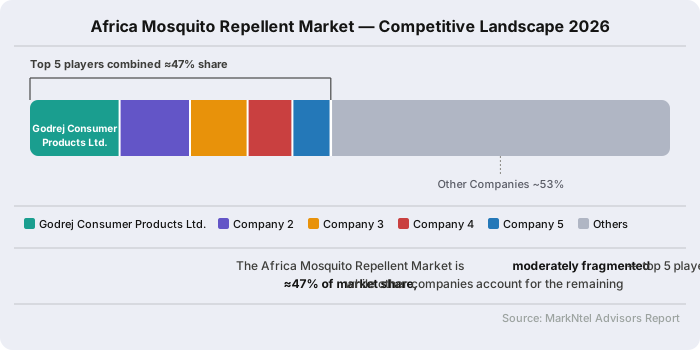
The Africa mosquito repellent industry is led by five key players like SC Johnson & Son, Inc., Reckitt Benckiser Group plc, Godrej Consumer Products Limited, Spectrum Brands Holdings, Inc., and Dabur India Ltd. Collectively, these players are estimated to hold approximately 47% of the total market share, indicating a market structure.
Major Companies in Africa Mosquito Repellent Industry
- SC Johnson & Son, Inc.
- Reckitt Benckiser Group plc
- Godrej Consumer Products Limited
- Dabur India Ltd.
- Jyothy Labs Limited
- Kapi Limited
- Sara Lee Household & Body Care Kenya
- AIM Group
- Spectrum Brands Holdings, Inc.
- Thermacell Repellents, Inc.
- Others
Africa Mosquito Repellent Industry News and Recent Developments
January 2025: KEMRI & SC Johnson Launch Spatial Repellent Manufacturing Plant in Kenya
The Kenya Medical Research Institute and SC Johnson launched a spatial repellent manufacturing plant in Kenya to strengthen malaria prevention efforts across Africa. The facility produces Guardian™ spatial repellents designed for homes and semi-enclosed spaces, providing long-duration mosquito protection. The initiative combines local manufacturing with advanced vector-control technology and supports regional disease prevention programs targeting malaria-endemic communities.
Impact Analysis: The development marks a major shift toward localized mosquito repellent manufacturing and next-generation vector-control deployment in Africa. By producing repellents within Kenya, the initiative reduces import dependence, improves supply accessibility, and strengthens regional healthcare resilience. The launch also validates the rising adoption of spatial repellents as complementary tools alongside insecticide-treated bed nets. Furthermore, collaboration between public-health institutions and private manufacturers is expected to accelerate commercialization of innovative mosquito prevention technologies across East Africa while supporting broader malaria eradication objectives.
Frequently Asked Questions
- Market Segmentation
- Introduction
- Product Definition
- Research Process
- Assumptions
- Executive Summary
- Africa Mosquito Repellent Market Policies, Regulations, and Product Standards
- Africa Mosquito Repellent Production Trend 2022-2032
- Africa Mosquito Repellent Trend by Type of Product Type
- Coils
- Liquid Vaporizers
- Aerosol Sprays
- Topical Repellents
- Repellent Mats
- Wearable Repellents
- Others
- Company-Wise Production Plants and Statistics
- Installed Production Capacity
- Actual Production
- Planned Production Target
- Africa Mosquito Repellent Trend by Type of Product Type
- Africa Mosquito Repellent Pricing Analysis 2022-2032
- Africa Mosquito Repellent Pricing Trend 2022-2032
- Africa Mosquito Repellent Pricing Trend by Product Type 2022-2032
- Coils
- Liquid Vaporizers
- Aerosol Sprays
- Topical Repellents
- Repellent Mats
- Wearable Repellents
- Others
- Africa Mosquito Repellent Market Dynamics
- Growth Factors
- Challenges
- Africa Mosquito Repellent Market Hotspot & Opportunities
- Africa Mosquito Repellent Market Outlook, 2022-2032F
- Market Size & Outlook
- By Revenues (USD Million)
- Market Share & Analysis
- By Product Type - Market Size & Forecast 2022-2032, USD Million
- Coils
- Liquid Vaporizers
- Aerosol Sprays
- Topical Repellents
- Repellent Mats
- Wearable Repellents
- Others
- By Active Ingredient Type- Market Size & Forecast 2022-2032, USD Million
- Chemical-based
- Plant-based
- By Distribution Channel- Market Size & Forecast 2022-2032, USD Million
- Offline Retail
- Online Retail
- By Application - Market Size & Forecast 2022-2032, USD Million
- Indoor Use
- Outdoor Use
- By End User- Market Size & Forecast 2022-2032, USD Million
- Adults
- Children
- By Country
- South Africa
- Nigeria
- Kenya
- Egypt
- Algeria
- Angola
- Ethiopia
- Ghana
- Rest of Africa
- By Company
- Competition Characteristics
- Market Share & Analysis
- By Product Type - Market Size & Forecast 2022-2032, USD Million
- Market Size & Outlook
- South Africa Mosquito Repellent Market Outlook, 2022-2032F
- Market Size & Outlook
- By Revenues (USD Million)
- Market Share & Analysis
- By Product Type - Market Size & Forecast 2022-2032, USD Million
- By Active Ingredient Type- Market Size & Forecast 2022-2032, USD Million
- By Distribution Channel- Market Size & Forecast 2022-2032, USD Million
- By Application - Market Size & Forecast 2022-2032, USD Million
- By End User- Market Size & Forecast 2022-2032, USD Million
- Market Size & Outlook
- Nigeria Mosquito Repellent Market Outlook, 2022-2032F
- Market Size & Outlook
- By Revenues (USD Million)
- Market Share & Analysis
- By Product Type - Market Size & Forecast 2022-2032, USD Million
- By Active Ingredient Type- Market Size & Forecast 2022-2032, USD Million
- By Distribution Channel- Market Size & Forecast 2022-2032, USD Million
- By Application - Market Size & Forecast 2022-2032, USD Million
- By End User- Market Size & Forecast 2022-2032, USD Million
- Market Size & Outlook
- Kenya Mosquito Repellent Market Outlook, 2022-2032F
- Market Size & Outlook
- By Revenues (USD Million)
- Market Share & Analysis
- By Product Type - Market Size & Forecast 2022-2032, USD Million
- By Active Ingredient Type- Market Size & Forecast 2022-2032, USD Million
- By Distribution Channel- Market Size & Forecast 2022-2032, USD Million
- By Application - Market Size & Forecast 2022-2032, USD Million
- By End User- Market Size & Forecast 2022-2032, USD Million
- Market Size & Outlook
- Egypt Mosquito Repellent Market Outlook, 2022-2032F
- Market Size & Outlook
- By Revenues (USD Million)
- Market Share & Analysis
- By Product Type - Market Size & Forecast 2022-2032, USD Million
- By Active Ingredient Type- Market Size & Forecast 2022-2032, USD Million
- By Distribution Channel- Market Size & Forecast 2022-2032, USD Million
- By Application - Market Size & Forecast 2022-2032, USD Million
- By End User- Market Size & Forecast 2022-2032, USD Million
- Market Size & Outlook
- Algeria Mosquito Repellent Market Outlook, 2022-2032F
- Market Size & Outlook
- By Revenues (USD Million)
- Market Share & Analysis
- By Product Type - Market Size & Forecast 2022-2032, USD Million
- By Active Ingredient Type- Market Size & Forecast 2022-2032, USD Million
- By Distribution Channel- Market Size & Forecast 2022-2032, USD Million
- By Application - Market Size & Forecast 2022-2032, USD Million
- By End User- Market Size & Forecast 2022-2032, USD Million
- Market Size & Outlook
- Angola Mosquito Repellent Market Outlook, 2022-2032F
- Market Size & Outlook
- By Revenues (USD Million)
- Market Share & Analysis
- By Product Type - Market Size & Forecast 2022-2032, USD Million
- By Active Ingredient Type- Market Size & Forecast 2022-2032, USD Million
- By Distribution Channel- Market Size & Forecast 2022-2032, USD Million
- By Application - Market Size & Forecast 2022-2032, USD Million
- By End User- Market Size & Forecast 2022-2032, USD Million
- Market Size & Outlook
- Ethiopia Mosquito Repellent Market Outlook, 2022-2032F
- Market Size & Outlook
- By Revenues (USD Million)
- Market Share & Analysis
- By Product Type - Market Size & Forecast 2022-2032, USD Million
- By Active Ingredient Type- Market Size & Forecast 2022-2032, USD Million
- By Distribution Channel- Market Size & Forecast 2022-2032, USD Million
- By Application - Market Size & Forecast 2022-2032, USD Million
- By End User- Market Size & Forecast 2022-2032, USD Million
- Market Size & Outlook
- Ghana Mosquito Repellent Market Outlook, 2022-2032F
- Market Size & Outlook
- By Revenues (USD Million)
- Market Share & Analysis
- By Product Type - Market Size & Forecast 2022-2032, USD Million
- By Active Ingredient Type- Market Size & Forecast 2022-2032, USD Million
- By Distribution Channel- Market Size & Forecast 2022-2032, USD Million
- By Application - Market Size & Forecast 2022-2032, USD Million
- By End User- Market Size & Forecast 2022-2032, USD Million
- Market Size & Outlook
- Africa Mosquito Repellent Market Key Strategic Imperatives for Success & Growth
- Competitive Outlook
- Company Profiles
- SC Johnson & Son, Inc.
- Business Description
- Product Portfolio
- Collaborations & Alliances
- Recent Developments
- Financial Details
- Others
- Reckitt Benckiser Group plc
- Business Description
- Product Portfolio
- Collaborations & Alliances
- Recent Developments
- Financial Details
- Others
- Godrej Consumer Products Limited
- Business Description
- Product Portfolio
- Collaborations & Alliances
- Recent Developments
- Financial Details
- Others
- Dabur India Ltd.
- Business Description
- Product Portfolio
- Collaborations & Alliances
- Recent Developments
- Financial Details
- Others
- Jyothy Labs Limited
- Business Description
- Product Portfolio
- Collaborations & Alliances
- Recent Developments
- Financial Details
- Others
- Kapi Limited
- Business Description
- Product Portfolio
- Collaborations & Alliances
- Recent Developments
- Financial Details
- Others
- Sara Lee Household & Body Care Kenya
- Business Description
- Product Portfolio
- Collaborations & Alliances
- Recent Developments
- Financial Details
- Others
- AIM Group
- Business Description
- Product Portfolio
- Collaborations & Alliances
- Recent Developments
- Financial Details
- Others
- Spectrum Brands Holdings, Inc.
- Business Description
- Product Portfolio
- Collaborations & Alliances
- Recent Developments
- Financial Details
- Others
- Thermacell Repellents, Inc.
- Business Description
- Product Portfolio
- Collaborations & Alliances
- Recent Developments
- Financial Details
- Others
- Others
- SC Johnson & Son, Inc.
- Company Profiles
- Disclaimer
MarkNtel Advisors follows a robust and iterative research methodology designed to ensure maximum accuracy and minimize deviation in market estimates and forecasts. Our approach combines both bottom-up and top-down techniques to effectively segment and quantify various aspects of the market. A consistent feature across all our research reports is data triangulation, which examines the market from three distinct perspectives to validate findings. Key components of our research process include:
1. Scope & Research Design At the outset, MarkNtel Advisors define the research objectives and formulate pertinent questions. This phase involves determining the type of research—qualitative or quantitative—and designing a methodology that outlines data collection methods, target demographics, and analytical tools. They also establish timelines and budgets to ensure the research aligns with client goals.
2. Sample Selection and Data Collection In this stage, the firm identifies the target audience and determines the appropriate sample size to ensure representativeness. They employ various sampling methods, such as random or stratified sampling, based on the research objectives. Data collection is carried out using tools like surveys, interviews, and observations, ensuring the gathered data is reliable and relevant.
3. Data Analysis and Validation Once data is collected, MarkNtel Advisors undertake a rigorous analysis process. This includes cleaning the data to remove inconsistencies, employing statistical software for quantitative analysis, and thematic analysis for qualitative data. Validation steps are taken to ensure the accuracy and reliability of the findings, minimizing biases and errors.

4. Data Forecast and FinalizationThe final phase involves forecasting future market trends based on the analyzed data. MarkNtel Advisors utilize predictive modeling and time series analysis to anticipate market behaviors. The insights are then compiled into comprehensive reports, featuring visual aids like charts and graphs, and include strategic recommendations to inform client decision-making
We offer flexible licensing options to cater to varying organizational needs. Choose the pricing pack that best suits your requirements:
Buy Now Inquire Before Buying
 Request Customization
 Talk to our Consultant







