

Japan Space Launch Services Market Research Report: Forecast (2025-2030)
Japan Space Launch Services Market - By Product (Small Satellite Launch Vehicles (SSLVs), Medium-Lift Launch Vehicles, Heavy-Lift Launch Vehicles, Reusable Rocket Systems), By Serv ... ice (Pre-Launch Services (Payload Integration, Testing, Licensing), Launch Services (Orbital, Suborbital), Post-Launch Services (Debris Mitigation, Mission Support)), By End-User (Government & Defense, Commercial Entities, Research & Academic Institutions) and others Read more
- Aerospace & Defense
- Jun 2025
- Pages 154
- Report Format: PDF, Excel, PPT
Market Insights & Analysis: Japan Space Launch Services Market (2025-30):
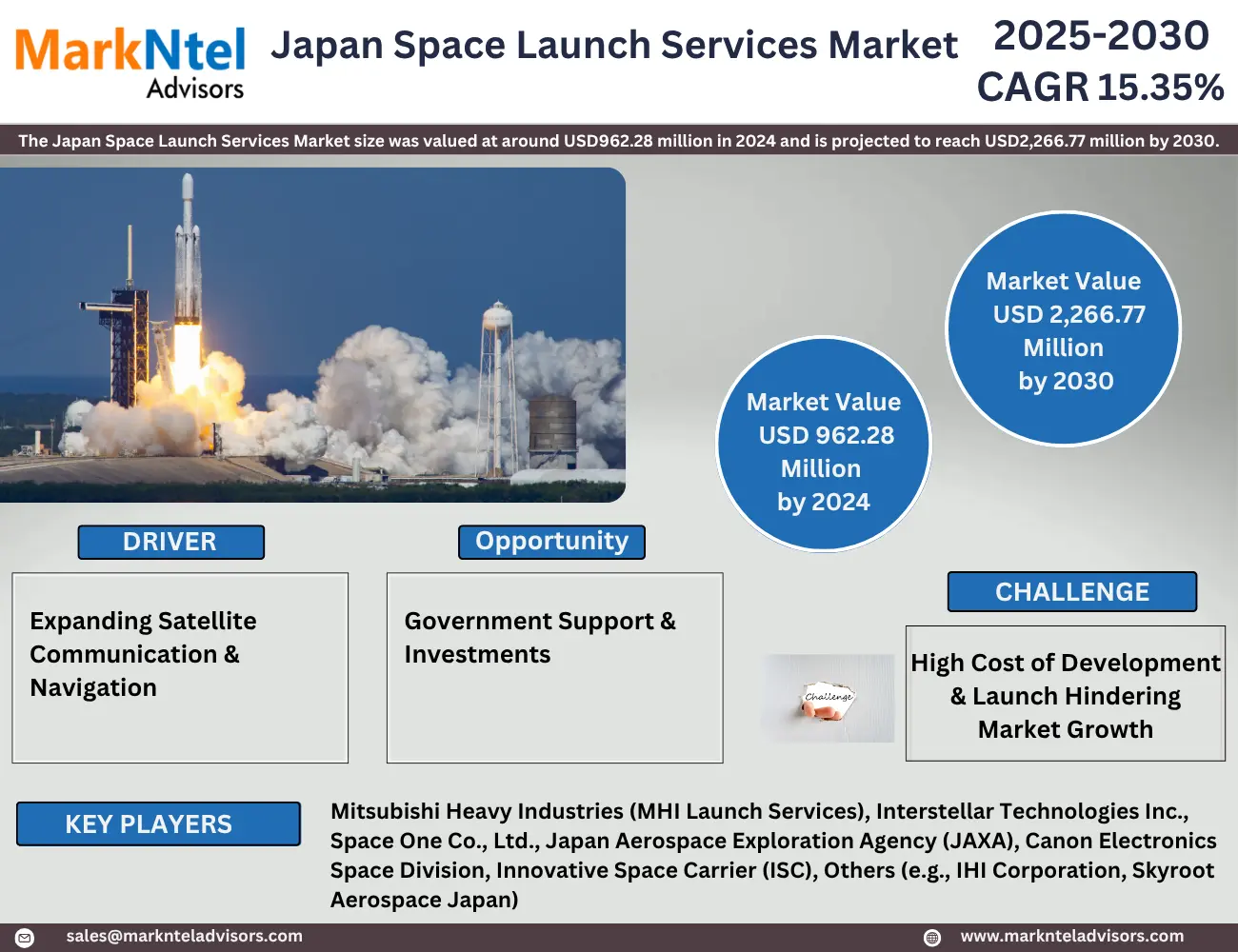
The Japan Space Launch Services Market size was valued at around USD962.28 million in 2024 and is projected to reach USD2,266.77 million by 2030. Along with this, the market is estimated to grow at a CAGR of around 15.35% during the forecast period, i.e., 2025-30. The Japan Space Launch Services Market growth is due to the increasing need for navigation & communication services, growing investments in the space industry, growing need for the current updates in the Earth observatory for the accurate and precise forecasting of the weather, natural disasters, etc., advancement in technologies, government support, and others.
The growing need for satellites in the Earth observatory due to the close monitoring of the Earth’s surface and the collection of data for real-time tracking of the changes in the environment, physical features, weather, etc. Thus, for the coverage of all the regions, Japan’s launch ports are an ideal choice because of their reach to the polar and equatorial regions, offering a precise and accurate analysis.
| Report Coverage | Details |
|---|---|
| Historical Years | 2020–23 |
| Forecast Years | 2025–30 |
| Market Value in 2024 | USD 962.28 Million |
| Market Value by 2030 | USD 2,266.77 Million |
| CAGR (2025–30) | 15.35% |
| Top Key Players | Mitsubishi Heavy Industries (MHI Launch Services), Interstellar Technologies Inc., Space One Co., Ltd., Japan Aerospace Exploration Agency (JAXA), Canon Electronics Space Division, Innovative Space Carrier (ISC), Others (e.g., IHI Corporation, Skyroot Aerospace Japan) |
| Key Report Highlights |
|
*Boost strategic growth with in-depth market analysis - Get a free sample preview today!
Moreover, the technological advances across numerous sectors have increased due to the rapid digitalization and investment in the research and innovation of new technologies. The upgradation in the launching services has led to the offering of rideshare missions, under which, on a launcher vehicle or rocket, multiple payloads can be launched. Such advanced technology generates a potential for the growth of space launch service providers in Japan. Thus, the increasing investments, collaboration of the public-private sector, increasing inclination of consumers and the government towards reusable alternatives, and the growing multiple sectors such as telecommunication, observatory, etc., boost the demand for Space launch services in Japan.
Japan Space Launch Services Market Driver:
Expanding Satellite Communication & Navigation – The navigation and communication industry of Japan is growing due to the increasing adoption of electronic devices, digitalization of the sectors, growing need for high-speed internet services, advancements in technology, etc.
The need for electronic devices, like smartphones, laptops, PCs, and others, has surged due to the growing connectivity, white collar population, compactness & portability of such devices, etc. As per the Groupe Speciale Mobile Association (GSMA), there are about 130 million smartphone users, with 120 million equipped with internet services and over 90 million with 5G internet connections, with a penetration rate of smartphones of 104% of the population, in 2025. These large volumes of connections rely on the American GPS system for connection and navigability; thus, to become a self-reliant country, the country introduced its QZSS navigation system. The satellites in this system account for 5 in 2025, with the plan to increase this number to 7 by 2026, and to 11 by the end of 2030, increasing the satellite launches.
Thus, the increasing connectivity and adoption of 5G internet services & smartphones among individuals are boosting the navigation system of the country, leading to a rise in the satellite launches, hence boosting the space launch services in Japan.
Japan Space Launch Services Market Opportunity:
Government Support & Investments – The Japanese government is actively contributing to the market growth through various initiatives, programs, and collaborations with other organizations to support the Space industry, to establish an independent navigation system, and to strengthen national security. The government of Japan is encouraging the space launch industry through programs like the Artemis Program, a basic plan on space policy, and others, under which the nation aims to strengthen its presence in space and on the moon by deploying satellites and a base camp on the moon. Further, the government is collaborating with the leading global space institutes and countries like India and the US, supporting and providing space services for their launches.
The government is devising funds and offering grants & funds to the domestic space launch service providers. In 2024, approximately USD69 million in financial aid was offered to 3 launch start-ups of the country. Under the Space Strategy Fund, the authorities announced in 2024 that about USD6.6 billion in funds will be added for the next ten years. Thus, the funds, collaborative projects, programs, and policies of the government for the growth of domestic launch service providers create a potential for the growth and expansion of the market.
Japan Space Launch Services Market Challenge:
High Cost of Development & Launch Hindering Market Growth – The overall cost, including production, permits, safety certification, failures, and others, of Space Launch increases the cost because of the high investment made in the research and development of launchers and technologies, regulatory compliances, etc.
The extensive testing, advanced cutting-edge technologies, the usage of advanced materials like Ablative, Inconel, Niobium, etc., compliance with strict regulatory measures for safety & environmental protection, and other miscellaneous investments, raise the cost of launching services. These materials are specially designed and manufactured to protect the launcher from the impact of various atmospheric layers, like the mesosphere, ionosphere, etc., and in the successful launch of the payloads. The expensive materials and electronic components used in the launchers, along with the strict regulations of the Japanese government, increase the cost of the service in the country.
Additionally, due to numerous technological reasons and environmental challenges, it sometimes results in operational failures, leading to a huge economic loss for the service providers and loss of their goodwill. For instance, the H3 rocket of the JAXA and Mitsubishi Heavy Industries failed during the launch due to an issue in the second-stage ignition stage in 2023. Similarly, the Kairos rocket of Space One service provider failed within a few minutes of liftoff in 2024. To prevent such incidents, testing and validations are carried out on a large scale, and the monetary cost required for the refurbishment of RLVs adds to the cost. Thus, the expensive material, testing, and refurbishment, along with the safety certification, further increase the cost of the development and launch cost of the space launch services in the market.
Japan Space Launch Services Market Trend:
Shift Towards Sustainable Space Launch Vehicles – The growing initiatives of the national and international organizations have influenced the market to adopt sustainability. The launching activities have increased the debris of the rockets and launchers in space, leading to innovation in such technology and vehicles, which prevents further contribution to the rise in debris.
As a solution, the service providers in Japan are adopting reusable launch vehicles (RLV) for the launch of the payloads. The aim of RLVs is to return to the Earth’s surface after the purpose of the spacecraft is fulfilled, using vertical landings, parachute landings, or gliding. The returned RLVs are again sent to space during the next launch. This returning and reusing of the space launch vehicles has subsequently reduced the rate of debris deposition around planets, satellites, and other celestial bodies. The service providers, such as Innovation Space Carrier (ISC), Space One, Interstellar Technologies, etc., are integrating and developing such advancements and technologies. Thus, the increasing shift towards cleaner and greener products has led to the increasing adoption of reusable launch vehicles among space launch service providers in Japan.
Japan Space Launch Services Market (2025-30): Segmentation Analysis
The Japan Space Launch Services Market study of MarkNtel Advisors evaluates & highlights the major trends and influencing factors in each segment. It includes predictions for the period 2025–2030 at the national level. Based on the analysis, the market has been further classified as:
Based on Product Type:
- Small Satellite Launch Vehicles (SSLVs)
- Medium-Lift Launch Vehicles
- Heavy-Lift Launch Vehicles
- Reusable Rocket Systems
Based on product type, the small satellite launch vehicles segment holds the largest market share of around 41%. This market share is due to the miniaturization of the devices, advanced technologies, increasing investment, cost-effective methods, frequent launches, etc.
The minimization of the electric components and equipment due to the growing advances and investments in micro and nanotechnology decreases the size of the payloads. The decreased size and load require small satellite launch vehicles, for the launches leading to a decrease in the cost of the launch services. The reduced size of the payloads and launchers accelerates the launching procedure, leading to a rise in the number of launches. The frequent launches made by the telecommunication, Earth observatory, and scientific research sectors increase the utility of the small satellite launch vehicles. The increased demand for low Earth orbit-based services (LEO) needed for communication, intelligence, disaster management, etc., further increases the demand for small satellite launch vehicles in Japan.
Based on Service Type:
- Pre-Launch Services (Payload Integration, Testing, Licensing)
- Launch Services (Orbital, Suborbital)
- Post-Launch Services (Debris Mitigation, Mission Support)
The launch services segment holds the largest market share of about 52%. This is due to the strategic position of launch centers along the coastline, increasing investments by the government and private sector, international collaborations, space tourism, etc.
The launching services in Japan have increased lately due to the ideal location of the launching pads and ports along the coastline, like Tanegashima, Uchinoura Space Center, etc. The launches from such locations reduce the exposure of risk to the population due to operational inefficiency, leading Japan to be one of the launching hub globally. The growing investment and collaborations of the Japanese government through agencies like JAXA and the Ministry of Economy Trade and Industry in programs like Space Strategy Funds, and in start-ups have attracted the launching service providers to the country, leading to an increase in the launch activities, thus, facilitating its largest market share in Japan.
Japan Space Launch Services Industry Recent Development:
- 2025: Interstellar Technologies Inc. (IST) received an investment of approximately USD44.4 million from Woven by Toyota, a subsidiary of Toyota Motor Corporation, to support the mass production of reusable rockets, aiming to enhance Japan’s commercial space launch capabilities and enable more cost-effective, high-frequency satellite deployments.
- 2025: Innovative Space Carrier (ISC) announced plans to test-launch its ASCA 1.0 reusable launcher prototype in December 2025 at Spaceport America in New Mexico, marking the first commercial U.S.-Japan rocket collaboration and aiming to demonstrate low-cost, high-frequency launch capabilities through reusable technology.
Gain a Competitive Edge with Our Japan Space Launch Services Market Report
- Japan Space Launch Services Market by MarkNtel Advisors provides a detailed & thorough analysis of market size & share, growth rate, competitive landscape, and key players. This comprehensive analysis helps businesses gain a holistic understanding of the market dynamics & make informed decisions.
- This report also highlights current market trends & future projections, allowing businesses to identify emerging opportunities & potential challenges. By understanding market forecasts, companies can align their strategies & stay ahead of the competition.
- The Japan Space Launch Services Market Report aids in assessing & mitigating risks associated with entering or operating in the market. By understanding market dynamics, regulatory frameworks, and potential challenges, businesses can develop strategies to minimize risks & optimize their operations.
*Reports Delivery Format - Market research studies from MarkNtel Advisors are offered in PDF, Excel and PowerPoint formats. Within 24 hours of the payment being successfully received, the report will be sent to your email address.
Frequently Asked Questions
- Market Segmentation
- Introduction
- Product Definition
- Research Process
- Assumptions
- Executive Summary
- Japan Space Launch Services Market Policies, Regulations, and Product Standards
- Japan Space Launch Services Market Supply Chain Analysis
- Japan Space Launch Services Market Trends & Developments
- Japan Space Launch Services Market Dynamics
- Growth Drivers
- Challenges
- Japan Space Launch Services Market Hotspot & Opportunities
- Japan Space Launch Services Market Outlook, 2025–2030
- Market Size & Outlook
- By Revenues (USD Million)
- By Volume (Number of Launches)
- Market Share & Outlook
- By Product Type – Market Size & Forecast (2020–2030), USD Million & Number of Launches
- Small Satellite Launch Vehicles (SSLVs)
- Medium-Lift Launch Vehicles
- Heavy-Lift Launch Vehicles
- Reusable Rocket Systems
- By Service Type – Market Size & Forecast (2020–2030), USD Million & Number of Launches
- Pre-Launch Services (Payload Integration, Testing, Licensing)
- Launch Services (Orbital, Suborbital)
- Post-Launch Services (Debris Mitigation, Mission Support)
- By End-User – Market Size & Forecast (2020–2030), USD Million & Number of Launches
- Government & Defense
- Commercial Entities
- Research & Academic Institutions
- By Company – Market Size & Forecast (2020–2030), USD Million & Number of Launches
- Company Revenue Shares
- Competitor Characteristics
- By Product Type – Market Size & Forecast (2020–2030), USD Million & Number of Launches
- Market Size & Outlook
- Japan Small Satellite Launch Vehicle (SSLV) Market Outlook, 2025–2030
- Market Size & Outlook
- By Revenues (USD Million)
- By Volume (Number of Launches)
- Market Share & Outlook
- By Payload Capacity – Market Size & Forecast (2025–2030), USD Million & Number of Launches
- By End-User – Market Size & Forecast (2025–2030), USD Million & Number of Launches
- By Region – Market Size & Forecast (2025–2030), USD Million & Number of Launches
- Market Size & Outlook
- Japan Space Pre-Launch Service Market Outlook, 2025–2030
- Market Size & Outlook
- By Revenues (USD Million)
- By Volume (Number of Launches)
- Market Share & Outlook
- By Product– Market Size & Forecast (2025–2030), USD Million & Number of Launches
- By End-User – Market Size & Forecast (2025–2030), USD Million & Number of Launches
- Market Size & Outlook
- Japan Space Launch Services Market Outlook, 2025–2030
- Market Size & Outlook
- By Revenues (USD Million)
- By Volume (Number of Launches)
- Market Share & Outlook
- By Product– Market Size & Forecast (2025–2030), USD Million & Number of Launches
- By End-User – Market Size & Forecast (2025–2030), USD Million & Number of Launches
- Market Size & Outlook
- Japan Space Post-Launch Service Market Outlook, 2025–2030
- Market Size & Outlook
- By Revenues (USD Million)
- By Volume (Number of Launches)
- Market Share & Outlook
- By Product– Market Size & Forecast (2025–2030), USD Million & Number of Launches
- By End-User – Market Size & Forecast (2025–2030), USD Million & Number of Launches
- Market Size & Outlook
- Japan Space Launch Services Market Key Strategic Imperatives for Success & Growth
- Competition Outlook
- Company Profiles
- Mitsubishi Heavy Industries (MHI Launch Services)
- Business Description
- Product Portfolio
- Strategic Alliances or Partnerships
- Recent Developments
- Financial Details
- Others
- Interstellar Technologies Inc.
- Business Description
- Product Portfolio
- Strategic Alliances or Partnerships
- Recent Developments
- Financial Details
- Others
- Space One Co., Ltd.
- Business Description
- Product Portfolio
- Strategic Alliances or Partnerships
- Recent Developments
- Financial Details
- Others
- Japan Aerospace Exploration Agency (JAXA)
- Business Description
- Product Portfolio
- Strategic Alliances or Partnerships
- Recent Developments
- Financial Details
- Others
- Canon Electronics Space Division
- Business Description
- Product Portfolio
- Strategic Alliances or Partnerships
- Recent Developments
- Financial Details
- Others
- Innovative Space Carrier (ISC)
- Business Description
- Product Portfolio
- Strategic Alliances or Partnerships
- Recent Developments
- Financial Details
- Others
- Others (e.g., IHI Corporation, Skyroot Aerospace Japan)
- Business Description
- Product Portfolio
- Strategic Alliances or Partnerships
- Recent Developments
- Financial Details
- Others
- Mitsubishi Heavy Industries (MHI Launch Services)
- Company Profiles
- Disclaimer
MarkNtel Advisors follows a robust and iterative research methodology designed to ensure maximum accuracy and minimize deviation in market estimates and forecasts. Our approach combines both bottom-up and top-down techniques to effectively segment and quantify various aspects of the market. A consistent feature across all our research reports is data triangulation, which examines the market from three distinct perspectives to validate findings. Key components of our research process include:
1. Scope & Research Design At the outset, MarkNtel Advisors define the research objectives and formulate pertinent questions. This phase involves determining the type of research—qualitative or quantitative—and designing a methodology that outlines data collection methods, target demographics, and analytical tools. They also establish timelines and budgets to ensure the research aligns with client goals.
2. Sample Selection and Data Collection In this stage, the firm identifies the target audience and determines the appropriate sample size to ensure representativeness. They employ various sampling methods, such as random or stratified sampling, based on the research objectives. Data collection is carried out using tools like surveys, interviews, and observations, ensuring the gathered data is reliable and relevant.
3. Data Analysis and Validation Once data is collected, MarkNtel Advisors undertake a rigorous analysis process. This includes cleaning the data to remove inconsistencies, employing statistical software for quantitative analysis, and thematic analysis for qualitative data. Validation steps are taken to ensure the accuracy and reliability of the findings, minimizing biases and errors.

4. Data Forecast and FinalizationThe final phase involves forecasting future market trends based on the analyzed data. MarkNtel Advisors utilize predictive modeling and time series analysis to anticipate market behaviors. The insights are then compiled into comprehensive reports, featuring visual aids like charts and graphs, and include strategic recommendations to inform client decision-making
We offer flexible licensing options to cater to varying organizational needs. Choose the pricing pack that best suits your requirements:
Buy Now Inquire Before Buying
 Request Customization
 Talk to our Consultant







