

Japan Semiconductor Manufacturing Equipment Market Research Report: Forecast (2025-2030)
Japan Semiconductor Manufacturing Equipment Market Size & Analysis By Equipment Type (Memory Devices, Logic Devices, Analog IC, Microprocessors (MPU), Microcontrollers (MCU), Discr ... ete Power Devices, Sensors, Others), By Material Used (Silicon Carbide, Gallium Manganese Arsenide, Copper Indium Gallium Selenide, Molybdenum Disulfide, Others), By End User (Automotive, Industrial, Data Center, Telecommunication, Consumer Electronics, Aerospace and Defense, Healthcare, Others) and others Read more
- ICT & Electronics
- Jun 2025
- Pages 154
- Report Format: PDF, Excel, PPT
Market Definition
Semiconductor manufacturing equipment refers to the tools and machinery used in the designing of circuits and devices, integrated across multiple sectors.
Market Insights & Analysis: Japan Semiconductor Manufacturing Equipment Market (2025-30):
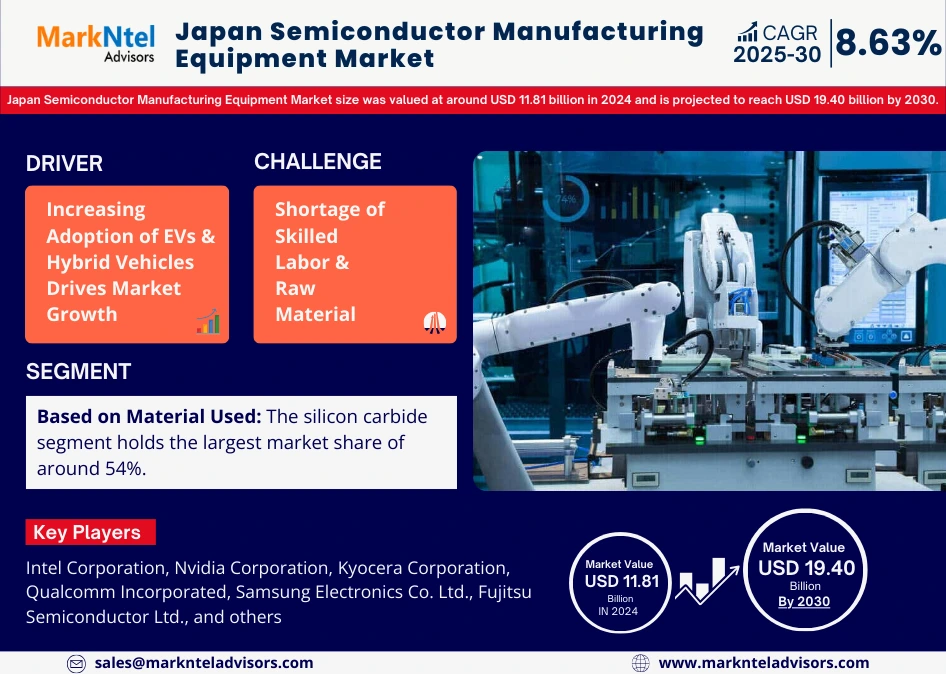
The Japan Semiconductor Manufacturing Equipment Market size was valued at around USD 11.81 billion in 2024 and is projected to reach USD 19.40 billion by 2030. Along with this, the market is estimated to grow at a CAGR of around 8.63% during the forecast period, i.e., 2025-30. The Japan Semiconductor Manufacturing Equipment Market growth is due to the shift in the adoption of hybrid and electric automotive, increasing penetration of 5G internet services and electronic devices, increasing investments in the sector, government support, increasing integration of AI, ML, Cloud, etc.
| Report Coverage | Details |
|---|---|
| Historical Years | 2020–23 |
| Base Years | 2024 |
| Forecast Years | 2025–30 |
| Market Value in 2024 | USD 11.81 Billion |
| Market Value by 2030 | USD 19.40 Billion |
| CAGR (2025–30) | 8.63% |
| Top Key Players | Intel Corporation, Nvidia Corporation, Kyocera Corporation, Qualcomm Incorporated, STMicroelectronics NV, Micron Technology Inc., Xilinx Inc., NXP Semiconductors NV, Toshiba Corporation, Texas Instruments Inc., Taiwan Semiconductor Manufacturing Company (TSMC) Limited, Samsung Electronics Co. Ltd., Fujitsu Semiconductor Ltd., and others |
| Segmentation | By Equipment Type (Memory Devices, Logic Devices, Analog IC, Microprocessors (MPU), Microcontrollers (MCU), Discrete Power Devices, Sensors, Others), By Material Used (Silicon Carbide, Gallium Manganese Arsenide, Copper Indium Gallium Selenide, Molybdenum Disulfide, Others), By End User (Automotive, Industrial, Data Center, Telecommunication, Consumer Electronics, Aerospace and Defense, Healthcare, Others) and others |
| Key Report Highlights |
|
*Boost strategic growth with in-depth market analysis - Get a free sample preview today!
The growth in the digital infrastructure, such as data centers and parks, has increased lately due to the advancements in technology, such as AI, ML, cloud, edge-computing, IIoT and others, because of the growing investment and support of the government, increasing white collar population, adoption of smartphones, etc. Japan has one of the advanced and high-tech manufacturing machines with IIoT, AI integration, which monitors the real-time processing and automates the manufacturing process, improving the quality of the production. To power such machinery, a stable 5G internet services are required; thus, to power the manufacturing sector, the data centers and other digital infrastructure are integrated with semiconductor chips and circuits such as CPUs, GPUs, DRAM, etc., enabling the connectivity and smooth functioning of the manufacturing sector, hence for the seamless services of the data centers, semiconductors are needed.
The increasing funding in research and innovation in semiconductors & related technologies, and training the unskilled workforce, has increased in Japan, for the promotion and growth of the domestic semiconductor manufacturing units, due to the ongoing US-China trade war. Thus, the increasing advances and innovations in semiconductors require advanced manufacturing equipment, hence increasing the demand for semiconductor manufacturing equipment in Japan.
Japan Semiconductor Manufacturing Equipment Market Driver:
Increasing Adoption of EVs & Hybrid Vehicles Drives Market Growth – The automobile industry in Japan has surged recently, due to the increasing inclination towards greener products, stringent government regulations, reduced road tax and tolls for EVs, subsidies & incentives on the purchase of electric vehicles, etc. The Japanese government is encouraging the adoption of electric vehicles in Japan by offering nearly USD5,700 on Battery EV (BEV), USD3,852.75 on Plug-in Hybrid EV (PHEV), and USD17,867.85 on Fused Cell Vehicles (FCV) subsidies on the purchase of automobile under Clean Energy Vehicle Subsidy Program, in 2024, as per the Ministry of Economy, Trade and Industry (METI).
Similarly, other programs and tax exemptions are being deployed to increase the energy-friendly vehicles. These programs are initiated the support individuals due to the ban on gasoline-only vehicles since 2035. Thus, the impending ban and support have led to an increase in the sale of EVs in the country, with more than 60,000 units of EVs sold in 2024. The increasing sales of hybrid and electric vehicles have led the EV manufacturers Nissan, BYD, Toyota, etc., to expand their reach in the country. Such vehicles for power rely on semiconductor batteries; thus, the increase in the production of electric vehicles increases the demand for semiconductor batteries. Thus, the increasing need for semiconductor batteries in automotive vehicles, such as hybrid and electric vehicles, is driving the Semiconductor Manufacturing Equipment industry growth in the i japan.
Japan Semiconductor Manufacturing Equipment Market Opportunity:
Government Support to Small-Scale Domestic Manufacturers & Start-Ups – The government is supporting the domestic companies and innovation of new technologies in the market to boost the economic growth of the nation, through initiatives such as investments in research, collaborations, public–private partnership, etc. The Ministry of Economy, Trade and Industry (METI) is offering incentives, grants, and subsidies to small-scale semiconductor manufacturers like Rapidus Corporation. In 2025, METI announced the investment of about USD5.62 billion in the manufacturing and setting up of the 2nm semiconductor chip manufacturing unit, leading to a total of about USD11.6 billion in government investment done so far since 2022. The investments are made for the setting up of new advanced high-tech semiconductor manufacturing equipment with the EUV technology.
Further, the government initiated a five-year development plan in 2022, under which the government planned to invest approximately USD70 billion in 100,000 start-up companies by 2027. Such investments are made to transition Japan into Silicon Valley. Thus, such government favorable efforts are creating lucrative growth opportunities for the market players in Japanese Semiconductor Manufacturing Equipment Industry.
Japan Semiconductor Manufacturing Equipment Market Challenge:
Shortage of Skilled Labor & Raw Material – Most of the raw material, such as silicon carbide, rare earth metals like gallium, antimony, etc., are imported from neighboring countries like China, Taiwan, Chile, and others. The ongoing China-US tariff is impacting the supply of raw materials across the globe, including Japan. The increasing tariff on the import of raw materials negatively affects the manufacturing of semiconductors.
Additionally, the shortage of skilled labor due to the strict immigration policy of the government, the aging population of Japan, which accounts for nearly 30% of the population, the demand for high-tech semiconductor talent, and no support for young talent in the field of semiconductors, etc. The strict immigration policy of the Japanese government slows the visa process, with long working hours, and cultural differences, which have reduced the rate of immigration of skilled labor from foreign countries. However, the lower skill set of the youth and aging population prevails, leading to a shortage of skilled labor. Thus, the challenges in the import of raw materials and the aging and unskilled population of Japan hinder the market growth, leading to a loss in the domestic market of the country.
Japan Semiconductor Manufacturing Equipment Market Trend:
Advancements in Technologies Changing Market Dynamics – The advancements in cutting-edge technology like Extreme Ultraviolet (EUV) lithography, Nanotechnology, etc., are evolving the semiconductor industry. The EUV lithography technology is used to make small, precise patterns of circuits on silicon wafers, using light of wavelength 13.5 nanometers, used to make small and complex semiconductor devices at nodes of 7nm or below. In EUV lithography, an EUV mask is deployed, which inspects the silicon layers, making the semiconductor chip more effective. Lasertec Corporation is deploying EUV masks in the manufacturing equipment, thus increasing the production of semiconductors. End-user companies such as Samsung, Intel, TSMC, etc., are using these nano semiconductors in their devices. Thus, increasing the demand for such advanced technologies in the manufacturing process of semiconductors for the effective operation of the end-user products in the country.
Japan Semiconductor Manufacturing Equipment Market (2025-30): Segmentation Analysis
The Japan Semiconductor Manufacturing Equipment Market study of MarkNtel Advisors evaluates & highlights the major trends and influencing factors in each segment. It includes predictions for the period 2025–2030 at the country level. Based on the analysis, the market has been further classified as:
Based on Material Used:
- Silicon Carbide
- Gallium Manganese Arsenide
- Copper Indium Gallium Selenide
- Molybdenum Disulfide
- Others
Based on the material used, the silicon carbide segment holds the largest market share of around 54%. This market share is due to the properties of the silicon carbide, its utility in the automotive industry, and the abundance of silicon carbide in the country. Silicon carbide is extensively used in the end-user industries due to its properties, such as high heat and electrical conductivity. Because of this high thermal conductivity, the automotive or heavy machinery that generates a lot of heat are integrating silicon carbide semiconductors as it eliminates the need for the cooling system, thus operating efficiently even in extreme temperatures. The silicon carbide chip and circuits offer high voltage and bandwidth for the seamless operation of the equipment, and as a DC to AC inverter in the automobile sector, thus they are extensively used in the end-user industry. For instance, Tesla’s Model 3 EV uses SiC MOSFETs, which enhance the overall efficiency of the vehicle and are lightweight.
Additionally, Japan is the home to several leading SiC wafers and device manufacturers, such as Sumitomo Electric, Denko, etc., which are investing and developing in the advancements in the material and devices, thus increasing their integration in the semiconductor manufacturing equipment in Japan.
Based on Equipment Type:
- Memory Devices
- Logic Devices
- Analog IC
- Microprocessors (MPU)
- Microcontrollers (MCU)
- Discrete Power Devices
- Sensors
- Others
Memory Devices hold the largest market share of about 63%. This is due to the increasing penetration of electronic devices, development of the digital infrastructure, increasing advancements such as AI, ML, Cloud, and others, digitalization of various sectors, the adoption of 5G internet services, government support, etc.
The penetration of electronic devices, primarily smartphones, is growing due to the increasing remote working culture, high-speed internet services, and digitalization of sectors like banking, education, government, etc. As per GSMA, in 2024, there were around 190 million active mobile connections, accounting for 153% population. These numbers represent the surging consumption of smartphones. Such utility requires a high storage capacity for storing the critical data. Thus, advanced semiconductor memory storage chips are produced, leading to an increase in the need for semiconductor memory devices manufacturing equipment.
The digital infrastructure, such as data centers, parks, etc., is developing in the country due to the rising need for 5G internet connectivity. The digital infrastructure requires humongous storage capacity for the data generated by the consumers; thus, to offer large storage capacity, semiconductor memory devices and chips are used. Thus, the growing data generation due to the accessibility of high-speed internet services, increasing adoption of smartphones, etc., has led to an increase in the demand for the segment in the semiconductor manufacturing equipment market in Japan.
Japan Semiconductor Manufacturing Equipment Industry Recent Development:
- 2024: Taiwan Semiconductor Manufacturing Company (TSMC) Limited, in partnership with Sony, began mass production at its new Kumamoto semiconductor fab in Japan, following an $8.3 billion investment and over $3 billion in Japanese government subsidies.
- 2024: Micron Technology Inc. announced a USD3.8–5.1 billion investment to build a Hiroshima DRAM fab with EUV lithography, backed by USD1.3 billion in Japanese government subsidies, operational by 2027.
Gain a Competitive Edge with Our Japan Semiconductor Manufacturing Equipment Market Report
- Japan Semiconductor Manufacturing Equipment Market by MarkNtel Advisors provides a detailed & thorough analysis of market size & share, growth rate, competitive landscape, and key players. This comprehensive analysis helps businesses gain a holistic understanding of the market dynamics & make informed decisions.
- This report also highlights current market trends & future projections, allowing businesses to identify emerging opportunities & potential challenges. By understanding market forecasts, companies can align their strategies & stay ahead of the competition.
- Japan Semiconductor Manufacturing Equipment Market Report aids in assessing & mitigating risks associated with entering or operating in the market. By understanding market dynamics, regulatory frameworks, and potential challenges, businesses can develop strategies to minimize risks & optimize their operations.
Frequently Asked Questions
- Market Segmentation
- Introduction
- Product Definition
- Research Process
- Assumptions
- Executive Summary
- Japan Semiconductor Manufacturing Equipment Market Regulations, Policies & Standards
- Japan Semiconductor Manufacturing Equipment Market Trends & Developments
- Japan Semiconductor Manufacturing Equipment Market Dynamics
- Growth Drivers
- Challenges
- Japan Semiconductor Manufacturing Equipment Market Hotspots & Opportunities
- Japan Semiconductor Manufacturing Equipment Market Value Chain Analysis
- Japan Semiconductor Manufacturing Equipment Market Outlook, 2020-2030F
- Market Size & Analysis
- Market Revenues (USD Million)
- Market Share & Analysis
- By Equipment Type
- Memory Devices- Market Size & Forecast 2020-2030, USD Million
- Logic Devices- Market Size & Forecast 2020-2030, USD Million
- Analog IC- Market Size & Forecast 2020-2030, USD Million
- Microprocessors (MPU)- Market Size & Forecast 2020-2030, USD Million
- Microcontrollers (MCU)- Market Size & Forecast 2020-2030, USD Million
- Discrete Power Devices- Market Size & Forecast 2020-2030, USD Million
- Sensors- Market Size & Forecast 2020-2030, USD Million
- Others- Market Size & Forecast 2020-2030, USD Million
- By Material Used
- Silicon Carbide- Market Size & Forecast 2020-2030, USD Million
- Gallium Manganese Arsenide- Market Size & Forecast 2020-2030, USD Million
- Copper Indium Gallium Selenide- Market Size & Forecast 2020-2030, USD Million
- Molybdenum Disulfide- Market Size & Forecast 2020-2030, USD Million
- Others- Market Size & Forecast 2020-2030, USD Million
- By End User
- Automotive- Market Size & Forecast 2020-2030, USD Million
- Industrial- Market Size & Forecast 2020-2030, USD Million
- Data Center- Market Size & Forecast 2020-2030, USD Million
- Telecommunication- Market Size & Forecast 2020-2030, USD Million
- Consumer Electronics- Market Size & Forecast 2020-2030, USD Million
- Aerospace and Defense- Market Size & Forecast 2020-2030, USD Million
- Healthcare- Market Size & Forecast 2020-2030, USD Million
- Others- Market Size & Forecast 2020-2030, USD Million
- By Region
- North
- East
- West
- South
- By Competitors
- Competition Characteristics
- Market Share & Analysis
- By Equipment Type
- Market Size & Analysis
- Japan Automotive Semiconductor Manufacturing Equipment Market Outlook, 2020-2030F
- Market Size & Analysis
- Market Revenues (USD Million)
- Market Share & Analysis
- By Equipment Type- Market Size & Forecast 2020-2030, USD Million
- By Material Used- Market Size & Forecast 2020-2030, USD Million
- Market Size & Analysis
- Japan Industrial Semiconductor Manufacturing Equipment Market Outlook, 2020-2030F
- Market Size & Analysis
- Market Revenues (USD Million)
- Market Share & Analysis
- By Equipment Type- Market Size & Forecast 2020-2030, USD Million
- By Material Used- Market Size & Forecast 2020-2030, USD Million
- Market Size & Analysis
- Japan Data Center Semiconductor Manufacturing Equipment Market Outlook, 2020-2030F
- Market Size & Analysis
- Market Revenues (USD Million)
- Market Share & Analysis
- By Equipment Type- Market Size & Forecast 2020-2030, USD Million
- By Material Used- Market Size & Forecast 2020-2030, USD Million
- Market Size & Analysis
- Japan Telecommunication Semiconductor Manufacturing Equipment Market Outlook, 2020-2030F
- Market Size & Analysis
- Market Revenues (USD Million)
- Market Share & Analysis
- By Equipment Type- Market Size & Forecast 2020-2030, USD Million
- By Material Used- Market Size & Forecast 2020-2030, USD Million
- Market Size & Analysis
- Japan Consumer Electronics Semiconductor Manufacturing Equipment Market Outlook, 2020-2030F
- Market Size & Analysis
- Market Revenues (USD Million)
- Market Share & Analysis
- By Equipment Type- Market Size & Forecast 2020-2030, USD Million
- By Material Used- Market Size & Forecast 2020-2030, USD Million
- Market Size & Analysis
- Japan Aerospace & Defense Semiconductor Manufacturing Equipment Market Outlook, 2020-2030F
- Market Size & Analysis
- Market Revenues (USD Million)
- Market Share & Analysis
- By Equipment Type- Market Size & Forecast 2020-2030, USD Million
- By Material Used- Market Size & Forecast 2020-2030, USD Million
- Market Size & Analysis
- Japan Healthcare Semiconductor Manufacturing Equipment Market Outlook, 2020-2030F
- Market Size & Analysis
- Market Revenues (USD Million)
- Market Share & Analysis
- By Equipment Type- Market Size & Forecast 2020-2030, USD Million
- By Material Used- Market Size & Forecast 2020-2030, USD Million
- Market Size & Analysis
- Japan Semiconductor Manufacturing Equipment Market Key Strategic Imperatives for Growth & Success
- Competitive Outlook
- Company Profiles
- Intel Corporation
- Business Description
- Product Portfolio
- Strategic Alliances or Partnerships
- Recent Developments
- Financial Details
- Others
- Nvidia Corporation
- Business Description
- Product Portfolio
- Strategic Alliances or Partnerships
- Recent Developments
- Financial Details
- Others
- Kyocera Corporation
- Business Description
- Product Portfolio
- Strategic Alliances or Partnerships
- Recent Developments
- Financial Details
- Others
- Qualcomm Incorporated
- Business Description
- Product Portfolio
- Strategic Alliances or Partnerships
- Recent Developments
- Financial Details
- Others
- STMicroelectronics NV
- Business Description
- Product Portfolio
- Strategic Alliances or Partnerships
- Recent Developments
- Financial Details
- Others
- Micron Technology Inc.
- Business Description
- Product Portfolio
- Strategic Alliances or Partnerships
- Recent Developments
- Financial Details
- Others
- Xilinx Inc.
- Business Description
- Product Portfolio
- Strategic Alliances or Partnerships
- Recent Developments
- Financial Details
- Others
- NXP Semiconductors NV
- Business Description
- Product Portfolio
- Strategic Alliances or Partnerships
- Recent Developments
- Financial Details
- Others
- Toshiba Corporation
- Business Description
- Product Portfolio
- Strategic Alliances or Partnerships
- Recent Developments
- Financial Details
- Others
- Texas Instruments Inc.
- Business Description
- Product Portfolio
- Strategic Alliances or Partnerships
- Recent Developments
- Financial Details
- Others
- Taiwan Semiconductor Manufacturing Company (TSMC) Limited
- Business Description
- Product Portfolio
- Strategic Alliances or Partnerships
- Recent Developments
- Financial Details
- Others
- Samsung Electronics Co., Ltd.
- Business Description
- Product Portfolio
- Strategic Alliances or Partnerships
- Recent Developments
- Financial Details
- Others
- Fujitsu Semiconductor Ltd.
- Business Description
- Product Portfolio
- Strategic Alliances or Partnerships
- Recent Developments
- Financial Details
- Others
- Others
- Intel Corporation
- Company Profiles
- Disclaimer
MarkNtel Advisors follows a robust and iterative research methodology designed to ensure maximum accuracy and minimize deviation in market estimates and forecasts. Our approach combines both bottom-up and top-down techniques to effectively segment and quantify various aspects of the market. A consistent feature across all our research reports is data triangulation, which examines the market from three distinct perspectives to validate findings. Key components of our research process include:
1. Scope & Research Design At the outset, MarkNtel Advisors define the research objectives and formulate pertinent questions. This phase involves determining the type of research—qualitative or quantitative—and designing a methodology that outlines data collection methods, target demographics, and analytical tools. They also establish timelines and budgets to ensure the research aligns with client goals.
2. Sample Selection and Data Collection In this stage, the firm identifies the target audience and determines the appropriate sample size to ensure representativeness. They employ various sampling methods, such as random or stratified sampling, based on the research objectives. Data collection is carried out using tools like surveys, interviews, and observations, ensuring the gathered data is reliable and relevant.
3. Data Analysis and Validation Once data is collected, MarkNtel Advisors undertake a rigorous analysis process. This includes cleaning the data to remove inconsistencies, employing statistical software for quantitative analysis, and thematic analysis for qualitative data. Validation steps are taken to ensure the accuracy and reliability of the findings, minimizing biases and errors.

4. Data Forecast and FinalizationThe final phase involves forecasting future market trends based on the analyzed data. MarkNtel Advisors utilize predictive modeling and time series analysis to anticipate market behaviors. The insights are then compiled into comprehensive reports, featuring visual aids like charts and graphs, and include strategic recommendations to inform client decision-making
We offer flexible licensing options to cater to varying organizational needs. Choose the pricing pack that best suits your requirements:
Buy Now Inquire Before Buying
 Request Customization
 Talk to our Consultant







