

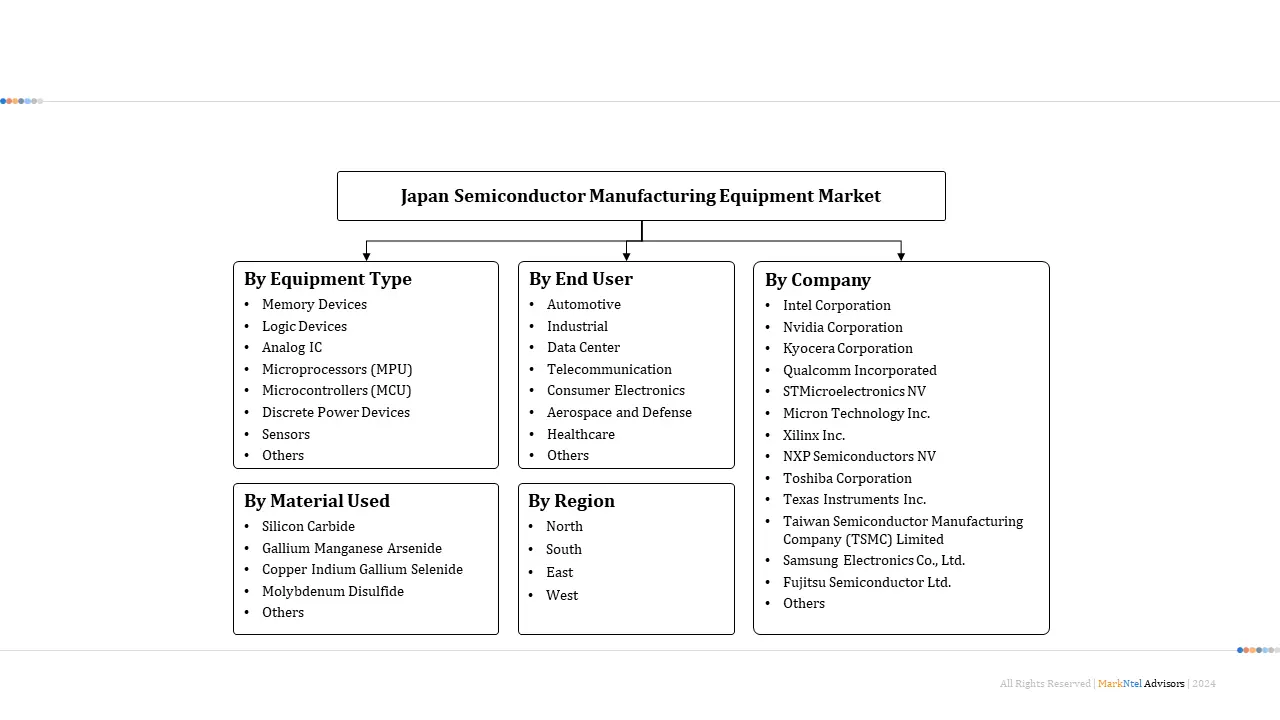
Japan Semiconductor Manufacturing Equipment Market Size & Analysis By Equipment Type (Memory Devices, Logic Devices, Analog IC, Microprocessors (MPU), Microcontrollers (MCU), Discr......ete Power Devices, Sensors, Others), By Material Used (Silicon Carbide, Gallium Manganese Arsenide, Copper Indium Gallium Selenide, Molybdenum Disulfide, Others), By End User (Automotive, Industrial, Data Center, Telecommunication, Consumer Electronics, Aerospace and Defense, Healthcare, Others) and others Read more
- ICT & Electronics
- Jun 2025
- 154
- PDF, Excel, PPT
Market Definition
Semiconductor manufacturing equipment refers to the tools and machinery used in the designing of circuits and devices, integrated across multiple sectors.
Market Insights & Analysis: Japan Semiconductor Manufacturing Equipment Market (2025-30):
The Japan Semiconductor Manufacturing Equipment Market size was valued at around USD 11.81 billion in 2024 and is projected to reach USD 19.40 billion by 2030. Along with this, the market is estimated to grow at a CAGR of around 8.63% during the forecast period, i.e., 2025-30. The Japan Semiconductor Manufacturing Equipment Market growth is due to the shift in the adoption of hybrid and electric automotive, increasing penetration of 5G internet services and electronic devices, increasing investments in the sector, government support, increasing integration of AI, ML, Cloud, etc.
| Report Coverage | Details |
|---|---|
| Historical Years | 2020–23 |
| Base Years | 2024 |
| Forecast Years | 2025–30 |
| Market Value in 2024 | USD 11.81 Billion |
| Market Value by 2030 | USD 19.40 Billion |
| CAGR (2025–30) | 8.63% |
| Top Key Players | Intel Corporation, Nvidia Corporation, Kyocera Corporation, Qualcomm Incorporated, STMicroelectronics NV, Micron Technology Inc., Xilinx Inc., NXP Semiconductors NV, Toshiba Corporation, Texas Instruments Inc., Taiwan Semiconductor Manufacturing Company (TSMC) Limited, Samsung Electronics Co. Ltd., Fujitsu Semiconductor Ltd., and others |
| Segmentation | By Equipment Type (Memory Devices, Logic Devices, Analog IC, Microprocessors (MPU), Microcontrollers (MCU), Discrete Power Devices, Sensors, Others), By Material Used (Silicon Carbide, Gallium Manganese Arsenide, Copper Indium Gallium Selenide, Molybdenum Disulfide, Others), By End User (Automotive, Industrial, Data Center, Telecommunication, Consumer Electronics, Aerospace and Defense, Healthcare, Others) and others |
| Key Report Highlights |
|
*Boost strategic growth with in-depth market analysis - Get a free sample preview today!
The growth in the digital infrastructure, such as data centers and parks, has increased lately due to the advancements in technology, such as AI, ML, cloud, edge-computing, IIoT and others, because of the growing investment and support of the government, increasing white collar population, adoption of smartphones, etc. Japan has one of the advanced and high-tech manufacturing machines with IIoT, AI integration, which monitors the real-time processing and automates the manufacturing process, improving the quality of the production. To power such machinery, a stable 5G internet services are required; thus, to power the manufacturing sector, the data centers and other digital infrastructure are integrated with semiconductor chips and circuits such as CPUs, GPUs, DRAM, etc., enabling the connectivity and smooth functioning of the manufacturing sector, hence for the seamless services of the data centers, semiconductors are needed.
The increasing funding in research and innovation in semiconductors & related technologies, and training the unskilled workforce, has increased in Japan, for the promotion and growth of the domestic semiconductor manufacturing units, due to the ongoing US-China trade war. Thus, the increasing advances and innovations in semiconductors require advanced manufacturing equipment, hence increasing the demand for semiconductor manufacturing equipment in Japan.
Japan Semiconductor Manufacturing Equipment Market Driver:
Increasing Adoption of EVs & Hybrid Vehicles Drives Market Growth – The automobile industry in Japan has surged recently, due to the increasing inclination towards greener products, stringent government regulations, reduced road tax and tolls for EVs, subsidies & incentives on the purchase of electric vehicles, etc. The Japanese government is encouraging the adoption of electric vehicles in Japan by offering nearly USD5,700 on Battery EV (BEV), USD3,852.75 on Plug-in Hybrid EV (PHEV), and USD17,867.85 on Fused Cell Vehicles (FCV) subsidies on the purchase of automobile under Clean Energy Vehicle Subsidy Program, in 2024, as per the Ministry of Economy, Trade and Industry (METI).
Similarly, other programs and tax exemptions are being deployed to increase the energy-friendly vehicles. These programs are initiated the support individuals due to the ban on gasoline-only vehicles since 2035. Thus, the impending ban and support have led to an increase in the sale of EVs in the country, with more than 60,000 units of EVs sold in 2024. The increasing sales of hybrid and electric vehicles have led the EV manufacturers Nissan, BYD, Toyota, etc., to expand their reach in the country. Such vehicles for power rely on semiconductor batteries; thus, the increase in the production of electric vehicles increases the demand for semiconductor batteries. Thus, the increasing need for semiconductor batteries in automotive vehicles, such as hybrid and electric vehicles, is driving the Semiconductor Manufacturing Equipment industry growth in the i japan.
- Market Segmentation
- Introduction
- Product Definition
- Research Process
- Assumptions
- Executive Summary
- Japan Semiconductor Manufacturing Equipment Market Regulations, Policies & Standards
- Japan Semiconductor Manufacturing Equipment Market Trends & Developments
- Japan Semiconductor Manufacturing Equipment Market Dynamics
- Growth Drivers
- Challenges
- Japan Semiconductor Manufacturing Equipment Market Hotspots & Opportunities
- Japan Semiconductor Manufacturing Equipment Market Value Chain Analysis
- Japan Semiconductor Manufacturing Equipment Market Outlook, 2020-2030F
- Market Size & Analysis
- Market Revenues (USD Million)
- Market Share & Analysis
- By Equipment Type
- Memory Devices- Market Size & Forecast 2020-2030, USD Million
- Logic Devices- Market Size & Forecast 2020-2030, USD Million
- Analog IC- Market Size & Forecast 2020-2030, USD Million
- Microprocessors (MPU)- Market Size & Forecast 2020-2030, USD Million
- Microcontrollers (MCU)- Market Size & Forecast 2020-2030, USD Million
- Discrete Power Devices- Market Size & Forecast 2020-2030, USD Million
- Sensors- Market Size & Forecast 2020-2030, USD Million
- Others- Market Size & Forecast 2020-2030, USD Million
- By Material Used
- Silicon Carbide- Market Size & Forecast 2020-2030, USD Million
- Gallium Manganese Arsenide- Market Size & Forecast 2020-2030, USD Million
- Copper Indium Gallium Selenide- Market Size & Forecast 2020-2030, USD Million
- Molybdenum Disulfide- Market Size & Forecast 2020-2030, USD Million
- Others- Market Size & Forecast 2020-2030, USD Million
- By End User
- Automotive- Market Size & Forecast 2020-2030, USD Million
- Industrial- Market Size & Forecast 2020-2030, USD Million
- Data Center- Market Size & Forecast 2020-2030, USD Million
- Telecommunication- Market Size & Forecast 2020-2030, USD Million
- Consumer Electronics- Market Size & Forecast 2020-2030, USD Million
- Aerospace and Defense- Market Size & Forecast 2020-2030, USD Million
- Healthcare- Market Size & Forecast 2020-2030, USD Million
- Others- Market Size & Forecast 2020-2030, USD Million
- By Region
- North
- East
- West
- South
- By Competitors
- Competition Characteristics
- Market Share & Analysis
- By Equipment Type
- Market Size & Analysis
- Japan Automotive Semiconductor Manufacturing Equipment Market Outlook, 2020-2030F
- Market Size & Analysis
- Market Revenues (USD Million)
- Market Share & Analysis
- By Equipment Type- Market Size & Forecast 2020-2030, USD Million
- By Material Used- Market Size & Forecast 2020-2030, USD Million
- Market Size & Analysis
- Japan Industrial Semiconductor Manufacturing Equipment Market Outlook, 2020-2030F
- Market Size & Analysis
- Market Revenues (USD Million)
- Market Share & Analysis
- By Equipment Type- Market Size & Forecast 2020-2030, USD Million
- By Material Used- Market Size & Forecast 2020-2030, USD Million
- Market Size & Analysis
- Japan Data Center Semiconductor Manufacturing Equipment Market Outlook, 2020-2030F
- Market Size & Analysis
- Market Revenues (USD Million)
- Market Share & Analysis
- By Equipment Type- Market Size & Forecast 2020-2030, USD Million
- By Material Used- Market Size & Forecast 2020-2030, USD Million
- Market Size & Analysis
- Japan Telecommunication Semiconductor Manufacturing Equipment Market Outlook, 2020-2030F
- Market Size & Analysis
- Market Revenues (USD Million)
- Market Share & Analysis
- By Equipment Type- Market Size & Forecast 2020-2030, USD Million
- By Material Used- Market Size & Forecast 2020-2030, USD Million
- Market Size & Analysis
- Japan Consumer Electronics Semiconductor Manufacturing Equipment Market Outlook, 2020-2030F
- Market Size & Analysis
- Market Revenues (USD Million)
- Market Share & Analysis
- By Equipment Type- Market Size & Forecast 2020-2030, USD Million
- By Material Used- Market Size & Forecast 2020-2030, USD Million
- Market Size & Analysis
- Japan Aerospace & Defense Semiconductor Manufacturing Equipment Market Outlook, 2020-2030F
- Market Size & Analysis
- Market Revenues (USD Million)
- Market Share & Analysis
- By Equipment Type- Market Size & Forecast 2020-2030, USD Million
- By Material Used- Market Size & Forecast 2020-2030, USD Million
- Market Size & Analysis
- Japan Healthcare Semiconductor Manufacturing Equipment Market Outlook, 2020-2030F
- Market Size & Analysis
- Market Revenues (USD Million)
- Market Share & Analysis
- By Equipment Type- Market Size & Forecast 2020-2030, USD Million
- By Material Used- Market Size & Forecast 2020-2030, USD Million
- Market Size & Analysis
- Japan Semiconductor Manufacturing Equipment Market Key Strategic Imperatives for Growth & Success
- Competitive Outlook
- Company Profiles
- Intel Corporation
- Business Description
- Product Portfolio
- Strategic Alliances or Partnerships
- Recent Developments
- Financial Details
- Others
- Nvidia Corporation
- Business Description
- Product Portfolio
- Strategic Alliances or Partnerships
- Recent Developments
- Financial Details
- Others
- Kyocera Corporation
- Business Description
- Product Portfolio
- Strategic Alliances or Partnerships
- Recent Developments
- Financial Details
- Others
- Qualcomm Incorporated
- Business Description
- Product Portfolio
- Strategic Alliances or Partnerships
- Recent Developments
- Financial Details
- Others
- STMicroelectronics NV
- Business Description
- Product Portfolio
- Strategic Alliances or Partnerships
- Recent Developments
- Financial Details
- Others
- Micron Technology Inc.
- Business Description
- Product Portfolio
- Strategic Alliances or Partnerships
- Recent Developments
- Financial Details
- Others
- Xilinx Inc.
- Business Description
- Product Portfolio
- Strategic Alliances or Partnerships
- Recent Developments
- Financial Details
- Others
- NXP Semiconductors NV
- Business Description
- Product Portfolio
- Strategic Alliances or Partnerships
- Recent Developments
- Financial Details
- Others
- Toshiba Corporation
- Business Description
- Product Portfolio
- Strategic Alliances or Partnerships
- Recent Developments
- Financial Details
- Others
- Texas Instruments Inc.
- Business Description
- Product Portfolio
- Strategic Alliances or Partnerships
- Recent Developments
- Financial Details
- Others
- Taiwan Semiconductor Manufacturing Company (TSMC) Limited
- Business Description
- Product Portfolio
- Strategic Alliances or Partnerships
- Recent Developments
- Financial Details
- Others
- Samsung Electronics Co., Ltd.
- Business Description
- Product Portfolio
- Strategic Alliances or Partnerships
- Recent Developments
- Financial Details
- Others
- Fujitsu Semiconductor Ltd.
- Business Description
- Product Portfolio
- Strategic Alliances or Partnerships
- Recent Developments
- Financial Details
- Others
- Others
- Intel Corporation
- Company Profiles
- Disclaimer
MarkNtel Advisors follows a robust and iterative research methodology designed to ensure maximum accuracy and minimize deviation in market estimates and forecasts. Our approach combines both bottom-up and top-down techniques to effectively segment and quantify various aspects of the market. A consistent feature across all our research reports is data triangulation, which examines the market from three distinct perspectives to validate findings. Key components of our research process include:
1. Scope & Research Design At the outset, MarkNtel Advisors define the research objectives and formulate pertinent questions. This phase involves determining the type of research—qualitative or quantitative—and designing a methodology that outlines data collection methods, target demographics, and analytical tools. They also establish timelines and budgets to ensure the research aligns with client goals.
2. Sample Selection and Data Collection In this stage, the firm identifies the target audience and determines the appropriate sample size to ensure representativeness. They employ various sampling methods, such as random or stratified sampling, based on the research objectives. Data collection is carried out using tools like surveys, interviews, and observations, ensuring the gathered data is reliable and relevant.
3. Data Analysis and Validation Once data is collected, MarkNtel Advisors undertake a rigorous analysis process. This includes cleaning the data to remove inconsistencies, employing statistical software for quantitative analysis, and thematic analysis for qualitative data. Validation steps are taken to ensure the accuracy and reliability of the findings, minimizing biases and errors.

4. Data Forecast and FinalizationThe final phase involves forecasting future market trends based on the analyzed data. MarkNtel Advisors utilize predictive modeling and time series analysis to anticipate market behaviors. The insights are then compiled into comprehensive reports, featuring visual aids like charts and graphs, and include strategic recommendations to inform client decision-making
FILL THE FORM TO INQUIRE BEFORE BUYING THIS REPORT
We offer flexible licensing options to cater to varying organizational needs. Choose the pricing pack that best suits your requirements:
Buy Now Talk to our Consultant
 Request Customization