

Global AI in Computer Vision Market Research Report: Growth Drivers & Forecast (2026-2032)
By Component (Hardware (Cameras & sensors, GPUs, TPUs, AI chips, Edge AI devices, Vision-enabled drones & robots), Software (Vision analytics platforms, Deep learning & ML algorith ... ms, Image/video analytics software, Facial recognition software, Object detection & tracking, Vision SDKs & APIs), Services (Integration & deployment, Consulting, Maintenance & support, AI model training & data labeling)), By Function (Training, Inference), By Technology (Deep Learning, Machine Learning, Image Processing, Pattern Recognition), By Deployment Mode (Cloud-Based, Edge-Based, Hybrid), By Enterprise Size (Large Enterprises, Small & Medium Enterprises (SMEs)), By Application (Quality Inspection & Automation, Surveillance & Security, Predictive Maintenance, Autonomous Navigation, Traffic & Crowd Monitoring, AR/VR & Gaming, Document Processing & OCR), By End User (Manufacturing, Consumer Electronics, Aerospace & Defense, Transportation & Logistics, Healthcare, Retail & E-commerce, BFSI, Agriculture, Others), and others Read more
- ICT & Electronics
- May 2026
- Pages 345
- Report Format: PDF, Excel, PPT
Global AI in Computer Vision Market
Projected 22.12% CAGR from 2026 to 2032
Study Period
2026-2032
Market Size (2026)
USD 28.12 Billion
Market Size (2032)
USD 93.27 Billion
Largest Region
North America
Projected CAGR
22.12%
Leading Segments
By component: Software
Global AI in Computer Vision Market Key Takeaways
- The global AI in computer vision market was valued at USD 23.03 billion in 2025 and is projected to grow from USD 28.12 billion in 2026 to USD 93.27 billion by 2032, registering a CAGR of 22.12% during the forecast period (2026–2032).
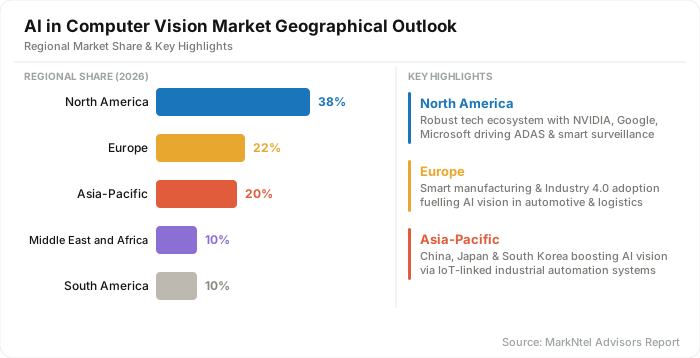
- North America dominates the market, accounting for approximately 38% of the total share.
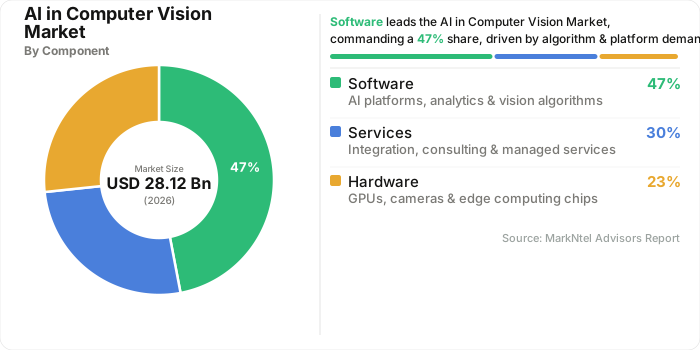
- By component, the software segment leads the market, holding an estimated 47% share.
- In terms of end users, the manufacturing sector accounted for a significant 28% share in 2026.
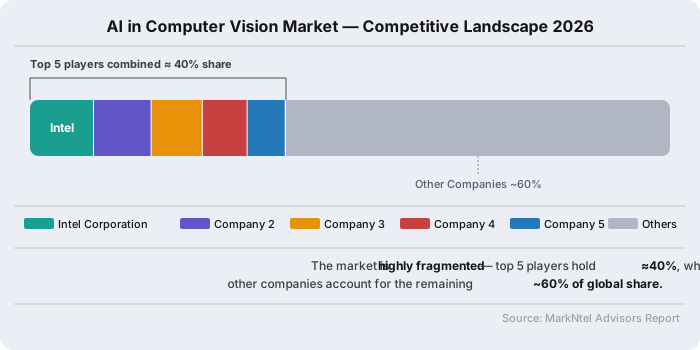
- The market structure remains highly fragmented, although the top five companies collectively account for around 40% of the overall market share.
Global AI in Computer Vision Market Size and Outlook
The global AI in computer vision market is projected to witness a CAGR of approximately 22.12% during 2026–2032, reflecting strong and sustained expansion over the forecast period. This growth is primarily driven by the rapid proliferation of visual data across digital ecosystems, fueled by the widespread adoption of cameras, sensors, and connected devices across industries. Additionally, the increasing integration of edge-based and real-time processing capabilities is enabling low-latency decision-making and improving operational efficiency in applications such as autonomous systems, smart surveillance, and industrial automation.
As per UN-Habitat, nearly 73% of cities worldwide have already deployed sensor-based systems, while close to 80% of countries have implemented national digital data frameworks. This widespread digitalization is resulting in the continuous generation of large-scale visual and spatial datasets, thereby increasing reliance on advanced object detection algorithms to interpret data streams and enable real-time, data-driven decision-making across sectors.
Moreover, government-led investments in surveillance and smart city initiatives are significantly accelerating the growth, with the market projected to increase from USD 28.12 billion in 2026 to USD 93.27 billion by 2032. Under India’s Smart Cities Mission, more than 84,000 CCTV cameras have been deployed across 100 cities, enabling continuous monitoring for traffic regulation, public safety, and governance applications.
In Chongqing city, situated in China, a district implemented 27,900 surveillance cameras along with 245 sensors in 2025 to strengthen grid-based governance systems . Additionally, preparations for the Simhastha Kumbh Mela 2027 include surveillance investments exceeding USD 48 million, reflecting growing reliance on facial recognition technology and AI-enabled monitoring to manage large-scale public events efficiently.
Simultaneously, advancements in industrial automation are reinforcing demand for AI-powered visual solutions. Data from the International Federation of Robotics indicates that global robot density reached 267 units per 10,000 employees in Western Europe, 204 in North America, and 131 in Asia in 2024, with leading countries such as Germany, Japan, and the United States demonstrating highly automated manufacturing ecosystems. This increase in robot penetration is directly linked to the growing adoption of computer vision systems for inspection, navigation, and quality assurance processes within industrial environments.
Moreover, the ongoing transition toward edge-based computing is reshaping deployment models by enabling faster data processing, enhanced privacy protection, and reduced reliance on centralized cloud infrastructure. This approach supports real-time analytics across industries, improving scalability and operational efficiency in applications requiring immediate visual interpretation.
The convergence of expanding sensor networks, rising public-sector investments in surveillance infrastructure, increasing industrial automation, and the evolution of edge computing is expected to significantly accelerate the growth of AI in the computer vision market, ensuring sustained demand across both public and private sectors globally.
Global AI in Computer Vision Market Key Indicators
- A total of 542,000 industrial robot installations were recorded globally in 2024 by the International Federation of Robotics, reflecting more than a twofold increase compared to deployment levels a decade earlier. Of these installations, 74% were concentrated in Asia, while China alone accounted for 295,000 units, representing the highest contribution by a single country . Each robotic system integrated into production lines relies on machine vision technology for precision tasks such as assembly validation and defect detection, establishing a direct correlation between automation expansion and computer vision demand.
- The U.S. Department of Transportation has committed up to USD 500 million under its SMART Grants Program (2022–2026) to advance connected infrastructure, sensor networks, and intelligent transport ecosystems. These initiatives are enabling large-scale deployment of autonomous vision applications, particularly in traffic monitoring and vehicle coordination, reinforcing the role of AI-powered visual systems in next-generation mobility frameworks.
- Siemens Healthineers introduced AI-enabled radiology solutions that automate image interpretation and reporting workflows, enabling radiologists to process chest CT scans up to 25% faster while reducing cognitive burden. These advancements leverage neural network imaging to enhance diagnostic precision, highlighting the growing reliance on AI-driven visual analysis within healthcare systems facing increasing imaging volumes and workforce constraints.
- The Chandigarh administration is advancing urban mobility infrastructure through a large-scale enhancement of its traffic management framework, involving the installation of nearly 2,000 AI-enabled cameras across 287 sites and the extension of adaptive signaling systems to 109 intersections. This deployment leverages intelligent video surveillance to enable real-time traffic optimization, strengthen incident response capabilities, and support centralized command operations, reflecting the growing integration of AI-driven visual systems in smart city ecosystems.
Global AI in Computer Vision Market Scope
| Category | Segments |
|---|---|
| By Component | Hardware (Cameras & sensors, GPUs, TPUs, AI chips, Edge AI devices, Vision-enabled drones & robots), Software (Vision analytics platforms, Deep learning & ML algorithms, Image/video analytics software, Facial recognition software, Object detection & tracking, Vision SDKs & APIs), Services (Integration & deployment, Consulting, Maintenance & support, AI model training & data labeling |
| By Function | Training, Inference |
| By Technology | Deep Learning, Machine Learning, Image Processing, Pattern Recognition |
| By Deployment Mode | Cloud-Based, Edge-Based, Hybrid |
| By Enterprise Size | Large Enterprises, Small & Medium Enterprises (SMEs |
| By Application | Quality Inspection & Automation, Surveillance & Security, Predictive Maintenance, Autonomous Navigation, Traffic & Crowd Monitoring, AR/VR & Gaming, Document Processing & OCR |
| By End User | Manufacturing, Consumer Electronics, Aerospace & Defense, Transportation & Logistics, Healthcare, Retail & E-commerce, BFSI, Agriculture, Others |
Global AI in Computer Vision Market Growth Drivers
Explosion of Visual Data Across Digital Ecosystems
The rapid expansion of urban digital infrastructure and connected sensing ecosystems is significantly accelerating the adoption of AI in computer vision globally. According to the UN-Habitat, it is estimated that nearly 83 billion sensing devices were deployed worldwide by the end of 2024, while approximately 80% of cities globally and 82% in Europe are actively using data for decision-making . This large-scale proliferation of sensors, cameras, and IoT-enabled systems is generating massive volumes of visual data, necessitating advanced deep learning visual systems for real-time analysis and actionable insights.
At the city level, governments are further strengthening this ecosystem through targeted investments in surveillance and traffic infrastructure. For instance, Bhubaneswar has initiated the deployment of an additional 1,500 AI-enabled CCTV cameras, expanding its total network to around 3,300 cameras integrated with Integrated Command and Control Centre (ICCC) systems . This expansion reflects the increasing reliance on AI-powered video analytics for traffic monitoring, public safety, and urban management.
The convergence of large-scale sensor networks and city-wide surveillance infrastructure is creating a continuous flow of visual data, driving the need for scalable AI-enabled processing capabilities.
The exponential growth in connected sensing devices and smart city deployments is emerging as a critical driver for AI in computer vision, as governments and enterprises increasingly rely on intelligent visual systems for data-driven urban governance and operational efficiency.
Recent Trends
Rise of Edge-Based Real-Time Image Processing Solutions in Computer Vision
The shift toward decentralized computing architectures is emerging as a key growth trend in the Global AI in computer vision industry, driven by increasing demand for low-latency analytics, enhanced data privacy, and real-time decision-making.
Enterprises are progressively deploying real-time image processing solutions at the edge directly on cameras, sensors, and embedded systems, reducing dependence on cloud infrastructure while improving responsiveness and operational efficiency across critical applications.
A notable example is a smart city testbed in Aveiro, where edge-based computer vision systems have been deployed to detect and track vehicles, pedestrians, and cyclists in real time while predicting collision risks . By processing visual data locally from surveillance cameras, the system enables instantaneous decision-making without cloud latency, significantly enhancing urban safety outcomes. This deployment reflects the growing preference for edge-enabled AI in high-density, real-time environments.
Beyond smart cities, industries such as manufacturing and retail are increasingly adopting edge-based vision systems for defect detection, automated checkout, and inventory monitoring, where immediate insights are critical to operational continuity. The expansion of global digital infrastructure is further enabling scalable deployment of connected edge devices. Overall, the integration of real-time image processing solutions at the edge is redefining computer vision architectures by enabling faster, more secure, and scalable visual intelligence across industries.
Global AI in Computer Vision Market Opportunities and Challenges
EU AI Act Restrictions Accelerating Demand for Privacy-Compliant Computer Vision Systems
Stringent regulatory frameworks governing biometric AI applications are reshaping deployment dynamics in the computer vision market, creating both compliance challenges and new growth avenues for privacy-compliant solutions.
The EU Artificial Intelligence Act, effective from August 1, 2024, establishes strict controls on real-time biometric identification in publicly accessible environments, permitting usage only under narrowly defined law-enforcement scenarios.
Non-compliance may result in penalties of up to EUR 35 million or 7% of global annual turnover, while the regulation’s extraterritorial scope requires global vendors to align solutions serving EU users with these standards . Concurrently, enforcement under the General Data Protection Regulation remains robust, with fines exceeding EUR 1.2 billion across the European technology sector in 2025 , underscoring heightened scrutiny of personal and biometric data processing.
These regulatory developments present a material challenge for providers reliant on surveillance-oriented applications, increasing compliance complexity and limiting deployment scalability. However, they simultaneously create a structurally favorable environment for privacy-compliant AI-powered image recognition solutions. Applications such as industrial inspection, semiconductor quality assurance, and medical imaging, where personal data is not processed, offer a clear regulatory advantage and are increasingly prioritized by enterprise buyers.
Regulatory tightening is not only constraining biometric use cases but also redirecting demand toward compliant, non-biometric applications, thereby supporting sustained growth across industrial and healthcare segments.
Segmentation Insights
The Adoption of Software Components across AI in Computer Vision Solutions
The software segment represents the core value of AI in computer vision industry, accounting for nearly 47% of the overall volume due to its critical role in enabling intelligence from visual data. Unlike hardware components, which primarily capture and process images, software platforms are responsible for interpreting, analyzing, and converting visual inputs into actionable insights. This includes vision analytics platforms, deep learning algorithms, image and video analytics tools, and application-specific modules such as facial recognition and object tracking systems.
The dominance of this segment is driven by the increasing demand for scalable and customizable solutions across industries. Enterprises are prioritizing software-driven capabilities to enhance operational efficiency, automate decision-making, and extract real-time insights from large volumes of visual data. Additionally, the rise of cloud computing and API-based deployment models has made it easier for organizations to integrate computer vision functionalities into existing systems without heavy infrastructure investments.
Continuous advancements in artificial intelligence, particularly in deep learning and model optimization, are further strengthening the software ecosystem. Organizations are increasingly investing in AI model training, data labeling, and platform development to improve accuracy and performance.
As use cases expand across sectors such as healthcare, retail, manufacturing, and smart cities, the software segment is expected to maintain its leading position, driven by its flexibility, scalability, and ability to deliver high-value analytical outcomes. The market segmentation, based on component, includes:
- Hardware
- Cameras & sensors
- GPUs, TPUs, AI chips
- Edge AI devices
- Vision-enabled drones & robots
- Software
- Vision analytics platforms
- Deep learning & ML algorithms
- Image/video analytics software
- Facial recognition software
- Object detection & tracking
- Vision SDKs & APIs
- Services
- Integration & deployment
- Consulting
- Maintenance & support
- AI model training & data labeling
The Manufacturing Sector Dominates the End User Segment
The manufacturing segment holds a leading share of approximately 28% in the AI in computer vision industry, primarily due to its early and extensive adoption of automation and quality control technologies.
Industrial environments generate large volumes of visual data across production lines, creating strong demand for computer vision systems to ensure precision, efficiency, and consistency. These systems are widely used for defect detection, assembly verification, and process monitoring, with AI-driven visual inspection enabling faster and more accurate identification of defects while reducing human intervention.
The integration of AI-powered vision solutions supports real-time inspection and predictive maintenance, allowing companies to identify faults at early stages and optimize production workflows. Additionally, the rise of Industry 4.0 and smart factory initiatives has accelerated the deployment of connected machines and automated systems, further strengthening the role of computer vision in manufacturing operations.
Another key factor driving dominance is the increasing adoption of robotics and automated assembly lines, where visual systems play a critical role in guiding robotic movements and ensuring accuracy.
As manufacturers continue to focus on cost efficiency, product quality, and scalability, investments in AI-enabled vision technologies are expected to rise. This sustained demand positions the manufacturing sector as a primary contributor to market growth, reinforcing its leadership within the AI in computer vision landscape. The study identifies the following key end-user industries:
- Manufacturing
- Consumer Electronics
- Aerospace & Defense
- Transportation & Logistics
- Healthcare
- Retail & E-commerce
- BFSI
- Agriculture
- Others
Global AI in Computer Vision Market Geographical Outlook
The North America region accounts for approximately 38% of Global AI in computer vision market, supported by its advanced digital infrastructure and early adoption of intelligent technologies across industries.
A key factor underpinning this dominance is the region’s leadership in smart infrastructure deployment, with nearly 92% of cities utilizing data-driven systems for governance and urban management. This high penetration reflects the extensive rollout of camera networks, IoT-enabled sensors, and intelligent transportation systems that continuously generate large volumes of visual data.
Such mature ecosystems necessitate the integration of AI-powered computer vision solutions to enable real-time analytics, efficient traffic management, and enhanced public safety monitoring. The region’s strong focus on innovation, coupled with substantial investments in smart city initiatives, has accelerated the deployment of advanced visual technologies across both public and private sectors. Additionally, widespread adoption across industries such as manufacturing, retail, and healthcare further strengthens demand for AI-based vision systems.
The presence of leading technology providers and robust R&D capabilities also contributes to rapid innovation and commercialization of computer vision solutions. As organizations continue to prioritize automation, operational efficiency, and data-driven decision-making, North America is expected to maintain its leading position in the market.
Collectively, North America’s well-developed digital infrastructure and advanced technological capabilities establish it as a leading hub for the adoption and deployment of AI in computer vision solutions globally.
Global AI in Computer Vision Market Competitive Analysis
The Global AI in Computer Vision industry remains highly fragmented, characterized by the presence of numerous international and regional participants across hardware, software, and service segments. The competitive landscape includes semiconductor firms, cloud platform providers, and specialized vision solution developers, creating a multi-layered ecosystem. Key players such as NVIDIA Corporation, Microsoft Corporation, Alphabet Inc., Amazon.com, Inc., and Intel Corporation together hold an estimated 40% share.
Key Players in AI in Computer Vision Industry
- Intel Corporation
- Sony Group Corporation
- Cognex Corporation
- Microsoft Corporation
- KEYENCE Corporation
- Amazon.com, Inc.
- Basler AG
- NVIDIA Corporation
- OMRON Corporation
- Teledyne Technologies Incorporated
- Alphabet Inc.
- Texas Instruments Incorporated
- SICK AG
- Hailo Technologies Ltd.
- Qualcomm Technologies, Inc.
- Advanced Micro Devices, Inc.
- Samsung Electronics Co., Ltd.
- Huawei Technologies Co., Ltd.
- Honeywell International Inc.
- Bosch Group
- Others
Global AI in Computer Vision Industry News and Recent Developments
April 2026: SenseTime Launches SenseNova U1 Image Processing Model
SenseTime introduced SenseNova U1, an advanced image-processing AI model designed for high-speed visual analysis. The model processes images directly rather than converting them into text, improving efficiency and enabling faster performance in applications such as surveillance, robotics, and geospatial intelligence.
Impact Analysis: This development enhances real-time processing capabilities in computer vision by reducing latency and computational overhead. Faster image analysis enables improved performance in time-sensitive applications such as security monitoring and autonomous systems. As demand for real-time decision-making increases, such innovations are expected to drive adoption across industries, particularly in regions investing heavily in AI infrastructure, thereby strengthening the competitive landscape and accelerating technological advancements in the market.
January 2026: NVIDIA Launches Vera Rubin AI Computing Platform
NVIDIA Corporation introduced the Vera Rubin AI computing platform, integrating next-generation CPUs, GPUs, and high-speed interconnects into a unified architecture. The platform is designed to accelerate AI training and inference workloads, offering significantly higher performance for data-intensive applications such as computer vision, robotics, and autonomous systems.
Impact Analysis: This launch strengthens NVIDIA’s leadership in AI infrastructure and directly supports the scaling of computer vision applications requiring high computational power. Enhanced processing capabilities will enable faster model training, real-time analytics, and improved accuracy across industries. As enterprises increasingly adopt AI-driven visual systems, such platforms are expected to accelerate deployment timelines and reduce operational constraints, thereby expanding the overall addressable market for advanced computer vision solutions globally.
October 2025: Microsoft Expands Copilot with Vision Capabilities in Windows 11
Microsoft Corporation announced new AI upgrades to Windows 11, including enhanced Copilot features with vision capabilities. The system can interpret on-screen content, analyze visual inputs, and provide contextual assistance, enabling users to interact more intuitively with applications and digital environments through integrated AI-powered visual understanding.
Impact Analysis: This advancement reflects the growing integration of computer vision into everyday computing environments, extending AI capabilities beyond industrial and enterprise use cases. By embedding vision-based intelligence into widely used operating systems, Microsoft is accelerating mainstream adoption of AI-driven visual tools. This is expected to expand the user base, increase demand for scalable vision models, and drive innovation in real-time image processing applications across both consumer and enterprise segments.
Frequently Asked Questions
- Market Segmentation
- Introduction
- Product Definition
- Research Process
- Assumptions
- Executive Summary
- Global AI in Computer Vision Market Policies, Regulations, and Product Standards
- Global AI in Computer Vision Market Trends & Developments
- Global AI in Computer Vision Market Dynamics
- Growth Factors
- Challenges
- Global AI in Computer Vision Market Hotspot & Opportunities
- Global AI in Computer Vision Market Outlook, 2022-2032F
- Market Size & Outlook
- By Revenues (USD Million)
- Market Share & Analysis
- By Component - Market Size & Forecast 2022-2032, USD Million
- Hardware
- Cameras & sensors
- GPUs, TPUs, AI chips
- Edge AI devices
- Vision-enabled drones & robots
- Software
- Vision analytics platforms
- Deep learning & ML algorithms
- Image/video analytics software
- Facial recognition software
- Object detection & tracking
- Vision SDKs & APIs
- Services
- Integration & deployment
- Consulting
- Maintenance & support
- AI model training & data labeling
- Hardware
- By Function- Market Size & Forecast 2022-2032, USD Million
- Training
- Inference
- By Technology - Market Size & Forecast 2022-2032, USD Million
- Deep Learning
- Machine Learning
- Image Processing
- Pattern Recognition
- By Deployment Mode - Market Size & Forecast 2022-2032, USD Million
- Cloud-Based
- Edge-Based
- Hybrid
- By Enterprise Size - Market Size & Forecast 2022-2032, USD Million
- Large Enterprises
- Small & Medium Enterprises (SMEs)
- By Application- Market Size & Forecast 2022-2032, USD Million
- Quality Inspection & Automation
- Surveillance & Security
- Predictive Maintenance
- Autonomous Navigation
- Traffic & Crowd Monitoring
- AR/VR & Gaming
- Document Processing & OCR
- By End User - Market Size & Forecast 2022-2032, USD Million
- Manufacturing
- Consumer Electronics
- Aerospace & Defense
- Transportation & Logistics
- Healthcare
- Retail & E-commerce
- BFSI
- Agriculture
- Others
- By Region
- North America
- Middle East and Africa
- South America
- Europe
- Asia Pacific
- By Company
- Competition Characteristics
- Market Share & Analysis
- By Component - Market Size & Forecast 2022-2032, USD Million
- Market Size & Outlook
- North America AI in Computer Vision Market Outlook, 2022-2032F
- Market Size & Outlook
- By Revenues (USD Million)
- Market Share & Analysis
- By Component - Market Size & Forecast 2022-2032, USD Million
- By Function- Market Size & Forecast 2022-2032, USD Million
- By Technology - Market Size & Forecast 2022-2032, USD Million
- By Deployment Mode - Market Size & Forecast 2022-2032, USD Million
- By Enterprise Size - Market Size & Forecast 2022-2032, USD Million
- By Application- Market Size & Forecast 2022-2032, USD Million
- By End User - Market Size & Forecast 2022-2032, USD Million
- By Country
- The US
- Canada
- Mexico
- Rest of North America
- The US AI in Computer Vision Market Outlook, 2022-2032F
- Market Size & Outlook
- By Revenues (USD Million)
- Market Share & Analysis
- By Component - Market Size & Forecast 2022-2032, USD Million
- By Function- Market Size & Forecast 2022-2032, USD Million
- By Technology - Market Size & Forecast 2022-2032, USD Million
- By Deployment Mode - Market Size & Forecast 2022-2032, USD Million
- By Enterprise Size - Market Size & Forecast 2022-2032, USD Million
- By Application- Market Size & Forecast 2022-2032, USD Million
- By End User - Market Size & Forecast 2022-2032, USD Million
- Market Size & Outlook
- Canada AI in Computer Vision Market Outlook, 2022-2032F
- Market Size & Outlook
- By Revenues (USD Million)
- Market Share & Analysis
- By Component - Market Size & Forecast 2022-2032, USD Million
- By Function- Market Size & Forecast 2022-2032, USD Million
- By Technology - Market Size & Forecast 2022-2032, USD Million
- By Deployment Mode - Market Size & Forecast 2022-2032, USD Million
- By Enterprise Size - Market Size & Forecast 2022-2032, USD Million
- By Application- Market Size & Forecast 2022-2032, USD Million
- By End User - Market Size & Forecast 2022-2032, USD Million
- Market Size & Outlook
- Mexico AI in Computer Vision Market Outlook, 2022-2032F
- Market Size & Outlook
- By Revenues (USD Million)
- Market Share & Analysis
- By Component - Market Size & Forecast 2022-2032, USD Million
- By Function- Market Size & Forecast 2022-2032, USD Million
- By Technology - Market Size & Forecast 2022-2032, USD Million
- By Deployment Mode - Market Size & Forecast 2022-2032, USD Million
- By Enterprise Size - Market Size & Forecast 2022-2032, USD Million
- By Application- Market Size & Forecast 2022-2032, USD Million
- By End User - Market Size & Forecast 2022-2032, USD Million
- Market Size & Outlook
- Market Size & Outlook
- South America AI in Computer Vision Market Outlook, 2022-2032F
- Market Size & Outlook
- By Revenues (USD Million)
- Market Share & Analysis
- By Component - Market Size & Forecast 2022-2032, USD Million
- By Function- Market Size & Forecast 2022-2032, USD Million
- By Technology - Market Size & Forecast 2022-2032, USD Million
- By Deployment Mode - Market Size & Forecast 2022-2032, USD Million
- By Enterprise Size - Market Size & Forecast 2022-2032, USD Million
- By Application- Market Size & Forecast 2022-2032, USD Million
- By End User - Market Size & Forecast 2022-2032, USD Million
- By Country
- Brazil
- Argentina
- Rest of South America
- Brazil AI in Computer Vision Market Outlook, 2022-2032F
- Market Size & Outlook
- By Revenues (USD Million)
- Market Share & Analysis
- By Component - Market Size & Forecast 2022-2032, USD Million
- By Function- Market Size & Forecast 2022-2032, USD Million
- By Technology - Market Size & Forecast 2022-2032, USD Million
- By Deployment Mode - Market Size & Forecast 2022-2032, USD Million
- By Enterprise Size - Market Size & Forecast 2022-2032, USD Million
- By Application- Market Size & Forecast 2022-2032, USD Million
- By End User - Market Size & Forecast 2022-2032, USD Million
- Market Size & Outlook
- Argentina AI in Computer Vision Market Outlook, 2022-2032F
- Market Size & Outlook
- By Revenues (USD Million)
- Market Share & Analysis
- By Component - Market Size & Forecast 2022-2032, USD Million
- By Function- Market Size & Forecast 2022-2032, USD Million
- By Technology - Market Size & Forecast 2022-2032, USD Million
- By Deployment Mode - Market Size & Forecast 2022-2032, USD Million
- By Enterprise Size - Market Size & Forecast 2022-2032, USD Million
- By Application- Market Size & Forecast 2022-2032, USD Million
- By End User - Market Size & Forecast 2022-2032, USD Million
- Market Size & Outlook
- Market Size & Outlook
- Europe AI in Computer Vision Market Outlook, 2022-2032F
- Market Size & Outlook
- By Revenues (USD Million)
- Market Share & Analysis
- By Component - Market Size & Forecast 2022-2032, USD Million
- By Function- Market Size & Forecast 2022-2032, USD Million
- By Technology - Market Size & Forecast 2022-2032, USD Million
- By Deployment Mode - Market Size & Forecast 2022-2032, USD Million
- By Enterprise Size - Market Size & Forecast 2022-2032, USD Million
- By Application- Market Size & Forecast 2022-2032, USD Million
- By End User - Market Size & Forecast 2022-2032, USD Million
- By Country
- The UK
- Germany
- France
- Italy
- Spain
- Rest of Europe
- The UK AI in Computer Vision Market Outlook, 2022-2032F
- Market Size & Outlook
- By Revenues (USD Million)
- Market Share & Analysis
- By Component - Market Size & Forecast 2022-2032, USD Million
- By Function- Market Size & Forecast 2022-2032, USD Million
- By Technology - Market Size & Forecast 2022-2032, USD Million
- By Deployment Mode - Market Size & Forecast 2022-2032, USD Million
- By Enterprise Size - Market Size & Forecast 2022-2032, USD Million
- By Application- Market Size & Forecast 2022-2032, USD Million
- By End User - Market Size & Forecast 2022-2032, USD Million
- Market Size & Outlook
- Germany AI in Computer Vision Market Outlook, 2022-2032F
- Market Size & Outlook
- By Revenues (USD Million)
- Market Share & Analysis
- By Component - Market Size & Forecast 2022-2032, USD Million
- By Function- Market Size & Forecast 2022-2032, USD Million
- By Technology - Market Size & Forecast 2022-2032, USD Million
- By Deployment Mode - Market Size & Forecast 2022-2032, USD Million
- By Enterprise Size - Market Size & Forecast 2022-2032, USD Million
- By Application- Market Size & Forecast 2022-2032, USD Million
- By End User - Market Size & Forecast 2022-2032, USD Million
- Market Size & Outlook
- France AI in Computer Vision Market Outlook, 2022-2032F
- Market Size & Outlook
- By Revenues (USD Million)
- Market Share & Analysis
- By Component - Market Size & Forecast 2022-2032, USD Million
- By Function- Market Size & Forecast 2022-2032, USD Million
- By Technology - Market Size & Forecast 2022-2032, USD Million
- By Deployment Mode - Market Size & Forecast 2022-2032, USD Million
- By Enterprise Size - Market Size & Forecast 2022-2032, USD Million
- By Application- Market Size & Forecast 2022-2032, USD Million
- By End User - Market Size & Forecast 2022-2032, USD Million
- Market Size & Outlook
- Italy AI in Computer Vision Market Outlook, 2022-2032F
- Market Size & Outlook
- By Revenues (USD Million)
- Market Share & Analysis
- By Component - Market Size & Forecast 2022-2032, USD Million
- By Function- Market Size & Forecast 2022-2032, USD Million
- By Technology - Market Size & Forecast 2022-2032, USD Million
- By Deployment Mode - Market Size & Forecast 2022-2032, USD Million
- By Enterprise Size - Market Size & Forecast 2022-2032, USD Million
- By Application- Market Size & Forecast 2022-2032, USD Million
- By End User - Market Size & Forecast 2022-2032, USD Million
- Market Size & Outlook
- Spain AI in Computer Vision Market Outlook, 2022-2032F
- Market Size & Outlook
- By Revenues (USD Million)
- Market Share & Analysis
- By Component - Market Size & Forecast 2022-2032, USD Million
- By Function- Market Size & Forecast 2022-2032, USD Million
- By Technology - Market Size & Forecast 2022-2032, USD Million
- By Deployment Mode - Market Size & Forecast 2022-2032, USD Million
- By Enterprise Size - Market Size & Forecast 2022-2032, USD Million
- By Application- Market Size & Forecast 2022-2032, USD Million
- By End User - Market Size & Forecast 2022-2032, USD Million
- Market Size & Outlook
- Market Size & Outlook
- Middle East & Africa AI in Computer Vision Market Outlook, 2022-2032F
- Market Size & Outlook
- By Revenues (USD Million)
- Market Share & Analysis
- By Component - Market Size & Forecast 2022-2032, USD Million
- By Function- Market Size & Forecast 2022-2032, USD Million
- By Technology - Market Size & Forecast 2022-2032, USD Million
- By Deployment Mode - Market Size & Forecast 2022-2032, USD Million
- By Enterprise Size - Market Size & Forecast 2022-2032, USD Million
- By Application- Market Size & Forecast 2022-2032, USD Million
- By End User - Market Size & Forecast 2022-2032, USD Million
- By Country
- Saudi Arabia
- The UAE
- South Africa
- Egypt
- Rest of Middle East & Africa
- Saudi Arabia AI in Computer Vision Market Outlook, 2022-2032F
- Market Size & Outlook
- By Revenues (USD Million)
- Market Share & Analysis
- By Component - Market Size & Forecast 2022-2032, USD Million
- By Function- Market Size & Forecast 2022-2032, USD Million
- By Technology - Market Size & Forecast 2022-2032, USD Million
- By Deployment Mode - Market Size & Forecast 2022-2032, USD Million
- By Enterprise Size - Market Size & Forecast 2022-2032, USD Million
- By Application- Market Size & Forecast 2022-2032, USD Million
- By End User - Market Size & Forecast 2022-2032, USD Million
- Market Size & Outlook
- The UAE AI in Computer Vision Market Outlook, 2022-2032F
- Market Size & Outlook
- By Revenues (USD Million)
- Market Share & Analysis
- By Component - Market Size & Forecast 2022-2032, USD Million
- By Function- Market Size & Forecast 2022-2032, USD Million
- By Technology - Market Size & Forecast 2022-2032, USD Million
- By Deployment Mode - Market Size & Forecast 2022-2032, USD Million
- By Enterprise Size - Market Size & Forecast 2022-2032, USD Million
- By Application- Market Size & Forecast 2022-2032, USD Million
- By End User - Market Size & Forecast 2022-2032, USD Million
- Market Size & Outlook
- South Africa AI in Computer Vision Market Outlook, 2022-2032F
- Market Size & Outlook
- By Revenues (USD Million)
- Market Share & Analysis
- By Component - Market Size & Forecast 2022-2032, USD Million
- By Function- Market Size & Forecast 2022-2032, USD Million
- By Technology - Market Size & Forecast 2022-2032, USD Million
- By Deployment Mode - Market Size & Forecast 2022-2032, USD Million
- By Enterprise Size - Market Size & Forecast 2022-2032, USD Million
- By Application- Market Size & Forecast 2022-2032, USD Million
- By End User - Market Size & Forecast 2022-2032, USD Million
- Market Size & Outlook
- Egypt AI in Computer Vision Market Outlook, 2022-2032F
- Market Size & Outlook
- By Revenues (USD Million)
- Market Share & Analysis
- By Component - Market Size & Forecast 2022-2032, USD Million
- By Function- Market Size & Forecast 2022-2032, USD Million
- By Technology - Market Size & Forecast 2022-2032, USD Million
- By Deployment Mode - Market Size & Forecast 2022-2032, USD Million
- By Enterprise Size - Market Size & Forecast 2022-2032, USD Million
- By Application- Market Size & Forecast 2022-2032, USD Million
- By End User - Market Size & Forecast 2022-2032, USD Million
- Market Size & Outlook
- Market Size & Outlook
- Asia Pacific AI in Computer Vision Market Outlook, 2022-2032F
- Market Size & Outlook
- By Revenues (USD Million)
- Market Share & Analysis
- By Component - Market Size & Forecast 2022-2032, USD Million
- By Function- Market Size & Forecast 2022-2032, USD Million
- By Technology - Market Size & Forecast 2022-2032, USD Million
- By Deployment Mode - Market Size & Forecast 2022-2032, USD Million
- By Enterprise Size - Market Size & Forecast 2022-2032, USD Million
- By Application- Market Size & Forecast 2022-2032, USD Million
- By End User - Market Size & Forecast 2022-2032, USD Million
- By Country
- China
- Japan
- India
- South Korea
- Australia
- Rest of Asia-Pacific
- China AI in Computer Vision Market Outlook, 2022-2032F
- Market Size & Outlook
- By Revenues (USD Million)
- Market Share & Analysis
- By Component - Market Size & Forecast 2022-2032, USD Million
- By Function- Market Size & Forecast 2022-2032, USD Million
- By Technology - Market Size & Forecast 2022-2032, USD Million
- By Deployment Mode - Market Size & Forecast 2022-2032, USD Million
- By Enterprise Size - Market Size & Forecast 2022-2032, USD Million
- By Application- Market Size & Forecast 2022-2032, USD Million
- By End User - Market Size & Forecast 2022-2032, USD Million
- Market Size & Outlook
- Japan AI in Computer Vision Market Outlook, 2022-2032F
- Market Size & Outlook
- By Revenues (USD Million)
- Market Share & Analysis
- By Component - Market Size & Forecast 2022-2032, USD Million
- By Function- Market Size & Forecast 2022-2032, USD Million
- By Technology - Market Size & Forecast 2022-2032, USD Million
- By Deployment Mode - Market Size & Forecast 2022-2032, USD Million
- By Enterprise Size - Market Size & Forecast 2022-2032, USD Million
- By Application- Market Size & Forecast 2022-2032, USD Million
- By End User - Market Size & Forecast 2022-2032, USD Million
- Market Size & Outlook
- India AI in Computer Vision Market Outlook, 2022-2032F
- Market Size & Outlook
- By Revenues (USD Million)
- Market Share & Analysis
- By Component - Market Size & Forecast 2022-2032, USD Million
- By Function- Market Size & Forecast 2022-2032, USD Million
- By Technology - Market Size & Forecast 2022-2032, USD Million
- By Deployment Mode - Market Size & Forecast 2022-2032, USD Million
- By Enterprise Size - Market Size & Forecast 2022-2032, USD Million
- By Application- Market Size & Forecast 2022-2032, USD Million
- By End User - Market Size & Forecast 2022-2032, USD Million
- Market Size & Outlook
- South Korea AI in Computer Vision Market Outlook, 2022-2032F
- Market Size & Outlook
- By Revenues (USD Million)
- Market Share & Analysis
- By Component - Market Size & Forecast 2022-2032, USD Million
- By Function- Market Size & Forecast 2022-2032, USD Million
- By Technology - Market Size & Forecast 2022-2032, USD Million
- By Deployment Mode - Market Size & Forecast 2022-2032, USD Million
- By Enterprise Size - Market Size & Forecast 2022-2032, USD Million
- By Application- Market Size & Forecast 2022-2032, USD Million
- By End User - Market Size & Forecast 2022-2032, USD Million
- Market Size & Outlook
- Australia AI in Computer Vision Market Outlook, 2022-2032F
- Market Size & Outlook
- By Revenues (USD Million)
- Market Share & Analysis
- By Component - Market Size & Forecast 2022-2032, USD Million
- By Function- Market Size & Forecast 2022-2032, USD Million
- By Technology - Market Size & Forecast 2022-2032, USD Million
- By Deployment Mode - Market Size & Forecast 2022-2032, USD Million
- By Enterprise Size - Market Size & Forecast 2022-2032, USD Million
- By Application- Market Size & Forecast 2022-2032, USD Million
- By End User - Market Size & Forecast 2022-2032, USD Million
- Market Size & Outlook
- Market Size & Outlook
- Global AI in Computer Vision Market Key Strategic Imperatives for Success & Growth
- Competitive Outlook
- Company Profiles
- Intel Corporation
- Business Description
- Product Portfolio
- Collaborations & Alliances
- Recent Developments
- Financial Details
- Others
- Sony Group Corporation
- Business Description
- Product Portfolio
- Collaborations & Alliances
- Recent Developments
- Financial Details
- Others
- Cognex Corporation
- Business Description
- Product Portfolio
- Collaborations & Alliances
- Recent Developments
- Financial Details
- Others
- Microsoft Corporation
- Business Description
- Product Portfolio
- Collaborations & Alliances
- Recent Developments
- Financial Details
- Others
- KEYENCE Corporation
- Business Description
- Product Portfolio
- Collaborations & Alliances
- Recent Developments
- Financial Details
- Others
- Amazon.com, Inc.
- Business Description
- Product Portfolio
- Collaborations & Alliances
- Recent Developments
- Financial Details
- Others
- Basler AG
- Business Description
- Product Portfolio
- Collaborations & Alliances
- Recent Developments
- Financial Details
- Others
- NVIDIA Corporation
- Business Description
- Product Portfolio
- Collaborations & Alliances
- Recent Developments
- Financial Details
- Others
- OMRON Corporation
- Business Description
- Product Portfolio
- Collaborations & Alliances
- Recent Developments
- Financial Details
- Others
- Teledyne Technologies Incorporated
- Business Description
- Product Portfolio
- Collaborations & Alliances
- Recent Developments
- Financial Details
- Others
- Alphabet Inc.
- Business Description
- Product Portfolio
- Collaborations & Alliances
- Recent Developments
- Financial Details
- Others
- Texas Instruments Incorporated
- Business Description
- Product Portfolio
- Collaborations & Alliances
- Recent Developments
- Financial Details
- Others
- SICK AG
- Business Description
- Product Portfolio
- Collaborations & Alliances
- Recent Developments
- Financial Details
- Others
- Hailo Technologies Ltd.
- Business Description
- Product Portfolio
- Collaborations & Alliances
- Recent Developments
- Financial Details
- Others
- Qualcomm Technologies, Inc.
- Business Description
- Product Portfolio
- Collaborations & Alliances
- Recent Developments
- Financial Details
- Others
- Advanced Micro Devices, Inc.
- Business Description
- Product Portfolio
- Collaborations & Alliances
- Recent Developments
- Financial Details
- Others
- Samsung Electronics Co., Ltd.
- Business Description
- Product Portfolio
- Collaborations & Alliances
- Recent Developments
- Financial Details
- Others
- Huawei Technologies Co., Ltd.
- Business Description
- Product Portfolio
- Collaborations & Alliances
- Recent Developments
- Financial Details
- Others
- Honeywell International Inc.
- Business Description
- Product Portfolio
- Collaborations & Alliances
- Recent Developments
- Financial Details
- Others
- Bosch Group
- Business Description
- Product Portfolio
- Collaborations & Alliances
- Recent Developments
- Financial Details
- Others
- Others
- Intel Corporation
- Company Profiles
- Disclaimer
MarkNtel Advisors follows a robust and iterative research methodology designed to ensure maximum accuracy and minimize deviation in market estimates and forecasts. Our approach combines both bottom-up and top-down techniques to effectively segment and quantify various aspects of the market. A consistent feature across all our research reports is data triangulation, which examines the market from three distinct perspectives to validate findings. Key components of our research process include:
1. Scope & Research Design At the outset, MarkNtel Advisors define the research objectives and formulate pertinent questions. This phase involves determining the type of research—qualitative or quantitative—and designing a methodology that outlines data collection methods, target demographics, and analytical tools. They also establish timelines and budgets to ensure the research aligns with client goals.
2. Sample Selection and Data Collection In this stage, the firm identifies the target audience and determines the appropriate sample size to ensure representativeness. They employ various sampling methods, such as random or stratified sampling, based on the research objectives. Data collection is carried out using tools like surveys, interviews, and observations, ensuring the gathered data is reliable and relevant.
3. Data Analysis and Validation Once data is collected, MarkNtel Advisors undertake a rigorous analysis process. This includes cleaning the data to remove inconsistencies, employing statistical software for quantitative analysis, and thematic analysis for qualitative data. Validation steps are taken to ensure the accuracy and reliability of the findings, minimizing biases and errors.

4. Data Forecast and FinalizationThe final phase involves forecasting future market trends based on the analyzed data. MarkNtel Advisors utilize predictive modeling and time series analysis to anticipate market behaviors. The insights are then compiled into comprehensive reports, featuring visual aids like charts and graphs, and include strategic recommendations to inform client decision-making
We offer flexible licensing options to cater to varying organizational needs. Choose the pricing pack that best suits your requirements:
Buy Now Inquire Before Buying
 Request Customization
 Talk to our Consultant







