

Japan Salicylic Acid Market Research Report: Size, Share, Trends & Forecast (2026-2032)
By Application (Pharmaceuticals (Medicine Ingredient Production, Skin Treatment Medicines), Skincare & Cosmetics (Acne Treatment Products, Exfoliants & Peels, Cleansers & Toners, S ... erums & Other Skincare), Hair Care (Anti-Dandruff Shampoos, Scalp & Other Hair Treatments), Others (Farming & Plant Products, Dyes, Fragrances & Specialty Chemicals, Other Industrial Uses)), By Form (Powder/Crystal, Liquid) Read more
- FMCG
- Jul 2026
- Pages 140
- Report Format: PDF, Excel, PPT
Japan Salicylic Acid Market
Projected 7.6% CAGR from 2026 to 2032
Study Period
2026-2032
Market Size (2026)
USD 45.01 Million
Market Size (2032)
USD 69.85 Million
Base Year
2025
Projected CAGR
7.6%
Leading Segments
By Application: Pharmaceuticals
Japan Salicylic Acid Market Key Takeaways
-
The Japan Salicylic Acid Market was valued at USD 41.83 million in 2025 and is projected to reach USD 69.85 million by 2032 from USD 45.01 million in 2026, growing at a CAGR of 7.6% during the forecast period.
-
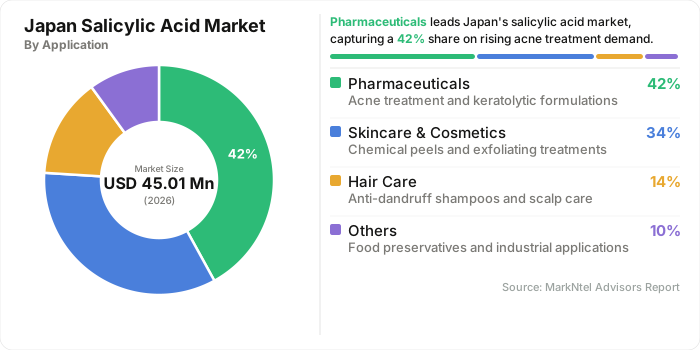
Pharmaceuticals led the market by application, accounting for 42% of the total market share in 2026.
-
Powder/Crystal led the market by form, accounting for 70% of the total market share in 2026.
-
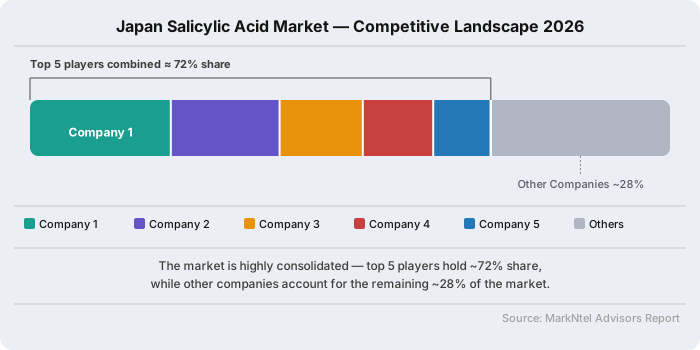
The industry is moderately consolidated, with the top five companies collectively accounting for 72% of the market revenue.
Japan Salicylic Acid Market Size and Outlook
The salicylic acid market size in Japan was valued at USD 41.83 million in 2025 and is projected to grow from USD 45.01 million in 2026 to USD 69.85 million by 2032. Along with this, the market is estimated to grow at a CAGR of around 7.6% during the forecast period, i.e., 2026-32.
In the pharmaceutical sector, salicylic acid is used to make aspirin as well as topical treatments for acne, warts, and other skin conditions. Among these, cardiovascular care drives the most volume because heart disease is Japan's second-leading cause of death, causing 226,388 deaths in 2024, about 14% of all deaths, as per the Ministry of Health, Labour and Welfare. Salicylic acid is the base material for aspirin, which doctors widely prescribe for these heart conditions, keeping its demand steady.
Additionally, the significant demand deepens as Japan's population ages. Japan's demographic profile is characterized by a rapidly aging population, and older people consume more painkillers, topical skin treatments, and medicated skincare that rely on salicylic acid. Since this age group keeps expanding, the market gains a structural, long-term demand base rather than a cyclical one.
To strengthen the supply of essential medicines, the Japanese government is reshaping pharmaceutical raw material sourcing. Since 2021, the Ministry of Health, Labour and Welfare has identified critical medicines and pharmaceutical ingredients that require a secure and stable supply. This list expanded to 762 essential items in 2025.
In the same year, amendments to the Pharmaceuticals and Medical Devices Act required pharmaceutical manufacturers to ensure the reliable procurement of key medicines and their raw materials. As a result, manufacturers are increasingly prioritizing certified and secure domestic sources of pharmaceutical ingredients, supporting demand for high-quality salicylic acid within Japan pharmaceutical industry.
Growing demand for premium skincare products is supporting the expansion of Japan's skincare market, which is projected to increase from approximately USD 14 billion in 2025 to USD 18 billion by 2032. This growth is driving higher consumption of cosmetic-grade salicylic acid in acne treatment and exfoliating formulations. As a result, market value is increasingly driven by demand for high-purity pharmaceutical- and cosmetic-grade salicylic acid rather than by higher production volumes alone.
Japan Salicylic Acid Market Key Indicators
- Japan's expanding personal care and dermatology segment is driving downstream demand for cosmetic-grade salicylic acid in acne care, exfoliants, cleansers, and functional skincare. As per the Japan Cosmetic Industry Association, citing METI production statistics, cosmetics domestic shipments reached USD 9.3 billion, up 2.9% year-on-year, with skincare the largest category at 43.6% of value. As formulations shift toward active-ingredient, dermatology-led skincare, salicylic acid usage scales in step, directly widening the market's cosmetic-grade demand base.
- Japan's strict pharmaceutical and cosmetic regulations are pushing demand toward high-purity, certified salicylic acid grades. As per the Ministry of Health, Labour and Welfare (MHLW), pharmaceutical domestic production value reached USD 68 billion in 2024, a large and tightly regulated market for active ingredients. The Pharmaceuticals and Medical Devices Agency (PMDA) enforces Japanese Pharmacopoeia standards, now the 19th Edition (JP19, effective 2026) governing identity, purity, and testing. As compliance tightens, buyers increasingly source certified pharmaceutical- and cosmetic-grade material, shifting the market toward higher-value, specification-controlled salicylic acid.
- Japan's high-value chemical manufacturing ecosystem continues to reinforce demand for premium-grade salicylic acid. According to the World Bank, manufacturing accounted for approximately 20.6% of Japan's GDP in 2023 (latest available official data), highlighting the country's strong industrial base. Supported by METI's focus on expanding specialty chemicals and functional materials, manufacturers are increasingly relying on high-purity, specification-controlled raw materials for pharmaceutical and cosmetic formulations. As a result, demand for pharmaceutical- and cosmetic-grade salicylic acid continues to strengthen, driven by stringent quality requirements rather than higher production volumes alone.
Japan Salicylic Acid Market Scope
| Category | Segments |
|---|---|
| By Application | Pharmaceuticals (Medicine Ingredient Production, Skin Treatment Medicines), Skincare & Cosmetics (Acne Treatment Products, Exfoliants & Peels, Cleansers & Toners, Serums & Other Skincare), Hair Care (Anti-Dandruff Shampoos, Scalp & Other Hair Treatments), Others (Farming & Plant Products, Dyes, Fragrances & Specialty Chemicals, Other Industrial Uses |
| By Form | Powder/Crystal, Liquid |
Japan Salicylic Acid Market Growth Drivers
Aging Population at 29.3% Reinforcing Salicylic Acid Demand Growth
Japan’s rapidly aging population is a structural demand driver for the salicylic acid industry across both pharmaceutical and dermatological applications. According to the Statistics Bureau of Japan, the population aged 65 years and above reached 36.24 million, representing nearly one-third of the country’s total population. This demographic transition is increasing healthcare utilization and expanding demand for products designed to address age-related health and skincare needs. As the elderly population continues to grow, manufacturers are increasingly focusing on formulations that support long-term health management and skin maintenance, strengthening demand for specialized active ingredients.
The aging demographic is particularly significant for the salicylic acid market because it supports consumption across multiple end-use sectors. In pharmaceuticals, salicylic acid serves as a precursor for acetylsalicylic acid (aspirin), which is widely used in pain management and cardiovascular care. At the same time, older consumers are increasingly adopting dermatological and functional skincare products aimed at improving skin texture, promoting skin renewal, and maintaining overall skin health.
This combination of healthcare and personal care demand broadens the application base of salicylic acid and supports stable consumption across regulated industries. Overall, Japan’s demographic aging trend provides a long-term foundation for market growth by reinforcing demand from both pharmaceutical and skincare applications.
Recent Trends
Government Support for Aesthetic Medicine Driving Professional Salicylic Acid Applications
The growing emphasis on aesthetic medicine is emerging as a significant trend supporting the use of salicylic acid in professional dermatology and skincare treatments across Japan. In 2024, the Ministry of Health, Labour and Welfare (MHLW) established the Committee on the Appropriate Practice of Aesthetic Medicine to strengthen governance, improve patient safety, and promote the appropriate delivery of cosmetic medical services. The formation of this committee highlights the increasing importance of aesthetic medicine within Japan’s healthcare and personal care landscape and reflects a broader regulatory focus on ensuring quality and accountability in cosmetic medical procedures.
The resulting regulatory framework supports the expansion of physician-supervised aesthetic treatments, including chemical peels and acne management procedures where salicylic acid is widely used, thereby creating favorable demand conditions for salicylic acid-based dermatological and aesthetic skincare products. Owing to its proven keratolytic, exfoliating, and comedolytic properties, salicylic acid remains a key active ingredient in professional treatments targeting acne, oily skin, clogged pores, and skin texture concerns.
As consumers increasingly seek clinically supervised, results-oriented skincare solutions and aesthetic procedures gain wider acceptance, demand for high-purity and professional-grade salicylic acid formulations is expected to strengthen. Consequently, the continued development and regulation of Japan’s aesthetic medicine sector is likely to support long-term growth opportunities for salicylic acid across professional dermatology and aesthetic skincare applications.
Japan Salicylic Acid Market Opportunities and Challenges
Over 95% Import Dependence Creates Domestic Production Opportunities
Japan’s salicylic acid industry faces a supply-side challenge due to its high dependence on imported raw materials, with limited domestic production capacity compared with demand from the pharmaceutical and personal care industries. According to UN Comtrade data, Japan imported approximately 707.5 tonnes of salicylic acid and its salts, with France and China accounting for the majority of the supply. This reliance on international suppliers exposes domestic manufacturers and formulators to potential supply chain disruptions, pricing fluctuations, and longer procurement cycles.
However, this challenge also presents a broader opportunity for the Japan salicylic acid market to strengthen domestic chemical manufacturing capabilities and reduce dependence on imported specialty ingredients. As Japan continues to prioritize supply chain resilience across pharmaceutical and personal care value chains, increasing focus on domestic production and sourcing diversification could support the development of a more secure salicylic acid supply ecosystem. Such a shift would enhance raw material availability for downstream industries while reducing exposure to external supply disruptions. Over the long term, greater domestic supply security could support stable market expansion and strengthen the industry's competitiveness.
Segmentation Insights
Pharmaceuticals Commanding 42.0% Share Driven by Drug-Precursor Demand
Pharmaceuticals lead because salicylic acid serves the widest and highest-value range of medical uses in Japan. It works both as a direct skin-treatment active and as a raw material for a broad family of salicylate drugs, salicylamide, sodium salicylate, methyl salicylate, and para-aminosalicylic acid, giving it more distinct end-uses than cosmetic or hair-care applications. These uses require tightly specified, pharmaceutical-grade material that commands premium pricing, so the segment's value share outweighs its volume, with no ready substitute in regulated formulations.
That premium demand is pushing producers to modernize how pharmaceutical-grade salicylic acid is made. Advances to the long-standing Kolbe–Schmitt production route in 2024–2025 raised process yields toward 92.68% and enabled more continuous, lower-emission manufacturing, letting suppliers cut unit costs and improve consistency of high-purity output. For a segment where regulated buyers pay for guaranteed quality, these gains strengthen domestic supply economics and help manufacturers defend margins as drug and dermatology demand grows.
With the broadest range of medical end-uses, premium pharmaceutical-grade pricing, and demand embedded in regulated formulations that resist substitution, pharmaceuticals hold a durable lead over cosmetic and hair-care applications. By the application, the market is further segmented into the following sub-categories:
- Pharmaceuticals
- Skincare & Cosmetics
- Hair Care
- Others
Powder & Crystal Form Accounting for 70% Share Due to Superior Stability
Powder and crystal lead because Japanese manufacturers procure and stock salicylic acid as a bulk solid, priced and shipped by weight. According to UN Comtrade, Japan imported 759,930 kg of salicylic acid and its salts, as crystalline material in tonne-scale lots. Solids ship lighter per unit of active and resist degradation far longer than dilute liquids.
Quality assurance reinforces this. The Japanese Pharmacopoeia specifies salicylic acid as white crystals or crystalline powder assaying not less than 99.5% on the dried basis, a purity audited far more reliably in solid form, since it is only slightly water-soluble but freely soluble in ethanol. For medicine-ingredient production, feeding aspirin and skin-treatment actives, this keeps powder as the default.
At the finished-product end, developers increasingly specify encapsulated salicylic acid for controlled, low-irritation release in acne and scalp formulations. Yet those encapsulated actives are themselves supplied as engineered powders, so even this innovation flows through the solid form, keeping powder and crystal the anchor of upstream demand. By form, the market is further segmented into the following sub-categories-
- Powder/Crystal
- Liquid
Japan Salicylic Acid Market Competitive Landscape
The Japan salicylic acid industry is moderately consolidated, with a limited number of integrated fine-chemical manufacturers accounting for a significant share of production across pharmaceutical, cosmetic, and technical grades. The top five companies, Seqens Group SAS, Shandong Xinhua Pharmaceutical Co., Ltd., Zhenjiang Gaopeng Pharmaceutical Co., Ltd., Merck KGaA, and Thermo Fisher Scientific Inc., collectively account for approximately 72% of the market.
Major Companies of Japan Salicylic Acid Market
- Seqens Group SAS
- Shandong Xinhua Pharmaceutical Co., Ltd. (parent: Shandong Hualu Holdings Co., Ltd.)
- Zhenjiang Gaopeng Pharmaceutical Co., Ltd.
- Merck KGaA
- Thermo Fisher Scientific Inc.
- Tokyo Chemical Industry Co., Ltd.
- FUJIFILM Wako Pure Chemical Corporation (parent: FUJIFILM Holdings Corporation)
- Kanto Chemical Co., Inc.
- UBE Corporation (formerly API Corporation)
- Kishida Chemical Co., Ltd.
Japan Salicylic Acid Market News and Recent Developments
2026: Japan's MHLW Issues Q&A Clarifying Quasi-Drug Manufacturing and Marketing Approval Applications
In May 2026, Japan's Ministry of Health, Labour and Welfare (MHLW) released a Q&A collection clarifying procedures for quasi-drug manufacturing and marketing approval applications. Because anti-acne, anti-dandruff, and keratolytic products formulated with salicylic acid are regulated as quasi-drugs requiring MHLW pre-market approval, the guidance directly affects how such formulations are registered and commercialized in Japan. The clarification is intended to reduce procedural ambiguity within a dossier-review process that can extend several months, giving manufacturers clearer expectations when preparing salicylic acid-based product submissions.
Market Impact Analysis: Clearer approval guidance is expected to streamline the registration pathway for new salicylic acid-based medicated skincare products, reducing entry uncertainty for manufacturers and supporting a steadier pipeline of compliant anti-acne quasi-drugs across Japanese drugstores, clinics, and personal-care retail channels, while modestly lowering the regulatory burden that has historically favored larger, resource-rich domestic players.
2025: Shiseido Develops 4MSK/Fluid Penetration Technology for Advanced Brightening Skincare
On January 31, 2025, Shiseido announced its proprietary "4MSK/Fluid Penetration Technology," which combines 4MSK (4-methoxysalicylic acid potassium salt), a salicylic acid derivative that is solid at room temperature, with trimethylglycine to form an ionic liquid that stays fluid after application. According to Shiseido, this roughly doubles the amount of 4MSK penetrating the skin versus older formulations, enhancing its melanin-suppressing brightening effect. 4MSK was approved by Japan's then-Ministry of Health, Labour and Welfare in 2003 as a quasi-drug active for preventing dark spots and freckles.
Market Impact Analysis: The innovation strengthens demand for high-purity salicylic acid derivatives within Japan's premium medicated skincare segment and encourages specialty chemical manufacturers to advance functional salicylate-based actives for dermatological and cosmetic applications. It also reinforces Japan's leadership in science-based brightening formulations, supporting sustained domestic investment in high-value salicylate research and quasi-drug active development.
Frequently Asked Questions
- Market Segmentation
- Introduction
- Product Definition
- Research Process
- Assumptions
- Executive Summary
- Japan Salicylic Acid Market Policies, Regulations, and Product Standards
- Japan Salicylic Acid Market Trends & Developments
- Japan Salicylic Acid Market Dynamics
- Growth Factors
- Challenges
- Japan Salicylic Acid Market Hotspot & Opportunities
- Japan Salicylic Acid Market Outlook, 2022-2032
- Market Size & Outlook
- By Revenues (USD Million)
- By Quantity Sold (Kilotons)
- Market Share & Outlook
- By Application- Market Size & Forecast 2022-2032, USD Million & Kilotons
- Pharmaceuticals
- Medicine Ingredient Production
- Skin Treatment Medicines
- Skincare & Cosmetics
- Acne Treatment Products
- Exfoliants & Peels
- Cleansers & Toners
- Serums & Other Skincare
- Hair Care
- Anti-Dandruff Shampoos
- Scalp & Other Hair Treatments
- Others
- Farming & Plant Products
- Dyes, Fragrances & Specialty Chemicals
- Other Industrial Uses
- Pharmaceuticals
- By Form- Market Size & Forecast 2022-2032, USD Million & Kilotons
- Powder/Crystal
- Liquid
- By Company
- Competition Characteristics
- Market Share & Analysis
- By Application- Market Size & Forecast 2022-2032, USD Million & Kilotons
- Market Size & Outlook
- Japan Salicylic Acid in Pharmaceuticals Market Outlook, 2022-2032
- Market Size & Outlook
- By Revenues (USD Million)
- By Quantity Sold (Kilotons)
- Market Share & Outlook
- By Form- Market Size & Forecast 2022-2032, USD Million & Kilotons
- Market Size & Outlook
- Japan Salicylic Acid in Skincare & Cosmetics Market Outlook, 2022-2032
- Market Size & Outlook
- By Revenues (USD Million)
- By Quantity Sold (Kilotons)
- Market Share & Outlook
- By Form- Market Size & Forecast 2022-2032, USD Million & Kilotons
- Market Size & Outlook
- Japan Salicylic Acid in Hair Care Market Outlook, 2022-2032
- Market Size & Outlook
- By Revenues (USD Million)
- By Quantity Sold (Kilotons)
- Market Share & Outlook
- By Form- Market Size & Forecast 2022-2032, USD Million & Kilotons
- Market Size & Outlook
- Japan Salicylic Acid Market Key Strategic Imperatives for Success & Growth
- Competitive Outlook
- Company Profiles
- Seqens Group SAS
- Business Description
- Product Portfolio
- Collaborations & Alliances
- Recent Developments
- Financial Details
- Others
- Shandong Xinhua Pharmaceutical Co. Ltd. (Shandong Hualu Holdings Co. Ltd.)
- Business Description
- Product Portfolio
- Collaborations & Alliances
- Recent Developments
- Financial Details
- Others
- Zhenjiang Gaopeng Pharmaceutical Co. Ltd.
- Business Description
- Product Portfolio
- Collaborations & Alliances
- Recent Developments
- Financial Details
- Others
- Merck KGaA
- Business Description
- Product Portfolio
- Collaborations & Alliances
- Recent Developments
- Financial Details
- Others
- Thermo Fisher Scientific Inc.
- Business Description
- Product Portfolio
- Collaborations & Alliances
- Recent Developments
- Financial Details
- Others
- Tokyo Chemical Industry Co. Ltd.
- Business Description
- Product Portfolio
- Collaborations & Alliances
- Recent Developments
- Financial Details
- Others
- FUJIFILM Wako Pure Chemical Corporation (FUJIFILM Holdings Corporation)
- Business Description
- Product Portfolio
- Collaborations & Alliances
- Recent Developments
- Financial Details
- Others
- Kanto Chemical Co. Inc.
- Business Description
- Product Portfolio
- Collaborations & Alliances
- Recent Developments
- Financial Details
- Others
- UBE Corporation (formerly API Corporation)
- Business Description
- Product Portfolio
- Collaborations & Alliances
- Recent Developments
- Financial Details
- Others
- Kishida Chemical Co. Ltd.
- Business Description
- Product Portfolio
- Collaborations & Alliances
- Recent Developments
- Financial Details
- Others
- Seqens Group SAS
- Company Profiles
- Disclaimer
MarkNtel Advisors follows a robust and iterative research methodology designed to ensure maximum accuracy and minimize deviation in market estimates and forecasts. Our approach combines both bottom-up and top-down techniques to effectively segment and quantify various aspects of the market. A consistent feature across all our research reports is data triangulation, which examines the market from three distinct perspectives to validate findings. Key components of our research process include:
1. Scope & Research Design At the outset, MarkNtel Advisors define the research objectives and formulate pertinent questions. This phase involves determining the type of research—qualitative or quantitative—and designing a methodology that outlines data collection methods, target demographics, and analytical tools. They also establish timelines and budgets to ensure the research aligns with client goals.
2. Sample Selection and Data Collection In this stage, the firm identifies the target audience and determines the appropriate sample size to ensure representativeness. They employ various sampling methods, such as random or stratified sampling, based on the research objectives. Data collection is carried out using tools like surveys, interviews, and observations, ensuring the gathered data is reliable and relevant.
3. Data Analysis and Validation Once data is collected, MarkNtel Advisors undertake a rigorous analysis process. This includes cleaning the data to remove inconsistencies, employing statistical software for quantitative analysis, and thematic analysis for qualitative data. Validation steps are taken to ensure the accuracy and reliability of the findings, minimizing biases and errors.

4. Data Forecast and FinalizationThe final phase involves forecasting future market trends based on the analyzed data. MarkNtel Advisors utilize predictive modeling and time series analysis to anticipate market behaviors. The insights are then compiled into comprehensive reports, featuring visual aids like charts and graphs, and include strategic recommendations to inform client decision-making
We offer flexible licensing options to cater to varying organizational needs. Choose the pricing pack that best suits your requirements:
Buy Now Inquire Before Buying
 Request Customization
 Talk to our Consultant







