Asia Skin Care Market Research Report: Growth Drivers & Forecast (2026-2032)
By Product (Body Care, Facial Care, Hand Care, Skin Care Sets/Kits), By Category (Premium, Mass), By Gender (Men, Women, Unisex), By End User (Adults, Teenagers, Children), By Pack ... aging (Tubes, Bottles, Jars, Others), By Sales Channel (Online, Offline), and others Read more
- FMCG
- Mar 2026
- Pages 210
- Report Format: PDF, Excel, PPT
Asia Skin Care Market
Projected 3.91% CAGR from 2026 to 2032
Study Period
2026-2032
Market Size (2026)
USD 91.0 Billion
Market Size (2032)
USD 114.57 Billion
Base Year
2025
Projected CAGR
3.91%
Leading Segments
By Product Type: Facial Care
Asia Skin Care Market Report Key Takeaways:
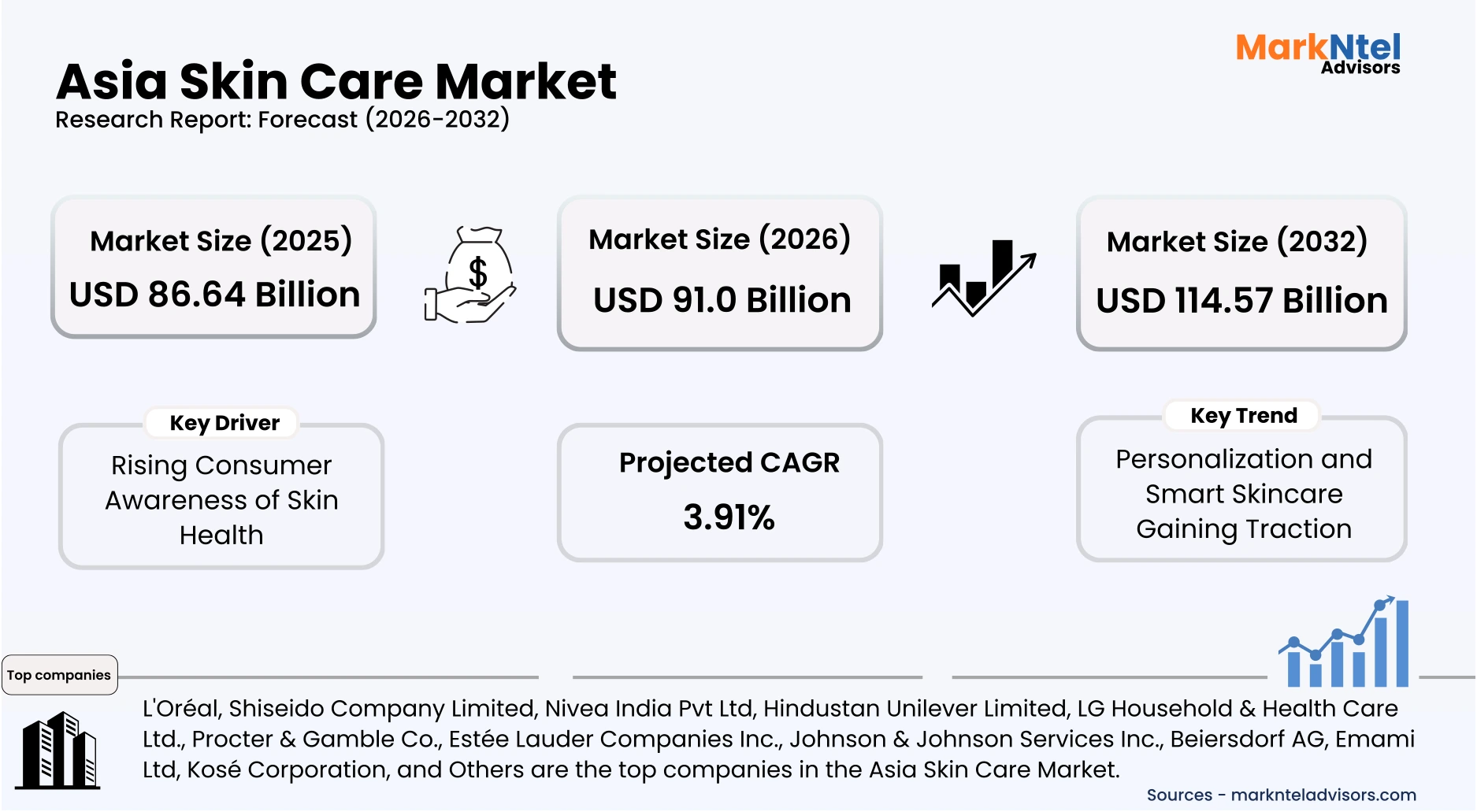
- The Asia Skin Care Market size was valued at around USD 86.64 billion in 2025 and is projected to grow from USD 91.0 billion in 2026 to USD 114.57 billion by 2032, exhibiting a CAGR of 3.91% during the forecast period.
- China holds the largest market share of about 39% in the Asia Skin Care Market in 2026.
- By product, the facial care segment represented a significant share of about 43% in the Asia Skin Care Market in 2026.
- By sales channel, the online segment seized a significant share of about 42% in the Asia Skin Care Market in 2026.
- Leading skin care companies in Asia are L'Oréal, Shiseido Company Limited, Nivea India Pvt Ltd, Hindustan Unilever Limited, LG Household & Health Care Ltd., Procter & Gamble Co., Estée Lauder Companies Inc., Johnson & Johnson Services Inc., Beiersdorf AG, Emami Ltd, Kosé Corporation, and Others.
Market Insights & Analysis: Asia Skin Care Market (2026-32):
The Asia Skin Care Market size was valued at around USD 86.64 billion in 2025 and is projected to grow from USD 91.0 billion in 2026 to USD 114.57 billion by 2032. Along with this, the market is estimated to grow at a CAGR of around 3.91% during the forecast period, i.e., 2026-32.
The Asia skincare market is poised for robust growth driven by a combination of rising consumer awareness, technological innovation, and strategic investments in digital and AI-enabled solutions. A key driver is the increasing recognition of skin health and preventive skincare practices across the region. Public health initiatives emphasize UV protection and daily skincare routines, supported by organizations such as the World Health Organization (WHO) through its INTERSUN program, which guides member states, including China, on mitigating UV-related skin damage . Regional studies also indicate that the adoption of systematic photoprotection behaviors, such as sunscreen use and seeking shade, remains limited, prompting governments to prioritize educational campaigns on skin health and photoaging prevention.
Personalization and smart skincare are increasingly shaping market dynamics. In South Korea, dermatology clinics employ AI-powered multi-spectral imaging and 3D facial scanning to evaluate over 16 skin conditions, enabling targeted treatments and continuous monitoring of skin health.
Similarly, in India, Nykaa launched its AI-based Skin Scan tool in 2025, analyzing selfies for up to 15 skin parameters and recommending personalized products. while Kaya Limited developed an AI-powered mobile application offering diagnostic insights and tailored skincare solutions .
These innovations reflect the growing importance of technology-driven personalization in meeting diverse consumer needs across urban and semi-urban markets.
The market is further supported by future investments aimed at expanding regional R&D and innovation capabilities. For instance, L'Oréal plans to invest USD 383 million by 2030 to establish an AI-powered beauty tech innovation hub in Hyderabad, India, focused on developing advanced skincare technologies and AI solutions to strengthen Asia’s position as a global center for beauty innovation .
Additionally, Korean derma-esthetic brand MEDIPEEL expanded into Southeast Asia with immersive pop-up events in Bangkok, enhancing brand visibility and consumer engagement ahead of broader retail growth .
The Asia skincare market is set to experience sustained growth, underpinned by increasing awareness of skin health, the adoption of AI-driven personalized solutions, and significant regional investments in innovation and technology. Combined with strategic retail expansion and government-supported public health initiatives, these factors are expected to drive higher consumer engagement, diversify product offerings, and strengthen the region’s position as a leading hub for skincare innovation.
Asia Skin Care Market Recent Developments:
- 2025: Swiss cellular cosmetics brand Cellcosmet debuted two limited‑edition skincare innovations, the CellEctive CellLift Serum and UltraCell Intensive, at the Fifth China International Consumer Products Expo in Hainan, strengthening its presence in Asia with advanced peptide‑ and marine‑derived anti‑aging formulas .
- 2025: Shinsegae’s pop‑up store in Bangkok featured 15 Korean skincare brands, elevating exposure and trial opportunities for emerging K‑beauty players and reflecting rising demand among Southeast Asian Millennials and Gen Z for innovative and trend‑driven formulas .
Asia Skin Care Market Scope:
| Category | Segments |
|---|---|
| By Product | (Body Care, Facial Care, Hand Care, Skin Care Sets/Kits), |
| By Category | (Premium, Mass), |
| By Gender | (Men, Women, Unisex), |
| By End User | (Adults, Teenagers, Children), |
| By Packaging | (Tubes, Bottles, Jars, Others), |
| By Sales Channel | (Online, Offline), |
Asia Skin Care Market Driver:
Rising Consumer Awareness of Skin Health
A fundamental driver of the Asia skincare market is the increasing recognition of skin health risks and the growing importance of preventive care among consumers across the region. Rising exposure to ultraviolet (UV) radiation and environmental pollutants has heightened awareness about long-term skin damage, including photoaging and skin cancer. Public health authorities, including the World Health Organization (WHO), recommend sun protection measures such as broad-spectrum sunscreen, protective clothing, and seeking shade when the UV index reaches 3 or above. These recommendations are actively promoted through WHO’s INTERSUN programme, which aims to educate the public on UV-related risks and protective behaviors .
In India, a 2022 nationwide study found that 64.2% of individuals reported practicing at least one sun-safe behavior, indicating increasing adoption of preventive measures against UV exposure .
Similarly, in Singapore, a Singapore Medical Journal study revealed that over 50% of schoolchildren experienced sunburn, and nearly 80% of parents expressed concern about sun damage and potential skin cancer. Schools and families demonstrated strong willingness to adopt “sunsmart” behaviors, reinforcing preventive habits.
Future initiatives beyond 2025 are expected to further drive market growth. Public health systems plan to integrate digital UV-risk tracking tools, expand community skin cancer screenings, subsidize broad-spectrum sunscreens, and enhance dermatology education programs in schools and workplaces across ASEAN and South Asia.
Overall, as public health campaigns and educational programs continue to raise awareness of UV risks and skin health, consumers increasingly prioritize preventive skincare. This sustained emphasis on skin health is expected to significantly expand demand for protective and daily-use skincare products, propelling the Asia skincare market in the coming years.
Asia Skin Care Market Trend:
Personalization and Smart Skincare Gaining Traction
Personalization and smart skincare are emerging as a significant trend in the Asia skincare market as advanced digital technologies increasingly integrate with dermatological research and cosmetic innovation. Artificial intelligence (AI), high-resolution digital imaging, and data analytics are enabling more precise skin diagnostics and individualized product recommendations. Dermatology clinics and research laboratories across Asia, particularly in countries such as South Korea and Japan, are deploying AI-powered facial analysis systems that assess multiple skin parameters, including moisture levels, pores, wrinkles, pigmentation, and sensitivity, to develop tailored skincare regimens.
Recent technological developments further highlight this shift toward data-driven skincare solutions. In May 2025, Indian digital dermatology platform Clinikally introduced “Clara,” an AI-based skin analysis tool designed to evaluate individual skin data and recommend personalized dermatology-supported treatments and skincare products .
Additionally, Expo 2025 Osaka featured advanced AI-enabled facial imaging technologies capable of assessing multiple skin conditions through machine learning algorithms to generate personalized skincare insights . Similarly, Amorepacific introduced its AI Skin Analysis & Care Solution, integrated with a smart beauty mirror and connected devices, enabling camera-based diagnosis and customized skincare guidance. The company also launched the Skin Light Therapy 3S, an LED-based device connected to a smartphone application that delivers tailored light-therapy treatments based on skin diagnostics.
The growing integration of AI diagnostics, smart devices, and digital dermatology platforms is transforming skincare from standardized product usage to highly customized solutions. As technology adoption continues to expand across Asia, personalized and smart skincare is expected to become a key driver of innovation and consumer engagement in the regional skincare market.
Asia Skin Care Market Opportunity:
Expansion of E-commerce Platforms
The rapid growth of e-commerce platforms across Asia presents a significant opportunity for the skincare market, enabling brands to reach wider consumer bases and enhance accessibility. Increasing internet penetration and mobile adoption are driving online retail activity across the region. According to the Asian Development Bank, Southeast Asia’s internet user base grew from 250 million in 2015 to around 440 million, approximately 75% of the region’s population, expanding the potential online consumer pool.
The region’s digital economy is also expanding rapidly. Southeast Asia’s internet economy exceeded USD 170 billion in 2021 and is projected to reach around USD 360 billion by 2025, fueled by mobile commerce, digital payments, and improved logistics infrastructure .
Government initiatives like Vietnam’s National E-commerce Development Master Plan and India’s Digital India program are promoting online business adoption, secure digital payments, and cross-border e-commerce, further supporting the expansion of digital retail.
For Example, India’s Nykaa leverages over 900 million internet users (2025, Ministry of Electronics & IT) to sell skincare products online, offering personalized recommendations and home delivery. Government support for digital infrastructure has enabled the platform to expand accessibility and sales across urban and semi-urban markets.
Overall, with expanding internet access, mobile commerce, and supportive government initiatives, e-commerce platforms are driving market growth by increasing product availability, enhancing customer engagement, and creating a scalable channel for skincare brands across Asia.
Asia Skin Care Market Challenge:
Regulatory and Compliance Issues
A significant challenge in the Asia skincare market is navigating the complex and evolving regulatory landscape, which varies widely across countries and imposes stringent requirements on product safety, labeling, ingredient usage, and market entry. In major markets like China, the Cosmetic Supervision and Administration Regulation (CSAR) mandates detailed pre‑market safety assessments, ingredient registration, and Chinese‑language documentation for both general and special cosmetics. Manufacturers must submit dossiers with safety data and ingredient details to the National Medical Products Administration (NMPA) before products can be approved or notified for sale, increasing compliance complexity for international brands.
In the ASEAN region, the ASEAN Cosmetic Directive (ACD) requires products to comply with harmonized safety standards, prohibited ingredient lists, and detailed labeling, including maintaining a Product Information File (PIF) for each product placed on the market. Failure to meet these standards may result in enforcement actions or market withdrawal.
Countries such as Japan have also revised labeling regulations, demanding evidence‑based claims and stricter ingredient disclosure to prevent misleading messaging, while South Korea continuously updates ingredient safety standards and bans certain chemicals like 1,2,4‑trihydroxy benzene, requiring reformulation and re‑approval before market distribution .
These disparate and frequently updated regulatory frameworks require skincare companies to invest heavily in compliance systems, testing, documentation, and local regulatory expertise. This increases costs, prolongs time‑to‑market, and poses significant barriers, especially for small and medium enterprises, hindering product innovation and regional expansion.
Asia Skin Care Market (2026-32) Segmentation Analysis:
The Asia Skin Care Market study of MarkNtel Advisors evaluates & highlights the major trends and influencing factors in each segment. It includes predictions for the period 2026–32 at the regional level. Based on the analysis, the market has been further classified as;
Based on Product Type:
-
- Body Care
- Firming Body Care
- General Purpose Body Care
- Facial Care
- Acne Treatments
- Face Masks
- Facial Cleansers
- Body Care
- Liquid
- Cream
- Gel
- Bar Cleansers
- Facial Cleansing Wipes
-
- Moisturizers and Treatments
-
- Basic Moisturizers
- Anti-Agers
-
- Lip Care
- Toners
- Hand Care
- Skin Care Sets/Kits
-
The facial care segment dominates the Asia skincare market, accounting for 43% of the market size, due to the growing consumer focus on maintaining skin health, appearance, and anti-aging. Products such as facial cleansers, moisturizers, masks, acne treatments, and toners are increasingly prioritized by both men and women, reflecting the cultural and social emphasis on clear, youthful skin. Urban populations in countries like China, South Korea, and Japan are particularly inclined toward specialized facial care products that target pigmentation, acne, wrinkles, and hydration. Rising awareness of preventive skincare, combined with dermatological endorsements and increased access to professional skincare information, has heightened demand for daily facial routines.
Additionally, the surge in beauty influencers, skincare education platforms, and clinical research-backed product launches has reinforced the importance of facial care over general or body care, making it the largest and fastest-growing product segment in the region.
Based on Sales Channel:
-
- Online
- Offline
The online sales channel leads the Asia skincare industry with 42% share, driven by the rapid adoption of e-commerce, digital beauty platforms, and mobile shopping apps. Consumers increasingly prefer the convenience of ordering products online, accessing a wide variety of brands, and receiving personalized product recommendations using AI tools and skin diagnostic apps. Online platforms also provide access to exclusive products, limited-edition kits, and promotions that are often unavailable offline, encouraging frequent purchases.
In countries like India, South Korea, and China, high internet penetration, smartphone usage, and secure digital payment systems support this growth. Furthermore, online reviews, tutorials, and influencer endorsements increase consumer confidence in product selection. The combination of convenience, personalization, and broader product accessibility has positioned online retail as the dominant channel in the Asia skincare market.
Asia Skin Care Market (2026-32): Regional Projection
The Asia Skin Care Market is dominated by East Asia, particularly China, South Korea, and Japan. These countries lead due to high consumer awareness of skin health, strong purchasing power, and a culture that emphasizes skincare and beauty routines. Advanced technological adoption, including AI-powered diagnostics, smart devices, and digital beauty platforms, further strengthens market penetration.
In China, urban centers such as Beijing, Shanghai, and Guangzhou are the primary consumers of premium and mid-range skincare products, supported by rising disposable incomes and government initiatives promoting public health and skin protection awareness. South Korea is a hub for innovative derma-esthetic products and smart skincare solutions, with cities like Seoul and Busan driving trends in personalized skincare and AI-powered beauty tools. Japan contributes with a mature skincare market, high R&D investment, and strong consumer preference for quality and efficacy.
Overall, the dominance of these regions is driven by urbanization, technological integration, high consumer spending, and strong local and international brand presence, making East Asia the leading market in Asia for skincare products.
Gain a Competitive Edge with Our Asia Skin Care Market Report:
- Asia Skin Care Market Report by MarkNtel Advisors provides a detailed & thorough analysis of market size & share, growth rate, competitive landscape, and key players. This comprehensive analysis helps businesses gain a holistic understanding of the market dynamics & make informed decisions.
- This report also highlights current market trends & future projections, allowing businesses to identify emerging opportunities & potential challenges. By understanding market forecasts, companies can align their strategies & stay ahead of the competition.
- Asia Skin Care Market Report aids in assessing & mitigating risks associated with entering or operating in the market. By understanding market dynamics, regulatory frameworks, and potential challenges, businesses can develop strategies to minimize risks & optimize their operations.
*Reports Delivery Format - Market research studies from MarkNtel Advisors are offered in PDF, Excel and PowerPoint formats. Within 24 hours of the payment being successfully received, the report will be sent to your email address.
Frequently Asked Questions
- Market Segmentation
- Introduction
- Product Definition
- Research Process
- Assumptions
- Executive Summary
- Asia Skin Care Market Policies, Regulations, and Product Standards
- Asia Skin Care Market Trends & Developments
- Asia Skin Care Market Dynamics
- Growth Factors
- Challenges
- Asia Skin Care Market Hotspot & Opportunities
- Asia Skin Care Market Outlook, 2022-2032F
- Market Size & Outlook
- By Revenues (USD Million)
- Market Share & Analysis
- By Product - Market Size & Forecast 2022-2032, USD Million
- Body Care
- Firming Body Care
- General Purpose Body Care
- Facial Care
- Acne Treatments
- Face Masks
- Facial Cleansers
- Liquid
- Cream
- Gel
- Bar Cleansers
- Facial Cleansing Wipes
- Moisturizers and Treatments
- Basic Moisturizers
- Anti-Agers
- Lip Care
- Toners
- Hand Care
- Skin Care Sets/Kits
- Body Care
- By Category- Market Size & Forecast 2022-2032, USD Million
- Premium
- Mass
- By Gender- Market Size & Forecast 2022-2032, USD Million
- Men
- Women
- Unisex
- By End User- Market Size & Forecast 2022-2032, USD Million
- Adults
- Teenagers
- Children
- By Packaging- Market Size & Forecast 2022-2032, USD Million
- Tubes
- Bottles
- Jars
- Others
- By Sales Channel- Market Size & Forecast 2022-2032, USD Million
- Online
- Offline
- By Country
- China
- Japan
- South Korea
- India
- Saudi Arabia
- The UAE
- Russia
- Indonesia
- Thailand
- Malaysia
- Vietnam
- Singapore
- Philippines
- Rest of Asia
- By Company
- Competition Characteristics
- Market Share & Analysis
- By Product - Market Size & Forecast 2022-2032, USD Million
- Market Size & Outlook
- China Skin Care Market Outlook, 2022-2032F
- Market Size & Outlook
- By Revenues (USD Million)
- Market Share & Analysis
- By Product - Market Size & Forecast 2022-2032, USD Million
- By Category- Market Size & Forecast 2022-2032, USD Million
- By Gender- Market Size & Forecast 2022-2032, USD Million
- By End User- Market Size & Forecast 2022-2032, USD Million
- By Packaging- Market Size & Forecast 2022-2032, USD Million
- By Sales Channel- Market Size & Forecast 2022-2032, USD Million
- Market Size & Outlook
- Japan Skin Care Market Outlook, 2022-2032F
- Market Size & Outlook
- By Revenues (USD Million)
- Market Share & Analysis
- By Product - Market Size & Forecast 2022-2032, USD Million
- By Category- Market Size & Forecast 2022-2032, USD Million
- By Gender- Market Size & Forecast 2022-2032, USD Million
- By End User- Market Size & Forecast 2022-2032, USD Million
- By Packaging- Market Size & Forecast 2022-2032, USD Million
- By Sales Channel- Market Size & Forecast 2022-2032, USD Million
- Market Size & Outlook
- South Korea Skin Care Market Outlook, 2022-2032F
- Market Size & Outlook
- By Revenues (USD Million)
- Market Share & Analysis
- By Product - Market Size & Forecast 2022-2032, USD Million
- By Category- Market Size & Forecast 2022-2032, USD Million
- By Gender- Market Size & Forecast 2022-2032, USD Million
- By End User- Market Size & Forecast 2022-2032, USD Million
- By Packaging- Market Size & Forecast 2022-2032, USD Million
- By Sales Channel- Market Size & Forecast 2022-2032, USD Million
- Market Size & Outlook
- India Skin Care Market Outlook, 2022-2032F
- Market Size & Outlook
- By Revenues (USD Million)
- Market Share & Analysis
- By Product - Market Size & Forecast 2022-2032, USD Million
- By Category- Market Size & Forecast 2022-2032, USD Million
- By Gender- Market Size & Forecast 2022-2032, USD Million
- By End User- Market Size & Forecast 2022-2032, USD Million
- By Packaging- Market Size & Forecast 2022-2032, USD Million
- By Sales Channel- Market Size & Forecast 2022-2032, USD Million
- Market Size & Outlook
- Saudi Arabia Skin Care Market Outlook, 2022-2032F
- Market Size & Outlook
- By Revenues (USD Million)
- Market Share & Analysis
- By Product - Market Size & Forecast 2022-2032, USD Million
- By Category- Market Size & Forecast 2022-2032, USD Million
- By Gender- Market Size & Forecast 2022-2032, USD Million
- By End User- Market Size & Forecast 2022-2032, USD Million
- By Packaging- Market Size & Forecast 2022-2032, USD Million
- By Sales Channel- Market Size & Forecast 2022-2032, USD Million
- Market Size & Outlook
- The UAE Skin Care Market Outlook, 2022-2032F
- Market Size & Outlook
- By Revenues (USD Million)
- Market Share & Analysis
- By Product - Market Size & Forecast 2022-2032, USD Million
- By Category- Market Size & Forecast 2022-2032, USD Million
- By Gender- Market Size & Forecast 2022-2032, USD Million
- By End User- Market Size & Forecast 2022-2032, USD Million
- By Packaging- Market Size & Forecast 2022-2032, USD Million
- By Sales Channel- Market Size & Forecast 2022-2032, USD Million
- Market Size & Outlook
- Russia Skin Care Market Outlook, 2022-2032F
- Market Size & Outlook
- By Revenues (USD Million)
- Market Share & Analysis
- By Product - Market Size & Forecast 2022-2032, USD Million
- By Category- Market Size & Forecast 2022-2032, USD Million
- By Gender- Market Size & Forecast 2022-2032, USD Million
- By End User- Market Size & Forecast 2022-2032, USD Million
- By Packaging- Market Size & Forecast 2022-2032, USD Million
- By Sales Channel- Market Size & Forecast 2022-2032, USD Million
- Market Size & Outlook
- Indonesia Skin Care Market Outlook, 2022-2032F
- Market Size & Outlook
- By Revenues (USD Million)
- Market Share & Analysis
- By Product - Market Size & Forecast 2022-2032, USD Million
- By Category- Market Size & Forecast 2022-2032, USD Million
- By Gender- Market Size & Forecast 2022-2032, USD Million
- By End User- Market Size & Forecast 2022-2032, USD Million
- By Packaging- Market Size & Forecast 2022-2032, USD Million
- By Sales Channel- Market Size & Forecast 2022-2032, USD Million
- Market Size & Outlook
- Thailand Skin Care Market Outlook, 2022-2032F
- Market Size & Outlook
- By Revenues (USD Million)
- Market Share & Analysis
- By Product - Market Size & Forecast 2022-2032, USD Million
- By Category- Market Size & Forecast 2022-2032, USD Million
- By Gender- Market Size & Forecast 2022-2032, USD Million
- By End User- Market Size & Forecast 2022-2032, USD Million
- By Packaging- Market Size & Forecast 2022-2032, USD Million
- By Sales Channel- Market Size & Forecast 2022-2032, USD Million
- Market Size & Outlook
- Malaysia Skin Care Market Outlook, 2022-2032F
- Market Size & Outlook
- By Revenues (USD Million)
- Market Share & Analysis
- By Product - Market Size & Forecast 2022-2032, USD Million
- By Category- Market Size & Forecast 2022-2032, USD Million
- By Gender- Market Size & Forecast 2022-2032, USD Million
- By End User- Market Size & Forecast 2022-2032, USD Million
- By Packaging- Market Size & Forecast 2022-2032, USD Million
- By Sales Channel- Market Size & Forecast 2022-2032, USD Million
- Market Size & Outlook
- Vietnam Skin Care Market Outlook, 2022-2032F
- Market Size & Outlook
- By Revenues (USD Million)
- Market Share & Analysis
- By Product - Market Size & Forecast 2022-2032, USD Million
- By Category- Market Size & Forecast 2022-2032, USD Million
- By Gender- Market Size & Forecast 2022-2032, USD Million
- By End User- Market Size & Forecast 2022-2032, USD Million
- By Packaging- Market Size & Forecast 2022-2032, USD Million
- By Sales Channel- Market Size & Forecast 2022-2032, USD Million
- Market Size & Outlook
- Singapore Skin Care Market Outlook, 2022-2032F
- Market Size & Outlook
- By Revenues (USD Million)
- Market Share & Analysis
- By Product - Market Size & Forecast 2022-2032, USD Million
- By Category- Market Size & Forecast 2022-2032, USD Million
- By Gender- Market Size & Forecast 2022-2032, USD Million
- By End User- Market Size & Forecast 2022-2032, USD Million
- By Packaging- Market Size & Forecast 2022-2032, USD Million
- By Sales Channel- Market Size & Forecast 2022-2032, USD Million
- Market Size & Outlook
- Philippines Skin Care Market Outlook, 2022-2032F
- Market Size & Outlook
- By Revenues (USD Million)
- Market Share & Analysis
- By Product - Market Size & Forecast 2022-2032, USD Million
- By Category- Market Size & Forecast 2022-2032, USD Million
- By Gender- Market Size & Forecast 2022-2032, USD Million
- By End User- Market Size & Forecast 2022-2032, USD Million
- By Packaging- Market Size & Forecast 2022-2032, USD Million
- By Sales Channel- Market Size & Forecast 2022-2032, USD Million
- Market Size & Outlook
- Asia Skin Care Market Key Strategic Imperatives for Success & Growth
- Competitive Outlook
- Company Profiles
- L'Oréal Co Ltd
- Business Description
- Product Portfolio
- Collaborations & Alliances
- Recent Developments
- Financial Details
- Others
- Shiseido Company Limited
- Business Description
- Product Portfolio
- Collaborations & Alliances
- Recent Developments
- Financial Details
- Others
- Nivea India Pvt Ltd
- Business Description
- Product Portfolio
- Collaborations & Alliances
- Recent Developments
- Financial Details
- Others
- Hindustan Unilever Ltd
- Business Description
- Product Portfolio
- Collaborations & Alliances
- Recent Developments
- Financial Details
- Others
- LG Household & Health Care Ltd.
- Business Description
- Product Portfolio
- Collaborations & Alliances
- Recent Developments
- Financial Details
- Others
- Procter & Gamble Co.
- Business Description
- Product Portfolio
- Collaborations & Alliances
- Recent Developments
- Financial Details
- Others
- Estée Lauder Companies Inc.
- Business Description
- Product Portfolio
- Collaborations & Alliances
- Recent Developments
- Financial Details
- Others
- Johnson & Johnson Services Inc.
- Business Description
- Product Portfolio
- Collaborations & Alliances
- Recent Developments
- Financial Details
- Others
- Beiersdorf AG
- Business Description
- Product Portfolio
- Collaborations & Alliances
- Recent Developments
- Financial Details
- Others
- Emami Ltd
- Business Description
- Product Portfolio
- Collaborations & Alliances
- Recent Developments
- Financial Details
- Others
- Kosé Corporation
- Business Description
- Product Portfolio
- Collaborations & Alliances
- Recent Developments
- Financial Details
- Others
- Others
- Business Description
- Product Portfolio
- Collaborations & Alliances
- Recent Developments
- Financial Details
- Others
- L'Oréal Co Ltd
- Company Profiles
- Disclaimer
MarkNtel Advisors follows a robust and iterative research methodology designed to ensure maximum accuracy and minimize deviation in market estimates and forecasts. Our approach combines both bottom-up and top-down techniques to effectively segment and quantify various aspects of the market. A consistent feature across all our research reports is data triangulation, which examines the market from three distinct perspectives to validate findings. Key components of our research process include:
1. Scope & Research Design At the outset, MarkNtel Advisors define the research objectives and formulate pertinent questions. This phase involves determining the type of research—qualitative or quantitative—and designing a methodology that outlines data collection methods, target demographics, and analytical tools. They also establish timelines and budgets to ensure the research aligns with client goals.
2. Sample Selection and Data Collection In this stage, the firm identifies the target audience and determines the appropriate sample size to ensure representativeness. They employ various sampling methods, such as random or stratified sampling, based on the research objectives. Data collection is carried out using tools like surveys, interviews, and observations, ensuring the gathered data is reliable and relevant.
3. Data Analysis and Validation Once data is collected, MarkNtel Advisors undertake a rigorous analysis process. This includes cleaning the data to remove inconsistencies, employing statistical software for quantitative analysis, and thematic analysis for qualitative data. Validation steps are taken to ensure the accuracy and reliability of the findings, minimizing biases and errors.

4. Data Forecast and FinalizationThe final phase involves forecasting future market trends based on the analyzed data. MarkNtel Advisors utilize predictive modeling and time series analysis to anticipate market behaviors. The insights are then compiled into comprehensive reports, featuring visual aids like charts and graphs, and include strategic recommendations to inform client decision-making
We offer flexible licensing options to cater to varying organizational needs. Choose the pricing pack that best suits your requirements:
Buy Now Inquire Before Buying
 Request Customization
 Talk to our Consultant