

Japan Cybersecurity Market Research Report: Forecast (2026-2032)
By Offering (Solution (Standalone Hardware), Service (Professional Services (Design, Consulting & implementation, Risk & Threat Management, Training & Education, Support & Mainten ... ance), Managed Services)), By Solution Type (Identity & Access Management (IAM), Antivirus/Antimalware, Log Management & SIEM, Firewall, Encryption & Tokenization, Compliance & Policy Management, Patch Management, Others), By Security Type (Network Security, Endpoint & IoT Security, Cloud Security, Application Security, Content Security, Others), By Deployment Mode (On-Premises, Cloud, Hybrid), By Organization Size (Small and Medium-Sized Enterprises, Large Enterprises), By Application (IT & Telecom, Retail, BFSI, Healthcare, Defence/Government, Manufacturing, Energy, Others), and others Read more
- ICT & Electronics
- Jun 2026
- Pages 140
- Report Format: PDF, Excel, PPT
Japan Cybersecurity Market
Projected 10.61% CAGR from 2026 to 2032
Study Period
2026-2032
Market Size (2026)
USD 11.48 Billion
Market Size (2032)
USD 21.01 Billion
Base Year
2025
Projected CAGR
10.61%
Leading Segments
By Offering: Solution
Japan Cybersecurity Market Key Takeaways
- Japan Cybersecurity market size was valued at USD 9.9 billion in 2025 and is projected to grow from USD 11.48 billion in 2026 to USD 21.01 billion by 2032.
- The industry is projected to reflect sustain growth at a steady CAGR of 10.61% during 2026-2032.
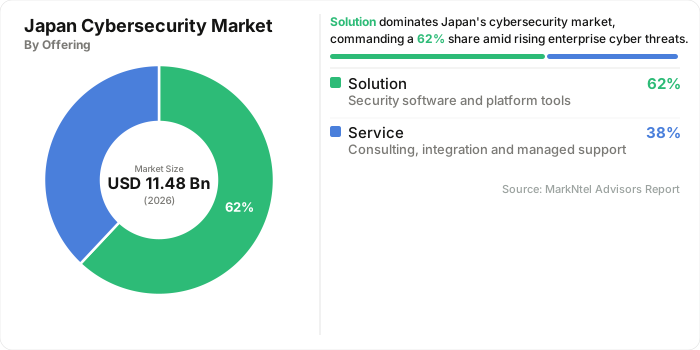
- By offering, solution holds a significant share of about 68% in 2026.
- By application, IT & Telecom seized a significant share of about 24% in 2026.
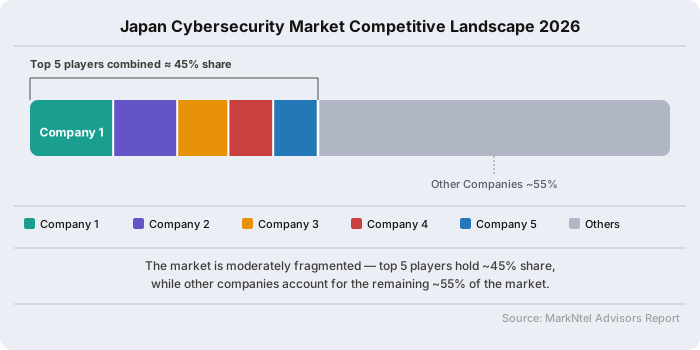
- The industry is moderately fragmented. However, the top five players collectively account for nearly 45% share.
Japan Cybersecurity Market Size and Outlook
The cybersecurity market size in Japan was valued at USD 9.9 billion in 2025 and is projected to grow from USD 11.48 billion in 2026 to USD 21.01 billion by 2032. Along with this, the market is estimated to grow at a CAGR of around 10.61% during the forecast period, i.e., 2026-32.
The market is expanding rapidly as businesses and government organizations prioritize digital resilience amid increasing dependence on cloud platforms, connected technologies, and advanced digital services. The acceleration of digital transformation across industries such as manufacturing, telecommunications, banking, healthcare, and government has increased the need for robust cybersecurity frameworks. Organizations are increasingly adopting solutions such as Zero Trust architecture, cloud security platforms, identity and access management, endpoint protection, and managed security services to protect sensitive information and maintain operational continuity.
The growing focus on secure digital infrastructure is creating significant opportunities for cybersecurity providers in Japan. According to the Digital Agency of Japan, the Government Solution Services (GSS) platform, developed based on Zero Trust Architecture, had been deployed to approximately 45,000 users across 14 ministries and agencies as of July 2025. The platform integrates secure government networks, office devices, cloud collaboration tools, centralized identity management, and unified security controls, enabling stronger protection of government systems. The continued expansion of GSS across central government organizations is expected to increase demand for identity security, network protection, cloud security, and continuous monitoring solutions.
Additionally, Japan's increasing adoption of cloud computing, artificial intelligence, and IoT technologies is expanding the country's digital ecosystem while creating new cybersecurity requirements. Enterprises are focusing on proactive threat prevention, security automation, and real-time monitoring to address emerging risks associated with complex IT environments. The expansion of data-driven operations, remote work models, and digital infrastructure is further encouraging organizations to strengthen cybersecurity investments.
With continued modernization of public and private sector infrastructure, rising demand for advanced security technologies, and greater emphasis on cyber resilience, Japan's cybersecurity market is positioned for sustained growth. The increasing deployment of Zero Trust frameworks, cloud-based security solutions, and next-generation protection technologies will remain key factors driving market development in the coming years.
Japan Cybersecurity Market Key Indicators
- According to Cisco Talos Intelligence, 134 ransomware incidents were reported in Japan during 2025, representing a 17.5% year-on-year increase from 2024. The Qilin ransomware group accounted for 22 incidents, or 16.4% of all reported attacks, making it the most active ransomware threat in the country. The manufacturing sector was the most affected, accounting for 28% of victim organizations, while 57% of attacks targeted small and medium-sized enterprises (SMEs). The increasing frequency of ransomware campaigns is accelerating investments in Endpoint Detection and Response (EDR), Managed Detection and Response (MDR), Zero Trust architecture, and continuous threat monitoring, reinforcing long-term growth prospects for Japan's cybersecurity industry.
- Japan's expanding hyperscale data center footprint is creating substantial cybersecurity opportunities. Japan plans to develop its largest data center hub in Toyama Prefecture with a planned capacity of 3.1 GW, while the country's data center market is projected to exceed approximately USD 32 billion) by 2028. As hyperscale facilities support AI, cloud computing, and digital services, demand for cloud security, Security Operations Centers (SOCs), network protection, and physical cybersecurity solutions will continue to expand.
Japan Cybersecurity Market Scope
| Category | Segments |
|---|---|
| By Offering | Solution (Standalone Hardware), Service (Professional Services (Design, Consulting & implementation, Risk & Threat Management, Training & Education, Support & Maintenance), Managed Services |
| By Solution Type | Identity & Access Management (IAM), Antivirus/Antimalware, Log Management & SIEM, Firewall, Encryption & Tokenization, Compliance & Policy Management, Patch Management, Others |
| By Security Type | Network Security, Endpoint & IoT Security, Cloud Security, Application Security, Content Security, Others |
| By Deployment Mode | On-Premises, Cloud, Hybrid |
| By Organization Size | Small and Medium-Sized Enterprises, Large Enterprises |
| By Application | IT & Telecom, Retail, BFSI, Healthcare, Defence/Government, Manufacturing, Energy, Others |
Japan Cybersecurity Market Growth Drivers
Increasing Cyber Threats and Regulatory Measures Accelerate Cybersecurity Adoption in Japan
The rising scale and complexity of cyberattacks are significantly accelerating cybersecurity investments across Japan. According to Japan's National Police Agency (NPA), 1,196,390 phishing reports were recorded in 2023, the highest level on record and an increase of 227,558 cases from the previous year. During the same year, the NPA received 197 ransomware attack reports, with many involving double-extortion tactics, while online banking fraud reached 5,578 cases, causing financial losses of approximately USD 58.7 million. Additionally, credit card fraud losses reached approximately USD 363.5 million, the highest since records began in 1997.
The threat landscape continued to worsen in 2024, with the NPA reporting 13,164 cybercrime arrests, a 5.5% year-on-year increase and the highest level on record, alongside 5,358 unauthorized access incidents, of which 81% involved fraudulent internet banking transactions. Moreover, Japan's Active Cyber Defence Law, enacted in May 2025, mandates critical infrastructure operators to report cyber incidents while enabling proactive government intervention against overseas cyber threats.
Growing financial losses, record cybercrime volumes, and stronger government intervention are compelling enterprises to increase spending on threat detection, identity security, Zero Trust architecture, and managed security services. These factors will continue to fuel robust growth in Japan's cybersecurity platforms throughout the forecast period.
Recent Trends
Government-Led Adoption of Zero Trust Architecture Gains Momentum
Japan is increasingly adopting Zero Trust Security Architecture (ZTSA) as organizations modernize digital infrastructure and strengthen protection against sophisticated cyber threats. A major example is the Digital Agency's Government Solution Services (GSS) initiative, which integrates the network environments of ministries and government agencies into a standardized digital platform. The GSS leverages Zero Trust Architecture to enable secure remote work, centralized identity management, continuous authentication, and secure information sharing instead of relying on traditional perimeter-based security.
As of July 2025, 45,000 government employees across 14 ministries and agencies were using GSS, demonstrating the government's large-scale implementation of Zero Trust principles. Furthermore, by February 2026, GSS had expanded to 53,000 employees across 18 agencies, highlighting the rapid pace of adoption.
Looking ahead, Japan's Cybersecurity Strategy 2025 identifies Zero Trust as a core element of national cyber resilience, while the Active Cyber Defence Law supports stronger identity-based security and continuous monitoring for critical infrastructure. These initiatives are expected to accelerate investments in Identity and Access Management (IAM), Multi-Factor Authentication (MFA), Privileged Access Management (PAM), and Zero Trust Network Access (ZTNA) solutions across both public and private sectors.
As government agencies and enterprises continue migrating to cloud-first environments, Zero Trust is becoming the preferred cybersecurity framework for protecting users, devices, and data. Its expanding deployment will drive sustained demand for identity-centric security solutions, reinforcing long-term growth of Japan's cybersecurity industry.
Japan Cybersecurity Market Opportunities and Challenges
Shortage of Skilled Cybersecurity Professionals Restrains Market Readiness While Accelerating Managed Security Adoption
Japan's persistent shortage of cybersecurity professionals remains one of the most significant barriers to strengthening its cyber resilience. The shortage limits organizations' ability to operate Security Operations Centers (SOCs), monitor threats around the clock, investigate incidents, and implement advanced security solutions, particularly as cyberattacks become more sophisticated. According to CyberS2, citing multiple Japanese government surveys, the country faces a shortage of approximately 170,000–190,000 cybersecurity professionals. To address this gap, Japan's Ministry of Economy, Trade and Industry (METI) has set a goal of increasing the number of registered Information Security Specialists to 50,000 by 2030. However, as of April 2025, only about 24,000 professionals were registered, highlighting the scale of the workforce challenge.
Recognizing the talent shortage, Japanese companies are increasingly adopting AI-driven security operations. In April 2025, NEC Corporation enhanced its Cyber Intelligence & Operation Center (CyIOC) by integrating generative AI to automate threat analysis, improve incident response, and reduce the workload of security analysts, enabling enterprises to strengthen security operations despite limited human resources.
The widening cybersecurity skills gap is accelerating demand for managed security services (MSS), Security-as-a-Service (SECaaS), AI-powered threat detection, and automated security platforms. As organizations increasingly rely on external expertise and intelligent automation to bridge workforce shortages, this challenge is expected to become a key catalyst for sustained growth in Japan's cybersecurity adoption.
Segmentation Insights
Solution Captures Approximately 68% of Total Industry Revenue
Solution holds nearly 68% share of Japan cybersecurity industry revenue due to increasing enterprise investments in preventive security technologies and integrated cyber defense platforms. Organizations across banking, manufacturing, healthcare, telecommunications, and government sectors are prioritizing deployment of endpoint protection, network security, cloud security, identity and access management (IAM), security information and event management (SIEM), and Zero Trust solutions to address increasingly sophisticated cyber threats.
The rapid adoption of cloud computing, artificial intelligence, and connected devices has expanded the cyberattack surface, encouraging businesses to strengthen real-time threat detection and data protection capabilities. Government initiatives are further reinforcing demand for cybersecurity solutions. For instance, the Digital Agency's Government Solution Services (GSS) platform, built on Zero Trust Architecture, had been deployed to approximately 45,000 users across 14 ministries and agencies as of July 2025, driving adoption of secure cloud access and centralized identity management. Consequently, continuous investments in digital transformation and critical infrastructure protection are sustaining the dominance of the solution segment across Japan's cybersecurity ecosystem. Based on offering, the scope has been segmented into
- Solution
- Service
IT & Telecom Leads the Industry with Approximately 24% Revenue Share
IT & Telecom holds the dominant position in the Japan cybersecurity market, accounting for an estimated 24% of industry revenue, driven by the sector's extensive digital infrastructure and increasing exposure to sophisticated cyber threats. Telecommunications operators, cloud service providers, internet service providers, and IT enterprises manage critical assets such as 5G networks, hyperscale data centers, cloud platforms, and enterprise communication systems, making them prime targets for ransomware, phishing, distributed denial-of-service (DDoS), and supply chain attacks.
According to the National Police Agency (NPA), Japan recorded 1,196,390 phishing reports in 2023, highlighting the growing threat environment facing digitally intensive industries. Additionally, the rapid deployment of cloud services, artificial intelligence, IoT devices, and edge computing has expanded the attack surface, encouraging continuous investment in network security, Zero Trust architecture, Security Operations Centers (SOCs), identity and access management (IAM), and cloud security solutions. As telecom operators continue expanding next-generation digital connectivity and enterprise cloud services, the sector is expected to maintain its leadership in cybersecurity spending throughout the forecast period. Based on application, the market is categorized into
- IT & Telecom
- Retail
- BFSI
- Healthcare
- Defence/Government
- Manufacturing
- Energy
- Others
Japan Cybersecurity Market Competitive Analysis
The Japan cybersecurity market is moderately fragmented, with the top five companies collectively accounting for approximately 45% of the market by value in 2026. Key participants include Trend Micro Incorporated, NEC Corporation, Fujitsu Limited, NTT Security Holdings Corporation, and Cisco Systems G.K.
Major Companies in Japan Cybersecurity Industry
- Trend Micro Incorporated
- NEC Corporation
- NTT Security Holdings Corporation
- Fujitsu Limited
- Cisco Systems G.K.
- Palo Alto Networks K.K.
- Fortinet Japan G.K.
- IBM Japan, Ltd.
- Check Point Software Technologies Ltd.
- CrowdStrike Japan G.K.
- Others
Japan Cybersecurity Industry News and Recent Developments
March 2025: Fortinet Japan Enhances FortiSASE Portfolio for Japanese Enterprises
In March 2025, Fortinet Japan G.K. expanded its FortiSASE platform for the Japanese market by integrating enhanced AI-driven threat detection and Zero Trust Network Access (ZTNA). The launch supports organizations adopting hybrid work and cloud-first strategies while simplifying secure access management and improving network visibility.
Impact Analysis: The enhanced FortiSASE platform strengthens Japan's transition toward secure hybrid work and cloud-based operations by integrating AI-powered threat detection with Zero Trust Network Access (ZTNA). The launch enables enterprises to improve secure remote connectivity, simplify security management, and reduce cyber risks across distributed environments. It also intensifies competition in the Secure Access Service Edge (SASE) market, encouraging wider adoption of cloud-delivered cybersecurity solutions among enterprises and government organizations.
March 2025: METI Launches Strategy for Vitalization of the Cybersecurity Industry
In March 2025, Japan's Ministry of Economy, Trade and Industry (METI) launched the Strategy for Vitalization of the Cybersecurity Industry. The initiative promotes domestic cybersecurity technologies, supports cybersecurity startups, strengthens public-private collaboration, and encourages wider deployment of Japanese cybersecurity solutions across critical sectors.
Impact Analysis: METI's strategy is expected to strengthen Japan's domestic cybersecurity ecosystem by accelerating innovation, supporting startup growth, and encouraging the commercialization of locally developed cybersecurity technologies. Increased collaboration between government, academia, and private enterprises will enhance national cyber resilience while reducing dependence on foreign security solutions. The initiative is also expected to stimulate long-term investments in AI-driven cybersecurity, cloud security, and critical infrastructure protection, supporting sustainable market growth.
Frequently Asked Questions
- Market Segmentation
- Introduction
- Product Definition
- Research Process
- Assumptions
- Executive Summary
- Japan Cybersecurity Market Policies, Regulations, and Product Standards
- Japan Cybersecurity Market Trends & Developments
- Japan Cybersecurity Market Dynamics
- Growth Factors
- Challenges
- Japan Cybersecurity Market Hotspot & Opportunities
- Japan Cybersecurity Market Outlook, 2022-2032
- Market Size & Outlook
- By Revenues (USD Million)
- Market Segmentation & Outlook
- By Offering- Market Size & Forecast 2022-2032, USD Million
- Solution
- Standalone Hardware
- Service
- Professional Services
- Design, Consulting & implementation
- Risk & Threat Management
- Training & Education
- Support & Maintenance
- Managed Services
- Professional Services
- Solution
- By Solution Type
- Identity & Access Management (IAM)
- Antivirus/Antimalware
- Log Management & SIEM
- Firewall
- Encryption & Tokenization
- Compliance & Policy Management
- Patch Management
- Others
- By Security Type- Market Size & Forecast 2022-2032, USD Million
- Network Security
- Endpoint & IoT Security
- Cloud Security
- Application Security
- Content Security
- Others
- By Deployment Mode- Market Size & Forecast 2022-2032, USD Million
- On-Premises
- Cloud
- Hybrid
- By Organization Size- Market Size & Forecast 2022-2032, USD Million
- Small and Medium-Sized Enterprises
- Large Enterprises
- By Application- Market Size & Forecast 2022-2032, USD Million
- IT & Telecom
- Retail
- BFSI
- Healthcare
- Defence/Government
- Manufacturing
- Energy
- Others
- By Region- Market Size & Forecast 2022-2032, USD Million
- Northern
- Central
- Southern
- Eastern
- Western
- By Company
- Competition Characteristics
- Market Share & Analysis
- By Offering- Market Size & Forecast 2022-2032, USD Million
- Market Size & Outlook
- Japan Network Security Market Outlook, 2022-2032
- Market Size & Outlook
- By Revenues (USD Million)
- Market Segmentation & Outlook
- By Offering- Market Size & Forecast 2022-2032, USD Million
- By Deployment Mode- Market Size & Forecast 2022-2032, USD Million
- By Organization Size- Market Size & Forecast 2022-2032, USD Million
- By Application- Market Size & Forecast 2022-2032, USD Million
- By Region- Market Size & Forecast 2022-2032, USD Million
- Market Size & Outlook
- Japan Endpoint & IoT Security Market Outlook, 2022-2032
- Market Size & Outlook
- By Revenues (USD Million)
- Market Segmentation & Outlook
- By Offering- Market Size & Forecast 2022-2032, USD Million
- By Deployment Mode- Market Size & Forecast 2022-2032, USD Million
- By Organization Size- Market Size & Forecast 2022-2032, USD Million
- By Application- Market Size & Forecast 2022-2032, USD Million
- By Region- Market Size & Forecast 2022-2032, USD Million
- Market Size & Outlook
- Japan Cloud Security Market Outlook, 2022-2032
- Market Size & Outlook
- By Revenues (USD Million)
- Market Segmentation & Outlook
- By Offering- Market Size & Forecast 2022-2032, USD Million
- By Deployment Mode- Market Size & Forecast 2022-2032, USD Million
- By Organization Size- Market Size & Forecast 2022-2032, USD Million
- By Application- Market Size & Forecast 2022-2032, USD Million
- By Region- Market Size & Forecast 2022-2032, USD Million
- Market Size & Outlook
- Japan Application Security Market Outlook, 2022-2032
- Market Size & Outlook
- By Revenues (USD Million)
- Market Segmentation & Outlook
- By Offering- Market Size & Forecast 2022-2032, USD Million
- By Deployment Mode- Market Size & Forecast 2022-2032, USD Million
- By Organization Size- Market Size & Forecast 2022-2032, USD Million
- By Application- Market Size & Forecast 2022-2032, USD Million
- By Region- Market Size & Forecast 2022-2032, USD Million
- Market Size & Outlook
- Japan Content Security Market Outlook, 2022-2032
- Market Size & Outlook
- By Revenues (USD Million)
- Market Segmentation & Outlook
- By Offering- Market Size & Forecast 2022-2032, USD Million
- By Deployment Mode- Market Size & Forecast 2022-2032, USD Million
- By Organization Size- Market Size & Forecast 2022-2032, USD Million
- By Application- Market Size & Forecast 2022-2032, USD Million
- By Region- Market Size & Forecast 2022-2032, USD Million
- Market Size & Outlook
- Japan Cybersecurity Market Key Strategic Imperatives for Success & Growth
- Competitive Outlook
- Company Profiles
- Trend Micro Incorporated
- Business Description
- Product Portfolio
- Collaborations & Alliances
- Recent Developments
- Financial Details
- Others
- NEC Corporation
- Business Description
- Product Portfolio
- Collaborations & Alliances
- Recent Developments
- Financial Details
- Others
- NTT Security Holdings Corporation
- Business Description
- Product Portfolio
- Collaborations & Alliances
- Recent Developments
- Financial Details
- Others
- Fujitsu Limited
- Business Description
- Product Portfolio
- Collaborations & Alliances
- Recent Developments
- Financial Details
- Others
- Cisco Systems G.K.
- Business Description
- Product Portfolio
- Collaborations & Alliances
- Recent Developments
- Financial Details
- Others
- Palo Alto Networks K.K.
- Business Description
- Product Portfolio
- Collaborations & Alliances
- Recent Developments
- Financial Details
- Others
- Fortinet Japan G.K.
- Business Description
- Product Portfolio
- Collaborations & Alliances
- Recent Developments
- Financial Details
- Others
- IBM Japan, Ltd.
- Business Description
- Product Portfolio
- Collaborations & Alliances
- Recent Developments
- Financial Details
- Others
- Check Point Software Technologies Ltd.
- Business Description
- Product Portfolio
- Collaborations & Alliances
- Recent Developments
- Financial Details
- Others
- CrowdStrike Japan G.K.
- Business Description
- Product Portfolio
- Collaborations & Alliances
- Recent Developments
- Financial Details
- Others
- Others
- Trend Micro Incorporated
- Company Profiles
- Disclaimer
MarkNtel Advisors follows a robust and iterative research methodology designed to ensure maximum accuracy and minimize deviation in market estimates and forecasts. Our approach combines both bottom-up and top-down techniques to effectively segment and quantify various aspects of the market. A consistent feature across all our research reports is data triangulation, which examines the market from three distinct perspectives to validate findings. Key components of our research process include:
1. Scope & Research Design At the outset, MarkNtel Advisors define the research objectives and formulate pertinent questions. This phase involves determining the type of research—qualitative or quantitative—and designing a methodology that outlines data collection methods, target demographics, and analytical tools. They also establish timelines and budgets to ensure the research aligns with client goals.
2. Sample Selection and Data Collection In this stage, the firm identifies the target audience and determines the appropriate sample size to ensure representativeness. They employ various sampling methods, such as random or stratified sampling, based on the research objectives. Data collection is carried out using tools like surveys, interviews, and observations, ensuring the gathered data is reliable and relevant.
3. Data Analysis and Validation Once data is collected, MarkNtel Advisors undertake a rigorous analysis process. This includes cleaning the data to remove inconsistencies, employing statistical software for quantitative analysis, and thematic analysis for qualitative data. Validation steps are taken to ensure the accuracy and reliability of the findings, minimizing biases and errors.

4. Data Forecast and FinalizationThe final phase involves forecasting future market trends based on the analyzed data. MarkNtel Advisors utilize predictive modeling and time series analysis to anticipate market behaviors. The insights are then compiled into comprehensive reports, featuring visual aids like charts and graphs, and include strategic recommendations to inform client decision-making
We offer flexible licensing options to cater to varying organizational needs. Choose the pricing pack that best suits your requirements:
Buy Now Inquire Before Buying
 Request Customization
 Talk to our Consultant







