

Japan Bags & Luggage Market Research Report: Trends & Forecast (2026-2032)
By Product Type (Bags, Luggage), By Price Category (Luxury, Mass/Economy, Premium), By Application (Travel, Business), By Distribution Channel (Dealers & Distributors, Retail Store ... s, Online), and others Read more
- FMCG
- Mar 2026
- Pages 145
- Report Format: PDF, Excel, PPT
Japan Bags & Luggage Market
Projected 4.05% CAGR from 2026 to 2032
Study Period
2026-2032
Market Size (2026)
USD 9.7 Billion
Market Size (2032)
USD 12.31 Billion
Base Year
2025
Projected CAGR
4.05%
Leading Segments
By Application: Travel
Japan Bags & Luggage Market Report Key Takeaways:
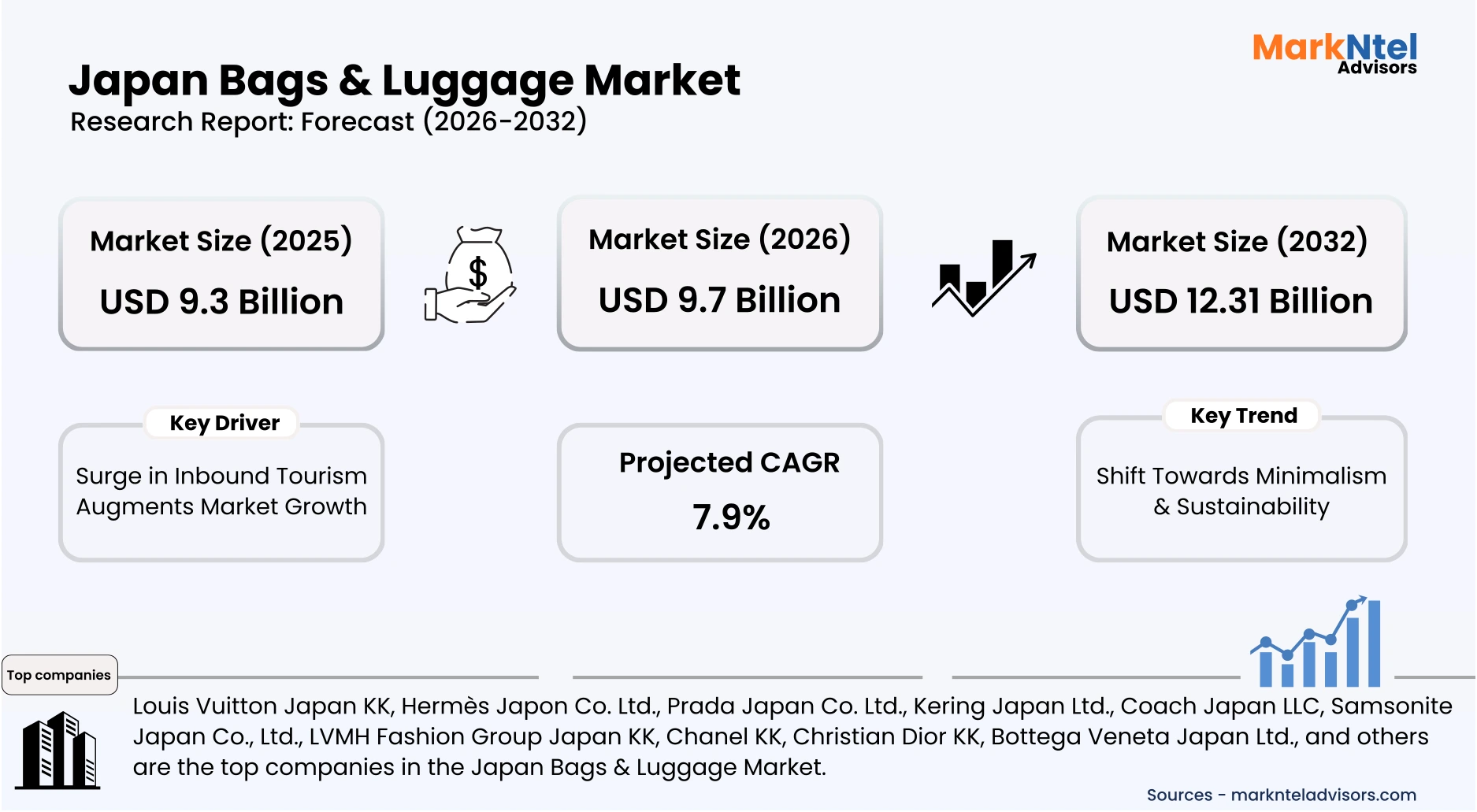
- The Japan Bags & Luggage Market size was valued at USD 9.3 billion in 2025 and is projected to grow from USD 9.7 billion in 2026 to USD 12.31 billion by 2032, exhibiting a CAGR of 4.05% during the forecast period.
- The Kanto region of Japan is the leading region with a significant share of 54% in 2026.
- By Product Type, the luggage segment represented a significant share of about 55% in the Japan Bags & Luggage Market in 2026.
- By Application type, the travel segment presented a significant share of about 33% in the Japan Bags & Luggage Market in 2026.
- Top companies in the Japan Bags & Luggage Market are Louis Vuitton Japan KK, Hermès Japon Co. Ltd., Prada Japan Co. Ltd., Kering Japan Ltd., Coach Japan LLC, Samsonite Japan Co., Ltd., LVMH Fashion Group Japan KK, Chanel KK, Christian Dior KK, Bottega Veneta Japan Ltd., and others.
Market Insights & Analysis: Japan Bags & Luggage Market (2026-32):
The Japan Bags & Luggage Market size was valued at USD 9.3 billion in 2025 and is projected to grow from USD 9.7 billion in 2026 to USD 12.31 billion by 2032, exhibiting a CAGR of 4.05% during the forecast period. i.e., 2026-32.
Japan’s bags and luggage market has experienced a notable upswing in demand driven by robust tourism activity and elevated consumer spending on travel-related products. Official figures from the Japan National Tourism Organisation (JNTO) show that inbound foreign visitor arrivals reached a historic 42 million in 2025, surpassing prior annual records and reflecting a sustained rebound from pandemic lows. Domestic retail sales growth across travel and lifestyle goods has also continued, supported by a broader 3.1 % year‑over‑year rise in total retail sales in March 2025 reported by the Japanese government, indicating solid underlying consumer engagement.
The ongoing expansion of international travel into and within Japan has stimulated end-user demand for luggage and bags, as travelers seek functional products for leisure, business, and transit. Economic incentives like a relatively weak yen have increased foreign visitors' purchasing power and uplifted consumer spending on accessories and premium travel gear across metropolitan and gateway regions. Moreover, local demographic shifts such as increasing participation of senior and youth travelers have diversified end-use requirements, generating demand for specialized backpacks, business bags, and versatile luggage designed for multi-purpose travel and urban mobility.
Japan’s national tourism framework continues to play a central role in sustaining market momentum through policy-driven initiatives to strengthen regional tourism and balance the distribution of travel activity beyond core urban centers. The government’s Tourism Nation Promotion Basic Plan (2023–2025) emphasizes expanding inbound travel, enhancing sustainable tourism, and developing regional attractions, with direct support for infrastructure improvements, human‑resource training, and digital transformation in tourism services. Parallel efforts by the Ministry of Land, Infrastructure, Transport and Tourism target improved connectivity and visitor experience, which indirectly support consumption of travel products such as luggage and bags by increasing the duration and geographic spread of trips.
Looking ahead, future market prospects remain positive, underpinned by Japan’s strategic emphasis on tourism as a growth driver and anticipated continued increases in global travel. The government targets to attract up to 60 million foreign tourists by 2030 , and associated investments in regional tourism infrastructure are expected to further stimulate travel-related purchases. Rising disposable incomes, broader access to digital retail channels, and evolving consumer preferences for high-quality, durable travel accessories suggest sustained expansion in bags and luggage demand across both domestic and inbound segments.
Japan Bags & Luggage Market Recent Developments:
- 2025: Louis Vuitton relaunched its iconic Takashi Murakami collab collection on Jan 1 2025, reviving a long-standing creative partnership with vibrant Monogram pieces. This move harnesses cultural resonance and design novelty to drive product interest and premium leather goods sales among Japanese and global buyers alike.
- 2026: Gucci’s 2026 Giglio collection, including a versatile tote bag available through Gucci Japan’s official channels, underscores brand efforts to update staple designs for local consumers. By highlighting customization options, e.g., monogramming and functional form, this release targets everyday luxury users in Japan’s bag market
Japan Bags & Luggage Market Scope:
| Category | Segments |
|---|---|
| By Product Type | (Fruit Juice (Fresh Juice, Fortified Juice, Fruit Nectars (High Concentration (40%–50% fruit content), Medium Concentration (30%–39% fruit content), Low Concentration (25%–29% fruit content))), Vegetable Juice, Fruit and Vegetable Blends), |
| By Source | (Not from Concentrate (NFC), From Concentrate (FC)), |
| By Packaging | (Cartons (Tetra Pak) (Single-Serve Packs, Family Packs), PET Bottles (Small-Size Bottles, Large-Size Bottles), Glass Bottles, Cans, Others), |
| By Distribution Channel | (Off-Trade (Retail) (Supermarkets & Hypermarkets, Convenience Stores, Traditional Grocery), On-Trade (HoReCa) (Hotels, Restaurants & Cafes), Online Retail), |
| By End User | (Household, Hotels, Restaurants, and Cafes (HoReCa), Institutional, Industrial), |
Japan Bags & Luggage Market Driver:
Surge in Inbound Tourism Augments Market Growth
Japan’s bags and luggage market is being fundamentally propelled by a structural surge in inbound tourism, which has emerged as the most influential driver of demand growth and market expansion. Official data from the Japan National Tourism Organisation (JNTO) confirms that foreign visitor arrivals surpassed 42 million in 2025, setting a new record. Total tourism consumption also reached USD 60 billion in the same year, illustrating a measurable expansion of travel-related expenditure that directly supports demand for luggage and travel bags.
This driver emerged and intensified over recent years as Japan fully reopened its borders post‑pandemic and implemented policy and visa measures to stimulate global travel. The surge in arrivals from diverse source markets in 2025 reflects more than a short-lived trend; it represents a structural increase in travel volume, with tourism now functioning as one of Japan’s leading economic sectors. The volume of foreign visitors is increasing across major gateway cities such as Tokyo, Osaka, and Kyoto, where retail ecosystems for bags and luggage are concentrated, thus translating directly into higher sales volumes across both luxury and mainstream product lines rather than merely affecting pricing.
The cause-and-effect linkage between inbound tourism growth and demand expansion in the bags and luggage market is clear and sustained. As more visitors travel longer distances and for diverse purposes, the need for functional and varied types of luggage, from suitcases to travel backpacks, expands structurally. This demand uplift is observable in rising retail sales and higher tourism expenditure totals rather than transient pricing effects alone. Moreover, government tourism targets for continuing increases in visitor numbers through 2030, reinforced by supportive travel policies, ensure that tourism-driven demand will continue to expand the market volume in the coming years.
Japan Bags & Luggage Market Trend:
Shift Towards Minimalism & Sustainability
In Japan, a growing consumer emphasis on minimalist lifestyles and sustainable consumption is reshaping demand for bags and luggage. Shoppers increasingly favor durable, lightweight materials, such as high-density polyethene and carbon fiber, which combine functionality with longevity and ease of transport. Concurrently, eco-conscious choices are rising, with recycled plastics, organic textiles, and biodegradable materials gaining traction in premium and mid-range segments.
Manufacturers are responding by reengineering value chains to include sustainable sourcing, eco-friendly packaging, and modular designs that extend product life. Tokyo-based brands, such as FUMIKODA and Shupatto , have pioneered products combining functional efficiency with environmental consciousness. These design changes influence production, logistics, and retail practices, promoting circular economy principles and altering consumer expectations.
This trend is expected to persist and expand, as regulatory frameworks, growing environmental awareness, and shifting consumer values reinforce sustainable purchasing habits. Increasing social campaigns and public education on eco-conscious consumption are further embedding sustainability into everyday decisions, ensuring that this structural shift will continue reshaping product portfolios, retail strategies, and manufacturing standards across Japan’s bags and luggage sector.
Japan Bags & Luggage Market Opportunity:
Growth Potential in Customization and Personalization
Japan’s consumers are increasingly seeking products that reflect individual identity and distinct aesthetic preferences, creating a structural opportunity for customized and personalized bags and luggage. Japanese culture places a high value on personal expression and craftsmanship, a dynamic illustrated by the longstanding popularity of “ita‑bags,” where owners decorate bags with character-themed badges and ensure uniqueness in everyday accessories. This cultural orientation toward individual uniqueness has extended into broader fashion and accessory choices.
The combination of digital customization tools and mobile commerce platforms has lowered technical barriers and enabled brands, especially new entrants, to offer made-to-order features such as monogramming, choice of color, and modular components. Digital tools allow customers to preview and tailor designs before purchase, transforming customization from a niche service into a scalable business model. This directly translates to tangible demand, as buyers are increasingly willing to pay premiums for products aligned with personal style and practical needs.
This opportunity is particularly beneficial to new and smaller players because it allows competitive differentiation without requiring large upfront investments in physical retail networks. Startups and independent brands can leverage e-commerce and on-demand manufacturing to deliver bespoke products efficiently, meeting evolving consumer expectations in Japan’s fashion-conscious market.
Japan Bags & Luggage Market Challenge:
Tariff & Customs Complexities Impeding Market Growth
Japan’s bags and luggage industry faces a structural barrier rooted in tariff uncertainty and complex customs compliance that materially impacts costs, market entry, and operational efficiency. Sudden shifts in tariff policies and trade negotiations have increased cost volatility, particularly for imported raw materials and components vital to luggage manufacturing. This has forced firms to absorb higher costs or adjust pricing strategies, compressing profit margins and limiting competitive flexibility. The administrative burden of meeting Japan Customs documentation and classification requirements further slows decision-making and heightens compliance risk.
This challenge persists despite Japan’s relatively low average applied tariff rates in general trade, because industry-specific tariff uncertainty and procedural complexity remain high. The Customs Tariff Act mandates duty and consumption tax applications based on detailed classification rules, and inconsistencies in policy implementation can delay imports, affecting inventory levels and production planning. Costs linked to compliance and customs delays reduce operational efficienc y for both domestic producers and foreign entrants, discouraging new investments and scale-up.
As a structural constraint, tariff and customs complexity restricts market expansion by elevating barriers to entry and increasing cost risk. Manufacturers and distributors grapple with unpredictable cost structures and administrative overhead, deterring foreign suppliers and slowing the adoption of innovative materials or global supply chain integration. Persistent compliance burdens thus dampen investment appeals and constrain broader sector growth.
Japan Bags & Luggage Market (2026-32) Segmentation Analysis:
The Japan Bags & Luggage Market study of MarkNtel Advisors evaluates & highlights the major trends and influencing factors in each segment. It includes predictions for the period 2026–32 at the country level. Based on the analysis, the market has been further classified as;
Based on Product Type:
- Bags
- Cross Body Bags
- Bags and Backpacks
- Business Bags
- Duffle Bags
- Clutches
- Handbags
- Wallets & Coin Pouches
- Others
- Luggage
- Soft Luggage
- Hard Luggage
- Wheeled Luggage
- Non-Wheeled Luggage
- Others
In Japan’s bags & luggage market, hard-side luggage stands as the dominant product type by revenue share of 55%, driven by consumer preferences for durability and secure protection of personal and business items. Consumer and retailer observations in Japan indicate that hard-sided luggage is highly favored due to its durability, protection of contents, and suitability for frequent travel. Compared with backpacks, duffels, and handbags, hard luggage is generally perceived as offering greater longevity and reliability, which drives stronger adoption in both domestic and international travel contexts. robust travel demand and rising expectations for quality, reinforced by technological material innovations, e.g., polycarbonate and lightweight composites that enhance performance without significant weight penalties.
Rigorous quality standards under Japan’s Consumer Product Safety Act also elevate consumer trust in premium hard-side luggage offerings. Investment flows from major brands, both global and local, into hard-side luggage R&D and retail presence, further cementing its position. Frequent business and leisure travel within Japan supports demand for protective, feature-rich luggage. High disposable incomes enable shoppers to prioritize longevity and functionality over price, sustaining hard-side dominance in the product mix.
Based on Application:
-
- Travel
- Business
Across applications, Travel leads Japan’s bags & luggage market with a market share of 33%, driven by continued expansion in both domestic and international mobility. Post‑pandemic travel recovery in 2025 solidified travel‑centric purchases, with rising tourism and airline connectivity expanding short‑haul and long ‑haul trips.
Japanese consumers exhibit a strong travel culture that prioritizes compact, high‑durability luggage solutions tailored to frequent journeys, elevating travel segment demand relative to business use. Official Japan National Tourism Organisation statistics show millions of international visitors per month in 2025, regularly setting new historical records for inbound travel, indicating sustained travel market strength.
Policy influences such as streamlined airport security protocols and tourism promotion initiatives indirectly bolster travel segment sales by reducing travel barriers and encouraging mobility. Investment into premium, feature‑rich travel baggage by global brands amplifies consumer choice and adoption, reinforcing the travel application’s leadership in Japan’s bags and luggage market.
Japan Bags & Luggage Market (2026-32) Regional Analysis:
The Kantō region is Japan’s largest and most economically dominant region, with a market share of 54%. It hosts the nation’s political and financial centers, with a highly concentrated population that supports strong consumer demand and a skilled workforce for industry and services. The region’s economy consistently ranks as the most productive in Japan, reflecting its central role in commerce, finance, and industrial activity. Its cities serve as hubs for corporate headquarters, manufacturing, and services, establishing Kantō as the leading driver of national economic output and market activity.
Structural advantages contribute significantly to Kantō’s leadership. Tokyo serves as Japan’s political and financial capital and global business hub, hosting corporate headquarters, financial institutions, and international firms. The region’s infrastructure network, anchored by Haneda and Narita international airports, extensive rail and road systems, and major ports, enables high‑volume trade and connectivity both domestically and internationally. The prestigious Japanese bag brand Yoshida & Co. (PORTER) has multiple flagship and dealer stores across Tokyo and the broader Kantō area, including PORTER flagship stores, PORTER GINZA, PORTER SHINJUKU, and other dealer locations in Musashino, Chofu, and Saitama. These outlets carry a wide range of backpacks, business bags, and travel luggage.
Policy and demand dynamics further reinforce its dominance. National and regional policy initiatives from ministries such as METI actively support innovation, new business creation, and SME development in the region . Kantō’s concentration of end‑users, large corporations, SMEs, research institutions, and global companies, coupled with strong demand from both domestic and international travelers and businesses, sustains robust economic activity, fostering continuous adoption of products and services across sectors.
Gain a Competitive Edge with Our Japan Bags & Luggage Market Report:
- The Japan Bags & Luggage Market Report by MarkNtel Advisors provides a detailed & thorough analysis of market size & share, growth rate, competitive landscape, and key players. This comprehensive analysis helps businesses gain a holistic understanding of the market dynamics & make informed decisions.
- This report also highlights current market trends & future projections, allowing businesses to identify emerging opportunities & potential challenges. By understanding market forecasts, companies can align their strategies & stay ahead of the competition.
- The Japan Bags & Luggage Market Report aids in assessing & mitigating risks associated with entering or operating in the market. By understanding market dynamics, regulatory frameworks, and potential challenges, businesses can develop strategies to minimize risks & optimize their operations.
*Reports Delivery Format - Market research studies from MarkNtel Advisors are offered in PDF, Excel and PowerPoint formats. Within 24 hours of the payment being successfully received, the report will be sent to your email address.
Frequently Asked Questions
- Market Segmentation
- Introduction
- Product Definition
- Research Process
- Assumptions
- Executive Summary
- Japan Bags & Luggage Market Policies, Regulations, and Product Standards
- Japan Bags & Luggage Market Trends & Developments
- Japan Bags & Luggage Market Dynamics
- Growth Factors
- Challenges
- Japan Bags & Luggage Market Hotspot & Opportunities
- Japan Bags & Luggage Market Outlook, 2022-2032F
- Market Size & Outlook
- By Revenues (USD Million)
- By Units Sold (Thousand Units)
- Market Share & Outlook
- By Product Type- Market Size & Forecast 2022-2032, USD Million & Thousand Units
- Bags
- Cross Body Bags
- Bags and Backpacks
- Business Bags
- Duffle Bags
- Clutches
- Handbags
- Wallets & Coin Pouches
- Others
- Luggage
- Soft Luggage
- Hard Luggage
- Wheeled Luggage
- Non-Wheeled Luggage
- Others
- Bags
- By Price Category- Market Size & Forecast 2022-2032, USD Million & Thousand Units
- Luxury
- Mass/Economy
- Premium
- By Application- Market Size & Forecast 2022-2032, USD Million & Thousand Units
- Travel
- Business
- By Distribution Channel- Market Size & Forecast 2022-2032, USD Million & Thousand Units
- Dealers & Distributors
- Retail Stores
- Online
- By Region- Market Size & Forecast 2022-2032, USD Million & Thousand Units
- Hokkaido
- Tohoku
- Kanto
- Chubu
- Kansai
- Chugoku
- Shikoku
- Kyushu
- By Company
- Competition Characteristics
- Market Share & Analysis
- By Product Type- Market Size & Forecast 2022-2032, USD Million & Thousand Units
- Market Size & Outlook
- Japan Luxury Bags & Luggage Market Outlook, 2022-2032
- Market Size & Outlook
- By Revenues (USD Million)
- By Units Sold (Thousand Units)
- Market Share & Outlook
- By Price Category- Market Size & Forecast 2022-2032, USD Million & Thousand Units
- By Application- Market Size & Forecast 2022-2032, USD Million & Thousand Units
- By Distribution Channel- Market Size & Forecast 2022-2032, USD Million & Thousand Units
- By Region- Market Size & Forecast 2022-2032, USD Million & Thousand Units
- Market Size & Outlook
- Japan Mass/Economy Bags & Luggage Market Outlook, 2022-2032
- Market Size & Outlook
- By Revenues (USD Million)
- By Units Sold (Thousand Units)
- Market Share & Outlook
- By Price Category- Market Size & Forecast 2022-2032, USD Million & Thousand Units
- By Application- Market Size & Forecast 2022-2032, USD Million & Thousand Units
- By Distribution Channel- Market Size & Forecast 2022-2032, USD Million & Thousand Units
- By Region- Market Size & Forecast 2022-2032, USD Million & Thousand Units
- Market Size & Outlook
- Japan Premium Bags & Luggage Market Outlook, 2022-2032
- Market Size & Outlook
- By Revenues (USD Million)
- By Units Sold (Thousand Units)
- Market Share & Outlook
- By Price Category- Market Size & Forecast 2022-2032, USD Million & Thousand Units
- By Application- Market Size & Forecast 2022-2032, USD Million & Thousand Units
- By Distribution Channel- Market Size & Forecast 2022-2032, USD Million & Thousand Units
- By Region- Market Size & Forecast 2022-2032, USD Million & Thousand Units
- Market Size & Outlook
- Japan Bags & Luggage Market Key Strategic Imperatives for Success & Growth
- Competitive Outlook
- Company Profiles
- Louis Vuitton Japan KK
- Business Description
- Product Portfolio
- Collaborations & Alliances
- Recent Developments
- Financial Details
- Others
- Hermès Japon Co. Ltd.
- Business Description
- Product Portfolio
- Collaborations & Alliances
- Recent Developments
- Financial Details
- Others
- Prada Japan Co. Ltd.
- Business Description
- Product Portfolio
- Collaborations & Alliances
- Recent Developments
- Financial Details
- Others
- Kering Japan Ltd.
- Business Description
- Product Portfolio
- Collaborations & Alliances
- Recent Developments
- Financial Details
- Others
- Coach Japan LLC
- Business Description
- Product Portfolio
- Collaborations & Alliances
- Recent Developments
- Financial Details
- Others
- Samsonite Japan Co., Ltd.
- Business Description
- Product Portfolio
- Collaborations & Alliances
- Recent Developments
- Financial Details
- Others
- LVMH Fashion Group Japan KK
- Business Description
- Product Portfolio
- Collaborations & Alliances
- Recent Developments
- Financial Details
- Others
- Chanel KK
- Business Description
- Product Portfolio
- Collaborations & Alliances
- Recent Developments
- Financial Details
- Others
- Christian Dior KK
- Business Description
- Product Portfolio
- Collaborations & Alliances
- Recent Developments
- Financial Details
- Others
- Bottega Veneta Japan Ltd.
- Business Description
- Product Portfolio
- Collaborations & Alliances
- Recent Developments
- Financial Details
- Others
- Gucci
- Business Description
- Product Portfolio
- Collaborations & Alliances
- Recent Developments
- Financial Details
- Others
- Others
- Business Description
- Product Portfolio
- Collaborations & Alliances
- Recent Developments
- Financial Details
- Others
- Louis Vuitton Japan KK
- Company Profiles
- Disclaimer
MarkNtel Advisors follows a robust and iterative research methodology designed to ensure maximum accuracy and minimize deviation in market estimates and forecasts. Our approach combines both bottom-up and top-down techniques to effectively segment and quantify various aspects of the market. A consistent feature across all our research reports is data triangulation, which examines the market from three distinct perspectives to validate findings. Key components of our research process include:
1. Scope & Research Design At the outset, MarkNtel Advisors define the research objectives and formulate pertinent questions. This phase involves determining the type of research—qualitative or quantitative—and designing a methodology that outlines data collection methods, target demographics, and analytical tools. They also establish timelines and budgets to ensure the research aligns with client goals.
2. Sample Selection and Data Collection In this stage, the firm identifies the target audience and determines the appropriate sample size to ensure representativeness. They employ various sampling methods, such as random or stratified sampling, based on the research objectives. Data collection is carried out using tools like surveys, interviews, and observations, ensuring the gathered data is reliable and relevant.
3. Data Analysis and Validation Once data is collected, MarkNtel Advisors undertake a rigorous analysis process. This includes cleaning the data to remove inconsistencies, employing statistical software for quantitative analysis, and thematic analysis for qualitative data. Validation steps are taken to ensure the accuracy and reliability of the findings, minimizing biases and errors.

4. Data Forecast and FinalizationThe final phase involves forecasting future market trends based on the analyzed data. MarkNtel Advisors utilize predictive modeling and time series analysis to anticipate market behaviors. The insights are then compiled into comprehensive reports, featuring visual aids like charts and graphs, and include strategic recommendations to inform client decision-making
We offer flexible licensing options to cater to varying organizational needs. Choose the pricing pack that best suits your requirements:
Buy Now Inquire Before Buying
 Request Customization
 Talk to our Consultant







