

India Variable Frequency Drives (VFDs) Market Research Report: Trends, Forecast & Opportunities (2026-2032)
By Voltage (Low Voltage VFDs, Medium Voltage VFDs, High Voltage VFDs), By Drive Type (AC Drives, DC Drives, Servo Drives), By Application (Pumps, Fans & Blowers, Compressors, Conve ... yors, Others), By End-Use Industry (Infrastructure & Buildings (HVAC), Manufacturing & Process Industries, Oil & Gas, Power Generation, Water & Wastewater, Others), and others Read more
- Energy
- Apr 2026
- Pages 130
- Report Format: PDF, Excel, PPT
India Variable Frequency Drives (VFDs) Market
Projected 6.5% CAGR from 2026 to 2032
Study Period
2026-2032
Market Size (2026)
USD 0.52 Billion
Market Size (2032)
USD 0.76 Billion
Base Year
2025
Projected CAGR
6.5%
Leading Segments
By Voltage: Low Voltage VFDs
India Variable Frequency Drives (VFDs) Market Report Key Takeaways:
- The India Variable Frequency Drives (VFDs) Market size was valued at around USD 0.49 billion in 2025 and is projected grow from USD 0.52 billion in 2026 to USD 0.76 billion by 2032, exhibiting a CAGR of 6.5% during the forecast period.
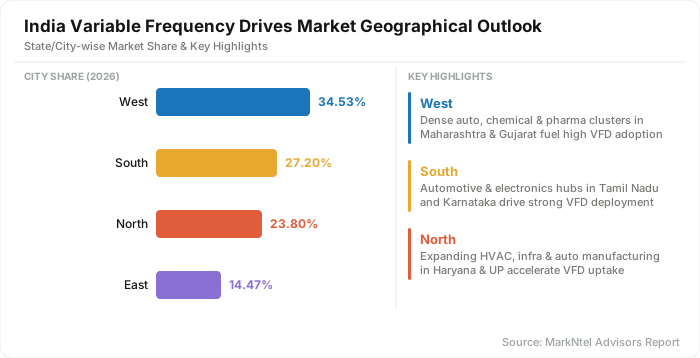
- The West India holds the largest market share of about 34.53% in the India Variable Frequency Drives (VFDs) Market in 2026.
- By Voltage, the Low Voltage VFDs segment represented a significant share of about 71% in the India Variable Frequency Drives (VFDs) Market in 2026.
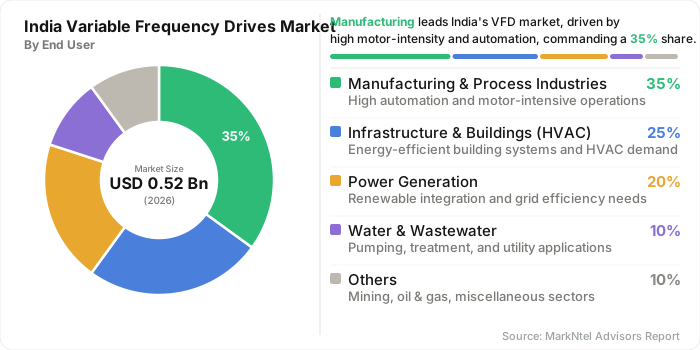
- By End Use Industry, the Manufacturing & Process Industries segment presented a significant share of about 35% in the India Variable Frequency Drives (VFDs) Market in 2026.
Market Insights & Analysis: India Variable Frequency Drives (VFDs) Market (2026-32):
The India Variable Frequency Drives (VFDs) Market size was valued at around USD 0.49 billion in 2025 and is projected grow from USD 0.52 billion in 2026 to USD 0.76 billion by 2032, exhibiting a CAGR of 6.5% during the forecast period, i.e., 2026-32.
India’s Variable Frequency Drives (VFDs) market has demonstrated steady expansion, supported by rising electricity demand and increasing electrification across industrial and infrastructure sectors. According to the International Energy Agency, India’s electricity demand is projected to grow at approximately 6.3% annually between 2025 and 2027, reinforcing the need for efficient motor control technologies . Historically, the widespread deployment of motor-driven systems across manufacturing, water management, and commercial infrastructure has created a strong foundation for VFD adoption. This installed base continues to drive replacement demand and gradual technology upgrades.
Current market conditions are shaped by strong demand from industrial and commercial end users, particularly in manufacturing, HVAC, and water infrastructure applications. Industrial sectors such as cement, metals, and chemicals rely heavily on continuous motor-driven processes, while commercial segments, including data centers and urban infrastructure, depend on efficient cooling and ventilation systems. The Government of India’s National Infrastructure Pipeline, with planned investments exceeding USD 1.4 trillion, is significantly expanding deployment of pumps, ventilation, and automation systems . These developments directly support increased adoption of VFD-integrated solutions.
Regulatory support and infrastructure growth further reinforce market expansion by encouraging energy efficiency and electrification. As reported by the Press Information Bureau, India recorded a peak power demand of 242.49 GW in FY2025–26, with total installed capacity exceeding 509 GW, reflecting the rapid expansion of electrified systems . This growth necessitates efficient energy management solutions, strengthening the role of VFDs in reducing operational costs and improving system performance. Industry participants are aligning with these trends through localized manufacturing, energy-efficient product development, and automation-focused innovations.
Looking ahead, the market outlook remains positive, driven by continued urbanization, digital infrastructure growth, and rising demand for energy-efficient systems. India is expected to witness a USD 100 billion data center investment pipeline by 2027, significantly increasing demand for advanced HVAC systems where VFDs play a critical role . Expanding infrastructure, increasing industrial automation, and supportive policy frameworks are expected to sustain demand across end-user segments. These combined factors position the VFD market for stable and long-term growth in the coming years.
India Variable Frequency Drives (VFDs) Market Recent Developments:
- 2025 : ABB India announced an investment of ~USD 17 million to expand its low-voltage motor manufacturing facility, enhancing production of energy-efficient motors integrated with VFD systems. The expansion supports rising industrial automation and energy efficiency demand across India.
India Variable Frequency Drives (VFDs) Market Scope:
| Category | Segments |
|---|---|
| By Voltage | (Low Voltage VFDs, Medium Voltage VFDs, High Voltage VFDs), |
| By Drive Type | (AC Drives, DC Drives, Servo Drives), |
| By Application | (Pumps, Fans & Blowers, Compressors, Conveyors, Others), |
| By End-Use Industry | (Infrastructure & Buildings (HVAC), Manufacturing & Process Industries, Oil & Gas, Power Generation, Water & Wastewater, Others), |
India Variable Frequency Drives (VFDs) Market Driver:
Rising Demand for Energy Efficiency Across Industries
The rising demand for energy efficiency across industries has become a structural driver accelerating the adoption of Variable Frequency Drives (VFDs) in India. This trend has intensified as India’s total energy demand is expected to grow at approximately 3% annually through 2035, with industry accounting for the largest share of incremental consumption . As energy demand rises across manufacturing and infrastructure, industries are increasingly prioritizing efficiency to control operating costs. This has shifted VFD adoption from a cost-saving option to a strategic necessity in energy-intensive operations.
The impact of this driver is measurable across industrial, commercial, and infrastructure end-user segments where motor-driven systems dominate electricity usage. Industrial facilities, commercial buildings, and SMEs are all contributing to rising electricity consumption, particularly through HVAC, pumping, and processing systems. Simultaneously, India added over 41 GW of renewable capacity in 2025, accelerating electrification across sectors and increasing reliance on efficient electrical systems. This transition is driving the adoption of VFDs to optimize energy usage in both new installations and upgraded infrastructure.
This driver is materially expanding market volume by increasing the number of motor-driven systems requiring efficient control rather than merely influencing pricing or short-term adoption cycles. As industries expand capacity and integrate electrified systems powered by renewable energy, each installation creates incremental demand for VFDs. Additionally, regulatory emphasis on energy efficiency and sustainability is reinforcing long-term adoption across sectors. This combination of rising demand, electrification, and policy alignment ensures sustained volume growth in the VFD market.
India Variable Frequency Drives (VFDs) Market Trend:
Integration of IoT and Smart Monitoring in Drives
The integration of IoT and smart monitoring in Variable Frequency Drives (VFDs) has emerged as a key structural trend, driven by rapid digitalization across India’s industrial ecosystem. This shift has accelerated with the adoption of Industry 4.0 practices and initiatives such as Digital India. Industries are increasingly prioritizing real-time monitoring, predictive maintenance, and system optimization to reduce downtime and improve efficiency. Consequently, VFDs are evolving from standalone devices into connected, intelligent components within broader automation systems.
This trend is reshaping operational practices across manufacturing, infrastructure, and commercial sectors by enabling data-driven asset management and performance optimization. Companies such as ABB have introduced connected drives like the ACS380-E with built-in Ethernet and cybersecurity features , while Schneider Electric has launched Altivar HVAC drives and Altivar Predict solutions offering cloud connectivity and predictive diagnostics . These innovations enable remote monitoring, reduce unplanned downtime, and enhance lifecycle efficiency across motor-driven systems.
The persistence of this trend is supported by increasing investments in digital infrastructure, smart manufacturing, and intelligent building systems. The growing deployment of connected technologies in data centers, commercial buildings, and industrial facilities is reinforcing demand for digitally enabled drives. Additionally, regulatory emphasis on efficiency and reliability is encouraging the adoption of advanced monitoring solutions. As digital transformation continues across sectors, IoT-enabled VFDs are expected to remain central to long-term market evolution, fundamentally transforming system management and operational efficiency.
India Variable Frequency Drives (VFDs) Market Opportunity:
Expansion of Industrial Automation in India
The expansion of industrial automation in India presents a compelling structural opportunity for new entrants in the Variable Frequency Drives (VFDs) market. This opportunity has accelerated due to policy-driven manufacturing growth under Make in India and Production-Linked Incentive (PLI) schemes. Government data indicates that PLI programs have attracted investments exceeding USD 26 billion, significantly expanding production capacity across electronics, automotive, and industrial sectors. These structural shifts are increasing the adoption of automated and energy-efficient systems across manufacturing facilities.
This transition directly translates into tangible demand for VFDs as automation requires precise control of motor-driven equipment across production processes. Automated systems such as conveyors, compressors, and robotic assembly lines rely on VFDs for speed regulation and energy optimization. Additionally, recent approvals of over USD 750 million in electronics manufacturing projects (2026) highlight ongoing industrial expansion, further increasing the installed base of motor-driven systems . As industries scale operations and modernize facilities, each new automated installation generates incremental demand for advanced drive technologies.
The opportunity is particularly advantageous for new and emerging players due to the evolving and fragmented nature of India’s automation landscape. Unlike legacy-heavy markets, India’s ongoing industrial transformation allows new entrants to offer cost-effective, application-specific, and digitally integrated solutions. Smaller players can leverage localization, customization, and flexible pricing to compete effectively. As automation adoption continues to expand across sectors, this creates a scalable and accessible growth pathway for new participants in the VFD ecosystem.
India Variable Frequency Drives (VFDs) Market Challenge:
High Initial Cost for Small-Scale Industries
The high initial cost of Variable Frequency Drives (VFDs) remains a critical structural barrier, particularly for small and medium enterprises (SMEs) in India’s industrial ecosystem. This challenge persists due to upfront capital requirements for equipment, integration, and system compatibility upgrades. According to the Ministry of Micro, Small, and Medium Enterprises, MSMEs account for over 30% of India’s GDP yet operate under constrained access to affordable financing. Rising borrowing costs and limited capital availability have further intensified investment hesitancy among smaller firms.
This cost barrier is measurably impacting adoption rates across SMEs, which constitute a large share of manufacturing and industrial activity in India. Many smaller units continue to rely on conventional fixed-speed motors due to lower upfront costs, despite higher lifecycle energy expenses. Government programs promoting energy efficiency, such as schemes under the Bureau of Energy Efficiency, have improved awareness but have not fully offset capital constraints. As a result, adoption remains concentrated among large enterprises with stronger financial capacity.
The challenge materially restricts market expansion by limiting penetration in a vast and underserved SME segment, thereby constraining overall volume growth. While large industries continue to adopt VFDs, the slower uptake among SMEs reduces the total addressable market size. Additionally, longer payback periods and limited financing mechanisms discourage investment in efficiency technologies. Until cost barriers are addressed through incentives, subsidies, or financing models, this constraint will continue to hinder broader market scalability and adoption.
India Variable Frequency Drives (VFDs) Market (2026-32) Segmentation Analysis:
The India Variable Frequency Drives (VFDs) market study of MarkNtel Advisors evaluates & highlights the major trends and influencing factors in each segment. It includes predictions for the period 2026–32 at the country level. Based on the analysis, the market has been further classified as;
Based on Voltage:
- Low Voltage VFDs
- Medium Voltage VFDs
- High Voltage VFDs
Low Voltage VFDs dominate the India Variable Frequency Drives (VFDs) market, accounting for approximately 71% of total demand, primarily because the majority of installed motor capacity in India operates in low-power applications such as pumps, fans, and compressors. According to the International Energy Agency, motor-driven systems account for a significant share of industrial electricity consumption globally, with small and medium motors forming the bulk of installations. In India, these systems are extensively deployed across manufacturing, water infrastructure, and commercial buildings, directly supporting demand for low-voltage drives.
This dominance is further reinforced by large-scale infrastructure and urban utility expansion, particularly in water supply and HVAC systems. Government programs such as the Atal Mission for Rejuvenation and Urban Transformation focus on urban water management and infrastructure upgrades, significantly increasing the deployment of pump-based systems . These applications typically operate within low-voltage ranges, making low-voltage VFDs the most practical and cost-efficient solution. The sheer volume of such installations ensures sustained demand compared to medium- and high-voltage segments.
From a supply perspective, low-voltage VFDs benefit from standardization, modular design, and widespread local manufacturing, which reduce costs and improve accessibility. Leading manufacturers such as Delta Electronics and Siemens offer compact, application-specific drives tailored for HVAC, water, and light industrial use. This combination of high application volume, affordability, and ease of integration enables low-voltage VFDs to maintain their dominant market position across India’s diverse end-user landscape.
Based on End Use Industry:
- Infrastructure & Buildings (HVAC)
- Manufacturing & Process Industries
- Oil & Gas
- Power Generation
- Water & Wastewater
- Others
Manufacturing & Process Industries dominate the India Variable Frequency Drives (VFDs) market, accounting for approximately 35% of total demand, primarily because these sectors rely heavily on continuous motor-driven operations across production lines. Industries such as cement, steel, chemicals, and food processing require precise speed and torque control in applications including conveyors, compressors, mixers, and pumps. According to the Ministry of Statistics and Programme Implementation, manufacturing contributes significantly to India’s gross value added, reflecting a large and expanding industrial base. This scale of industrial activity directly sustains high demand for VFD-integrated systems.
Industrial capacity expansion further reinforces this dominance, supported by national initiatives aimed at strengthening domestic manufacturing. Programs such as Make in India have accelerated investments in sectors like automotive, electronics, and chemicals, increasing the deployment of automated machinery. These facilities operate with high-capacity motor systems requiring energy-efficient control solutions to maintain productivity and reduce operational costs. The continuous nature of process industries, where equipment runs for extended durations, further amplifies the need for VFDs compared to intermittent-use applications in other sectors.
Additionally, manufacturing environments demand high operational efficiency, reliability, and process optimization, all of which are enabled by VFD integration. Companies such as Siemens and ABB provide advanced drive solutions tailored for industrial automation, supporting large-scale production facilities. The combination of extensive motor usage, continuous operations, and ongoing industrial expansion ensures that manufacturing and process industries maintain their leading position in the India VFD market.
India Variable Frequency Drives (VFDs) Market (2026-32): Regional Projection
West India dominates the India Variable Frequency Drives (VFDs) market, accounting for approximately 34.53% of total regional demand, primarily because it represents the country’s most concentrated industrial and manufacturing hub. States such as Maharashtra and Gujarat host a large share of India’s chemical, petrochemical, pharmaceutical, and automotive industries, all of which rely heavily on motor-driven systems. According to the Ministry of Commerce and Industry, Western states consistently account for a significant portion of India’s industrial output and exports, reinforcing their position as key production centers . This industrial density directly sustains high demand for VFDs across process and discrete manufacturing applications.
This dominance is further supported by strong infrastructure and investment activity across the region, particularly in industrial corridors and energy-intensive sectors. The Delhi-Mumbai Industrial Corridor, one of India’s largest infrastructure initiatives, passes through major western states and is driving the development of smart industrial cities and manufacturing zones. These developments involve extensive deployment of automation systems, pumps, compressors, and HVAC units, all of which require efficient motor control solutions. The scale and continuity of such projects significantly expand the regional demand base for VFDs compared to other regions.
Additionally, West India benefits from well-established industrial clusters, port connectivity, and reliable power infrastructure, enabling high-capacity and continuous industrial operations. Companies such as Reliance Industries and Tata Chemicals operate large-scale facilities in the region, requiring advanced automation and energy-efficient systems. This combination of industrial concentration, infrastructure development, and operational scale ensures consistent and high-volume demand for VFDs. As a result, West India maintains its leading position within the national market.
India Variable Frequency Drives (VFD) Market Competitive Landscape
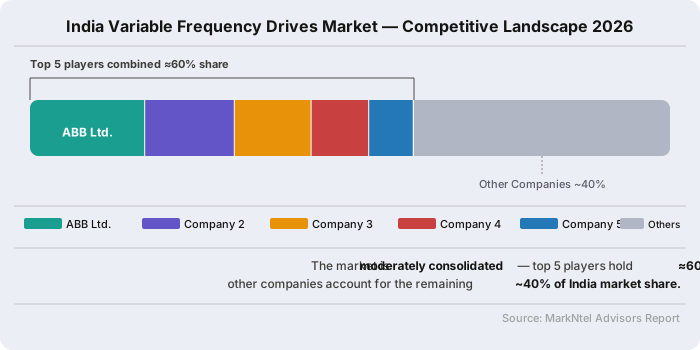
The market is moderately consolidated, with the top five players accounting for approximately 60% of the total market share. Leading companies include ABB, Siemens, Schneider Electric, Danfoss, and Mitsubishi Electric.
Key players in India Variable Frequency Drives (VFD) Industry
- ABB
- Siemens
- Schneider Electric
- Danfoss
- Mitsubishi Electric
- Yaskawa Electric
- Rockwell Automation
- Delta Electronics
- Fuji Electric
- CG Power & Industrial Solutions
- Others
Gain a Competitive Edge with Our India Variable Frequency Drives (VFDs) Market Report:
- India Variable Frequency Drives (VFDs) Market Report by MarkNtel Advisors provides a detailed & thorough analysis of market size & share, growth rate, competitive landscape, and key players. This comprehensive analysis helps businesses gain a holistic understanding of the market dynamics & make informed decisions.
- This report also highlights current market trends & future projections, allowing businesses to identify emerging opportunities & potential challenges. By understanding market forecasts, companies can align their strategies & stay ahead of the competition.
- India Variable Frequency Drives (VFDs) Market Report aids in assessing & mitigating risks associated with entering or operating in the market. By understanding market dynamics, regulatory frameworks, and potential challenges, businesses can develop strategies to minimize risks & optimize their operations.
*Reports Delivery Format - Market research studies from MarkNtel Advisors are offered in PDF, Excel and PowerPoint formats. Within 24 hours of the payment being successfully received, the report will be sent to your email address.
Frequently Asked Questions
- Market Segmentation
- Introduction
- Product Definition
- Research Process
- Assumptions
- Executive Summary
- India Variable Frequency Drives (VFDs) Market Policies, Regulations, and Product Standards
- India Variable Frequency Drives (VFDs) Market Trends & Developments
- India Variable Frequency Drives (VFDs) Market Dynamics
- Growth Factors
- Challenges
- India Variable Frequency Drives (VFDs) Market Hotspot & Opportunities
- India Variable Frequency Drives (VFDs) Market Outlook, 2022-2032F
- Market Size & Outlook
- By Revenues (USD Million)
- Market Share & Outlook
- By Voltage- Market Size & Forecast 2022-2032, USD Million
- Low Voltage VFDs
- Medium Voltage VFDs
- High Voltage VFDs
- By Drive Type- Market Size & Forecast 2022-2032, USD Million
- AC Drives
- DC Drives
- Servo Drives
- By Application- Market Size & Forecast 2022-2032, USD Million
- Pumps
- Fans & Blowers
- Compressors
- Conveyors
- Others
- By End-Use Industry- Market Size & Forecast 2022-2032, USD Million
- Infrastructure & Buildings (HVAC)
- Manufacturing & Process Industries
- Oil & Gas
- Power Generation
- Water & Wastewater
- Others
- By Region- Market Size & Forecast 2022-2032, USD Million
- South India
- North India
- West India
- East India
- By Company
- Competition Characteristics
- Market Share & Analysis
- By Voltage- Market Size & Forecast 2022-2032, USD Million
- Market Size & Outlook
- India Low Voltage VFDs Market Outlook, 2022-2032
- Market Size & Outlook
- By Revenues (USD Million)
- Market Share & Outlook
- By Drive Type- Market Size & Forecast 2022-2032, USD Million
- By Application- Market Size & Forecast 2022-2032, USD Million
- By End-Use Industry- Market Size & Forecast 2022-2032, USD Million
- By Region- Market Size & Forecast 2022-2032, USD Million
- Market Size & Outlook
- India Medium Voltage VFDs Market Outlook, 2022-2032
- Market Size & Outlook
- By Revenues (USD Million)
- Market Share & Outlook
- By Drive Type- Market Size & Forecast 2022-2032, USD Million
- By Application- Market Size & Forecast 2022-2032, USD Million
- By End-Use Industry- Market Size & Forecast 2022-2032, USD Million
- By Region- Market Size & Forecast 2022-2032, USD Million
- Market Size & Outlook
- India High Voltage VFDs Market Outlook, 2022-2032
- Market Size & Outlook
- By Revenues (USD Million)
- Market Share & Outlook
- By Drive Type- Market Size & Forecast 2022-2032, USD Million
- By Application- Market Size & Forecast 2022-2032, USD Million
- By End-Use Industry- Market Size & Forecast 2022-2032, USD Million
- By Region- Market Size & Forecast 2022-2032, USD Million
- Market Size & Outlook
- India Variable Frequency Drives (VFDs) Market Key Strategic Imperatives for Success & Growth
- Competitive Outlook
- Company Profiles
- ABB
- Business Description
- Product Portfolio
- Collaborations & Alliances
- Recent Developments
- Financial Details
- Others
- Siemens
- Business Description
- Product Portfolio
- Collaborations & Alliances
- Recent Developments
- Financial Details
- Others
- Schneider Electric
- Business Description
- Product Portfolio
- Collaborations & Alliances
- Recent Developments
- Financial Details
- Others
- Danfoss
- Business Description
- Product Portfolio
- Collaborations & Alliances
- Recent Developments
- Financial Details
- Others
- Mitsubishi Electric
- Business Description
- Product Portfolio
- Collaborations & Alliances
- Recent Developments
- Financial Details
- Others
- Yaskawa Electric
- Business Description
- Product Portfolio
- Collaborations & Alliances
- Recent Developments
- Financial Details
- Others
- Rockwell Automation
- Business Description
- Product Portfolio
- Collaborations & Alliances
- Recent Developments
- Financial Details
- Others
- Delta Electronics
- Business Description
- Product Portfolio
- Collaborations & Alliances
- Recent Developments
- Financial Details
- Others
- Fuji Electric
- Business Description
- Product Portfolio
- Collaborations & Alliances
- Recent Developments
- Financial Details
- Others
- CG Power & Industrial Solutions
- Business Description
- Product Portfolio
- Collaborations & Alliances
- Recent Developments
- Financial Details
- Others
- ABB
- Company Profiles
- Disclaimer
MarkNtel Advisors follows a robust and iterative research methodology designed to ensure maximum accuracy and minimize deviation in market estimates and forecasts. Our approach combines both bottom-up and top-down techniques to effectively segment and quantify various aspects of the market. A consistent feature across all our research reports is data triangulation, which examines the market from three distinct perspectives to validate findings. Key components of our research process include:
1. Scope & Research Design At the outset, MarkNtel Advisors define the research objectives and formulate pertinent questions. This phase involves determining the type of research—qualitative or quantitative—and designing a methodology that outlines data collection methods, target demographics, and analytical tools. They also establish timelines and budgets to ensure the research aligns with client goals.
2. Sample Selection and Data Collection In this stage, the firm identifies the target audience and determines the appropriate sample size to ensure representativeness. They employ various sampling methods, such as random or stratified sampling, based on the research objectives. Data collection is carried out using tools like surveys, interviews, and observations, ensuring the gathered data is reliable and relevant.
3. Data Analysis and Validation Once data is collected, MarkNtel Advisors undertake a rigorous analysis process. This includes cleaning the data to remove inconsistencies, employing statistical software for quantitative analysis, and thematic analysis for qualitative data. Validation steps are taken to ensure the accuracy and reliability of the findings, minimizing biases and errors.

4. Data Forecast and FinalizationThe final phase involves forecasting future market trends based on the analyzed data. MarkNtel Advisors utilize predictive modeling and time series analysis to anticipate market behaviors. The insights are then compiled into comprehensive reports, featuring visual aids like charts and graphs, and include strategic recommendations to inform client decision-making
We offer flexible licensing options to cater to varying organizational needs. Choose the pricing pack that best suits your requirements:
Buy Now Inquire Before Buying
 Request Customization
 Talk to our Consultant







