

India Swiss Watch Market Research Report: Trends & Forecast (2026-2032)
By Product Type (Mechanical Watches, Quartz Watches), By Price Range (Entry Luxury (USD 500 – 3,000), Mid Luxury (USD 3,000 – 10,000), High Luxury (USD 10,000 – 50,000), Ultra Luxu ... ry (Above USD 50,000)), By End User (Men, Women, Unisex), By Distribution Channel (Offline, Online), and others Read more
- FMCG
- Apr 2026
- Pages 150
- Report Format: PDF, Excel, PPT
India Swiss Watch Market
Projected 8.2% CAGR from 2026 to 2032
Study Period
2026-2032
Market Size (2026)
USD 0.32 Billion
Market Size (2032)
USD 0.51 Billion
Base Year
2025
Projected CAGR
8.2%
Leading Segments
By End User: Men
India Swiss Watch Market Report Key Takeaways:
- The India Swiss Watch Market size was valued at around USD 0.30 billion in 2025 and is projected grow from USD 0.32 billion in 2026 to USD 0.51 billion by 2032, exhibiting a CAGR of 8.2% during the forecast period.
- West India holds the largest market share of about 35.59% in the India Swiss Watch Market in 2026.
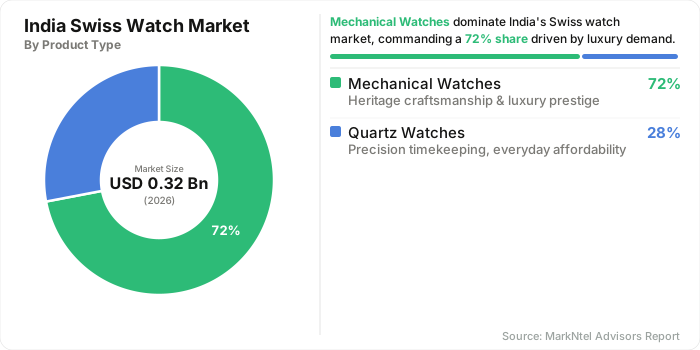
- By Product Type, the Mechanical Watches segment represented a significant share of about 72% in the India Swiss Watch Market in 2026.
- By End User, the Men segment seized a significant share of about 68% in the India Swiss Watch Market in 2026.
- Leading Swiss Watch companies in the India market are Rolex, Omega, TAG Heuer, Longines, Tissot, Rado, Breitling, Hublot, Patek Philippe, Audemars Piguet, and Others.
Market Insights & Analysis: India Swiss Watch Market (2026-32):
The India Swiss Watch Market size was valued at around USD 0.30 billion in 2025 and is projected grow from USD 0.32 billion in 2026 to USD 0.51 billion by 2032, exhibiting a CAGR of 8.2% during the forecast period, i.e., 2026-32.
India’s Swiss watch market has demonstrated steady expansion, supported by rising luxury consumption and sustained import growth. According to the Federation of the Swiss Watch Industry, exports to India reached approximately USD 300–310 million in 2024, reflecting a strong post-pandemic recovery. India remains a small but rapidly growing destination globally, with demand concentrated in metropolitan regions. The historical trajectory reflects increasing acceptance of high-value mechanical timepieces among affluent consumers.
Current market conditions are shaped by demographic expansion and evolving consumer behavior, particularly among high-net-worth individuals. Reports from the World Bank and Credit Suisse highlight a steady rise in India’s affluent population, directly supporting luxury goods demand. End-user segmentation shows dominance of individual residential buyers, accounting for nearly 50% of purchases, driven by gifting culture and status consumption. Commercial demand is limited but includes corporate gifting and institutional procurement in premium segments.
Regulatory and policy developments are increasingly supportive of market expansion, particularly through trade liberalization efforts. The India–EFTA Trade and Economic Partnership Agreement, effective from October 2025, has initiated a phased reduction in import duties on Swiss watches, lowering tariffs from around 22% to nearly 15%, with further reductions planned. Additionally, infrastructure initiatives such as airport modernization and luxury retail expansion under government-backed urban programs are enhancing access to premium products. These frameworks collectively improve distribution efficiency and consumer reach.
Industry participants are actively strengthening market presence through product innovation, retail expansion, and localization strategies. Leading brands such as Rolex and Omega continue to introduce advanced mechanical models and expand boutique networks in major Indian cities. Sustainability initiatives and digital engagement strategies are also improving brand visibility. Looking ahead, the market is expected to sustain growth, supported by policy tailwinds, rising disposable incomes, and increasing aspirational demand.
India Swiss Watch Market Recent Developments:
- 2025 : Rolex unveiled its new Oyster Perpetual Land-Dweller at Watches & Wonders 2025, marking its first major new collection in over a decade. The model features a high-frequency movement for improved precision and reflects continued innovation in mechanical watchmaking.
- 2025 : Omega expanded its portfolio in India with the launch of the 4th-generation Seamaster Planet Ocean collection, featuring multiple new models and configurations. The launch highlights the brand’s continued focus on innovation and strengthening its presence in the premium dive watch segment across authorized Indian retailers.
India Swiss Watch Market Scope:
| Category | Segments |
|---|---|
| By Product Type | (Mechanical Watches, Quartz Watches), |
| By Price Range | (Entry Luxury (USD 500 – 3,000), Mid Luxury (USD 3,000 – 10,000), High Luxury (USD 10,000 – 50,000), Ultra Luxury (Above USD 50,000)), |
| By End User | (Men, Women, Unisex), |
| By Distribution Channel | (Offline, Online), |
India Swiss Watch Market Driver:
Rising Number of High-Net-Worth Individuals (HNIs)
The rapid expansion of India’s high-net-worth individual (HNI) population has emerged as the most influential structural driver of demand in the Swiss watch market. According to the World Bank and recent wealth studies reported by Reuters, India’s economic growth has consistently outpaced global averages, supporting wealth creation. In 2024, India added over 33,000 new millionaires, taking the total HNWI population to nearly 380,000, with wealth exceeding USD 1.5 trillion. This sustained rise reflects structural income growth rather than cyclical recovery.
This driver is directly translating into measurable demand expansion across key urban geographies such as Mumbai, Delhi, and Bengaluru, where luxury retail penetration is highest. High-income households allocate a greater share of discretionary spending to premium goods, including Swiss watches, which are perceived as both status symbols and investment assets. Reports indicate that India’s ultra-high-net-worth population is projected to grow by nearly 50% by 2028, reinforcing long-term consumption potential . This demographic concentration is significantly increasing transaction volumes in the luxury watch segment.
Unlike short-term consumption trends, the rise in HNIs is materially expanding the market size by increasing the addressable consumer base for high-value timepieces. Policy support, including the 2025 India–EFTA agreement, is expected to further enhance accessibility by reducing import duties, thereby converting latent demand into actual purchases. Additionally, government-led infrastructure initiatives, such as airport modernization and luxury retail development, are improving product accessibility. Together, these structural and policy-driven factors ensure sustained volume growth rather than price-led expansion.
India Swiss Watch Market Trend:
Shift Toward Mechanical Watches
The shift toward mechanical watches has accelerated in India, driven by increasing consumer preference for craftsmanship, exclusivity, and long-term value retention. Data from the Federation of the Swiss Watch Industry indicates that mechanical watches account for over 85% of total Swiss watch export value, underscoring their premium positioning. This trend has intensified alongside rising affluence, with consumers prioritizing high-end automatic timepieces over mass-market quartz models.
This structural shift is reshaping industry dynamics, with manufacturers increasingly focusing on limited-edition mechanical innovations to drive demand and margins. For instance, Rolex launched the Land-Dweller collection in 2025, while Audemars Piguet introduced anniversary Royal Oak limited editions, both produced in restricted volumes . These strategies create scarcity-driven demand and reinforce premium pricing, while retail channels shift toward boutique-led, experience-focused models.
The trend is expected to persist due to its strong alignment with investment-oriented consumption and collector behavior. Limited production models often appreciate, strengthening their appeal as alternative assets. Additionally, supportive policy measures such as the India–EFTA agreement are expected to improve affordability over time. These combined factors ensure that mechanical watches will continue to shape long-term market evolution and demand patterns.
India Swiss Watch Market Opportunity:
Expanding Women Luxury Segment
The women’s luxury segment in India has emerged as a structurally strong opportunity, supported by rising economic participation and income growth. According to the World Bank, female labor force participation increased from 22.9% in 2018 to 35.3% in 2025, while India’s Economic Survey reports a rise to 41.7% in 2023–24. This sustained improvement in income generation is enabling higher discretionary spending among women, directly supporting luxury consumption.
This opportunity is translating into measurable demand expansion as women increasingly purchase luxury watches for personal use and lifestyle expression. Established publications such as The Times of India report that luxury demand in India is being driven by aspirational consumers, including working women in urban regions. Additionally, global fashion platforms such as Vogue highlight a narrowing gender gap in luxury watch consumption, with women emerging as active buyers and collectors.
The segment offers a favorable entry point for new and emerging players due to relatively lower saturation compared to male-dominated luxury categories. Established brands have historically focused on men’s collections, creating scope for differentiated product design and targeted branding strategies. This enables new entrants to target underserved demand through design innovation, pricing flexibility, and digital-first engagement models, supporting scalable growth opportunities.
India Swiss Watch Market Challenge:
High Import Duties and Pricing Barriers
High import duties remain a critical structural constraint in the India Swiss watch market, driven by the country’s broader tariff framework on luxury goods. Government-linked reporting indicates that import duties on Swiss watches have historically been around 20–22%, significantly increasing retail prices . This pricing structure reflects India’s policy approach to protect domestic manufacturing and regulate luxury imports. As a result, Swiss watches enter the market at a substantial price premium compared to global benchmarks.
This cost burden directly impacts market participants by limiting consumer affordability and constraining demand expansion beyond affluent segments. News coverage from The Economic Times highlights that high duties elevate final retail prices by thousands of dollars, restricting access for aspirational buyers. Consequently, authorized retailers face slower inventory turnover, while consumers often turn to overseas purchases or informal channels. This dynamic creates measurable distortions in official sales volumes and distribution efficiency.
The challenge materially restricts market scalability by narrowing the addressable consumer base and discouraging broader market penetration. Although the India–EFTA agreement initiated duty reductions to nearly 15% in 2025, tariffs remain elevated relative to other luxury markets. This continued pricing barrier affects long-term investment decisions by brands and limits expansion into non-metro regions. As a result, growth remains concentrated within a niche, high-income consumer segment.
India Swiss Watch Market (2026-32) Segmentation Analysis:
The India Swiss Watch market study of MarkNtel Advisors evaluates & highlights the major trends and influencing factors in each segment. It includes predictions for the period 2026–32 at the country level. Based on the analysis, the market has been further classified as;
Based on Product Type:
- Mechanical Watches
- Quartz Watches
Mechanical watches dominate the India Swiss Watch Market, accounting for approximately 72% of total demand, primarily due to consumer preference for high-value discretionary goods in luxury categories. Unlike functional timekeeping devices, mechanical watches are positioned as symbols of status and craftsmanship, which aligns with purchasing behavior among affluent Indian buyers. This demand is structurally different from quartz watches, which are largely perceived as utilitarian and price-sensitive products.
This dominance is further reinforced by strong growth in India’s luxury consumption ecosystem. According to the India Brand Equity Foundation, India’s luxury market continues to expand, supported by rising disposable incomes and urban consumption. Within this ecosystem, high-value categories such as premium watches benefit disproportionately, as consumers increasingly shift toward fewer but higher-ticket purchases. This behavior directly drives higher sales volumes for mechanical watches over quartz alternatives.
Additionally, retail and channel strategies in India are inherently aligned with premium product categories. Multi-brand luxury retailers and boutique stores prioritize high-margin products that justify experiential selling and personalized services. Mechanical watches, with higher price points and brand storytelling, receive greater visibility and promotion compared to quartz models. This retail bias, combined with consumer preference for premium ownership, ensures sustained dominance of mechanical watches in the Indian market.
Based on End User:
- Men
- Women
- Unisex
The men segment dominates the India Swiss Watch Market, accounting for approximately 68% of total demand, primarily due to the established role of watches as one of the most widely accepted luxury accessories for men. Unlike other luxury categories, watches remain a core component of men’s personal style and professional appearance, leading to higher ownership rates and repeat purchases compared to women consumers in India.
This dominance is further supported by income-driven consumption patterns. The Economic Times indicates that luxury watch demand in India is primarily driven by affluent consumers and high-net-worth individuals who are increasingly trading up to premium timepieces. These high-income buyers contribute disproportionately to total market value, and their purchasing behavior is centered on high-ticket products, which are more commonly marketed toward men.
Additionally, product availability and retail strategies reinforce male dominance in the market. Swiss manufacturers such as Rolex and Omega offer a broader portfolio of men’s models across sports, formal, and high-complication categories. Retailers prioritize showcasing these high-value collections due to stronger demand and margins, resulting in greater visibility and sales volume for men’s watches. This alignment of consumer behavior, income concentration, and product strategy sustains the segment’s leading position.
India Swiss Watch Market (2026-32): Regional Projection
West India dominates the India Swiss Watch Market, accounting for approximately 35.59% of total regional demand, primarily due to its high concentration of affluent consumers. According to the Hurun Research Institute, Mumbai ranks as India’s “millionaire capital” with over 142,000 high-net-worth households, while Maharashtra leads nationally in wealth concentration . This dense concentration of wealthy consumers directly supports sustained demand for high-value luxury goods, including Swiss watches.
This dominance is further reinforced by the region’s well-developed luxury retail infrastructure and brand presence. Major metropolitan areas such as Mumbai host a high density of premium malls, airport retail outlets, and authorized boutiques, enabling greater accessibility to Swiss watch brands. The Economic Times indicates that luxury retail expansion in India is heavily concentrated in key urban centers, with Mumbai serving as a primary hub for premium brand activity and consumer engagement .
Additionally, West India benefits from strong financial and corporate activity, which drives higher discretionary spending on luxury products. The region hosts a large base of business owners, executives, and professionals with significant purchasing power, supporting consistent demand for premium timepieces. This combination of wealth concentration, advanced retail ecosystems, and high-income consumer presence ensures that West India maintains its leading position over other regions in the Indian Swiss watch market.
India Swiss Watch Market Competitive Landscape
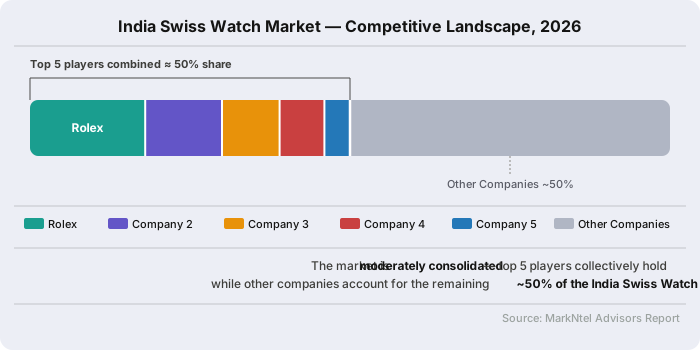
The market is moderately consolidated, with the top five players accounting for approximately 50% of the total market share. Leading companies include Rolex, Omega, TAG Heuer, Longines, and Tissot.
Key Swiss Watch Companies in India
- Rolex
- Omega
- TAG Heuer
- Longines
- Tissot
- Rado
- Breitling
- Hublot
- Patek Philippe
- Audemars Piguet
- Others
Gain a Competitive Edge with Our India Swiss Watch Market Report:
- India Swiss Watch Market Report by MarkNtel Advisors provides a detailed & thorough analysis of market size & share, growth rate, competitive landscape, and key players. This comprehensive analysis helps businesses gain a holistic understanding of the market dynamics & make informed decisions.
- This report also highlights current market trends & future projections, allowing businesses to identify emerging opportunities & potential challenges. By understanding market forecasts, companies can align their strategies & stay ahead of the competition.
- India Swiss Watch Market Report aids in assessing & mitigating risks associated with entering or operating in the market. By understanding market dynamics, regulatory frameworks, and potential challenges, businesses can develop strategies to minimize risks & optimize their operations.
*Reports Delivery Format - Market research studies from MarkNtel Advisors are offered in PDF, Excel and PowerPoint formats. Within 24 hours of the payment being successfully received, the report will be sent to your email address.
Frequently Asked Questions
- Market Segmentation
- Introduction
- Product Definition
- Research Process
- Assumptions
- Executive Summary
- India Swiss Watch Market Policies, Regulations, and Product Standards
- India Swiss Watch Market Trends & Developments
- India Swiss Watch Market Dynamics
- Growth Factors
- Challenges
- India Swiss Watch Market Hotspot & Opportunities
- India Swiss Watch Market Outlook, 2022-2032F
- Market Size & Outlook
- By Revenues (USD Million)
- Market Share & Outlook
- By Product Type- Market Size & Forecast 2022-2032, USD Million
- Mechanical Watches
- Automatic Watches
- Manual Watches
- Quartz Watches
- Mechanical Watches
- By Price Range- Market Size & Forecast 2022-2032, USD Million
- Entry Luxury (USD 500 – 3,000)
- Mid Luxury (USD 3,000 – 10,000)
- High Luxury (USD 10,000 – 50,000)
- Ultra Luxury (Above USD 50,000)
- By End User- Market Size & Forecast 2022-2032, USD Million
- Men
- Women
- Unisex
- By Distribution Channel- Market Size & Forecast 2022-2032, USD Million
- Offline
- Exclusive Brand Boutiques
- Multi-brand Retailers
- Online
- Brand Websites
- Luxury E-commerce Platforms
- Offline
- By Region- Market Size & Forecast 2022-2032, USD Million
- South India
- Bengaluru
- Chennai
- Hyderabad
- Kochi
- Others
- North India
- Delhi NCR
- Chandigarh
- Ludhiana
- Others
- West India
- Mumbai
- Surat
- Ahmedabad
- Pune
- Others
- East India
- Kolkata
- Others
- South India
- By Company
- Competition Characteristics
- Market Share & Analysis
- By Product Type- Market Size & Forecast 2022-2032, USD Million
- Market Size & Outlook
- India Mechanical Watches Market Outlook, 2022-2032
- Market Size & Outlook
- By Revenues (USD Million)
- Market Share & Outlook
- By Price Range- Market Size & Forecast 2022-2032, USD Million
- By End User- Market Size & Forecast 2022-2032, USD Million
- By Distribution Channel- Market Size & Forecast 2022-2032, USD Million
- By Region- Market Size & Forecast 2022-2032, USD Million
- Market Size & Outlook
- India Quartz Watches Market Outlook, 2022-2032
- Market Size & Outlook
- By Revenues (USD Million)
- Market Share & Outlook
- By Price Range- Market Size & Forecast 2022-2032, USD Million
- By End User- Market Size & Forecast 2022-2032, USD Million
- By Distribution Channel- Market Size & Forecast 2022-2032, USD Million
- By Region- Market Size & Forecast 2022-2032, USD Million
- Market Size & Outlook
- India Swiss Watch Market Key Strategic Imperatives for Success & Growth
- Competitive Outlook
- Company Profiles
- Rolex
- Business Description
- Product Portfolio
- Collaborations & Alliances
- Recent Developments
- Financial Details
- Others
- Omega
- Business Description
- Product Portfolio
- Collaborations & Alliances
- Recent Developments
- Financial Details
- Others
- TAG Heuer
- Business Description
- Product Portfolio
- Collaborations & Alliances
- Recent Developments
- Financial Details
- Others
- Longines
- Business Description
- Product Portfolio
- Collaborations & Alliances
- Recent Developments
- Financial Details
- Others
- Tissot
- Business Description
- Product Portfolio
- Collaborations & Alliances
- Recent Developments
- Financial Details
- Others
- Rado
- Business Description
- Product Portfolio
- Collaborations & Alliances
- Recent Developments
- Financial Details
- Others
- Breitling
- Business Description
- Product Portfolio
- Collaborations & Alliances
- Recent Developments
- Financial Details
- Others
- Hublot
- Business Description
- Product Portfolio
- Collaborations & Alliances
- Recent Developments
- Financial Details
- Others
- Patek Philippe
- Business Description
- Product Portfolio
- Collaborations & Alliances
- Recent Developments
- Financial Details
- Others
- Audemars Piguet
- Business Description
- Product Portfolio
- Collaborations & Alliances
- Recent Developments
- Financial Details
- Others
- Rolex
- Company Profiles
- Disclaimer
MarkNtel Advisors follows a robust and iterative research methodology designed to ensure maximum accuracy and minimize deviation in market estimates and forecasts. Our approach combines both bottom-up and top-down techniques to effectively segment and quantify various aspects of the market. A consistent feature across all our research reports is data triangulation, which examines the market from three distinct perspectives to validate findings. Key components of our research process include:
1. Scope & Research Design At the outset, MarkNtel Advisors define the research objectives and formulate pertinent questions. This phase involves determining the type of research—qualitative or quantitative—and designing a methodology that outlines data collection methods, target demographics, and analytical tools. They also establish timelines and budgets to ensure the research aligns with client goals.
2. Sample Selection and Data Collection In this stage, the firm identifies the target audience and determines the appropriate sample size to ensure representativeness. They employ various sampling methods, such as random or stratified sampling, based on the research objectives. Data collection is carried out using tools like surveys, interviews, and observations, ensuring the gathered data is reliable and relevant.
3. Data Analysis and Validation Once data is collected, MarkNtel Advisors undertake a rigorous analysis process. This includes cleaning the data to remove inconsistencies, employing statistical software for quantitative analysis, and thematic analysis for qualitative data. Validation steps are taken to ensure the accuracy and reliability of the findings, minimizing biases and errors.

4. Data Forecast and FinalizationThe final phase involves forecasting future market trends based on the analyzed data. MarkNtel Advisors utilize predictive modeling and time series analysis to anticipate market behaviors. The insights are then compiled into comprehensive reports, featuring visual aids like charts and graphs, and include strategic recommendations to inform client decision-making
We offer flexible licensing options to cater to varying organizational needs. Choose the pricing pack that best suits your requirements:
Buy Now Inquire Before Buying
 Request Customization
 Talk to our Consultant







