

India Gaming Market Research Report: Trends & Forecast (2026-2032)
By Game Type (Action, Adventure, Role-Playing Games (RPG), Sports Games, Strategy Games, Simulation Games, Puzzle Games, Others), By Platform (Online, Offline), By Revenue Model (F ... ree-to-Play (F2P), Pay-to-Play (Premium Games), Subscription-Based Gaming, In-App Purchases, Advertising-Based Revenue), By Device Type (Smartphones, Tablets, Personal Computers, Gaming Consoles, Virtual Reality (VR) / Augmented Reality (AR) Devices), By Age group (Adult, Children), By Distribution Channel (Digital Distribution, Physical Retail, Online Gaming Platforms / App Stores), and others Read more
- ICT & Electronics
- Apr 2026
- Pages 150
- Report Format: PDF, Excel, PPT
India Gaming Market
Projected 12.16% CAGR from 2026 to 2032
Study Period
2026-2032
Market Size (2026)
USD 1.09 Billion
Market Size (2032)
USD 2.17 Billion
Base Year
2025
Projected CAGR
12.16%
Leading Segments
By Device Type: Smartphones
India Gaming Market Report Key Takeaways:
- The India Gaming market size was valued at USD 0.91 billion in 2025 and is projected to grow from USD 1.09 billion in 2026 to USD 2.17 billion by 2032, exhibiting a CAGR of 12.16% during the forecast period.
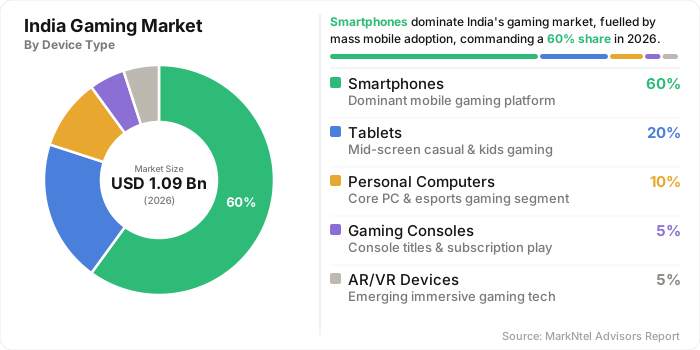
- By device type, the smartphones segment represented a significant share of about 60% in the India Gaming Market in 2026.
- By revenue model, the in-app purchases segment represented a significant share of about 63% in the India Gaming Market in 2026.
Market Insights & Analysis: India Gaming Market (2026-32):
The Indian gaming market size was valued at approximately USD 0.91 billion in 2025 and is projected to grow from USD 1.09 billion in 2026 to USD 2.17 billion by 2032. Along with this, the market is estimated to grow at a CAGR of around 12.16% during the forecast period, i.e., 2026-32.
The India gaming market is poised for robust growth, driven by a combination of technological adoption, digital infrastructure, and strategic long-term investments. One of the primary growth drivers is the rapid expansion of digital payments, which has enabled seamless in-app purchases, subscriptions, and microtransactions across mobile and online gaming platforms. The Unified Payments Interface (UPI), operated by the National Payments Corporation of India, has emerged as the country’s dominant real-time payment system, processing 131 billion transactions in FY2023-24. Northern states such as Uttar Pradesh and Delhi report high UPI adoption, supported by strong smartphone penetration and integration with fintech platforms. This widespread use of real-time payments allows gaming users to engage easily in micro-transactions, supporting monetization strategies for developers and enhancing user engagement.
A key trend shaping the market is the integration of artificial intelligence (AI) in game design, which enhances player experiences, optimizes gameplay, and enables personalized content recommendations. As reported in June 2025 by Outlook Business, Indian gaming studios increasingly leverage AI for content production, storyline generation, and gameplay personalization. Leaders such as Nazara Technologies have highlighted that AI can reduce development costs by 20–30% while improving design efficiency, monetization opportunities, and competitive positioning of Indian titles in global markets. This trend not only enhances player engagement but also accelerates development cycles and supports innovation.
Looking ahead, strategic investments and policy initiatives are expected to further propel market growth beyond 2025. The Game Developer Association of India (GDAI) introduced the “India Gaming Vision 2035”, a comprehensive roadmap aimed at transforming India into a global gaming powerhouse. The plan targets the creation of USD 100 billion in economic value and over 2 million jobs by 2035. Key focus areas include infrastructure development, skill enhancement programs, creation of global intellectual property, and fostering commercial partnerships to expand gaming exports. This initiative positions India to leverage both domestic and international growth opportunities in gaming, e-sports, and content creation.
Overall, the convergence of digital payments, AI-enabled game design, and strategic long-term investments establishes a strong growth trajectory for India’s gaming market. As infrastructure, talent, and technology adoption expand, the sector is expected to achieve sustained revenue growth, enhance global competitiveness, and create new avenues for employment and innovation across the country.
India Gaming Market Recent Developments:
- 2026: SYBO has announced Subway Surfers City, a new installment of its globally popular franchise, launched for iOS and Android. Building on over 4.5 billion downloads of the original game, the new title introduces updated characters, fresh locations, and enhanced gameplay features, with pre-registrations already open .
- 2025: Nazara Technologies launched “Bigg Boss: The Game,” a mobile title based on the popular TV franchise Bigg Boss. Developed with Banijay Rights, the game aims to monetize the show’s massive fan base and expand Nazara’s IP-driven gaming strategy in India’s growing mobile gaming ecosystem.
India Gaming Market Scope:
| Category | Segments |
|---|---|
| By Game Type | (Action, Adventure, Role-Playing Games (RPG), Sports Games, Strategy Games, Simulation Games, Puzzle Games, Others), |
| By Platform | (Online, Offline), |
| By Revenue Model | (Free-to-Play (F2P), Pay-to-Play (Premium Games), Subscription-Based Gaming, In-App Purchases, Advertising-Based Revenue), |
| By Device Type | (Smartphones, Tablets, Personal Computers, Gaming Consoles, Virtual Reality (VR) / Augmented Reality (AR) Devices), |
| By Age group | (Adult, Children), |
| By Distribution Channel | (Digital Distribution, Physical Retail, Online Gaming Platforms / App Stores), |
India Gaming Market Driver:
Expanding Digital Payments Ecosystem Driving Market Growth
The rapid development of India’s digital payments infrastructure has become a major factor supporting the growth of the gaming industry, particularly for mobile and online games that depend on micro-transactions and subscription-based revenue models. Government-supported platforms such as the Unified Payments Interface (UPI), developed by the National Payments Corporation of India under the regulatory framework of the Reserve Bank of India, have simplified secure and instant financial transactions for millions of users.
According to the Press Information Bureau, India recorded USD 237.53 million digital payment transactions in FY2024–25, with a total transaction value of approximately USD 10.2 trillion. UPI alone represented nearly 81% of total retail digital payment transactions, highlighting its central role in enabling digital commerce across sectors, including online entertainment and gaming .
The adoption of digital payments continued to accelerate during 2025. Data released by the National Payments Corporation of India shows that UPI processed more than 19 billion transactions in November 2025, with a total value of around USD 295 billion for that month . In addition, the report highlighted by India Brand Equity Foundation, citing research from the State Bank of India, the average daily UPI transaction value increased to approximately USD 10.3 billion, rising from USD 8.67 billion in January 2025, indicating the rapid growth and widespread adoption of digital payments across retail and online services in India.
Regionally, western India, particularly Maharashtra, has emerged as a strong digital transaction hub due to the presence of financial institutions and fintech companies. According to payment system statistics from the Reserve Bank of India, India recorded 208.5 billion digital payment transactions in 2024, with UPI accounting for approximately 83% of the total share, reflecting the dominance of mobile-based payments .
Looking ahead, the Indian government and financial regulators plan to expand UPI services to around 20 countries by FY2029, strengthening cross-border digital commerce and enabling international digital service payments.
The continued expansion of secure, low-cost digital payment systems is expected to support seamless in-game purchases and subscription payments. As digital transaction infrastructure strengthens both domestically and internationally, it will significantly enhance monetization opportunities and drive sustained growth in the gaming market.
India Gaming Market Trend:
Integration of Artificial Intelligence in Game Design
A significant trend shaping India’s gaming market is the integration of artificial intelligence (AI) in game development, which is transforming gameplay, content creation, and player engagement. In 2025, a Google Cloud survey conducted with The Harris Poll revealed that 87% of video-game developers worldwide use AI agents to automate repetitive tasks, streamline workflows, and focus more on creative aspects of game design. These AI agents assist in coding, testing, content generation, and optimization, highlighting the growing role of AI across the gaming development lifecycle.
In India, studios are increasingly leveraging AI to enhance both game mechanics and operational efficiency. For example, in its 2026 strategic update, nCore Games reported that the development of FAU‑G: Domination incorporates AI into critical gameplay elements, including matchmaking, live operations, competitive integrity, and player engagement systems. AI-driven analytics allow the studio to tailor gameplay dynamics based on player behavior, improve competitive balance, and support data-led decisions across its esports league ecosystem, enhancing the overall user experience in India’s mobile esports market.
The adoption of AI in Indian game development not only reduces production costs and development cycles but also strengthens monetization opportunities through personalized gameplay experiences. By integrating AI technologies, Indian studios can compete globally with improved design quality, operational efficiency, and engagement strategies.
AI integration is driving a paradigm shift in India’s gaming industry, enabling smarter, faster, and more engaging game development. As studios increasingly adopt AI-driven tools, this trend is set to enhance player experiences, accelerate innovation, and support the long-term growth of the mobile and esports gaming market.
India Gaming Market Opportunity:
Growth of Esports and Gaming Content Creation
One of the strongest opportunities in the India gaming market is the rapid growth of esports and gaming content creation, underpinned by notable government support and international competitive success. In 2024, India achieved historic milestones on the global esports stage by winning a silver medal in Tekken 8 at the BRICS Esports Championship and a bronze in eFootball at the Asian Esports Games, showcasing Indian competitive gaming’s rising standards. These achievements not only increased global visibility but also legitimized esports as a viable professional and entertainment domain.
Institutional backing has also expanded domestically. The Union Cabinet approved the creation of the National Centre of Excellence for AVGC‑XR in Mumbai, aimed at strengthening infrastructure and talent development in animation, visual effects, gaming, and extended reality—key areas that support both esports and content creation ecosystems. State governments such as Bihar and Meghalaya have introduced esports tournaments and sponsorship programs, reflecting grassroots growth and regional engagement.
Moreover, the integration of esports into mainstream sporting events and media coverage has increased audience reach and sponsorship interest. Broadcasters are televising esports competitions, while gaming influencers and streamers generate substantial viewership on platforms, further driving brand partnerships and advertising revenue opportunities.
The combination of international competitive success, formal government support, and expanding content creation platforms positions esports and gaming content as a high‑growth opportunity, enhancing monetization avenues and sustaining long‑term industry expansion.
India Gaming Market Challenge:
Regulatory Uncertainties Around Online Gaming
A significant challenge confronting India’s gaming market is regulatory uncertainty surrounding online gaming, particularly real-money gaming (RMG). The Promotion and Regulation of Online Gaming Act, 2025, enacted to establish a uniform framework, effectively prohibits real-money online games, encompassing both skill- and chance-based formats, as well as associated financial transactions and promotions.
Despite its passage, the Act’s formal implementation remains pending, leaving companies in legal and operational ambiguity. Major gaming platforms, including fantasy sports and cash-based game providers, have suspended real-money operations to mitigate potential liabilities.
The regulatory uncertainty has led to estimated losses exceeding USD 1.2 billion and disrupted employment for thousands of industry professionals . Ongoing legal disputes over the Act’s scope and the definition of “games of skill” further exacerbate the unpredictability, with state and national jurisdictions often presenting conflicting interpretations. Overall, this fragmented regulatory landscape restricts market expansion, complicates monetization strategies, and diminishes investor confidence. Establishing clear, consistent, and enforceable guidelines is essential to stabilizing India’s online gaming ecosystem and enabling sustainable growth.
India Gaming Market (2026-32) Segmentation Analysis:
The India Gaming Market study of MarkNtel Advisors evaluates & highlights the major trends and influencing factors in each segment. It includes predictions for the period 2026–32 at the country level. Based on the analysis, the market has been further classified as;
Based on Device Type:
- Smartphones
- Tablets
- Personal Computers
- Gaming Consoles
- Virtual Reality (VR) / Augmented Reality (AR) Devices
Smartphones represent the leading device segment in the India gaming market, accounting for around 60% of total gaming usage. The dominance of mobile devices is largely driven by India’s rapidly expanding smartphone penetration and affordable internet connectivity. According to industry data from organizations such as Telecom Regulatory Authority of India and Internet and Mobile Association of India, the country has hundreds of millions of smartphone users, creating a vast base of potential gamers.
Another major factor supporting mobile gaming growth is the accessibility of low-cost Android devices and budget data plans offered by telecom operators. This has enabled gaming to reach smaller cities and rural markets, where dedicated gaming hardware such as consoles or high-performance PCs remains relatively expensive. Mobile app ecosystems like Google Play and Apple App Store also simplify game distribution and updates, allowing developers to reach large audiences instantly.
Additionally, many popular Indian games are designed specifically for mobile gameplay, emphasizing short sessions, multiplayer features, and localized content. These factors collectively make smartphones the most accessible and widely used gaming devices across the country.
Based on Revenue Model:
- Free-to-Play (F2P)
- Pay-to-Play (Premium Games)
- Subscription-Based Gaming
- In-App Purchases
- Advertising-Based Revenue
In-App Purchases (IAP) represent the leading revenue model in the India gaming market, contributing approximately 63% of total gaming revenue. This model has become dominant because it allows players to access games for free while monetization occurs through optional purchases such as virtual currency, character upgrades, skins, power-ups, and additional levels.
The free-to-play ecosystem encourages large user adoption because players can start gaming without any upfront cost. Once engaged, a portion of players choose to spend money to enhance their gaming experience or gain competitive advantages. This approach has proven highly effective in mobile-first markets like India, where price sensitivity influences purchasing behavior.
Gaming companies leverage analytics and player behavior data to design targeted monetization strategies, including seasonal content, limited-time items, and premium upgrades. Payment infrastructure improvements through digital wallets and UPI systems further support micro-transactions within games. As a result, the in-game purchase model enables developers to generate recurring revenue while maintaining high user engagement and retention across gaming platforms.
India Gaming Market (2026-32): Regional Projection
The India gaming market is dominated by the South and West regions, particularly Tamil Nadu, Karnataka, Maharashtra, and Delhi-NCR. These regions lead due to high smartphone penetration, advanced internet infrastructure, and tech-savvy populations actively engaging in mobile, online, and esports gaming. Cities like Bengaluru, Chennai, and Mumbai host major gaming studios, fostering innovation in gaming apps, esports, and content creation.
For example, in March 2026, Rockstar Games launched a game tester recruitment drive in Bangalore, Karnataka, for Associate QA Tester roles. This initiative reflects growing investment in South India’s gaming talent and infrastructure, with responsibilities including gameplay testing and bug identification for upcoming titles like Grand Theft Auto VI .
Additionally, widespread adoption of digital payments like UPI enables seamless in-app purchases, subscriptions, and microtransactions, further supporting regional growth. The presence of professional esports leagues, gaming tournaments, and content creation hubs enhances user engagement and monetization opportunities. Higher disposable income and lifestyle awareness in metropolitan areas consolidate the dominance of South and West India in the national gaming ecosystem.
India Gaming Market Competitive Landscape
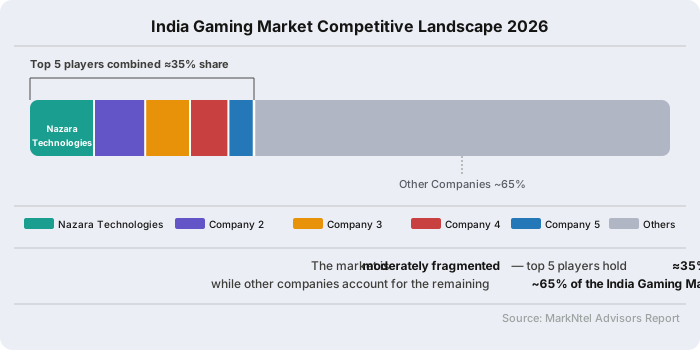
The market is highly fragmented, with the top five players accounting for approximately 35% of the total market share. Leading companies include Nazara Technologies, nCore Games, PlaySimple Games, Zupee, and WinZO.
Key Gaming Companies in India
- Nazara Technologies
- Juego Studios
- nCore Games
- Rockstar India
- 99Games
- PlaySimple Games
- Games2win
- Zupee
- WinZO
- Octro
- HashCube
- Highbrow Interactive
- Electronic Arts
- Sony Interactive Entertainment
- Others
Gain a Competitive Edge with Our India Gaming Market Report:
- India Gaming Market Report by MarkNtel Advisors provides a detailed & thorough analysis of market size & share, growth rate, competitive landscape, and key players. This comprehensive analysis helps businesses gain a holistic understanding of the market dynamics & make informed decisions.
- This report also highlights current market trends & future projections, allowing businesses to identify emerging opportunities & potential challenges. By understanding market forecasts, companies can align their strategies & stay ahead of the competition.
- India Gaming Market Report aids in assessing & mitigating risks associated with entering or operating in the market. By understanding market dynamics, regulatory frameworks, and potential challenges, businesses can develop strategies to minimize risks & optimize their operations.
*Reports Delivery Format - Market research studies from MarkNtel Advisors are offered in PDF, Excel and PowerPoint formats. Within 24 hours of the payment being successfully received, the report will be sent to your email address.
Frequently Asked Questions
- Market Segmentation
- Introduction
- Product Definition
- Research Process
- Assumptions
- Executive Summary
- India Gaming Market Policies, Regulations, and Product Standards
- India Gaming Market Supply Chain Analysis
- India Gaming Market Trends & Developments
- India Gaming Market Dynamics
- Growth Drivers
- Challenges
- India Gaming Market Hotspot & Opportunities
- India Gaming Market Outlook, 2022-2032
- Market Size & Outlook
- By Revenues (USD Million)
- Market Share & Outlook
- By Game Type- Market Size & Forecast 2022-2032F, USD Million
- Action
- Adventure
- Role-Playing Games (RPG)
- Sports Games
- Strategy Games
- Simulation Games
- Puzzle Games
- Others
- By Platform- Market Size & Forecast 2022-2032F, USD Million
- Online
- Offline
- By Revenue Model- Market Size & Forecast 2022-2032F, USD Million
- Free-to-Play (F2P)
- Pay-to-Play (Premium Games)
- Subscription-Based Gaming
- In-App Purchases
- Advertising-Based Revenue
- By Device Type- Market Size & Forecast 2022-2032F, USD Million
- Smartphones
- Tablets
- Personal Computers
- Gaming Consoles
- Virtual Reality (VR) / Augmented Reality (AR) Devices
- By Age group- Market Size & Forecast 2022-2032F, USD Million
- Adult
- Children
- By Distribution Channel- Market Size & Forecast 2022-2032F, USD Million
- Digital Distribution
- Physical Retail
- Online Gaming Platforms / App Stores
- By Region
- South
- West
- East
- North
- By Company
- Company Revenue Shares
- Competitor Characteristics
- By Game Type- Market Size & Forecast 2022-2032F, USD Million
- Market Size & Outlook
- India Action Gaming Market Outlook, 2022-2032
- Market Size & Analysis
- Market Share & Analysis
- By Platform- Market Size & Forecast 2022-2032, USD Million
- By Revenue Model- Market Size & Forecast 2022-2032, USD Million
- By Device Type- Market Size & Forecast 2022-2032, USD Million
- By Age group- Market Size & Forecast 2022-2032, USD Million
- By Distribution Channel- Market Size & Forecast 2022-2032, USD Million
- India Adventure Gaming Market Outlook, 2022-2032
- Market Size & Analysis
- Market Revenues (USD Million)
- Market Share & Analysis
- By Platform- Market Size & Forecast 2022-2032, USD Million
- By Revenue Model- Market Size & Forecast 2022-2032, USD Million
- By Device Type- Market Size & Forecast 2022-2032, USD Million
- By Age group- Market Size & Forecast 2022-2032, USD Million
- By Distribution Channel- Market Size & Forecast 2022-2032, USD Million
- Market Size & Analysis
- India Role-Playing Games (RPG) Market Outlook, 2022-2032
- Market Size & Analysis
- Market Revenues (USD Million)
- Market Share & Analysis
- By Platform- Market Size & Forecast 2022-2032, USD Million
- By Revenue Model- Market Size & Forecast 2022-2032, USD Million
- By Device Type- Market Size & Forecast 2022-2032, USD Million
- By Age group- Market Size & Forecast 2022-2032, USD Million
- By Distribution Channel- Market Size & Forecast 2022-2032, USD Million
- Market Size & Analysis
- India Sports Games Gaming Market Outlook, 2022-2032
- Market Size & Analysis
- Market Revenues (USD Million)
- Market Share & Analysis
- By Platform- Market Size & Forecast 2022-2032, USD Million
- By Revenue Model- Market Size & Forecast 2022-2032, USD Million
- By Device Type- Market Size & Forecast 2022-2032, USD Million
- By Age group- Market Size & Forecast 2022-2032, USD Million
- By Distribution Channel- Market Size & Forecast 2022-2032, USD Million
- Market Size & Analysis
- India Strategy Games Market Outlook, 2022-2032
- Market Size & Analysis
- Market Revenues (USD Million)
- Market Share & Analysis
- By Platform- Market Size & Forecast 2022-2032, USD Million
- By Revenue Model- Market Size & Forecast 2022-2032, USD Million
- By Device Type- Market Size & Forecast 2022-2032, USD Million
- By Age group- Market Size & Forecast 2022-2032, USD Million
- By Distribution Channel- Market Size & Forecast 2022-2032, USD Million
- Market Size & Analysis
- India Simulation Games Market Outlook, 2022-2032
- Market Size & Analysis
- Market Revenues (USD Million)
- Market Share & Analysis
- By Platform- Market Size & Forecast 2022-2032, USD Million
- By Revenue Model- Market Size & Forecast 2022-2032, USD Million
- By Device Type- Market Size & Forecast 2022-2032, USD Million
- By Age group- Market Size & Forecast 2022-2032, USD Million
- By Distribution Channel- Market Size & Forecast 2022-2032, USD Million
- Market Size & Analysis
- India Puzzle Games Market Outlook, 2022-2032
- Market Size & Analysis
- Market Revenues (USD Million)
- Market Share & Analysis
- By Platform- Market Size & Forecast 2022-2032, USD Million
- By Revenue Model- Market Size & Forecast 2022-2032, USD Million
- By Device Type- Market Size & Forecast 2022-2032, USD Million
- By Age group- Market Size & Forecast 2022-2032, USD Million
- By Distribution Channel- Market Size & Forecast 2022-2032, USD Million
- Market Size & Analysis
- India Gaming Market Key Strategic Imperatives for Success & Growth
- Competition Outlook
- Company Profiles
- Nazara Technologies
- Business Description
- Product Portfolio
- Strategic Alliances or Partnerships
- Recent Developments
- Financial Details
- Others
- Juego Studios
- Business Description
- Product Portfolio
- Strategic Alliances or Partnerships
- Recent Developments
- Financial Details
- Others
- nCore Games
- Business Description
- Product Portfolio
- Strategic Alliances or Partnerships
- Recent Developments
- Financial Details
- Others
- Rockstar India
- Business Description
- Product Portfolio
- Strategic Alliances or Partnerships
- Recent Developments
- Financial Details
- Others
- 99Games
- Business Description
- Product Portfolio
- Strategic Alliances or Partnerships
- Recent Developments
- Financial Details
- Others
- PlaySimple Games
- Business Description
- Product Portfolio
- Strategic Alliances or Partnerships
- Recent Developments
- Financial Details
- Others
- Games2win
- Business Description
- Product Portfolio
- Strategic Alliances or Partnerships
- Recent Developments
- Financial Details
- Others
- Zupee
- Business Description
- Product Portfolio
- Strategic Alliances or Partnerships
- Recent Developments
- Financial Details
- Others
- WinZO
- Business Description
- Product Portfolio
- Strategic Alliances or Partnerships
- Recent Developments
- Financial Details
- Others
- Octro
- Business Description
- Product Portfolio
- Strategic Alliances or Partnerships
- Recent Developments
- Financial Details
- Others
- HashCube
- Business Description
- Product Portfolio
- Strategic Alliances or Partnerships
- Recent Developments
- Financial Details
- Others
- Highbrow Interactive
- Business Description
- Product Portfolio
- Strategic Alliances or Partnerships
- Recent Developments
- Financial Details
- Others
- Electronic Arts Games
- Business Description
- Product Portfolio
- Strategic Alliances or Partnerships
- Recent Developments
- Financial Details
- Others
- Sony Interactive Entertainment
- Business Description
- Product Portfolio
- Strategic Alliances or Partnerships
- Recent Developments
- Financial Details
- Others
- Others
- Nazara Technologies
- Company Profiles
- Disclaimer
MarkNtel Advisors follows a robust and iterative research methodology designed to ensure maximum accuracy and minimize deviation in market estimates and forecasts. Our approach combines both bottom-up and top-down techniques to effectively segment and quantify various aspects of the market. A consistent feature across all our research reports is data triangulation, which examines the market from three distinct perspectives to validate findings. Key components of our research process include:
1. Scope & Research Design At the outset, MarkNtel Advisors define the research objectives and formulate pertinent questions. This phase involves determining the type of research—qualitative or quantitative—and designing a methodology that outlines data collection methods, target demographics, and analytical tools. They also establish timelines and budgets to ensure the research aligns with client goals.
2. Sample Selection and Data Collection In this stage, the firm identifies the target audience and determines the appropriate sample size to ensure representativeness. They employ various sampling methods, such as random or stratified sampling, based on the research objectives. Data collection is carried out using tools like surveys, interviews, and observations, ensuring the gathered data is reliable and relevant.
3. Data Analysis and Validation Once data is collected, MarkNtel Advisors undertake a rigorous analysis process. This includes cleaning the data to remove inconsistencies, employing statistical software for quantitative analysis, and thematic analysis for qualitative data. Validation steps are taken to ensure the accuracy and reliability of the findings, minimizing biases and errors.

4. Data Forecast and FinalizationThe final phase involves forecasting future market trends based on the analyzed data. MarkNtel Advisors utilize predictive modeling and time series analysis to anticipate market behaviors. The insights are then compiled into comprehensive reports, featuring visual aids like charts and graphs, and include strategic recommendations to inform client decision-making
We offer flexible licensing options to cater to varying organizational needs. Choose the pricing pack that best suits your requirements:
Buy Now Inquire Before Buying
 Request Customization
 Talk to our Consultant







