

India City Gas Distribution (CGD) Market Research Report: Size, Share, Trends & Forecast (2026-2032)
By Distribution Type (Compressed Natural Gas (CNG), Piped Natural Gas (PNG)), By Infrastructure (Pipeline Network, CNG Station Infrastructure, Metering & Pressure Regulation System ... s), By Source (Domestic Gas (APM Gas), Regasified LNG (RLNG / Imported LNG)), By End-User (Households, Commercial, Industrial, Automotive Sector), and others Read more
- Energy
- Apr 2026
- Pages 160
- Report Format: PDF, Excel, PPT
India City Gas Distribution (CGD) Market
Projected 12.67% CAGR from 2026 to 2032
Study Period
2026-2032
Market Size (2026)
USD 12.78 Billion
Market Size (2032)
USD 26.14 Billion
Base Year
2025
Projected CAGR
12.67%
Leading Segments
By Distribution Type: Compressed Natural Gas (CNG)
India City Gas Distribution (CGD) Market Report Key Takeaways:
- The India City Gas Distribution (CGD) market size was valued at USD 11.34 billion in 2025 and is projected to grow from USD 12.78 billion in 2026 to USD 26.14 billion by 2032, exhibiting a CAGR of 12.67% during the forecast period.
- North India holds the largest market share of about 40% in the UAE Green Building Material Market in 2026.
- By distribution type, the compressed natural gas (CNG) segment represented a significant share of about 55% in the India City Gas Distribution (CGD) Market in 2026.
- By infrastructure, the pipeline network segment presented a significant share of about 70% in the India City Gas Distribution (CGD) Market in 2026.
Market Insights & Analysis: India City Gas Distribution (CGD) Market (2026-32):
The India City Gas Distribution (CGD) Market size was valued at around USD 11.34 billion in 2025 and is projected to grow from USD 12.78 billion in 2026 to USD 26.14 billion by 2032. Along with this, the market is estimated to grow at a CAGR of around 12.67% during the forecast period, i.e., 2026-32.
The India City Gas Distribution (CGD) Market is projected to expand steadily, driven by strategic government initiatives promoting a gas-based economy and the accelerated adoption of digitalization and smart metering, enhancing operational efficiency, transparency, and consumer engagement across the network.
The Government of India has set a clear objective to increase the share of natural gas in the country’s energy mix from approximately 6% in 2023 to 15% by 2030, creating sustained long-term demand for CGD infrastructure and services.
Significant capital investments are reinforcing this transition. For instance, in 2024, India announced investments of nearly USD 4.95 billion to expand its natural gas pipeline network across northern and northeastern regions, targeting improved connectivity to underserved states and industrial clusters. This expansion is complemented by rapid growth in downstream infrastructure.
The number of CNG stations has surged to over 7,000 by mid-2024, compared to around 1,349, while PNG connections have exceeded 13.3 million, reflecting a threefold increase over the same period.
The scale of network penetration is also expanding rapidly. The CGD network now covers 784 districts across 34 states and union territories, indicating near pan-India reach . State-level initiatives further strengthen this outlook; for instance, infrastructure development in Uttar Pradesh has enabled over 23.9 million PNG connections , while cities such as Kolkata are targeting approximately 500,000 households and around 90 CNG stations, demonstrating aggressive localized expansion strategies.
Digitalization is emerging as a parallel growth catalyst. The adoption of smart metering and digital monitoring systems has improved operational efficiency and reduced losses. Government data indicates that Aggregate Technical & Commercial (AT&C) losses declined from 21.91% to 15.04% in 2025, highlighting the impact of technology-driven reforms.
Additionally, the national push to deploy nearly 250 million smart prepaid meters by 2026 signals a structural shift toward real-time consumption tracking and efficient billing systems, which will further support CGD network optimization .
Looking ahead, ambitious future targets are set to accelerate growth beyond 2025. The government plans to scale up to approximately 126 million PNG connections and 18,336 CNG stations by 2034, significantly expanding the consumer base.
Simultaneously, sustainability initiatives such as the Compressed Biogas (CBG) blending mandate starting at 1% in 2025–26 and increasing to 5% by 2028–29 are expected to enhance supply security while promoting cleaner energy adoption.
Strong policy backing, large-scale infrastructure investments, and digital transformation are positioning the CGD market for sustained expansion. These combined efforts will significantly enhance accessibility, efficiency, and demand, driving long-term growth across India’s gas distribution ecosystem.
India City Gas Distribution (CGD) Market Recent Developments:
- 2026: GAIL (India) Limited is awaiting final regulatory approval to operationalize its 317 km Nagpur–Jabalpur natural gas pipeline, a key segment of the national gas grid. Once commissioned, the pipeline will strengthen connectivity between central and eastern India, enabling seamless gas supply across regions.
- 2025: Amid LPG supply disruptions, demand for piped natural gas (PNG) is rising across Jharkhand, particularly in cities like Ranchi and Jamshedpur. Expanding pipeline infrastructure over 750 km laid and growing awareness are driving adoption among households and businesses, positioning PNG as a reliable and cost-effective alternative.
India City Gas Distribution (CGD) Market Scope:
| Category | Segments |
|---|---|
| By Distribution Type | (Compressed Natural Gas (CNG), Piped Natural Gas (PNG)), |
| By Infrastructure | (Pipeline Network, CNG Station Infrastructure, Metering & Pressure Regulation Systems), |
| By Source | (Domestic Gas (APM Gas), Regasified LNG (RLNG / Imported LNG)), |
| By End-User | (Households, Commercial, Industrial, Automotive Sector), |
India City Gas Distribution (CGD) Market Driver:
Strategic Government Initiatives for Gas-Based Economy Transition
The rapid expansion of India’s City Gas Distribution (CGD) network is being strongly driven by proactive regulatory initiatives led by the Petroleum and Natural Gas Regulatory Board (PNGRB). Through multiple competitive bidding rounds, PNGRB has significantly widened the scope of CGD infrastructure, authorizing 307 geographical areas (GAs) for development. This expansion now covers nearly 100% of India’s population and landmass, ensuring widespread access to natural gas across urban and semi-urban regions.
This regulatory push has translated into tangible infrastructure growth. As of September 2024, India has surpassed 13.6 million PNG household connections and established 7,259 CNG stations, reflecting accelerated last-mile connectivity and rising adoption of cleaner fuels. The continuous expansion of CGD networks is enabling broader accessibility for residential, commercial, and transport segments, thereby strengthening the overall gas ecosystem.
Moreover, the structured bidding framework adopted by PNGRB has encouraged private and public sector participation, enhancing competition and driving investments in pipeline infrastructure, distribution networks, and fueling stations. This has not only improved service reach but also increased efficiency and scalability across regions.
The large-scale authorization of geographical areas and rapid infrastructure rollout are key enablers of CGD market growth. This regulatory-driven expansion is expected to accelerate gas adoption and significantly strengthen India’s transition toward a gas-based economy.
India City Gas Distribution (CGD) Market Trend:
Digitalization & Smart Metering Changing Market Dynamics
India’s broader transition toward digital utility infrastructure is significantly accelerating the adoption of smart metering, emerging as a key trend in the City Gas Distribution (CGD) market. Government-backed programs aimed at modernizing energy monitoring systems are driving large-scale deployment of smart meters, enabling real-time consumption tracking, improved billing accuracy, and enhanced operational efficiency across utilities.
As of December 2025, over 52.8 million smart meters have already been installed across India, reflecting rapid progress in digital infrastructure rollout. This large-scale deployment demonstrates the government’s strong commitment to transforming conventional energy systems into data-driven, technology-enabled networks. The integration of such digital solutions is particularly relevant for CGD operators, as it allows better demand forecasting, leak detection, and consumer management.
The future pipeline further reinforces this trend. Approximately 197.9 million smart meters have been sanctioned under various government schemes, covering not only consumers but also distribution transformers and feeders. This indicates a substantial expansion of digital monitoring capabilities in the coming years, which will indirectly support CGD network optimization and scalability.
The rapid deployment and large sanctioned base of smart meters highlight a structural shift toward digital energy management. This trend will enhance efficiency, transparency, and consumer engagement, thereby accelerating the long-term growth of the CGD market.
India City Gas Distribution (CGD) Market Opportunity:
Rising Gas Demand Across Multiple Sectors
India’s increasing natural gas consumption across diverse sectors presents a strong growth opportunity for the City Gas Distribution (CGD) market. The country’s total natural gas demand reached approximately 189 million metric standard cubic meters per day (MMSCMD) in 2025, highlighting a steady rise in consumption across industries, transport, and residential segments. This growing demand base creates a favorable environment for expanding CGD infrastructure and last-mile connectivity.
Sector-wise dynamics further reinforce this opportunity. Data from the Petroleum Planning and Analysis Cell shows that the fertilizer sector accounted for nearly 32% of total gas consumption in 2024, making it the largest consumer, followed by CGD, power generation, and industrial applications. This diversified consumption pattern ensures consistent and multi-sector demand, reducing dependency on any single segment.
Additionally, consumption momentum is accelerating. India’s natural gas usage grew by approximately 11% in 2024, driven by increased demand in refining, petrochemicals, CNG-based transportation, and rising adoption of PNG in households. This growth reflects a structural shift toward cleaner fuels and expanding energy needs across urban and industrial ecosystems.
The steady rise in gas demand across key sectors creates a strong foundation for CGD expansion. As consumption continues to diversify and grow, CGD networks will play a critical role in meeting this demand, driving sustained market growth in the coming years.
India City Gas Distribution (CGD) Market Challenge:
Dependence on Imported Gas and Price Volatility
India’s City Gas Distribution (CGD) market is increasingly constrained by its heavy reliance on imported natural gas, which exposes the sector to global supply disruptions and price volatility. As domestic gas production remains relatively stagnant, rising demand from industries, transport, and households is being met through higher imports. This structural imbalance is intensifying over time.
According to the Petroleum Planning & Analysis Cell (PPAC), nearly 50% of India’s total natural gas consumption is fulfilled through imports, underscoring the country’s dependence on external energy sources. This reliance has grown further, with India importing over 30.9 billion cubic meters of LNG in FY2024, marking a 17.5% year-on-year increase. The surge reflects the widening demand-supply gap in the domestic market.
Such dependence creates significant exposure to international market fluctuations, where geopolitical tensions and supply constraints can lead to unpredictable price spikes. For CGD operators, this results in higher procurement costs and pricing challenges, particularly in cost-sensitive segments like CNG and PNG.
Rising dependence on imported gas increases vulnerability to global volatility and supply risks. This can limit pricing stability and slow consumer adoption, ultimately hindering the sustained growth of India’s CGD market.
India City Gas Distribution (CGD) Market (2026-32) Segmentation Analysis:
The India City Gas Distribution (CGD) Market study of MarkNtel Advisors evaluates & highlights the major trends and influencing factors in each segment. It includes predictions for the period 2026–32 at the country level. Based on the analysis, the market has been further classified as;
Based on Distribution Type:
- Compressed Natural Gas (CNG)
- Piped Natural Gas (PNG)
The compressed natural gas (CNG) segment dominates the India City Gas Distribution (CGD) market, accounting for approximately 55% of market size, primarily supported by its extensive utilization in the transportation sector and strong regulatory backing for cleaner mobility solutions.
The segment has gained significant traction due to its cost advantage over conventional fuels and its lower carbon emissions profile, making it a preferred choice for public transport systems, commercial fleets, and urban commuters.
Infrastructure expansion has been a critical enabler of this dominance. Government-led initiatives have accelerated the rollout of CNG refueling stations across the country, resulting in the commissioning of over 8,067 stations by 2025, significantly exceeding the initial target of approximately 4,877 stations . This substantial increase has enhanced fuel accessibility and reduced range constraints, thereby encouraging higher adoption rates. The National Capital Region (NCR), in particular, has emerged as a key growth hub, driven by stringent emission regulations and large-scale conversion of public transport fleets to CNG.
Furthermore, rising petrol and diesel prices, coupled with growing environmental concerns, continue to influence consumer preference toward CNG as a more economical and sustainable alternative. The segment’s alignment with national decarbonization objectives and ongoing infrastructure development ensures its continued leadership within the CGD market.
Based on Infrastructure:
- Pipeline Network
- Steel Pipelines
- MDPE Pipelines
- CNG Station Infrastructure
- Mother Stations
- Daughter Stations
- Metering & Pressure Regulation Systems
The pipeline network segment dominates the India City Gas Distribution (CGD) market, accounting for about 70% of total market size, serving as the foundational backbone for gas transmission and distribution.
The deployment of steel pipelines for trunk connectivity and MDPE pipelines for last-mile delivery enables seamless and continuous supply of natural gas across residential, commercial, and industrial segments.
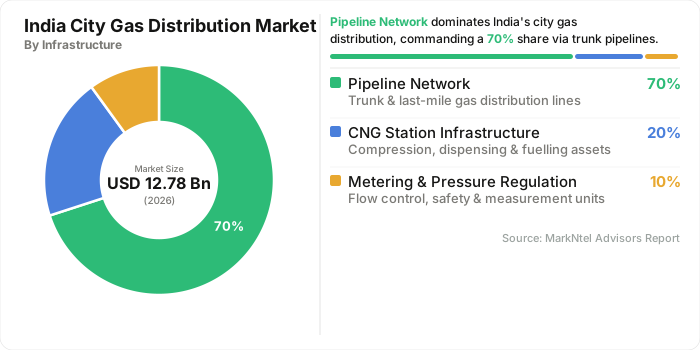
This segment’s leadership is driven by its indispensable role in ensuring network scalability, reliability, and operational efficiency. Unlike CNG station infrastructure, which caters primarily to the mobility segment, pipeline networks facilitate uninterrupted gas flow to a broader consumer base, making them central to the expansion of PNG connections and overall CGD penetration. Additionally, pipeline infrastructure supports long-term cost optimization and system integration, further reinforcing its strategic importance.
Ongoing regional developments underscore this dominance. For instance, in Kolkata and its surrounding districts, the planned addition of 25,000 new PNG household connections by 2025 is directly dependent on pipeline network expansion.
India City Gas Distribution (CGD) Market (2026-32): Regional Projection
North India dominates the India City Gas Distribution (CGD) market with an estimated 40% share, supported by well-established infrastructure, high urban concentration, and strong policy enforcement favoring cleaner energy adoption. The region has witnessed early and extensive deployment of CGD networks, enabling widespread access to both CNG and PNG across transportation, residential, and industrial applications.
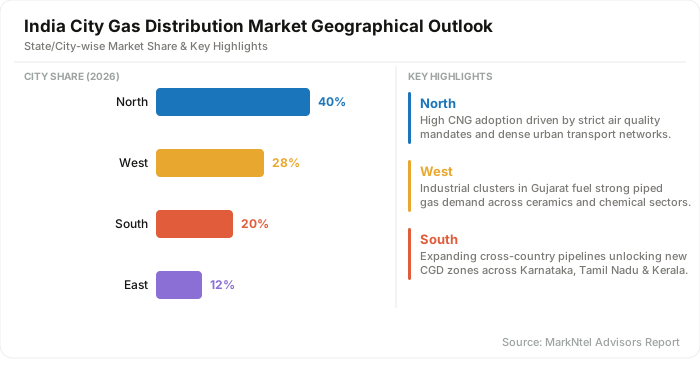
A major factor underpinning this leadership is the scale of infrastructure in Uttar Pradesh, which stands as the largest contributor at the state level. As of 2025, the state hosts approximately 1,130 CNG stations, the highest in the country, demonstrating significant network depth and accessibility. This extensive infrastructure base has facilitated accelerated adoption of CNG in public transport and commercial vehicle fleets, while also supporting the expansion of piped gas connections across urban and semi-urban households.
Furthermore, the presence of key metropolitan clusters such as the National Capital Region (NCR) reinforces regional demand, driven by stringent environmental regulations and a strong shift toward low-emission fuels. Continuous expansion of pipeline networks and CGD coverage across northern states further strengthens the region’s leadership position.
Collectively, the combination of advanced infrastructure, regulatory support, and high consumption demand firmly establishes North India as the dominant region in the India City Gas Distribution (CGD) market.
India City Gas Distribution (CGD) Market Competitive Analysis:
The India City Gas Distribution (CGD) market is moderately consolidated, with multiple public and private players operating across authorized geographical areas. The top five companies Indraprastha Gas Limited (IGL), Mahanagar Gas Limited (MGL), GAIL Gas Limited, Gujarat Gas Limited (GGL), and IndianOil-Adani Gas Private Limited (IOAGPL) collectively account for approximately 60% of the total market share.
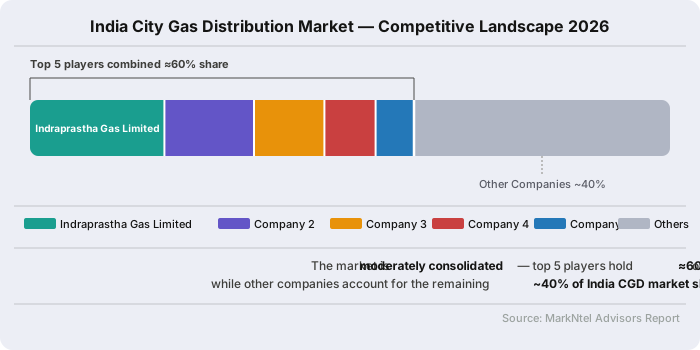
Indraprastha Gas Limited (IGL) leads in the Delhi-NCR region, while Mahanagar Gas Limited (MGL) holds a strong position in Mumbai and adjoining areas. Gujarat Gas Limited dominates in Gujarat, and GAIL Gas has a widespread presence across multiple regions. IOAGPL is expanding rapidly across newly awarded geographical areas, strengthening its national footprint.
Major Companies in City Gas Distribution (CGD):
- Indraprastha Gas Limited (IGL)
- Mahanagar Gas Limited (MGL)
- Gujarat Gas Limited (GGL)
- Adani Total Gas Limited (ATGL)
- IndianOil-Adani Gas Private Limited (IOAGPL)
- Bharat Gas Resources Limited (Subsidiary of BPCL)
- GAIL Gas Limited
- Torrent Gas Limited
- Megha City Gas Distribution Private Limited (Megha Gas)
- AG&P Pratham
Gain a Competitive Edge with Our India City Gas Distribution (CGD) Market Report:
- India City Gas Distribution (CGD) Market Report by MarkNtel Advisors provides a detailed & thorough analysis of market size & share, growth rate, competitive landscape, and key players. This comprehensive analysis helps businesses gain a holistic understanding of the market dynamics & make informed decisions.
- This report also highlights current market trends & future projections, allowing businesses to identify emerging opportunities & potential challenges. By understanding market forecasts, companies can align their strategies & stay ahead of the competition.
- India City Gas Distribution (CGD) Market Report aids in assessing & mitigating risks associated with entering or operating in the market. By understanding market dynamics, regulatory frameworks, and potential challenges, businesses can develop strategies to minimize risks & optimize their operations.
*Reports Delivery Format - Market research studies from MarkNtel Advisors are offered in PDF, Excel and PowerPoint formats. Within 24 hours of the payment being successfully received, the report will be sent to your email address.
Frequently Asked Questions
- Market Segmentation
- Introduction
- Product Definition
- Research Process
- Assumptions
- Executive Summary
- India City Gas Distribution (CGD) Market Policies, Regulations, and Product Standards
- India City Gas Distribution (CGD) Market Trends & Developments
- India City Gas Distribution (CGD) Market Dynamics
- Growth Factors
- Challenges
- India City Gas Distribution (CGD) Market Hotspot & Opportunities
- India City Gas Distribution (CGD) Market Structure and Value Chain
- Value Chain Overview
- Gas Supply (Domestic + LNG Imports)
- Transmission (National Gas Grid)
- Distribution (City-Level CGD Networks)
- Role of Geographical Areas (GAs)
- GA as the Core Economic Unit
- Exclusivity and Market Control
- GA-Level Demand and Revenue Pools
- Value Chain Overview
- India City Gas Distribution (CGD) By States, 2026
- State-Wise CGD Penetration
- Leading States (Gujarat, Maharashtra, Uttar Pradesh, Haryana)
- Emerging Markets (Rajasthan, Madhya Pradesh, Punjab, South India)
- Low Penetration Regions (Eastern and North-East India)
- Drivers of Regional Disparity
- Pipeline Connectivity and LNG Terminal Proximity
- Industrial Cluster Presence
- Urban Density and Vehicle Base
- State-Level Demand Contribution
- Share of CNG Consumption by State
- PNG Household Penetration by Region
- Industrial Gas Demand Clusters
- GA-Level Expansion Trends
- Coverage Across ~300+ GAs
- Population vs Geographic Coverage
- Tier-1 vs Tier-2/3 Expansion Economics
- State-Wise CGD Penetration
- India City Gas Distribution (CGD) Market Regulatory and Policy Framework
- PNGRB Authorization and Bidding
- GA Allocation Rounds and Expansion
- Minimum Work Programme (MWP) Obligations
- Tariff and Network Exclusivity
- Gas Allocation and Pricing Policy
- Priority Allocation to CNG and PNG-D
- Transition from APM to LNG-linked Supply
- Policy Impact on Regional Profitability
- State-Level Policy Influence
- Local Government Support and Approvals
- Variability in Execution Ease Across States
- PNGRB Authorization and Bidding
- India City Gas Distribution (CGD) Market Infrastructure and Network Economics
- Pipeline Connectivity and Regional Access
- National Gas Grid Coverage
- States with Strong vs Weak Connectivity
- Impact on CGD Viability
- Network Build-Out Economics
- Pipeline Density vs Cost Efficiency
- Urban vs Semi-Urban Rollout Costs
- CNG Station Density by Region
- Execution Risks by Geography
- Right-of-Way (RoW) Challenges
- Delays in Pipeline Connectivity
- State-Level Administrative Frictio
- Pipeline Connectivity and Regional Access
- India City Gas Distribution (CGD) Market Business Model and Unit Economics
- Segment Economics
- CNG – High Margin, High Utilization
- PNG-D – Low Margin, High Stability
- PNG-I/C – Volume Driven, Margin Constrained
- Regional Variability in Economics
- High-Density Urban Markets vs Low-Density Regions
- Industrial vs Residential Demand Mix
- Impact of Gas Sourcing Costs
- Pricing and Competitive Benchmarking
- Comparison with LPG, Diesel, Fuel Oil
- Regional Price Sensitivity
- Segment Economics
- India City Gas Distribution (CGD) Market Key Risks
- Input Cost Risk
- LNG Price Exposure
- Declining APM Allocation
- Demand Risk
- Industrial Switching Behavior
- Regional Demand Volatility
- Regulatory Risk
- Policy Changes
- State-Level Implementation Variability
- Execution Risk
- Infrastructure Delays
- MWP Compliance
- Energy Transition Risk
- EV Adoption (Urban Markets Impact)
- Electrification Trends
- Input Cost Risk
- India City Gas Distribution (CGD) Market Outlook, 2022-2032F
- Market Size & Outlook
- By Revenues (USD Million)
- Market Share & Outlook
- By Distribution Type- Market Size & Forecast 2022-2032, USD Million
- Compressed Natural Gas (CNG)
- Piped Natural Gas (PNG)
- By Infrastructure- Market Size & Forecast 2022-2032, USD Million
- Pipeline Network
- Steel Pipelines
- MDPE Pipelines
- CNG Station Infrastructure
- Mother Stations
- Daughter Stations
- Metering & Pressure Regulation Systems
- Pipeline Network
- By Source- Market Size & Forecast 2022-2032, USD Million
- Domestic Gas (APM Gas)
- Regasified LNG (RLNG / Imported LNG)
- By End-User- Market Size & Forecast 2022-2032, USD Million
- Households
- Commercial
- Industrial
- Automotive Sector
- By Region- Market Size & Forecast 2022-2032, USD Million
- North
- Uttar Pradesh
- Punjab
- Haryana
- Delhi NCR
- Others
- East
- West Bengal
- Bihar
- Jharkhand
- North Eastern States
- Chhattisgarh
- Others
- West
- Rajasthan
- Gujarat
- Maharashtra
- Madhya Pradesh
- Others
- South
- Tamil Nadu
- Karnataka
- Kerala
- Andhra
- Telangana
- Others
- North
- By Company
- Competition Characteristics
- Market Share & Analysis
- By Distribution Type- Market Size & Forecast 2022-2032, USD Million
- Market Size & Outlook
- India Compressed Natural Gas (CNG) Market Outlook, 2022-2032
- Market Size & Outlook
- By Revenues (USD Million)
- Market Share & Outlook
- By Infrastructure- Market Size & Forecast 2022-2032, USD Million
- By Source- Market Size & Forecast 2022-2032, USD Million
- By End-User- Market Size & Forecast 2022-2032, USD Million
- By Region- Market Size & Forecast 2022-2032, USD Million
- Market Size & Outlook
- India Piped Natural Gas (PNG) Market Outlook, 2022-2032
- Market Size & Outlook
- By Revenues (USD Million)
- Market Share & Outlook
- By Infrastructure- Market Size & Forecast 2022-2032, USD Million
- By Source- Market Size & Forecast 2022-2032, USD Million
- By End-User- Market Size & Forecast 2022-2032, USD Million
- By Region- Market Size & Forecast 2022-2032, USD Million
- Market Size & Outlook
- India City Gas Distribution (CGD) Market Key Strategic Imperatives for Success & Growth
- Competitive Outlook
- Company Profiles
- Indraprastha Gas Limited (IGL)
- Business Description
- Product Portfolio
- Collaborations & Alliances
- Recent Developments
- Financial Details
- Others
- Mahanagar Gas Limited (MGL)
- Business Description
- Product Portfolio
- Collaborations & Alliances
- Recent Developments
- Financial Details
- Others
- Gujarat Gas Limited (GGL)
- Business Description
- Product Portfolio
- Collaborations & Alliances
- Recent Developments
- Financial Details
- Others
- Adani Total Gas Limited (ATGL)
- Business Description
- Product Portfolio
- Collaborations & Alliances
- Recent Developments
- Financial Details
- Others
- IndianOil-Adani Gas Private Limited (IOAGPL)
- Business Description
- Product Portfolio
- Collaborations & Alliances
- Recent Developments
- Financial Details
- Others
- Bharat Gas Resources Limited (Subsidiary of BPCL)
- Business Description
- Product Portfolio
- Collaborations & Alliances
- Recent Developments
- Financial Details
- Others
- GAIL Gas Limited
- Business Description
- Product Portfolio
- Collaborations & Alliances
- Recent Developments
- Financial Details
- Others
- Torrent Gas Limited
- Business Description
- Product Portfolio
- Collaborations & Alliances
- Recent Developments
- Financial Details
- Others
- Megha City Gas Distribution Private Limited (Megha Gas)
- Business Description
- Product Portfolio
- Collaborations & Alliances
- Recent Developments
- Financial Details
- Others
- AG&P Pratham
- Business Description
- Product Portfolio
- Collaborations & Alliances
- Recent Developments
- Financial Details
- Others
- Indraprastha Gas Limited (IGL)
- Company Profiles
- Disclaimer
MarkNtel Advisors follows a robust and iterative research methodology designed to ensure maximum accuracy and minimize deviation in market estimates and forecasts. Our approach combines both bottom-up and top-down techniques to effectively segment and quantify various aspects of the market. A consistent feature across all our research reports is data triangulation, which examines the market from three distinct perspectives to validate findings. Key components of our research process include:
1. Scope & Research Design At the outset, MarkNtel Advisors define the research objectives and formulate pertinent questions. This phase involves determining the type of research—qualitative or quantitative—and designing a methodology that outlines data collection methods, target demographics, and analytical tools. They also establish timelines and budgets to ensure the research aligns with client goals.
2. Sample Selection and Data Collection In this stage, the firm identifies the target audience and determines the appropriate sample size to ensure representativeness. They employ various sampling methods, such as random or stratified sampling, based on the research objectives. Data collection is carried out using tools like surveys, interviews, and observations, ensuring the gathered data is reliable and relevant.
3. Data Analysis and Validation Once data is collected, MarkNtel Advisors undertake a rigorous analysis process. This includes cleaning the data to remove inconsistencies, employing statistical software for quantitative analysis, and thematic analysis for qualitative data. Validation steps are taken to ensure the accuracy and reliability of the findings, minimizing biases and errors.

4. Data Forecast and FinalizationThe final phase involves forecasting future market trends based on the analyzed data. MarkNtel Advisors utilize predictive modeling and time series analysis to anticipate market behaviors. The insights are then compiled into comprehensive reports, featuring visual aids like charts and graphs, and include strategic recommendations to inform client decision-making
We offer flexible licensing options to cater to varying organizational needs. Choose the pricing pack that best suits your requirements:
Buy Now Inquire Before Buying
 Request Customization
 Talk to our Consultant







