

India Agricultural Biotechnology Market Research Report: Growth Drivers & Forecast (2026-2032)
By Technique (Genetic Engineering, Molecular Breeding, Molecular Diagnostics, Tissue Culture), By Crop Type (Cereals & Grains, Oilseeds & Pulses, Fruits & Vegetables, Others), By F ... unction (Yield Enhancement, Pest & Disease Resistance, Yield Enhancement, Drought & Stress Tolerance, Nutritional Enhancement, Others), By End-User (Farmers, Research Institutes & Universities, Biotechnology Companies, Agrochemical & Seed Companies, Government Organizations, Others), and others Read more
- Environment
- Mar 2026
- Pages 120
- Report Format: PDF, Excel, PPT
India Agricultural Biotechnology Market
Projected 9.72% CAGR from 2026 to 2032
Study Period
2026-2032
Market Size (2026)
USD 4.5 Billion
Market Size (2032)
USD 7.85 Billion
Base Year
2025
Projected CAGR
9.72%
Leading Segments
By Crop Type: Cereals & Grains
India Agricultural Biotechnology Market Report Key Takeaways:
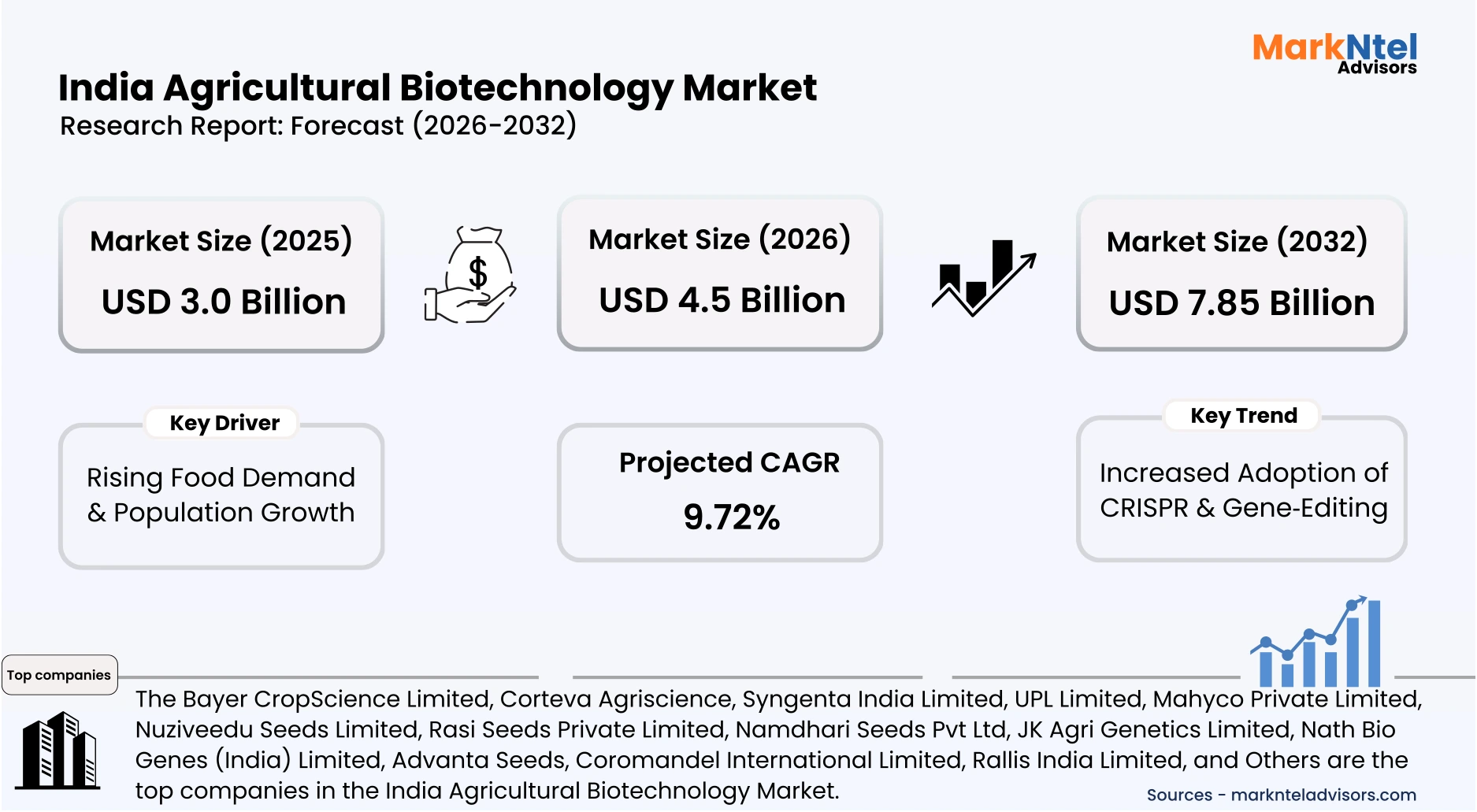
- The India Agricultural Biotechnology market size was valued at around USD 3.0 billion in 2025 and is projected to grow from USD 4.5 billion in 2026 to USD 7.85 billion by 2032, exhibiting a CAGR of 9.72% during the forecast period.
- The North region holds the largest market share of about 34% in the India Agricultural Biotechnology Market in 2026.
- By technique, the genetic engineering segment represented a significant share of about 33% in the India Agricultural Biotechnology Market in 2026.
- By crop type, the cereals & grains segment presented a significant share of about 41% in the India Agricultural Biotechnology Market in 2026.
- Leading agricultural biotechnology companies in the India Market are Bayer CropScience Limited, Corteva Agriscience, Syngenta India Limited, UPL Limited, Mahyco Private Limited, Nuziveedu Seeds Limited, Rasi Seeds Private Limited, Namdhari Seeds Pvt Ltd, JK Agri Genetics Limited, Nath Bio Genes (India) Limited, Advanta Seeds, Coromandel International Limited, Rallis India Limited, and Others.
Market Insights & Analysis: India Agricultural Biotechnology Market (2026-32):
The India Agricultural Biotechnology market size was valued at around USD 3.0 billion in 2025 and is projected to grow from USD 4.5 billion in 2026 to USD 7.85 billion by 2032. Along with this, the market is estimated to grow at a CAGR of around 9.72% during the forecast period, i.e., 2026-32.
The India Agricultural Biotechnology Market is poised for significant growth, driven primarily by rising food demand and population growth. Government projections, including NITI Aayog analyses, estimate India’s population will exceed 1.6 billion by 2047, with urbanization and rising incomes contributing to higher food consumption and diversified diets. This scenario underscores the need for high-yielding, climate-resilient, and nutrient-rich crops, compelling stakeholders to adopt advanced biotechnology solutions such as gene-edited varieties and high-yield seed platforms .
In the 2024–25 crop year, India achieved a record food grain output of 354 million metric tons, marking a 6.5% year-on-year increase, supported by high-yield seed varieties and favourable agricultural policies. Meeting growing food demand will require continued investments in biotechnology to enhance productivity, particularly for crops with low natural yields such as vegetables and fruits . Government studies project that vegetable demand may reach 365 million tons and fruit demand 233 million tons by 2047, reinforcing the need for biotech-enabled crop improvements like disease resistance, drought tolerance, and improved shelf life .
A key trend accelerating market growth is the increased adoption of CRISPR and gene-editing technologies. Field trials of genome-edited rice varieties demonstrated 19–30% higher yields compared with parent varieties, along with reduced irrigation requirements, highlighting practical benefits in addressing abiotic stresses. Beyond rice, genome-edited mustard varieties engineered for higher oil content and lower pungency are nearing approval, signaling the expansion of gene-editing applications beyond cereals to oilseed crops .
The market also benefits from recognition of domestic innovation, exemplified by Hyderabad-based ATGC Biotech, which received the Innovation Leadership Award 2025 for synthetic-biology-driven pest control solutions that reduce chemical inputs and enhance sustainable farming practices .
Moreover, the Government of India plans to expand the bio-economy to USD 300 billion by 2030, with initiatives like BioE3, increased genomics R&D, and enhanced biotech research funding. These investments are expected to accelerate sustainable crop innovations, improve productivity, and support climate-resilient agriculture .
Overall, with population growth, rising food demand, government backing, and the adoption of advanced technologies like gene editing, the India Agricultural Biotechnology Market is poised for robust expansion. Continuous innovation and strategic investments in sustainable and nutritionally enhanced crops will further strengthen India’s food security and market growth over the next decade.
India Agricultural Biotechnology Market Recent Developments:
- 2025: Cibus, Inc. entered a strategic collaboration with AgVay to introduce Cibus’s advanced gene‑editing solutions into India’s rice seed sector, developing resilient, high‑yield varieties through market partnerships and R&D agreements.
- 2025: Corteva launched Clearfield mustard hybrid seeds in India in 2025, aimed at improving yield and unlocking farmland for biofuel and oilseed crops. The company is also investing in hybrid wheat R&D suited for Indian conditions .
India Agricultural Biotechnology Market Scope:
| Category | Segments |
|---|---|
| By Technique | (Genetic Engineering, Molecular Breeding, Molecular Diagnostics, Tissue Culture), |
| By Crop Type | (Cereals & Grains, Oilseeds & Pulses, Fruits & Vegetables, Others), |
| By Function | (Yield Enhancement, Pest & Disease Resistance, Yield Enhancement, Drought & Stress Tolerance, Nutritional Enhancement, Others), |
| By End-User | (Farmers, Research Institutes & Universities, Biotechnology Companies, Agrochemical & Seed Companies, Government Organizations, Others), |
| By Technology Type | (Genetically Modified (GM) Crops, Marker-Assisted Breeding, Tissue Culture & Micropropagation, Biofertilizers & Biopesticides) |
India Agricultural Biotechnology Market Driver:
Rising Food Demand & Population Growth
India’s rapidly expanding population is a fundamental driver of agricultural biotechnology adoption. The country is projected to need to feed over 1.6 billion people by 2050, up from the current number of around 1.42 billion, pushing aggregate food demand significantly higher. Government data and planning projections indicate that India’s total food grain demand could rise toward 400 million metric tons by 2050 to ensure food security for its growing population .
In response, the government has intensified efforts to sustain record crop production levels. In 2024–25, India achieved a record food grain output of 353.95 million metric tons, a 6.5% increase year‑on‑year, driven by improved seed varieties and supportive farm policies. This expanding food requirement from staples like rice and wheat to pulses, fruits, and vegetables is motivating investments in high‑yielding, resilient seed technologies and advanced breeding techniques.
Beyond 2025, official agriculture projections through initiatives such as Viksit Bharat@2047 and increased funding for precision breeding, gene editing, and molecular diagnostics reflect strategic plans to double food availability and enhance nutritional quality by mid‑century.
In conclusion, population growth and rising food demand are compelling stakeholders to deploy biotechnology for improved productivity, climate resilience, and nutrition, directly surging market growth and strengthening India’s food security framework.
India Agricultural Biotechnology Market Trend:
Increased Adoption of CRISPR & Gene‑Editing
A major trend shaping the India Agricultural Biotechnology Market is the rapid adoption of CRISPR and gene‑editing technologies for crop improvement. In May 2025, the Government of India officially released the first genome‑edited rice varieties DRR Dhan 100 (Kamala) and Pusa DST Rice 1 developed using CRISPR‑Cas tools by ICAR institutions, marking a historic shift toward precision breeding and enhanced agricultural productivity. These varieties demonstrate improved drought and salinity tolerance, reduced greenhouse gas emissions, and up to 19% higher yields over traditional counterparts, while requiring less irrigation water and inputs.
This trend has been accelerated by government policy changes that treat genome‑edited (GE) crops differently from genetically modified organisms (GMOs). GE crops that contain no foreign DNA now only require clearance by an Institutional Biosafety Committee, significantly reducing regulatory hurdles and encouraging research and commercialization. Funding support, such as the USD 60 million allocation in the 2023‑24 Union Budget for GE crop research, further incentivizes adoption.
Indian scientists are also developing indigenous gene‑editing platforms (e.g., TnpB‑based systems) that reduce dependency on foreign, patented CRISPR tools, making editing more affordable and accessible for crop improvement programs.
Overall, the expanded use of CRISPR and related gene‑editing methods is enabling faster development of climate‑resilient, high‑yielding, precision crops, significantly changing India’s agricultural biotechnology landscape and bolstering food security efforts.
India Agricultural Biotechnology Market Opportunity:
Investment in Stress-Tolerant Crops
A major opportunity in the India Agricultural Biotechnology Market lies in government‑backed investments to develop stress‑tolerant crop varieties capable of thriving under abiotic pressures such as drought, heat, salinity, waterlogging, and extreme temperature swings. In 2024, the Indian Council of Agricultural Research (ICAR) reported the development of 455 new crop varieties exhibiting resistance to various stresses, including 92 specifically bred for tolerance to drought, floods, extreme heat, low temperature, and salinity, addressing key climate‑related production challenges .
For example, in May 2025, India’s first genome‑edited rice varieties DRR Dhan 100 (Kamala) and Pusa DST Rice 1 were approved. Using CRISPR gene‑editing, these varieties deliver up to 30% higher yields, improved drought and salinity tolerance, reduced irrigation requirements, and lower greenhouse‑gas emissions compared with conventional lines, demonstrating the commercial potential of stress‑tolerant crops developed through biotech innovation .
Government investment has matched this scientific progress. The Union Budget allocated USD 60 million for genome‑editing research in crops, boosting public research capacity in stress‑tolerance breeding and enabling future scalable solutions for climate‑impacted farming .
Beyond 2025, continued funding for climate‑resilience programs and expanded release of stress‑tolerant varieties across states will strengthen food security and expand farmer adoption. In summary, investment in stress‑tolerant crops positions India to mitigate climate risks, enhance yields, and accelerate market growth for agricultural biotechnology solutions.
India Agricultural Biotechnology Market Challenge:
Regulatory Hurdles & Approval Delays
A significant challenge in the India Agricultural Biotechnology Market is the lengthy, multi‑layered regulatory process for approving genetically modified (GM) or advanced biotech crops, which slows commercialization and investor confidence. India’s apex biotech regulatory body, the Genetic Engineering Appraisal Committee (GEAC) under the Ministry of Environment, Forest, and Climate Change, must evaluate complex biosafety, environmental, and food safety data before approving. Despite decades of research, only Bt cotton has been approved for commercial cultivation since its introduction in 2002, while other GM crops such as Bt brinjal and GM mustard remain in regulatory limbo due to extended reviews, moratoriums, and legal scrutiny .
The draft guidelines for safety assessment of gene‑edited plants were reviewed by multiple expert committees and forwarded to GEAC years ago, yet approval has been delayed, partly due to additional consultations with states lacking scientific capacity to assess such technologies. Additionally, the requirement for No Objection Certificates (NOCs) from state governments before field trials introduced after a moratorium on GM crops has created bottlenecks when states decline to grant clearances, despite GEAC approvals.
These procedural and jurisdictional complexities extend timelines by several years, discouraging biotech firms from investing in next‑generation varieties and slowing the adoption of technologies essential for meeting future agricultural challenges.
India Agricultural Biotechnology Market (2026-32) Segmentation Analysis:
The India Agricultural Biotechnology Market study of MarkNtel Advisors evaluates & highlights the major trends and influencing factors in each segment. It includes predictions for the period 2026–32 at the country level. Based on the analysis, the market has been further classified as;
Based on Technique:
-
- Genetic Engineering
- Molecular Breeding
- Molecular Diagnostics
- Tissue Culture
- Others
The Genetic Engineering segment dominates the India Agricultural Biotechnology Market, holding around 33% share in 2025. This leadership is driven by the growing adoption of transgenic crops engineered for higher yield, pest resistance, and environmental adaptability. Genetic engineering allows precise modification of crop genomes, enabling traits that are difficult or slow to achieve through conventional breeding. Indian companies and research institutes are increasingly investing in genetically modified (GM) seeds for cotton, rice, and oilseeds, supported by favorable regulatory approvals for biotech crops.
Additionally, government initiatives promoting biotechnology R&D and public–private collaborations are accelerating the commercialization of genetically engineered crops. The technology reduces reliance on chemical pesticides, enhances crop resilience, and addresses food security challenges, particularly in regions facing soil degradation, water scarcity, or high pest pressure. Its potential for developing crops with multiple desirable traits ensures sustained demand and market growth, making it the most significant technique in the Indian agricultural biotechnology space.
Based on Crop Type:
- Cereals & Grains
- Oilseeds & Pulses
- Fruits & Vegetables
- Cash Crops (Cotton, Sugarcane, etc.)
- Others
The Cereals & Grains segment leads the crop-type market with a 41% share in 2026, reflecting India’s staple crop consumption patterns and production priorities. Crops such as rice, wheat, and maize form the backbone of the country’s food supply and agricultural economy, driving investments in biotechnology for yield improvement, disease resistance, and stress tolerance. High demand for cereals from both domestic consumption and export markets incentivizes research on genetically improved varieties, hybrid seeds, and molecular breeding techniques. Biotechnology adoption in cereals ensures faster crop cycles, enhanced productivity on limited arable land, and resilience against climatic stressors like drought or flooding. Government programs such as improved seed distribution and support for biotech crop adoption further reinforce this trend.
Additionally, cereals benefit significantly from both molecular diagnostics and tissue culture applications, making them a key segment where biotechnological innovations can have the maximum impact, securing food security and economic stability in India.
India Agricultural Biotechnology Market (2026-32): Regional Projection
The India Agricultural Biotechnology Market is dominated by the Northern region, accounting for 34% of the total market size. This dominance is driven by the region’s high agricultural activity, fertile plains, and adoption of modern farming technologies. States such as Punjab, Haryana, and Uttar Pradesh are major producers of wheat, rice, and oilseeds, where farmers increasingly rely on high-yielding, genetically improved seeds and biotech solutions to maximize crop productivity. Government agricultural programs, research institutions, and ICAR regional centers are heavily concentrated in the north, facilitating faster deployment of innovations such as disease-resistant crops, CRISPR-edited varieties, and bio-fortified seeds.
The availability of irrigation infrastructure, access to research support, and proactive farmer adoption make the northern region the epicenter for biotechnology-driven agriculture in India. For example, ICAR-National Rice Research Institute and other regional centers actively promote biotech adoption for staple crops, strengthening the market leadership of this region.
Gain a Competitive Edge with Our India Agricultural Biotechnology Market Report:
- India Agricultural Biotechnology Market Report by MarkNtel Advisors provides a detailed & thorough analysis of market size & share, growth rate, competitive landscape, and key players. This comprehensive analysis helps businesses gain a holistic understanding of the market dynamics & make informed decisions.
- This report also highlights current market trends & future projections, allowing businesses to identify emerging opportunities & potential challenges. By understanding market forecasts, companies can align their strategies & stay ahead of the competition.
- India Agricultural Biotechnology Market Report aids in assessing & mitigating risks associated with entering or operating in the market. By understanding market dynamics, regulatory frameworks, and potential challenges, businesses can develop strategies to minimize risks & optimize their operations.
*Reports Delivery Format - Market research studies from MarkNtel Advisors are offered in PDF, Excel and PowerPoint formats. Within 24 hours of the payment being successfully received, the report will be sent to your email address.
Frequently Asked Questions
- Market Segmentation
- Introduction
- Product Definition
- Research Process
- Assumptions
- Executive Summary
- India Agricultural Biotechnology Market Policies, Regulations, and Product Standards
- India Agricultural Biotechnology Market Trends & Developments
- India Agricultural Biotechnology Market Dynamics
- Growth Factors
- Challenges
- India Agricultural Biotechnology Market Hotspot & Opportunities
- India Agricultural Biotechnology Market Outlook, 2022-2032F
- Market Size & Outlook
- By Revenues (USD Million)
- Market Share & Outlook
- By Technique- Market Size & Forecast 2022-2032, USD Million
- Genetic Engineering
- Molecular Breeding
- Molecular Diagnostics
- Tissue Culture
- By Crop Type- Market Size & Forecast 2022-2032, USD Million
- Cereals & Grains
- Oilseeds & Pulses
- Fruits & Vegetables
- Cash Crops (Cotton, Sugarcane, etc.)
- Others
- By Function- Market Size & Forecast 2022-2032, USD Million
- Yield Enhancement
- Pest & Disease Resistance
- Yield Enhancement
- Drought & Stress Tolerance
- Nutritional Enhancement
- Others
- By End-User- Market Size & Forecast 2022-2032, USD Million
- Farmers
- Research Institutes & Universities
- Biotechnology Companies
- Agrochemical & Seed Companies
- Government Organizations
- Others
- By Region- Market Size & Forecast 2022-2032, USD Million
- North
- South
- East
- West
- By Technology Type- Market Size & Forecast 2022-2032, USD Million
- Genetically Modified (GM) Crops
- Marker-Assisted Breeding
- Tissue Culture & Micropropagation
- Biofertilizers & Biopesticides
- By Company
- Competition Characteristics
- Market Share & Analysis
- By Technique- Market Size & Forecast 2022-2032, USD Million
- Market Size & Outlook
- India Genetic Engineering Market Outlook, 2022-2032
- Market Size & Outlook
- By Revenues (USD Million)
- Market Share & Outlook
- By Crop Type- Market Size & Forecast 2022-2032, USD Million
- By Function- Market Size & Forecast 2022-2032, USD Million
- By End-User- Market Size & Forecast 2022-2032, USD Million
- By Region- Market Size & Forecast 2022-2032, USD Million
- By Technology Type- Market Size & Forecast 2022-2032, USD Million
- Market Size & Outlook
- India Molecular Breeding Market Outlook, 2022-2032
- Market Size & Outlook
- By Revenues (USD Million)
- Market Share & Outlook
- By Crop Type- Market Size & Forecast 2022-2032, USD Million
- By Function- Market Size & Forecast 2022-2032, USD Million
- By End-User- Market Size & Forecast 2022-2032, USD Million
- By Region- Market Size & Forecast 2022-2032, USD Million
- By Technology Type- Market Size & Forecast 2022-2032, USD Million
- Market Size & Outlook
- India Molecular Diagnostics Market Outlook, 2022-2032
- Market Size & Outlook
- By Revenues (USD Million)
- Market Share & Outlook
- By Crop Type- Market Size & Forecast 2022-2032, USD Million
- By Function- Market Size & Forecast 2022-2032, USD Million
- By End-User- Market Size & Forecast 2022-2032, USD Million
- By Region- Market Size & Forecast 2022-2032, USD Million
- By Technology Type- Market Size & Forecast 2022-2032, USD Million
- Market Size & Outlook
- India Tissue Culture Market Outlook, 2022-2032
- Market Size & Outlook
- By Revenues (USD Million)
- Market Share & Outlook
- By Crop Type- Market Size & Forecast 2022-2032, USD Million
- By Function- Market Size & Forecast 2022-2032, USD Million
- By End-User- Market Size & Forecast 2022-2032, USD Million
- By Region- Market Size & Forecast 2022-2032, USD Million
- By Technology Type- Market Size & Forecast 2022-2032, USD Million
- Market Size & Outlook
- India Agricultural Biotechnology Market Key Strategic Imperatives for Success & Growth
- Competitive Outlook
- Company Profiles
- Bayer CropScience Limited
- Business Description
- Product Portfolio
- Collaborations & Alliances
- Recent Developments
- Financial Details
- Others
- Corteva Agriscience
- Business Description
- Product Portfolio
- Collaborations & Alliances
- Recent Developments
- Financial Details
- Others
- Syngenta India Limited
- Business Description
- Product Portfolio
- Collaborations & Alliances
- Recent Developments
- Financial Details
- Others
- UPL Limited
- Business Description
- Product Portfolio
- Collaborations & Alliances
- Recent Developments
- Financial Details
- Others
- Mahyco Private Limited
- Business Description
- Product Portfolio
- Collaborations & Alliances
- Recent Developments
- Financial Details
- Others
- Nuziveedu Seeds Limited
- Business Description
- Product Portfolio
- Collaborations & Alliances
- Recent Developments
- Financial Details
- Others
- Rasi Seeds Private Limited
- Business Description
- Product Portfolio
- Collaborations & Alliances
- Recent Developments
- Financial Details
- Others
- Namdhari Seeds Pvt Ltd
- Business Description
- Product Portfolio
- Collaborations & Alliances
- Recent Developments
- Financial Details
- Others
- JK Agri Genetics Limited
- Business Description
- Product Portfolio
- Collaborations & Alliances
- Recent Developments
- Financial Details
- Others
- Nath Bio Genes (India) Limited
- Business Description
- Product Portfolio
- Collaborations & Alliances
- Recent Developments
- Financial Details
- Others
- Advanta Seeds
- Business Description
- Product Portfolio
- Collaborations & Alliances
- Recent Developments
- Financial Details
- Others
- Coromandel International Limited
- Business Description
- Product Portfolio
- Collaborations & Alliances
- Recent Developments
- Financial Details
- Others
- Rallis India Limited
- Business Description
- Product Portfolio
- Collaborations & Alliances
- Recent Developments
- Financial Details
- Others
- Bayer CropScience Limited
- Company Profiles
- Disclaimer
MarkNtel Advisors follows a robust and iterative research methodology designed to ensure maximum accuracy and minimize deviation in market estimates and forecasts. Our approach combines both bottom-up and top-down techniques to effectively segment and quantify various aspects of the market. A consistent feature across all our research reports is data triangulation, which examines the market from three distinct perspectives to validate findings. Key components of our research process include:
1. Scope & Research Design At the outset, MarkNtel Advisors define the research objectives and formulate pertinent questions. This phase involves determining the type of research—qualitative or quantitative—and designing a methodology that outlines data collection methods, target demographics, and analytical tools. They also establish timelines and budgets to ensure the research aligns with client goals.
2. Sample Selection and Data Collection In this stage, the firm identifies the target audience and determines the appropriate sample size to ensure representativeness. They employ various sampling methods, such as random or stratified sampling, based on the research objectives. Data collection is carried out using tools like surveys, interviews, and observations, ensuring the gathered data is reliable and relevant.
3. Data Analysis and Validation Once data is collected, MarkNtel Advisors undertake a rigorous analysis process. This includes cleaning the data to remove inconsistencies, employing statistical software for quantitative analysis, and thematic analysis for qualitative data. Validation steps are taken to ensure the accuracy and reliability of the findings, minimizing biases and errors.

4. Data Forecast and FinalizationThe final phase involves forecasting future market trends based on the analyzed data. MarkNtel Advisors utilize predictive modeling and time series analysis to anticipate market behaviors. The insights are then compiled into comprehensive reports, featuring visual aids like charts and graphs, and include strategic recommendations to inform client decision-making
We offer flexible licensing options to cater to varying organizational needs. Choose the pricing pack that best suits your requirements:
Buy Now Inquire Before Buying
 Request Customization
 Talk to our Consultant







