

Germany Aerospace Digital Twin Systems Market Research Report: Forecast (2026-2032)
Germany Aerospace Digital Twin Systems Market - By Twin Type (Part Digital Twin, Asset Digital Twin, System Digital Twin, Aircraft Digital Twin, Fleet Digital Twin, Manufacturing / ... Process Digital Twin), By Technology (Simulation & Modeling Software, IoT Sensors & Data Acquisition, Artificial Intelligence & Machine Learning, Cloud Computing & Edge Computing, Big Data Analytics, AR/VR & Visualization Tools, Cybersecurity & Data Management), By Deployment Type (On-Premise, Cloud-Based), By Aircraft Type (Commercial Aircraft, Business Jets, Military Aircraft, Helicopters, Unmanned Aerial Vehicles (UAVs), Spacecraft & Launch Vehicles), By Business Model (Subscription-Based, License-Based, Outcome-Based, Others), By Application (Predictive Maintenance, Performance Optimization, Virtual Prototyping & Certification, Fault Detection & Diagnostics, Condition-Based Monitoring, Asset Lifecycle Management, Training & Simulation Support), and others Read more
- Aerospace & Defense
- Feb 2026
- Pages 140
- Report Format: PDF, Excel, PPT
Germany Aerospace Digital Twin Systems Market
Projected 24.7% CAGR from 2026 to 2032
Study Period
2026-2032
Market Size (2025)
USD 765 Million
Market Size (2032)
USD 3587 Million
Base Year
2025
Projected CAGR
24.7%
Leading Segments
By Aircraft Type: Commercial Aircraft
Germany Aerospace Digital Twin Systems Market Report Key Takeaways:
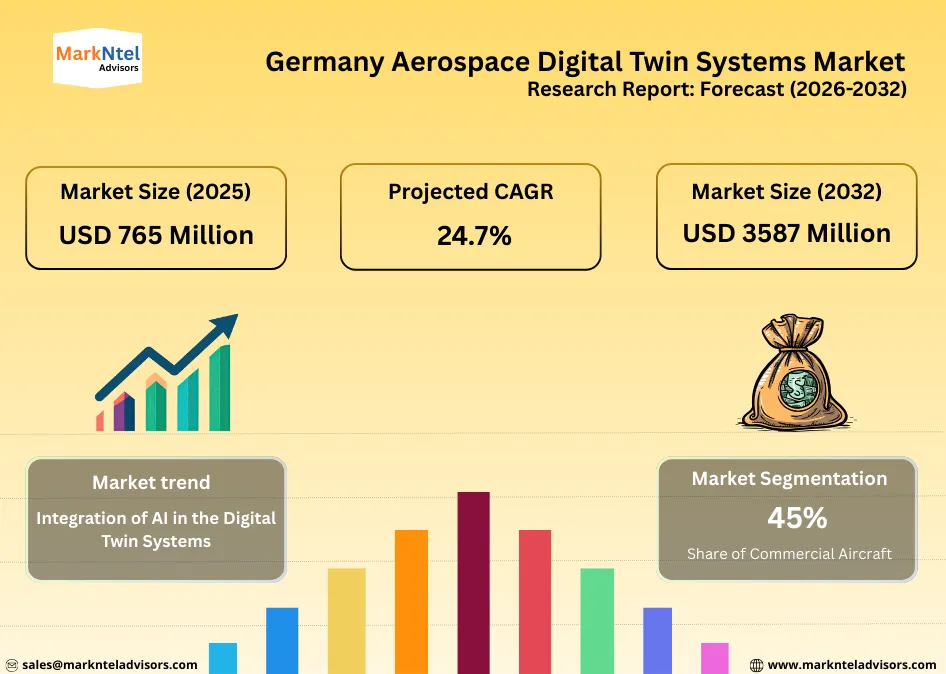
- Market size was valued at around USD765 million in 2025 and is projected to reach USD3,587 million by 2032. The estimated CAGR from 2026 to 2032 is around 24.7%, indicating strong growth.
- By Twin Type, the Asset Digital Twin segment represented a significant share of about 26% in the Germany Aerospace Digital Twin Systems Market in 2025.
- By Aircraft Type, the Commercial Aircraft segment seized a significant share of about 45% in the Germany Aerospace Digital Twin Systems Market in 2025.
- Leading Aerospace Digital Twin Systems Companies in the Germany Market are Siemens AG, Bosch GmbH, Complement AG, DigitalTwin Technology GmbH, msg group, Bertrandt AG, Fraunhofer Institutes, DC Smarter, GE Digital / GE Vernova, Dassault Systèmes, Ansys, PTC, Microsoft (Azure Digital Twins), and Others.
Market Insights & Analysis: Germany Aerospace Digital Twin Systems Market (2026-32):
The Germany Aerospace Digital Twin Systems Market size was valued at around USD765 million in 2025 and is projected to reach USD3,587 million by 2032. Along with this, the market is estimated to grow at a CAGR of around 24.7% during the forecast period, i.e., 2026-32.
Germany’s aerospace industry is structurally well-positioned for large-scale digital twin adoption due to its advanced manufacturing base, deep engineering expertise, and high automation intensity. According to the German Aerospace Industries Association (BDLI), aerospace systems are becoming increasingly complex as manufacturers integrate electrified propulsion, advanced composites, and software-defined avionics. This rising complexity is significantly increasing development, testing, and certification costs, making virtual validation and continuous digital testing through digital twins a strategic necessity rather than an optional tool.
Government-backed digitalization programs are accelerating this shift. According to the Federal Ministry for Economic Affairs and Climate Action (BMWK), Germany has expanded Industry 4.0 and applied digital engineering initiatives that prioritize simulation software, artificial intelligence, edge computing, and interoperable digital manufacturing platforms. These programs directly support the infrastructure required for aerospace digital twin systems, particularly in high-precision and safety-critical industries.
In parallel, aerospace production and MRO investments are reinforcing sustained demand. Airbus’ German production facilities continue to expand the use of simulation-driven manufacturing and virtual commissioning, while Lufthansa Technik is scaling asset-level digital twins across its maintenance hubs to improve predictive maintenance and fleet availability. Additionally, Fraunhofer Institutes are advancing applied research in physics-based simulation, digital lifecycle modeling, and real-time data integration, ensuring a steady pipeline of innovation and skilled talent. Together, these investments anchor digital twins as a core technology across Germany’s aerospace value chain.
Germany Aerospace Digital Twin Systems Market Recent Developments:
- 2025 : Airbus is using digital twin technology at its Hamburg, Germany, production facilities to create virtual twins of aircraft, tooling, workflows, and supply chains, improving real-time comparisons between planned and actual production progress.
Germany Aerospace Digital Twin Systems Market Scope:
| Category | Segments |
|---|---|
| By Twin Type | Part Digital Twin, Asset Digital Twin, System Digital Twin, Aircraft Digital Twin, Fleet Digital Twin, Manufacturing / Process Digital Twin |
| By Technology | Simulation & Modeling Software, IoT Sensors & Data Acquisition, Artificial Intelligence & Machine Learning, Cloud Computing & Edge Computing, Big Data Analytics, AR/VR & Visualization Tools, Cybersecurity & Data Management |
| By Deployment Type | On-Premise, Cloud-Based |
| By Aircraft Type | Commercial Aircraft, Business Jets, Military Aircraft, Helicopters, Unmanned Aerial Vehicles (UAVs), Spacecraft & Launch Vehicles |
| By Business Model | Subscription-Based, License-Based, Outcome-Based, Others |
| By Application | Predictive Maintenance, Performance Optimization, Virtual Prototyping & Certification, Fault Detection & Diagnostics, Condition-Based Monitoring, Asset Lifecycle Management, Training & Simulation Support |
Germany Aerospace Digital Twin Systems Market Driver:
Rising MRO Optimization and Fleet Availability Pressures Driving Digital Twin Adoption
Germany’s aerospace maintenance, repair, and overhaul (MRO) sector is facing rising operational and financial pressure, directly driving demand for digital twin systems. According to the German Aerospace Industries Association, aircraft utilization among German airlines and MRO providers increased with huge numbers during 2024–2025, approaching historical highs. Higher utilization accelerates component wear, increases failure probability, and raises the cost of unplanned maintenance, exposing the limitations of traditional time-based maintenance models.
To address these pressures, major German MRO providers are investing in digital twin–enabled predictive maintenance. Lufthansa Technik is advancing digital transformation at its Hamburg and Frankfurt facilities, integrating IoT sensor data with digital twin platforms to monitor asset health in real time. Moreover, institutional research strengthens this business case. The German Aerospace Center reports that digital twin–based maintenance can reduce unscheduled events by 20–30% and extend component life by 15–25% under simulated operational conditions . Therefore, increasing the market demand.
Germany Aerospace Digital Twin Systems Market Trend:
Integration of AI in the Digital Twin Systems
Germany is witnessing a clear shift where digital twins are no longer static simulation tools but AI-powered decision engines embedded into real industrial operations. Traditionally, German industries relied on physics-based models for design and validation. However, these models are computationally heavy and slow for real-time use. Now, AI is being layered onto digital twins to overcome this limitation, enabling faster predictions, adaptive learning, and continuous optimization.
For instance, applied research organizations such as Fraunhofer Society are training neural-network models on high-fidelity digital-twin simulations so that complex industrial behavior can be predicted instantly on factory-floor systems. Similarly, industrial leaders like Bosch are commercializing AI-enabled digital twins for asset performance management, using machine learning to anticipate failures and optimize maintenance decisions.
Additionally, platform providers such as Siemens and SAP are integrating AI-driven digital twins into broader industrial software ecosystems, linking design, operations, and lifecycle management within a single digital thread. This convergence is reinforced by Germany’s policy and standards ecosystem, with organizations like OECD and DIN highlighting digital twins and industrial AI as strategic priorities.
Germany Aerospace Digital Twin Systems Market Opportunity:
Digital Twins for Sustainable and Next-Generation Aircraft Programs
Germany’s aerospace digital-twin market is accelerating as national investments in sustainable aviation increasingly prioritize virtual design, testing, and certification to reduce development cost, timelines, and emissions. At the center of this shift is the German Aerospace Center (DLR), which anchors publicly funded aerospace R&D in Germany. For instance, DLR has been operating structured digital-twin initiatives such as DigTwin and DigECAT (2022–2025), focused on developing system-level digital twins for aircraft, engines, and critical components, enabling virtual validation across the full aircraft lifecycle.
Crucially, these programs integrate high-fidelity simulation models with real operational data generated from DLR’s research fleet of around 12 instrumented aircraft, allowing continuous validation of aerodynamic, structural, and propulsion behavior under real flight conditions. As a result, Germany can increasingly substitute fuel-intensive physical testing with virtual trials, directly lowering certification costs and development-phase emissions.
This technical momentum is reinforced by federal investment commitments. For instance, Germany’s 2025 Federal Aerospace Funding Plan allocates USD2.72 billion to aerospace research and related programs, including USD871 million for DLR’s aerospace research activities, alongside funding for domestic innovation programs. Together, sustained public funding and DLR-led digital-twin infrastructure create a strong, long-term opportunity for advanced aerospace digital-twin solutions in Germany.
Germany Aerospace Digital Twin Systems Market Challenge:
High Capital Intensity and Regulatory-Driven Deployment Constraints
High capital intensity in Germany’s Aerospace Digital Twin Systems market is closely linked to the way digital twins are positioned within national industrial and aerospace policies. According to the Federal Ministry for Economic Affairs and Climate Action, flagship programs such as Manufacturing-X have committed approximately USD140 million to build interoperable industrial data ecosystems , highlighting that digital twin deployment depends on large-scale investments in data platforms, simulation environments, and secure digital infrastructure rather than standalone software adoption.
This policy-driven push increases cost pressure on aerospace firms. Aerospace digital twins require high-performance computing, physics-based simulation, AI analytics, and continuous data integration. According to the German Aerospace Center, safety-critical aerospace applications demand extensive model validation, traceability, and lifecycle documentation before digital twins can be used in certification or operational decision-making, significantly extending project timelines and engineering effort.
Regulatory requirements further amplify costs. The Federal Office for Information Security mandates strict cybersecurity and data-sovereignty compliance for aerospace and defense data, limiting the use of standardized public-cloud solutions. This forces companies to invest in hybrid or on-premise infrastructures with dedicated security controls and redundancy.
While large OEMs and MRO providers can absorb these costs, small and mid-sized aerospace suppliers face proportionally higher financial and technical barriers, slowing ecosystem-wide digital twin adoption despite clear long-term efficiency benefits.
Germany Aerospace Digital Twin Systems Market (2026-32) Segmentation Analysis:
The Germany Aerospace Digital Twin Systems Market study of MarkNtel Advisors evaluates & highlights the major trends and influencing factors in each segment. It includes predictions for the period 2026–32 at the country level. Based on the analysis, the market has been further classified as;
Based on Twin Type:
- Part Digital Twin
- Asset Digital Twin
- System Digital Twin
- Aircraft Digital Twin
- Fleet Digital Twin
- Manufacturing / Process Digital Twin
In Germany’s aerospace sector, Asset Digital Twins dominate over others with a market share of about 26% because they are closest to operational value creation and regulatory acceptance. Unlike design-centric digital twins, asset twins focus on in-service equipment such as engines, landing gear, and avionics, where real-time condition monitoring directly influences safety, maintenance cost, and aircraft availability.
This dominance is strongly visible in Germany’s MRO-led aerospace ecosystem. For instance, Lufthansa Technik operates advanced asset-level digital twin platforms for engines and aircraft components, using sensor data and AI analytics to predict failures and optimize maintenance intervals. Lufthansa Technik has publicly stated that digital condition monitoring is central to reducing unscheduled removals and improving fleet reliability for global airline customers, making asset twins commercially indispensable.
Similarly, Germany’s engine manufacturing base reinforces this trend. MTU Aero Engines applies digital twins at the engine-asset level to monitor performance degradation, thermal behavior, and lifecycle efficiency across operational environments. These asset twins support long-term service agreements, where cost savings are realized during operation rather than at the design stage.
Consequently, while aircraft, fleet, and manufacturing digital twins remain important enablers, asset digital twins dominate Germany’s aerospace digital twin market because they deliver measurable, continuous value across maintenance, safety compliance, and lifecycle cost optimization.
Based on Aircraft Type:
- Commercial Aircraft
- Business Jets
- Military Aircraft
- Helicopters
- Unmanned Aerial Vehicles (UAVs)
- Spacecraft & Launch Vehicles
The commercial aircraft segment dominates Germany’s aerospace digital-twin systems market with a market share of 45% because the highest economic and regulatory value of digital twins lies in continuous operations, maintenance, and airworthiness compliance, rather than in military or experimental aviation. Germany hosts one of Europe’s largest commercial aviation ecosystems, anchored by major airlines, OEM activity, and MRO providers.
For instance, the Lufthansa Group operates a fleet of over 700 commercial aircraft across passenger and cargo services, creating massive demand for asset-level and system-level digital twins to manage engine health, component lifecycles, and operational efficiency. Each commercial aircraft generates high-frequency operational data, making digital twins economically viable at scale. Additionally, regulatory frameworks under the European Union Aviation Safety Agency (EASA) focus heavily on continuing airworthiness of individual commercial aircraft, further accelerating digital-twin adoption among commercial operators.
As a result, commercial aviation remains the dominant end user of aerospace digital twin systems in Germany, driven by fleet scale, operational economics, and strict regulatory oversight.
Gain a Competitive Edge with Our Germany Aerospace Digital Twin Systems Market Report:
- Germany Aerospace Digital Twin Systems Market Report by MarkNtel Advisors provides a detailed & thorough analysis of market size & share, growth rate, competitive landscape, and key players. This comprehensive analysis helps businesses gain a holistic understanding of the market dynamics & make informed decisions.
- This report also highlights current market trends & future projections, allowing businesses to identify emerging opportunities & potential challenges. By understanding market forecasts, companies can align their strategies & stay ahead of the competition.
- Germany Aerospace Digital Twin Systems Market Report aids in assessing & mitigating risks associated with entering or operating in the market. By understanding market dynamics, regulatory frameworks, and potential challenges, businesses can develop strategies to minimize risks & optimize their operations.
*Reports Delivery Format - Market research studies from MarkNtel Advisors are offered in PDF, Excel and PowerPoint formats. Within 24 hours of the payment being successfully received, the report will be sent to your email address.
Frequently Asked Questions
- Market Segmentation
- Introduction
- Product Definition
- Research Process
- Assumptions
- Executive Summary
- Germany Aerospace Digital Twin Systems Market Policies, Regulations, and Product Standards
- Germany Aerospace Digital Twin Systems Market Trends & Developments
- Germany Aerospace Digital Twin Systems Market Dynamics
- Growth Factors
- Challenges
- Germany Aerospace Digital Twin Systems Market Hotspot & Opportunities
- Germany Aerospace Digital Twin Systems Market Outlook, 2022-2032F
- Market Size & Outlook
- By Revenues (USD Million)
- Market Share & Outlook
- By Twin Type- Market Size & Forecast 2022-2032, USD Million
- Part Digital Twin
- Asset Digital Twin
- System Digital Twin
- Aircraft Digital Twin
- Fleet Digital Twin
- Manufacturing / Process Digital Twin
- By Technology - Market Size & Forecast 2022-2032, USD Million
- Simulation & Modeling Software
- IoT Sensors & Data Acquisition
- Artificial Intelligence & Machine Learning
- Cloud Computing & Edge Computing
- Big Data Analytics
- AR/VR & Visualization Tools
- Cybersecurity & Data Management
- By Deployment Type- Market Size & Forecast 2022-2032, USD Million
- On-Premise
- Cloud-Based
- By Aircraft Type- Market Size & Forecast 2022-2032, USD Million
- Commercial Aircraft
- Business Jets
- Military Aircraft
- Helicopters
- Unmanned Aerial Vehicles (UAVs)
- Spacecraft & Launch Vehicles
- By Business Model - Market Size & Forecast 2022-2032, USD Million
- Subscription-Based
- License-Based
- Outcome-Based
- Others
- By Application- Market Size & Forecast 2022-2032, USD Million
- Predictive Maintenance
- Performance Optimization
- Virtual Prototyping & Certification
- Fault Detection & Diagnostics
- Condition-Based Monitoring
- Asset Lifecycle Management
- Training & Simulation Support
- By Region- Market Size & Forecast 2022-2032, USD Million
- Bavaria
- North Rhine-Westphalia
- Lower Saxony
- Baden Württemberg
- Berlin Brandenburg
- By Company
- Competition Characteristics
- Market Share & Analysis
- By Twin Type- Market Size & Forecast 2022-2032, USD Million
- Market Size & Outlook
- Germany Aerospace Part Digital Twin Market Outlook, 2022-2032
- Market Size & Outlook
- By Revenues (USD Million)
- Market Share & Outlook
- By Technology - Market Size & Forecast 2022-2032, USD Million
- By Deployment Type- Market Size & Forecast 2022-2032, USD Million
- By Aircraft Type- Market Size & Forecast 2022-2032, USD Million
- By Business Model - Market Size & Forecast 2022-2032, USD Million
- By Application- Market Size & Forecast 2022-2032, USD Million
- By Region- Market Size & Forecast 2022-2032, USD Million
- Market Size & Outlook
- Germany Aerospace Asset Digital Twin Market Outlook, 2022-2032
- Market Size & Outlook
- By Revenues (USD Million)
- Market Share & Outlook
- By Technology - Market Size & Forecast 2022-2032, USD Million
- By Deployment Type- Market Size & Forecast 2022-2032, USD Million
- By Aircraft Type- Market Size & Forecast 2022-2032, USD Million
- By Business Model - Market Size & Forecast 2022-2032, USD Million
- By Application- Market Size & Forecast 2022-2032, USD Million
- By Region- Market Size & Forecast 2022-2032, USD Million
- Market Size & Outlook
- Germany Aerospace System Digital Twin Market Outlook, 2022-2032
- Market Size & Outlook
- By Revenues (USD Million)
- Market Share & Outlook
- By Technology - Market Size & Forecast 2022-2032, USD Million
- By Deployment Type- Market Size & Forecast 2022-2032, USD Million
- By Aircraft Type- Market Size & Forecast 2022-2032, USD Million
- By Business Model - Market Size & Forecast 2022-2032, USD Million
- By Application- Market Size & Forecast 2022-2032, USD Million
- By Region- Market Size & Forecast 2022-2032, USD Million
- Market Size & Outlook
- Germany Aerospace Aircraft Digital Twin Market Outlook, 2022-2032
- Market Size & Outlook
- By Revenues (USD Million)
- Market Share & Outlook
- By Technology - Market Size & Forecast 2022-2032, USD Million
- By Deployment Type- Market Size & Forecast 2022-2032, USD Million
- By Aircraft Type- Market Size & Forecast 2022-2032, USD Million
- By Business Model - Market Size & Forecast 2022-2032, USD Million
- By Application- Market Size & Forecast 2022-2032, USD Million
- By Region- Market Size & Forecast 2022-2032, USD Million
- Market Size & Outlook
- Germany Aerospace Fleet Digital Twin Market Outlook, 2022-2032
- Market Size & Outlook
- By Revenues (USD Million)
- Market Share & Outlook
- By Technology - Market Size & Forecast 2022-2032, USD Million
- By Deployment Type- Market Size & Forecast 2022-2032, USD Million
- By Aircraft Type- Market Size & Forecast 2022-2032, USD Million
- By Business Model - Market Size & Forecast 2022-2032, USD Million
- By Application- Market Size & Forecast 2022-2032, USD Million
- By Region- Market Size & Forecast 2022-2032, USD Million
- Market Size & Outlook
- Germany Aerospace Manufacturing / Process Digital Twin Market Outlook, 2022-2032
- Market Size & Outlook
- By Revenues (USD Million)
- Market Share & Outlook
- By Technology - Market Size & Forecast 2022-2032, USD Million
- By Deployment Type- Market Size & Forecast 2022-2032, USD Million
- By Aircraft Type- Market Size & Forecast 2022-2032, USD Million
- By Business Model - Market Size & Forecast 2022-2032, USD Million
- By Application- Market Size & Forecast 2022-2032, USD Million
- By Region- Market Size & Forecast 2022-2032, USD Million
- Market Size & Outlook
- Germany Aerospace Digital Twin Systems Market Key Strategic Imperatives for Success & Growth
- Competitive Outlook
- Company Profiles
- Siemens AG
- Business Description
- Product Portfolio
- Collaborations & Alliances
- Recent Developments
- Financial Details
- Others
- Bosch GmbH
- Business Description
- Product Portfolio
- Collaborations & Alliances
- Recent Developments
- Financial Details
- Others
- Complement AG
- Business Description
- Product Portfolio
- Collaborations & Alliances
- Recent Developments
- Financial Details
- Others
- DigitalTwin Technology GmbH
- Business Description
- Product Portfolio
- Collaborations & Alliances
- Recent Developments
- Financial Details
- Others
- msg group
- Business Description
- Product Portfolio
- Collaborations & Alliances
- Recent Developments
- Financial Details
- Others
- Bertrandt AG
- Business Description
- Product Portfolio
- Collaborations & Alliances
- Recent Developments
- Financial Details
- Others
- Fraunhofer Institutes
- Business Description
- Product Portfolio
- Collaborations & Alliances
- Recent Developments
- Financial Details
- Others
- DC Smarter
- Business Description
- Product Portfolio
- Collaborations & Alliances
- Recent Developments
- Financial Details
- Others
- GE Digital / GE Vernova
- Business Description
- Product Portfolio
- Collaborations & Alliances
- Recent Developments
- Financial Details
- Others
- Dassault Systèmes
- Business Description
- Product Portfolio
- Collaborations & Alliances
- Recent Developments
- Financial Details
- Others
- Ansys
- Business Description
- Product Portfolio
- Collaborations & Alliances
- Recent Developments
- Financial Details
- Others
- PTC
- Business Description
- Product Portfolio
- Collaborations & Alliances
- Recent Developments
- Financial Details
- Others
- Microsoft (Azure Digital Twins)
- Business Description
- Product Portfolio
- Collaborations & Alliances
- Recent Developments
- Financial Details
- Others
- Others
- Business Description
- Product Portfolio
- Collaborations & Alliances
- Recent Developments
- Financial Details
- Others
- Siemens AG
- Company Profiles
- Disclaimer
MarkNtel Advisors follows a robust and iterative research methodology designed to ensure maximum accuracy and minimize deviation in market estimates and forecasts. Our approach combines both bottom-up and top-down techniques to effectively segment and quantify various aspects of the market. A consistent feature across all our research reports is data triangulation, which examines the market from three distinct perspectives to validate findings. Key components of our research process include:
1. Scope & Research Design At the outset, MarkNtel Advisors define the research objectives and formulate pertinent questions. This phase involves determining the type of research—qualitative or quantitative—and designing a methodology that outlines data collection methods, target demographics, and analytical tools. They also establish timelines and budgets to ensure the research aligns with client goals.
2. Sample Selection and Data Collection In this stage, the firm identifies the target audience and determines the appropriate sample size to ensure representativeness. They employ various sampling methods, such as random or stratified sampling, based on the research objectives. Data collection is carried out using tools like surveys, interviews, and observations, ensuring the gathered data is reliable and relevant.
3. Data Analysis and Validation Once data is collected, MarkNtel Advisors undertake a rigorous analysis process. This includes cleaning the data to remove inconsistencies, employing statistical software for quantitative analysis, and thematic analysis for qualitative data. Validation steps are taken to ensure the accuracy and reliability of the findings, minimizing biases and errors.

4. Data Forecast and FinalizationThe final phase involves forecasting future market trends based on the analyzed data. MarkNtel Advisors utilize predictive modeling and time series analysis to anticipate market behaviors. The insights are then compiled into comprehensive reports, featuring visual aids like charts and graphs, and include strategic recommendations to inform client decision-making
We offer flexible licensing options to cater to varying organizational needs. Choose the pricing pack that best suits your requirements:
Buy Now Inquire Before Buying
 Request Customization
 Talk to our Consultant







