

GCC Fiber Optic Cable Market Research Report: Forecast (2026-2032)
By Fibre Type (Single-Mode fibre, Multi-Mode fibre), By Deployment (Underground, Underwater, Aerial), By Cable Design (Ribbon Tube, Loose Tube, Tight Buffered, Central Core, Micro ... Module Tube), By End Users (Oil & Gas, IT & Telecommunications, Energy & Power, Healthcare, Aerospace & Defence, BFSI, Others), By Application (Data Transmission & Networking, Broadcasting & Entertainment, Imaging & Sensing, Others (Avionics, Light Guides, etc.)), and others Read more
- ICT & Electronics
- Jun 2026
- Pages 240
- Report Format: PDF, Excel, PPT
GCC Fiber Optic Cable Market
Projected 8.71% CAGR from 2026 to 2032
Study Period
2026-2032
Market Size (2026)
USD 378.60 Million
Market Size (2032)
USD 624.80 Million
Base Year
2025
Projected CAGR
8.71%
Leading Segments
By Fiber Type: Single-Mode Fiber
GCC Fiber Optic Cable Market Key Takeaways
- The GCC fiber optic cable market was valued at approximately USD 343.20 million in 2025 and is projected to reach nearly USD 624.80 million by 2032 from USD 378.60 million in 2026.
- The market is expected to register a CAGR of around 8.71% during the forecast period (2026–2032).
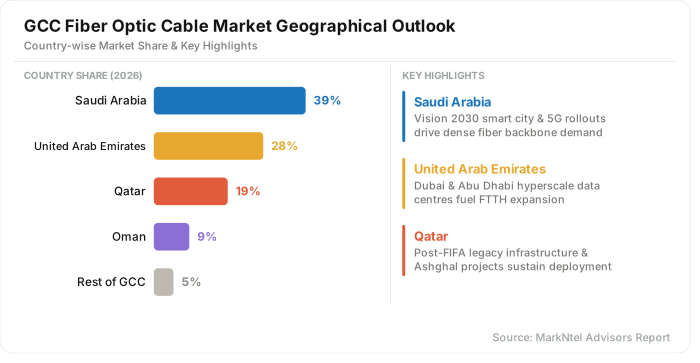
- Saudi Arabia leads the GCC fiber optic cable market, accounting for approximately 39% of total regional demand in 2026
- By fiber type, single-mode fiber cables accounted for approximately 68% of the market in 2026.
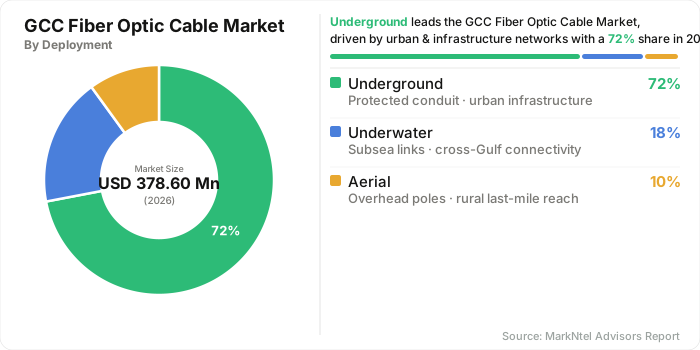
- By Deployment, Underground Fiber Optic Cables held the leading market share of approximately 72% in 2026.
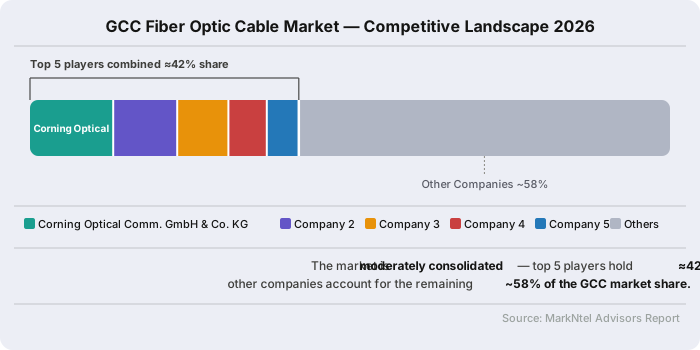
- The market remains moderately consolidated, with leading companies collectively accounting for 42% of the significant share of organized fiber optic cable deployments across GCC countries.Top of Form
GCC Fiber Optic Cable Market Size and Outlook
The GCC Fiber Optic Cable Market is projected to witness steady growth at a CAGR of around 8.71% during 2026–2032, primarily driven by expanding broadband connectivity, rising deployment of 5G networks, and government-led digital transformation initiatives across the Gulf region. Governments throughout the GCC are making substantial investments in digital infrastructure under long-term economic diversification programs such as Saudi Vision 2030, UAE Digital Government Strategy, Qatar National Vision 2030, and Oman Vision 2040. These initiatives prioritize nationwide fiber-to-the-home (FTTH) deployment, smart city development, cloud infrastructure expansion, and next-generation telecommunications networks. As a result, fiber optic cables have become a critical component of regional digital infrastructure development.
Saudi Arabia remains the largest market within the GCC, supported by major projects such as NEOM, smart industrial zones, and nationwide broadband expansion programs. In 2025, stc Group announced the activation of 125,000 new FTTH connections and the deployment of more than 1,100 km of additional fiber cables, further strengthening the Kingdom’s digital connectivity infrastructure. Similarly, Qatar is accelerating fiber infrastructure expansion through government-backed initiatives. In June 2025, the Communications Regulatory Authority (CRA) opened access to more than 4,860 km of government telecom duct infrastructure, covering over 40,000 residential, commercial, and government premises to support FTTH and 5G rollout.
In parallel, growing adoption of artificial intelligence, cloud computing, IoT applications, smart transportation systems, and digital public services is increasing demand for high-capacity optical networks across residential, commercial, industrial, and government sectors. Additionally, investments in submarine cable systems and regional data center hubs are strengthening the GCC’s role as a digital gateway connecting Asia, Europe, and Africa.
Consequently, continued investment in broadband modernization, smart cities, 5G deployment, and cloud infrastructure is expected to support robust long-term growth of the GCC fiber optic cable market, which is valued at USD 378.60 million in 2026 and is projected to reach nearly USD 624.80 million by 2032.
GCC Fiber Optic Cable Market Key Indicators
- The GCC is witnessing unprecedented investments in smart cities and digital infrastructure. Saudi Arabia’s NEOM project alone involves investments exceeding USD 500 billion, while the UAE continues to expand smart city initiatives in Dubai and Abu Dhabi. These projects require extensive fiber optic networks for IoT connectivity, AI applications, data transmission, and intelligent infrastructure management.
- According to regional telecom regulators and operators, 5G population coverage has surpassed 90% in several GCC countries, including the UAE, Qatar, and Saudi Arabia. The expansion of 5G networks is significantly increasing demand for fiber optic backhaul infrastructure to support higher bandwidth and ultra-low latency connectivity.
- According to Ericsson's Mobility Report (2025), 5G subscriptions in the Gulf region are expected to reach 86 million connections by 2030, accounting for approximately 90% of all mobile subscriptions. Since every 5G base station requires extensive fiber backhaul and fronthaul connectivity, increasing 5G penetration directly drives demand for fiber optic cable deployment across GCC countries.
- Ericsson projects that Fixed Wireless Access (FWA) will account for more than 35% of new fixed broadband connections globally by 2030, with Gulf operators actively expanding broadband infrastructure. To support rising broadband traffic and network capacity requirements, telecom operators continue expanding fiber backbone and FTTH networks, thereby increasing fiber optic cable consumption.
- The Middle East currently hosts more than 170 operational data centers, while an additional 98 facilities are under development. The UAE alone accounts for over 400 MW of operational data center power capacity, while Saudi Arabia represents nearly 50% of upcoming regional capacity additions. Data centers require dense fiber connectivity for interconnection, cloud services, and high-speed data transmission, making data center expansion a major demand driver for fiber optic cables.
- Saudi Arabia plans to invest approximately USD 1 trillion in infrastructure projects by 2030 under Vision 2030. These investments encompass smart cities, transportation systems, industrial zones, airports, and digital infrastructure, all of which require extensive fiber optic networks for communications, automation, and data transmission.
- Mega projects such as NEOM, Qiddiya, and the Red Sea development are being built as digitally connected ecosystems incorporating IoT, AI, cloud computing, smart mobility, and intelligent infrastructure. Such projects require large-scale fiber optic backbone networks, thereby creating substantial long-term demand for fiber optic cable installations.
GCC Fiber Optic Cable Market Scope
| Category | Segments |
|---|---|
| By Fibre Type | Single-Mode fibre, Multi-Mode fibre |
| By Deployment | Underground, Underwater, Aerial |
| By Cable Design | Ribbon Tube, Loose Tube, Tight Buffered, Central Core, Micro Module Tube |
| By End Users | Oil & Gas, IT & Telecommunications, Energy & Power, Healthcare, Aerospace & Defence, BFSI, Others |
| By Application | Data Transmission & Networking, Broadcasting & Entertainment, Imaging & Sensing, Others (Avionics, Light Guides, etc. |
GCC Fiber Optic Cable Market Growth Drivers
Rising Investments in AI Data Centers and Digital Infrastructure
Rising investments in AI data centers and digital infrastructure are emerging as a key growth driver for the GCC fiber optic cable market. As Gulf countries accelerate digital transformation, artificial intelligence adoption, cloud computing, and smart city development, the need for high-capacity fiber optic networks is increasing substantially. Fiber optic cables form the backbone of AI ecosystems by enabling ultra-fast, low-latency data transmission between data centers, cloud platforms, enterprises, and end users.
Governments across the GCC are positioning their economies as global technology and AI hubs through large-scale investments in digital infrastructure. The rapid expansion of hyperscale data centers, cloud regions, and advanced computing facilities requires extensive fiber connectivity to support growing data traffic and AI workloads. Additionally, increasing adoption of AI applications in healthcare, finance, transportation, manufacturing, and government services is further boosting demand for reliable optical communication networks.
For example, during LEAP 2025, global technology companies announced more than USD 14.9 billion in new AI, cloud, and data center investments in Saudi Arabia. Major investments from companies such as Google Cloud, Oracle, Alibaba Cloud, Salesforce, and Databricks are expected to expand the Kingdom’s digital infrastructure significantly. These facilities require extensive fiber optic networks for inter-data-center connectivity, cloud service delivery, and high-speed data transmission. As similar investments continue across the other GCC countries, demand for fiber optic cable deployment is expected to grow steadily, supporting the region's ambition to become a leading global digital economy.
Recent Trend
Accelerating 5G Network Expansion and Fiber-to-the-Tower (FTTT) Deployment
A major trend shaping the GCC fiber optic cable market is the rapid expansion of 5G networks and the corresponding increase in fiber-to-the-tower (FTTT) deployments. Telecom operators across Saudi Arabia, the UAE, Qatar, Kuwait, Bahrain, and Oman are investing heavily in next-generation mobile infrastructure to support growing demand for high-speed connectivity, smart city applications, industrial automation, and digital services. Since 5G networks require dense fiber backhaul connections to deliver ultra-low latency and high bandwidth, the expansion of 5G coverage is directly driving demand for fiber optic cables across the region.
Governments are also prioritizing advanced telecommunications infrastructure as part of their national digital transformation strategies. According to the GCC's digital economy initiatives, operators continue to expand fiber networks to support wider 5G coverage, improved network performance, and increasing data traffic generated by IoT devices and smart applications. For example, in 2025, stc Group announced the deployment of more than 1,100 kilometers of additional fiber optic cables and activation of approximately 125,000 new FTTH connections as part of its nationwide network expansion strategy in Saudi Arabia.
The project supports both broadband connectivity and 5G infrastructure development, highlighting the growing integration between fiber networks and next-generation mobile communications. As 5G adoption continues to rise across the GCC, investments in fiber backhaul and telecom infrastructure are expected to remain a key market trend, supporting sustained growth in fiber optic cable demand.
GCC Fiber Optic Cable Market Opportunity & Challenge
High Fiber Deployment Costs in Remote Areas Creating Opportunities for Government Broadband Expansion
Despite strong demand for high-speed connectivity, one of the key challenges facing the GCC fiber optic cable market is the high cost of deploying fiber networks in remote areas, industrial zones, desert regions, and sparsely populated communities. The installation of fiber infrastructure requires significant capital investment in trenching, civil works, network equipment, and maintenance, making it economically challenging for telecom operators to achieve full coverage in less densely populated locations.
However, this challenge is simultaneously creating substantial growth opportunities. Governments across the GCC are increasingly launching broadband expansion programs and public-private partnerships to bridge the digital divide and improve nationwide connectivity. Under initiatives such as Saudi Vision 2030, UAE Digital Government Strategy, and Oman Vision 2040, authorities are investing in nationwide broadband infrastructure to ensure digital inclusion and support economic diversification.
For example, Saudi Arabia's Communications, Space & Technology Commission (CST) reported that fiber-optic household coverage exceeded 5.8 million homes in 2026, with ongoing expansion projects targeting underserved regions. As governments continue investing in broadband accessibility, smart cities, industrial corridors, and digital services, demand for fiber optic cables is expected to increase significantly.
Segmentation Analysis
Single-Mode Fiber Dominates the Market Owing to Its Superior Long-Distance Transmission Capability
Single-Mode Fiber dominates the GCC Fiber Optic Cable Market, accounting for approximately 68% of total market revenue. The segment's leadership is driven by increasing investments in fiber-to-the-home (FTTH) networks, 5G infrastructure, hyperscale data centers, and national broadband expansion programs across the GCC. Single-mode fiber enables high-speed data transmission over long distances with minimal signal loss, making it the preferred choice for telecommunications backbones, metro networks, data transport systems, and international connectivity projects.
Telecom operators across Saudi Arabia, the UAE, Qatar, and other GCC countries are increasingly deploying single-mode fiber to support growing internet traffic, cloud services, and digital transformation initiatives. Governments across the GCC continue to prioritize nationwide FTTH deployment and next-generation telecommunications infrastructure, further supporting demand for single-mode fiber solutions.
Multi-Mode Fiber is also witnessing steady adoption, particularly within enterprise networks, commercial buildings, industrial facilities, healthcare institutions, and campus environments where shorter-distance, high-bandwidth connectivity is required. As a result, single-mode fiber continues to dominate the GCC fiber optic cable market, while multi-mode fiber increasingly supports the expansion of enterprise, commercial, and industrial connectivity infrastructure. Based on Fiber Type, the market has been segmented into:
- Single-Mode Fiber
- Multi-Mode Fiber
Underground Deployment Dominates the Market Owing to Large-Scale Broadband and Smart City Infrastructure Projects
Underground deployment dominates the GCC Fiber Optic Cable Market, accounting for approximately 72% of total market revenue. The segment's leadership is driven by extensive investments in 5G infrastructure, fiber-to-the-home (FTTH) networks, smart city developments, metro rail projects, commercial districts, and nationwide broadband expansion initiatives across the region. Governments and telecom operators in GCC countries increasingly prefer underground installations due to their higher reliability, protection from harsh weather conditions, improved network security, and longer operational lifespan.
Underwater fiber optic cables are witnessing significant growth, supported by rising investments in submarine cable systems connecting the GCC with Asia, Europe, and Africa. Aerial fiber deployment also maintains a notable presence, particularly in rural areas, industrial zones, utility corridors, and locations where rapid deployment and lower installation costs are priorities. However, exposure to environmental conditions and higher maintenance requirements limit their adoption compared to underground networks.
As a result, underground deployment continues to dominate the GCC fiber optic cable market, while underwater installations benefit from growing international connectivity investments and aerial deployment supports cost-effective network expansion initiatives. Based on Deployment, the market has been segmented into:
- Underground
- Underwater
- Aerial
GCC Fiber Optic Cable Market Geographical Outlook
Saudi Arabia continues to lead the GCC fiber optic cable market, accounting for the 39% of total market share, supported by substantial investments in digital infrastructure, broadband expansion, smart city developments, and next-generation telecommunications networks. As part of its Vision 2030 strategy, Saudi Arabia has committed over USD 1 trillion toward infrastructure and economic diversification projects, many of which require extensive fiber optic connectivity to support digital services, industrial automation, and intelligent urban ecosystems.
Mega-projects such as NEOM, The Line, and Red Sea Global are generating significant demand for fiber optic cables to support high-speed broadband, IoT networks, autonomous mobility systems, smart utilities, and AI-driven infrastructure. The Kingdom's digital transformation agenda is further reinforced by the rapid expansion of hyperscale data centers and cloud regions established by global technology providers, creating additional demand for high-capacity fiber backbone and data center interconnection networks.
Saudi Arabia also possesses one of the region's largest fiber broadband footprints. According to government and telecom sector initiatives, fiber-to-the-home coverage has expanded to more than 3.9 million homes, while broadband penetration continues to increase alongside rising digital consumption. Furthermore, the country is among the GCC leaders in 5G deployment, with thousands of 5G base stations requiring extensive fiber backhaul connectivity to support growing mobile data traffic.
In parallel, increasing adoption of cloud computing, artificial intelligence, edge computing, and Industry 4.0 technologies across sectors such as manufacturing, energy, healthcare, and government services is accelerating investments in high-speed optical communication infrastructure. Consequently, Saudi Arabia is expected to maintain its dominant position in the GCC fiber optic cable market throughout the forecast period, supported by continuous network modernization, expanding broadband coverage, and large-scale smart infrastructure investments.
GCC Fiber Optic Cable Market Competitive Analysis
The GCC fiber optic cable market is moderately consolidated, with a mix of global optical fiber manufacturers and regional cable producers competing through product innovation, telecom partnerships, local manufacturing expansion, and participation in large-scale broadband and digital infrastructure projects. Leading companies such as Corning Optical Communications GmbH & Co. KG, Prysmian Cavi E Sistemi S.r.l (DMCC Branch), Sumitomo Electric Industries, Ltd., Hengtong Optic-Electric Egypt Co., S.A.E, and Sterlite Technologies Limited collectively account for approximately 42% of the market share, supported by their strong presence in telecommunications, FTTH deployment, data transmission networks, submarine cable projects, and smart city infrastructure.
Key Companies in the GCC Fiber Optic Cable Market
- Corning Optical Communications GmbH & Co. KG
- Prysmian Cavi E Sistemi S.r.l (DMCC Branch)
- Sumitomo Electric Industries, Ltd.
- Hengtong Optic-Electric Egypt Co., S.A.E
- Sterlite Technologies Limited
- CommScope Holding Company Inc.
- Arabian Fiber Optic Cables Manufacturing LLC
- Naficon Fiber Optic Manufacturing LLC
- HELUKABEL Middle East DWC LLC
- Middle East Fiber Cable Manufacturing Co. (MEFC)
- Electra
- Oman Fiber Optic Co. S.A.OC
GCC Fiber Optic Cable Industry News and Recent Developments
June 2025: Qatar Communications Regulatory Authority Opens 4,860 km Government Telecom Infrastructure
The Communications Regulatory Authority (CRA) of Qatar announced access to over 4,860 kilometers of government telecom duct infrastructure to support network expansion and accelerate FTTH deployment.
Impact Analysis: The initiative is expected to reduce deployment costs, accelerate broadband expansion, and increase demand for fiber optic cables across Qatar.
November 2025: Microsoft and QNBN Strategic Digital Infrastructure Partnership
Qatar National Broadband Network entered a strategic agreement with Microsoft to support digital and AI transformation initiatives through advanced broadband infrastructure.
Impact Analysis: The partnership strengthens demand for high-capacity fiber infrastructure required for AI, cloud computing, and enterprise digital services.
June 2025: E& UAE Deploys World's First High-Density XGS-PON Technology
e& UAE deployed the world's first 32-port high-density XGS-PON solution, enabling ultra-fast fiber broadband services and supporting future 10 Gbps connectivity requirements.
Impact Analysis: The deployment accelerates next-generation fiber infrastructure upgrades in the UAE and increases demand for advanced optical fiber networks capable of supporting AI, cloud computing, and hyperscale data centers.
Frequently Asked Questions
- Market Segmentation
- Introduction
- Product Definition
- Research Process
- Assumptions
- Executive Summary
- GCC Fiber Optic Cable Market Policies, Regulations, and Product Standards
- GCC Fiber Optic Cable Market Trends & Developments
- GCC Fiber Optic Cable Market Dynamics
- Growth Factors
- Challenges
- GCC Fiber Optic Cable Market Hotspot & Opportunities
- GCC Fiber Optic Cable Market Outlook, 2022-2032F
- Market Size & Outlook
- By Revenues (USD Million)
- Market Share & Analysis
- By Fibre Type- Market Size & Forecast 2022-2032, USD Million
- Single-Mode fibre
- Multi-Mode fibre
- By Deployment- Market Size & Forecast 2022-2032, USD Million
- Underground
- Underwater
- Aerial
- By Cable Design- Market Size & Forecast 2022-2032, USD Million
- Ribbon Tube
- Loose Tube
- Tight Buffered
- Central Core
- Micro Module Tube
- By End Users- Market Size & Forecast 2022-2032, USD Million
- Oil & Gas
- IT & Telecommunications
- Energy & Power
- Healthcare
- Aerospace & Defence
- BFSI
- Others
- By Application- Market Size & Forecast 2022-2032, USD Million
- Data Transmission & Networking
- Broadcasting & Entertainment
- Imaging & Sensing
- Others (Avionics, Light Guides, etc.)
- By Country
- The UAE
- Saudi Arabia
- Qatar
- Kuwait
- Bahrain
- Oman
- By Company
- Competition Characteristics
- Market Share & Analysis
- By Fibre Type- Market Size & Forecast 2022-2032, USD Million
- Market Size & Outlook
- The UAE Fiber Optic Cable Market Outlook, 2022-2032F
- Market Size & Outlook
- By Revenues (USD Million)
- Market Share & Analysis
- By Fibre Type- Market Size & Forecast 2022-2032, USD Million
- By Deployment- Market Size & Forecast 2022-2032, USD Million
- By Cable Design- Market Size & Forecast 2022-2032, USD Million
- By End Users- Market Size & Forecast 2022-2032, USD Million
- By Application- Market Size & Forecast 2022-2032, USD Million
- Market Size & Outlook
- Saudi Arabia Fiber Optic Cable Market Outlook, 2022-2032F
- Market Size & Outlook
- By Revenues (USD Million)
- Market Share & Analysis
- By Fibre Type- Market Size & Forecast 2022-2032, USD Million
- By Deployment- Market Size & Forecast 2022-2032, USD Million
- By Cable Design- Market Size & Forecast 2022-2032, USD Million
- By End Users- Market Size & Forecast 2022-2032, USD Million
- By Application- Market Size & Forecast 2022-2032, USD Million
- Market Size & Outlook
- Qatar Fiber Optic Cable Market Outlook, 2022-2032F
- Market Size & Outlook
- By Revenues (USD Million)
- Market Share & Analysis
- By Fibre Type- Market Size & Forecast 2022-2032, USD Million
- By Deployment- Market Size & Forecast 2022-2032, USD Million
- By Cable Design- Market Size & Forecast 2022-2032, USD Million
- By End Users- Market Size & Forecast 2022-2032, USD Million
- By Application- Market Size & Forecast 2022-2032, USD Million
- Market Size & Outlook
- Kuwait Fiber Optic Cable Market Outlook, 2022-2032F
- Market Size & Outlook
- By Revenues (USD Million)
- Market Share & Analysis
- By Fibre Type- Market Size & Forecast 2022-2032, USD Million
- By Deployment- Market Size & Forecast 2022-2032, USD Million
- By Cable Design- Market Size & Forecast 2022-2032, USD Million
- By End Users- Market Size & Forecast 2022-2032, USD Million
- By Application- Market Size & Forecast 2022-2032, USD Million
- Market Size & Outlook
- Bahrain Fiber Optic Cable Market Outlook, 2022-2032F
- Market Size & Outlook
- By Revenues (USD Million)
- Market Share & Analysis
- By Fibre Type- Market Size & Forecast 2022-2032, USD Million
- By Deployment- Market Size & Forecast 2022-2032, USD Million
- By Cable Design- Market Size & Forecast 2022-2032, USD Million
- By End Users- Market Size & Forecast 2022-2032, USD Million
- By Application- Market Size & Forecast 2022-2032, USD Million
- Market Size & Outlook
- GCC Fiber Optic Cable Market Key Strategic Imperatives for Success & Growth
- Competitive Outlook
- Company Profiles
- Corning Optical Communications GmbH & Co. KG
- Business Description
- Product Portfolio
- Collaborations & Alliances
- Recent Developments
- Financial Details
- Others
- Prysmian Cavi E Sistemi S.r.l (DMCC Branch)
- Business Description
- Product Portfolio
- Collaborations & Alliances
- Recent Developments
- Financial Details
- Others
- Sumitomo Electric Industries, Ltd.
- Business Description
- Product Portfolio
- Collaborations & Alliances
- Recent Developments
- Financial Details
- Others
- Hengtong Optic-Electric Egypt Co., S.A.E
- Business Description
- Product Portfolio
- Collaborations & Alliances
- Recent Developments
- Financial Details
- Others
- Sterlite Technologies Limited
- Business Description
- Product Portfolio
- Collaborations & Alliances
- Recent Developments
- Financial Details
- Others
- CommScope Holding Company Inc.
- Business Description
- Product Portfolio
- Collaborations & Alliances
- Recent Developments
- Financial Details
- Others
- Arabian Fiber Optic Cables Manufacturing LLC
- Business Description
- Product Portfolio
- Collaborations & Alliances
- Recent Developments
- Financial Details
- Others
- Naficon Fiber Optic Manufacturing LLC
- Business Description
- Product Portfolio
- Collaborations & Alliances
- Recent Developments
- Financial Details
- Others
- HELUKABEL Middle East DWC LLC
- Business Description
- Product Portfolio
- Collaborations & Alliances
- Recent Developments
- Financial Details
- Others
- Middle East Fiber Cable Manufacturing Co. (MEFC)
- Business Description
- Product Portfolio
- Collaborations & Alliances
- Recent Developments
- Financial Details
- Others
- Electra
- Business Description
- Product Portfolio
- Collaborations & Alliances
- Recent Developments
- Financial Details
- Others
- Corning Optical Communications GmbH & Co. KG
- Company Profiles
- Disclaimer
MarkNtel Advisors follows a robust and iterative research methodology designed to ensure maximum accuracy and minimize deviation in market estimates and forecasts. Our approach combines both bottom-up and top-down techniques to effectively segment and quantify various aspects of the market. A consistent feature across all our research reports is data triangulation, which examines the market from three distinct perspectives to validate findings. Key components of our research process include:
1. Scope & Research Design At the outset, MarkNtel Advisors define the research objectives and formulate pertinent questions. This phase involves determining the type of research—qualitative or quantitative—and designing a methodology that outlines data collection methods, target demographics, and analytical tools. They also establish timelines and budgets to ensure the research aligns with client goals.
2. Sample Selection and Data Collection In this stage, the firm identifies the target audience and determines the appropriate sample size to ensure representativeness. They employ various sampling methods, such as random or stratified sampling, based on the research objectives. Data collection is carried out using tools like surveys, interviews, and observations, ensuring the gathered data is reliable and relevant.
3. Data Analysis and Validation Once data is collected, MarkNtel Advisors undertake a rigorous analysis process. This includes cleaning the data to remove inconsistencies, employing statistical software for quantitative analysis, and thematic analysis for qualitative data. Validation steps are taken to ensure the accuracy and reliability of the findings, minimizing biases and errors.

4. Data Forecast and FinalizationThe final phase involves forecasting future market trends based on the analyzed data. MarkNtel Advisors utilize predictive modeling and time series analysis to anticipate market behaviors. The insights are then compiled into comprehensive reports, featuring visual aids like charts and graphs, and include strategic recommendations to inform client decision-making
We offer flexible licensing options to cater to varying organizational needs. Choose the pricing pack that best suits your requirements:
Buy Now Inquire Before Buying
 Request Customization
 Talk to our Consultant







