

Global Flight Simulation Systems Market Research Report: Trends, Forecast & Opportunities (2026-2032)
By Component (Hardware, Software, Services), By Type (Full Flight Simulators (FFS), Full Mission Simulators (FMS), Flight Training Devices (FTD), Fixed Base Simulators (FBS), UAV S ... imulators, Others), By Platform (Commercial, Military, Unmanned Aerial Vehicles (UAVS)), By Training Method (Synthetic Simulation, Virtual Reality (VR) / Mixed Reality (MR)), By End-User (Simulation & Training, Facilities, Air Forces, Civil), and others Read more
- Aerospace & Defense
- Mar 2026
- Pages 198
- Report Format: PDF, Excel, PPT
Global Flight Simulation Systems Market
Projected 5.96% CAGR from 2026 to 2032
Study Period
2026-2032
Market Size (2026)
USD 6.5 Billion
Market Size (2032)
USD 9.2 Billion
Largest Region
North America
Projected CAGR
5.96%
Leading Segments
By Training Method: Synthetic Simulation
Global Flight Simulation Systems Market Report Key Takeaways:
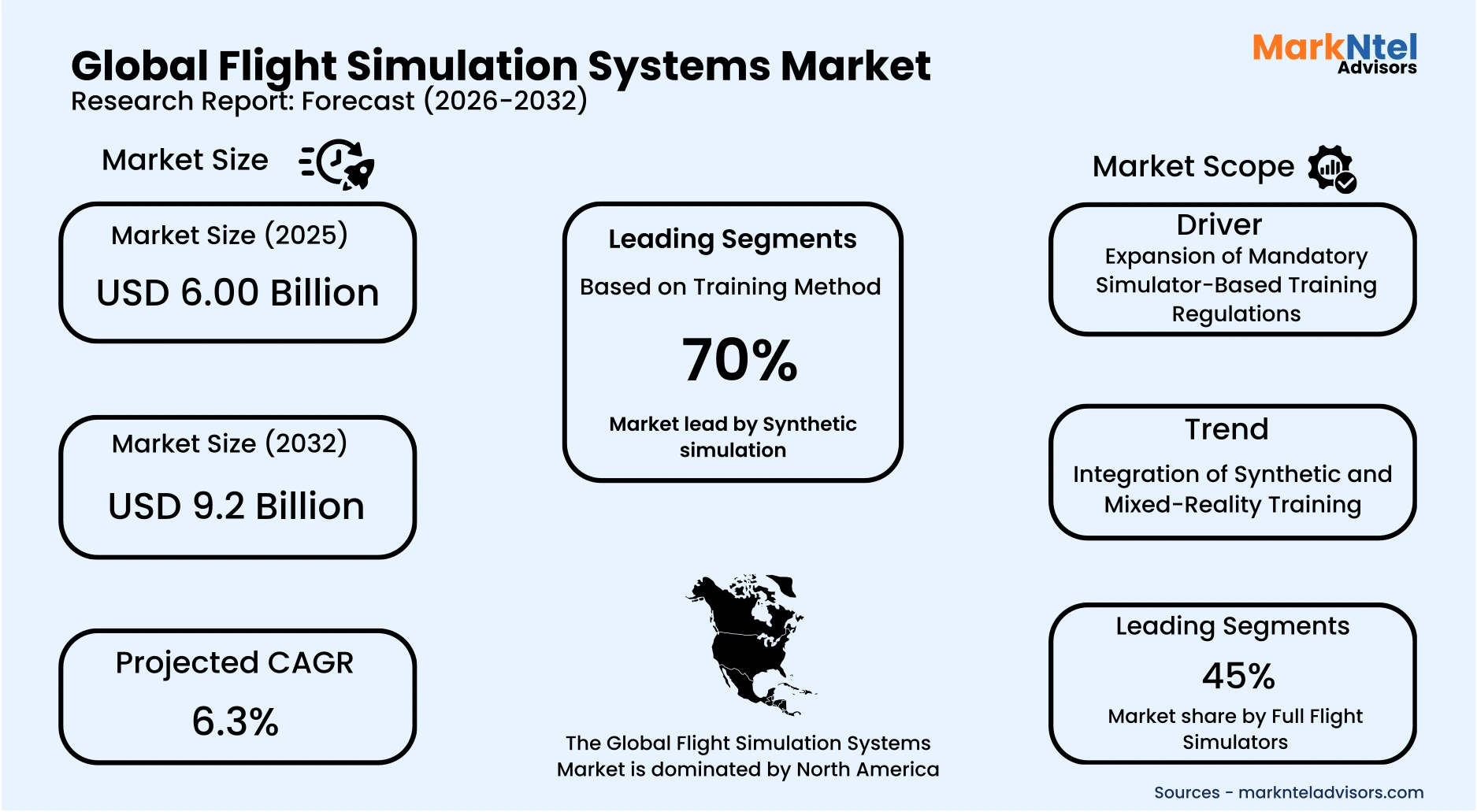
- Market size was valued at around USD 6.00 billion in 2025 and is projected to grow from USD 6.5 billion in 2026 to USD 9.2 billion by 2032. The estimated CAGR from 2026 to 2032 is around 5.96%, indicating strong growth.
- North America holds the largest market share of about 32% in the Global Flight Simulation Systems Market in 2026.
- By type, the full flight simulators (FFS) segment represented a significant share of about 45% in the Global Flight Simulation Systems Market in 2026.
- By Training Method, the synthetic simulation segment presented a significant share of about 70% in the Global Flight Simulation Systems Market in 2026.
- Leading flight simulation systems companies in the Global Market are CAE Inc., L3Harris Technologies, The Boeing Company, Thales, FlightSafety International, Airbus, Raytheon Technologies, Indra Sistemas, Elite Simulation Solutions, SIMCOM Aviation Training, Precision Flight Controls, Avion Group, Leonardo, FAAC, ECA Group, and Others.
Market Insights & Analysis: Global Flight Simulation Systems Market (2026-32):
The Global Flight Simulation Systems Market size was valued at around USD 6.00 billion in 2025 and is projected to grow from USD 6.5 billion in 2026 to USD 9.2 billion by 2032. Along with this, the market is estimated to grow at a CAGR of around 5.96% during the forecast period, i.e., 2026-32.
The global flight simulation systems market continues to grow as aviation stakeholders expand training infrastructure to meet pilot competency needs and regulatory expectations. In May 2025, Airbus expanded its Airbus Helicopters Training Academy in Malaysia by adding a third full-flight simulator (FFS), the first H175 unit outside Europe to support type rating, recurrent training, and mission scenarios, demonstrating manufacturer-led investment in regional training capacity.
Commercial and business aviation operators are deploying advanced simulators to enhance pilot readiness amid fleet expansions and evolving safety requirements. In October 2025, Cathay Pacific welcomed a new CAE Airbus A320neo full-flight simulator at its Hong Kong Flight Training Centre to strengthen pilot training for a modernized fleet and rising crew demands .
Defense and rotorcraft training infrastructure are also driving demand as operators seek certified devices for mission-specific readiness and transition training. In November 2025, Bell Textron’s Bell 525 flight simulation training device received FAA Interim Level C qualification, enabling pilots to accrue credited simulator hours ahead of aircraft certification and improving operational preparedness.
Additionally, market resilience is supported by simulator manufacturers achieving regulatory milestones that validate product maturity and operational use. In December 2025, HAVELSAN secured EASA certification for another Airbus A320 Full Flight Simulator, expanding certified simulation capabilities at training centers globally, an indicator of broad industry confidence in simulator technology adoption .
Global Flight Simulation Systems Market Recent Developments:
- 2025: Havelsan signed an agreement with Boeing to integrate the B737 MAX‑8 Full Flight Simulator into its production line. This development bolsters global simulator supply and training capacity for one of the world’s most widely used commercial aircraft platforms in 2025.
- 2025: Reiser Simulation and Training partnered with Leonardo to co‑develop a Level 3 Flight Training Device (FTD) for the AW139 helicopter. This collaboration aims to deliver advanced, cost‑efficient rotorcraft simulation solutions that meet evolving civil and military market needs.
Global Flight Simulation Systems Market Driver:
Expansion of Mandatory Simulator-Based Training Regulations
The expansion of mandatory simulator-based training regulations has emerged as the most influential structural driver of growth in the global flight simulation systems market. Aviation regulators are increasingly formalizing simulator usage within licensing, recurrent training, and competency assessment frameworks to improve safety outcomes and standardize pilot proficiency. This shift reflects the growing complexity of modern aircraft systems and the need for risk-free, repeatable training environments that cannot be fully replicated through live flight operations alone.
In 2025, the European Union Aviation Safety Agency (EASA) issued Opinion No 01/2025, proposing amendments to flight simulation training device (FSTD) requirements by introducing a task-based regulatory framework that directly links simulator fidelity levels to specific training objectives . This regulatory update strengthens the formal role of simulators in approved training programs and compels airlines and training organizations to deploy certified simulation systems that meet updated technical and performance standards.
This driver is materially expanding market volume rather than influencing short-term adoption patterns. Once embedded into regulatory compliance cycles, simulator usage becomes non-discretionary, requiring continuous investment in certified devices, software upgrades, and capacity expansion. Training organizations and fleet operators must align with updated mandates regardless of economic conditions, ensuring sustained demand across commercial, institutional, and specialized aviation segments. As regulatory bodies continue to refine simulator-centric training frameworks, mandatory adoption remains a long-term growth engine for the global flight simulation systems market.
Global Flight Simulation Systems Market Trend:
Integration of Synthetic and Mixed-Reality Training
The integration of synthetic and mixed-reality (MR) technologies in flight simulation training is a defining trend reshaping the global flight simulation systems market by enabling more immersive, cost-effective, and scalable training environments. In June 2025, a mixed reality flight simulator powered by Varjo XR technology became the first to achieve qualification under European Union Aviation Safety Agency (EASA) standards, validating MR as an officially recognized training modality for civil aviation and pilot proficiency programs .
This regulatory milestone reflects broader adoption of synthetic and immersive technologies not only in commercial pilot training but also in defense and advanced mission rehearsal. For instance, NASA’s Ames Research Center conducted mixed-reality pilot simulations in its Vertical Motion Simulator in mid-2025 to generate empirical performance data that informs future certification and training efficacy studies .
By blending physical controls with high-fidelity virtual scenarios, synthetic and MR systems improve situational awareness, reduce dependency on expensive live flight hours, and support scenario-based training that is difficult or unsafe to replicate in traditional simulators. This trend is accelerating the modernization of pilot training curricula and expanding global simulation capacity.
Global Flight Simulation Systems Market Opportunity:
Entry into Modular and Lower-Cost Training Devices
A compelling opportunity in the global flight simulation systems market lies in the development and deployment of modular, lower-cost training devices that satisfy regulatory training credits at significantly reduced cost and complexity compared to traditional full-flight simulators. Demand is growing from flight schools and regional training hubs that require affordable, flexible simulators capable of supporting initial, instrument, and multi-engine pilot training without the high capital investment of full motion devices. These modular devices enable scalable training capacity in emerging markets where pilot pipelines are growing quickly, but budgets remain constrained.
In 2025, IFA Academy in Portugal expanded its training fleet with an ALSIM AL250 simulator, certified as an EASA FNPT II device, demonstrating real market traction for cost-effective, task-specific training equipment among civilian pilot training organizations.
This structural opportunity exists because aviation authorities increasingly accept certified lower-cost devices for specific training credits under structured programs, reducing barriers to entry for new players. Unlike incumbents focused on full motion simulators, emerging manufacturers can innovate with software-centric platforms, modular hardware, and subscription-style offerings that lower up-front investment and shorten certification timelines. The modular device sector thus offers scalable growth pathways for new firms to participate in pilot training markets globally.
Global Flight Simulation Systems Market Challenge:
High Certification and Compliance Costs
A significant challenge for participants in the global flight simulation systems market is the high costs associated with regulatory certification and ongoing compliance, which directly affects investment decisions and operational scalability. Professional certification processes by aviation authorities such as the Federal Aviation Administration (FAA) and European Union Aviation Safety Agency (EASA) require rigorous qualification standards, documentation, and periodic surveillance that cumulatively increase operational expenses for simulator manufacturers and training providers. Under EASA’s Commission Implementing Regulation (EU) 2025/2347, flat fees for flight simulation training device (FSTD) approval and annual surveillance are charged per application and per billing cycle, with amounts rising over time due to inflation indexing and administrative fees.
Beyond formal fees, compliance requires adherence to 14 CFR Part 60 standards in the United States, dictating detailed qualification performance, quality management systems, and periodic evaluations before an FSTD can be used for regulated training. These requirements extend timelines and operational planning, adding indirect costs through audits, documentation preparation, and staff allocation.
Enforcement actions underscore compliance burdens: in 2025, India’s Directorate General of Civil Aviation (DGCA) fined IndiGo approximately USD 48,000 for using uncertified simulators to train 1,700 pilots, demonstrating that non-compliance can result in financial penalties and reputational risk.
Collectively, certification and compliance costs, including regulatory fees, audit readiness, and risk of fines, create substantial barriers for smaller operators and new entrants, limiting competitive participation and contributing to market concentration among larger, well-capitalized entities.
Global Flight Simulation Systems Market (2026-32) Segmentation Analysis:
The Global Flight Simulation Systems Market study of MarkNtel Advisors evaluates & highlights the major trends and influencing factors in each segment. It includes predictions for the period 2026–32 at the global level. Based on the analysis, the market has been further classified as;
Based on Type:
- Full Flight Simulators (FFS)
- Full Mission Simulators (FMS)
- Flight Training Devices (FTD)
- Fixed Base Simulators (FBS)
- UAV Simulators
- Others
Full Flight Simulators (FFS) represent the most dominant segment, accounting for approximately 45% of the global flight simulation systems market. This leadership is primarily driven by their highest regulatory acceptance level, as FFS are certified to replicate aircraft behavior with full motion, visual, and systems fidelity. Aviation regulators across major markets permit FFS for critical training activities such as type rating, recurrent checks, emergency procedure training, and license renewals, making them indispensable for commercial airlines and air forces.
Additionally, FFS allows pilots to complete a substantial portion of mandatory training hours without using live aircraft, reducing fuel consumption, operational risk, and maintenance costs. Airlines operating narrow-body and wide-body fleets prefer FFS due to their ability to simulate rare but high-risk scenarios that cannot be safely practiced in real flight. The high capital cost of FFS also contributes to its dominance, as large airlines and defense organizations invest heavily in long-term training infrastructure, reinforcing sustained demand and market leadership.
Based on Training Method:
- Synthetic Simulation
- Virtual Reality (VR) / Mixed Reality (MR)
Synthetic simulation dominates with an estimated 70% market share, reflecting a structural shift toward digitally driven training environments. This segment leads because synthetic simulation encompasses a broad range of software-based training tools that can be deployed across full flight simulators, flight training devices, and fixed-base platforms. Unlike hardware-intensive solutions, synthetic simulation enables scalable, repeatable, and cost-efficient training while supporting complex mission rehearsal, system failures, and environmental variability.
The increasing complexity of modern aircraft avionics and flight management systems has made software-centric simulation essential for pilot competency development. Synthetic environments also support continuous updates, allowing training scenarios to evolve alongside aircraft software upgrades and regulatory changes. Furthermore, defense organizations increasingly rely on synthetic simulation for mission planning and tactical training, as it minimizes operational exposure and resource usage. Its compatibility with emerging technologies such as data analytics and artificial intelligence further strengthens its position, ensuring long-term dominance across commercial, military, and institutional aviation training ecosystems.
Global Flight Simulation Systems Market (2026-32): Regional Projection
The Global Flight Simulation Systems Market is dominated by North America, accounting for around 32% market share. The region’s leadership is driven by its concentration of major commercial airlines, defense aviation programs, and simulator manufacturing leaders. The United States hosts some of the world’s largest airline fleets, including American Airlines, Delta Air Lines, and United Airlines, which rely heavily on certified simulators for pilot type ratings and recurrent training.
North America also benefits from strong defense spending, with the U.S. Department of Defense using advanced simulation for pilot readiness, mission rehearsal, and unmanned aerial vehicle training. The presence of leading providers such as CAE, L3Harris Technologies, and Boeing Global Services strengthens regional supply capabilities. Strict oversight by the Federal Aviation Administration reinforces simulator utilization through mandatory training compliance. Combined fleet scale, defense investment, regulatory enforcement, and industrial maturity sustain North America’s dominance in the flight simulation systems market.
Gain a Competitive Edge with Our Global Flight Simulation Systems Market Report:
- Global Flight Simulation Systems Market Report by MarkNtel Advisors provides a detailed & thorough analysis of market size & share, growth rate, competitive landscape, and key players. This comprehensive analysis helps businesses gain a holistic understanding of the market dynamics & make informed decisions.
- This report also highlights current market trends & future projections, allowing businesses to identify emerging opportunities & potential challenges. By understanding market forecasts, companies can align their strategies & stay ahead of the competition.
- Global Flight Simulation Systems Market Report aids in assessing & mitigating risks associated with entering or operating in the market. By understanding market dynamics, regulatory frameworks, and potential challenges, businesses can develop strategies to minimize risks & optimize their operations.
*Reports Delivery Format - Market research studies from MarkNtel Advisors are offered in PDF, Excel and PowerPoint formats. Within 24 hours of the payment being successfully received, the report will be sent to your email address.
Frequently Asked Questions
- Market Segmentation
- Introduction
- Product Definition
- Research Process
- Assumptions
- Executive Summary
- Global Flight Simulation Systems Market Policies, Regulations, and Product Standards
- Global Flight Simulation Systems Market Trends & Developments
- Global Flight Simulation Systems Market Dynamics
- Growth Factors
- Challenges
- Global Flight Simulation Systems Market Hotspot & Opportunities
- Global Flight Simulation Systems Market Outlook, 2022-2032F
- Market Size & Outlook
- By Revenues (USD Million)
- Market Share & Analysis
- By Component- Market Size & Forecast 2022-2032, USD Million
- Hardware
- Software
- Services
- By Type- Market Size & Forecast 2022-2032, USD Million
- Full Flight Simulators (FFS)
- Full Mission Simulators (FMS)
- Flight Training Devices (FTD)
- Fixed Base Simulators (FBS)
- UAV Simulators
- Others
- By Platform- Market Size & Forecast 2022-2032, USD Million
- Commercial
- Military
- Unmanned Aerial Vehicles (UAVS)
- By Training Method- Market Size & Forecast 2022-2032, USD Million
- Synthetic Simulation
- Virtual Reality (VR) / Mixed Reality (MR)
- By End-User - Market Size & Forecast 2022-2032, USD Million
- Simulation & Training
- Facilities
- Air Forces
- Civil
- By Region
- North America
- South America
- Europe
- The Middle East & Africa
- Asia-Pacific
- By Company
- Competition Characteristics
- Market Share & Analysis
- By Component- Market Size & Forecast 2022-2032, USD Million
- Market Size & Outlook
- North America Flight Simulation Systems Market Outlook, 2022-2032F
- Market Size & Outlook
- By Revenues (USD Million)
- Market Share & Analysis
- By Component- Market Size & Forecast 2022-2032, USD Million
- By Type- Market Size & Forecast 2022-2032, USD Million
- By Platform- Market Size & Forecast 2022-2032, USD Million
- By Training Method- Market Size & Forecast 2022-2032, USD Million
- By End-User - Market Size & Forecast 2022-2032, USD Million
- By Country
- The US
- Canada
- Mexico
- Rest of North America
- The US Flight Simulation Systems Market Outlook, 2022-2032F
- Market Size & Outlook
- By Revenues (USD Million)
- Market Share & Analysis
- By Component- Market Size & Forecast 2022-2032, USD Million
- By Type- Market Size & Forecast 2022-2032, USD Million
- By Platform- Market Size & Forecast 2022-2032, USD Million
- By Training Method- Market Size & Forecast 2022-2032, USD Million
- By End-User - Market Size & Forecast 2022-2032, USD Million
- Market Size & Outlook
- Canada Flight Simulation Systems Market Outlook, 2022-2032F
- Market Size & Outlook
- By Revenues (USD Million)
- Market Share & Analysis
- By Component- Market Size & Forecast 2022-2032, USD Million
- By Type- Market Size & Forecast 2022-2032, USD Million
- By Platform- Market Size & Forecast 2022-2032, USD Million
- By Training Method- Market Size & Forecast 2022-2032, USD Million
- By End-User - Market Size & Forecast 2022-2032, USD Million
- Market Size & Outlook
- Mexico Flight Simulation Systems Market Outlook, 2022-2032F
- Market Size & Outlook
- By Revenues (USD Million)
- Market Share & Analysis
- By Component- Market Size & Forecast 2022-2032, USD Million
- By Type- Market Size & Forecast 2022-2032, USD Million
- By Platform- Market Size & Forecast 2022-2032, USD Million
- By Training Method- Market Size & Forecast 2022-2032, USD Million
- By End-User - Market Size & Forecast 2022-2032, USD Million
- Market Size & Outlook
- Market Size & Outlook
- South America Flight Simulation Systems Market Outlook, 2022-2032F
- Market Size & Outlook
- By Revenues (USD Million)
- Market Share & Analysis
- By Component- Market Size & Forecast 2022-2032, USD Million
- By Type- Market Size & Forecast 2022-2032, USD Million
- By Platform- Market Size & Forecast 2022-2032, USD Million
- By Training Method- Market Size & Forecast 2022-2032, USD Million
- By End-User - Market Size & Forecast 2022-2032, USD Million
- By Country
- Brazil
- Argentina
- Rest of South America
- Brazil Flight Simulation Systems Market Outlook, 2022-2032F
- Market Size & Outlook
- By Revenues (USD Million)
- Market Share & Analysis
- By Component- Market Size & Forecast 2022-2032, USD Million
- By Type- Market Size & Forecast 2022-2032, USD Million
- By Platform- Market Size & Forecast 2022-2032, USD Million
- By Training Method- Market Size & Forecast 2022-2032, USD Million
- By End-User - Market Size & Forecast 2022-2032, USD Million
- Market Size & Outlook
- Argentina Flight Simulation Systems Market Outlook, 2022-2032F
- Market Size & Outlook
- By Revenues (USD Million)
- Market Share & Analysis
- By Component- Market Size & Forecast 2022-2032, USD Million
- By Type- Market Size & Forecast 2022-2032, USD Million
- By Platform- Market Size & Forecast 2022-2032, USD Million
- By Training Method- Market Size & Forecast 2022-2032, USD Million
- By End-User - Market Size & Forecast 2022-2032, USD Million
- Market Size & Outlook
- Market Size & Outlook
- Europe Flight Simulation Systems Market Outlook, 2022-2032F
- Market Size & Outlook
- By Revenues (USD Million)
- Market Share & Analysis
- By Component- Market Size & Forecast 2022-2032, USD Million
- By Type- Market Size & Forecast 2022-2032, USD Million
- By Platform- Market Size & Forecast 2022-2032, USD Million
- By Training Method- Market Size & Forecast 2022-2032, USD Million
- By End-User - Market Size & Forecast 2022-2032, USD Million
- By Country
- The UK
- Italy
- Germany
- France
- Spain
- BENELUX
- Rest of Europe
- The UK Flight Simulation Systems Market Outlook, 2022-2032F
- Market Size & Outlook
- By Revenues (USD Million)
- Market Share & Analysis
- By Component- Market Size & Forecast 2022-2032, USD Million
- By Type- Market Size & Forecast 2022-2032, USD Million
- By Platform- Market Size & Forecast 2022-2032, USD Million
- By Training Method- Market Size & Forecast 2022-2032, USD Million
- By End-User - Market Size & Forecast 2022-2032, USD Million
- Market Size & Outlook
- Italy Flight Simulation Systems Market Outlook, 2022-2032F
- Market Size & Outlook
- By Revenues (USD Million)
- Market Share & Analysis
- By Component- Market Size & Forecast 2022-2032, USD Million
- By Type- Market Size & Forecast 2022-2032, USD Million
- By Platform- Market Size & Forecast 2022-2032, USD Million
- By Training Method- Market Size & Forecast 2022-2032, USD Million
- By End-User - Market Size & Forecast 2022-2032, USD Million
- Market Size & Outlook
- Germany Flight Simulation Systems Market Outlook, 2022-2032F
- Market Size & Outlook
- By Revenues (USD Million)
- Market Share & Analysis
- By Component- Market Size & Forecast 2022-2032, USD Million
- By Type- Market Size & Forecast 2022-2032, USD Million
- By Platform- Market Size & Forecast 2022-2032, USD Million
- By Training Method- Market Size & Forecast 2022-2032, USD Million
- By End-User - Market Size & Forecast 2022-2032, USD Million
- Market Size & Outlook
- France Flight Simulation Systems Market Outlook, 2022-2032F
- Market Size & Outlook
- By Revenues (USD Million)
- Market Share & Analysis
- By Component- Market Size & Forecast 2022-2032, USD Million
- By Type- Market Size & Forecast 2022-2032, USD Million
- By Platform- Market Size & Forecast 2022-2032, USD Million
- By Training Method- Market Size & Forecast 2022-2032, USD Million
- By End-User - Market Size & Forecast 2022-2032, USD Million
- Market Size & Outlook
- Spain Flight Simulation Systems Market Outlook, 2022-2032F
- Market Size & Outlook
- By Revenues (USD Million)
- Market Share & Analysis
- By Component- Market Size & Forecast 2022-2032, USD Million
- By Type- Market Size & Forecast 2022-2032, USD Million
- By Platform- Market Size & Forecast 2022-2032, USD Million
- By Training Method- Market Size & Forecast 2022-2032, USD Million
- By End-User - Market Size & Forecast 2022-2032, USD Million
- Market Size & Outlook
- BENELUX Flight Simulation Systems Market Outlook, 2022-2032F
- Market Size & Outlook
- By Revenues (USD Million)
- Market Share & Analysis
- By Component- Market Size & Forecast 2022-2032, USD Million
- By Type- Market Size & Forecast 2022-2032, USD Million
- By Platform- Market Size & Forecast 2022-2032, USD Million
- By Training Method- Market Size & Forecast 2022-2032, USD Million
- By End-User - Market Size & Forecast 2022-2032, USD Million
- Market Size & Outlook
- Market Size & Outlook
- The Middle East & Africa Flight Simulation Systems Market Outlook, 2022-2032F
- Market Size & Outlook
- By Revenues (USD Million)
- Market Share & Analysis
- By Component- Market Size & Forecast 2022-2032, USD Million
- By Type- Market Size & Forecast 2022-2032, USD Million
- By Platform- Market Size & Forecast 2022-2032, USD Million
- By Training Method- Market Size & Forecast 2022-2032, USD Million
- By End-User - Market Size & Forecast 2022-2032, USD Million
- By Country
- Saudi Arabia
- UAE
- South Africa
- Bahrain
- Rest of Middle East & Africa
- Saudi Arabia Flight Simulation Systems Market Outlook, 2022-2032F
- Market Size & Outlook
- By Revenues (USD Million)
- Market Share & Analysis
- By Component- Market Size & Forecast 2022-2032, USD Million
- By Type- Market Size & Forecast 2022-2032, USD Million
- By Platform- Market Size & Forecast 2022-2032, USD Million
- By Training Method- Market Size & Forecast 2022-2032, USD Million
- By End-User - Market Size & Forecast 2022-2032, USD Million
- Market Size & Outlook
- UAE Flight Simulation Systems Market Outlook, 2022-2032F
- Market Size & Outlook
- By Revenues (USD Million)
- Market Share & Analysis
- By Component- Market Size & Forecast 2022-2032, USD Million
- By Type- Market Size & Forecast 2022-2032, USD Million
- By Platform- Market Size & Forecast 2022-2032, USD Million
- By Training Method- Market Size & Forecast 2022-2032, USD Million
- By End-User - Market Size & Forecast 2022-2032, USD Million
- Market Size & Outlook
- South Africa Flight Simulation Systems Market Outlook, 2022-2032F
- Market Size & Outlook
- By Revenues (USD Million)
- Market Share & Analysis
- By Component- Market Size & Forecast 2022-2032, USD Million
- By Type- Market Size & Forecast 2022-2032, USD Million
- By Platform- Market Size & Forecast 2022-2032, USD Million
- By Training Method- Market Size & Forecast 2022-2032, USD Million
- By End-User - Market Size & Forecast 2022-2032, USD Million
- Market Size & Outlook
- Bahrain Flight Simulation Systems Market Outlook, 2022-2032F
- Market Size & Outlook
- By Revenues (USD Million)
- Market Share & Analysis
- By Component- Market Size & Forecast 2022-2032, USD Million
- By Type- Market Size & Forecast 2022-2032, USD Million
- By Platform- Market Size & Forecast 2022-2032, USD Million
- By Training Method- Market Size & Forecast 2022-2032, USD Million
- By End-User - Market Size & Forecast 2022-2032, USD Million
- Market Size & Outlook
- Market Size & Outlook
- Asia-Pacific Flight Simulation Systems Market Outlook, 2022-2032F
- Market Size & Outlook
- By Revenues (USD Million)
- Market Share & Analysis
- By Component- Market Size & Forecast 2022-2032, USD Million
- By Type- Market Size & Forecast 2022-2032, USD Million
- By Platform- Market Size & Forecast 2022-2032, USD Million
- By Training Method- Market Size & Forecast 2022-2032, USD Million
- By End-User - Market Size & Forecast 2022-2032, USD Million
- By Country
- China
- Japan
- India
- South Korea
- Australia
- Rest of Asia-Pacific
- China Flight Simulation Systems Market Outlook, 2022-2032F
- Market Size & Outlook
- By Revenues (USD Million)
- Market Share & Analysis
- By Component- Market Size & Forecast 2022-2032, USD Million
- By Type- Market Size & Forecast 2022-2032, USD Million
- By Platform- Market Size & Forecast 2022-2032, USD Million
- By Training Method- Market Size & Forecast 2022-2032, USD Million
- By End-User - Market Size & Forecast 2022-2032, USD Million
- Market Size & Outlook
- Japan Flight Simulation Systems Market Outlook, 2022-2032F
- Market Size & Outlook
- By Revenues (USD Million)
- Market Share & Analysis
- By Component- Market Size & Forecast 2022-2032, USD Million
- By Type- Market Size & Forecast 2022-2032, USD Million
- By Platform- Market Size & Forecast 2022-2032, USD Million
- By Training Method- Market Size & Forecast 2022-2032, USD Million
- By End-User - Market Size & Forecast 2022-2032, USD Million
- Market Size & Outlook
- India Flight Simulation Systems Market Outlook, 2022-2032F
- Market Size & Outlook
- By Revenues (USD Million)
- Market Share & Analysis
- By Component- Market Size & Forecast 2022-2032, USD Million
- By Type- Market Size & Forecast 2022-2032, USD Million
- By Platform- Market Size & Forecast 2022-2032, USD Million
- By Training Method- Market Size & Forecast 2022-2032, USD Million
- By End-User - Market Size & Forecast 2022-2032, USD Million
- Market Size & Outlook
- South Korea Flight Simulation Systems Market Outlook, 2022-2032F
- Market Size & Outlook
- By Revenues (USD Million)
- Market Share & Analysis
- By Component- Market Size & Forecast 2022-2032, USD Million
- By Type- Market Size & Forecast 2022-2032, USD Million
- By Platform- Market Size & Forecast 2022-2032, USD Million
- By Training Method- Market Size & Forecast 2022-2032, USD Million
- By End-User - Market Size & Forecast 2022-2032, USD Million
- Market Size & Outlook
- Australia Flight Simulation Systems Market Outlook, 2022-2032F
- Market Size & Outlook
- By Revenues (USD Million)
- Market Share & Analysis
- By Component- Market Size & Forecast 2022-2032, USD Million
- By Type- Market Size & Forecast 2022-2032, USD Million
- By Platform- Market Size & Forecast 2022-2032, USD Million
- By Training Method- Market Size & Forecast 2022-2032, USD Million
- By End-User - Market Size & Forecast 2022-2032, USD Million
- Market Size & Outlook
- Market Size & Outlook
- Global Flight Simulation Systems Market Key Strategic Imperatives for Success & Growth
- Competitive Outlook
- Company Profiles
- CAE Inc.
- Business Description
- Product Portfolio
- Collaborations & Alliances
- Recent Developments
- Financial Details
- Others
- L3Harris Technologies, Inc.
- Business Description
- Product Portfolio
- Collaborations & Alliances
- Recent Developments
- Financial Details
- Others
- The Boeing Company
- Business Description
- Product Portfolio
- Collaborations & Alliances
- Recent Developments
- Financial Details
- Others
- Thales SA
- Business Description
- Product Portfolio
- Collaborations & Alliances
- Recent Developments
- Financial Details
- Others
- FlightSafety International
- Business Description
- Product Portfolio
- Collaborations & Alliances
- Recent Developments
- Financial Details
- Others
- Airbus S.A.S.
- Business Description
- Product Portfolio
- Collaborations & Alliances
- Recent Developments
- Financial Details
- Others
- Raytheon Company
- Business Description
- Product Portfolio
- Collaborations & Alliances
- Recent Developments
- Financial Details
- Others
- Indra Sistemas, S.A.
- Business Description
- Product Portfolio
- Collaborations & Alliances
- Recent Developments
- Financial Details
- Others
- Elite Simulation Solutions
- Business Description
- Product Portfolio
- Collaborations & Alliances
- Recent Developments
- Financial Details
- Others
- SIMCOM Aviation Training
- Business Description
- Product Portfolio
- Collaborations & Alliances
- Recent Developments
- Financial Details
- Others
- Precision Flight Controls, Inc.
- Business Description
- Product Portfolio
- Collaborations & Alliances
- Recent Developments
- Financial Details
- Others
- Avion Group
- Business Description
- Product Portfolio
- Collaborations & Alliances
- Recent Developments
- Financial Details
- Others
- Leonardo S.p.A.
- Business Description
- Product Portfolio
- Collaborations & Alliances
- Recent Developments
- Financial Details
- Others
- FAAC Inc.
- Business Description
- Product Portfolio
- Collaborations & Alliances
- Recent Developments
- Financial Details
- Others
- ECA Group
- Business Description
- Product Portfolio
- Collaborations & Alliances
- Recent Developments
- Financial Details
- Others
- Others
- Business Description
- Product Portfolio
- Collaborations & Alliances
- Recent Developments
- Financial Details
- Others
- CAE Inc.
- Company Profiles
- Disclaimer
MarkNtel Advisors follows a robust and iterative research methodology designed to ensure maximum accuracy and minimize deviation in market estimates and forecasts. Our approach combines both bottom-up and top-down techniques to effectively segment and quantify various aspects of the market. A consistent feature across all our research reports is data triangulation, which examines the market from three distinct perspectives to validate findings. Key components of our research process include:
1. Scope & Research Design At the outset, MarkNtel Advisors define the research objectives and formulate pertinent questions. This phase involves determining the type of research—qualitative or quantitative—and designing a methodology that outlines data collection methods, target demographics, and analytical tools. They also establish timelines and budgets to ensure the research aligns with client goals.
2. Sample Selection and Data Collection In this stage, the firm identifies the target audience and determines the appropriate sample size to ensure representativeness. They employ various sampling methods, such as random or stratified sampling, based on the research objectives. Data collection is carried out using tools like surveys, interviews, and observations, ensuring the gathered data is reliable and relevant.
3. Data Analysis and Validation Once data is collected, MarkNtel Advisors undertake a rigorous analysis process. This includes cleaning the data to remove inconsistencies, employing statistical software for quantitative analysis, and thematic analysis for qualitative data. Validation steps are taken to ensure the accuracy and reliability of the findings, minimizing biases and errors.

4. Data Forecast and FinalizationThe final phase involves forecasting future market trends based on the analyzed data. MarkNtel Advisors utilize predictive modeling and time series analysis to anticipate market behaviors. The insights are then compiled into comprehensive reports, featuring visual aids like charts and graphs, and include strategic recommendations to inform client decision-making
We offer flexible licensing options to cater to varying organizational needs. Choose the pricing pack that best suits your requirements:
Buy Now Inquire Before Buying
 Request Customization
 Talk to our Consultant







