

Europe Automobile 48 Volt Battery System Market Research Report: Size, Share, Trends & Forecast
By Battery Type (Lithium Ion (Li ion) 48 V Batteries, Nickel Metal Hydride (NiMH) 48 V Batteries, Lead Acid 48 V Batteries, Solid State 48 V Batteries), By Vehicle Type (Passenger ... Vehicles, Light Commercial Vehicles, Heavy Commercial Vehicles), By Application (Start Stop Systems, Regenerative Braking Support, Electric Turbocharger Assist (Torque Boost), Auxiliary Power Supply, Electric Power Steering & Chassis Systems, Mild Hybrid Electric Vehicles (MHEVs)), By Component Type (Batteries, DC/DC Converters, Starter-Generators, Inverters, Others), By End User (Original Equipment Manufacturers (OEMs), Aftermarket Upgrades & Retrofits), and others Read more
- Automotive
- Mar 2026
- Pages 250
- Report Format: PDF, Excel, PPT
Europe Automobile 48 Volt Battery System Market
Projected 9.87% CAGR from 2026 to 2032
Study Period
2026-2032
Market Size (2026)
USD 5.8 Billion
Market Size (2032)
USD 10.2 Billion
Base Year
2025
Projected CAGR
9.87%
Leading Segments
"Based on Battery Type: Lithium Ion (Li ion) 48 V Batteries "
Europe Automobile 48 Volt Battery System Market Report Key Takeaways:
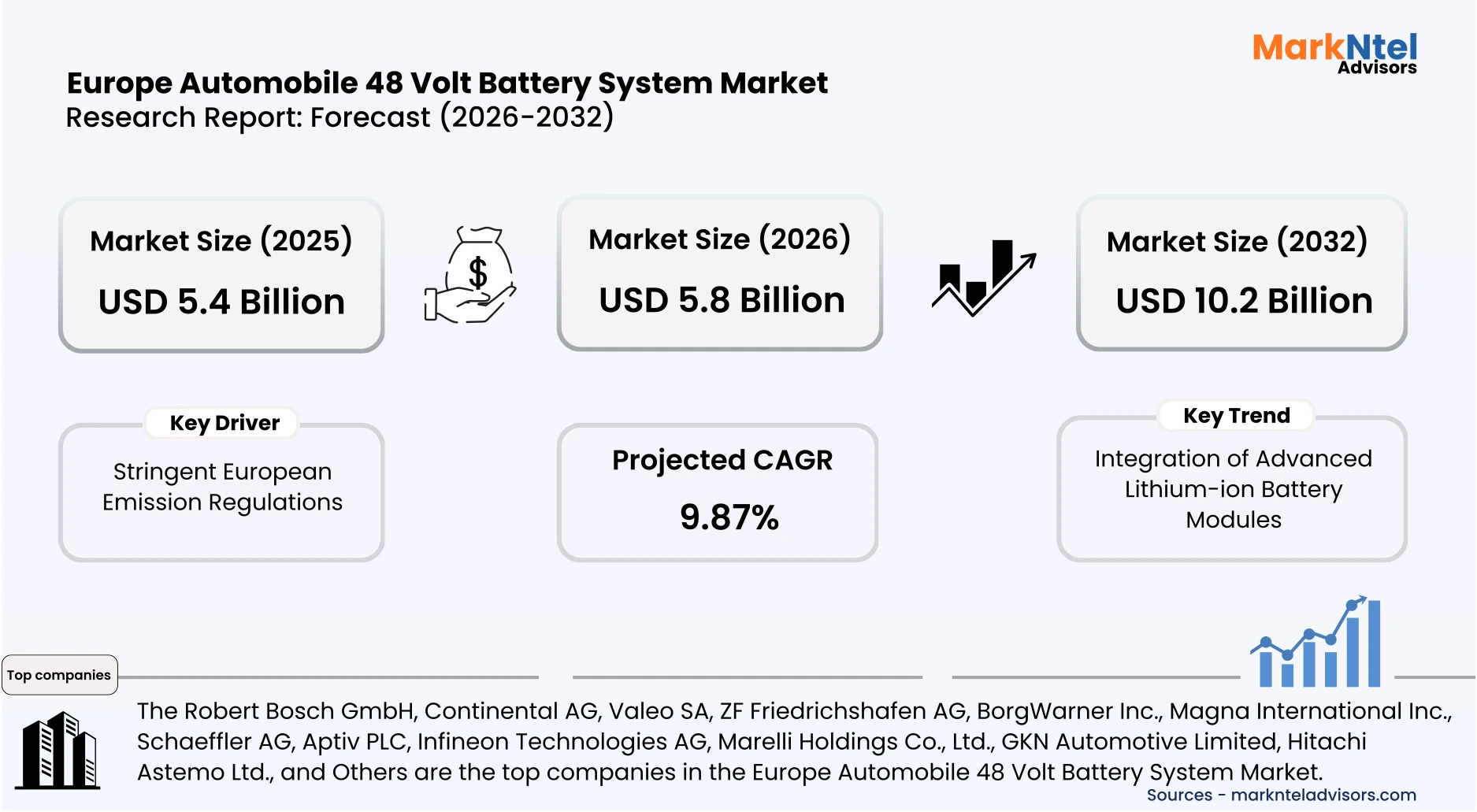
- The Europe Automobile 48 Volt Battery System market size was valued at USD 5.4 billion in 2025 and is projected to grow from USD 5.8 billion in 2026 to USD 10.2 billion by 2032, exhibiting a CAGR of 9.87% during the forecast period.
- Germany holds the largest market share of about 31% in 2026.
- By Product Type, the Lithium-Ion (Li-ion) 48 V batteries segment represented a significant share of about 60% in the Europe Automobile 48 Volt Battery System Industry in 2026.
- By Vehicle Type, the Passenger Vehicles captured a significant share of about 80% in the Europe Automobile 48 Volt Battery System Market in 2026.
- Leading companies are Robert Bosch GmbH, Continental AG, Valeo SA, ZF Friedrichshafen AG, BorgWarner Inc., Magna International Inc., Schaeffler AG, Aptiv PLC, Infineon Technologies AG, Marelli Holdings Co., Ltd., GKN Automotive Limited, Hitachi Astemo Ltd., and Others.
Market Insights & Analysis: Europe Automobile 48 Volt Battery System Market (2026-32):
The Europe Automobile 48 Volt Battery System Market size was valued at around USD 5.4 billion in 2025 and is projected to grow from USD 5.8 billion in 2026 to USD 10.2 billion by 2032. Along with this, the market is estimated to grow at a CAGR of around 9.87% during the forecast period, i.e., 2026-32.
The Europe automobile 48‑volt battery system market is poised for significant growth, driven by stringent vehicle emission regulations and rising adoption of electrification technologies. Across the region, governments are tightening CO₂ standards to achieve climate targets, compelling automakers to integrate cost-effective solutions such as 48‑volt mild-hybrid systems into their vehicle portfolios. In France, for instance, CO₂-based taxation and electrification incentives are key policy tools. The country enforces a progressive “malus” registration tax that can reach USD 65,000 for vehicles emitting over 193 g CO₂/km, directly encouraging the deployment of low-emission technologies. France also aligns with EU regulations that set the fleet-average emission target at 93.6 g CO₂/km by 2025, incentivizing automakers to adopt mild-hybrid and electrified components to improve efficiency .
Technology advancement is a critical driver of market expansion. Automakers are increasingly integrating advanced lithium-ion 48‑volt battery modules with compact, high-efficiency designs to enhance mild-hybrid vehicle performance. In March 2025, Valeo SA showcased its expanded 48‑volt electrification technologies, including integrated battery and power electronics systems, at the IAA Mobility 2025 event. These solutions help OEMs meet stringent emissions standards by optimizing energy recuperation and reducing fuel consumption in mild-hybrid platforms.
Future investments are set to accelerate market growth further. The European Commission and European Investment Bank (EIB) launched a partnership to strengthen Europe’s battery ecosystem, providing a USD 218 million guarantee under the InvestEU program, alongside USD 1.09 billion in grants and additional EIB financing that could mobilize approximately USD 3.27 billion in public support for battery manufacturing projects. These funds are intended to expand domestic battery production, reduce dependence on imports, and support the deployment of vehicle electrification technologies across multiple platforms.
The convergence of regulatory pressure, technological innovation, and substantial investment underscores a robust outlook for the 48‑volt battery market in Europe. As emission standards tighten and electrification technologies become more efficient and cost-effective, mild-hybrid vehicles equipped with 48‑volt systems are likely to see widespread adoption across passenger cars and light commercial vehicles. Combined with continued investment in domestic battery manufacturing, the market is well-positioned for sustained growth through 2030 and beyond.
Overall, Europe’s regulatory framework, coupled with advanced lithium-ion module integration and strategic investments in battery production, ensures that 48‑volt mild-hybrid systems will play a central role in vehicle electrification. The market is expected to expand steadily as automakers adopt these technologies to meet emissions targets and improve vehicle efficiency.
Europe Automobile 48 Volt Battery System Market Recent Developments:
- 2025: Toyota Motor Corporation introduced the Land Cruiser Hybrid 48V for the European market, integrating a compact 48-volt mild-hybrid battery system with a diesel powertrain. The system improves fuel efficiency, enables regenerative braking, and enhances acceleration while maintaining off-road capability. European customer deliveries began in late 2025 .
Europe Automobile 48 Volt Battery System Market Scope:
| Category | Segments |
|---|---|
| By Battery Type | (Lithium Ion (Li ion) 48 V Batteries, Nickel Metal Hydride (NiMH) 48 V Batteries, Lead Acid 48 V Batteries, Solid State 48 V Batteries), |
| By Vehicle Type | (Passenger Vehicles, Light Commercial Vehicles, Heavy Commercial Vehicles), |
| By Application | (Start Stop Systems, Regenerative Braking Support, Electric Turbocharger Assist (Torque Boost), Auxiliary Power Supply, Electric Power Steering & Chassis Systems, Mild Hybrid Electric Vehicles (MHEVs)), |
| By Component Type | (Batteries, DC/DC Converters, Starter-Generators, Inverters, Others), |
| By End User | (Original Equipment Manufacturers (OEMs), Aftermarket Upgrades & Retrofits), |
Europe Automobile 48 Volt Battery System Market Driver:
Stringent European Emission Regulations
Strict emission policies across Europe are significantly accelerating the adoption of automobile 48-volt battery systems. The European Commission implemented binding CO₂ limits under Regulation (EU) 2019/631, requiring vehicle manufacturers to reduce emissions from newly registered passenger cars and light commercial vehicles. Under this framework, the EU established a fleet-wide emission target of 95 g CO₂/km for passenger cars during 2020–2024, with the requirement becoming stricter from 2025 at around 93.6 g CO₂/km. These tightening standards are pushing automakers to integrate efficiency-enhancing technologies, including mild-hybrid powertrains supported by 48-volt battery systems.
The regulatory framework is further reinforced by long-term climate commitments under the European Green Deal, which aims to make the region climate-neutral by 2050. EU legislation mandates that emissions from new passenger cars must decline by 55% by 2030 compared with 2021 levels, and the policy establishes a 100% reduction target by 2035, effectively requiring all newly sold vehicles to be zero-emission. This transition is critical because the transport sector accounts for approximately one-quarter of total greenhouse-gas emissions in the European Union, highlighting the need for rapid decarbonization of road mobility.
Since full battery-electric vehicles require higher investments and infrastructure expansion, many manufacturers are adopting 48-volt mild-hybrid systems as an intermediate electrification solution. These systems improve fuel efficiency and reduce emissions while keeping vehicle costs competitive. As regulatory milestones tighten between 2025 and 2030, the integration of 48-volt battery architectures across European vehicle platforms is expected to accelerate.
Stricter emission mandates and long-term decarbonization goals are compelling automakers to electrify powertrains at scale. As a cost-effective transitional technology, 48-volt battery systems will experience rising deployment across European vehicles to help manufacturers meet evolving regulatory thresholds.
Europe Automobile 48 Volt Battery System Market Trend:
Integration of Advanced Lithium-ion Battery Modules
A key technological trend in the Europe automobile 48‑volt battery system market is the integration of advanced, compact 48 V battery modules that improve efficiency and support electrified vehicle functions. In July 2025, FORVIA HELLA successfully launched its 48 V Flatpack battery module designed specifically for mild‑hybrid vehicles. This highly integrated module combines the battery management system (BMS) and DC/DC converter into a single compact unit, which enhances energy efficiency, reduces system weight, and saves valuable vehicle space. It also supports critical auxiliary systems such as electric power steering, air conditioning, and other electrical loads that are increasingly demanded by modern vehicle designs.
The Flatpack module entered series production for European passenger cars, reflecting automotive OEMs’ shift toward standardized, modular electrification components that can be deployed across global platforms. By integrating key power electronics with the battery pack, suppliers help automakers simplify vehicle architecture and improve overall fuel efficiency, a priority given stringent regional emissions standards and fuel‑economy regulations. As European countries progressively tighten CO₂ limits and incentivize mild‑hybrid adoption, modules like the 48 V Flatpack are increasingly preferred for balancing cost, performance, and manufacturability.
Overall, the move toward highly integrated 48 V modules such as FORVIA HELLA’s Flatpack demonstrates how battery system innovations are shaping electrification strategies in Europe, making mild‑hybrid technology more efficient, scalable, and cost‑effective for manufacturers.
Europe Automobile 48 Volt Battery System Market Opportunity:
Electrification of Light Commercial Vehicle Fleets
The electrification of light commercial vehicle (LCV) fleets is a compelling opportunity for the Europe automobile 48‑volt battery system market. Under EU climate policy, light commercial vehicles such as vans are subject to increasingly tight CO₂ emission performance standards, with targets becoming stricter from 2025 onward and moving toward net‑zero emissions by 2035. This regulatory pressure encourages fleet operators to transition from internal combustion engine (ICE) vans to electrified and hybrid alternatives. For example, electric vans accounted for about 7.8% of new van registrations in the EU in 2023, reflecting a growing shift toward low‑emission commercial vehicles. However, the share of electric vans slightly dipped to 5.9% in 2024, indicating continued growth potential as infrastructure and incentives improve .
Light commercial vehicles represent a high‑usage segment where efficiency gains translate directly to operational cost savings, especially for logistics and delivery companies operating in urban environments. Although fully battery‑electric vans are increasing, mild‑hybrid and electrified solutions such as 48‑volt systems offer a transitional pathway that improves fuel economy and reduces emissions with lower upfront costs than full electrification. As CO₂ targets tighten further toward 2030, fleet electrification efforts are expected to accelerate significantly.
Growing regulatory requirements and operational cost benefits make light commercial fleet electrification a strategic opportunity for 48‑volt system adoption, complementing the broader shift toward sustainable mobility in Europe.
Europe Automobile 48 Volt Battery System Market Challenge:
Volatile Raw Material Prices
Raw material cost volatility poses a significant challenge for the Europe automobile 48‑volt battery system market due to its strong reliance on critical minerals used in lithium‑ion batteries. According to the International Energy Agency (IEA), raw materials now account for 50–70% of total lithium‑ion battery costs, meaning fluctuations in mineral prices can significantly affect the economics of battery systems. For example, a doubling of lithium or nickel prices could increase overall battery costs by about 6%, while simultaneous price spikes would completely offset expected cost declines from increased production capacity. This volatility directly influences the price stability and profitability of mild‑hybrid battery systems in the automotive sector.
Europe’s dependence on imported critical materials further exacerbates this challenge. The region lacks domestic refining capacity for key components like lithium and natural graphite, relying heavily on imports from Chile, Australia, and China, which introduces geopolitical supply risks and exposes manufacturers to global price swings. Sharp historical price shifts underline this risk. Lithium prices surged nearly ninefold between 2021 and 2022 before declining by up to 80%, and other battery metals like nickel and cobalt also experienced significant fluctuations. These swings have led to both temporary cost increases and sharp reductions in battery pack prices, creating an unpredictable investment environment.
The result is that automakers and suppliers face uncertainty in cost forecasting and supply contracts, making long‑term production planning challenging.
Overall, raw material price volatility, driven by concentrated global supply chains and shifting demand patterns, threatens to destabilize battery cost structures and complicate the deployment of 48‑volt systems in Europe, making cost management and supply diversification critical for sustainable market growth.
Europe Automobile 48 Volt Battery System Market (2026-32) Segmentation Analysis:
The Europe Automobile 48 Volt Battery System Market study of MarkNtel Advisors evaluates & highlights the major trends and influencing factors in each segment. It includes predictions for the period 2026–32 at the regional level. Based on the analysis, the market has been further classified as;
Based on Battery Type:
-
- Lithium Ion (Li ion) 48 V Batteries
- Nickel Metal Hydride (NiMH) 48 V Batteries
- Lead Acid 48 V Batteries
- Solid State 48 V Batteries
Lithium-ion 48-volt batteries hold the leading share in the Europe automobile 48 V battery system market, accounting for nearly 60% of the total revenue. Their dominance is mainly linked to performance efficiency and compatibility with mild-hybrid architectures used by European automakers. Compared with nickel-metal hydride or lead-acid systems, Li-ion batteries deliver higher energy density and lower weight, enabling better fuel-efficiency improvements when integrated with 48-volt starter-generator systems. European OEMs have increasingly adopted these batteries in mild-hybrid platforms to meet strict emission regulations such as Euro 7 targets and fleet-average CO₂ reduction requirements.
In addition, Li-ion technology supports faster charge–discharge cycles, which improves regenerative braking energy recovery and overall vehicle electrical stability. Battery manufacturers and Tier-1 suppliers have also expanded Li-ion module production in Europe to support localized electrification supply chains. These operational advantages, combined with declining lithium-ion battery costs and improved thermal management systems, continue to strengthen the technology’s adoption in 48-volt architectures across multiple passenger and light commercial vehicle platforms.
Based on Vehicle Type:
-
- Passenger Vehicles
- Light Commercial Vehicles
- Heavy Commercial Vehicles
Passenger vehicles represent the dominant vehicle category in the Europe automobile 48-volt battery system market, accounting for nearly 80% of total adoption. The segment’s leadership stems from the widespread integration of 48-volt mild-hybrid systems in compact cars, sedans, and sport utility vehicles across the region. European automakers increasingly use 48-volt architectures to enhance fuel efficiency without the high cost associated with full hybrid or battery-electric powertrains. This approach allows manufacturers to meet tightening emissions regulations while maintaining competitive vehicle pricing for mass-market customers. Passenger vehicles also incorporate a higher number of electronic subsystems, such as electric power steering, active chassis control, and electric turbochargers, which benefit from the additional power provided by 48-volt systems.
Furthermore, consumer demand for fuel-efficient vehicles with improved driving performance continues to encourage OEMs to integrate mild-hybrid technology into mainstream passenger car platforms. As a result, the large production volumes of passenger vehicles across European automotive markets continue to drive the majority of 48-volt battery system installations.
Europe Automobile 48 Volt Battery System Market (2026-32): Regional Projection
The Europe automobile 48‑volt battery system market is dominated by Germany, accounting for approximately 31% of the regional market value. Germany’s leadership stems from its position as Europe’s largest automotive manufacturing hub, hosting major OEMs such as Volkswagen AG, Mercedes-Benz Group AG, and BMW AG, which are actively integrating 48‑volt mild-hybrid systems to comply with tightening emission standards. Germany is intensifying its climate policy under the Climate Protection Act, maintaining a legally binding emissions ceiling of 661.6 million tonnes CO₂-equivalent in 2025, with actual emissions around 648.9 million tonnes. The transport sector, being a major contributor, has pressured automakers to adopt electrified drivetrains.
Furthermore, Germany raised its carbon price on fuels to USD 60 in 2025, incentivizing low-emission mobility. High consumer awareness, strong regulatory enforcement, and advanced automotive infrastructure encourage rapid adoption of hybrid and electrified vehicles, including 48‑volt systems, solidifying Germany’s dominance in the European market.
Gain a Competitive Edge with Our Europe Automobile 48 Volt Battery System Market Report:
- Europe Automobile 48 Volt Battery System Market Report by MarkNtel Advisors provides a detailed & thorough analysis of market size & share, growth rate, competitive landscape, and key players. This comprehensive analysis helps businesses gain a holistic understanding of the market dynamics & make informed decisions.
- This report also highlights current market trends & future projections, allowing businesses to identify emerging opportunities & potential challenges. By understanding market forecasts, companies can align their strategies & stay ahead of the competition.
- Europe Automobile 48 Volt Battery System Market Report aids in assessing & mitigating risks associated with entering or operating in the market. By understanding market dynamics, regulatory frameworks, and potential challenges, businesses can develop strategies to minimize risks & optimize their operations.
*Reports Delivery Format - Market research studies from MarkNtel Advisors are offered in PDF, Excel and PowerPoint formats. Within 24 hours of the payment being successfully received, the report will be sent to your email address.
Frequently Asked Questions
- Market Segmentation
- Introduction
- Product Definition
- Research Process
- Assumptions
- Executive Summary
- Europe Automobile 48 Volt Battery System Market Policies, Regulations, and Product Standards
- Europe Automobile 48 Volt Battery System Market Trends & Developments
- Europe Automobile 48 Volt Battery System Market Dynamics
- Growth Factors
- Challenges
- Europe Automobile 48 Volt Battery System Market Hotspot & Opportunities
- Europe Automobile 48 Volt Battery System Market Outlook, 2022-2032F
- Market Size & Outlook
- By Revenues (USD Million)
- Market Share & Analysis
- By Battery Type- Market Size & Forecast 2022-2032, USD Million
- Lithium Ion (Li ion) 48 V Batteries
- Nickel Metal Hydride (NiMH) 48 V Batteries
- Lead Acid 48 V Batteries
- Solid State 48 V Batteries
- By Vehicle Type - Market Size & Forecast 2022-2032, USD Million
- Passenger Vehicles
- Light Commercial Vehicles
- Heavy Commercial Vehicles
- By Application - Market Size & Forecast 2022-2032, USD Million
- Start Stop Systems
- Regenerative Braking Support
- Electric Turbocharger Assist (Torque Boost)
- Auxiliary Power Supply
- Electric Power Steering & Chassis Systems
- Mild Hybrid Electric Vehicles (MHEVs)
- By Component Type- Market Size & Forecast 2022-2032, USD Million
- Batteries
- DC/DC Converters
- Starter-Generators
- Inverters
- Others
- By End User- Market Size & Forecast 2022-2032, USD Million
- Original Equipment Manufacturers (OEMs)
- Aftermarket Upgrades & Retrofits
- By Country
- France
- Germany
- Spain
- Italy
- Benelux
- UK
- Rest of Europe
- By Company
- Competition Characteristics
- Market Share & Analysis
- By Battery Type- Market Size & Forecast 2022-2032, USD Million
- Market Size & Outlook
- France Automobile 48 Volt Battery System Market Outlook, 2022-2032F
- Market Size & Outlook
- By Revenues (USD Million)
- Market Share & Analysis
- By Battery Type- Market Size & Forecast 2022-2032, USD Million
- By Vehicle Type - Market Size & Forecast 2022-2032, USD Million
- By Application - Market Size & Forecast 2022-2032, USD Million
- By Component Type- Market Size & Forecast 2022-2032, USD Million
- By End User- Market Size & Forecast 2022-2032, USD Million
- Market Size & Outlook
- Germany Automobile 48 Volt Battery System Market Outlook, 2022-2032F
- Market Size & Outlook
- By Revenues (USD Million)
- Market Share & Analysis
- By Battery Type- Market Size & Forecast 2022-2032, USD Million
- By Vehicle Type - Market Size & Forecast 2022-2032, USD Million
- By Application - Market Size & Forecast 2022-2032, USD Million
- By Component Type- Market Size & Forecast 2022-2032, USD Million
- By End User- Market Size & Forecast 2022-2032, USD Million
- Market Size & Outlook
- Spain Automobile 48 Volt Battery System Market Outlook, 2022-2032F
- Market Size & Outlook
- By Revenues (USD Million)
- Market Share & Analysis
- By Battery Type- Market Size & Forecast 2022-2032, USD Million
- By Vehicle Type - Market Size & Forecast 2022-2032, USD Million
- By Application - Market Size & Forecast 2022-2032, USD Million
- By Component Type- Market Size & Forecast 2022-2032, USD Million
- By End User- Market Size & Forecast 2022-2032, USD Million
- Market Size & Outlook
- Italy Automobile 48 Volt Battery System Market Outlook, 2022-2032F
- Market Size & Outlook
- By Revenues (USD Million)
- Market Share & Analysis
- By Battery Type- Market Size & Forecast 2022-2032, USD Million
- By Vehicle Type - Market Size & Forecast 2022-2032, USD Million
- By Application - Market Size & Forecast 2022-2032, USD Million
- By Component Type- Market Size & Forecast 2022-2032, USD Million
- By End User- Market Size & Forecast 2022-2032, USD Million
- Market Size & Outlook
- Benelux Automobile 48 Volt Battery System Market Outlook, 2022-2032F
- Market Size & Outlook
- By Revenues (USD Million)
- Market Share & Analysis
- By Battery Type- Market Size & Forecast 2022-2032, USD Million
- By Vehicle Type - Market Size & Forecast 2022-2032, USD Million
- By Application - Market Size & Forecast 2022-2032, USD Million
- By Component Type- Market Size & Forecast 2022-2032, USD Million
- By End User- Market Size & Forecast 2022-2032, USD Million
- Market Size & Outlook
- UK Automobile 48 Volt Battery System Market Outlook, 2022-2032F
- Market Size & Outlook
- By Revenues (USD Million)
- Market Share & Analysis
- By Battery Type- Market Size & Forecast 2022-2032, USD Million
- By Vehicle Type - Market Size & Forecast 2022-2032, USD Million
- By Application - Market Size & Forecast 2022-2032, USD Million
- By Component Type- Market Size & Forecast 2022-2032, USD Million
- By End User- Market Size & Forecast 2022-2032, USD Million
- Market Size & Outlook
- Europe Automobile 48 Volt Battery System Market Key Strategic Imperatives for Success & Growth
- Competitive Outlook
- Company Profiles
- Robert Bosch GmbH
- Business Description
- Product Portfolio
- Collaborations & Alliances
- Recent Developments
- Financial Details
- Others
- Continental AG
- Business Description
- Product Portfolio
- Collaborations & Alliances
- Recent Developments
- Financial Details
- Others
- Valeo SA
- Business Description
- Product Portfolio
- Collaborations & Alliances
- Recent Developments
- Financial Details
- Others
- ZF Friedrichshafen AG
- Business Description
- Product Portfolio
- Collaborations & Alliances
- Recent Developments
- Financial Details
- Others
- BorgWarner Inc.
- Business Description
- Product Portfolio
- Collaborations & Alliances
- Recent Developments
- Financial Details
- Others
- Magna International Inc.
- Business Description
- Product Portfolio
- Collaborations & Alliances
- Recent Developments
- Financial Details
- Others
- Schaeffler AG
- Business Description
- Product Portfolio
- Collaborations & Alliances
- Recent Developments
- Financial Details
- Others
- Aptiv PLC
- Business Description
- Product Portfolio
- Collaborations & Alliances
- Recent Developments
- Financial Details
- Others
- Infineon Technologies AG
- Business Description
- Product Portfolio
- Collaborations & Alliances
- Recent Developments
- Financial Details
- Others
- Marelli Holdings Co., Ltd.
- Business Description
- Product Portfolio
- Collaborations & Alliances
- Recent Developments
- Financial Details
- Others
- GKN Automotive Limited
- Business Description
- Product Portfolio
- Collaborations & Alliances
- Recent Developments
- Financial Details
- Others
- Hitachi Astemo Ltd.
- Business Description
- Product Portfolio
- Collaborations & Alliances
- Recent Developments
- Financial Details
- Others
- Others
- Business Description
- Product Portfolio
- Collaborations & Alliances
- Recent Developments
- Financial Details
- Others
- Robert Bosch GmbH
- Company Profiles
- Disclaimer
MarkNtel Advisors follows a robust and iterative research methodology designed to ensure maximum accuracy and minimize deviation in market estimates and forecasts. Our approach combines both bottom-up and top-down techniques to effectively segment and quantify various aspects of the market. A consistent feature across all our research reports is data triangulation, which examines the market from three distinct perspectives to validate findings. Key components of our research process include:
1. Scope & Research Design At the outset, MarkNtel Advisors define the research objectives and formulate pertinent questions. This phase involves determining the type of research—qualitative or quantitative—and designing a methodology that outlines data collection methods, target demographics, and analytical tools. They also establish timelines and budgets to ensure the research aligns with client goals.
2. Sample Selection and Data Collection In this stage, the firm identifies the target audience and determines the appropriate sample size to ensure representativeness. They employ various sampling methods, such as random or stratified sampling, based on the research objectives. Data collection is carried out using tools like surveys, interviews, and observations, ensuring the gathered data is reliable and relevant.
3. Data Analysis and Validation Once data is collected, MarkNtel Advisors undertake a rigorous analysis process. This includes cleaning the data to remove inconsistencies, employing statistical software for quantitative analysis, and thematic analysis for qualitative data. Validation steps are taken to ensure the accuracy and reliability of the findings, minimizing biases and errors.

4. Data Forecast and FinalizationThe final phase involves forecasting future market trends based on the analyzed data. MarkNtel Advisors utilize predictive modeling and time series analysis to anticipate market behaviors. The insights are then compiled into comprehensive reports, featuring visual aids like charts and graphs, and include strategic recommendations to inform client decision-making
We offer flexible licensing options to cater to varying organizational needs. Choose the pricing pack that best suits your requirements:
Buy Now Inquire Before Buying
 Request Customization
 Talk to our Consultant







