

Southeast Asia EHR and EMR Solutions Market Research Report: Forecast (2026-2032)
Southeast Asia EHR and EMR Solutions Market - By Product Type (EHR (Electronic Health Records), Longitudinal patient health records, Interoperable across departments and facilitie ... s, Population health management, Integrated clinical & administrative modules, Others), EMR (Electronic Medical Records), Facility-specific patient records, Episode-based clinical documentation, Others), By Deployment Mode (Cloud-Based, Public cloud, Private cloud, Others, On-Premise, Hospital/clinic-hosted servers, Local data center deployment, Others, Hybrid), By Component (Software, Core EMR/EHR platform, Clinical modules (documentation, CPOE, e-prescribing), Administrative modules (scheduling, billing), Interoperability engines / HIE connectors, Patient portals, Others, Services, Implementation & System Integration, Customization / Configuration, Training & Change Management, Maintenance & Technical Support, Data Migration & Upgrades, Others), By Application / Functionality (Clinical Applications, Clinical documentation & progress notes, Clinical decision support (CDSS), Care planning & workflow management, CPOE, Lab & diagnostic test ordering, Medication ordering, Radiology & imaging orders, E-Prescribing, Digital prescription generation, Allergy and drug interaction checks, Pharmacy connectivity, Patient Management, Registration, ADT (admission, discharge, transfer), Appointment scheduling, Referral management, Billing & Revenue Cycle Management, Charge capture, Insurance claims processing, Payment processing, Reporting & Analytics, Clinical, operational, financial reporting, Quality, compliance, KPI dashboards), By End User (Hospitals, Public hospitals (MOH-run), Private hospitals, Tertiary & multi-specialty hospitals, Clinics, Primary care clinics, Specialty outpatient clinics, Physician group practices, Diagnostic Centers, Pathology laboratories, Radiology & imaging centers, Specialty Centers, Oncology, cardiology, orthopedics, dental, ophthalmology), By Ownership (Public, Ministry of Health hospitals, Government clinics, National health system facilities, Teaching/public academic hospitals, Private, Corporate hospital chains, Independent hospitals Read more
- Healthcare
- Dec 2025
- Pages 168
- Report Format: PDF, Excel, PPT
Southeast Asia EHR and EMR Solutions Market
Projected 10.47% CAGR from 2026 to 2032
Study Period
2026-2032
Market Size (2025)
USD 1.32 Billion
Market Size (2032)
USD 2.65 Billion
Base Year
2025
Projected CAGR
10.47%
Leading Segments
By Product Type: EHR (Electronic Health Records)
Southeast Asia EHR and EMR Solutions Market Report Key Takeaways:
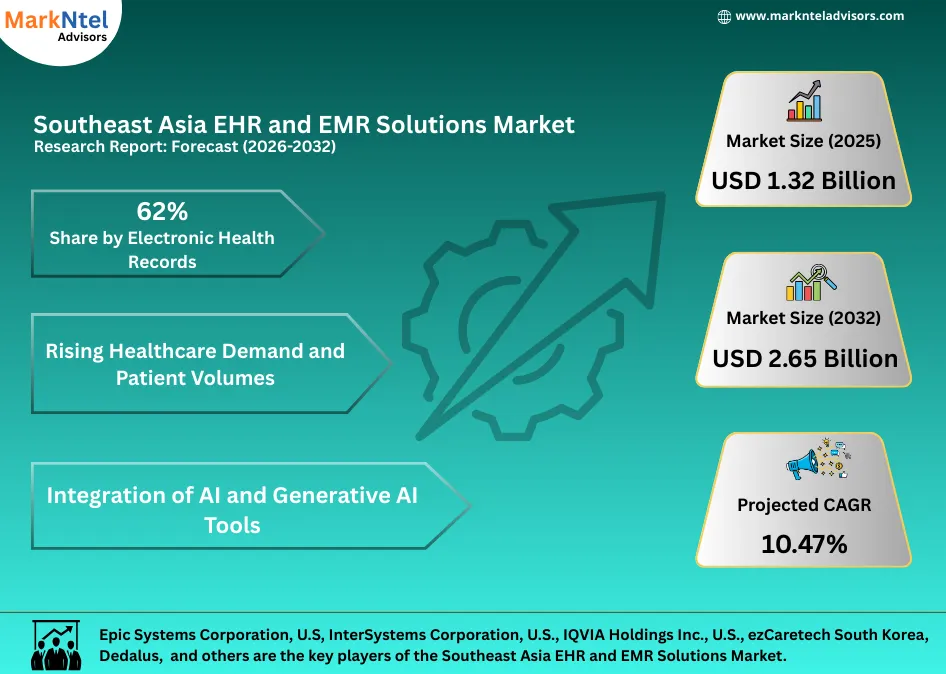
- The Southeast Asia EHR and EMR Solutions Market size is valued at around USD 1.32 billion in 2025 and is projected to reach USD 2.65 billion by 2032. The estimated CAGR from 2026 to 2032 is around 10.47%, indicating strong growth.
- By Product Type, the EHR (Electronic Health Records) segment holds 62% share of the Southeast Asia EHR and EMR Solutions Market in 2025.
- By Component, the software represented 67% of the Southeast Asia EHR and EMR Solutions Market size in 2025.
- By Deployment, the cloud-based deployment holds 47% market share in 2025.
- By End User, the hospitals represented 55% of the Southeast Asia EHR and EMR Solutions Market size in 2025.
- The leading EHR and EMR Solutions companies in Southeast Asia are Epic Systems Corporation, U.S, InterSystems Corporation, U.S., IQVIA Holdings Inc., U.S., ezCaretech South Korea, Dedalus, Oncoshot, Oracle Health, Napier Healthcare, Meditech, and others.
Market Insights & Analysis: Southeast Asia EHR and EMR Solutions Market (2026-2032):
The Southeast Asia EHR and EMR Solutions Market size is valued at around USD 1.32 billion in 2025 and is projected to reach USD 2.65 billion by 2032. Along with this, the market is estimated to grow at a CAGR of around 10.47% during the forecast period, i.e., 2026-32.
The Southeast Asia EHR and EMR Solutions Market is experiencing rapid growth, supported by rising patient volumes across healthcare systems and the growing integration of AI and generative-AI technologies to enhance clinical efficiency, documentation accuracy, and data-driven care delivery.
In Malaysia, the Ministry of Health’s Health Facts 2025 highlights more than 1.71 million hospital admissions in 2024, alongside millions of outpatient encounters across public hospitals and primary care facilities. Sustained care volumes strain manual records, increasing fragmentation risks and driving demand for EMRs that enable continuity, rapid data access, and coordinated clinical decisions.
Indonesia reflects a similar scale challenge. By mid-2025, the national JKN insurance programme recorded 14.02 million healthcare visits among subsidized beneficiaries, including over 12 million outpatient consultations and nearly 1.84 million inpatient admissions. Such a scale requires integrated EHR platforms enabling real-time data access, claims processing, and seamless cross-facility coordination.
Thailand’s healthcare system also illustrates utilization-driven digitization needs. Official data show more than 176.5 million outpatient visits in 2024, averaging roughly 3.75 visits per capita, largely due to chronic and non-communicable disease management. These patterns require longitudinal records tracking treatments, diagnostics, and outcomes.
Singapore faces parallel pressures from an ageing population. Acute hospital admissions exceeded 620,000 in 2023, with patients aged 65 and above accounting for more than 40% of admissions. This demographic shift intensifies demand for interoperable EHRs that enable seamless data sharing across acute, community, and long-term care settings.
These rising hospital admissions drive hospitals to hold about 55% market share, as high patient volumes and complex, multi-department workflows require interoperable EHR/EMR systems to manage acute and chronic care efficiently.
Beyond volume-driven adoption, the integration of AI and generative AI tools is shaping the next phase of market evolution. For instance, Vietnam’s Ministry of Health has approved AITRICS' predictive software that analyses EMR data to anticipate patient deterioration, including early sepsis detection, while seamlessly integrating with existing EHR clinical workflows.
Further, cloud-based deployment accounts for about 47% of the market, driven by lower upfront costs, scalability, faster implementation, remote access, and government support for secure, interoperable digital health infrastructure.
Looking ahead, government-led digital health initiatives are set to accelerate market growth. For example, Vietnam’s Ministry of Health is executing Decision 5316/QD-BYT, targeting over 90% EMR adoption in public facilities and a national health data center by 2030, mandating interoperable electronic records across all care levels and driving demand for advanced EHR/EMR platforms.
Similarly, Cambodia’s Ministry of Health, together with DHIS2 partners, is finalizing a 2026–2030 digital health architecture that integrates EMRs with HMIS, immunization, and supply-chain systems, strengthening nationwide interoperability.
Rising patient volumes, ageing populations, AI-enabled clinical workflows, and government-mandated digital health strategies collectively position EHR and EMR solutions as foundational infrastructure for Southeast Asia’s healthcare systems over the coming decade.
Southeast Asia EHR and EMR Solutions Market Recent Developments:
- September 2025: InterSystems announced early adoption of its AI-native EHR, IntelliCare™, in Indonesia, positioning the country as a regional frontrunner in advanced digital health systems. The solution integrates AI-driven clinical workflows, real-time data sharing, and decision support to reduce clinician workload and enhance care delivery efficiency.
- June 2025: FPT signed its first EMR Cloud contract with Ho Chi Minh City Oncology Hospital, backed by VietinBank, marking a key step in Vietnam’s healthcare digitalisation. The cloud-based system integrates with core hospital systems to digitize records, improve data interoperability, and enhance clinical workflows across both hospital campuses.
Southeast Asia EHR and EMR Solutions Market Scope:
| Category | Segments |
|---|---|
| By Product Type | EHR (Electronic Health Records), Longitudinal patient health records, Interoperable across departments and facilities, Population health management, Integrated clinical & administrative modules, Others), EMR (Electronic Medical Records), Facility-specific patient records, Episode-based clinical documentation, Others), |
| By Deployment Mode | Cloud-Based, Public cloud, Private cloud, Others, On-Premise, Hospital/clinic-hosted servers, Local data center deployment, Others, Hybrid), |
| By Component | Software, Core EMR/EHR platform, Clinical modules (documentation, CPOE, e-prescribing), Administrative modules (scheduling, billing), Interoperability engines / HIE connectors, Patient portals, Others, Services, Implementation & System Integration, Customization / Configuration, Training & Change Management, Maintenance & Technical Support, Data Migration & Upgrades, Others), |
| By Application / Functionality | Clinical Applications, Clinical documentation & progress notes, Clinical decision support (CDSS), Care planning & workflow management, CPOE, Lab & diagnostic test ordering, Medication ordering, Radiology & imaging orders, E-Prescribing, Digital prescription generation, Allergy and drug interaction checks, Pharmacy connectivity, Patient Management, Registration, ADT (admission, discharge, transfer), Appointment scheduling, Referral management, Billing & Revenue Cycle Management, Charge capture, Insurance claims processing, Payment processing, Reporting & Analytics, Clinical, operational, financial reporting, Quality, compliance, KPI dashboards), |
| By End User | Hospitals, Public hospitals (MOH-run), Private hospitals, Tertiary & multi-specialty hospitals, Clinics, Primary care clinics, Specialty outpatient clinics, Physician group practices, Diagnostic Centers, Pathology laboratories, Radiology & imaging centers, Specialty Centers, Oncology, cardiology, orthopedics, dental, ophthalmology), |
| By Ownership | Public, Ministry of Health hospitals, Government clinics, National health system facilities, Teaching/public academic hospitals, Private, Corporate hospital chains, Independent hospitals, Private clinics and specialty centers), and others |
Southeast Asia EHR and EMR Solutions Market Drivers:
Rising Healthcare Demand and Patient Volumes
Rising healthcare demand and patient volumes are sharply increasing the need for digital health records across Southeast Asia. For instance, in Vietnam, official data from the Vietnam Social Security authority indicate that total outpatient and inpatient visits exceeded 186.2 million in 2024, representing an increase of around 12.2 million visits compared with 2023. These services accounted for health insurance expenditures of approximately USD 5.63 billion, highlighting both the scale and financial intensity of care delivery.
Complementing this, the Ministry of Health reports more than 170 million outpatient visits and 17 million inpatient treatments annually, reflecting highly complex and frequent clinical interactions that are difficult to manage without structured electronic records.
Furthermore, in the Philippines, healthcare utilization is expanding alongside infrastructure growth. The opening of the outpatient department at Taguig City General Hospital in early 2025 exemplifies rising service capacity, while the government’s Digital Health Strategic Framework 2024–2028 formally embeds electronic medical records to manage increasing patient flows.
Looking beyond 2025, government projections indicate that outpatient and inpatient demand in the Philippines could rise by around 60% by 2040, driven by ageing populations and non-communicable diseases, alongside continued hospital expansions in Singapore and Vietnam.
Overall, accelerating patient volumes, ageing demographics, and expanding healthcare infrastructure are compelling providers to replace manual systems, positioning EHR and EMR platforms as critical enablers of scalable, efficient, and coordinated care delivery.
Southeast Asia EHR and EMR Solutions Market Trends:
Integration of AI and Generative AI Tools
The integration of artificial intelligence, particularly generative AI, into EHR and EMR platforms is emerging as a transformative trend across Southeast Asia. Governments are increasingly formalizing AI use within clinical workflows to address clinician workload and data management challenges.
Singapore’s Ministry of Health has announced plans to scale generative AI tools across the public healthcare system by the end of 2025, focusing on automated clinical documentation and real-time record updates. This initiative is supported by the government’s USD 112 million Enterprise Compute programme, which aims to accelerate AI adoption by expanding access to advanced computing infrastructure.
Healthcare providers are strengthening digital infrastructure to support AI integration. For instance, in 2025, Indonesia’s Siloam Hospitals migrated core systems to Amazon Web Services and implemented AI-based clinical note summarization within EMRs.
Operational benefits from AI-linked EMRs are increasingly evident. In Singapore, Ng Teng Fong General Hospital improved appropriate patient discharge identification by about 45% using AI integrated with electronic records. Meanwhile, Indonesia’s EMC Healthcare is adopting an AI-driven EMR with ambient documentation, automated follow-ups, and AI-assisted coding.
With government backing, cloud readiness, and early clinical success, AI-enabled EHR and EMR systems are moving rapidly from pilots to scaled adoption, positioning generative AI as a key trend for sustained market growth across Southeast Asia.
Southeast Asia EHR and EMR Solutions Market Challenges:
Data Privacy, Cybersecurity, and Compliance Risks
Data privacy, cybersecurity, and regulatory compliance risks represent a significant challenge to EHR/EMR adoption across Southeast Asia. For example, in Singapore, reported public-sector data leak incidents reached 201 cases in 2023, prompting stricter oversight and the proposal of a Health Information Bill mandating breach notifications and stronger security safeguards.
In parallel, the Ministry of Health issued formal Cyber and Data Security Guidelines in December 2023, requiring healthcare providers to meet defined technical, governance, and risk-management standards before connecting to national health systems.
Across the region, cyber incidents have demonstrated tangible operational risks. In Vietnam, a hospital ransomware attack reported in October 2024 encrypted core systems and disrupted clinical services, highlighting how cyber vulnerabilities can directly affect patient care when electronic records become inaccessible.
Academic research further confirms the sector’s exposure, with 2024 studies documenting thousands of healthcare data breaches globally, frequently linked to misconfigurations, compromised credentials, and ransomware attacks.
Escalating cyber threats and tightening regulatory requirements raise implementation costs, slow decision-making, and may delay large-scale EHR/EMR rollouts, particularly cloud-based and interoperable systems, until robust security frameworks are firmly established.
Southeast Asia EHR and EMR Solutions Market (2026-32) Segmentation Analysis:
The Southeast Asia EHR and EMR Solutions Market Report and Forecast 2026-2032 offers a detailed analysis of the market based on the following segments:
Based on Product Type
- EHR (Electronic Health Records)
- Longitudinal patient health records
- Interoperable across departments and facilities
- Population health management
- Integrated clinical & administrative modules
- Others
- EMR (Electronic Medical Records)
- Facility-specific patient records
- Episode-based clinical documentation
- Others
The EHR (Electronic Health Records) segment holds the top spot in the Southeast Asia EHR and EMR Solutions Market, holding around 62% market share, primarily due to its ability to support comprehensive, longitudinal patient records across multiple care settings.
Unlike EMRs, which are typically confined to single facilities and episode-based documentation, EHR systems enable seamless data exchange across departments, hospitals, laboratories, and specialist clinics. This interoperability is increasingly critical as healthcare systems manage ageing populations, chronic diseases, and higher referral volumes that require continuity of care.
EHR platforms also support population health management by aggregating patient data for disease surveillance, preventive care planning, and outcomes monitoring capabilities that align closely with national digital health strategies across Southeast Asia.
Additionally, the integration of clinical and administrative modules, such as billing, scheduling, and insurance claims, enhances operational efficiency for large hospital networks and public health systems.
Government mandates for interoperable electronic records and investments in national health information exchanges further strengthen EHR adoption, positioning the segment ahead of EMR solutions that remain limited in scope and scalability.
Based on Component
- Software
- Core EMR/EHR platform
- Clinical modules (documentation, CPOE, e-prescribing)
- Administrative modules (scheduling, billing)
- Interoperability engines / HIE connectors
- Patient portals
- Others
- Services
- Implementation & System Integration
- Customization / Configuration
- Training & Change Management
- Maintenance & Technical Support
- Data Migration & Upgrades
- Others
The software category leads the Southeast Asia EHR and EMR Solutions Industry, accounting for 67% market share, reflecting its central role in enabling digital healthcare delivery. Core EMR/EHR platforms form the foundation of hospital digitalization, supporting clinical documentation, computerized physician order entry (CPOE), and e-prescribing across care settings. Demand is further strengthened by administrative modules such as scheduling, billing, and insurance integration, which streamline workflows and reduce manual processes.
Interoperability engines and health information exchange (HIE) connectors are increasingly critical as governments mandate data sharing across facilities and care levels, driving higher software adoption. Patient portals also contribute to growth by supporting appointment management, access to records, and patient engagement.
Compared with services, software represents a one-time or periodically upgraded investment that scales across multiple facilities, particularly in large hospital networks and public systems. As healthcare providers prioritize interoperable, AI-ready, and cloud-enabled platforms, spending remains concentrated on software solutions, reinforcing their dominance over implementation and support services.
Southeast Asia EHR and EMR Solutions Market (2026-32): Regional Projection
The Southeast Asia EHR and EMR Solutions Market is dominated by Singapore, driven by its highly digitized healthcare system, strong regulatory framework, and early adoption of nationwide health IT infrastructure.
The country has implemented a national electronic health record (NEHR) system that enables secure data sharing across public and private healthcare providers, supporting continuity of care and clinical efficiency. High healthcare spending per capita, widespread broadband connectivity, and a digitally mature hospital ecosystem further accelerate adoption.
Government-led initiatives, including mandatory participation in national health data exchange frameworks and clear cybersecurity and data governance guidelines, have reinforced trust in electronic records. Singapore’s ageing population and high chronic disease burden also increase the need for interoperable, longitudinal patient records across acute, community, and long-term care settings.
Compared with other Southeast Asian countries, Singapore’s advanced policy execution, funding capacity, and strong public–private collaboration position it as the leading market for EHR and EMR solutions in the region.
Gain a Competitive Edge with Our Southeast Asia EHR and EMR Solutions Market Report
- Southeast Asia EHR and EMR Solutions Market Report by MarkNtel Advisors provides a detailed & thorough analysis of market size & share, growth rate, competitive landscape, and key players. This comprehensive analysis helps businesses gain a holistic understanding of the market dynamics & make informed decisions.
- This report also highlights current market trends & future projections, allowing businesses to identify emerging opportunities & potential challenges. By understanding market forecasts, companies can align their strategies & stay ahead of the competition.
- Southeast Asia EHR and EMR Solutions Market Report aids in assessing & mitigating risks associated with entering or operating in the market. By understanding market dynamics, regulatory frameworks, and potential challenges, businesses can develop strategies to minimize risks & optimize their operations.
*Reports Delivery Format - Market research studies from MarkNtel Advisors are offered in PDF, Excel and PowerPoint formats. Within 24 hours of the payment being successfully received, the report will be sent to your email address.
Frequently Asked Questions
- Market Segmentation
- Introduction
- Market Definition
- Research Process
- Assumptions
- Executive Summary
- Southeast Asia EHR and EMR Solutions Market Trends & Development
- Southeast Asia EHR and EMR Solutions Market Dynamics
- Growth Drivers
- Challenges
- Southeast Asia EHR and EMR Solutions Market Regulations, Policies & Standards
- Southeast Asia EHR and EMR Solutions Market Hotspots & Opportunities
- Southeast Asia EHR and EMR Solutions Market Outlook, 2022-2032F
- Market Size & Analysis
- By Revenues (USD Million)
- Market Share & Analysis
- By Product Type - Market Size & Forecast 2022-2032, USD Million
- EHR (Electronic Health Records)
- Longitudinal patient health records
- Interoperable across departments and facilities
- Population health management
- Integrated clinical & administrative modules
- Others
- EMR (Electronic Medical Records)
- Facility-specific patient records
- Episode-based clinical documentation
- Others
- EHR (Electronic Health Records)
- By Deployment Mode - Market Size & Forecast 2022-2032, USD Million
- Cloud-Based
- Public cloud
- Private cloud
- Others
- On-Premise
- Hospital/clinic-hosted servers
- Local data center deployment
- Others
- Hybrid
- Cloud-Based
- By Component - Market Size & Forecast 2022-2032, USD Million
- Software
- Core EMR/EHR platform
- Clinical modules (documentation, CPOE, e-prescribing)
- Administrative modules (scheduling, billing)
- Interoperability engines / HIE connectors
- Patient portals
- Others
- Services
- Implementation & System Integration
- Customization / Configuration
- Training & Change Management
- Maintenance & Technical Support
- Data Migration & Upgrades
- Others
- Software
- By Application / Functionality - Market Size & Forecast 2022-2032, USD Million
- Clinical Applications
- Clinical documentation & progress notes
- Clinical decision support (CDSS)
- Care planning & workflow management
- CPOE
- Lab & diagnostic test ordering
- Medication ordering
- Radiology & imaging orders
- E-Prescribing
- Digital prescription generation
- Allergy and drug interaction checks
- Pharmacy connectivity
- Patient Management
- Registration, ADT (admission, discharge, transfer)
- Appointment scheduling
- Referral management
- Billing & Revenue Cycle Management
- Charge capture
- Insurance claims processing
- Payment processing
- Reporting & Analytics
- Clinical, operational, financial reporting
- Quality, compliance, KPI dashboards
- Clinical Applications
- By End User - Market Size & Forecast 2022-2032, USD Million
- Hospitals
- Public hospitals (MOH-run)
- Private hospitals
- Tertiary & multi-specialty hospitals
- Clinics
- Primary care clinics
- Specialty outpatient clinics
- Physician group practices
- Diagnostic Centers
- Pathology laboratories
- Radiology & imaging centers
- Specialty Centers
- Oncology, cardiology, orthopedics, dental, ophthalmology
- Hospitals
- By Ownership- Market Size & Forecast 2022-2032, USD Million
- Public
- Ministry of Health hospitals
- Government clinics
- National health system facilities
- Teaching/public academic hospitals
- Private
- Corporate hospital chains
- Independent hospitals
- Private clinics and specialty centers
- Public
- By Country
- Malaysia
- Indonesia
- Singapore
- Cambodia
- Vietnam
- Thailand
- Philippines
- Others
- By Company
- Competition Characteristics
- Market Share of Leading Companies
- By Product Type - Market Size & Forecast 2022-2032, USD Million
- Market Size & Analysis
- Malaysia EHR and EMR Solutions Market Outlook, 2022-2032F
- Market Size & Analysis
- By Revenues (USD Million)
- Market Share & Analysis
- By Product Type - Market Size & Forecast 2022-2032, USD Million
- By Deployment Mode - Market Size & Forecast 2022-2032, USD Million
- By Component - Market Size & Forecast 2022-2032, USD Million
- By Application / Functionality - Market Size & Forecast 2022-2032, USD Million
- By End User - Market Size & Forecast 2022-2032, USD Million
- By Ownership- Market Size & Forecast 2022-2032, USD Million
- Market Size & Analysis
- Indonesia EHR and EMR Solutions Market Outlook, 2022-2032F
- Market Size & Analysis
- By Revenues (USD Million)
- Market Share & Analysis
- By Product Type - Market Size & Forecast 2022-2032, USD Million
- By Deployment Mode - Market Size & Forecast 2022-2032, USD Million
- By Component - Market Size & Forecast 2022-2032, USD Million
- By Application / Functionality - Market Size & Forecast 2022-2032, USD Million
- By End User - Market Size & Forecast 2022-2032, USD Million
- By Ownership- Market Size & Forecast 2022-2032, USD Million
- Market Size & Analysis
- Singapore EHR and EMR Solutions Market Outlook, 2022-2032F
- Market Size & Analysis
- By Revenues (USD Million)
- Market Share & Analysis
- By Product Type - Market Size & Forecast 2022-2032, USD Million
- By Deployment Mode - Market Size & Forecast 2022-2032, USD Million
- By Component - Market Size & Forecast 2022-2032, USD Million
- By Application / Functionality - Market Size & Forecast 2022-2032, USD Million
- By End User - Market Size & Forecast 2022-2032, USD Million
- By Ownership- Market Size & Forecast 2022-2032, USD Million
- Market Size & Analysis
- Cambodia EHR and EMR Solutions Market Outlook, 2022-2032F
- Market Size & Analysis
- By Revenues (USD Million)
- Market Share & Analysis
- By Product Type - Market Size & Forecast 2022-2032, USD Million
- By Deployment Mode - Market Size & Forecast 2022-2032, USD Million
- By Component - Market Size & Forecast 2022-2032, USD Million
- By Application / Functionality - Market Size & Forecast 2022-2032, USD Million
- By End User - Market Size & Forecast 2022-2032, USD Million
- By Ownership- Market Size & Forecast 2022-2032, USD Million
- Market Size & Analysis
- Vietnam EHR and EMR Solutions Market Outlook, 2022-2032F
- Market Size & Analysis
- By Revenues (USD Million)
- Market Share & Analysis
- By Product Type - Market Size & Forecast 2022-2032, USD Million
- By Deployment Mode - Market Size & Forecast 2022-2032, USD Million
- By Component - Market Size & Forecast 2022-2032, USD Million
- By Application / Functionality - Market Size & Forecast 2022-2032, USD Million
- By End User - Market Size & Forecast 2022-2032, USD Million
- By Ownership- Market Size & Forecast 2022-2032, USD Million
- Market Size & Analysis
- Thailand EHR and EMR Solutions Market Outlook, 2022-2032F
- Market Size & Analysis
- By Revenues (USD Million)
- Market Share & Analysis
- By Product Type - Market Size & Forecast 2022-2032, USD Million
- By Deployment Mode - Market Size & Forecast 2022-2032, USD Million
- By Component - Market Size & Forecast 2022-2032, USD Million
- By Application / Functionality - Market Size & Forecast 2022-2032, USD Million
- By End User - Market Size & Forecast 2022-2032, USD Million
- By Ownership- Market Size & Forecast 2022-2032, USD Million
- Market Size & Analysis
- Philippines EHR and EMR Solutions Market Outlook, 2022-2032F
- Market Size & Analysis
- By Revenues (USD Million)
- Market Share & Analysis
- By Product Type - Market Size & Forecast 2022-2032, USD Million
- By Deployment Mode - Market Size & Forecast 2022-2032, USD Million
- By Component - Market Size & Forecast 2022-2032, USD Million
- By Application / Functionality - Market Size & Forecast 2022-2032, USD Million
- By End User - Market Size & Forecast 2022-2032, USD Million
- By Ownership- Market Size & Forecast 2022-2032, USD Million
- Market Size & Analysis
- Southeast Asia EHR and EMR Solutions Market Key Strategic Imperatives for Growth & Success
- Competition Outlook
- Company Profiles
- Epic Systems Corporation U.S
- Business Description
- Product Portfolio
- Strategic Alliances or Partnerships
- Recent Developments
- Financial Details
- Others
- InterSystems Corporation U.S.
- Business Description
- Product Portfolio
- Strategic Alliances or Partnerships
- Recent Developments
- Financial Details
- Others
- IQVIA Holdings Inc. U.S
- Business Description
- Product Portfolio
- Strategic Alliances or Partnerships
- Recent Developments
- Financial Details
- Others
- ezCaretech South Korea
- Business Description
- Product Portfolio
- Strategic Alliances or Partnerships
- Recent Developments
- Financial Details
- Others
- Dedalus
- Business Description
- Product Portfolio
- Strategic Alliances or Partnerships
- Recent Developments
- Financial Details
- Others
- Oncoshot
- Business Description
- Product Portfolio
- Strategic Alliances or Partnerships
- Recent Developments
- Financial Details
- Others
- Oracle Health
- Business Description
- Product Portfolio
- Strategic Alliances or Partnerships
- Recent Developments
- Financial Details
- Others
- Napier Healthcare
- Business Description
- Product Portfolio
- Strategic Alliances or Partnerships
- Recent Developments
- Financial Details
- Others
- Meditech
- Business Description
- Product Portfolio
- Strategic Alliances or Partnerships
- Recent Developments
- Financial Details
- Others
- Others
- Epic Systems Corporation U.S
- Company Profiles
- Disclaimer
MarkNtel Advisors follows a robust and iterative research methodology designed to ensure maximum accuracy and minimize deviation in market estimates and forecasts. Our approach combines both bottom-up and top-down techniques to effectively segment and quantify various aspects of the market. A consistent feature across all our research reports is data triangulation, which examines the market from three distinct perspectives to validate findings. Key components of our research process include:
1. Scope & Research Design At the outset, MarkNtel Advisors define the research objectives and formulate pertinent questions. This phase involves determining the type of research—qualitative or quantitative—and designing a methodology that outlines data collection methods, target demographics, and analytical tools. They also establish timelines and budgets to ensure the research aligns with client goals.
2. Sample Selection and Data Collection In this stage, the firm identifies the target audience and determines the appropriate sample size to ensure representativeness. They employ various sampling methods, such as random or stratified sampling, based on the research objectives. Data collection is carried out using tools like surveys, interviews, and observations, ensuring the gathered data is reliable and relevant.
3. Data Analysis and Validation Once data is collected, MarkNtel Advisors undertake a rigorous analysis process. This includes cleaning the data to remove inconsistencies, employing statistical software for quantitative analysis, and thematic analysis for qualitative data. Validation steps are taken to ensure the accuracy and reliability of the findings, minimizing biases and errors.

4. Data Forecast and FinalizationThe final phase involves forecasting future market trends based on the analyzed data. MarkNtel Advisors utilize predictive modeling and time series analysis to anticipate market behaviors. The insights are then compiled into comprehensive reports, featuring visual aids like charts and graphs, and include strategic recommendations to inform client decision-making
We offer flexible licensing options to cater to varying organizational needs. Choose the pricing pack that best suits your requirements:
Buy Now Inquire Before Buying
 Request Customization
 Talk to our Consultant







