

China Amino Acid Surfactants Market Research Report: Growth Drivers & Forecast (2026-2032)
By Type (Glutamate-Based Surfactants, Glycinate-Based Surfactants, Sarcosinate-Based Surfactants, Alaninate-Based Surfactants), By Form (Liquid, Powder, Granules), By Application ( ... Personal Care, Oral Care, Household Cleaning, Industrial Applications), By End-User (Cosmetics, Household Products, Food Industry, Pharmaceuticals, Agricultural Products), and others Read more
- Chemicals
- Feb 2026
- Pages 135
- Report Format: PDF, Excel, PPT
China Amino Acid Surfactants Market
Projected 12.59% CAGR from 2026 to 2032
Study Period
2026-2032
Market Size (2026)
USD 0.48 Billion
Market Size (2032)
USD 0.98 Billion
Base Year
2025
Projected CAGR
12.59%
Leading Segments
By End-User: Cosmetics
China Amino Acid Surfactants Market Report Key Takeaways:
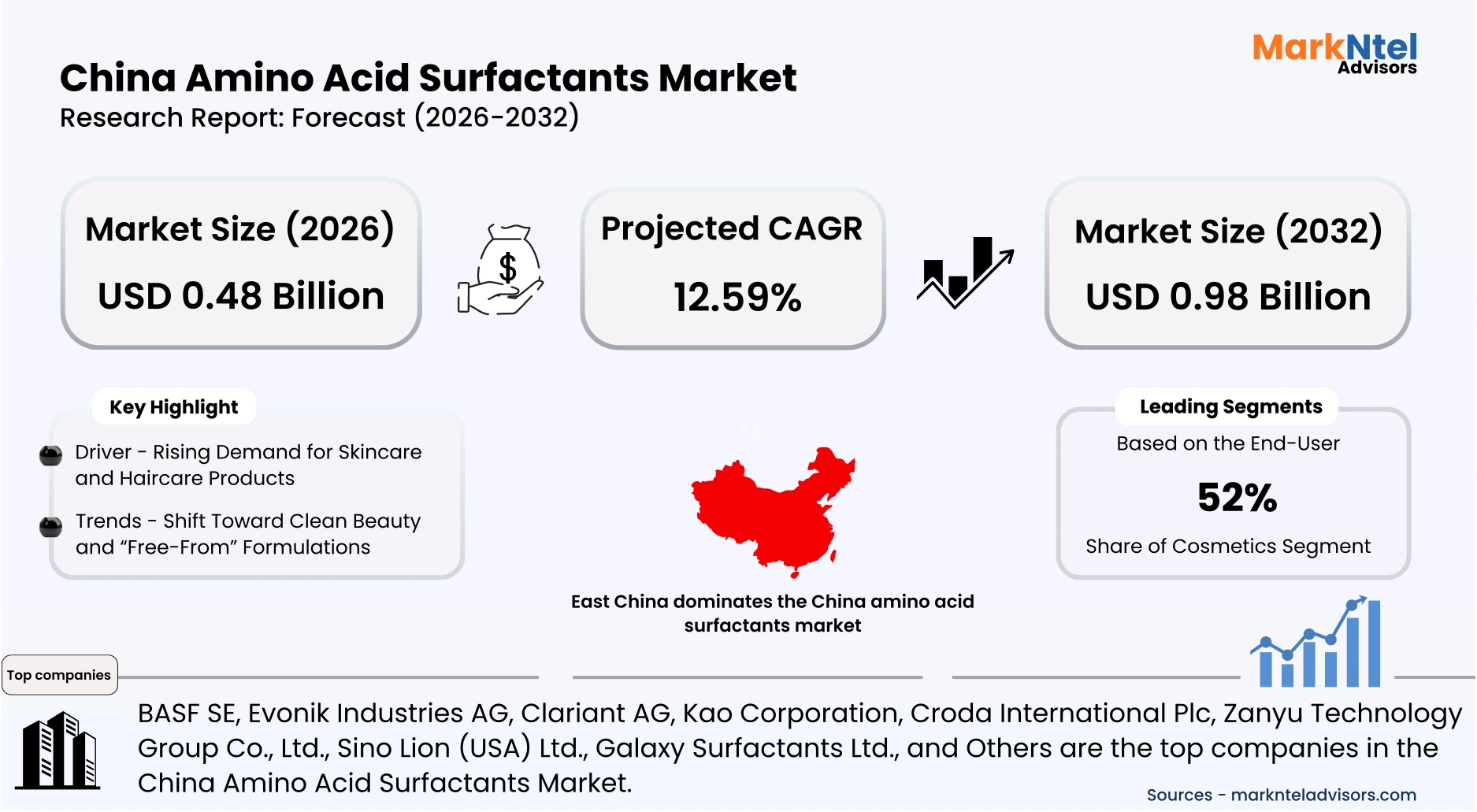
- Market size is estimated at USD 0.48 billion in 2026 and is projected to reach USD 0.98 billion by 2032. The estimated CAGR from 2026 to 2032 is around 12.59%, indicating strong growth.
- The East China is dominating this market with 33% market share in 2026.
- By Type, the Glutamate-Based Surfactants segment represented a significant share of about 38% in the China Amino Acid Surfactants Market in 2026.
- By End-Use, the Cosmetic segment represented a significant share of about 52% in the China Amino Acid Surfactants Market in 2026.
- Leading Amino Acid Surfactants companies in China are BASF SE, Evonik Industries AG, Clariant AG, Kao Corporation, Croda International Plc, Zanyu Technology Group Co., Ltd., Sino Lion (USA) Ltd., Galaxy Surfactants Ltd., and Others.
Market Insights & Analysis: China Amino Acid Surfactants Market (2026-32):
The China Amino Acid Surfactants Market size is estimated at USD 0.48 billion in 2026 and is projected to reach USD 0.98 billion by 2032. Along with this, the market is estimated to grow at a CAGR of around 12.59% during the forecast period, i.e., 2026-32.
China’s amino acid surfactants market has expanded steadily over the past decade, supported by the country’s strong cosmetics and personal care manufacturing base and resilient consumer demand. According to the National Bureau of Statistics, total retail sales of consumer goods reached approximately USD 6.9 trillion in 2025, growing 3.7% year-on-year, with cosmetics sales also recording positive annual growth. As amino acid surfactants are widely used in sulfate-free cleansers and shampoos, sustained consumer spending on skincare and hygiene products has directly supported downstream volume demand. In addition, National Bureau of Statistics indicate that China’s value-added industrial output increased by 5.8% year-on-year in 2025, reinforcing recovery in specialty chemical production .
Market conditions continue to be shaped by regulatory and sustainability priorities under China’s 14th Five-Year Plan (2021–2025), which emphasizes green manufacturing transformation and development of environmentally friendly materials. The Ministry of Ecology and Environment has strengthened pollutant discharge supervision and pollution control measures, encouraging adoption of biodegradable and lower-impact chemical inputs. At the same time, the Cosmetics Supervision and Administration Regulation implemented by the National Medical Products Administration has tightened ingredient safety and compliance standards. These regulatory developments collectively favor mild and environmentally compatible surfactants such as amino acid-based formulations.
End-user demand remains primarily concentrated in cosmetics and personal care manufacturing, which accounts for the largest share of consumption, followed by household cleaning and oral care producers. In 2025, as per the National Bureau of Statistics of China, China’s urbanization rate exceeded 66% , reflecting continued migration to urban centers and rising disposable income levels. This demographic transition supports stronger demand for premium and sensitive-skin formulations that rely on gentle surfactant systems. Institutional and commercial buyers, including healthcare and hospitality facilities, are also gradually adopting milder cleaning agents aligned with hygiene and environmental standards.
Industry investment further strengthens medium-term prospects, with multinational chemical producers expanding localized production and research capabilities in China. BASF continues development of its large-scale Zhanjiang Verbund site, while Evonik has expanded specialty chemical operations to support regional demand and sustainability objectives. Domestic manufacturers are simultaneously upgrading facilities to comply with environmental standards and enhance export competitiveness. Supported by stable consumer growth, regulatory alignment, and ongoing industrial modernization, the China amino acid surfactants market outlook remains positive in the coming years.
China Amino Acid Surfactants Market Recent Developments:
- 2025 : BASF highlighted its new amino acid surfactant Plantapon Amino ASP, designed for gentle yet effective cleansing with strong foaming, at the upcoming Personal Care & Homecare Ingredients show, demonstrating industry innovation in mild surfactants for sensitive skin and sustainable formulations in China’s growing personal-care ingredient market.
- 2025 : Croda International Plc announced a strategic partnership with Amino GmbH to enhance global supply of high-purity pharmaceutical-grade amino acids for biopharma applications. The collaboration supports biologic drug formulation and manufacturing, alongside the upcoming launch of Croda’s BioXPro histidine and arginine range, strengthening its life sciences portfolio and commitment to high-quality ingredients.
China Amino Acid Surfactants Market Scope:
| Category | Segments |
|---|---|
| By Type | (Glutamate-Based Surfactants, Glycinate-Based Surfactants, Sarcosinate-Based Surfactants, Alaninate-Based Surfactants), |
| By Form | (Liquid, Powder, Granules), |
| By Application | (Personal Care, Oral Care, Household Cleaning, Industrial Applications), |
| By End-User | (Cosmetics, Household Products, Food Industry, Pharmaceuticals, Agricultural Products), |
China Amino Acid Surfactants Market Driver:
Rising Demand for Skincare and Haircare Products
The sustained expansion of skincare and haircare consumption remains the most influential structural driver of amino acid surfactant demand. In 2025, China’s total population reached approximately 1.409 billion, with urban residents accounting for over two-thirds of the population, according to the National Bureau of Statistics . Urban households typically demonstrate higher per-capita expenditure on personal care products, particularly facial cleansers and shampoos. This demographic concentration materially increases production volumes of rinse-off formulations that rely on amino acid–based surfactants.
Household income dynamics further reinforce this demand expansion. The World Bank’s 2025 China Economic Update notes continued growth in real disposable income, supporting sustained consumer spending on premium and sensitive-skin products. Additionally, customs data released in 2025 show steady imports of high-end cosmetic products, indicating strong domestic demand for advanced formulations . In 2025, The Estée Lauder Companies reported a 9% year-on-year increase in mainland China net sales to USD532 million, while L’Oréal also returned to positive growth in the market, signaling early recovery in the beauty sector. These developments reflect a structural shift toward higher-quality personal care products rather than short-term cyclical consumption spikes.
Crucially, this driver expands raw material volume rather than simply influencing pricing structures. Higher product penetration rates, increased frequency of use, and reformulation toward sulfate-free systems collectively raise surfactant input per unit of output. Regulatory frameworks under the Cosmetics Supervision and Administration Regulation continue to encourage safer ingredient selection, accelerating substitution toward milder surfactant chemistries. As skincare and haircare manufacturing output rises in tandem with demographic and income growth, amino acid surfactant demand correspondingly expands on a sustained basis.
China Amino Acid Surfactants Market Trend:
Shift Toward Clean Beauty and “Free-From” Formulations
The shift toward clean beauty and “free-from” formulations has become a structural transformation within the personal care industry. In 2025, Chinese authorities introduced 24 reform measures to advance the cosmetics sector, emphasizing product safety, innovation, and higher regulatory standards. These measures strengthen oversight of ingredient compliance and encourage safer alternatives in formulation practices . As scrutiny over synthetic additives increases, manufacturers are accelerating the transition toward milder surfactant systems, including amino acid–based ingredients.
The National Medical Products Administration also released new guidance in 2025 to support innovation in cosmetic ingredients, publishing its first official innovation guidance list. This initiative incentivizes research and filing of safer and functionally differentiated ingredients, reinforcing demand for low-irritation and biodegradable surfactants. Multinational and domestic brands have responded by expanding sulfate-free and dermatologically tested product lines. These shifts are restructuring procurement strategies, pushing suppliers to prioritize transparency, traceability, and higher-purity raw materials.
The trend is expected to persist due to regulatory alignment with environmental governance and evolving consumer expectations for ingredient transparency. As compliance thresholds rise, reformulation becomes a long-term operational requirement rather than a marketing choice. This structural repositioning increases sustained demand for specialty surfactants compatible with clean-label positioning. Consequently, amino acid surfactants are benefiting from a durable transition in formulation standards and industry operating models.
China Amino Acid Surfactants Market Opportunity:
Expansion into Dermo-Cosmetic and Sensitive Skin Products
The expansion into dermo-cosmetic and sensitive skin products offers a substantial structural opportunity for amino acid surfactant suppliers, driven by increasing prevalence of sensitive skin and consumer behavioral shifts toward gentle formulations. A real-world clinical study conducted in China and reported for presentation at the 2025 European Academy of Dermatology and Venereology shows that sensitive skin affects up to 70% of people globally and modern environmental factors heighten skin reactivity, accelerating demand for low-irritation products .
Concurrently, demand for medical aesthetic and dermatology services continues to grow, reshaping skincare consumption patterns. China’s medical aesthetics sector has rapidly risen in prominence with expanding clinics and consumer-driven momentum, indicating increased adoption of post-treatment and professional skincare products that require gentle surfactants. These structural demand shifts translate into higher procurement of mild surfactant systems in clinical-grade and post-procedure skincare formulations.
The segment is particularly advantageous for emerging players because differentiation is driven by formulation science rather than scale economics. Smaller manufacturers can compete through high-purity grades, traceability, and customized solutions tailored for clinical skincare brands. As sensitive-skin prevalence continues to rise globally, reformulation becomes a long-term operational requirement. This creates scalable and defensible growth potential within the premium dermo-cosmetic value chain.
China Amino Acid Surfactants Market Challenge:
Volatility in Amino Acid Raw Material Prices
Volatility in amino acid raw material prices is a critical structural challenge for the China amino acid surfactants market, driven by unstable agricultural commodity dynamics. In 2025, China’s grain output reached a record 714.9 million tons, up 1.2% from 2024, according to the Ministry of Agriculture and Rural Affairs and National Bureau of Statistics . While overall production increased, rapid changes in supply and reduced import dependence caused domestic price fluctuations in key feedstock crops such as corn and other grains used in microbial fermentation for amino acids. These shifts create unpredictability in feedstock costs critical to surfactant production.
Energy cost volatility further exacerbates price uncertainty in production. China reformed electricity pricing in 2025, requiring new renewable power projects to fully market-participate, which introduced variability in on-grid electricity tariffs and industrial energy pricing . This market-oriented pricing mechanism impacts energy costs for fermentation, distillation, and drying processes that are highly electricity-intensive.
The combined effect of fluctuating agricultural inputs and evolving energy price structures restricts long-term planning for manufacturers, particularly small and medium producers without hedging capacity. Feedstock cost instability directly increases production expenses, compresses margins, and dampens investment confidence, limiting capacity expansion and slowing overall market growth for amino acid surfactants.
China Amino Acid Surfactants Market (2026-32) Segmentation Analysis:
The China Amino Acid Surfactants Market study of MarkNtel Advisors evaluates & highlights the major trends and influencing factors in each segment. It includes predictions for the period 2026–32 at the country level. Based on the analysis, the market has been further classified as;
Based on Type:
- Glutamate-Based Surfactants
- Glycinate-Based Surfactants
- Sarcosinate-Based Surfactants
- Alaninate-Based Surfactants
The glutamate-based surfactants segment leads the China amino acid surfactants industry with approximately 38% share due to the country’s globally significant monosodium glutamate (MSG) production base, which provides a stable upstream glutamic acid supply. According to the U.S. International Trade Commission and Federal Register trade reviews in 2025, China remains a major global exporter of MSG, demonstrating substantial industrial-scale production capacity of glutamate derivatives. This large-scale manufacturing ecosystem supports cost efficiencies and raw material accessibility for downstream surfactant production.
China’s well-established fermentation industry infrastructure further strengthens glutamate dominance. Peer-reviewed environmental life-cycle assessments of MSG production in China highlight advanced fermentation optimization and cleaner production improvements over the past decade. These technological efficiencies reduce per-unit production costs and enhance scalability, enabling glutamate-based surfactants to maintain competitive pricing relative to glycinate or sarcosinate alternatives.
Additionally, glutamate derivatives benefit from strong domestic supply chain integration across fermentation plants, chemical processing units, and personal care ingredient manufacturers. The combination of industrial maturity, export-scale production, and supply security positions glutamate-based surfactants as the most commercially viable and widely adopted amino acid type in China.
Based on the End-User:
- Cosmetics
- Household Products
- Food Industry
- Pharmaceuticals
- Agricultural Products
The cosmetics segment dominates the China amino acid surfactants market, accounting for approximately 52% share, primarily due to the scale and resilience of the country’s beauty and personal care industry. According to the National Bureau of Statistics China, cosmetics retail sales reached approximately USD 52.8 billion in December 2025, reflecting an 8.8% year-on-year increase. This sustained consumer spending indicates strong downstream manufacturing activity across cosmetic product categories. As cleansing and formulation systems require surfactant inputs, this retail expansion directly supports raw material demand.
The structural size of the cosmetics manufacturing base further reinforces its dominance over other end-use segments. Cosmetic formulations depend on surfactants as essential functional ingredients for cleansing efficiency, texture stabilization, and skin compatibility. Unlike industrial or agricultural applications where surfactants may serve auxiliary roles, cosmetics production integrates them as core formulation components. This functional dependency results in consistent procurement volumes and recurring supply contracts.
Additionally, regulatory oversight under the Cosmetics Supervision and Administration Regulation strengthens safety and compliance standards for cosmetic ingredients. Reformulation toward milder and biodegradable surfactant systems increases reliance on amino acid–based chemistries. Continuous product launches, reformulation cycles, and inventory replenishment within the cosmetics sector sustain high ingredient turnover. Consequently, the combination of strong retail performance, formulation necessity, and regulatory alignment positions the cosmetics segment as the leading end-use contributor in the China amino acid surfactants market.
China Amino Acid Surfactants Market (2026-32): Regional Projection
East China dominates the China amino acid surfactants market, accounting for approximately 33% market share, primarily due to its strong industrial base and concentration of chemical manufacturing clusters. Provinces such as Jiangsu, Zhejiang, and Shanghai collectively represent some of the country’s largest industrial economies. According to the National Bureau of Statistics, Jiangsu and Zhejiang consistently rank among the top provinces in industrial output value, reflecting dense manufacturing ecosystems. This industrial concentration supports fermentation facilities, specialty chemical plants, and downstream surfactant processing units, enabling cost efficiencies and supply chain integration that outpace inland regions.
The region also benefits from advanced infrastructure and trade connectivity. East China hosts major international ports, including Shanghai and Ningbo-Zhoushan, which rank among the world’s busiest container ports by throughput. High export activity facilitates raw material imports and finished ingredient exports, reducing logistics costs and improving market responsiveness . Additionally, provincial governments in Jiangsu and Zhejiang have implemented green manufacturing and chemical industry upgrading initiatives under national industrial transformation policies, supporting environmentally compliant specialty chemical production.
End-user demand is equally concentrated in East China due to the presence of large cosmetic and personal care manufacturing bases. Shanghai and neighboring provinces host numerous multinational and domestic beauty product manufacturers, creating sustained procurement demand for amino acid surfactants. Higher disposable income levels and strong urban consumption further reinforce local product manufacturing. Consequently, the combination of industrial clustering, infrastructure superiority, policy support, and concentrated end-user presence positions East China as the leading regional contributor to the amino acid surfactants market.
Gain a Competitive Edge with Our China Amino Acid Surfactants Market Report:
- China Amino Acid Surfactants Market Report by MarkNtel Advisors provides a detailed & thorough analysis of market size & share, growth rate, competitive landscape, and key players. This comprehensive analysis helps businesses gain a holistic understanding of the market dynamics & make informed decisions.
- This report also highlights current market trends & future projections, allowing businesses to identify emerging opportunities & potential challenges. By understanding market forecasts, companies can align their strategies & stay ahead of the competition.
- China Amino Acid Surfactants Market Report aids in assessing & mitigating risks associated with entering or operating in the market. By understanding market dynamics, regulatory frameworks, and potential challenges, businesses can develop strategies to minimize risks & optimize their operations.
*Reports Delivery Format - Market research studies from MarkNtel Advisors are offered in PDF, Excel and PowerPoint formats. Within 24 hours of the payment being successfully received, the report will be sent to your email address.
Frequently Asked Questions
- Market Segmentation
- Introduction
- Product Definition
- Research Process
- Assumptions
- Executive Summary
- China Amino Acid Surfactants Market Policies, Regulations, and Product Standards
- China Amino Acid Surfactants Market Trends & Developments
- China Amino Acid Surfactants Market Dynamics
- Growth Factors
- Challenges
- China Amino Acid Surfactants Market Hotspot & Opportunities
- China Amino Acid Surfactants Market Outlook, 2022-2032F
- Market Size & Outlook
- By Revenues (USD Million)
- Market Share & Outlook
- By Type- Market Size & Forecast 2022-2032, USD Million
- Glutamate-Based Surfactants
- Glycinate-Based Surfactants
- Sarcosinate-Based Surfactants
- Alaninate-Based Surfactants
- By Form- Market Size & Forecast 2022-2032, USD Million
- Liquid
- Powder
- Granules
- By Application- Market Size & Forecast 2022-2032, USD Million
- Personal Care
- Oral Care
- Household Cleaning
- Industrial Applications
- By End-User- Market Size & Forecast 2022-2032, USD Million
- Cosmetics
- Household Products
- Food Industry
- Pharmaceuticals
- Agricultural Products
- By Region - Market Size & Forecast 2022-2032, USD Million
- East China
- South China
- North China
- Central China
- North-East China
- South-West China
- By Company
- Competition Characteristics
- Market Share & Analysis
- By Type- Market Size & Forecast 2022-2032, USD Million
- Market Size & Outlook
- China Glutamate-Based Surfactants Market Outlook, 2022-2032
- Market Size & Outlook
- By Revenues (USD Million)
- Market Share & Outlook
- By Form- Market Size & Forecast 2022-2032, USD Million
- By Application- Market Size & Forecast 2022-2032, USD Million
- By End-User- Market Size & Forecast 2022-2032, USD Million
- By Region - Market Size & Forecast 2022-2032, USD Million
- Market Size & Outlook
- China Glycinate-Based Surfactants Market Outlook, 2022-2032
- Market Size & Outlook
- By Revenues (USD Million)
- Market Share & Outlook
- By Form- Market Size & Forecast 2022-2032, USD Million
- By Application- Market Size & Forecast 2022-2032, USD Million
- By End-User- Market Size & Forecast 2022-2032, USD Million
- By Region - Market Size & Forecast 2022-2032, USD Million
- Market Size & Outlook
- China Sarcosinate-Based Surfactants Market Outlook, 2022-2032
- Market Size & Outlook
- By Revenues (USD Million)
- Market Share & Outlook
- By Form- Market Size & Forecast 2022-2032, USD Million
- By Application- Market Size & Forecast 2022-2032, USD Million
- By End-User- Market Size & Forecast 2022-2032, USD Million
- By Region - Market Size & Forecast 2022-2032, USD Million
- Market Size & Outlook
- China Alaninate-Based Surfactants Market Outlook, 2022-2032
- Market Size & Outlook
- By Revenues (USD Million)
- Market Share & Outlook
- By Form- Market Size & Forecast 2022-2032, USD Million
- By Application- Market Size & Forecast 2022-2032, USD Million
- By End-User- Market Size & Forecast 2022-2032, USD Million
- By Region - Market Size & Forecast 2022-2032, USD Million
- Market Size & Outlook
- China Amino Acid Surfactants Market Key Strategic Imperatives for Success & Growth
- Competitive Outlook
- Company Profiles
- BASF SE
- Business Description
- Product Portfolio
- Collaborations & Alliances
- Recent Developments
- Financial Details
- Others
- Evonik Industries AG
- Business Description
- Product Portfolio
- Collaborations & Alliances
- Recent Developments
- Financial Details
- Others
- Clariant AG
- Business Description
- Product Portfolio
- Collaborations & Alliances
- Recent Developments
- Financial Details
- Others
- Kao Corporation
- Business Description
- Product Portfolio
- Collaborations & Alliances
- Recent Developments
- Financial Details
- Others
- Croda International Plc
- Business Description
- Product Portfolio
- Collaborations & Alliances
- Recent Developments
- Financial Details
- Others
- Zanyu Technology Group Co., Ltd.
- Business Description
- Product Portfolio
- Collaborations & Alliances
- Recent Developments
- Financial Details
- Others
- Sino Lion (USA) Ltd.
- Business Description
- Product Portfolio
- Collaborations & Alliances
- Recent Developments
- Financial Details
- Others
- Galaxy Surfactants Ltd.
- Business Description
- Product Portfolio
- Collaborations & Alliances
- Recent Developments
- Financial Details
- Others
- Others
- Business Description
- Product Portfolio
- Collaborations & Alliances
- Recent Developments
- Financial Details
- Others
- BASF SE
- Company Profiles
- Disclaimer
MarkNtel Advisors follows a robust and iterative research methodology designed to ensure maximum accuracy and minimize deviation in market estimates and forecasts. Our approach combines both bottom-up and top-down techniques to effectively segment and quantify various aspects of the market. A consistent feature across all our research reports is data triangulation, which examines the market from three distinct perspectives to validate findings. Key components of our research process include:
1. Scope & Research Design At the outset, MarkNtel Advisors define the research objectives and formulate pertinent questions. This phase involves determining the type of research—qualitative or quantitative—and designing a methodology that outlines data collection methods, target demographics, and analytical tools. They also establish timelines and budgets to ensure the research aligns with client goals.
2. Sample Selection and Data Collection In this stage, the firm identifies the target audience and determines the appropriate sample size to ensure representativeness. They employ various sampling methods, such as random or stratified sampling, based on the research objectives. Data collection is carried out using tools like surveys, interviews, and observations, ensuring the gathered data is reliable and relevant.
3. Data Analysis and Validation Once data is collected, MarkNtel Advisors undertake a rigorous analysis process. This includes cleaning the data to remove inconsistencies, employing statistical software for quantitative analysis, and thematic analysis for qualitative data. Validation steps are taken to ensure the accuracy and reliability of the findings, minimizing biases and errors.

4. Data Forecast and FinalizationThe final phase involves forecasting future market trends based on the analyzed data. MarkNtel Advisors utilize predictive modeling and time series analysis to anticipate market behaviors. The insights are then compiled into comprehensive reports, featuring visual aids like charts and graphs, and include strategic recommendations to inform client decision-making
We offer flexible licensing options to cater to varying organizational needs. Choose the pricing pack that best suits your requirements:
Buy Now Inquire Before Buying
 Request Customization
 Talk to our Consultant







