

Chile IT Spending Market Research Report: Trends, Forecast & Opportunities (2026-2032)
By Components (Software (Enterprise Application Software, Infrastructure Software, Vertical Software, Gen AI Models, Others), Devices (Mobile Phones, Tablets, Desktops, Laptops), D ... ata Centers (Servers, Enterprise Network Equipment, External Controller-Based Software, Others), Communication Services (Unified Communications, Fixed Connectivity, Mobile Connectivity), Services (Consulting, Business Process Services, Infrastructure Implementation & Managed Services, Infrastructure as a Service (IaaS))), By Type of Enterprises (Large Enterprises (Headcount Above 10,000), Mid-Size Enterprises (Headcount 5,000 to 10,000), Small Enterprises (Headcount Up to 5,000)), By End Users (Banking & Financial Services, Manufacturing, Retail & Ecommerce, IT, Telecom & Media, Healthcare, Government or Public Sector, Education, Others), By Deployment Model (Onshore Delivery, Nearshore Delivery, Offshore Delivery), By Engagement Model (Project-based / Fixed Price, Staff Augmentation / Time-and-Material, Managed Services / Outcome-based), and others Read more
- ICT & Electronics
- Apr 2026
- Pages 140
- Report Format: PDF, Excel, PPT
Chile IT Spending Market
Projected 7.4% CAGR from 2026 to 2032
Study Period
2026-2032
Market Size (2026)
USD 6.11 Billion
Market Size (2032)
USD 9.13 Billion
Base Year
2025
Projected CAGR
7.4%
Leading Segments
By Type Enterprises: Large Enterprises
Chile IT Spending Market Key Report Takeaways
- The Chile IT spending market was valued at 5.19 billion in 2025 and is projected to reach USD 9.13 billion by 2032, registering a CAGR of 7.4% over the forecast period. The spending is expected to rise to USD 6.11 billion in 2026, indicating steady year-on-year expansion.
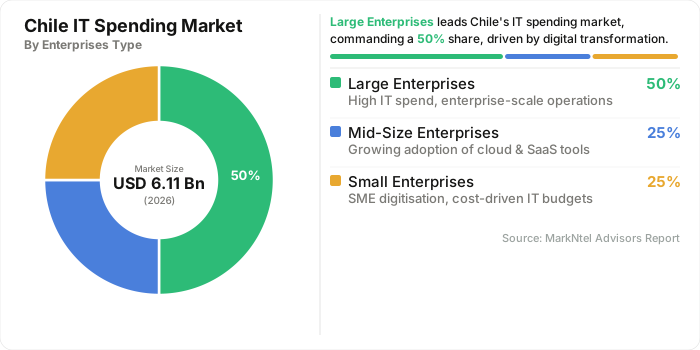
- By type of enterprises, the large enterprises segment contributed a significant share of 50% in 2026.
- By End-User, around 22% of the total spending incurred on the Banking & Financial Services segment in 2026
- Leading Companies of Chile IT spending industry are Entel Chile S.A., Telefónica Chile S.A. (Movistar), Claro Chile S.A., Sonda S.A., Adexus S.A., IBM de Chile S.A.C., Microsoft Chile Ltda., Amazon Web Services Chile SpA, Google Chile SpA, Huawei Technologies Chile S.A., Cisco Systems Chile Ltda., Oracle Chile S.A., SAP Chile S.A., Tata Consultancy Services Chile Limitada, Accenture Chile Ltda., Wipro Technologies Chile SpA, Atos IT Solutions and Services Chile SpA, Capgemini Chile SpA, NTT Data Chile SpA, Deloitte Consulting Chile SpA, and others.
Chile IT Spending Market Size and Outlook
The Chile information & technology (IT) spending market stood at USD 5.19 billion in 2025 and is projected to grow from USD 6.11 billion in 2026 to USD 9.13 billion by 2032, exhibiting a CAGR of 7.4% during 2026–2032.
The expansion of digital transformation across enterprises, public institutions, and industrial sectors is significantly accelerating IT spending growth in Chile. Organizations are increasingly viewing IT budgets as strategic enablers of productivity, efficiency, and competitiveness rather than operational overhead. This shift is particularly evident in mining, banking, and government services, where digital integration is closely tied to economic performance outcomes. As a result, IT spending is becoming more aligned with long-term modernization and national productivity enhancement goals.
Cloud computing adoption is a key growth driver, with enterprises increasingly migrating workloads from on-premise systems to hybrid environments. Chile benefits from the presence of global hyperscale cloud infrastructure, including Microsoft Azure’s Chile Central region and services from Amazon Web Services and Google Cloud. The availability of localized cloud infrastructure supports improved latency performance, data residency requirements, and scalable enterprise workloads. As a result, cloud services are becoming a foundational layer for digital operations across both private and public sector organizations.
Government-led digital transformation is significantly shaping IT demand through structured public sector digitization initiatives. Chile’s digital identity platform Clave Única provides nationwide secure access to public services and is widely used across government systems.
This has increased institutional reliance on secure authentication systems, identity management, and digital service platforms. In parallel, cybersecurity requirements are becoming more prominent as public and private systems become increasingly interconnected.
Emerging technologies such as artificial intelligence, data analytics, and automation are gradually reshaping enterprise IT priorities in Chile. Industrial applications, particularly in mining operations, are adopting predictive analytics and automation tools to improve operational efficiency. For instance, Chile’s mining industry, led by major operators such as CODELCO, is increasingly adopting automation and digital operational technologies to improve efficiency. Retail and logistics sectors are integrating digital platforms to enhance supply chain visibility and customer experience management. Overall, continued digital infrastructure development and enterprise modernization are expected to sustain steady IT spending growth in Chile.
Chile IT Spending Market Key Indicators
- According to ITU-based estimates, Internet penetration in Chile stood at approximately 94% of the population in 2023, placing it among the highest levels in Latin America’s major economies. Near-universal connectivity significantly expands the addressable market for cloud-based applications, SaaS platforms, and digital security solutions.
- Chile’s Subsecretaría de Telecomunicaciones (SUBTEL) reported that 5G users reached 8.2 million in Q2 2025 (up from 5 million in mid-2024), while fiber connections accounted for 74.7% of fixed networks, indicating a rapidly advancing digital infrastructure that is directly accelerating enterprise IT spending on cloud services, IoT deployments, and high-speed data-driven applications across industries.
- Inter-American Development Bank reported in 2023 that digitalization generated savings of USD 154 million in transport costs and USD 259 million in government operations, demonstrating clear efficiency gains that are encouraging both public and private sectors in Chile to increase IT spending on digital platforms, automation, and data-driven systems.
- Microsoft has committed USD 3.3 billion in Chile, projected to generate 81,000 jobs between 2025 and 2029, signaling large-scale digital infrastructure expansion that is accelerating enterprise IT adoption and driving sustained demand for cloud, AI, and data-driven solutions across industries.
Chile IT Spending Market Scope
| Category | Segments |
|---|---|
| By Components | (Software (Enterprise Application Software, Infrastructure Software, Vertical Software, Gen AI Models, Others), Devices (Mobile Phones, Tablets, Desktops, Laptops), Data Centers (Servers, Enterprise Network Equipment, External Controller-Based Software, Others), Communication Services (Unified Communications, Fixed Connectivity, Mobile Connectivity), Services (Consulting, Business Process Services, Infrastructure Implementation & Managed Services, Infrastructure as a Service (IaaS))), |
| By Type of Enterprises | (Large Enterprises (Headcount Above 10,000), Mid-Size Enterprises (Headcount 5,000 to 10,000), Small Enterprises (Headcount Up to 5,000)), |
| By End Users | (Banking & Financial Services, Manufacturing, Retail & Ecommerce, IT, Telecom & Media, Healthcare, Government or Public Sector, Education, Others), |
| By Deployment Model | (Onshore Delivery, Nearshore Delivery, Offshore Delivery), |
| By Engagement Model | (Project-based / Fixed Price, Staff Augmentation / Time-and-Material, Managed Services / Outcome-based), |
Chile IT Spending Market Growth Drivers
Cloud Infrastructure Expansion and Hyper Scaler Entry as a Structural Demand Engine
A key structural driver reshaping Chile’s IT investment is the rapid expansion of cloud infrastructure, where cloud and platform services already account for nearly 30% of total IT revenue share (2024). This reflects a deep transition away from traditional on-premise systems toward scalable, consumption-based digital architectures across both public and private sectors. The shift has been reinforced by enterprise digitalization needs, particularly in data-intensive industries such as banking, retail, and mining, where real-time analytics and secure data processing are becoming operational necessities.
This momentum is being materially strengthened by large-scale hyperscaler investments, most notably Amazon Web Services' planned USD 4 billion cloud region in Chile, expected to become operational around 2026. Such infrastructure deployment is not limited to capacity expansion but also establishes localized data residency, improved latency performance, and enterprise-grade reliability. These factors are critical for regulated workloads in government systems, financial services platforms, and healthcare digitization programs, directly expanding cloud workload migration across multiple end-user segments.
As compared to short-term digital adoption cycles, the cloud infrastructure development creates a persistent and compounding demand base for IT services. Once organizations migrate core workloads into hyperscale environments, they increasingly adopt adjacent services such as cybersecurity, AI-enabled analytics, and managed platform solutions, locking in recurring expenditure. Additionally, the availability of robust local cloud regions accelerates SME digital adoption by lowering entry barriers, thereby widening the total addressable IT expenditure. As a result, cloud infrastructure expansion is not only modernizing Chile’s IT ecosystem but also structurally increasing long-term market volume and expenditure intensity across the economy.
Recent Trends
Submarine Cable Landing Expansion Positioning Chile as a Regional Digital Connectivity Hub
A key structural trend reshaping Chile’s IT spending landscape is the rapid expansion of submarine cable landing infrastructure, positioning the country as a strategic digital gateway for Latin America and trans-Pacific connectivity. This trend has been driven by Chile’s geographic advantage and government-backed initiatives to strengthen international digital connectivity under its broader national digital transformation strategy. A notable development is the Humboldt subsea cable project, a joint initiative supported by Google and Chilean authorities to directly connect Chile with the Asia-Pacific region. This infrastructure significantly enhances international bandwidth capacity, reduces latency, and improves data transmission reliability for cloud and digital services.
The trend is materially transforming enterprise and public-sector IT architecture by enabling high-speed cross-border data flows and supporting hyperscale cloud operations.
With improved connectivity, global cloud providers and data-intensive industries such as fintech, mining analytics, and digital services are expanding localized operations in Chile.
This trend is expected to persist as Chile continues to position itself as a South American digital hub linking Pacific economies with global cloud ecosystems. The long-term deployment of submarine cables like Humboldt ensures structural improvements in bandwidth scalability and network resilience. Combined with growing hyperscale presence in Santiago, this strengthens Chile’s role as a regional data transit and processing node. As a result, submarine cable expansion is permanently reshaping Chile’s IT ecosystem by anchoring long-term digital infrastructure investment and cloud-driven demand growth.
Chile IT Spending Market Opportunities and Challenges
Low SME Productivity and Structural Digitalization Gap Driving IT Adoption in Chile
A key structural challenge in Chile’s IT infrastructure spending is persistently low productivity levels, driven largely by weak digital adoption among small and medium-sized enterprises (SMEs).
SMEs lag significantly in the adoption of advanced digital tools such as ERP systems, cloud computing, and CRM platforms compared to larger firms. This structural divide limits the diffusion of technology and reduces overall economy-wide productivity spillovers.
This challenge is already translating into concrete policy and market responses aimed at accelerating SME digitalization across Chile. Government-led programs such as “Digitaliza tu Pyme,” “Pymes en Línea,” and Corfo’s “Fortalece Pyme” are actively subsidizing and training SMEs to adopt digital tools, e-commerce systems, and management software. OECD findings further show that Chilean SMEs are less likely to use productivity-enhancing digital systems compared to large enterprises, reinforcing the need for structured intervention. This is directly increasing demand for cloud-based ERP platforms, SaaS tools, and affordable automation solutions tailored to small businesses.
This gap is simultaneously creating a strong structural opportunity for IT vendors, as digitalization shifts from an optional investment to a productivity necessity. Recent Chilean digital skills initiatives, such as “Talento Digital paraChile,” are improving workforce readiness and enabling SMEs to adopt more advanced technologies.
Also, SAP’s operations in Chile highlight that enterprises are investing in advanced digital solutions such as ERP and cloud systems at a level comparable to developed economies, reinforcing strong SME digitalization potential and sustained enterprise IT spending growth. At the same time, Chile’s broader inn ovation strategy and low national R&D intensity are pushing firms toward external digital solutions rather than in-house development. As a result, SME digital transformation is becoming a long-term growth engine for IT spending across cloud services, enterprise software, and automation platforms in Chile.
Segmentation Insights
Large Enterprises as the Primary IT Spending Powerhouse in Chile
Large enterprises in Chile, defined as organizations with headcounts above 10,000, lead IT spending with a share of 50% due to their operational scale and compliance requirements. Mining majors like Codelco integrate private clouds with hyperscale regions to ensure disaster recovery and burst capacity. The Framework Law on Cybersecurity and Critical Information Infrastructure (2025) obliges large institutions to modernize IT systems, reinforcing their leadership in digital transformation.
Codelco has partnered with Huawei and Microsoft to deploy AI-driven analytics, IoT sensor integration, and automation in copper mines, enhancing predictive maintenance and operational efficiency. These examples illustrate how Chile’s largest enterprises anchor IT demand through hybrid cloud adoption and advanced analytics.
Partnerships with global IT service providers like Accenture and IBM execute complex migrations, layering predictive analytics over IoT data in mining and retail chains. Edge computing pilots at autonomous haulage sites underscore demand for sub-10-millisecond latency, driving investment in next-generation infrastructure. This structurally entrenched demand makes large enterprises the dominant revenue-generating segment in the enterprise IT spending outlook. By type of enterprises, the market is further subdivided into the following categories:
- Large Enterprises (Headcount Above 10,000)
- Mid-Size Enterprises (Headcount 5,000 to 10,000)
- Small Enterprises (Headcount Up to 5,000)
BFSI as the Core Anchor of Chile’s IT Spending Landscape
The Banking & Financial Services (BFSI) segment dominates Chile’s IT expenditure with a market share of 22% due to a structurally deep digital transformation cycle where banks are becoming the primary buyers of enterprise IT. This leadership is not incidental it is driven by regulatory modernization, fintech disruption, and aggressive digital banking investment cycles, all converging into sustained technology demand.
The core driver is Chile’s rapid shift toward digital-first banking ecosystems, where institutions are investing heavily in mobile banking, core banking modernization, cybersecurity, and API-based open banking systems. Chile is already one of the most digitized banking markets in Latin America, with banks expanding digital channels and reducing reliance on physical branches, which directly increases IT procurement intensity. In parallel, rising fintech competition and regulatory support such as Chile’s Fintech Law are accelerating technology adoption in payments, lending platforms, and compliance systems.
Additionally, the major banks like Banco de Chile and Banco Santander Chile are deploying cloud transformation, AI-driven risk systems, and digital payment ecosystems to improve efficiency and customer experience. For example, digital transformation initiatives in Chilean banks have significantly improved operational efficiency ratios and boosted fee income through digital services and fintech integration. This reflects a clear capital shift: IT spending is no longer support-based but revenue-generating for BFSI institutions.
Sustained dominance is further reinforced by high fintech penetration, strong regulatory oversight by CMF, and rising digital transaction volumes, which now account for the majority of financial operations in Chile. As a result, BFSI remains the most IT-intensive end-user segment, continuously outpacing manufacturing, retail, and government in enterprise technology adoption. By end users the industry is further sub divided into following categories:
- Banking & Financial Services
- Manufacturing
- Retail & Ecommerce
- IT, Telecom & Media
- Healthcare
- Government or Public Sector
- Education
- Others
Chile IT Spending Industry News and Recent Developments
2026: Chile’s Entel Digital launches micro-Edge data center offering alongside Zella DC
Chilean telecom company Entel, through its digital division, has introduced a new micro edge data center solution in partnership with Zella DC. The offering, called EdgeDC, is designed to bring data processing capabilities closer to where data is generated, such as retail sites, branches, and remote operations. This marks a shift from centralized data centers toward distributed infrastructure models. The solution integrates with Entel’s broader cloud, IT, and IoT service portfolio, enabling real-time data processing and improved operational continuity. The initiative also supports emerging workloads like AI inference and edge analytics that require low latency.
Impact analysis: This development signals a structural shift in Chile’s IT spending toward edge computing and decentralized infrastructure, which increases enterprise demand for localized IT investments. By enabling real-time processing at the source, industries such as retail, banking, and telecom will require higher spending on edge hardware, networking, and integrated software platforms. It also accelerates adoption of AI and IoT use cases, which depend on low-latency environments, thereby expanding the overall IT spending base. Additionally, telecom operators like Entel are positioning themselves as full-stack digital service providers, increasing competition and innovation in enterprise IT services. This move strengthens Chile’s digital infrastructure ecosystem and supports the broader transition toward cloud-edge hybrid architectures, reinforcing long-term IT market growth.
2026: Entel partners with Australia’s Zella for modular data centers in Chile
Chilean telecom operator Entel has partnered with Australian firm Zella DC to deploy modular micro data center solutions across Chile. The offering focuses on compact, all-in-one infrastructure units that integrate power, cooling, security, and monitoring within a single system. These modular data centers are designed to be deployed closer to enterprise operations, such as industrial sites, retail outlets, and remote locations. The initiative aims to support decentralized computing needs and enable faster data processing at the edge. It reflects Entel’s strategy to expand beyond connectivity into IT and digital infrastructure services.
Impact Analysis: This development reinforces the shift toward distributed and edge-based IT infrastructure, which is becoming a key driver of Chile’s IT spending growth. By enabling localized data processing, enterprises will increase investments in edge hardware, networking, and integrated IT systems, particularly in sectors like telecom, mining, and retail. It also indicates telecom operators moving up the value chain into enterprise IT services, intensifying competition and expanding the IT ecosystem. Modular deployment reduces time-to-market and capex barriers, accelerating adoption among large enterprises. Overall, this strengthens Chile’s position as an emerging digital infrastructure hub and supports sustained expansion in enterprise IT spending.
2025: Ascenty unveils SCL03 in Chile and plans an AI- ready mega data center campus with USD 1 billion investment
Ascenty, a major Latin American data center operator backed by Digital Realty and Brookfield Infrastructure, has launched its third data center (SCL03) in Santiago, Chile. The facility has a capacity of around 16 MW and is specifically designed for large-scale clients such as cloud providers and digital platforms. The company also announced plans to develop a large-scale campus with additional facilities (SCL04 and SCL05), significantly expanding capacity in the coming years. These future developments are expected to reach nearly 150 MW combined capacity, positioning Chile as a regional digital infrastructure hub. The data centers are fully integrated with cloud providers and internet exchange points, enabling high-speed, low-latency connectivity.
Impact Analysis: This development is a direct, high-impact driver of Chile’s IT spending growth, as hyperscale data center investments form the backbone of enterprise IT infrastructure. The expansion supports rising demand for cloud computing, AI workloads, and large-scale data processing, particularly from BFSI, telecom, and digital platforms. It also indicates strong foreign capital inflow into Chile’s digital economy, reinforcing its position as a Latin American technology hub. As capacity scales up, enterprises will increase spending on cloud migration, cybersecurity, and data-driven applications. Additionally, the AI-ready infrastructure signals a shift toward next-generation IT workloads, further expanding long-term enterprise IT demand. Overall, such mega investments create a multiplier effect across the IT ecosystem, accelerating both infrastructure and software spending in Chile.
2025: Scala secures USD 254 million for Chile data center expansion
Scala Data Centers secured approximately USD254 million in long-term financing to develop three hyperscale data centers and a supporting power substation in Chile. The investment is backed by a consortium of global banks including MUFG, SMBC, BNP Paribas, and Natixis . These facilities will be located across key regions such as Curauma, Lampa, and Huechuraba, strengthening Chile’s digital infrastructure footprint. The project includes an initial IT capacity of around 23 MW, with an additional 30 MW already reserved for future expansion. The infrastructure is designed to support hyperscale clients and operate on renewable energy, aligning with sustainability goals.
Impact analysis: This investment represents a high-impact expansion of Chile’s core IT infrastructure, directly accelerating enterprise IT spending across cloud, storage, and data processing segments. The scale of hyperscale-ready capacity indicates rising demand from large enterprises, BFSI, and global cloud providers, reinforcing Chile’s role as a regional digital hub. It also signals strong foreign capital inflows into the ICT sector, which typically triggers downstream spending on software, cybersecurity, and managed services. Additionally, the integration of renewable energy-backed infrastructure aligns with ESG-driven IT investments, attracting global tech firms. Overall, such large-scale financing creates a multiplier effect, boosting both infrastructure and enterprise-level IT spending in Chile.
2024: Equinix plans USD130 million data center (ST5) in Santiago, Chile
Global data center company Equinix announced plans to build a new facility (ST5) in Santiago, marking its fifth data center in Chile. The project involves an investment of around USD 130 million and will be located in the Pudahuel district. The facility will span over 24,000 sqm and include multiple data rooms, office space, and backup power infrastructure. Construction is expected to begin in 2025, with the first phase operational by 2027. This expansion builds on Equinix’s existing presence in Chile, where it already operates four data centers. The project reflects continued demand for colocation and cloud infrastructure in the region.
Impact analysis: This development is a direct indicator of rising hyperscale and colocation demand in Chile’s IT spending market, particularly from large enterprises and cloud providers. The expansion strengthens Chile’s position as a regional digital infrastructure hub, encouraging enterprises to increase spending on cloud migration and data hosting. It also reflects sustained foreign investment inflows into the ICT sector, which typically drive downstream spending on networking, cybersecurity, and enterprise software. Additionally, the presence of global players like Equinix enhances ecosystem maturity, attracting more multinational clients. Over time, such infrastructure investments create a multiplier effect, boosting both infrastructure and application-level IT spending across BFSI, telecom, and digital services sectors.
Frequently Asked Questions
- Market Segmentation
- Introduction
- Product Definition
- Research Process
- Assumptions
- Executive Summary
- Chile Information & Technology (IT) Spending Market Policies, Regulations, and Product Standards
- Chile Information & Technology (IT) Spending Market Trends & Developments
- Chile Information & Technology (IT) Spending Market Dynamics
- Growth Factors
- Challenges
- Chile Information & Technology (IT) Spending Market Hotspot & Opportunities
- Chile Information & Technology (IT) Spending Market Outlook, 2022-2032F
- Market Size & Outlook
- By Revenues (USD Million)
- Market Share & Outlook
- By Components- Market Size & Forecast 2022-2032, USD Million
- Software
- Enterprise Application Software
- Infrastructure Software
- Vertical Software
- Gen AI Models
- Others
- Devices
- Mobile Phones
- Tablets
- Desktops
- Laptops
- Data Centers
- Servers
- Enterprise Network Equipment
- External Controller-Based Software
- Others
- Communication Services
- Unified Communications
- Fixed Connectivity
- Mobile Connectivity
- Services
- Consulting
- Business Process Services
- Infrastructure Implementation & Managed Services
- Infrastructure as a Service (IaaS)
- Software
- By Type of Enterprises- Market Size & Forecast 2022-2032, USD Million
- Large Enterprises (Headcount Above 10,000)
- Mid-Size Enterprises (Headcount 5,000 to 10,000)
- Small Enterprises (Headcount Up to 5,000)
- By End Users- Market Size & Forecast 2022-2032, USD Million
- Banking & Financial Services
- Manufacturing
- Retail & Ecommerce
- IT, Telecom & Media
- Healthcare
- Government or Public Sector
- Education
- Others
- By Deployment Model- Market Size & Forecast 2022-2032, USD Million
- Onshore Delivery
- Nearshore Delivery
- Offshore Delivery
- By Engagement Model- Market Size & Forecast 2022-2032, USD Million
- Project-based / Fixed Price
- Staff Augmentation / Time-and-Material
- Managed Services / Outcome-based
- By region- Market Size & Forecast 2022-2032, USD Million
- North
- South
- East
- West
- Central
- By Company
- Competition Characteristics
- Market Share & Analysis
- By Components- Market Size & Forecast 2022-2032, USD Million
- Market Size & Outlook
- Chile Software Market Outlook, 2022-2032
- Market Size & Outlook
- By Revenues (USD Million)
- Market Share & Outlook
- By Type of Enterprises- Market Size & Forecast 2022-2032, USD Million
- By End Users- Market Size & Forecast 2022-2032, USD Million
- By Deployment Model- Market Size & Forecast 2022-2032, USD Million
- By Engagement Model- Market Size & Forecast 2022-2032, USD Million
- By region- Market Size & Forecast 2022-2032, USD Million
- Market Size & Outlook
- Chile Services Market Outlook, 2022-2032
- Market Size & Outlook
- By Revenues (USD Million)
- Market Share & Outlook
- By Type of Enterprises- Market Size & Forecast 2022-2032, USD Million
- By End Users- Market Size & Forecast 2022-2032, USD Million
- By Deployment Model- Market Size & Forecast 2022-2032, USD Million
- By Engagement Model- Market Size & Forecast 2022-2032, USD Million
- By region- Market Size & Forecast 2022-2032, USD Million
- Market Size & Outlook
- Chile Data Centers Market Outlook, 2022-2032
- Market Size & Outlook
- By Revenues (USD Million)
- Market Share & Outlook
- By Type of Enterprises- Market Size & Forecast 2022-2032, USD Million
- By End Users- Market Size & Forecast 2022-2032, USD Million
- By Deployment Model- Market Size & Forecast 2022-2032, USD Million
- By Engagement Model- Market Size & Forecast 2022-2032, USD Million
- By region- Market Size & Forecast 2022-2032, USD Million
- Market Size & Outlook
- Chile Communication Services Market Outlook, 2022-2032
- Market Size & Outlook
- By Revenues (USD Million)
- Market Share & Outlook
- By Type of Enterprises- Market Size & Forecast 2022-2032, USD Million
- By End Users- Market Size & Forecast 2022-2032, USD Million
- By Deployment Model- Market Size & Forecast 2022-2032, USD Million
- By Engagement Model- Market Size & Forecast 2022-2032, USD Million
- By region- Market Size & Forecast 2022-2032, USD Million
- Market Size & Outlook
- Chile Devices Market Outlook, 2022-2032
- Market Size & Outlook
- By Revenues (USD Million)
- Market Share & Outlook
- By Type of Enterprises- Market Size & Forecast 2022-2032, USD Million
- By End Users- Market Size & Forecast 2022-2032, USD Million
- By Deployment Model- Market Size & Forecast 2022-2032, USD Million
- By Engagement Model- Market Size & Forecast 2022-2032, USD Million
- By region- Market Size & Forecast 2022-2032, USD Million
- Market Size & Outlook
- Chile Information & Technology (IT) Spending Market Key Strategic Imperatives for Success & Growth
- Competitive Outlook
- Company Profiles
- Cisco Systems Chile Ltda
- Business Description
- Product Portfolio
- Collaborations & Alliances
- Recent Developments
- Financial Details
- Others
- Entel Chile S.A.
- Business Description
- Product Portfolio
- Collaborations & Alliances
- Recent Developments
- Financial Details
- Others
- Telefonica Chile S.A. (Movistar)
- Business Description
- Product Portfolio
- Collaborations & Alliances
- Recent Developments
- Financial Details
- Others
- Claro Chile S.A.
- Business Description
- Product Portfolio
- Collaborations & Alliances
- Recent Developments
- Financial Details
- Others
- Sonda S.A.
- Business Description
- Product Portfolio
- Collaborations & Alliances
- Recent Developments
- Financial Details
- Others
- Adexus S.A.
- Business Description
- Product Portfolio
- Collaborations & Alliances
- Recent Developments
- Financial Details
- Others
- IBM de Chile S.A.C.
- Business Description
- Product Portfolio
- Collaborations & Alliances
- Recent Developments
- Financial Details
- Others
- Microsoft Chile Ltda.
- Business Description
- Product Portfolio
- Collaborations & Alliances
- Recent Developments
- Financial Details
- Others
- Amazon Web Services Chile SpA
- Business Description
- Product Portfolio
- Collaborations & Alliances
- Recent Developments
- Financial Details
- Others
- Google Chile SpA
- Business Description
- Product Portfolio
- Collaborations & Alliances
- Recent Developments
- Financial Details
- Others
- Oracle Chile S.A.
- Business Description
- Product Portfolio
- Collaborations & Alliances
- Recent Developments
- Financial Details
- Others
- SAP Chile S.A.
- Business Description
- Product Portfolio
- Collaborations & Alliances
- Recent Developments
- Financial Details
- Others
- Tata Consultancy Services Chile Limitada
- Business Description
- Product Portfolio
- Collaborations & Alliances
- Recent Developments
- Financial Details
- Others
- Accenture Chile Ltda.
- Business Description
- Product Portfolio
- Collaborations & Alliances
- Recent Developments
- Financial Details
- Others
- Wipro Technologies Chile SpA
- Business Description
- Product Portfolio
- Collaborations & Alliances
- Recent Developments
- Financial Details
- Others
- Atos IT Solutions and Services Chile SpA
- Business Description
- Product Portfolio
- Collaborations & Alliances
- Recent Developments
- Financial Details
- Others
- Capgemini Chile SpA
- Business Description
- Product Portfolio
- Collaborations & Alliances
- Recent Developments
- Financial Details
- Others
- NTT Data Chile SpA
- Business Description
- Product Portfolio
- Collaborations & Alliances
- Recent Developments
- Financial Details
- Others
- Deloitte Consulting Chile SpA
- Business Description
- Product Portfolio
- Collaborations & Alliances
- Recent Developments
- Financial Details
- Others
- Others
- Cisco Systems Chile Ltda
- Company Profiles
- Disclaimer
MarkNtel Advisors follows a robust and iterative research methodology designed to ensure maximum accuracy and minimize deviation in market estimates and forecasts. Our approach combines both bottom-up and top-down techniques to effectively segment and quantify various aspects of the market. A consistent feature across all our research reports is data triangulation, which examines the market from three distinct perspectives to validate findings. Key components of our research process include:
1. Scope & Research Design At the outset, MarkNtel Advisors define the research objectives and formulate pertinent questions. This phase involves determining the type of research—qualitative or quantitative—and designing a methodology that outlines data collection methods, target demographics, and analytical tools. They also establish timelines and budgets to ensure the research aligns with client goals.
2. Sample Selection and Data Collection In this stage, the firm identifies the target audience and determines the appropriate sample size to ensure representativeness. They employ various sampling methods, such as random or stratified sampling, based on the research objectives. Data collection is carried out using tools like surveys, interviews, and observations, ensuring the gathered data is reliable and relevant.
3. Data Analysis and Validation Once data is collected, MarkNtel Advisors undertake a rigorous analysis process. This includes cleaning the data to remove inconsistencies, employing statistical software for quantitative analysis, and thematic analysis for qualitative data. Validation steps are taken to ensure the accuracy and reliability of the findings, minimizing biases and errors.

4. Data Forecast and FinalizationThe final phase involves forecasting future market trends based on the analyzed data. MarkNtel Advisors utilize predictive modeling and time series analysis to anticipate market behaviors. The insights are then compiled into comprehensive reports, featuring visual aids like charts and graphs, and include strategic recommendations to inform client decision-making
We offer flexible licensing options to cater to varying organizational needs. Choose the pricing pack that best suits your requirements:
Buy Now Inquire Before Buying
 Request Customization
 Talk to our Consultant







