

US IT Spending Market Research Report: Trends & Forecast (2026-2032)
By Components (Software (Enterprise Application Software, Infrastructure Software, Vertical Software, Gen AI Models, Others), Devices (Mobile Phones, Tablets, Desktops, Laptops), D ... ata Centers (Servers, Enterprise Network Equipment, External Controller-Based Software, Others), Communication Services (Unified Communications, Fixed Connectivity, Mobile Connectivity), Services (Consulting, Business Process Services, Infrastructure Implementation & Managed Services, Infrastructure as a Service (IaaS))), By Type of Enterprises (Large Enterprises (Headcount Above 10,000), Mid-Size Enterprises (Headcount 5,000 to 10,000), Small Enterprises (Headcount Up to 5,000)), By End Users (Banking & Financial Services, Manufacturing, Retail & Ecommerce, IT, Telecom & Media, Healthcare, Government or Public Sector, Education, Others), By Deployment Model (Onshore Delivery, Nearshore Delivery, Offshore Delivery), By Engagement Model (Project-based / Fixed Price, Staff Augmentation / Time-and-Material, Managed Services / Outcome-based), and others Read more
- ICT & Electronics
- Apr 2026
- Pages 145
- Report Format: PDF, Excel, PPT
US IT Spending Market
Projected 4.79% CAGR from 2026 to 2032
Study Period
2026-2032
Market Size (2026)
USD 1.89 Trillion
Market Size (2032)
USD 2.96 Trillion
Base Year
2025
Projected CAGR
4.79%
Leading Segments
By components: services
US IT Spending Market Key Report Takeaways
- The U.S. IT spending market totaled USD 1.78 trillion in 2025 and is projected to reach USD 2.96 trillion by 2032, registering a CAGR of 4.79% over the forecast period. Spending is expected to rise to USD 1.89 trillion in 2026, indicating steady year-on-year expansion.
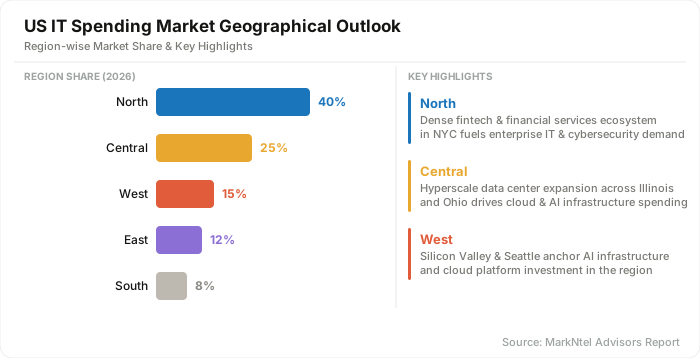
- The North region holds the largest regional share at 40%.
- By components, the services segment is leading the market with a share of 42%, and the software segment is also rapidly growing with a market share of 38%. Additionally, GEN AI models are expected to grow at a CAGR of around 39% during 2026-32, and Explosive growth in Servers is also experienced at a CAGR of 29% during 2026-32.
- By End-User, around 29% of the total spending incurred on the Banking & Financial Services segment in 2026.
- Leading Companies of US IT spending industry are Accenture plc, IBM Corporation, Cognizant Technology Solutions Corp., Tata Consultancy Services Ltd., Microsoft Corporation, Infosys Ltd., Wipro Ltd., Deloitte Consulting LLP, Capgemini SE, HCL Technologies Ltd., Amazon Web Services (AWS), Google Cloud, Oracle, Cisco Systems, Dell Technologies, Hewlett Packard Enterprise (HPE), Broadcom, NVIDIA, and others.
US IT Spending Market Size & Outlook
The US information & technology (IT) spending market was valued at USD 1.78 trillion in 2025 and is projected to grow from USD 1.89 trillion in 2026 to USD 2.96 trillion by 2032, exhibiting a CAGR of 4.79% during 2026–2032.
The rising enterprise digital transformation, innovation in emerging technologies, and sustained demand for cloud and cybersecurity solutions significantly accelerate the growth of the IT Expenditure Market in the United States. Organizations across sectors are increasingly treating IT spending as a strategic investment rather than a cost center, aligning technology budgets closely with business outcomes and revenue growth.
Cloud computing continues to dominate spending priorities, with enterprises accelerating migration from on-premise infrastructure to hybrid and multi-cloud environments. Major providers such as Amazon Web Services, Microsoft Azure, and Google Cloud are capturing a significant share of enterprise budgets. This shift is enabling scalability, operational efficiency, and faster deployment of applications, while also supporting remote and distributed work environments.
Cybersecurity has become a top spending category in the U.S., reflecting heightened concerns over ransomware, data breaches, and regulatory compliance. Enterprises are investing heavily in advanced threat detection, zero-trust architectures, and endpoint protection to safeguard critical infrastructure and sensitive data. Also, government regulations and industry standards are further reinforcing the need for robust security frameworks.
Artificial intelligence and automation are rapidly transforming IT investment strategies. Companies are allocating more budget to AI-driven analytics, generative AI tools, and intelligent automation to enhance productivity, streamline operations, and improve customer experiences. Major U.S. tech companies collectively spent USD155 billion on AI in 2025, with projections exceeding USD 400 billion annually in the near term. This is particularly strong in sectors such as finance, healthcare, and retail, where data-driven insights are critical to maintaining competitive advantage.
A key driver of continued growth in the U.S. IT spending market is the rising investment in software solutions, particularly Software-as-a-Service (SaaS) applications. Enterprises are increasingly adopting cloud-based platforms for critical functions such as enterprise resource planning (ERP), customer relationship management (CRM), and collaboration tools. This shift reflects a broader preference for flexible, scalable, and subscription-based models over traditional on-premise licensing. Leading companies such as Salesforce and Oracle are capitalizing on this transition by expanding their SaaS offerings and strengthening cloud ecosystems.
In parallel, IT services and consulting continue to account for a substantial share of overall spending, driven by the growing complexity of digital transformation initiatives. Organizations are increasingly relying on external expertise to manage areas such as cloud migration, system integration, cybersecurity, and innovation strategies. Prominent players, including Accenture and IBM, play a critical role in enabling enterprises to modernize their IT infrastructure, optimize operations, and accelerate digital adoption.
Overall, the US digital spending landscape is evolving toward a value-driven, innovation-focused model, where investments in cloud, AI, and cybersecurity are central to sustaining long-term competitiveness and resilience.
US IT Spending Market Key Indicators
- The U.S. Census Bureau reported through its 2023 Annual Integrated Economic Survey that Telecommunications (NAICS 517) generated approximately USD 155.9 billion in revenue. Complementary Census datasets indicate that the broader Information sector (NAICS 51) supports a workforce of roughly 1.4 million employees in the U.S. West region. Together, the scale of revenue generation and regional employment concentration across ICT industries reflects the embedded role of digital infrastructure within enterprise operations, underpinning sustained baseline demand for enterprise software, cloud services, and managed IT solutions.
- The National Science Foundation’s National Center for Science and Engineering Statistics reports that U.S. gross domestic expenditure on R&D reached approximately 3.4% of GDP in 2023, with the business sector accounting for roughly three-quarters of total funding and the majority of R&D performance. This sustained level of private-sector dominance reflects the concentration of innovation activity within industry, particularly in software-intensive and digital technology domains where R&D is largely oriented toward experimental development. As a result, elevated business R&D intensity is closely associated with ongoing enterprise investment in application software and IT infrastructure required to support product development, data processing, and digital service delivery across multiple end-use industries.
- The U.S. Office of Management and Budget (OMB) proposed approximately USD 75.1 billion in civilian federal IT spending for fiscal year 2025, representing a 0.93% increase over FY2024 levels. The budget includes 4,446 IT investments across 25 federal agencies, of which 595 are designated as major IT investments requiring enhanced governance and oversight. While this federal framework establishes structured procurement and compliance standards for U.S. government agencies, it indirectly influences enterprise IT governance practices, particularly in regulated sectors such as banking, healthcare, and defense-adjacent industries, through the adoption of federal cybersecurity and procurement frameworks such as NIST and FedRAMP, rather than through direct budgetary replication.
- The National Science Foundation’s NCSES estimates that U.S. domestic research and development performance reached approximately USD 993 billion in 2024, up from USD 937 billion in 2023. Within this ecosystem, software publishers demonstrate high R&D intensity (around 14–15% of revenue), reflecting the innovation-driven nature of the sector. This concentration of R&D activity in software and technology-oriented industries indirectly supports demand for enterprise IT infrastructure, including cloud computing, cybersecurity, and enterprise software, as firms commercialize research outputs and scale digital operations across multiple industry verticals such as IT services, telecommunications, and financial services.
US IT Spending Market Scope
| Category | Segments |
|---|---|
| By Components | Software (Enterprise Application Software, Infrastructure Software, Vertical Software, Gen AI Models, Others), Devices (Mobile Phones, Tablets, Desktops, Laptops), Data Centers (Servers, Enterprise Network Equipment, External Controller-Based Software, Others), Communication Services (Unified Communications, Fixed Connectivity, Mobile Connectivity), Services (Consulting, Business Process Services, Infrastructure Implementation & Managed Services, Infrastructure as a Service (IaaS |
| By Type of Enterprises | Large Enterprises (Headcount Above 10,000), Mid-Size Enterprises (Headcount 5,000 to 10,000), Small Enterprises (Headcount Up to 5,000 |
| By End Users | Banking & Financial Services, Manufacturing, Retail & Ecommerce, IT, Telecom & Media, Healthcare, Government or Public Sector, Education, Others |
| By Deployment Model | Onshore Delivery, Nearshore Delivery, Offshore Delivery |
| By Engagement Model | Project-based / Fixed Price, Staff Augmentation / Time-and-Material, Managed Services / Outcome-based |
US IT Spending Market Growth Drivers
Federal Cybersecurity and AI-Driven Digital Modernization Mandate
The most influential structural driver of the IT investment sector in the United States is the federal digital modernization mandate, combining Zero Trust cybersecurity and AI governance frameworks across public-sector systems. This has intensified through Office of Management and Budget (OMB) IT modernization directives and CISA Zero Trust maturity model requirements implemented across federal civilian and defence agencies. Executive Order 14110 on Artificial Intelligence and 2024 OMB guidance have formalized AI governance, procurement controls, and enterprise risk management standards. Between 2024 and 2026, these policies have accelerated large-scale cloud migration, identity security modernization, and data infrastructure upgrades across federal systems.
The impact is visible across US federal agencies, where more than 4,000 IT investments are increasingly aligned to standardized cloud, cybersecurity, and procurement governance frameworks. For instance, the Congressional Research Service reports that civilian federal IT spending for FY2025 is estimated at USD 75.1 billion, encompassing 4,446 IT investments across 25 agencies, including 595 major IT investments subject to enhanced oversight .
This is expanding demand for cloud infrastructure, cybersecurity platforms, and managed services, particularly within FedRAMP-authorized environments and NIST-compliant architecture ecosystems. Spillover adoption is evident in banking, financial services, and healthcare sectors, which increasingly align with federal-grade cybersecurity expectations and compliance requirements. As a result, IT spending is becoming a compliance-driven operational requirement embedded within enterprise risk management frameworks across critical industries.
Moreover, this driver embeds multi-year digital infrastructure upgrades into baseline operational expenditure across both public and private sector organizations.
Cloud subscription models, AI integration platforms, and cybersecurity compliance systems generate recurring enterprise-level IT spending rather than one-time capital investments.
Mandatory Zero Trust security frameworks and data protection regulations further convert previously optional upgrades into non-discretionary procurement requirements.
This ensures sustained expansion of the digital economy in the US, driven by governance-led digital transformation rather than short-term technology adoption cycles.
Recent Trends
Enterprise-Scale Deployment of Generative AI Reshaping US IT Spending Patterns
A defining trend in the US technology spending is the rapid shift from pilot-stage experimentation to enterprise-wide deployment of generative AI (GenAI) solutions. This acceleration is supported by strong projected growth, with GenAI spending expected to increase by 80.8% in 2026, indicating large-scale enterprise commitment. Policy momentum has reinforced this transition, as the Joe Biden administration’s Executive Order 14110 mandates responsible AI adoption across federal agencies. As a result, organizations are embedding GenAI into core workflows to enhance productivity, automate processes, and improve real-time decision-making.
This trend is structurally transforming AI and machine learning IT spending across the US, including cloud computing, advanced chips, and data platforms. Major financial institutions such as JPMorgan Chase and Bank of America are integrating AI tools internally to enhance productivity, client servicing, and risk management functions. JP Morgan has even rolled out internal GenAI platforms to over 200,000 employees and integrated AI across engineering , client servicing, and asset management.
The rapid enterprise-scale adoption of AI copilots is emerging as a defining trend in the US IT spending market, reflecting a shift from experimental AI use to embedded workplace integration.
Microsoft Copilot has witnessed substantial uptake, with 420 million monthly active users and widespread 160 million enterprise licensing users, including adoption across a majority of Fortune 500 companies.
The persistence of this trend is driven by long-term enterprise strategies where AI is becoming a foundational operational layer rather than a standalone tool. Despite uncertain short-term returns, firms continue investing due to competitive pressure and measurable productivity gains in large-scale operations. Federal AI governance and cybersecurity frameworks further institutionalize adoption, ensuring sustained and compliant deployment across industries.
Consequently, generative AI is expected to remain a central force reshaping US tech spending, driving continuous expansion in enterprise technology investments.
United States IT Spending Market Opportunities and Challenges
Cloud Cost Volatility Accelerating FinOps-Driven IT Optimization
The US IT spending industry is increasingly challenged by unpredictable cloud cost structures, driven by rapid adoption of AI, multi-cloud environments, and consumption-based pricing models. Cloud expenditure has become one of the largest IT cost centers, with many firms allocating nearly 10% of revenue to cloud services , highlighting its financial intensity within enterprise IT budgets.
A critical issue is the lack of cost visibility and financial control across decentralized cloud environments. Studies show that a majority of enterprises struggle to track and manage cloud spending effectively, with 94% of IT decision-makers reporting difficulties and 44% lacking clear visibility into their cloud costs. This opacity is further amplified by complex billing models and shadow IT provisioning.
Additionally, cloud programs are not consistently delivering expected cost efficiencies, as 66% of US organizations report that cloud adoption has not reduced total IT ownership costs. The rapid expansion of AI workloads, now accounting for a growing share of cloud usage, has intensified cost volatility, making budgeting and ROI measurement increasingly difficult for enterprises.
The same cost pressures are accelerating the adoption of FinOps as a core discipline in US IT spending management. Organizations are shifting toward integrated financial governance models that align IT, finance, and business teams to improve accountability and optimize cloud investments. This transformation is redefining cost management as a strategic capability rather than a back-end function. Companies like Finout have raised USD 45 million in total funding, including a major Series B round (2023) led by US-based venture investors. The company is actively expanding across US enterprise customers, positioning itself as a multi-cloud cost observability platform.
As enterprises scale AI, multi-cloud, and cloud-native workloads, FinOps is emerging as a high-impact opportunity layer driving measurable cost efficiency, improving financial accountability, and reshaping how organizations maximize returns on IT investments in the US market.
Segmentation Insights
Service-Led IT Spending Dominance Driven by Cloud, AI, and Outsourcing Demand
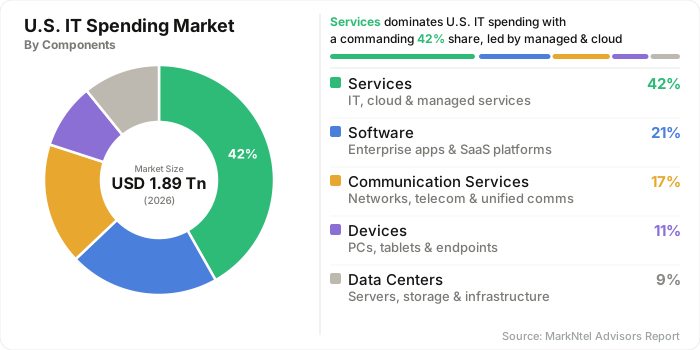
Services dominate the IT spending in the United States, with a market share of 42% as enterprises prioritize operational efficiency, cloud optimization, and continuous system modernization over one-time product purchases. The rapid shift toward hybrid and multi-cloud environments has structurally increased demand for consulting and managed services, particularly as organizations struggle with cost governance and architecture complexity. This creates sustained demand for infrastructure implementation and managed services across both public and private sectors.
Large-scale enterprise investments further reinforce the dominance of the services segment, as cloud adoption inherently depends on consulting, integration, and managed service layers. For instance, JPMorgan uses a multi-cloud strategy with AWS as the primary platform for core workloads, showing large-scale en terprise reliance on cloud + managed services. A leading US-based financial institution, Capital One, executed a large-scale cloud transformation by migrating over 40,000 workloads and approximately 10 petabytes of data to Amazon Web Services (AWS). This transition enabled the organization to reduce infrastructure costs by nearly 30% while improving application delivery speed by around 60%. The initiative highlights how enterprises in the US are increasingly leveraging third-party cloud and managed services to enhance operational efficiency, scalability, and time-to-market.
End-user behavior in the US strongly favors outsourcing non-core IT operations to improve agility and reduce in-house talent costs amid persistent tech workforce shortages. Consulting and business process services are increasingly embedded into digital transformation programs, especially AI deployment and data analytics integration. As a result, services are no longer support functions but core enablers of IT value realization. This transition ensures sustained segmental dominance through 2032, driven by recurring revenue models and enterprise dependency on external expertise. Based on components, the market is further segmented into the following categories:
- Software
- Devices
- Data Centers
- Communication Services
- Services
BFSI Sector Leads Due to Mission-Critical Digital Infrastructure and Regulatory-Driven IT Investments
The Banking & Financial Services (BFSI) sector leads US IT spending with a market share of 29% due to its high dependency on secure, real-time digital infrastructure and continuous regulatory compliance requirements. Institutions are investing heavily in advanced analytics, cybersecurity, and cloud-native platforms to manage rising transaction volumes and fraud risks. Regulatory frameworks such as those enforced by the Federal Reserve and SEC mandate ongoing technology upgrades, especially in risk management and reporting systems. This creates a non-discretionary IT spending environment, ensuring consistent investment regardless of economic cycles.
US-specific industry examples highlight this dominance, with major banks like JPMorgan Chase and Bank of America allocating billions annually toward technology transformation, including AI-driven fraud detection and cloud migration. For instance, the JPMorgan Chase case clearly demonstrates how AI is structurally increasing IT spending within the BFSI segment by embedding technology into core workflows rather than peripheral functions. The bank is allocating nearly USD 18 billion annually toward technology , with AI positioned as a foundational layer across operations, wealth management, and advisory services. This indicates that IT spending in BFSI is not discretionary but deeply integrated into revenue-generating and client-facing processes. Also, Bank of America spends USD 13 billion annually on technology, with USD 4 billion dedicated to new tech initiatives, including AI, cloud, and digital platforms.
Demand characteristics in BFSI are uniquely intensive, requiring low-latency systems, high data security, and 24/7 service availability, which significantly increases IT spending per enterprise compared to other sectors. This combination of regulatory pressure, competitive innovation, and mission-critical IT dependency firmly sustains BFSI’s leadership position in the IT spending in the US through the forecast period. Based on end users, the industry is further classified into the following sub-categories:
- Banking & Financial Services
- Manufacturing
- Retail & Ecommerce
- IT, Telecom & Media
- Healthcare
- Government or Public Sector
- Education
- Others
US IT Spending Market Geographical Analysis
The North region leads the US IT spending industry with a market share of 40% due to its concentration of high-value digital infrastructure and enterprise demand clusters, particularly across New York, Illinois, and surrounding states. The region hosts major financial and technology ecosystems, which directly drive IT spending intensity. For instance, New York has emerged as a major tech hub, attracting 14.3% of all relocated US tech workers in 2023, supported by a workforce of over 3.2 million highly educated professionals . This concentration of skilled talent and enterprises directly increases demand for enterprise software, cloud platforms, and IT services.
Infrastructure investment in the North further reinforces its dominance, particularly through large-scale data center expansion supporting cloud and AI workloads. Northern Virginia, one of the largest data center hubs globally, continues to anchor regional growth, while cities like Chicago and New York are experiencing rapid capacity expansion. In 2024 alone, US data center construction investment reached USD 31.5 billion, driven primaril y by AI and cloud demand. Additionally, primary data center markets recorded 34% year-on-year capacity growth, with vacancy rates dropping to just 1.9%, indicating extremely high demand utilization.
Policy and structural investment trends also favor the North, as high-density urban economies require continuous upgrades in digital and connectivity infrastructure. Data centers and high-tech investments contributed to nearly 80% of the growth in US private domestic demand in early 2025, highlighting the central role of IT infrastructure in economic expansion. These investments are heavily concentrated in established economic corridors in the North, where financial services, media, and enterprise sectors require low-latency, high-performance computing environments.
These sectors require real-time analytics, cybersecurity, and high-frequency transaction systems, significantly increasing IT spending per enterprise. As a result, the combination of talent concentration, infrastructure investment, and high-value enterprise demand firmly establishes the North as the leading region in the US IT spending industry.
US IT Spending Market News and Recent Developments
2025: Amazon pledges up to USD 50 billion to expand AI and supercomputing for the U.S. government
Amazon, through its cloud arm AWS, has announced an investment of up to $50 billion to build large-scale AI and supercomputing infrastructure specifically for U.S. government agencies. The project, starting around 2026, will create new high-security data centers and add nearly 1.3 gigawatts of computing capacity across classified cloud environments like GovCloud and Top Secret regions. This infrastructure will allow federal agencies to use advanced AI tools for tasks such as data analysis, cybersecurity, scientific research, and defense operations. The initiative also includes access to AI platforms like model training systems, foundation models, and specialized AI chips, enabling faster decision-making and large-scale data processing. Overall, the news highlights a massive scale-up of government-focused cloud and AI capabilities, positioning AWS as a critical technology partner for U.S. public-sector digital transformation.
Impact Analysis: This investment directly expands federal IT budgets toward cloud infrastructure, AI platforms, and high-performance computing. It indicates a structural shift where government spending is increasingly moving from traditional IT systems to advanced AI-driven cloud ecosystems, boosting overall U.S. IT spending growth. Building AI supercomputing capacity at this scale requires massive investments in data centers, chips, networking, and energy infrastructure. This will significantly increase capital expenditure across the U.S. IT infrastructure segment, especially in hyperscale cloud and HPC environments. Amazon’s USD 50 billion commitment will push competitors like Microsoft and Google to increase their own AI and government cloud investments. This “AI arms race” drives higher overall IT spending across both public and private sectors as firms compete for large federal contracts. This will expand a niche but high-value segment within U.S. IT spending on government-grade cybersecurity, sovereign cloud, and compliance-driven infrastructure.
2025: AWS offers USD 1 billion cloud credits to the U.S. government
Amazon Web Services (AWS) has agreed with the U.S. government to provide up to USD 1 billion in cloud service credits through 2028. This initiative, facilitated via the General Services Administration (GSA), is designed to help federal agencies continue using AWS cloud platforms while reducing costs associated with IT modernization. The credits will be used across core cloud services, infrastructure upgrades, and workforce training programs, supporting broader federal goals of shifting from legacy IT systems to cloud-based and AI-enabled environments.
Impact Analysis: This development highlights a structural shift in U.S. IT spending where cost optimization is becoming as critical as technology adoption. While the USD 1 billion credit reduces immediate government expenditure, it actually accelerates long-term IT spending by encouraging deeper reliance on cloud infrastructure and AI services. As agencies migrate more workloads to AWS using these credits, future spending commitments are likely to increase once the credits are exhausted, creating a sustained revenue pipeline for cloud providers.
Additionally, the agreement intensifies competition among hyperscalers such as Microsoft and Google, pushing them to offer similar incentives, which expands overall cloud adoption across federal agencies. This not only increases total IT spending but also shifts budget allocation from traditional hardware and legacy systems toward cloud, AI, and digital services. Overall, the move reinforces cloud computing as a foundational pillar of U.S. IT spending growth, with government demand acting as a major catalyst for market expansion.
2025: Microsoft offers USD 6 billion cloud and AI savings to U.S. agencies
Microsoft has signed a large agreement with the U.S. government under the General Services Administration (GSA) to provide up to USD 6 billion in cost savings on cloud, software, and AI tools over a multi-year period. The deal includes discounts across key offerings such as Microsoft 365 (Office tools like Word, Excel, Teams), Azure cloud infrastructure, Dynamics 365 business applications, and cybersecurity platforms like Sentinel. Additionally, federal agencies will receive free access to Microsoft Copilot (AI assistant) for up to one year, along with benefits like waived data transfer (egress) fees and reduced cloud pricing. This initiative is part of the government’s “OneGov” strategy, which centralizes IT procurement to negotiate better pricing and accelerate digital transformation.
Impact Analysis: This development clearly shows that U.S. IT spending is shifting toward a value-optimized, cloud-first model rather than pure budget expansion. While the $6 billion savings appear as cost reduction, it actually drives deeper adoption of cloud, SaaS, and AI tools across federal agencies. By lowering entry costs and offering free AI tools like Copilot, Microsoft is accelerating large-scale usage, which will translate into higher long-term IT spending once discount periods end.
At the same time, the deal intensifies competition among hyperscalers such as Amazon and Google, all of whom are now offering aggressive discounts to secure federal contracts. This creates a price-driven expansion cycle, where lower costs increase adoption, ultimately enlarging the total addressable IT spending Industry.
Frequently Asked Questions
- Market Segmentation
- Introduction
- Product Definition
- Research Process
- Assumptions
- Executive Summary
- US Information & Technology (IT) Spending Market Policies, Regulations, and Product Standards
- US Information & Technology (IT) Spending Market Trends & Developments
- US Information & Technology (IT) Spending Market Dynamics
- Growth Factors
- Challenges
- US Information & Technology (IT) Spending Market Hotspot & Opportunities
- US Information & Technology (IT) Spending Market Outlook, 2022-2032F
- Market Size & Outlook
- By Revenues (USD Million)
- Market Share & Outlook
- By Components- Market Size & Forecast 2022-2032, USD Million
- Software
- Enterprise Application Software
- Infrastructure Software
- Vertical Software
- Gen AI Models
- Others
- Devices
- Mobile Phones
- Tablets
- Desktops
- Laptops
- Data Centers
- Servers
- Enterprise Network Equipment
- External Controller-Based Software
- Others
- Communication Services
- Unified Communications
- Fixed Connectivity
- Mobile Connectivity
- Services
- Consulting
- Business Process Services
- Infrastructure Implementation & Managed Services
- Infrastructure as a Service (IaaS)
- Software
- By Type of Enterprises- Market Size & Forecast 2022-2032, USD Million
- Large Enterprises (Headcount Above 10,000)
- Mid-Size Enterprises (Headcount 5,000 to 10,000)
- Small Enterprises (Headcount Up to 5,000)
- By End Users- Market Size & Forecast 2022-2032, USD Million
- Banking & Financial Services
- Manufacturing
- Retail & Ecommerce
- IT, Telecom & Media
- Healthcare
- Government or Public Sector
- Education
- Others
- By Deployment Model- Market Size & Forecast 2022-2032, USD Million
- Onshore Delivery
- Nearshore Delivery
- Offshore Delivery
- By Engagement Model- Market Size & Forecast 2022-2032, USD Million
- Project-based / Fixed Price
- Staff Augmentation / Time-and-Material
- Managed Services / Outcome-based
- By Region- Market Size & Forecast 2022-2032, USD Million
- North
- South
- East
- West
- Central
- By Company
- Competition Characteristics
- Market Share & Analysis
- By Components- Market Size & Forecast 2022-2032, USD Million
- Market Size & Outlook
- US Software Market Outlook, 2022-2032
- Market Size & Outlook
- By Revenues (USD Million)
- Market Share & Outlook
- By Type of Enterprises- Market Size & Forecast 2022-2032, USD Million
- By End Users- Market Size & Forecast 2022-2032, USD Million
- By Deployment Model- Market Size & Forecast 2022-2032, USD Million
- By Engagement Model- Market Size & Forecast 2022-2032, USD Million
- By Region- Market Size & Forecast 2022-2032, USD Million
- Market Size & Outlook
- US Devices Market Outlook, 2022-2032
- Market Size & Outlook
- By Revenues (USD Million)
- Market Share & Outlook
- By Type of Enterprises- Market Size & Forecast 2022-2032, USD Million
- By End Users- Market Size & Forecast 2022-2032, USD Million
- By Deployment Model- Market Size & Forecast 2022-2032, USD Million
- By Engagement Model- Market Size & Forecast 2022-2032, USD Million
- By Region- Market Size & Forecast 2022-2032, USD Million
- Market Size & Outlook
- US Data Centers Market Outlook, 2022-2032
- Market Size & Outlook
- By Revenues (USD Million)
- Market Share & Outlook
- By Type of Enterprises- Market Size & Forecast 2022-2032, USD Million
- By End Users- Market Size & Forecast 2022-2032, USD Million
- By Deployment Model- Market Size & Forecast 2022-2032, USD Million
- By Engagement Model- Market Size & Forecast 2022-2032, USD Million
- By Region- Market Size & Forecast 2022-2032, USD Million
- Market Size & Outlook
- US Communication Services Market Outlook, 2022-2032
- Market Size & Outlook
- By Revenues (USD Million)
- Market Share & Outlook
- By Type of Enterprises- Market Size & Forecast 2022-2032, USD Million
- By End Users- Market Size & Forecast 2022-2032, USD Million
- By Deployment Model- Market Size & Forecast 2022-2032, USD Million
- By Engagement Model- Market Size & Forecast 2022-2032, USD Million
- By Region- Market Size & Forecast 2022-2032, USD Million
- Market Size & Outlook
- US Services Market Outlook, 2022-2032
- Market Size & Outlook
- By Revenues (USD Million)
- Market Share & Outlook
- By Type of Enterprises- Market Size & Forecast 2022-2032, USD Million
- By End Users- Market Size & Forecast 2022-2032, USD Million
- By Deployment Model- Market Size & Forecast 2022-2032, USD Million
- By Engagement Model- Market Size & Forecast 2022-2032, USD Million
- By Region- Market Size & Forecast 2022-2032, USD Million
- Market Size & Outlook
- US Information & Technology (IT) Spending Market Key Strategic Imperatives for Success & Growth
- Competitive Outlook
- Company Profiles
- Accenture plc
- Business Description
- Product Portfolio
- Collaborations & Alliances
- Recent Developments
- Financial Details
- Others
- IBM Corporation
- Business Description
- Product Portfolio
- Collaborations & Alliances
- Recent Developments
- Financial Details
- Others
- Cognizant Technology Solutions Corp.
- Business Description
- Product Portfolio
- Collaborations & Alliances
- Recent Developments
- Financial Details
- Others
- Tata Consultancy Services Ltd.
- Business Description
- Product Portfolio
- Collaborations & Alliances
- Recent Developments
- Financial Details
- Others
- Microsoft Corporation
- Business Description
- Product Portfolio
- Collaborations & Alliances
- Recent Developments
- Financial Details
- Others
- Infosys Ltd.
- Business Description
- Product Portfolio
- Collaborations & Alliances
- Recent Developments
- Financial Details
- Others
- Wipro Ltd.
- Business Description
- Product Portfolio
- Collaborations & Alliances
- Recent Developments
- Financial Details
- Others
- Deloitte Consulting LLP
- Business Description
- Product Portfolio
- Collaborations & Alliances
- Recent Developments
- Financial Details
- Others
- Capgemini SE
- Business Description
- Product Portfolio
- Collaborations & Alliances
- Recent Developments
- Financial Details
- Others
- HCL Technologies Ltd.
- Business Description
- Product Portfolio
- Collaborations & Alliances
- Recent Developments
- Financial Details
- Others
- Amazon Web Services (AWS)
- Business Description
- Product Portfolio
- Collaborations & Alliances
- Recent Developments
- Financial Details
- Others
- Google Cloud
- Business Description
- Product Portfolio
- Collaborations & Alliances
- Recent Developments
- Financial Details
- Others
- Oracle
- Business Description
- Product Portfolio
- Collaborations & Alliances
- Recent Developments
- Financial Details
- Others
- IBM
- Business Description
- Product Portfolio
- Collaborations & Alliances
- Recent Developments
- Financial Details
- Others
- Cisco Systems
- Business Description
- Product Portfolio
- Collaborations & Alliances
- Recent Developments
- Financial Details
- Others
- Dell Technologies
- Business Description
- Product Portfolio
- Collaborations & Alliances
- Recent Developments
- Financial Details
- Others
- Hewlett Packard Enterprise (HPE)
- Business Description
- Product Portfolio
- Collaborations & Alliances
- Recent Developments
- Financial Details
- Others
- Broadcom
- Business Description
- Product Portfolio
- Collaborations & Alliances
- Recent Developments
- Financial Details
- Others
- NVIDIA
- Business Description
- Product Portfolio
- Collaborations & Alliances
- Recent Developments
- Financial Details
- Others
- Others
- Accenture plc
- Company Profiles
- Disclaimer
MarkNtel Advisors follows a robust and iterative research methodology designed to ensure maximum accuracy and minimize deviation in market estimates and forecasts. Our approach combines both bottom-up and top-down techniques to effectively segment and quantify various aspects of the market. A consistent feature across all our research reports is data triangulation, which examines the market from three distinct perspectives to validate findings. Key components of our research process include:
1. Scope & Research Design At the outset, MarkNtel Advisors define the research objectives and formulate pertinent questions. This phase involves determining the type of research—qualitative or quantitative—and designing a methodology that outlines data collection methods, target demographics, and analytical tools. They also establish timelines and budgets to ensure the research aligns with client goals.
2. Sample Selection and Data Collection In this stage, the firm identifies the target audience and determines the appropriate sample size to ensure representativeness. They employ various sampling methods, such as random or stratified sampling, based on the research objectives. Data collection is carried out using tools like surveys, interviews, and observations, ensuring the gathered data is reliable and relevant.
3. Data Analysis and Validation Once data is collected, MarkNtel Advisors undertake a rigorous analysis process. This includes cleaning the data to remove inconsistencies, employing statistical software for quantitative analysis, and thematic analysis for qualitative data. Validation steps are taken to ensure the accuracy and reliability of the findings, minimizing biases and errors.

4. Data Forecast and FinalizationThe final phase involves forecasting future market trends based on the analyzed data. MarkNtel Advisors utilize predictive modeling and time series analysis to anticipate market behaviors. The insights are then compiled into comprehensive reports, featuring visual aids like charts and graphs, and include strategic recommendations to inform client decision-making
We offer flexible licensing options to cater to varying organizational needs. Choose the pricing pack that best suits your requirements:
Buy Now Inquire Before Buying
 Request Customization
 Talk to our Consultant







