

Asia Pacific Glass Interposers Market Research Report: Growth Drivers & Forecast (2026-2032)
By Product Type (3D Glass Interposers, Embedded Glass Interposers, Panel-Level Glass Interposers, Others), By Wafer Size (300 mm Wafers, 200 mm Wafers, Less than 200 mm Wafers), By ... Substrate Technology (Through-Glass Vias (TGV), Redistribution Layer First, Redistribution Layer Last, Glass Panel Level Packaging, Others), By Packaging Architecture (3D Packaging, Fan-Out Packaging, High-Bandwidth Memory, Logic and GPU Modules, RF and 5G Modules, Others),and others Read more
- ICT & Electronics
- Mar 2026
- Pages 205
- Report Format: PDF, Excel, PPT
Asia Pacific Glass Interposers Market
Projected 16.81% CAGR from 2026 to 2032
Study Period
2026-2032
Market Size (2026)
USD 100.3 Million
Market Size (2032)
USD 254.8 Million
Base Year
2025
Projected CAGR
16.81%
Leading Segments
By Wafer Size: 300 mm Wafers
Asia Pacific Glass Interposers Market Report Key Takeaways:
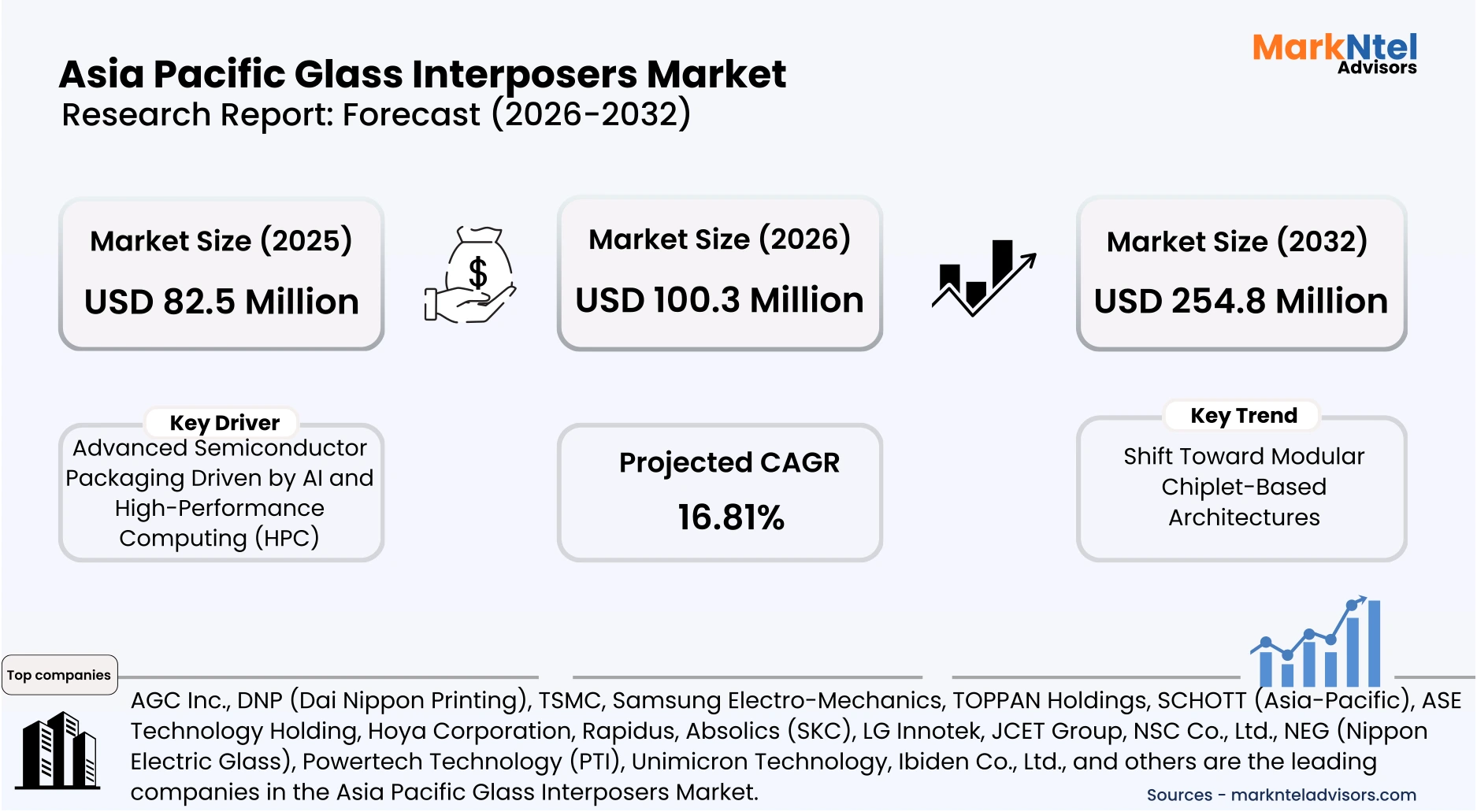
- The Asia Pacific Glass Interposers Market size was valued at USD 82.5 million in 2025 and is projected to grow from USD 100.3 million in 2026 to USD 254.8 million by 2032, exhibiting a CAGR of 16.81% during the forecast period.
- Japan is the leading country with a significant share of 36% in 2026.
- By Wafer size type, the 300mm wafer size represented a significant share of about 60% in the Asia Pacific Glass Interposers Market in 2026.
- By substrate technology, the Through-Glass Vias (TGV) segment seized a significant share of about 50% in the Asia Pacific Glass Interposers Market in 2026.
- Leading companies are AGC Inc., DNP (Dai Nippon Printing), TSMC, Samsung Electro-Mechanics, TOPPAN Holdings, SCHOTT (Asia-Pacific), ASE Technology Holding, Hoya Corporation, Rapidus, Absolics (SKC), LG Innotek, JCET Group, NSC Co., Ltd., NEG (Nippon Electric Glass), Powertech Technology (PTI), Unimicron Technology, Ibiden Co., Ltd., and others.
Market Insights & Analysis: Asia Pacific Glass Interposers Market (2026-32):
The Asia Pacific Glass Interposers Market size was valued at USD 82.5 million in 2025 and is projected to grow from USD 100.3 million in 2026 to USD 254.8 million by 2032, exhibiting a CAGR of 16.81% during the forecast period. i.e., 2026-32.
The Asia Pacific glass interposers market has demonstrated steady expansion, supported by the region’s leadership in advanced semiconductor packaging and electronics manufacturing ecosystems. Countries such as Taiwan, South Korea, and China have strengthened demand through rising chiplet-based architectures and high-density integration. According to World Semiconductor Trade Statistics, the Asia-Pacific region accounted for over 60% of global semiconductor consumption in 2025, thereby reinforcing upstream substrate demand. This regional dominance has directly translated into increased adoption of glass interposers for improved thermal stability and electrical performance.
Government-backed industrial strategies have further accelerated market maturity by promoting domestic semiconductor capabilities and packaging innovation. For instance, Japan’s government has undertaken large industrial policy measures to revitalize its semiconductor industry, including public funding and advanced semiconductor research support directed toward next‑generation technologies. These policy interventions have enhanced local supply chains, reduced import dependencies, and created favorable conditions for the adoption of glass interposers across fabrication and OSAT facilities.
End-user demand from high-performance computing, data centers, and consumer electronics has played a critical role in shaping current market dynamics. Hyperscale operators such as Alibaba Group and Samsung Electronics have expanded AI and cloud infrastructure investments in 2025–2026, increasing demand for advanced packaging solutions with higher bandwidth efficiency. In parallel, industrial applications including automotive electronics and 5G infrastructure have required enhanced signal integrity, further boosting adoption. These diverse application segments ensure sustained volume growth across both commercial and industrial end users.
Looking ahead, the market outlook remains positive, supported by continuous innovation and strategic industry collaborations. Additionally, sustainability initiatives, including energy-efficient substrate manufacturing promoted by the International Energy Agency, are influencing material selection trends. With increasing investments in heterogeneous integration and panel-level packaging, the Asia Pacific is expected to maintain its leadership and drive long-term market expansion.
Asia Pacific Glass Interposers Market Scope:
| Category | Segments |
|---|---|
| By Product Type | (3D Glass Interposers, Embedded Glass Interposers, Panel-Level Glass Interposers, Others), |
| By Wafer Size | (300 mm Wafers, 200 mm Wafers, Less than 200 mm Wafers), |
| By Substrate Technology | (Through-Glass Vias (TGV), Redistribution Layer First, Redistribution Layer Last, Glass Panel Level Packaging, Others), |
| By Packaging Architecture | (3D Packaging, Fan-Out Packaging, High-Bandwidth Memory, Logic and GPU Modules, RF and 5G Modules, Others), |
Asia Pacific Glass Interposers Market Driver:
Advanced Semiconductor Packaging Driven by AI and High-Performance Computing (HPC)
The rapid expansion of artificial intelligence (AI) and high-performance computing (HPC) applications has emerged as the most influential structural driver for the Asia Pacific glass interposers market. Over recent years, governments and industries have accelerated investments in data centers and AI infrastructure, significantly increasing demand for advanced semiconductor packaging solutions. According to the International Energy Agency (IEA), global data center electricity consumption is projected to be 620–1,050 TWh by 2026, up from ~800 TWh in 2018, reflecting exponential growth in computational demand. This surge has intensified the need for high-density, high-bandwidth chip architectures, where glass interposers provide superior signal integrity and thermal stability.
This driver is measurably impacting demand across key Asia-Pacific semiconductor hubs, including Taiwan, South Korea, China, and Japan, which collectively account for a dominant share of global chip manufacturing. Taiwan has accelerated the expansion of advanced semiconductor packaging capacity, supported by government-led industrial policies and rising demand for AI chips, particularly in 2.5D and 3D integration technologies. Similarly, South Korea’s government announced a USD 470 billion semiconductor investment plan extending into 2047, with near-term packaging innovations prioritized. These developments directly translate into higher adoption of 2.5D and 3D packaging technologies, where glass interposers are increasingly preferred over traditional silicon alternatives due to scalability advantages.
The driver is fundamentally expanding market volume rather than influencing pricing alone, as it necessitates entirely new packaging architectures for next-generation chips. Unlike cyclical semiconductor demand, AI workloads require sustained increases in processing power, driving consistent volume growth in interposer-based designs. The World Bank highlights that the expansion of the digital economy in the Asia-Pacific region continues to outpace global averages, reinforcing long-term semiconductor demand. Additionally, 2025 policy support, such as China’s continued semiconductor self-sufficiency initiatives and Japan’s subsidies for advanced chip packaging, allocated USD 5.4 billion, further institutionalize demand, ensuring that glass interposers remain integral to future semiconductor manufacturing ecosystems.
Asia Pacific Glass Interposers Market Trend:
Shift Toward Modular Chiplet-Based Architectures
A prominent trend in the Asia Pacific glass interposers market is the transition from monolithic chips to modular chiplet-based architectures. Rising AI, HPC, and 5G workloads have accelerated this shift as traditional Moore’s Law scaling faces physical limits. Glass interposers enable high-density, multi-die integration with improved signal integrity and thermal performance. Industry leaders such as Samsung signed a strategic HBM supply and advanced packaging partnership with AMD for next‑generation AI accelerators, emphasizing package‑level integration and memory interconnect improvements. This reflects the adoption of modular design strategies, in which memory and logic components are integrated via advanced packaging/interposer-like technology rather than through monolithic scaling. At the same time, SK Hynix is accelerating its High Bandwidth Memory (HBM) roadmap to support AI/HPC applications that demand 2.5D/3D integration, which requires advanced interposers. HBM stacks represent a real deployment of heterogeneous integration, memory plus logic that aligns with chiplet and interposer trends.
This trend is reshaping the value chain and operational models across the Asia Pacific region. South Korea is expanding advanced packaging and interposer lines to support multi-die integration, while Taiwan focuses on OSAT and backend capabilities for chiplet-enabled modules. Malaysia and India are scaling assembly and testing facilities. Thailand and Indonesia are enhancing electronics ecosystems, while Australia and New Zealand contribute via research collaborations and pilot packaging programs.
The trend is expected to persist in the long term because heterogeneous integration addresses chip-scaling limits and enables modular upgrades for AI, HPC, and networking workloads.
Asia Pacific Glass Interposers Market Opportunity:
Rise of Advanced Packaging and Heterogeneous Integration
The Asia Pacific semiconductor ecosystem is witnessing a sustained shift toward advanced packaging and heterogeneous integration, driven by the need to support high‑performance computing, AI, 5G, and automotive electronics demand. South Korea’s advanced packaging segment is expanding rapidly, supported by strong domestic industry investment and government policy incentives that bolster sophisticated back‑end processes. Malaysia’s government has announced incentives to support its domestic semiconductor industry, reinforcing its strategic role in packaging and testing, foundational to higher-density integration approaches.
In India, the India Semiconductor Mission 2.0, launched in 2026, aims to build a comprehensive semiconductor ecosystem, encompassing advanced assembly, testing, marking, and packaging (ATMP) capabilities that underpin heterogeneously integrated designs. Thailand is targeting $79 billion in investment in the semiconductor and electronics sectors by 2050, reflecting a long-term commitment to expanding the electronics value chain, including advanced back-end capabilities . Indonesia and other Southeast Asian nations are part of broader regional trends to capture larger shares of semiconductor assembly and packaging activities.
This is expected to persist because heterogeneous integration directly addresses the scaling limits of traditional monolithic chips and enables modular chiplet architectures needed for evolving digital workloads. Asia Pacific’s dominant role in advanced semiconductor packaging, supported by robust OSAT capacity and government support, ensures these structural practices will continue to reshape semiconductor value chains and support next-generation computing demands.
Asia Pacific Glass Interposers Market Challenge:
High Manufacturing Costs & Technical Barriers in Glass Interposer Production
The Asia Pacific glass interposers market is structurally constrained by high manufacturing costs and complex fabrication processes required for through‑glass via (TGV) formation and precision glass handling. Producing defect‑free TGVs uses advanced laser drilling, etching, and metallization equipment, increasing capital expenditure relative to organic substrates. Research highlights that specialized equipment and process controls are essential to manage glass brittleness and dimensional tolerances, directly elevating per‑unit costs and limiting competitive pricing.
For example, Taiwan’s Shyawei Optronics publicly noted ongoing issues in forming and inspecting through‑glass vias, specifically the precision, etch, and inspection challenges underscoring persistent process complexity that affects yield and throughput for regional equipment makers. This has forced several fabless packaging firms to delay adoption or revert to cost‑proven alternatives, illustrating real operational impacts and highlighting infrastructure gaps in precision processing capabilities. The need for skilled operators and tighter process windows further strains operational efficiency across regional fabs.
For instance, independent engineering analysis identifies low yield and costly laser drilling/metal fill defects as significant technical barriers in TGV implementation , showing how process issues manifest in real production environments.
Consequently, these costs and technological barriers materially restrict market expansion, limiting adoption to high-value segments and deterring new entrants or mid-tier players from investing in large-scale glass interposer production across the Asia Pacific.
Asia Pacific Glass Interposers Market (2026-32) Segmentation Analysis:
The Asia Pacific Glass Interposers Market study of MarkNtel Advisors evaluates & highlights the major trends and influencing factors in each segment. It includes predictions for the period 2026–32 at the regional level. Based on the analysis, the market has been further classified as;
Based on Wafer Size:
- 300 mm Wafers
- 200 mm Wafers
- Less than 200 mm Wafers
300 mm Wafers have emerged as the dominant segment with a market share of 60% in the Asia Pacific glass interposers market due to strong demand from advanced semiconductor packaging foundries focused on high‑density interconnects. Leading fab investments in China, Taiwan, South Korea, and Japan have prioritized 300 mm production lines to support AI accelerators and high‑performance computing chips, reinforcing volume demand for larger wafers. Government policies such as China’s 14th Five-Year Plan and South Korea’s semiconductor resilience programs have accelerated capital expenditure into 300 mm infrastructure , creating long‑term capacity commitments. Furthermore, OEMs targeting premium 5G and automotive applications require larger wafer formats for cost efficiencies and yield advantages, underscoring sustained end‑user pull.
This segment’s leadership is also linked to ecosystem readiness; substrate and packaging service providers in Singapore and Taiwan have optimized tooling for 300 mm glass interposer throughput, reducing cycle times and cost per die. Customer preferences in consumer electronics and data centre markets further solidify this wafer size’s dominance because of its ability to support multi‑chip modules. In contrast, smaller wafer segments show slower growth due to limited adoption in high‑margin, next‑gen packaging use cases.
Ultimately, the 300 mm wafer segment’s supremacy is a confluence of policy support, heavy capital investment, manufacturing ecosystem alignment, and robust end‑market demand for high‑performance systems.
Based on Substrate Technology:
- Through-Glass Vias (TGV)
- Redistribution Layer First
- Redistribution Layer Last
- Glass Panel Level Packaging
- Others
Through-Glass Via (TGV) technology leads the Asia Pacific glass interposer market with a market share of 50%, primarily due to its unmatched electrical performance, low signal loss, and high thermal stability, which are critical for high-density multi-chip modules used in AI accelerators, HPC platforms, and 5G devices. While TGV manufacturing is complex, requiring precision etching, glass drilling, and metallization, major foundries in Taiwan, South Korea, and Japan have invested heavily in automated production lines to improve yields and reduce cost per die. Phil optics TGV recognition shows explicit government backing for TGV development, indicating that policymakers see glass via technology as a strategic semiconductor capability worth supporting with tailored assistance and R&D collaboration. End-user demand from hyperscale cloud providers, automotive LiDAR, and premium mobile chip makers further reinforces the segment’s dominance despite the fabrication difficulties.
Industry key players like ASE have also introduced VIPack™, an advanced packaging platform covering heterogeneous integration (including 2.5D/3D packaging and interposer‑related technologies), which has been recognized with a Device Technology of the Year Award, showing its technical capability and industry leadership. At the same time, Samsung is actively developing glass interposers and glass substrate technology, aiming to replace traditional silicon interposers in advanced chip packaging by the end of the decade, with plans for prototyping and future production. Reports confirm Samsung’s Device Solutions division is exploring glass substrates for advanced packaging to target AI chips and improve performance.
Ultimately, TGV dominates not because it is easy to produce, but because its performance benefits align perfectly with end-user requirements, and sustained investment and policy support overcome its inherent challenges, creating a self-reinforcing leadership cycle in the Asia Pacific.
Asia Pacific Glass Interposers Market (2026-32) Regional Analysis:
Japan’s structural and economic foundations support its semiconductor leadership. The country remains one of the world’s largest suppliers of semiconductor materials, equipment, and mid‑to‑backend capabilities, even as logic fabrication faces global competition. According to trade data, Japan ranked third in global semiconductor exports in 2023, with automotive and power semiconductors driving notable export volumes, and Japanese firms controlling significant market share in essential inputs like silicon wafers, photoresists, and coater/develop systems critical for advanced packaging and substrate technologies. Such industrial concentration, rooted in decades of precision manufacturing and high‑value capital goods production, gives Japan a substantial infrastructure advantage in semiconductor value chains.
Regulatory frameworks and government investment have actively bolstered this competitive position. Japanese authorities have allocated multi‑trillion‑yen budgets supporting semiconductor R&D, manufacturing, and advanced packaging development, with direct support for projects like foreign fab investments by TSMC in Kumamoto, recently expanded toward 3nm production with up to USD 17 billion in investment. These policies include subsidies, R&D hubs with access to expensive tooling, and supplementary budgets dedicated to AI and semiconductor ventures, creating sustained incentives for cutting‑edge sector growth.
Strong end‑user demand and industry presence further reinforce Japan’s market leadership. Japan hosts world‑leading electronics, automotive, and industrial corporations (e.g., Sony, Toyota, Denso, Fujitsu) that drive demand for advanced chips, packaging, and processing technologies, while domestic firms and partnerships contribute heavily to global semiconductor materials and equipment markets. Japanese semiconductor tested exports and specialized segments such as automotive chips and power semiconductors continue to grow, reflecting both diversified domestic demand and global buyer concentration.
Gain a Competitive Edge with Our Asia Pacific Glass Interposers Market Report:
- The Asia Pacific Glass Interposers Market Report by MarkNtel Advisors provides a detailed & thorough analysis of market size & share, growth rate, competition, and key players. This comprehensive analysis helps businesses gain a holistic understanding of the market dynamics & make informed decisions.
- This report also highlights current market trends & future projections, allowing businesses to identify emerging opportunities & potential challenges. By understanding market forecasts, companies can align their strategies & stay ahead of the competition.
- The Asia Pacific Glass Interposers Market Landscape Report aids in assessing & mitigating risks associated with entering or operating in the market. By understanding market dynamics, regulatory frameworks, and potential challenges, businesses can develop strategies to minimize risks & optimize their operations.
*Reports Delivery Format - Market research studies from MarkNtel Advisors are offered in PDF, Excel and PowerPoint formats. Within 24 hours of the payment being successfully received, the report will be sent to your email address.
Frequently Asked Questions
- Market Segmentation
- Introduction
- Product Definition
- Research Process
- Assumptions
- Executive Summary
- Asia-Pacific Glass Interposers Market Policies, Regulations, and Product Standards
- Asia-Pacific Glass Interposers Market Trends & Developments
- Asia-Pacific Glass Interposers Market Dynamics
- Growth Factors
- Challenges
- Asia-Pacific Glass Interposers Market Hotspot & Opportunities
- Asia-Pacific Glass Interposers Market Outlook, 2022-2032F
- Market Size & Outlook
- By Revenues (USD Million)
- Market Share & Analysis
- By Product Type- Market Size & Forecast 2022-2032, USD Million
- 2.5D Glass Interposers
- 3D Glass Interposers
- Embedded Glass Interposers
- Panel-Level Glass Interposers
- Others
- By Wafer Size- Market Size & Forecast 2022-2032, USD Million
- 300 mm Wafers
- 200 mm Wafers
- Less than 200 mm Wafers
- By Substrate Technology- Market Size & Forecast 2022-2032, USD Million
- Through-Glass Vias (TGV)
- Redistribution Layer First
- Redistribution Layer Last
- Glass Panel Level Packaging
- Others
- By Packaging Architecture- Market Size & Forecast 2022-2032, USD Million
- 2.5D Packaging
- 3D Packaging
- Fan-Out Packaging
- High-Bandwidth Memory
- Logic and GPU Modules
- RF and 5G Modules
- Others
- By Country
- China
- India
- Japan
- South Korea
- Australia
- New Zealand
- Indonesia
- Malaysia
- Thailand
- Rest of Asia-Pacific
- By Company
- Competition Characteristics
- Market Share & Analysis
- By Product Type- Market Size & Forecast 2022-2032, USD Million
- Market Size & Outlook
- China Glass Interposers Market Outlook, 2022-2032F
- Market Size & Outlook
- By Revenues (USD Million)
- Market Share & Analysis
- By Product Type- Market Size & Forecast 2022-2032, USD Million
- By Wafer Size- Market Size & Forecast 2022-2032, USD Million
- By Substrate Technology- Market Size & Forecast 2022-2032, USD Million
- By Packaging Architecture- Market Size & Forecast 2022-2032, USD Million
- Market Size & Outlook
- India Glass Interposers Market Outlook, 2022-2032F
- Market Size & Outlook
- By Revenues (USD Million)
- Market Share & Analysis
- By Product Type- Market Size & Forecast 2022-2032, USD Million
- By Wafer Size- Market Size & Forecast 2022-2032, USD Million
- By Substrate Technology- Market Size & Forecast 2022-2032, USD Million
- By Packaging Architecture- Market Size & Forecast 2022-2032, USD Million
- Market Size & Outlook
- Japan Glass Interposers Market Outlook, 2022-2032F
- Market Size & Outlook
- By Revenues (USD Million)
- Market Share & Analysis
- By Product Type- Market Size & Forecast 2022-2032, USD Million
- By Wafer Size- Market Size & Forecast 2022-2032, USD Million
- By Substrate Technology- Market Size & Forecast 2022-2032, USD Million
- By Packaging Architecture- Market Size & Forecast 2022-2032, USD Million
- Market Size & Outlook
- South Korea Glass Interposers Market Outlook, 2022-2032F
- Market Size & Outlook
- By Revenues (USD Million)
- Market Share & Analysis
- By Product Type- Market Size & Forecast 2022-2032, USD Million
- By Wafer Size- Market Size & Forecast 2022-2032, USD Million
- By Substrate Technology- Market Size & Forecast 2022-2032, USD Million
- By Packaging Architecture- Market Size & Forecast 2022-2032, USD Million
- Market Size & Outlook
- Australia Glass Interposers Market Outlook, 2022-2032F
- Market Size & Outlook
- By Revenues (USD Million)
- Market Share & Analysis
- By Product Type- Market Size & Forecast 2022-2032, USD Million
- By Wafer Size- Market Size & Forecast 2022-2032, USD Million
- By Substrate Technology- Market Size & Forecast 2022-2032, USD Million
- By Packaging Architecture- Market Size & Forecast 2022-2032, USD Million
- Market Size & Outlook
- New Zealand Glass Interposers Market Outlook, 2022-2032F
- Market Size & Outlook
- By Revenues (USD Million)
- Market Share & Analysis
- By Product Type- Market Size & Forecast 2022-2032, USD Million
- By Wafer Size- Market Size & Forecast 2022-2032, USD Million
- By Substrate Technology- Market Size & Forecast 2022-2032, USD Million
- By Packaging Architecture- Market Size & Forecast 2022-2032, USD Million
- Market Size & Outlook
- Indonesia Glass Interposers Market Outlook, 2022-2032F
- Market Size & Outlook
- By Revenues (USD Million)
- Market Share & Analysis
- By Product Type- Market Size & Forecast 2022-2032, USD Million
- By Wafer Size- Market Size & Forecast 2022-2032, USD Million
- By Substrate Technology- Market Size & Forecast 2022-2032, USD Million
- By Packaging Architecture- Market Size & Forecast 2022-2032, USD Million
- Market Size & Outlook
- Malaysia Glass Interposers Market Outlook, 2022-2032F
- Market Size & Outlook
- By Revenues (USD Million)
- Market Share & Analysis
- By Product Type- Market Size & Forecast 2022-2032, USD Million
- By Wafer Size- Market Size & Forecast 2022-2032, USD Million
- By Substrate Technology- Market Size & Forecast 2022-2032, USD Million
- By Packaging Architecture- Market Size & Forecast 2022-2032, USD Million
- Market Size & Outlook
- Thailand Glass Interposers Market Outlook, 2022-2032F
- Market Size & Outlook
- By Revenues (USD Million)
- Market Share & Analysis
- By Product Type- Market Size & Forecast 2022-2032, USD Million
- By Wafer Size- Market Size & Forecast 2022-2032, USD Million
- By Substrate Technology- Market Size & Forecast 2022-2032, USD Million
- By Packaging Architecture- Market Size & Forecast 2022-2032, USD Million
- Market Size & Outlook
- Asia-Pacific Glass Interposers Market Key Strategic Imperatives for Success & Growth
- Competitive Outlook
- Company Profiles
- AGC Inc.
- Business Description
- Product Portfolio
- Collaborations & Alliances
- Recent Developments
- Financial Details
- Others
- DNP (Dai Nippon Printing)
- Business Description
- Product Portfolio
- Collaborations & Alliances
- Recent Developments
- Financial Details
- Others
- TSMC
- Business Description
- Product Portfolio
- Collaborations & Alliances
- Recent Developments
- Financial Details
- Others
- Samsung Electro-Mechanics
- Business Description
- Product Portfolio
- Collaborations & Alliances
- Recent Developments
- Financial Details
- Others
- TOPPAN Holdings
- Business Description
- Product Portfolio
- Collaborations & Alliances
- Recent Developments
- Financial Details
- Others
- SCHOTT (Asia-Pacific)
- Business Description
- Product Portfolio
- Collaborations & Alliances
- Recent Developments
- Financial Details
- Others
- ASE Technology Holding
- Business Description
- Product Portfolio
- Collaborations & Alliances
- Recent Developments
- Financial Details
- Others
- Hoya Corporation
- Business Description
- Product Portfolio
- Collaborations & Alliances
- Recent Developments
- Financial Details
- Others
- Rapidus
- Business Description
- Product Portfolio
- Collaborations & Alliances
- Recent Developments
- Financial Details
- Others
- Absolics (SKC)
- Business Description
- Product Portfolio
- Collaborations & Alliances
- Recent Developments
- Financial Details
- Others
- LG Innotek
- Business Description
- Product Portfolio
- Collaborations & Alliances
- Recent Developments
- Financial Details
- Others
- JCET Group
- Business Description
- Product Portfolio
- Collaborations & Alliances
- Recent Developments
- Financial Details
- Others
- NSC Co., Ltd.
- Business Description
- Product Portfolio
- Collaborations & Alliances
- Recent Developments
- Financial Details
- Others
- NEG (Nippon Electric Glass)
- Business Description
- Product Portfolio
- Collaborations & Alliances
- Recent Developments
- Financial Details
- Others
- Powertech Technology (PTI)
- Business Description
- Product Portfolio
- Collaborations & Alliances
- Recent Developments
- Financial Details
- Others
- Unimicron Technology
- Business Description
- Product Portfolio
- Collaborations & Alliances
- Recent Developments
- Financial Details
- Others
- Ibiden Co., Ltd.
- Business Description
- Product Portfolio
- Collaborations & Alliances
- Recent Developments
- Financial Details
- Others
- Others
- Business Description
- Product Portfolio
- Collaborations & Alliances
- Recent Developments
- Financial Details
- Others
- AGC Inc.
- Company Profiles
- Disclaimer
MarkNtel Advisors follows a robust and iterative research methodology designed to ensure maximum accuracy and minimize deviation in market estimates and forecasts. Our approach combines both bottom-up and top-down techniques to effectively segment and quantify various aspects of the market. A consistent feature across all our research reports is data triangulation, which examines the market from three distinct perspectives to validate findings. Key components of our research process include:
1. Scope & Research Design At the outset, MarkNtel Advisors define the research objectives and formulate pertinent questions. This phase involves determining the type of research—qualitative or quantitative—and designing a methodology that outlines data collection methods, target demographics, and analytical tools. They also establish timelines and budgets to ensure the research aligns with client goals.
2. Sample Selection and Data Collection In this stage, the firm identifies the target audience and determines the appropriate sample size to ensure representativeness. They employ various sampling methods, such as random or stratified sampling, based on the research objectives. Data collection is carried out using tools like surveys, interviews, and observations, ensuring the gathered data is reliable and relevant.
3. Data Analysis and Validation Once data is collected, MarkNtel Advisors undertake a rigorous analysis process. This includes cleaning the data to remove inconsistencies, employing statistical software for quantitative analysis, and thematic analysis for qualitative data. Validation steps are taken to ensure the accuracy and reliability of the findings, minimizing biases and errors.

4. Data Forecast and FinalizationThe final phase involves forecasting future market trends based on the analyzed data. MarkNtel Advisors utilize predictive modeling and time series analysis to anticipate market behaviors. The insights are then compiled into comprehensive reports, featuring visual aids like charts and graphs, and include strategic recommendations to inform client decision-making
We offer flexible licensing options to cater to varying organizational needs. Choose the pricing pack that best suits your requirements:
Buy Now Inquire Before Buying
 Request Customization
 Talk to our Consultant







