

By System (Flight Control Systems, Communication & Navigation Systems, Payload & Mission-Specific Instruments, Monitoring Systems, Power Systems, Detect-and-Avoid Systems, Others), By Wing Type (Fixed... ... By Wing Type (Fixed-Wing UAVs, Rotary-Wing UAVs, Hybrid UAVs), By Maximum Take-Off Weight (MTOW) (Less than 2 Kg, 2–25 Kg, 25–150 Kg, 150–600 Kg, 600–2,000 Kg, Above 2,000 Kg), By Application (Military & Defense, Commercial, Government & Law Enforcement, Consumer), and others Read more
- Aerospace & Defense
- May 2026
- 415
- PDF, Excel, PPT
Global UAV (Drone) Avionics Market Key Takeaways
- The Global UAV (Drone) Avionics Market was valued at around USD 6.6 billion in 2025 and is forecast to expand steadily, reaching approximately USD 7.21 billion in 2026 and further advancing to nearly USD 12.23 billion by 2032, reflecting a CAGR of about 9.2%.
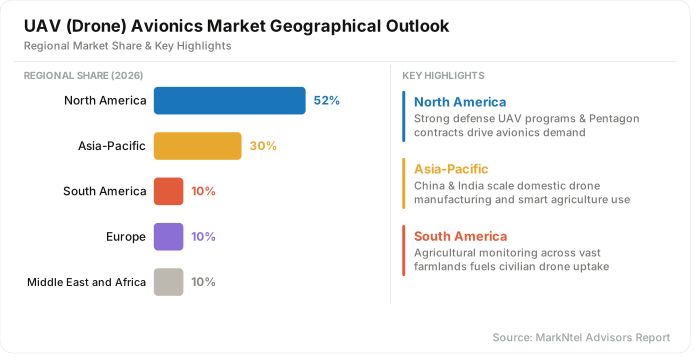
- North America maintained its dominant position in the global UAV avionics market in 2026, accounting for nearly 52% share due to extensive defense modernization programs, rising military UAV procurement, and strong presence of major avionics manufacturers across the United States.
- Based on system type, Flight Control Systems emerged as the leading segment, contributing around 31% market share in 2026, owing to increasing integration of autonomous navigation, real-time flight stabilization, and AI-enabled mission management capabilities in unmanned aerial platforms.
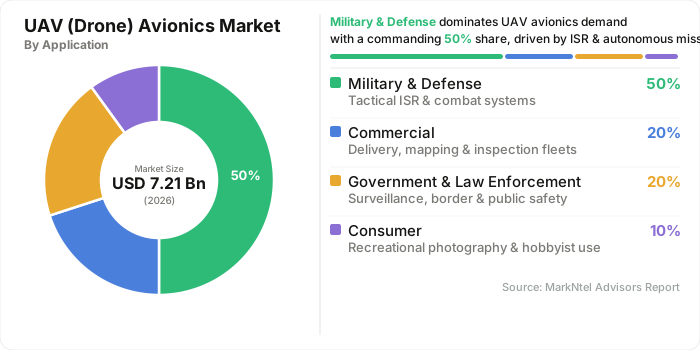
- By application, Military & Defense held the largest market share of approximately 50% in 2026, supported by rising deployment of ISR drones, combat UAVs, border surveillance systems, and tactical unmanned aircraft across global defense sectors.
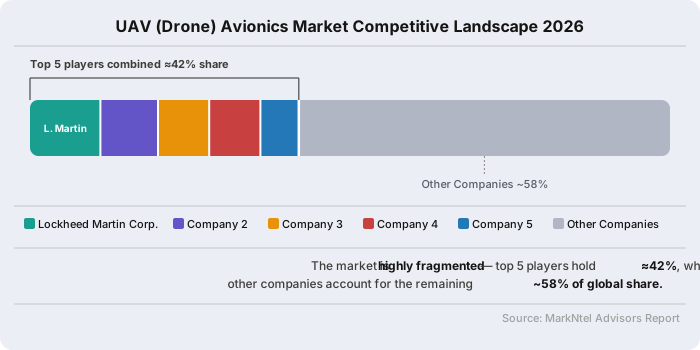
- The industry is highly fragmented, with several global aerospace, defense electronics, and drone technology companies operating across military and commercial applications. However, leading companies collectively account for nearly 42% of the overall market share.
Global UAV (Drone) Avionics Market Size and Outlook
The Global UAV (Drone) Avionics Market is expected to register a CAGR of 9.2% during 2026–2032, driven by the increasing adoption of unmanned aerial systems across surveillance, logistics, precision agriculture, commercial inspection, and tactical defense operations. Rising demand for autonomous navigation, real-time communication systems, advanced flight control technologies, and AI-enabled avionics platforms is further supporting market expansion globally.
Military and defense organizations continue to account for the largest share of demand as governments prioritize intelligence gathering, border surveillance, and autonomous combat capabilities requiring advanced flight control, navigation, and communication avionics systems. Supporting this trend, Sweden announced nearly USD 437 million in investments for unmanned military drone systems in 2026 under broader NATO-led defense modernization efforts focused on strengthening autonomous warfare readiness .
Simultaneously, commercial and industrial end users are increasingly deploying UAVs across infrastructure inspection, energy monitoring, mining, logistics, and agricultural operations to improve efficiency and enhance real-time operational visibility. This accelerating adoption is being reinforced by supportive regulatory developments, particularly in North America, where the U.S. Federal Aviation Administration continued advancing Beyond Visual Line of Sight regulations and UAS traffic management systems throughout 2025 and 2026. As regulatory certainty improves, commercial operators are investing more aggressively in AI-enabled avionics, autonomous navigation platforms, and detect-and-avoid systems capable of supporting scalable drone operations.
In addition, government-backed localization initiatives and regional aerospace investments are creating substantial long-term opportunities across Asia-Pacific and Europe. India has accelerated domestic drone manufacturing under the “Atmanirbhar Bharat” initiative, with the Indian Army inducting locally developed kamikaze drones and UAV-launched precision-guided munition systems in 2026 to strengthen indigenous defense capabilities and reduce import dependency . Likewise, the European Union introduced the AGILE defense innovation program to expand investments in artificial intelligence, autonomous systems, and advanced battlefield technologies, thereby supporting regional avionics manufacturing and supply chain development .
The evolving focus on autonomous drone ecosystems, integrated airspace management, and secure operational connectivity is expected to create favorable growth conditions for the Global UAV (Drone) Avionics Market, which is projected to grow from USD 7.21 billion in 2026 to nearly USD 12.23 billion by 2032. Ongoing advancements in modular avionics architectures, AI-powered mission computers, GNSS-independent navigation technologies, and secure telemetry systems are anticipated to enhance UAV operational performance across military, industrial, and emergency-response applications . Furthermore, increasing investments in autonomous UAV flight management technologies and intelligent airspace integration programs are likely to sustain technological innovation and reinforce long-term global demand for advanced UAV avionics solutions.
Global UAV (Drone) Avionics Market Key Indicators
- According to the Stockholm International Peace Research Institute (SIPRI), global military expenditure reached USD 2.89 trillion in 2025, marking the 11th consecutive year of growth. Rising defense modernization programs and increasing investments in autonomous warfare technologies are supporting demand for advanced UAV avionics systems globally.
- In 2026, the U.S. Air Force sought nearly USD 1 billion for the initial procurement of Collaborative Combat Aircraft (CCA) drones under its next-generation autonomous warfare modernization program. The growing deployment of AI-enabled “loyal wingman” drones is increasing demand for advanced UAV avionics systems, including autonomous flight controls, mission computers, secure communication, and navigation technologies.
- Japan is targeting domestic drone production capacity of nearly 80,000 units by 2030 to strengthen infrastructure inspection, disaster response, and industrial monitoring capabilities under its broader digital transformation and economic security initiatives. The expanding deployment of industrial UAVs is expected to increase demand for lightweight avionics systems, precision navigation modules, and real-time communication technologies.
- The U.S. Department of Defense announced plans for more than USD 70 billion in investments toward military drones, autonomous warfare systems, and counter-drone technologies under its fiscal 2027 budget proposal. The growing deployment of autonomous UAV platforms and collaborative combat aircraft is accelerating demand for advanced avionics systems, including secure communication, mission computing, autonomous flight control, and navigation technologies.
Global UAV (Drone) Avionics Market Scope
| Category | Segments |
|---|---|
| By System | Flight Control Systems, Communication & Navigation Systems, Payload & Mission-Specific Instruments, Monitoring Systems, Power Systems, Detect-and-Avoid Systems, Others |
| By Wing Type | Fixed-Wing UAVs, Rotary-Wing UAVs, Hybrid UAVs |
| By Maximum Take-Off Weight | MTOW) (Less than 2 Kg, 2–25 Kg, 25–150 Kg, 150–600 Kg, 600–2,000 Kg, Above 2,000 Kg |
| By Application | Military & Defense, Commercial, Government & Law Enforcement, Consumer |
Global UAV (Drone) Avionics Market Growth Drivers
Rising Defense Modernization and Expansion of Autonomous Military Drone Programs
Growing defense modernization initiatives and rapid deployment of unmanned aerial systems are strengthening the adoption of next-generation UAV avionics technologies worldwide. Military organizations across the United States, Europe, China, India, Israel, and several NATO countries are increasing investments in autonomous aerial platforms to enhance intelligence gathering, border security, combat surveillance, electronic warfare, and tactical strike operations. As modern warfare increasingly depends on unmanned systems, demand for advanced avionics technologies such as autonomous flight control systems, mission computers, encrypted communication modules, GPS-denied navigation systems, and sensor fusion platforms is accelerating across defense sectors globally.
The importance of advanced UAV avionics has increased further as geopolitical tensions and asymmetric warfare environments continue evolving worldwide. Modern military UAVs are increasingly required to support autonomous mission execution, resilient communication capabilities, and real-time battlefield intelligence under high-risk operational conditions. These developments are contributing to the expansion of the U.S. Department of Defense’s Collaborative Combat Aircraft (CCA) program in 2025, which focuses on developing AI-enabled autonomous drones designed to operate alongside manned fighter aircraft using advanced mission systems and next-generation avionics architectures. The program is generating strong demand for secure avionics technologies, autonomous flight systems, and integrated sensor management platforms.
Simultaneously, European defense agencies are expanding investments in MALE (Medium Altitude Long Endurance) drone programs and autonomous ISR platforms to strengthen regional defense readiness and operational flexibility . In parallel, in 2025, Singapore’s Defence Science and Technology Agency (DSTA) signed a collaboration agreement with France-based Icarus Swarms to co-develop autonomous control technologies for multiple unmanned systems and improve communication resilience for military drone operation s. These developments are accelerating demand for AI-enabled avionics systems, anti-jamming communication technologies, autonomous mission management platforms, and advanced payload integration systems across global defense UAV programs.
Recent Trends
Increasing Integration of Artificial Intelligence and Autonomous Flight Technologies in UAV Avionics
Artificial intelligence-driven flight systems and autonomous navigation technologies are rapidly transforming the operational capabilities of modern UAV avionics platforms worldwide. UAV manufacturers are developing intelligent avionics systems capable of autonomous takeoff and landing, obstacle avoidance, adaptive route optimization, predictive maintenance, and real-time mission decision-making. These AI-enabled capabilities are improving operational efficiency while reducing human intervention across military, commercial, and industrial drone operations. As autonomous drone deployment continues expanding worldwide, avionics systems are evolving from conventional navigation platforms into intelligent flight management ecosystems capable of supporting highly complex missions.
This technological transition is being accelerated by advancements in edge computing, embedded processors, and sensor fusion technologies that enhance UAV operational awareness and decision-making accuracy. Modern UAV platforms are increasingly integrating AI-powered flight computers with LiDAR sensors, electro-optical systems, infrared cameras, radar technologies, and satellite communication modules to strengthen situational awareness and operational reliability. In 2025, BAE Systems continued expanding autonomous systems and AI-enabled mission technologies designed for next-generation military drone operations and collaborative combat environments . These developments are supporting broader adoption of intelligent avionics architectures and AI-powered drone navigation systems across global unmanned aviation platforms.
At the same time, the growing deployment of loitering munitions and autonomous combat drones is accelerating development of intelligent autopilot and autonomous UAV flight management technologies. In 2026, UAV Navigation–Grupo Oesía introduced the VECTOR-300 autopilot designed for mass-produced loitering munitions, featuring autonomous trajectory planning, anti-jamming resilience, and advanced flight control capabilities for high-precision unmanned operations . Simultaneously, commercial drone operators are adopting autonomous avionics systems to improve operational scalability across logistics, agriculture, infrastructure inspection, mining, and energy monitoring applications. The rapid development of AI-powered flight technologies is anticipated to transform the future operational capabilities of unmanned aerial systems worldwide.
Global UAV (Drone) Avionics Market Opportunities and Challenges
Rising Cybersecurity Risks and Electronic Warfare Threats Driving Demand for Secure UAV Avionics Systems
The expanding deployment of network-enabled and autonomous drone systems is intensifying concerns related to cyber vulnerabilities, GPS spoofing, and electronic interference within UAV avionics operations. Modern UAVs increasingly rely on satellite communication, AI-driven flight control software, cloud-based mission systems, and real-time data transmission capabilities, making them more vulnerable to cyberattacks, signal jamming, and electronic interception. As governments and commercial operators continue deploying drones across defense, logistics, infrastructure monitoring, and public safety applications, protecting avionics platforms from cybersecurity threats has become a major operational priority. According to the European Union Aviation Safety Agency (EASA), resilient communication systems and secure navigation technologies are becoming essential for safe integration of unmanned aircraft operations into civilian and defense airspace systems.
While cybersecurity vulnerabilities remain a critical operational challenge, they are also creating substantial opportunities for avionics manufacturers and defense electronics companies developing secure UAV technologies. Increasing demand for encrypted communication platforms, anti-jamming navigation modules, cyber-resilient flight management systems, and secure satellite communication capabilities is accelerating innovation across the UAV avionics industry. In 2025, the U.S. Army awarded L3Harris Technologies nearly USD 300 million to strengthen resilient communication capabilities and secure battlefield connectivity technologies designed for contested operational environments. These developments are supporting increased adoption of cyber secure avionics architectures and resilient communication systems across next-generation unmanned aerial platforms.
Segmentation Insights
Flight Control Systems Hold Dominant Position within the System Segment
Flight Control Systems account for nearly 31% of the global UAV avionics market, making them the leading segment within the system category. The segment’s dominance is primarily driven by the growing need for autonomous flight operations, mission stability, real-time navigation accuracy, and advanced maneuverability across military and commercial drone platforms. Flight control systems play a critical role in maintaining aircraft stability, route planning, altitude management, automated takeoff and landing, and adaptive mission execution, making them one of the most essential components within modern UAV architectures. The rapid expansion of AI-enabled drones and autonomous aerial operations is further accelerating demand for advanced flight control technologies worldwide.
In 2026, London Defence R&D introduced the Raptor Pilot AI Pro, a lightweight AI-enabled autopilot module capable of autonomous trajectory management, onboard vision processing, and GPS-denied navigation for unmanned aerial platforms . These developments are strengthening adoption of intelligent flight control architectures and autonomous navigation systems across next-generation UAV platforms. At the same time, commercial drone operators are expanding adoption of autonomous navigation and autopilot technologies across agriculture, logistics, surveying, infrastructure inspection, and emergency response applications. Furthermore, integration of AI algorithms, inertial navigation systems, satellite positioning technologies, and real-time telemetry platforms is improving operational precision and flight reliability across UAV systems, supporting the continued dominance of flight control systems within the UAV avionics market. Based on system, the market is segmented into:
- Flight Control Systems
- Communication & Navigation Systems
- Payload & Mission-Specific Instruments
- Monitoring Systems
- Power Systems
- Detect-and-Avoid Systems
- Others
Military & Defense Dominates the Application Segment Driven by Rising Deployment of ISR and Combat UAV Platforms
Military & Defense represents nearly 50% share of the global UAV avionics market, positioning it as the largest application segment. The segment’s strong market position is supported by increasing global defense expenditure, rising geopolitical tensions, and growing reliance on unmanned aerial systems for intelligence, surveillance, reconnaissance (ISR), electronic warfare, tactical strike missions, and border security operations. Defense agencies worldwide are prioritizing deployment of advanced UAV platforms capable of operating in high-risk environments while delivering autonomous mission execution and real-time situational awareness capabilities.
The increasing use of combat drones, ISR platforms, and autonomous aerial systems in modern warfare is accelerating demand for mission-critical avionics technologies including encrypted communication modules, autonomous flight control systems, AI-enabled navigation platforms, mission computers, radar integration systems, and secure data transmission capabilities. Governments are also expanding investments in loyal wingman drones, autonomous combat aircraft, and swarm drone technologies requiring highly advanced avionics architectures. In 2025, NATO member countries continued strengthening investments in unmanned defense technologies and ISR modernization programs amid rising regional security concerns . In parallel, growing requirements for maritime surveillance, counterterrorism operations, and cross-border monitoring are further supporting long-term deployment of military UAVs globally. Based on application, the market is segmented into:
- Military & Defense
- Commercial
- Government & Law Enforcement
- Consumer
Global UAV (Drone) Avionics Market Geographical Outlook
Supported by strong aerospace and defense capabilities, North America represents nearly 52% of the worldwide UAV avionics market. The region’s dominance is driven by extensive defense modernization initiatives, advanced aerospace infrastructure, and the strong presence of major UAV and avionics manufacturers across the United States and Canada. Rising investments in autonomous defense systems, combat drones, ISR platforms, urban air mobility programs, and AI-enabled aviation technologies continue strengthening regional market expansion. The United States remains the leading contributor due to increasing military UAV procurement and rapid advancements in autonomous aviation capabilities.
The region’s leadership is further reinforced by the presence of major aerospace and defense companies including Lockheed Martin, Northrop Grumman, Boeing, and L3Harris Technologies, all of which are investing in next-generation UAV avionics and autonomous flight platforms. In parallel, the U.S. Department of Defense and NASA are supporting autonomous aerial mobility and advanced drone integration initiatives aimed at strengthening future aviation infrastructure. NASA’s Advanced Air Mobility Pathfinders (AAMP) project focuses on safe integration of autonomous aerial systems and scalable airspace coordination technologies across the United States. Supportive FAA policies regarding Beyond Visual Line of Sight (BVLOS) operations are also creating favorable conditions for continued regional market expansion.
Global UAV (Drone) Avionics Market Competitive Analysis
Competition within the Global UAV (Drone) Avionics Market is steadily increasing as major aerospace and defense companies continue investing in intelligent avionics platforms and autonomous flight technologies. Companies including Lockheed Martin, Northrop Grumman, Boeing, L3Harris Technologies, Honeywell Aerospace, and RTX collectively account for nearly 42% of the overall market share, indicating a highly fragmented competitive environment. Their market position is supported by strong defense contracts, advanced avionics integration capabilities, and long-term military UAV modernization partnerships.
Major Companies in UAV (Drone) Avionics worldwide
- Northrop Grumman
- Boeing
- L3Harris Technologies
- Honeywell Aerospace
- BAE Systems
- Thales
- Leonardo
- Elbit Systems
- Israel Aerospace Industries
- Garmin
- RTX
- Collins Aerospace
- AeroVironment
- DJI
- Others
Global UAV (Drone) Avionics Industry News and Recent Developments
April 2026: Honeywell Aerospace and Odys Aviation Partner to Develop Autonomous Counter-Drone Defense System
Honeywell Aerospace partnered with Odys Aviation to develop an airborne counter-drone defense system integrating Honeywell’s SAMURAI autonomous mission platform into Odys Aviation’s hybrid-electric UAV architecture. The collaboration is focused on strengthening autonomous aerial defense capabilities, resilient mission coordination, and real-time UAV threat response technologies for critical infrastructure and defense applications.
Impact Analysis: This development highlights increasing industry focus on AI-enabled autonomous defense ecosystems and integrated aerial security platforms. The partnership is expected to accelerate adoption of intelligent UAV avionics architectures, autonomous mission management systems, and resilient communication technologies across next-generation defense drone operations globally.
December 2025: ANAVIA and Embention Collaborate on Autonomous Flight Integration for Unmanned Helicopters
ANAVIA partnered with Embention to integrate Veronte Autopilot systems into next-generation unmanned helicopter platforms designed for industrial and defense applications. The collaboration aims to improve autonomous flight stability, intelligent navigation performance, mission reliability, and advanced flight control capabilities across long-endurance unmanned aerial systems.
Impact Analysis: This development reflects growing demand for autonomous flight control and intelligent navigation technologies across advanced UAV platforms. The partnership is expected to strengthen adoption of AI-enabled avionics systems, autonomous flight management capabilities, and precision navigation solutions within the global UAV avionics industry.
- Market Segmentation
- Introduction
- Product Definition
- Research Process
- Assumptions
- Executive Summary
- Global UAV (Drone) Avionics Market Policies, Regulations, and Product Standards
- Global UAV (Drone) Avionics Market Trends & Developments
- Global UAV (Drone) Avionics Start-ups and Funding Landscape, 2022-26
- Amount of Fund Raised By Start-ups, 2022-26
- By Series Type
- By Country
- By Specialties
- Investors Involved
- Others
- Amount of Fund Raised By Start-ups, 2022-26
- Global UAV (Drone) Avionics Market Technology Evolution Landscape
- Global UAV (Drone) Avionics Market Patents & Intellectual Property Rights Analysis, 2026
- Global UAV (Drone) Avionics Market Dynamics
- Growth Factors
- Challenges
- Global UAV (Drone) Avionics Market Hotspot & Opportunities
- Global UAV (Drone) Avionics Market Outlook, 2022-2032F
- Market Size & Outlook
- By Revenues (USD Million)
- Market Share & Analysis
- By System
- Flight Control Systems
- Communication & Navigation Systems
- Payload & Mission-Specific Instruments
- Monitoring Systems
- Power Systems
- Detect-and-Avoid Systems
- Others
- By Wing Type
- Fixed-Wing UAVs
- Rotary-Wing UAVs
- Hybrid UAVs
- By Maximum Take-Off Weight (MTOW)
- Less than 2 Kg
- 2–25 Kg
- 25–150 Kg
- 150–600 Kg
- 600–2,000 Kg
- Above 2,000 Kg
- By Application
- Military & Defense
- Commercial
- Government & Law Enforcement
- Consumer
- By Region
- North America
- South America
- Europe
- Middle East and Africa
- Asia Pacific
- By Company
- Competition Characteristics
- Market Share & Analysis
- By System
- Market Size & Outlook
- North America UAV (Drone) Avionics Market Outlook, 2022-2032F
- Market Size & Outlook
- By Revenues (USD Million)
- Market Share & Analysis
- By System
- By Wing Type
- By Maximum Take-Off Weight (MTOW)
- By Application
- By Country
- The US
- Canada
- Mexico
- The US UAV (Drone) Avionics Market Outlook, 2022-2032F
- Market Size & Outlook
- By Revenues (USD Million)
- Market Share & Analysis
- By System
- By Wing Type
- By Maximum Take-Off Weight (MTOW)
- By Application
- Market Size & Outlook
- Canada UAV (Drone) Avionics Market Outlook, 2022-2032F
- Market Size & Outlook
- By Revenues (USD Million)
- Market Share & Analysis
- By System
- By Wing Type
- By Maximum Take-Off Weight (MTOW)
- By Application
- Market Size & Outlook
- Mexico UAV (Drone) Avionics Market Outlook, 2022-2032F
- Market Size & Outlook
- By Revenues (USD Million)
- Market Share & Analysis
- By System
- By Wing Type
- By Maximum Take-Off Weight (MTOW)
- By Application
- Market Size & Outlook
- Market Size & Outlook
- South America UAV (Drone) Avionics Market Outlook, 2022-2032F
- Market Size & Outlook
- By Revenues (USD Million)
- Market Share & Analysis
- By System
- By Wing Type
- By Maximum Take-Off Weight (MTOW)
- By Application
- By Country
- Brazil
- Argentina
- Chile
- Colombia
- Rest of South America
- Brazil UAV (Drone) Avionics Market Outlook, 2022-2032F
- Market Size & Outlook
- By Revenues (USD Million)
- Market Share & Analysis
- By System
- By Wing Type
- By Maximum Take-Off Weight (MTOW)
- By Application
- Market Size & Outlook
- Argentina UAV (Drone) Avionics Market Outlook, 2022-2032F
- Market Size & Outlook
- By Revenues (USD Million)
- Market Share & Analysis
- By System
- By Wing Type
- By Maximum Take-Off Weight (MTOW)
- By Application
- Market Size & Outlook
- Chile UAV (Drone) Avionics Market Outlook, 2022-2032F
- Market Size & Outlook
- By Revenues (USD Million)
- Market Share & Analysis
- By System
- By Wing Type
- By Maximum Take-Off Weight (MTOW)
- By Application
- Market Size & Outlook
- Colombia UAV (Drone) Avionics Market Outlook, 2022-2032F
- Market Size & Outlook
- By Revenues (USD Million)
- Market Share & Analysis
- By System
- By Wing Type
- By Maximum Take-Off Weight (MTOW)
- By Application
- Market Size & Outlook
- Market Size & Outlook
- Europe UAV (Drone) Avionics Market Outlook, 2022-2032F
- Market Size & Outlook
- By Revenues (USD Million)
- Market Share & Analysis
- By System
- By Wing Type
- By Maximum Take-Off Weight (MTOW)
- By Application
- By Country
- The UK
- Germany
- France
- Italy
- Spain
- Netherlands
- Switzerland
- Sweden
- Belgium
- Poland
- Norway
- Rest of Europe
- The UK UAV (Drone) Avionics Market Outlook, 2022-2032F
- Market Size & Outlook
- By Revenues (USD Million)
- Market Share & Analysis
- By System
- By Wing Type
- By Maximum Take-Off Weight (MTOW)
- By Application
- Market Size & Outlook
- Germany UAV (Drone) Avionics Market Outlook, 2022-2032F
- Market Size & Outlook
- By Revenues (USD Million)
- Market Share & Analysis
- By System
- By Wing Type
- By Maximum Take-Off Weight (MTOW)
- By Application
- Market Size & Outlook
- France UAV (Drone) Avionics Market Outlook, 2022-2032F
- Market Size & Outlook
- By Revenues (USD Million)
- Market Share & Analysis
- By System
- By Wing Type
- By Maximum Take-Off Weight (MTOW)
- By Application
- Market Size & Outlook
- Italy UAV (Drone) Avionics Market Outlook, 2022-2032F
- Market Size & Outlook
- By Revenues (USD Million)
- Market Share & Analysis
- By System
- By Wing Type
- By Maximum Take-Off Weight (MTOW)
- By Application
- Market Size & Outlook
- Spain UAV (Drone) Avionics Market Outlook, 2022-2032F
- Market Size & Outlook
- By Revenues (USD Million)
- Market Share & Analysis
- By System
- By Wing Type
- By Maximum Take-Off Weight (MTOW)
- By Application
- Market Size & Outlook
- Netherlands UAV (Drone) Avionics Market Outlook, 2022-2032F
- Market Size & Outlook
- By Revenues (USD Million)
- Market Share & Analysis
- By System
- By Wing Type
- By Maximum Take-Off Weight (MTOW)
- By Application
- Market Size & Outlook
- Switzerland UAV (Drone) Avionics Market Outlook, 2022-2032F
- Market Size & Outlook
- By Revenues (USD Million)
- Market Share & Analysis
- By System
- By Wing Type
- By Maximum Take-Off Weight (MTOW)
- By Application
- Market Size & Outlook
- Sweden UAV (Drone) Avionics Market Outlook, 2022-2032F
- Market Size & Outlook
- By Revenues (USD Million)
- Market Share & Analysis
- By System
- By Wing Type
- By Maximum Take-Off Weight (MTOW)
- By Application
- Market Size & Outlook
- Belgium UAV (Drone) Avionics Market Outlook, 2022-2032F
- Market Size & Outlook
- By Revenues (USD Million)
- Market Share & Analysis
- By System
- By Wing Type
- By Maximum Take-Off Weight (MTOW)
- By Application
- Market Size & Outlook
- Poland UAV (Drone) Avionics Market Outlook, 2022-2032F
- Market Size & Outlook
- By Revenues (USD Million)
- Market Share & Analysis
- By System
- By Wing Type
- By Maximum Take-Off Weight (MTOW)
- By Application
- Market Size & Outlook
- Russia UAV (Drone) Avionics Market Outlook, 2022-2032F
- Market Size & Outlook
- By Revenues (USD Million)
- Market Share & Analysis
- By System
- By Wing Type
- By Maximum Take-Off Weight (MTOW)
- By Application
- Market Size & Outlook
- Market Size & Outlook
- Middle East and Africa UAV (Drone) Avionics Market Outlook, 2022-2032F
- Market Size & Outlook
- By Revenues (USD Million)
- Market Share & Analysis
- By System
- By Wing Type
- By Maximum Take-Off Weight (MTOW)
- By Application
- By Country
- Saudi Arabia
- The UAE
- South Africa
- Egypt
- Qatar
- Rest of Middle East & Africa
- Saudi Arabia UAV (Drone) Avionics Market Outlook, 2022-2032F
- Market Size & Outlook
- By Revenues (USD Million)
- Market Share & Analysis
- By System
- By Wing Type
- By Maximum Take-Off Weight (MTOW)
- By Application
- Market Size & Outlook
- The UAE UAV (Drone) Avionics Market Outlook, 2022-2032F
- Market Size & Outlook
- By Revenues (USD Million)
- Market Share & Analysis
- By System
- By Wing Type
- By Maximum Take-Off Weight (MTOW)
- By Application
- Market Size & Outlook
- South Africa UAV (Drone) Avionics Market Outlook, 2022-2032F
- Market Size & Outlook
- By Revenues (USD Million)
- Market Share & Analysis
- By System
- By Wing Type
- By Maximum Take-Off Weight (MTOW)
- By Application
- Market Size & Outlook
- Egypt UAV (Drone) Avionics Market Outlook, 2022-2032F
- Market Size & Outlook
- By Revenues (USD Million)
- Market Share & Analysis
- By System
- By Wing Type
- By Maximum Take-Off Weight (MTOW)
- By Application
- Market Size & Outlook
- Qatar UAV (Drone) Avionics Market Outlook, 2022-2032F
- Market Size & Outlook
- By Revenues (USD Million)
- Market Share & Analysis
- By System
- By Wing Type
- By Maximum Take-Off Weight (MTOW)
- By Application
- Market Size & Outlook
- Market Size & Outlook
- Asia Pacific UAV (Drone) Avionics Market Outlook, 2022-2032F
- Market Size & Outlook
- By Revenues (USD Million)
- Market Share & Analysis
- By System
- By Wing Type
- By Maximum Take-Off Weight (MTOW)
- By Application
- By Country
- China
- Japan
- India
- South Korea
- Australia
- Rest of Asia-Pacific
- China UAV (Drone) Avionics Market Outlook, 2022-2032F
- Market Size & Outlook
- By Revenues (USD Million)
- Market Share & Analysis
- By System
- By Wing Type
- By Maximum Take-Off Weight (MTOW)
- By Application
- Market Size & Outlook
- Japan UAV (Drone) Avionics Market Outlook, 2022-2032F
- Market Size & Outlook
- By Revenues (USD Million)
- Market Share & Analysis
- By System
- By Wing Type
- By Maximum Take-Off Weight (MTOW)
- By Application
- Market Size & Outlook
- India UAV (Drone) Avionics Market Outlook, 2022-2032F
- Market Size & Outlook
- By Revenues (USD Million)
- Market Share & Analysis
- By System
- By Wing Type
- By Maximum Take-Off Weight (MTOW)
- By Application
- Market Size & Outlook
- South Korea UAV (Drone) Avionics Market Outlook, 2022-2032F
- Market Size & Outlook
- By Revenues (USD Million)
- Market Share & Analysis
- By System
- By Wing Type
- By Maximum Take-Off Weight (MTOW)
- By Application
- Market Size & Outlook
- Australia UAV (Drone) Avionics Market Outlook, 2022-2032F
- Market Size & Outlook
- By Revenues (USD Million)
- Market Share & Analysis
- By System
- By Wing Type
- By Maximum Take-Off Weight (MTOW)
- By Application
- Market Size & Outlook
- Market Size & Outlook
- Global UAV (Drone) Avionics Market Key Strategic Imperatives for Success & Growth
- Competitive Outlook
- Company Profiles
- Lockheed Martin
- Business Description
- Product Portfolio
- Collaborations & Alliances
- Recent Developments
- Financial Details
- Others
- Northrop Grumman
- Business Description
- Product Portfolio
- Collaborations & Alliances
- Recent Developments
- Financial Details
- Others
- Boeing
- Business Description
- Product Portfolio
- Collaborations & Alliances
- Recent Developments
- Financial Details
- Others
- L3Harris Technologies
- Business Description
- Product Portfolio
- Collaborations & Alliances
- Recent Developments
- Financial Details
- Others
- Honeywell Aerospace
- Business Description
- Product Portfolio
- Collaborations & Alliances
- Recent Developments
- Financial Details
- Others
- BAE Systems
- Business Description
- Product Portfolio
- Collaborations & Alliances
- Recent Developments
- Financial Details
- Others
- Thales
- Business Description
- Product Portfolio
- Collaborations & Alliances
- Recent Developments
- Financial Details
- Others
- Leonardo
- Business Description
- Product Portfolio
- Collaborations & Alliances
- Recent Developments
- Financial Details
- Others
- Elbit Systems
- Business Description
- Product Portfolio
- Collaborations & Alliances
- Recent Developments
- Financial Details
- Others
- Israel Aerospace Industries
- Business Description
- Product Portfolio
- Collaborations & Alliances
- Recent Developments
- Financial Details
- Others
- Garmin
- Business Description
- Product Portfolio
- Collaborations & Alliances
- Recent Developments
- Financial Details
- Others
- RTX
- Business Description
- Product Portfolio
- Collaborations & Alliances
- Recent Developments
- Financial Details
- Others
- Collins Aerospace
- Business Description
- Product Portfolio
- Collaborations & Alliances
- Recent Developments
- Financial Details
- Others
- AeroVironment
- Business Description
- Product Portfolio
- Collaborations & Alliances
- Recent Developments
- Financial Details
- Others
- DJI
- Business Description
- Product Portfolio
- Collaborations & Alliances
- Recent Developments
- Financial Details
- Others
- Lockheed Martin
- Company Profiles
- Disclaimer

MarkNtel Advisors follows a robust and iterative research methodology designed to ensure maximum accuracy and minimize deviation in market estimates and forecasts. Our approach combines both bottom-up and top-down techniques to effectively segment and quantify various aspects of the market. A consistent feature across all our research reports is data triangulation, which examines the market from three distinct perspectives to validate findings. Key components of our research process include:
1. Scope & Research Design At the outset, MarkNtel Advisors define the research objectives and formulate pertinent questions. This phase involves determining the type of research—qualitative or quantitative—and designing a methodology that outlines data collection methods, target demographics, and analytical tools. They also establish timelines and budgets to ensure the research aligns with client goals.
2. Sample Selection and Data Collection In this stage, the firm identifies the target audience and determines the appropriate sample size to ensure representativeness. They employ various sampling methods, such as random or stratified sampling, based on the research objectives. Data collection is carried out using tools like surveys, interviews, and observations, ensuring the gathered data is reliable and relevant.
3. Data Analysis and Validation Once data is collected, MarkNtel Advisors undertake a rigorous analysis process. This includes cleaning the data to remove inconsistencies, employing statistical software for quantitative analysis, and thematic analysis for qualitative data. Validation steps are taken to ensure the accuracy and reliability of the findings, minimizing biases and errors.

4. Data Forecast and FinalizationThe final phase involves forecasting future market trends based on the analyzed data. MarkNtel Advisors utilize predictive modeling and time series analysis to anticipate market behaviors. The insights are then compiled into comprehensive reports, featuring visual aids like charts and graphs, and include strategic recommendations to inform client decision-making
We offer flexible licensing options to cater to varying organizational needs. Choose the pricing pack that best suits your requirements:
Buy Now Inquire Before Buying
 Request Customization