

By Product Type (Cementitious-Based, Bituminous-Based, Polyurethane (PU)-Based, Acrylic-Based, Elastomeric, Silicone- and Hybrid Polymer-Based, Epoxy-Based, Polyurea-Based, Other Waterproofing Chemica... ... aterproofing Chemicals), By End User (Residential, Commercial, Industrial, Infrastructure, Water and Wastewater), By Distribution Channel (Direct Sales, Distributors & Wholesalers, Retail/Building Material Stores, Online/E-commerce), and others Read more
- Chemicals
- Aug 2026
- 220
- PDF, Excel, PPT
Southeast Asia Waterproofing Chemicals Market Key Takeaways
- Southeast Asia waterproofing chemicals market size was valued at USD 1.11 billion in 2025 and is projected to grow from USD 1.20 billion in 2026 to USD 1.87 billion by 2032.
- The industry is projected to reflect sustained growth at a steady CAGR of 7.67% during 2026-2032.
- Indonesia holds the largest share of about 23% in 2026.
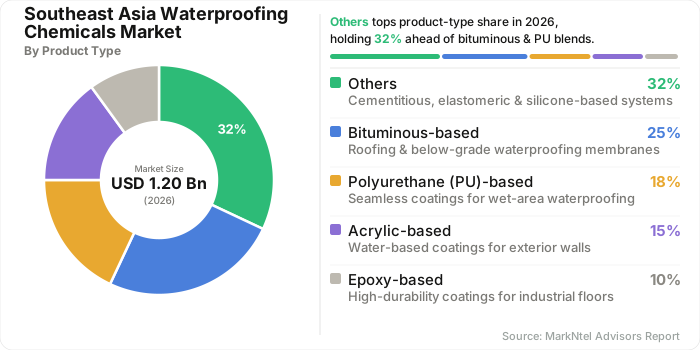
- By product type, bituminous-based waterproofing holds a significant share of about 25% in 2026.
- By end user, infrastructure seized a significant share of about 35% in 2026.
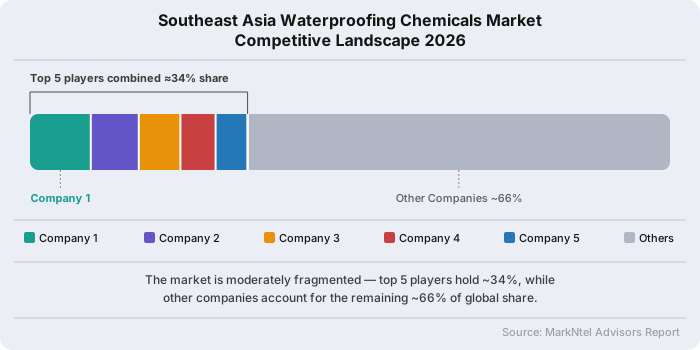
- The industry is moderately fragmented. However, the top five players collectively account for nearly 34% share.
Southeast Asia Waterproofing Chemicals Market Size and Outlook
The waterproofing chemicals market size in Southeast Asia was valued at USD 1.11 billion in 2025 and is projected to grow from USD 1.20 billion in 2026 to USD 1.87 billion by 2032. Along with this, the market is estimated to grow at a CAGR of around 7.67% during the forecast period, i.e., 2026-32.
The market is supported by sustained construction activity, infrastructure investment, urbanization, and growing requirements for durable moisture protection. Singapore’s Building and Construction Authority projected USD 35–39 billion in real construction demand for 2025, driven by major developments such as Changi Airport Terminal 5, the Marina Bay Sands expansion, public housing, industrial buildings, healthcare facilities, rail projects, and port infrastructure. These projects create broad applications for waterproofing chemicals across foundations, basements, roofs, wet areas, tunnels, transport structures, and underground utilities. Furthermore, BCA expects Singapore’s construction demand to average USD 39–46 billion annually from 2026 to 2029, indicating a continuing pipeline of construction activity.
The market is also benefiting from the expansion of regional construction-material capacity and technology-driven product development. In January 2025, Sika opened a new automated mortar plant in Singapore, strengthening local production and improving supply responsiveness for construction materials. In February 2025, the company also acquired Singapore-based Elmich, a specialist in greening systems, expanding its Asia-Pacific construction-solutions portfolio. Sika subsequently reported that its Southeast Asia business recorded dynamic growth in 2025, highlighting the region’s continuing importance within the broader construction-chemicals industry.
Moreover, Southeast Asia’s tropical climate, high humidity, intense rainfall, and flood exposure create persistent requirements for moisture protection in residential, commercial, industrial, and infrastructure projects. At the same time, manufacturing, data-center, logistics, housing, and transport investments are expanding the number of structures requiring specialized waterproofing. Consequently, demand is broadening from conventional cementitious and bituminous products toward polyurethane and acrylic coatings, liquid-applied membranes, sealants, repair systems, and high-performance protective technologies.
With construction activity remaining strong and developers increasingly focused on durability, lifecycle performance, and reliable building protection, the Southeast Asia waterproofing chemicals market is positioned for sustained growth.
Southeast Asia Waterproofing Chemicals Market Key Indicators
- Southeast Asia’s recurring heavy rainfall and flood exposure continue to support demand for waterproofing chemicals. The ASEAN Specialised Meteorological Centre reported that during January–March 2025, rainfall anomalies exceeded +2 mm per day across much of the Maritime Continent, with parts of central Sumatra and northern Borneo recording anomalies of +6 to +10 mm per day. In addition, ADB’s 2025 Asian Water Development Outlook identified increasing urban-flood risks in Indonesia and the Philippines. These conditions increase the need for waterproofing in buildings, tunnels, foundations, drainage systems, and other water-exposed structures, supporting demand for membranes, coatings, sealants, and cementitious systems.
- Expansion of water and wastewater infrastructure is creating additional demand for waterproofing chemicals across Southeast Asia. In December 2025, ADB approved a USD 763 million investment program in Cambodia to improve water supply, sanitation, and urban resilience across 14 cities and 12 districts. Similarly, the World Bank approved a 2024 project in Vietnam to improve water quality and wastewater treatment for more than 500,000 residents, while ADB invested USD 145 million in the Philippines in 2025 to expand and modernize water and wastewater infrastructure. Such projects require waterproofing for treatment tanks, reservoirs, sewerage structures, underground facilities, and concrete water-retaining systems.
- The availability and cost of cement, bitumen, polymers, acrylics, polyurethane components, resins, and additives directly influence the production cost, pricing, and supply reliability of waterproofing chemicals in Southeast Asia. The region’s expanding petrochemical capacity is therefore an important supply-side indicator. For example, in 2025, Indonesia commissioned Lotte Chemical’s USD 3.95 billion petrochemical complex, with annual capacity of 1 million tonnes of ethylene, 520,000 tonnes of propylene, and 350,000 tonnes of polypropylene. The facility is expected to increase Indonesia’s petrochemical self-sufficiency from 44% to 90%. Greater regional production of petrochemical feedstocks and polymers can reduce import dependence, improve raw-material availability, and support more competitive waterproofing-chemical manufacturing.
- Cement and concrete consumption provides a useful proxy for the volume of structures requiring waterproofing protection. Indonesia recorded approximately 64.9 million tonnes of domestic cement demand in 2024, including 45.1 million tonnes of bagged cement and 19.8 million tonnes of bulk cement, according to the Indonesian Cement Association (ASI). Bulk cement demand increased 4.4% year-on-year, reflecting infrastructure and large-scale construction activity. As cement and concrete usage expands, the application base for cementitious waterproofing, crystalline systems, coatings, sealants, and concrete-protection products also increases across Southeast Asia.
Southeast Asia Waterproofing Chemicals Market Scope
| Category | Segments |
|---|---|
| By Product Type | Cementitious-Based, Bituminous-Based, Polyurethane (PU)-Based, Acrylic-Based, Elastomeric, Silicone- and Hybrid Polymer-Based, Epoxy-Based, Polyurea-Based, Other Waterproofing Chemicals |
| By End User | Residential, Commercial, Industrial, Infrastructure, Water and Wastewater |
| By Distribution Channel | Direct Sales, Distributors & Wholesalers, Retail/Building Material Stores, Online/E-commerce |
Southeast Asia Waterproofing Chemicals Market Growth Drivers
Rapid Urbanization and Government-Led Housing Development Expand the Waterproofing Chemicals Demand Base
Rapid urbanization and housing development are expanding the demand base for waterproofing chemicals across Southeast Asia. The Philippines recorded 62.22 million urban residents, representing 55.2% of its population, in 2024, an increase of 3.29 million from 2020. Meanwhile, Vietnam’s 2025 social-housing program included 692 projects under implementation, representing 633,559 apartments. The country has also set a target of at least 1 million social-housing apartments by 2030, with 995,445 units planned for completion during 2025–2030. Indonesia is also expanding planned urban development through Nusantara, whose second development phase runs from 2025 to 2029 and includes housing and supporting infrastructure.
This construction activity directly supports demand for waterproofing chemicals because new residential and urban developments require protection for foundations, roofs, bathrooms, balconies, basements, and water-retaining structures. Moreover, Vietnam’s housing pipeline and Indonesia’s continued Nusantara development are expected to sustain construction activity and create recurring demand for membranes, coatings, sealants, and cementitious waterproofing systems.
Consequently, continued urban population growth and government-led housing development will expand the volume of structures requiring moisture protection, supporting steady growth in the Southeast Asia waterproofing chemicals market.
Recent Trends
Accelerating Shift Toward Low-VOC and Lower-Carbon Waterproofing Solutions
Environmental performance is becoming an increasingly important consideration in Southeast Asian construction, encouraging waterproofing manufacturers to develop low-VOC, water-based, and lower-carbon solutions. In 2024, the Asian Development Bank launched sustainable-construction-material surveys in Cambodia, Lao PDR, and Vietnam. The initiative plans to introduce CO₂-emission evaluation and reporting mechanisms in 2025 and work with public-procurement agencies in 2026 to integrate green-material criteria. This is significant because governments globally spend approximately USD 11 trillion annually on public procurement, generating around 7.5 billion tonnes of direct and indirect greenhouse-gas emissions.
A direct waterproofing example is CPAC Waterproof Concrete in Thailand, which received verified Environmental Product Declarations in November 2024 with a five-year validity through November 2029 and a geographical scope covering Southeast Asia. The product is designed for water-exposed structures such as basements, water tanks, and swimming pools, demonstrating the growing use of environmental documentation for water-resistant construction materials. Additionally, Sika’s Sikalastic-560 is a water-based, low-VOC liquid-applied waterproofing membrane used for new construction and refurbishment.
Moreover, carbon reporting, EPDs, and green procurement are expected to increase demand for waterproofing products with documented environmental performance. Consequently, low-VOC, water-based, durable, and lower-carbon solutions can gain greater acceptance in sustainable building and infrastructure projects, supporting market growth.
Southeast Asia Waterproofing Chemicals Market Opportunities and Challenges
High Cost of Advanced Waterproofing Systems Creates Demand for Cost-Effective, Easy-to-Apply Alternatives
The high upfront cost of advanced waterproofing systems can limit adoption among price-sensitive developers and contractors in Southeast Asia. A November 2024 Indonesian project quotation listed Sika Bituseal T-130 membrane waterproofing at approximately USD 11.60/m², compared with SikaTop 107 cementitious waterproofing at approximately USD 3.45/m²—a difference of around 3.4 times. Although project-specific, this illustrates the substantial price gap between waterproofing technologies.
This cost gap creates opportunities for manufacturers to develop simpler, more accessible waterproofing solutions. For example, Aquaproof’s Conseal, launched in Indonesia in 2024, is a spray-applied product designed to penetrate concrete or cement and seal capillary pores to address leakage. Its simplified application approach can potentially reduce installation complexity and labor requirements, although the company does not publicly confirm a direct price comparison with membrane systems.
Consequently, manufacturers can target different construction segments through tiered solutions, including cost-effective cementitious products for budget-sensitive projects, polymer-modified systems for mainstream construction, and advanced membranes for premium infrastructure. Products that combine adequate performance with simpler application can expand waterproofing adoption among price-sensitive customers and support market growth.
Segmentation Insights
Bituminous-based Waterproofing Leads with Nearly 25% Share
Bituminous-based waterproofing is estimated to account for nearly 25% of Southeast Asia’s waterproofing chemicals market, making it the largest product category. Its leading position is supported by widespread use in residential, commercial, and infrastructure construction, particularly for roofs, foundations, basements, underground structures, bridges, and roads. Bitumen membranes and coatings are valued for their strong water resistance, durability, and relatively cost-effective application, making them suitable for price-sensitive construction markets across the region.
The product is also compatible with large-scale infrastructure projects, where extensive surface areas require reliable moisture protection. In countries such as Indonesia, Vietnam, Thailand, Malaysia, and the Philippines, continued urbanization, housing construction, transport infrastructure development, and tropical rainfall exposure are sustaining demand for bitumen-based systems. Furthermore, the availability of modified formulations, including polymer-enhanced bitumen membranes, is improving flexibility, crack resistance, and service life.
Consequently, the combination of established contractor familiarity, broad application coverage, cost competitiveness, and strong demand from new construction and infrastructure projects supports bitumen-based waterproofing as the largest product segment in Southeast Asia. Based on product type, the scope has been segmented into
- Cementitious-Based
- Bituminous-Based
- Polyurethane (PU)-Based
- Acrylic-Based
- Elastomeric
- Silicone- and Hybrid Polymer-Based
- Epoxy-Based
- Polyurea-Based
- Other Waterproofing Chemicals
Infrastructure Commands Nearly 35% Share as Southeast Asia’s Waterproofing Powerhouse
The infrastructure segment is estimated to account for approximately 35% of the Southeast Asia waterproofing chemicals market, making it the largest end-user category. Its leading position is supported by extensive construction of roads, bridges, tunnels, railways, airports, ports, drainage networks, water-supply systems, wastewater-treatment facilities, reservoirs, and underground utilities. These structures face prolonged exposure to water and moisture, creating strong demand for waterproofing membranes, cementitious coatings, polyurethane systems, sealants, and protective coatings.
In addition, infrastructure projects generally require durable, high-performance materials because waterproofing failure can result in costly structural damage and maintenance. Large-scale public investment in transport, urban utilities, flood-control systems, and water infrastructure across Indonesia, Vietnam, Thailand, Malaysia, and the Philippines further supports demand. Consequently, the scale and long service-life requirements of infrastructure projects enable this segment to maintain the largest share, while residential, commercial, industrial, and institutional construction provide additional demand across the region. Based on end user, the market is categorized into
- Residential
- Commercial
- Industrial
- Infrastructure
- Institutional
Southeast Asia Waterproofing Chemicals Market Geographical Outlook
Indonesia accounts for approximately 23% of the Southeast Asia waterproofing chemicals market, making it the region’s leading country-level market. This position is supported by the country’s large population, rapid urbanization, extensive residential construction, and broad infrastructure development. Construction contributed 10.43% of Indonesia’s GDP in the fourth quarter of 2024, highlighting the sector’s significant economic contribution and the scale of building activity generating demand for construction chemicals.
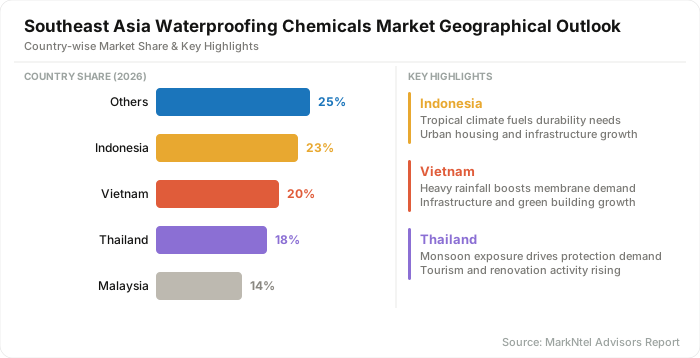
A major example is Nusantara, Indonesia’s planned new capital, where the continued development of residential areas, government facilities, roads, utilities, and supporting infrastructure is expanding the country’s construction pipeline. These projects require waterproofing solutions for foundations, roofs, basements, bathrooms, wet areas, underground utilities, tunnels, and other concrete structures exposed to moisture. In parallel, Indonesia’s industrial expansion, transportation infrastructure, commercial construction, and urban redevelopment are creating demand across both new-build and renovation applications.
The country’s tropical climate, high humidity, heavy rainfall, and exposure to flooding further increase the importance of moisture protection and durable waterproofing systems. Consequently, Indonesia’s large construction base, continued urban expansion, Nusantara development, and diverse application opportunities support its leading share of the regional waterproofing chemicals market.
Southeast Asia Waterproofing Chemicals Market Competitive Analysis
The Southeast Asia waterproofing chemicals market is moderately fragmented, with the top five players Sika AG, Compagnie de Saint-Gobain S.A., Mapei S.p.A., BASF SE, and RPM International Inc. collectively accounting for an estimated approximately 34% share of the regional market.
Major Companies in Southeast Asia waterproofing chemicals Industry
- Sika AG
- BASF SE
- Mapei S.p.A.
- Compagnie de Saint-Gobain S.A.
- ARDEX GmbH
- Arkema S.A.
- Dow Inc.
- Wacker Chemie AG
- RPM International Inc.
- Beijing Oriental Yuhong Waterproof Technology Co., Ltd.
- TOA Paint (Thailand) Public Company Limited
- Nippon Paint Holdings Co., Ltd.
- Others
Southeast Asia Waterproofing Chemicals Industry News and Recent Developments:
2026: Sika Introduces Sikalastic®-701 for Cool-Roof Waterproofing in Malaysia
Sika introduced Sikalastic®-701, a polyurethane/acrylic hybrid topcoat for roofing applications, with field testing conducted in Malaysia. The product is designed to improve UV resistance, solar reflectivity, and durability of waterproofing systems while supporting cooler roofs and potentially reducing air-conditioning energy consumption. Its introduction reflects the growing integration of waterproofing, roof durability, and energy-efficiency requirements in Southeast Asian construction.
Impact Analysis: The introduction of Sikalastic®-701 strengthens the market’s shift toward multifunctional waterproofing solutions that combine moisture protection with energy-efficiency benefits. Its cool-roof properties can improve roof surface performance in hot climates and potentially reduce cooling requirements in buildings. This development may encourage demand for advanced polyurethane/acrylic systems in tropical Southeast Asia, particularly for commercial, industrial, and infrastructure projects seeking durable and energy-conscious roofing solutions.
2025: Sika Opens New Singapore Plant to Strengthen Regional Construction-Material Supply
Sika opened a new automated mortar plant in Singapore in January 2025. The facility strengthens local production and shortens logistics distances, improving supply responsiveness for construction materials in Southeast Asia. The development supports the regional availability of mortar-based construction solutions, including products used in waterproofing applications.
Impact Analysis: Sika’s new automated Singapore plant strengthens regional production capacity and improves the availability of construction materials across Southeast Asia. By producing closer to end markets, the facility can support shorter supply chains and more responsive delivery for construction projects. Increased local manufacturing capacity may also improve access to mortar-based waterproofing and related systems, supporting market expansion as residential, commercial, and infrastructure construction continues across the region.
- Market Segmentation
- Introduction
- Product Definition
- Research Process
- Assumptions
- Executive Summary
- Southeast Asia Waterproofing Chemicals Market Policies, Regulations, and Product Standards
- Southeast Asia Waterproofing Chemicals Market Trends & Developments
- Southeast Asia Waterproofing Chemicals Market Dynamics
- Growth Factors
- Challenges
- Southeast Asia Waterproofing Chemicals Market Hotspot & Opportunities
- Southeast Asia Waterproofing Chemicals Market Outlook, 2022-2032
- Market Size & Outlook
- By Revenues (USD Million)
- By Quantity Sold (Thousand Tons)
- Market Segmentation & Outlook
- By Product Type- Market Size & Forecast 2022-2032, USD Million & Thousand Tons
- Cementitious-Based
- Bituminous-Based
- Polyurethane (PU)-Based
- Acrylic-Based
- Elastomeric
- Silicone- and Hybrid Polymer-Based
- Epoxy-Based
- Polyurea-Based
- Other Waterproofing Chemicals
- By End User - Market Size & Forecast 2022-2032, USD Million & Thousand Tons
- Residential
- Commercial
- Industrial
- Infrastructure
- Water and Wastewater
- By Distribution Channel- Market Size & Forecast 2022-2032, USD Million & Thousand Tons
- Direct Sales
- Distributors & Wholesalers
- Retail/Building Material Stores
- Online/E-commerce
- By Country
- Indonesia
- Vietnam
- Thailand
- Malaysia
- Singapore
- Philippines
- Cambodia
- By Company
- Competition Characteristics
- Market Share & Analysis
- By Product Type- Market Size & Forecast 2022-2032, USD Million & Thousand Tons
- Market Size & Outlook
- Indonesia Waterproofing Chemicals Market Outlook, 2022-2032
- Market Size & Outlook
- By Revenues (USD Million)
- By Quantity Sold (Thousand Tons)
- Market Segmentation & Outlook
- By Product Type- Market Size & Forecast 2022-2032, USD Million & Thousand Tons
- By End-User - Market Size & Forecast 2022-2032, USD Million & Thousand Tons
- By Distribution Channel- Market Size & Forecast 2022-2032, USD Million & Thousand Tons
- Market Size & Outlook
- Vietnam Waterproofing Chemicals Market Outlook, 2022-2032
- Market Size & Outlook
- By Revenues (USD Million)
- By Quantity Sold (Thousand Tons)
- Market Segmentation & Outlook
- By Product Type- Market Size & Forecast 2022-2032, USD Million & Thousand Tons
- By End-Use - Market Size & Forecast 2022-2032, USD Million & Thousand Tons
- By Distribution Channel- Market Size & Forecast 2022-2032, USD Million & Thousand Tons
- Market Size & Outlook
- Thailand Waterproofing Chemicals Market Outlook, 2022-2032
- Market Size & Outlook
- By Revenues (USD Million)
- By Quantity Sold (Thousand Tons)
- Market Segmentation & Outlook
- By Product Type- Market Size & Forecast 2022-2032, USD Million & Thousand Tons
- By End-Use - Market Size & Forecast 2022-2032, USD Million & Thousand Tons
- By Distribution Channel- Market Size & Forecast 2022-2032, USD Million & Thousand Tons
- Market Size & Outlook
- Malaysia Waterproofing Chemicals Market Outlook, 2022-2032
- Market Size & Outlook
- By Revenues (USD Million)
- By Quantity Sold (Thousand Tons)
- Market Segmentation & Outlook
- By Product Type- Market Size & Forecast 2022-2032, USD Million & Thousand Tons
- By End-User - Market Size & Forecast 2022-2032, USD Million & Thousand Tons
- By Distribution Channel- Market Size & Forecast 2022-2032, USD Million & Thousand Tons
- Market Size & Outlook
- Singapore Waterproofing Chemicals Market Outlook, 2022-2032
- Market Size & Outlook
- By Revenues (USD Million)
- By Quantity Sold (Thousand Tons)
- Market Segmentation & Outlook
- By Product Type- Market Size & Forecast 2022-2032, USD Million & Thousand Tons
- By End-User - Market Size & Forecast 2022-2032, USD Million & Thousand Tons
- By Distribution Channel- Market Size & Forecast 2022-2032, USD Million & Thousand Tons
- Market Size & Outlook
- Philippines Waterproofing Chemicals Market Outlook, 2022-2032
- Market Size & Outlook
- By Revenues (USD Million)
- By Quantity Sold (Thousand Tons)
- Market Segmentation & Outlook
- By Product Type- Market Size & Forecast 2022-2032, USD Million & Thousand Tons
- By End-User - Market Size & Forecast 2022-2032, USD Million & Thousand Tons
- By Distribution Channel- Market Size & Forecast 2022-2032, USD Million & Thousand Tons
- Market Size & Outlook
- Cambodia Waterproofing Chemicals Market Outlook, 2022-2032
- Market Size & Outlook
- By Revenues (USD Million)
- By Quantity Sold (Thousand Tons)
- Market Segmentation & Outlook
- By Product Type- Market Size & Forecast 2022-2032, USD Million & Thousand Tons
- By End-User - Market Size & Forecast 2022-2032, USD Million & Thousand Tons
- By Distribution Channel- Market Size & Forecast 2022-2032, USD Million & Thousand Tons
- Market Size & Outlook
- Southeast Asia Waterproofing Chemicals Market Key Strategic Imperatives for Success & Growth
- Competitive Outlook
- Company Profiles
- Sika AG
- Business Description
- Product Portfolio
- Collaborations & Alliances
- Recent Developments
- Financial Details
- Others
- BASF SE
- Business Description
- Product Portfolio
- Collaborations & Alliances
- Recent Developments
- Financial Details
- Others
- Mapei S.p.A.
- Business Description
- Product Portfolio
- Collaborations & Alliances
- Recent Developments
- Financial Details
- Others
- Compagnie de Saint-Gobain S.A.
- Business Description
- Product Portfolio
- Collaborations & Alliances
- Recent Developments
- Financial Details
- Others
- ARDEX GmbH
- Business Description
- Product Portfolio
- Collaborations & Alliances
- Recent Developments
- Financial Details
- Others
- Arkema S.A.
- Business Description
- Product Portfolio
- Collaborations & Alliances
- Recent Developments
- Financial Details
- Others
- Dow Inc.
- Business Description
- Product Portfolio
- Collaborations & Alliances
- Recent Developments
- Financial Details
- Others
- Wacker Chemie AG
- Business Description
- Product Portfolio
- Collaborations & Alliances
- Recent Developments
- Financial Details
- Others
- RPM International Inc.
- Business Description
- Product Portfolio
- Collaborations & Alliances
- Recent Developments
- Financial Details
- Others
- Beijing Oriental Yuhong Waterproof Technology Co., Ltd.
- Business Description
- Product Portfolio
- Collaborations & Alliances
- Recent Developments
- Financial Details
- Others
- TOA Paint (Thailand) Public Company Limited
- Business Description
- Product Portfolio
- Collaborations & Alliances
- Recent Developments
- Financial Details
- Others
- Nippon Paint Holdings Co., Ltd.
- Business Description
- Product Portfolio
- Collaborations & Alliances
- Recent Developments
- Financial Details
- Others
- Others
- Sika AG
- Company Profiles
- Disclaimer

MarkNtel Advisors follows a robust and iterative research methodology designed to ensure maximum accuracy and minimize deviation in market estimates and forecasts. Our approach combines both bottom-up and top-down techniques to effectively segment and quantify various aspects of the market. A consistent feature across all our research reports is data triangulation, which examines the market from three distinct perspectives to validate findings. Key components of our research process include:
1. Scope & Research Design At the outset, MarkNtel Advisors define the research objectives and formulate pertinent questions. This phase involves determining the type of research—qualitative or quantitative—and designing a methodology that outlines data collection methods, target demographics, and analytical tools. They also establish timelines and budgets to ensure the research aligns with client goals.
2. Sample Selection and Data Collection In this stage, the firm identifies the target audience and determines the appropriate sample size to ensure representativeness. They employ various sampling methods, such as random or stratified sampling, based on the research objectives. Data collection is carried out using tools like surveys, interviews, and observations, ensuring the gathered data is reliable and relevant.
3. Data Analysis and Validation Once data is collected, MarkNtel Advisors undertake a rigorous analysis process. This includes cleaning the data to remove inconsistencies, employing statistical software for quantitative analysis, and thematic analysis for qualitative data. Validation steps are taken to ensure the accuracy and reliability of the findings, minimizing biases and errors.

4. Data Forecast and FinalizationThe final phase involves forecasting future market trends based on the analyzed data. MarkNtel Advisors utilize predictive modeling and time series analysis to anticipate market behaviors. The insights are then compiled into comprehensive reports, featuring visual aids like charts and graphs, and include strategic recommendations to inform client decision-making
We offer flexible licensing options to cater to varying organizational needs. Choose the pricing pack that best suits your requirements:
Buy Now Inquire Before Buying
 Request Customization