

By Product Type (Table Shell Eggs, Processed Eggs Products), By Nature (Conventional, Organic), By Eggs Source (Chicken, Duck, Quail, Goose, Turkey, Others), By Distribution Channel (Offline, Foodserv... ... l (Offline, Foodservice & Institutional Channels (B2B), Online), By End User (Household Consumers, Foodservice/HORECA, Food Processing & Industrial), and others Read more
- Food & Beverages
- Jul 2026
- 140
- PDF, Excel, PPT
Saudi Arabia Eggs Market Key Takeaways
- The Saudi Arabia eggs market was valued at USD 1.43 billion in 2025, is projected to reach USD 1.59 billion in 2026, and USD 2.87 billion by 2032, growing at a 10.34% CAGR during 2026–2032.
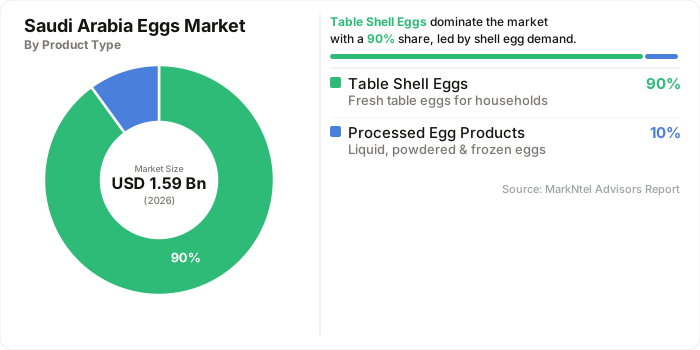
- Table shell eggs dominate the market by product type, accounting for approximately 90% share.
- Household consumers represent the leading end-user segment, capturing approximately 62% market share in 2026.
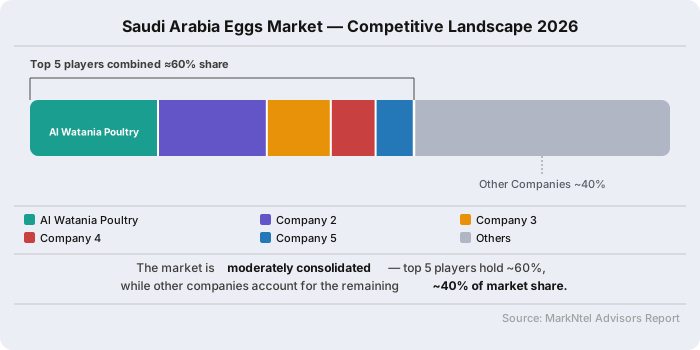
- The industry remains moderately consolidated, with the top five players collectively accounting for nearly 60% of the total market share through integrated production and extensive distribution networks.
Saudi Arabia Eggs Market Size and Outlook
The Saudi Arabia eggs market size was valued at USD 1.43 billion in 2025 and is projected to grow from USD 1.59 billion in 2026 to USD 2.87 billion by 2032, registering a CAGR of 10.34% during the forecast period. Market expansion is expected to be supported by rising domestic consumption, increasing production capacity, and sustained investments in poultry infrastructure. Growing demand across the animal protein industry further reinforces the sector's long-term growth prospects and strengthens its contribution to national food security.
Production fundamentals continue to improve, providing a solid foundation for sustained industry expansion. National table egg production exceeded 8.4 billion units in 2024, reflecting a 6.4% year-on-year increase as commercial layer capacity expanded across the Kingdom. Moreover, the Ministry of Environment, Water, and Agriculture reported that 82% of domestic table egg production achieved Saudi Good Agricultural Practices certification during 2024, strengthening product quality, food safety, and consumer confidence in locally produced eggs.
The long-term outlook for the Saudi eggs industry strengthened further after the Ministry of Environment, Water, and Agriculture confirmed in March 2025 that the Kingdom achieved full self-sufficiency in table eggs production, with annual output surpassing 8 billion eggs. This milestone reflects sustained investments in poultry infrastructure, layer-farm modernization, and supply-chain development, enabling domestic producers to pursue export opportunities across GCC markets while strengthening competitiveness and reducing reliance on imported table eggs.
Demand prospects remain favorable as institutional consumption increasingly complements household purchases. According to the General Authority for Statistics, 5,443,393 Umrah performers were recorded during the second quarter of 2025, significantly increasing eggs demand across hotels, restaurants, and catering establishments serving pilgrims in Makkah and Madinah. Expanding religious tourism is expected to sustain procurement through the food retail market and commercial foodservice channels, creating stable year-round consumption beyond traditional household purchasing patterns in the Saudi Arabia eggs market.
Saudi Arabia Eggs Market Key Indicators
- Saudi Arabia achieved 103% table egg self-sufficiency in 2024, up from 100% in the previous year, as per the General Authority for Statistics. Domestic layer farms now generate output exceeding national consumption requirements, creating additional capacity for exports to GCC markets without affecting local supply stability or affordability. This milestone highlights the expanding role of agribusiness in Saudi Arabia in enhancing food resilience and supporting export-oriented agricultural development.
- The General Authority for Statistics reported 188 operational layer-chicken projects across the Kingdom by the end of 2024, with a combined capacity of 55.1 million birds. Riyadh accounted for 67 projects, representing 29% of total national capacity, underscoring its position as the country's principal production hub. This extensive infrastructure reflects sustained agricultural investments supporting scalable output and long-term supply reliability.
- Per-capita poultry meat availability reached 46.9 kilograms in 2024, according to the General Authority for Statistics, reflecting continued growth in domestic protein consumption. Strong poultry demand enables integrated producers to optimize hatchery, feed, and cold-storage assets across broiler and layer operations, improving capital efficiency and operational performance. These structural advantages reinforce opportunities within the broader nutrition market as consumer demand for high-quality protein continues to rise.
Saudi Arabia Eggs Market Scope
| Category | Segments |
|---|---|
| By Product Type | Table Shell Eggs, Processed Eggs Products |
| By Nature | Conventional, Organic |
| By Eggs Source | Chicken, Duck, Quail, Goose, Turkey, Others |
| By Distribution Channel | Offline, Foodservice & Institutional Channels (B2B), Online |
| By End User | Household Consumers, Foodservice/HORECA, Food Processing & Industrial |
Saudi Arabia Eggs Market Growth Drivers
Government-Backed Agricultural Financing Accelerating Domestic Eggs Production
Government-backed financing is strengthening the Saudi Arabia eggs market by enabling large-scale investments in commercial layer farming. During September 2024, the Agricultural Development Fund approved loans and credit facilities exceeding USD 533 million for poultry projects, including eggs production, alongside greenhouse and cold-storage developments. These initiatives accelerate commercial layer farms expansion while supporting advanced poultry housing infrastructure needed to increase reliable domestic eggs supplies.
The financing momentum continues as Agricultural Development Fund approvals are projected to reach approximately USD 1.97 billion in 2025, compared with around USD 1.91 billion in 2024. Simultaneously, financing coverage for eligible projects has increased from 50% to 70%, encouraging investment in automation, precision poultry farming, and modern production technologies that improve operational efficiency throughout the Saudi eggs industry.
Greater access to concessional capital enables producers to expand automated facilities and strengthen cold-chain capabilities faster than competitors dependent on internal financing. The agricultural sector's contribution to national GDP also increased from 3.6% to 11% in 2024, highlighting rising sector importance. Collectively, these developments encourage industry consolidation while enhancing cold chain logistics and strengthening long-term food security across Saudi Arabia.
Recent Trends
Automation and Digitalization Transforming Commercial Layer Farming
Automation and digitalization are becoming defining trends across the Saudi Arabia eggs industry as commercial producers increasingly modernize production facilities. During 2024, poultry companies accelerated the adoption of Artificial Intelligence (AI), Internet of Things (IoT) sensors, automated feeding systems, and real-time environmental monitoring to optimize flock health, ventilation, feed consumption, and production efficiency. These investments strengthen smart poultry management while improving eggs grading systems across commercial operations.
Saudi Arabia's Vision 2030 continues to accelerate modernization through government support, infrastructure investments, and partnerships with private companies. The national strategy targets approximately 80% poultry self-sufficiency by 2025, compared with around 70%, encouraging wider deployment of automated production systems, climate-controlled poultry houses, and digital monitoring platforms. These developments advance automated feeding systems and digital poultry management throughout large-scale layer operations.
Growing technology adoption enables producers to improve productivity, reduce labor dependency, enhance animal welfare, and optimize resource utilization under challenging climatic conditions. As automation becomes increasingly integrated into commercial facilities, the Saudi eggs market is positioned to achieve greater operational consistency while strengthening livestock automation and poultry genetics capabilities that support long-term competitiveness and sustainable domestic eggs production.
Saudi Arabia Eggs Market Opportunities and Challenges
Imported Feed Dependence Driving Premium Eggs Diversification
Heavy reliance on imported feed ingredients remains a structural challenge for the Saudi Arabia eggs market. The Kingdom imported 3,393,692 metric tons of feed corn during 2024, approximately 24% higher than in 2023, with Argentina supplying 46%, Brazil 36%, and the United States 12%. Since corn represents nearly 60% of poultry feed formulations, rising global commodity prices pressure the feed conversion ratio and increase costs for fresh table egg producers.
Saudi Arabia's limited arable land and harsh climatic conditions restrict domestic feed cultivation, leaving producers exposed to currency fluctuations and international shipping disruptions. These persistent cost pressures compress profitability across conventional egg production, encouraging companies to improve operational efficiency while exploring functional eggs and egg product innovation that generate greater pricing resilience than commodity-focused offerings.
An important opportunity emerged after the Saudi Food and Drug Authority updated its organic food product clearance requirements on August 4, 2024, establishing a clearer certification pathway for premium producers. This enables the Saudi egg industry to expand certified organic and specialty portfolios targeting health-conscious consumers, while strengthening organic egg and premium egg segments capable of delivering higher margins despite ongoing feed-cost volatility.
Segmentation Insights
Table Shell Eggs Dominate Due to Extensive Retail Availability and Daily Household Consumption
Table shell eggs accounted for approximately 90% of the Saudi Arabia Eggs market by product type, reflecting their position as the preferred protein source for households across all income groups. Their affordability, versatility, and suitability for everyday meals continue to sustain consistent purchasing patterns. Widespread consumer acceptance further reinforces demand across the fresh food market in Saudi Arabia, where eggs remain an essential staple within daily grocery baskets.
The segment's leadership is supported by an extensive retail distribution network spanning supermarkets, hypermarkets, convenience stores, and traditional grocery outlets. Five leading retail chains like Othaim, Panda Retail Company, Tamimi Markets, Farms, and Danube collectively account for more than 80% of the Kingdom's food retail revenues, ensuring nationwide product availability and efficient replenishment. This organized distribution ecosystem strengthens sales across the broader FMCG food industry while maintaining high product visibility.
Stable household demand, efficient merchandising, and continuous replenishment cycles continue to reinforce the segment's market leadership. Standardized packaging, reliable quality, and convenient accessibility enable retailers to maintain consistent inventory levels while meeting routine consumer purchasing needs. As organized retail continues, table shell eggs are expected to preserve their dominant position, supported by well-established purchasing habits. Based on product type, the scope has been bifurcated into:
- Table Shell Eggs
- Processed Eggs Products
- Liquid Eggs Products
- Dried Eggs Products
- Frozen Eggs Products
Household Consumers Lead Owing to Daily Consumption Patterns and Population Growth
Household consumers accounted for approximately 62% of the Saudi eggs industry, reflecting eggs' essential role as an affordable and nutritious protein source in everyday diets. Regular consumption across breakfast, home cooking, and family meals sustains consistent purchasing throughout the year. This entrenched demand is further supported by the expanding protein food industry, where eggs remain one of the most accessible and economical sources of dietary protein.
The Kingdom's total population increased by 4.7% in 2024, reaching an estimated 35.3 million, driven largely by expatriate inflows. Population expansion has directly enlarged the household consumer base purchasing shell eggs through supermarkets, hypermarkets, convenience stores, and neighborhood grocery outlets. Growing residential demand continues to reinforce consumption across the broader fresh food category in Saudi Arabia, supporting stable retail sales volumes throughout the country.
Strong household purchasing behavior, combined with changing family structures and rising nutritional awareness, continues to underpin the segment's long-term leadership. Eggs remain a preferred ingredient because of their affordability, versatility, and suitability for multiple meal occasions. Continued population growth, together with increasing demand for convenient, nutritious foods, is expected to sustain the household segment's dominant contribution. The report analyzes the following key end-user categories:
- Household Consumers
- Foodservice/HORECA
- Food Processing & Industrial
- Bakery & Confectionery
- Dairy & Frozen Desserts
- Ready-to-Eat & Convenience Foods
- Sauces, Dressings & Mayonnaise
- Meat, Poultry & Seafood Processing
- Pharmaceuticals & Biotechnology
- Nutraceuticals & Sports Nutrition
- Cosmetics & Personal Care
- Animal Feed & Pet Food
Saudi Arabia Eggs Market Competitive Analysis
The Saudi Arabia eggs industry is moderately consolidated, with the top five players like Al Watania Poultry, Tanmiah Food Company, Fakieh Poultry Farms, Al Kadi Agri & Poultry, and Saha Eggs collectively accounting for an estimated 60% of total market revenue. Their leadership is supported by integrated production systems, large-scale layer operations, established retail distribution, and strong brand recognition. The remaining market comprises regional poultry farms and independent producers serving localized demand, resulting in moderate competitive intensity. Ongoing investments in automation, biosecurity, production capacity, and quality certifications are expected to strengthen the competitive positions of these companies.
Key Players in the Saudi Arabia Eggs Market
- Al Watania Poultry
- Tanmiah Food Company
- Fakieh Poultry Farms
- Al Kadi Agri & Poultry
- Al Gharbia Farms
- Golden Chicken Farms
- Al-Jazeera Poultry Farms
- Saha Eggs
- Al Ain Farms
- ARASCO (Entaj)
- Others
Saudi Arabia Eggs Industry News and Recent Developments
March 2025: Al Watania Poultry Partners with Halal Products Development Company to Expand Global Halal Presence
Al Watania Poultry entered a strategic partnership with the Halal Products Development Company (HPDC), a subsidiary of the Public Investment Fund (PIF), to accelerate the international expansion of halal poultry products. The collaboration supports Saudi Vision 2030 by strengthening halal food innovation, enhancing export capabilities, and positioning Saudi Arabia as a globally recognized hub for high-quality halal food production.
Impact Analysis: The partnership strengthens Al Watania Poultry's international competitiveness while creating long-term opportunities for integrated poultry businesses, including eggs production. Greater export readiness, enhanced halal certification capabilities, and stronger global market access are expected to improve industry investment attractiveness and encourage modernization across production operations. The initiative also reinforces Saudi Arabia's ambition to become a leading halal food exporter, supporting sustainable sector growth, supply-chain resilience, and higher-value product development within the broader poultry industry.
- Market Segmentation
- Introduction
- Product Definition
- Research Process
- Assumptions
- Executive Summary
- Saudi Arabia Eggs Market Policies, Regulations, and Product Standards
- Saudi Arabia Eggs Production Trend 2022-2032
- Saudi Arabia Eggs Trend by Type of Product Type
- Table Shell Eggs
- Processed Egg Products
- Company Wise Production Plants and Statistics
- Installed Production Capacity
- Actual Production
- Planned Production Target
- Saudi Arabia Eggs Trend by Type of Product Type
- Saudi Arabia Eggs Pricing Analysis 2022-2032
- Saudi Arabia Eggs Pricing Trend 2022-2032
- Saudi Arabia Eggs Pricing Trend by Product Type 2022-2032
- Table Shell Eggs
- Processed Egg Products
- Saudi Arabia Eggs Market Dynamics
- Growth Factors
- Challenges
- Saudi Arabia Eggs Market Value Chain Analysis
- Saudi Arabia Eggs Market Import & Export Analysis
- Saudi Arabia Eggs Market Hotspot & Opportunities
- Saudi Arabia Eggs Market Outlook, 2022-2032F
- Market Size & Outlook
- By Revenues (USD Million)
- By Quantity Sold (Thousand Tons)
- Market Segmentation & Outlook
- By Product Type- Market Size & Forecast 2022-2032, USD Million & Thousand Tons
- Table Shell Eggs
- Processed Eggs Products
- Liquid Eggs Products
- Whole Eggs
- Eggs White
- Eggs Yolk
- Dried Eggs Products
- Whole Eggs Powder
- Eggs White Powder
- Eggs Yolk Powder
- Frozen Eggs Products
- Whole Eggs
- Eggs White
- Eggs Yolk
- Liquid Eggs Products
- By Nature- Market Size & Forecast 2022-2032, USD Million & Thousand Tons
- Conventional
- Organic
- By Eggs Source- Market Size & Forecast 2022-2032, USD Million & Thousand Tons
- Chicken
- Duck
- Quail
- Goose
- Turkey
- Others
- By Distribution Channel- Market Size & Forecast 2022-2032, USD Million & Thousand Tons
- Offline
- Supermarkets & Hypermarkets
- Grocery & Convenience Stores
- Specialty Stores
- Wholesale Clubs — Retail Membership
- Direct-to-Consumer
- Foodservice & Institutional Channels (B2B)
- Foodservice Distributors
- Wholesale Clubs— Business Membership
- Institutional Procurement
- Online
- B2C E-commerce
- B2B E-commerce
- Offline
- By End User- Market Size & Forecast 2022-2032, USD Million & Thousand Tons
- Household Consumers
- Foodservice/HORECA
- Food Processing & Industrial
- Bakery & Confectionery
- Dairy & Frozen Desserts
- Ready-to-Eat & Convenience Foods
- Sauces, Dressings & Mayonnaise
- Meat, Poultry & Seafood Processing
- Pharmaceuticals & Biotechnology
- Nutraceuticals & Sports Nutrition
- Cosmetics & Personal Care
- Animal Feed & Pet Food
- By Region- Market Size & Forecast 2022-2032, USD Million & Thousand Tons
- Riyadh
- Jeddah
- Damam
- Mecca & Madinah
- Others
- By Company
- Competition Characteristics
- Market Share & Analysis
- By Product Type- Market Size & Forecast 2022-2032, USD Million & Thousand Tons
- Market Size & Outlook
- Saudi Arabia Table Shell Eggs Market Outlook, 2022-2032
- Market Size & Outlook
- By Revenues (USD Million)
- By Quantity Sold (Thousand Tons)
- Market Segmentation & Outlook
- By Nature- Market Size & Forecast 2022-2032, USD Million & Thousand Tons
- By Eggs Source- Market Size & Forecast 2022-2032, USD Million & Thousand Tons
- By Distribution Channel- Market Size & Forecast 2022-2032, USD Million & Thousand Tons
- By End User- Market Size & Forecast 2022-2032, USD Million & Thousand Tons
- By Region- Market Size & Forecast 2022-2032, USD Million & Thousand Tons
- Market Size & Outlook
- Saudi Arabia Processed Eggs Products Market Outlook, 2022-2032
- Market Size & Outlook
- By Revenues (USD Million)
- By Quantity Sold (Thousand Tons)
- Market Segmentation & Outlook
- By Nature- Market Size & Forecast 2022-2032, USD Million & Thousand Tons
- By Eggs Source- Market Size & Forecast 2022-2032, USD Million & Thousand Tons
- By Distribution Channel- Market Size & Forecast 2022-2032, USD Million & Thousand Tons
- By End User- Market Size & Forecast 2022-2032, USD Million & Thousand Tons
- By Region- Market Size & Forecast 2022-2032, USD Million & Thousand Tons
- Market Size & Outlook
- Saudi Arabia Eggs Market Key Strategic Imperatives for Success & Growth
- Competitive Outlook
- Company Profiles
- Al Watania Poultry
- Business Description
- Product Portfolio
- Collaborations & Alliances
- Recent Developments
- Financial Details
- Others
- Tanmiah Food Company
- Business Description
- Product Portfolio
- Collaborations & Alliances
- Recent Developments
- Financial Details
- Others
- Fakieh Poultry Farms
- Business Description
- Product Portfolio
- Collaborations & Alliances
- Recent Developments
- Financial Details
- Others
- Al Kadi Agri & Poultry
- Business Description
- Product Portfolio
- Collaborations & Alliances
- Recent Developments
- Financial Details
- Others
- Al Gharbia Farms
- Business Description
- Product Portfolio
- Collaborations & Alliances
- Recent Developments
- Financial Details
- Others
- Golden Chicken Farms
- Business Description
- Product Portfolio
- Collaborations & Alliances
- Recent Developments
- Financial Details
- Others
- Al-Jazeera Poultry Farms
- Business Description
- Product Portfolio
- Collaborations & Alliances
- Recent Developments
- Financial Details
- Others
- Saha Eggs
- Business Description
- Product Portfolio
- Collaborations & Alliances
- Recent Developments
- Financial Details
- Others
- Al Ain Farms
- Business Description
- Product Portfolio
- Collaborations & Alliances
- Recent Developments
- Financial Details
- Others
- ARASCO (Entaj)
- Business Description
- Product Portfolio
- Collaborations & Alliances
- Recent Developments
- Financial Details
- Others
- Others
- Al Watania Poultry
- Company Profiles
- Disclaimer

MarkNtel Advisors follows a robust and iterative research methodology designed to ensure maximum accuracy and minimize deviation in market estimates and forecasts. Our approach combines both bottom-up and top-down techniques to effectively segment and quantify various aspects of the market. A consistent feature across all our research reports is data triangulation, which examines the market from three distinct perspectives to validate findings. Key components of our research process include:
1. Scope & Research Design At the outset, MarkNtel Advisors define the research objectives and formulate pertinent questions. This phase involves determining the type of research—qualitative or quantitative—and designing a methodology that outlines data collection methods, target demographics, and analytical tools. They also establish timelines and budgets to ensure the research aligns with client goals.
2. Sample Selection and Data Collection In this stage, the firm identifies the target audience and determines the appropriate sample size to ensure representativeness. They employ various sampling methods, such as random or stratified sampling, based on the research objectives. Data collection is carried out using tools like surveys, interviews, and observations, ensuring the gathered data is reliable and relevant.
3. Data Analysis and Validation Once data is collected, MarkNtel Advisors undertake a rigorous analysis process. This includes cleaning the data to remove inconsistencies, employing statistical software for quantitative analysis, and thematic analysis for qualitative data. Validation steps are taken to ensure the accuracy and reliability of the findings, minimizing biases and errors.

4. Data Forecast and FinalizationThe final phase involves forecasting future market trends based on the analyzed data. MarkNtel Advisors utilize predictive modeling and time series analysis to anticipate market behaviors. The insights are then compiled into comprehensive reports, featuring visual aids like charts and graphs, and include strategic recommendations to inform client decision-making
We offer flexible licensing options to cater to varying organizational needs. Choose the pricing pack that best suits your requirements:
Buy Now Inquire Before Buying
 Request Customization