

By Components type (Design (Fabless / Chip Design) (Digital IC Design (CPU, GPU, SoC), Analog IC Design, Mixed-Signal Design, RF / Communication Chip Design, AI / HPC Chip Design), Front-end Manufactu... ... Front-end Manufacturing (Wafer Fabrication) (Process Stage (Photolithography, Etching, Deposition (CVD/PVD), Ion implantation, Wafer cleaning, CMP (polishing)), Manufacturing Node (Advanced Nodes (<28nm), Mid Nodes (28nm – 65nm), Mature Nodes (>65nm))), Back-end Manufacturing (Assembly, Testing, Packaging (OSAT)), Equipment (Lithography equipment, Etching equipment, Assembly & Packaging Equipment, Inspection & metrology tools, Portable Systems)), By Material Type (Silicon wafers, Silicon carbide (SiC), Gallium nitride (GaN), Compound semiconductors), By Manufacturing Ecosystem (Integrated device manufacturers, Fabless companies, Foundries , OSAT), By End-Use Industry (Automotive Industry, Consumer Electronics Industry, Aerospace and Defense, Healthcare and Medical Devices, Telecommunications Industry), and others Read more
- ICT & Electronics
- May 2026
- 125
- PDF, Excel, PPT
China Semiconductor Manufacturing Market Report Key Takeaways
- The China semiconductor manufacturing market is projected to grow from USD 333.46 billion in 2025 to USD 356.80 billion in 2026, reaching USD 740 billion by 2032.
- The industry is projected to reflect a CAGR of 12.93%, driven by rapid capacity expansion and domestic substitution strategies.
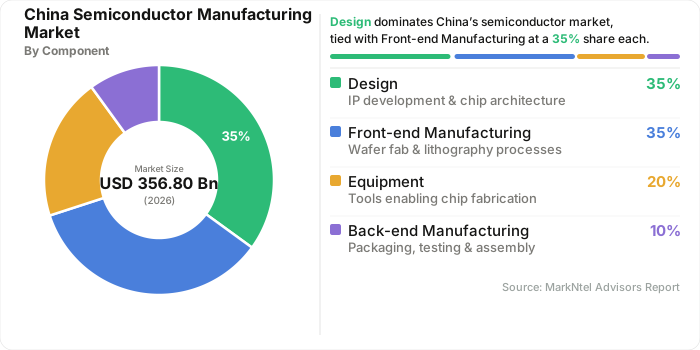
- Front-end Manufacturing (Wafer Fabrication) remains the leading segment, accounting for approximately 35% share.
- By end-use, Consumer Electronics (smartphones, laptops, IoT devices) dominates with nearly 65% share.
- Regionally, East China leads the market with around 45% share, supported by integrated supply chain ecosystems and advanced fab infrastructure.
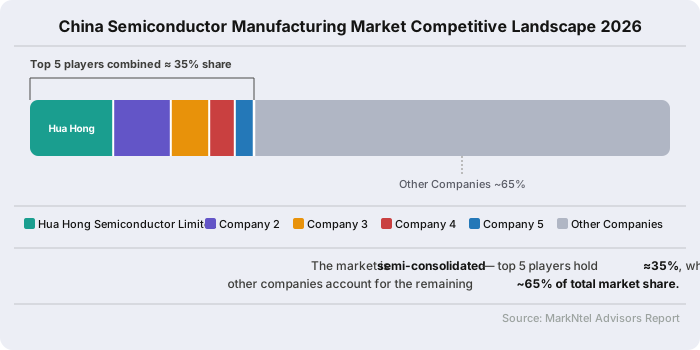
- The market is characterized by a semi-consolidated competitive structure, where leading ecosystem players collectively account for 35% market share.
China Semiconductor Manufacturing Market Size and Outlook
The China semiconductor manufacturing market is expected to register a steady CAGR of 12.93% during forecast period i.e., 2026-32. Semiconductor production in China has expanded steadily due to long-term industrial upgrading, rising electronics consumption, and large-scale infrastructure buildout across fabrication clusters such as Shanghai, Shenzhen, and Wuhan, supported by national semiconductor industrial planning under the 14th Five-Year Plan framework and digital economy development strategy.
Over the past decade, rapid urbanization and growth in consumer electronics manufacturing have strengthened domestic chip demand, particularly for smartphones, laptops, and IoT devices used in residential environments, aligned with broader national digital infrastructure expansion initiatives. Industrial automation in export-oriented manufacturing hubs has further accelerated the adoption of integrated circuits and sensors.
In 2025–2026, policy direction continues to prioritize semiconductor self-sufficiency through intensified state-backed funding mechanisms, including the third phase of the National Integrated Circuit Industry Investment Fund (commonly referred to as Big Fund III), which targets large-scale domestic capacity expansion. Regulatory emphasis on import substitution is also increasing, particularly for advanced logic and memory chips, reinforced by technology restrictions and external supply chain constraints.
These conditions have strengthened domestic fabrication incentives, accelerating localization across the design, wafer fabrication, and equipment ecosystems. On the industrial side, leading manufacturers such as Semiconductor Manufacturing International Corporation (SMIC) and Yangtze Memory Technologies Co. (YMTC) are expanding production capacity through new fabrication facilities and process improvements, reflecting rising domestic consolidation of supply.
These expansions are supported by domestic equipment substitution policies encouraging local sourcing in semiconductor production chains. Demand is structurally reinforced across end-user segments, including residential consumer electronics, commercial cloud and data center infrastructure, industrial automation systems, and institutional telecommunications and defense applications.
Looking forward, the semiconductor manufacturing industry is expected to sustain momentum as semiconductor development remains embedded within national digital infrastructure and AI deployment strategies, supported by continued policy emphasis on technological independence and supply chain resilience. As a result, the market is projected to grow from USD 356.80 billion in 2026 to USD 740 billion by 2032.
Expansion of advanced computing applications in enterprise and government systems is expected to increase demand for high-performance chips, while ongoing improvements in fabrication yield and localization of semiconductor manufacturing equipment will strengthen domestic capacity stability. These combined factors indicate a long-term shift toward higher-value semiconductor production and reduced external dependency across critical technology nodes.
China Semiconductor Manufacturing Market Key Indicators
- MIIT data confirms China's 5G base station count reached 3.8 million by the end of 2024, and it will hit 1.6 billion 5G connections by 2032; each station integrates RF semiconductors, baseband processors, and power management ICs, generating persistent and growing chip procurement demand across China Mobile, China Telecom, and China Unicom.
- According to the International Energy Agency (IEA) Global EV Outlook 2025, China produced 1.15 million electric cars in 2024, more than 70% of global EV output; the China Association of Automobile Manufacturers (CAAM) reported 139,000 NEV domestic sales in 2024, amplifying demand for power semiconductors, battery management ICs, and motor control chips manufactured domestically.
- MIIT reported China's electronic information manufacturing industry generated total revenue of USD 2.27 trillion in 2024, a 7.3% year-on-year increase; this production scale spans mobile phones, computers, and communications equipment , establishing a continuous high-volume pull on domestic semiconductor supply across all chip categories.
China Semiconductor Manufacturing Market Scope
| Category | Segments |
|---|---|
| By Components type | Design (Fabless / Chip Design) (Digital IC Design (CPU, GPU, SoC), Analog IC Design, Mixed-Signal Design, RF / Communication Chip Design, AI / HPC Chip Design), Front-end Manufacturing (Wafer Fabrication) (Process Stage (Photolithography, Etching, Deposition (CVD/PVD), Ion implantation, Wafer cleaning, CMP (polishing)), Manufacturing Node (Advanced Nodes (<28nm), Mid Nodes (28nm – 65nm), Mature Nodes (>65nm))), Back-end Manufacturing (Assembly, Testing, Packaging (OSAT)), Equipment (Lithography equipment, Etching equipment, Assembly & Packaging Equipment, Inspection & metrology tools, Portable Systems |
| By Material Type | Silicon wafers, Silicon carbide (SiC), Gallium nitride (GaN), Compound semiconductors |
| By Manufacturing Ecosystem | Integrated device manufacturers, Fabless companies, Foundries , OSAT |
| By End-Use Industry | Automotive Industry, Consumer Electronics Industry, Aerospace and Defense, Healthcare and Medical Devices, Telecommunications Industry |
China Semiconductor Manufacturing Market Growth Drivers
Government Localization Mandates in EV and Telecom Semiconductor Adoption
China’s semiconductor manufacturing market growth is strongly driven by government-led localization mandates that require critical industries such as electric vehicles (EVs) and telecommunications to substitute imported chips with domestically manufactured semiconductors. This policy direction has intensified in recent years under national industrial security and supply chain resilience objectives, where regulators actively guide procurement behavior across state-linked enterprises. According to China’s Ministry of Industry and Information Technology (MIIT), telecom operators and state systems have been instructed to progressively reduce reliance on foreign chips in core infrastructure, accelerating domestic chip uptake in network and computing systems.
This mandate has expanded significantly into the automotive sector, particularly EV manufacturing, where domestic chip integration is increasingly embedded into vehicle electronics, battery management systems, and autonomous driving modules. Chinese automakers have been directed to increase sourcing from local semiconductor suppliers, reflecting a structured substitution strategy rather than voluntary adoption. In parallel, telecom carriers are implementing phased replacement programs targeting foreign processors in network equipment, with deadlines extending toward the late 2020s, reinforcing predictable long-term domestic demand visibility.
Unlike short-term policy incentives, this driver directly increases semiconductor consumption volumes by legally and structurally redirecting procurement pipelines toward domestic producers such as SMIC-supported ecosystem suppliers and local fabless firms. It expands wafer demand across mature-node chips used in EV control units, 5G base stations, and enterprise telecom infrastructure, where high unit volumes are required. This creates a sustained demand multiplier effect, as each regulatory cycle of infrastructure upgrade or vehicle production directly translates into higher domestic chip absorption rather than substitution of existing pricing structures.
Recent Trends
AI-Specific Chip Architecture Driving Semiconductor Demand Shift in China
The Chinese semiconductor manufacturing field is witnessing a structural shift toward AI-specific chip architectures, including GPUs, NPUs, and custom accelerators designed for large-scale model training and inference workloads. This trend has accelerated in 2025–2026 due to the rapid expansion of generative AI adoption, cloud computing scale-up, and national-level AI infrastructure development. China’s broader semiconductor self-reliance strategy is further reinforcing domestic AI chip development, increasing demand for specialized compute solutions across data centers and enterprise systems.
At the company level, leading domestic players are actively aligning product strategies with this shift. Huawei has developed the Ascend AI chip family, including Ascend 950PR for inference and recommendation workloads and Ascend 950DT for training and decoding tasks, with next-generation architectures such as Ascend 960 and 970 under development for higher-performance AI computing. These chips are being positioned to support large-scale domestic AI model deployment and reduce reliance on foreign accelerators.
This trend is expected to persist as AI workloads in China continue to expand across cloud services, enterprise automation, and industrial applications, requiring higher computational density and energy-efficient processing. The growing need for faster training cycles and optimized inference performance is structurally shifting demand away from general-purpose processors toward specialized AI accelerators, permanently reshaping semiconductor design priorities and fabrication demand patterns within the domestic ecosystem.
China Semiconductor Manufacturing Market Opportunities and Challenges
Restrictions on Access to EUV Lithography System
A major structural challenge in China’s semiconductor manufacturing market is restricted access to extreme ultraviolet (EUV) lithography machines, which are essential for manufacturing advanced semiconductors below the 7nm node. Export restrictions imposed by the United States and its allies have effectively blocked Chinese foundries from purchasing ASML’s EUV systems, limiting domestic capability in advanced AI and high-performance computing chip production. As a result, Chinese fabs must rely on older deep ultraviolet (DUV) multi-patterning techniques, which increase manufacturing complexity, reduce yield efficiency, and raise production costs for advanced-node chips.
To overcome this challenge, China has significantly increased state-backed investment into domestic lithography research and semiconductor equipment localization programs. Reports from 2025 indicate that Chinese scientists, supported by government research institutes and Huawei-led coordination efforts, developed a prototype domestic EUV lithography machine inside a high-security Shenzhen research facility. The project involved former ASML engineers and large-scale national R&D coordination, reflecting a long-term strategic push toward semiconductor equipment self-sufficiency. China is reportedly targeting operational advanced chip production using domestic EUV systems by 2028–2030.
In parallel, Beijing has accelerated localization mandates requiring higher domestic semiconductor equipment usage in new fabrication capacity additions, which has significantly increased investment flows toward local lithography and semiconductor tooling firms. This policy push is directly supporting companies such as Shanghai Micro Electronics Equipment (SMEE), which recently announced a 28nm-capable immersion lithography system as part of China’s effort to reduce dependence on foreign lithography suppliers. These efforts demonstrate that China is addressing the EUV bottleneck through coordinated national investment, reverse-engineering programs, and long-term equipment ecosystem development rather than relying solely on imported technology.
Segmentation Analysis
Front-End Wafer Fabrication Dominance
Front-end manufacturing (wafer fabrication) leads the semiconductor value chain with a share of 35% because it directly determines transistor performance, yield, and node scaling efficiency.
It is capital-intensive, requiring multi-billion-dollar fabrication plants, creating strong entry barriers and consolidating production among a few global leaders. Companies such as Taiwan Semiconductor Manufacturing Company, dominate advanced-node manufacturing. This structural concentration ensures wafer fabrication remains the most value-dense and strategically critical segment.
Demand-side acceleration from AI, HPC chips, 5G infrastructure, and automotive electronics is sharply increasing wafer fabrication output requirements. Advanced nodes (<28nm) are essential for GPUs, CPUs, and AI accelerators, driving continuous capital expenditure in EUV lithography and process integration. Key enablers such as ASML, Applied Materials, and Lam Research strengthen process capability across photolithography, etching, and deposition stages. This tight coupling of demand and process innovation sustains long-term leadership of front-end manufacturing globally.
Policy-driven investment flows under “Made in China 2025” and semiconductor self-sufficiency programs further accelerate wafer fab expansion. China is aggressively investing in mature-node and selected advanced-node capacity due to export restrictions on cutting-edge EUV tools. By components the market is further segmented into following categories:
- Design (Fabless / Chip Design)
- Front-end Manufacturing (Wafer Fabrication)
- Back-end Manufacturing
- Equipment
Consumer Electronics Demand Base
Consumer electronics is the leading end-use segment in China’s semiconductor manufacturing market with a share of 65% because China remains the world’s largest hub for smartphones, PCs, tablets, wearables, and home appliances, which creates the highest and most continuous chip demand. This dominance is reinforced by rising device penetration, local assembly scale, and the need for high-volume components such as logic chips, memory, sensors, power management ICs, and display drivers.
Xiaomi also reinforces this segment’s dominance. Its smartphones still use Qualcomm and MediaTek chips while the company develops in-house silicon, which shows both the huge volume of external chip sourcing and the strategic push toward local chip design in consumer devices. OPPO’s Find X series using high-end MediaTek and Qualcomm platforms, along with vivo’s broad smartphone portfolio, further demonstrates how Chinese handset makers keep consumer-chip demand high across flagship and mass-market products.
The market impact is that consumer electronics creates the widest unit base, the fastest replacement cycle, and the strongest manufacturing pull across foundry, packaging, and testing. In practical terms, every smartphone launch, smart-device refresh, and premium handset upgrade translates into immediate demand for processors, memory, power management, and display semiconductors, which is why this segment stays ahead. Based on end user industry, the market is further segmented into following categories:
- Automotive Industry
- Consumer Electronics Industry
- Aerospace and Defense
- Healthcare and Medical Devices
- Telecommunications Industry
Geographical Analysis
East China is the largest and most dominant regional market with 45% share because it combines dense industrial clustering, higher income levels, and exceptional logistics connectivity. Shanghai, Jiangsu, Zhejiang, and Anhui together form a highly integrated manufacturing and consumption corridor, with Shanghai serving as a financial and trade gateway and the surrounding provinces hosting advanced electronics, machinery, and semiconductor ecosystems. This concentration lowers supply-chain costs, shortens lead times, and increases adoption intensity across end markets.
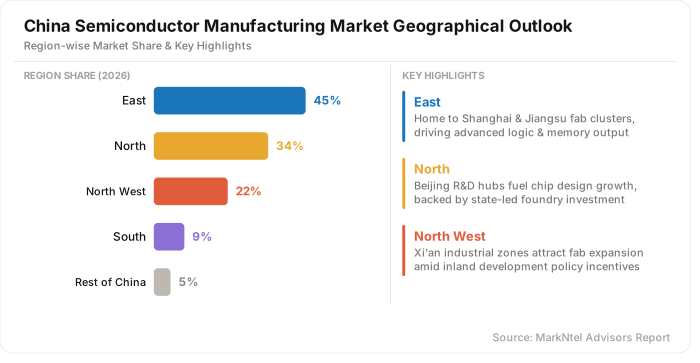
The region also benefits from strong policy support and infrastructure-led development. Shanghai Port’s automated expansion, Taicang’s inland-seaport connectivity in Jiangsu, and Ningbo-Zhoushan’s global trade network in Zhejiang illustrate why East China has superior logistics depth and faster cargo circulation. These advantages attract capital into high-tech production, accelerate equipment upgrades, and reinforce regional demand for semiconductors and related industrial inputs.
Demand is especially strong because East China hosts major customer bases in consumer electronics, industrial automation, automotive electronics, and communications equipment. Shenzhen is often discussed as the core of China’s consumer electronics cluster, while East China’s manufacturing belt complements this with upstream component supply, contract manufacturing, and system integration capabilities. The result is a market with broad end-user coverage , high purchase frequency, and strong enterprise adoption.
In market terms, East China outperforms other regions because it combines scale, sophistication, and trade reach in one ecosystem. China remains the world’s largest chip-consuming market, and domestic capacity growth has been reinforced by state support and new fab investment, which further strengthens East China’s role in absorption, processing, and distribution. This creates a self-reinforcing loop of infrastructure, policy support, and corporate activity that keeps the region ahead of others.
China Semiconductor Manufacturing Industry Competitive Landscape
The China semiconductor manufacturing market is characterized by a semi-consolidated competitive structure. The leading tier consists of core ecosystem players such as Semiconductor Manufacturing International Corporation (SMIC), Hua Hong Semiconductor, ChangXin Memory Technologies (CXMT), Yangtze Memory Technologies Co. (YMTC), and JCET Group, these companies collectively account for 35% of the total market structure, reflecting strong but not absolute concentration.
Major Companies China Semiconductor Manufacturing Landscape
- Huawei HiSilicon
- Hua Hong Semiconductor
- ChangXin Memory Technologies
- Yangtze Memory Technologies Corp
- GigaDevice Semiconductor
- Silan Microelectronics (Hangzhou)
- JCET (Jiangsu Changjiang Electronics Technology)
- SMIC (Semiconductor Manufacturing International Corporation)
- Dongguan Merry Electronic Co., Ltd.
- Shanghai Micro Electronics Equipment
- Jiangyin Changdian Advanced Packaging
China Semiconductor Manufacturing News and Recent Developments
2026: KB Asset Management Launches RISE China AI Semiconductor Top 4 Plus ETF
KB Asset Management launched the “RISE China AI Semiconductor Top 4 Plus ETF” to provide targeted exposure to Chinese companies operating across the AI semiconductor value chain. The ETF tracks firms involved in semiconductor foundries, AI chips, optical communication modules, and semiconductor materials and equipment segments. The launch reflects growing investor confidence in China’s domestic AI infrastructure and semiconductor localization strategy. The index includes companies listed in mainland China and Hong Kong, with quarterly rebalancing and IPO review mechanisms.
Market Impact Analysis: The ETF launch indicates increasing capital market support for China’s semiconductor manufacturing ecosystem, particularly AI-focused chip and equipment companies. Greater institutional investment exposure can improve funding access and valuation support for domestic semiconductor firms expanding fabrication and AI infrastructure capacity. The inclusion of foundries and semiconductor equipment players also highlights rising investor confidence in China’s long-term semiconductor self-sufficiency strategy. Over time, stronger financial participation may accelerate innovation, domestic supply-chain scaling, and advanced semiconductor ecosystem development across China’s AI industry.
2026: Hong Kong Launches RISC-V Alliance to Strengthen Open-Source Chip Ecosystem
Hong Kong Investment Corporation (HKIC), along with semiconductor and technology partners including StarFive Semiconductor, launched the Hong Kong RISC-V Alliance to accelerate development of the regional open-source chip ecosystem. The initiative focuses on chip R&D, industrial application, ecosystem collaboration, and talent development linked to RISC-V processor architecture. The alliance also aims to strengthen semiconductor cooperation across the Greater Bay Area while supporting commercialization of domestically developed chip technologies. Earlier collaborations under the initiative reportedly led to development of the “Lion Rock Chip” and RISC-V-based smart IoT semiconductor solutions.
Market Impact Analysis: The alliance strengthens China-linked semiconductor ecosystem development by promoting alternatives to foreign-controlled processor architectures such as x86 and ARM. Increased collaboration between semiconductor firms, telecom companies, universities, and investment institutions could accelerate commercialization of domestic chip technologies and improve long-term design capability. The initiative also supports expansion of local semiconductor innovation infrastructure, particularly in AI, edge computing, and smart city applications. Over time, broader adoption of RISC-V architectures may reduce technology licensing dependence and create new growth opportunities for domestic semiconductor manufacturing and processor design ecosystems.
2025: SiCarrier Subsidiaries Launch China’s First Domestic 3nm EDA and Advanced Test Equipment
Subsidiaries of Shenzhen-based SiCarrier, a semiconductor equipment company linked to Huawei and backed by the Shenzhen government, launched domestically developed EDA software and advanced 3nm-compatible semiconductor testing equipment during SEMiBAY 2025. Qiyunfang introduced proprietary EDA tools designed for electronic circuit and PCB development, while another subsidiary, Long Sight, launched ultra-high-speed oscilloscopes supporting 3nm and 5nm semiconductor R&D. The products are intended to reduce dependence on foreign semiconductor design software and advanced testing infrastructure dominated by US and European firms. Reports also indicated that more than 20,000 engineers had already adopted the newly launched EDA solutions within China’s semiconductor ecosystem.
Market Impact Analysis: The development strengthens China’s semiconductor self-sufficiency efforts by localizing critical chip design and validation technologies that are essential for advanced-node manufacturing. Domestic EDA and testing capability expansion could reduce operational vulnerability arising from export restrictions on foreign semiconductor software and process tools. The launch also supports China’s broader transition toward advanced semiconductor ecosystem integration, where design software, process equipment, and fabrication infrastructure are increasingly being developed internally.
2026: Alibaba Unveils More Powerful Zhenwu AI Chip and New Large Language Model
Alibaba introduced a more advanced version of its Zhenwu AI chip alongside a new large language model to strengthen its AI computing infrastructure and cloud ecosystem. The upgraded processor is designed to improve AI training and inference efficiency for enterprise and cloud-based generative AI workloads. Alibaba stated that the chip delivers higher computing performance and supports growing AI demand across commercial applications. The launch reflects increasing investment by Chinese technology firms in domestically developed AI semiconductor architectures amid rising demand for localized AI infrastructure.
Market Impact Analysis: The launch strengthens China’s domestic AI semiconductor ecosystem by increasing demand for locally designed AI accelerators and supporting semiconductor manufacturing expansion tied to cloud AI infrastructure. Alibaba’s continued investment in proprietary AI chips also reduces dependence on foreign AI processors for enterprise AI deployment and model training operations. The development is expected to stimulate further investment in advanced packaging, AI server infrastructure, and high-performance semiconductor manufacturing capabilities across China. Over the long term, growing adoption of domestically developed AI chips could accelerate semiconductor localization and improve China’s competitiveness in AI computing markets.
- Market Segmentation
- Introduction
- Product Definition
- Research Process
- Assumptions
- Executive Summary
- China Semiconductor Manufacturing Market Policies, Regulations, and Product Standards
- China Semiconductor Manufacturing Market Trends & Developments
- China Semiconductor Manufacturing Market Dynamics
- Growth Factors
- Challenges
- China Semiconductor Manufacturing Market Hotspot & Opportunities
- China Semiconductor Manufacturing Market Outlook, 2022-2032F
- Market Size & Outlook
- By Revenues (USD Million)
- Market Share & Outlook
- By Components type- Market Size & Forecast 2022-2032, USD Million
- Design (Fabless / Chip Design)
- Digital IC Design (CPU, GPU, SoC)
- Analog IC Design
- Mixed-Signal Design
- RF / Communication Chip Design
- AI / HPC Chip Design
- Front-end Manufacturing (Wafer Fabrication)
- Process Stage
- Photolithography
- Etching
- Deposition (CVD/PVD)
- Ion implantation
- Wafer cleaning
- CMP (polishing)
- Manufacturing Node
- Advanced Nodes (<28nm)
- Mid Nodes (28nm – 65nm)
- Mature Nodes (>65nm)
- Process Stage
- Back-end Manufacturing
- Assembly
- Testing
- Packaging (OSAT)
- Equipment
- Lithography equipment
- Etching equipment
- Assembly & Packaging Equipment
- Inspection & metrology tools
- Portable Systems
- Design (Fabless / Chip Design)
- By Material Type- Market Size & Forecast 2022-2032, USD Million
- Silicon wafers
- Silicon carbide (SiC)
- Gallium nitride (GaN)
- Compound semiconductors
- By Manufacturing Ecosystem- Market Size & Forecast 2022-2032, USD Million
- Integrated device manufacturers
- Fabless companies
- Foundries
- OSAT
- By End-Use Industry- Market Size & Forecast 2022-2032, USD Million
- Automotive Industry
- Consumer Electronics Industry
- Aerospace and Defense
- Healthcare and Medical Devices
- Telecommunications Industry
- By Region
- North
- North West
- North East
- South
- South West
- East
- Central
- By Company
- Competition Characteristics
- Market Share & Analysis
- By Components type- Market Size & Forecast 2022-2032, USD Million
- Market Size & Outlook
- China Silicon wafers Market Outlook, 2022-2032
- Market Size & Outlook
- By Revenues (USD Million)
- Market Share & Outlook
- By Material Type- Market Size & Forecast 2022-2032, USD Million
- By Manufacturing Ecosystem- Market Size & Forecast 2022-2032, USD Million
- By End-Use Industry- Market Size & Forecast 2022-2032, USD Million
- Market Size & Outlook
- China Silicon carbide (SiC) Market Outlook, 2022-2032
- Market Size & Outlook
- By Revenues (USD Million)
- Market Share & Outlook
- By Material Type- Market Size & Forecast 2022-2032, USD Million
- By Manufacturing Ecosystem- Market Size & Forecast 2022-2032, USD Million
- By End-Use Industry- Market Size & Forecast 2022-2032, USD Million
- Market Size & Outlook
- China Gallium nitride (GaN) Market Outlook, 2022-2032
- Market Size & Outlook
- By Revenues (USD Million)
- Market Share & Outlook
- By Material Type- Market Size & Forecast 2022-2032, USD Million
- By Manufacturing Ecosystem- Market Size & Forecast 2022-2032, USD Million
- By End-Use Industry- Market Size & Forecast 2022-2032, USD Million
- Market Size & Outlook
- China Semiconductor Manufacturing Market Key Strategic Imperatives for Success & Growth
- Competitive Outlook
- Company Profiles
- Compound semiconductors
- Business Description
- Product Portfolio
- Collaborations & Alliances
- Recent Developments
- Financial Details
- Others
- Huawei HiSilicon
- Business Description
- Product Portfolio
- Collaborations & Alliances
- Recent Developments
- Financial Details
- Others
- Hua Hong Semiconductor
- Business Description
- Product Portfolio
- Collaborations & Alliances
- Recent Developments
- Financial Details
- Others
- ChangXin Memory Technologies
- Business Description
- Product Portfolio
- Collaborations & Alliances
- Recent Developments
- Financial Details
- Others
- Yangtze Memory Technologies Corp
- Business Description
- Product Portfolio
- Collaborations & Alliances
- Recent Developments
- Financial Details
- Others
- GigaDevice Semiconductor
- Business Description
- Product Portfolio
- Collaborations & Alliances
- Recent Developments
- Financial Details
- Others
- Silan Microelectronics (Hangzhou)
- Business Description
- Product Portfolio
- Collaborations & Alliances
- Recent Developments
- Financial Details
- Others
- JCET (Jiangsu Changjiang Electronics Technology)
- Business Description
- Product Portfolio
- Collaborations & Alliances
- Recent Developments
- Financial Details
- Others
- SMIC (Semiconductor Manufacturing International Corporation)
- Business Description
- Product Portfolio
- Collaborations & Alliances
- Recent Developments
- Financial Details
- Others
- Dongguan Merry Electronic Co., Ltd.
- Business Description
- Product Portfolio
- Collaborations & Alliances
- Recent Developments
- Financial Details
- Others
- Compound semiconductors
- Company Profiles
- Disclaimer

MarkNtel Advisors follows a robust and iterative research methodology designed to ensure maximum accuracy and minimize deviation in market estimates and forecasts. Our approach combines both bottom-up and top-down techniques to effectively segment and quantify various aspects of the market. A consistent feature across all our research reports is data triangulation, which examines the market from three distinct perspectives to validate findings. Key components of our research process include:
1. Scope & Research Design At the outset, MarkNtel Advisors define the research objectives and formulate pertinent questions. This phase involves determining the type of research—qualitative or quantitative—and designing a methodology that outlines data collection methods, target demographics, and analytical tools. They also establish timelines and budgets to ensure the research aligns with client goals.
2. Sample Selection and Data Collection In this stage, the firm identifies the target audience and determines the appropriate sample size to ensure representativeness. They employ various sampling methods, such as random or stratified sampling, based on the research objectives. Data collection is carried out using tools like surveys, interviews, and observations, ensuring the gathered data is reliable and relevant.
3. Data Analysis and Validation Once data is collected, MarkNtel Advisors undertake a rigorous analysis process. This includes cleaning the data to remove inconsistencies, employing statistical software for quantitative analysis, and thematic analysis for qualitative data. Validation steps are taken to ensure the accuracy and reliability of the findings, minimizing biases and errors.

4. Data Forecast and FinalizationThe final phase involves forecasting future market trends based on the analyzed data. MarkNtel Advisors utilize predictive modeling and time series analysis to anticipate market behaviors. The insights are then compiled into comprehensive reports, featuring visual aids like charts and graphs, and include strategic recommendations to inform client decision-making
We offer flexible licensing options to cater to varying organizational needs. Choose the pricing pack that best suits your requirements:
Buy Now Inquire Before Buying
 Request Customization