

By Offering (Software (Space Situational Awareness (SSA) Software, Collision Avoidance Software, Orbit Determination & Prediction Software, Mission Planning Software, Data Analytic......s & Visualization Platforms), Services (Tracking & Monitoring Services, Data Processing & Analytics Services, Consulting & Integration Services, Managed Services, Maintenance & Support Services), Hardware (Ground-Based Radar Systems, Optical Telescopes & Sensors, Tracking Antennas, Communication Systems, Command & Control Infrastructure)), By Deployment Mode (Cloud-Based, On-Premises), By Orbit Type (Low Earth Orbit (LEO), Medium Earth Orbit (MEO), Geostationary Orbit (GEO), Beyond GEO / Deep Space), By Application (Collision Detection & Avoidance, Space Surveillance & Tracking, Space Debris Monitoring & Management, Satellite Launch Monitoring, Orbit Determination & Prediction, Regulatory & Compliance Management), By End User (Government & Defense, Commercial Space Operators, Launch Service Providers, Research & Academic Institutions) Read more
- Aerospace & Defense
- May 2026
- 130
- PDF, Excel, PPT
United States Space Traffic Management Market Key Takeaways
- The U.S. Space Traffic Management Market was valued at around USD 4.2 billion in 2025 and is anticipated to expand from USD 4.62 billion in 2026 to USD 8.23 billion by 2032, reflecting a CAGR of 10.1% over the forecast period.
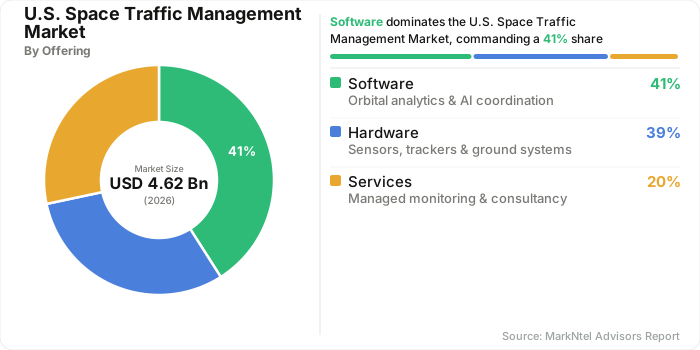
- The Software segment accounted for nearly 41% of the U.S. STM Market in 2026, primarily supported by increasing adoption of real-time orbital analytics, conjunction screening, and automated traffic coordination platforms.
- Government & Defense emerged as the leading end-user segment, capturing around 53% market share in 2026 due to rising investments in military space operations, orbital surveillance infrastructure, and space-domain awareness capabilities.
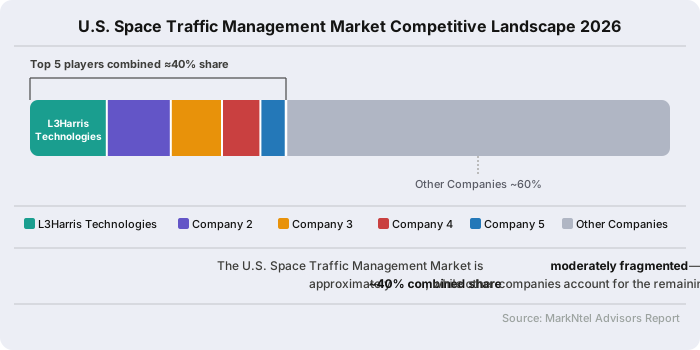
- The industry is moderately fragmented, with the top five players accounting for approximately 40% of the market, supported by strong expertise in space situational awareness systems, orbital tracking platforms, conjunction assessment technologies, and military space surveillance infrastructure.
United States Space Traffic Management Market Size and Outlook
The U.S. space traffic management market is expected to grow at a CAGR of approximately 10.1% during 2026–2032, driven by the rapid expansion of satellite networks, increasing orbital congestion, and the growing reliance on space-based communication, navigation, and defense systems.
As commercial and government-led space activities continue accelerating, the demand for advanced orbital tracking, collision avoidance, and Space Situational Awareness (SSA) Systems has strengthened across the country. The Federal Aviation Administration (FAA) reported more than 200 licensed commercial space operations during fiscal year 2025, while August 2025 marked the agency’s 1,000th licensed commercial space mission milestone . This growing launch frequency has consequently increased the need for efficient space traffic coordination and orbital safety infrastructure.
To support the rising complexity of orbital activities, the U.S. government has continued enhancing regulatory policies and expanding national space-monitoring infrastructure to ensure long-term market development. During 2025, the NOAA Office of Space Commerce upgraded the Traffic Coordination System for Space (TraCSS) with improved conjunction screening capabilities and expanded commercial data-sharing partnerships with multiple satellite operators . These initiatives are encouraging broader adoption of automated monitoring technologies and improving coordination between government agencies and private operators.
The increasing participation of defense organizations, commercial satellite operators, and launch service providers has also emerged as a major contributor to market demand. Agencies including the U.S. Space Force, NASA, NOAA, and the Department of Defense continue investing in surveillance infrastructure and orbital intelligence capabilities to strengthen national security and operational readiness. Simultaneously, commercial operators are expanding Low Earth Orbit satellite constellations for broadband connectivity and Earth observation services, increasing demand for real-time tracking and orbital traffic coordination technologies.
In addition, the FAA’s Part 450 licensing reforms introduced in 2026 are streamlining launch approvals and supporting higher commercial mission volumes. The continued growth in orbital operations, satellite density, and commercial space missions is expected to support the long-term expansion of the U.S. Space Traffic Management industry. The FAA Office of Spaceports announced continued infrastructure policy support in 2026 to strengthen commercial launch competitiveness and improve national space transportation capabilities .
At the same time, leading industry participants are investing in AI-enabled space situational awareness platforms, predictive collision analytics, and advanced debris monitoring technologies to improve mission safety and operational efficiency. Supported by these advancements and increasing collaboration between public agencies and private operators, the space traffic management market in the United states is projected to grow from USD 4.62 billion in 2026 to USD 8.23 billion by 2032.
United States Space Traffic Management Market Key Indicators
- According to the NASA Orbital Debris Program Office, more than 45,000 trackable human-made objects were present in Earth’s orbit as of early 2025, reflecting the growing complexity of orbital traffic and debris management. The increasing volume of operational satellites and orbital debris is significantly strengthening demand for space traffic management systems, collision avoidance technologies, and real-time orbital monitoring platforms across the United States.
- NOAA’s Office of Space Commerce distributed approximately USD 15.5 million to commercial data providers under the TraCSS Consolidated Pathfinder program in 2024 to strengthen national space traffic coordination capabilities. The initiative highlights growing U.S. government investment in commercial space situational awareness services and is accelerating demand for orbit determination solutions, radar-based tracking systems, and conjunction data services used in national space traffic operations.
- As per the U.S. Bureau of Economic Analysis (BEA), the U.S. space economy generated approximately USD 142.5 billion in gross output in 2023, reflecting the growing economic importance of satellite communications and commercial space activities. The increasing dependence on space-based infrastructure is consequently driving investments in space traffic management systems and orbital monitoring technologies.
United States Space Traffic Management Market Scope
| Category | Segments |
|---|---|
| By Offering | Software (Space Situational Awareness (SSA) Software, Collision Avoidance Software, Orbit Determination & Prediction Software, Mission Planning Software, Data Analytics & Visualization Platforms), Services (Tracking & Monitoring Services, Data Processing & Analytics Services, Consulting & Integration Services, Managed Services, Maintenance & Support Services), Hardware (Ground-Based Radar Systems, Optical Telescopes & Sensors, Tracking Antennas, Communication Systems, Command & Control Infrastructure |
| By Deployment Mode | Cloud-Based, On-Premises |
| By Orbit Type | Low Earth Orbit (LEO), Medium Earth Orbit (MEO), Geostationary Orbit (GEO), Beyond GEO / Deep Space |
| By Application | Collision Detection & Avoidance, Space Surveillance & Tracking, Space Debris Monitoring & Management, Satellite Launch Monitoring, Orbit Determination & Prediction, Regulatory & Compliance Management |
| By End User | Government & Defense, Commercial Space Operators, Launch Service Providers, Research & Academic Institutions |
United States Space Traffic Management Market Growth Drivers
Rapid Expansion of Commercial and Military Satellite Deployments
The growing deployment of commercial and military satellite constellations is substantially increasing demand for advanced space traffic management infrastructure across the United States. As satellite density rises in low Earth orbit, concerns regarding orbital congestion, collision risks, and operational safety are becoming increasingly significant for both government agencies and commercial operators. This evolving orbital environment is consequently strengthening the requirement for conjunction screening, maneuver coordination, and continuous satellite tracking capabilities. Space traffic management systems, including orbital tracking software, radar networks, and conjunction data services, therefore play a critical role in supporting safe and efficient satellite operations across shared orbital regions.
According to U.S. Space Command, more than 47,000 objects are currently tracked in Earth’s orbit, reflecting the growing complexity of orbital traffic and debris management activities . As the concentration of operational satellites and orbital debris continues increasing, the frequency of conjunction events and the complexity of orbital coordination activities are also rising steadily. This trend is accelerating demand for real-time orbital analytics, automated orbital monitoring platforms, and advanced collision avoidance systems capable of supporting continuous space traffic coordination.
Furthermore, rising investments in large-scale military satellite programs are continuing to strengthen the requirement for advanced space traffic management infrastructure across the United States. In 2025, SpaceX launched the first batch of 21 satellites for the U.S. Space Development Agency’s Tranche 1 Transport Layer program, part of a planned 126-satellite low Earth orbit network supporting secure military communications and space-domain operations. Such defense-focused deployment programs, combined with continued government investments in orbital tracking and space-domain awareness capabilities, are expected to support long-term demand for advanced space traffic management solutions throughout the forecast period.
Recent Trends
Adoption of AI-Enabled Space Situational Awareness Platforms
The adoption of AI-enabled SSA platforms has emerged as a major structural trend transforming the U.S. Space Traffic Management industry. The rapid increase in satellite launches, orbital congestion, and conjunction events has made traditional manual tracking systems increasingly inefficient for real-time orbital coordination. As orbital environments become more complex, AI-enabled technologies are increasingly being adopted to automate conjunction analysis, improve collision prediction accuracy, and support faster operational decision-making across commercial and government space activities. This trend has accelerated significantly alongside the expansion of large-scale low Earth orbit satellite constellations and rising national security space operations.
The growing integration of AI-driven orbital analytics is consequently reshaping operational models across satellite operators, defense organizations, and regulatory agencies. In 2025, the NOAA Office of Space Commerce continued expanding the Traffic Coordination System for Space (TraCSS) to strengthen civil space traffic coordination and improve conjunction screening capabilities across U.S. orbital operations . At the same time, commercial operators are increasingly deploying automated orbital monitoring tools and predictive orbital analytics platforms to improve tracking accuracy, reduce operational response times, and strengthen maneuver planning efficiency. These technologies are enabling more scalable and data-driven approaches to managing rapidly increasing orbital traffic volumes.
As orbital activity and satellite density continue increasing, the long-term importance of AI-enabled SSA technologies is expected to strengthen further across the United States. In 2026, LeoLabs expanded its Orbital Intelligence Platform to enhance real-time space-domain awareness capabilities through AI-powered analytics, radar-based tracking, and automated threat detection technologies. During the same year, the U.S. Space Force increased the ceiling of the Andromeda contract vehicle to approximately USD 6.2 billion for next-generation SSA satellites supporting advanced orbital monitoring operations. Such developments highlight the growing strategic importance of AI-enabled orbital intelligence and automated space traffic coordination technologies within the evolving U.S. space ecosystem.
United States Space Traffic Management Market Opportunities and Challenges
Increasing Orbital Data Complexity Creating Opportunities for Advanced Data Integration and Traffic Coordination Services
The rapid expansion of satellite constellations and orbital activities is significantly increasing the complexity of managing space traffic data across the United States. Modern space traffic management systems must continuously process large volumes of orbital trajectories, conjunction warnings, debris tracking information, and satellite telemetry generated by commercial operators, government agencies, and defense organizations. According to discussions presented during SpaceSec 2026, more than 100,000 satellites are projected to be launched globally over the coming decade, r eflecting the growing scale of orbital activity and the increasing operational burden on existing coordination systems. As satellite density continues increasing, challenges related to data interoperability, traffic coordination, and real-time orbital decision-making are becoming increasingly significant.
This growing operational complexity is simultaneously creating strong opportunities for advanced data integration and traffic coordination services across the U.S. space traffic management market. Satellite operators and government agencies are increasingly investing in centralized coordination platforms, cloud-based orbital analytics systems, and scalable data-sharing architectures capable of supporting real-time conjunction assessment and traffic monitoring. In 2026, SpaceX introduced the “Stargaze” system to strengthen real-time space traffic coordination capabilities through thousands of Starlink-based tracking sensors designed for continuous orbital monitoring and conjunction screening . The platform supports near real-time traffic coordination and ephemeris-sharing capabilities among satellite operators, reflecting the increasing industry demand for scalable orbital data integration and collaborative space traffic management infrastructure.
Segmentation Insights
Software Emerges as the Leading Offering Segment Due to Rising Demand for Real-Time Orbital Monitoring
The software segment dominates the United States space traffic management market, accounting for approximately 41% of the total market share, primarily due to the increasing need for real-time space situational awareness, collision prediction, and orbital traffic coordination as satellite activity intensifies across low Earth orbit. The growing number of commercial satellites and orbital debris has significantly increased the complexity of managing space operations, driving strong demand for advanced software platforms capable of processing large-scale tracking and telemetry data. According to the Office of Space Commerce, the development of the Traffic Coordination System for Space (TraCSS) is becoming critical for managing conjunction warnings and ensuring safe orbital operations, highlighting the rising importance of software-centric traffic management infrastructure in the United States.
The dominance of software is further reinforced by the need for greater speed, accuracy, and precision in orbital monitoring and collision avoidance systems. Software platforms provide scalable capabilities for conjunction assessment, predictive analytics, autonomous maneuver planning, and integration of commercial space situational awareness data, making them more adaptable than hardware-intensive systems. In addition, the increasing adoption of artificial intelligence and cloud-based analytics in traffic coordination systems enables satellite operators and government agencies to respond more efficiently to evolving orbital conditions. As commercial and government space programs continue expanding, software solutions remain the preferred segment due to their operational flexibility, lower upgrade costs, and ability to support increasingly congested space environments across the U.S. Based on offering, the study is segmented into:
- Software
- Hardware
- Services
Government & Defense Dominated the Industry Owing to Rising Demand for Orbital Surveillance Systems
Government & Defense dominates the U.S. space traffic management industry with nearly 53% share, supported by expanding military space programs and increasing demand for real-time orbital monitoring and satellite coordination systems. As orbital environments become increasingly congested, U.S. defense agencies are relying more heavily on advanced space command and control systems and military space surveillance capabilities to support secure communications, missile warning operations, intelligence activities, and strategic satellite coordination. The growing deployment of military satellite constellations is consequently strengthening demand for conjunction screening, collision avoidance, and continuous space traffic coordination capabilities across government-led space operations.
Sustained federal investments in military space infrastructure further reinforce the segment’s dominance across the market. The FY2025 U.S. Space Force budget request reached approximately USD 29.4 billion , supporting continued investments in space-domain awareness, orbital surveillance systems, and mission operations capabilities. Defense agencies are increasingly modernizing radar-based monitoring platforms and orbital intelligence technologies to improve operational readiness and protect strategic space assets. As military communications and reconnaissance missions continue expanding, Government & Defense is expected to maintain its leadership position within the space traffic management market in the US. Based on end user, the market is categorized into:
- Government & Defense
- Commercial Space Operators
- Launch Service Providers
- Research & Academic Institutions
United States Space Traffic Management Market Competitive Analysis
The competitive landscape of the U.S. space traffic management market is moderately fragmented, led by a mix of major defense contractors and specialized space situational awareness providers focusing on orbital surveillance and traffic coordination technologies. Key players such as Lockheed Martin, L3Harris Technologies, Kratos Defense & Security Solutions, LeoLabs and Slingshot Aerospace collectively account for approximately 40% of the market share. Their strong market presence is supported by extensive expertise in space situational awareness systems, orbital tracking platforms, conjunction assessment technologies, and military space surveillance infrastructure.
Major Space Traffic Management Companies in the United States
- Slingshot Aerospace
- AGI (Ansys/STK)
- Astroscale U.S.
- Neuraspace
- LeoLabs
- COMSPOC
- ExoAnalytic Solutions
- Kratos Defense & Security Solutions
- L3Harris Technologies
- Lockheed Martin
- Others
United States Space Traffic Management Industry News and Recent Developments
May 2026: Anduril Industries Secures USD 100.3 Million Contract to Modernize U.S. Space Surveillance Network
Anduril Industries secured a USD 100.3 million contract modification from the U.S. Space Force to modernize the Space Surveillance Network through deployment of resilient mesh-networking capabilities for Space Domain Awareness operations. The upgraded SDANet architecture is designed to improve real-time orbital tracking, sensor connectivity, and low-latency data sharing across increasingly congested orbital environments.
Impact Analysis: This development highlights the growing prioritization of resilient and defense-oriented orbital monitoring infrastructure across the U.S.. Rising military dependence on continuous space-domain awareness capabilities is accelerating investments in advanced surveillance networks, integrated tracking architectures, and secure orbital communication systems. The modernization of military surveillance infrastructure is therefore expected to strengthen operational efficiency and improve real-time coordination across increasingly complex orbital environments.
August 2024: Slingshot Aerospace Launches Beacon Collision Avoidance Collaboration Platform
Slingshot Aerospace introduced Beacon, the industry’s first collision avoidance collaboration platform designed to support real-time conjunction coordination and maneuver communication among satellite operators. The platform enables operators to exchange orbital data, manage conjunction alerts, and improve traffic coordination efficiency across increasingly congested orbital environments.
Impact Analysis: The launch of Beacon reflects the increasing industry shift toward collaborative and operator-driven space traffic coordination frameworks. As conjunction risks continue increasing across low Earth orbit, satellite operators are placing greater emphasis on shared orbital intelligence, real-time maneuver communication, and coordinated traffic management practices. This trend is encouraging wider adoption of interoperable traffic coordination platforms capable of improving transparency and reducing operational conflicts among commercial space operators.
- Market Segmentation
- Introduction
- Product Definition
- Research Process
- Assumptions
- Executive Summary
- U.S. Space Traffic Management Market Policies, Regulations, and Product Standards
- U.S. Space Traffic Management Market Trends & Developments
- U.S. Space Traffic Management Market Dynamics
- Growth Factors
- Challenges
- U.S. Space Traffic Management Market Hotspot & Opportunities
- U.S. Space Traffic Management Market Outlook, 2022-2032F
- Market Size & Outlook
- By Revenues (USD Million)
- Market Share & Outlook
- By Offering- Market Size & Forecast 2022-2032, USD Million
- Software
- Space Situational Awareness (SSA) Software
- Collision Avoidance Software
- Orbit Determination & Prediction Software
- Mission Planning Software
- Data Analytics & Visualization Platforms
- Services
- Tracking & Monitoring Services
- Data Processing & Analytics Services
- Consulting & Integration Services
- Managed Services
- Maintenance & Support Services
- Hardware
- Ground-Based Radar Systems
- Optical Telescopes & Sensors
- Tracking Antennas
- Communication Systems
- Command & Control Infrastructure
- Software
- By Deployment Mode- Market Size & Forecast 2022-2032, USD Million
- Cloud-Based
- On-Premises
- By Orbit Type- Market Size & Forecast 2022-2032, USD Million
- Low Earth Orbit (LEO)
- Medium Earth Orbit (MEO)
- Geostationary Orbit (GEO)
- Beyond GEO / Deep Space
- By Application- Market Size & Forecast 2022-2032, USD Million
- Collision Detection & Avoidance
- Space Surveillance & Tracking
- Space Debris Monitoring & Management
- Satellite Launch Monitoring
- Orbit Determination & Prediction
- Regulatory & Compliance Management
- By End User- Market Size & Forecast 2022-2032, USD Million
- Government & Defense
- Commercial Space Operators
- Launch Service Providers
- Research & Academic Institutions
- By Company
- Competition Characteristics
- Market Share & Analysis
- By Offering- Market Size & Forecast 2022-2032, USD Million
- Market Size & Outlook
- U.S. Software Market Outlook, 2022-2032
- Market Size & Outlook
- By Revenues (USD Million)
- Market Share & Outlook
- By Deployment Mode- Market Size & Forecast 2022-2032, USD Million
- By Orbit Type- Market Size & Forecast 2022-2032, USD Million
- By Application- Market Size & Forecast 2022-2032, USD Million
- By End User- Market Size & Forecast 2022-2032, USD Million
- Market Size & Outlook
- U.S. Hardware Market Outlook, 2022-2032
- Market Size & Outlook
- By Revenues (USD Million)
- Market Share & Outlook
- By Deployment Mode- Market Size & Forecast 2022-2032, USD Million
- By Orbit Type- Market Size & Forecast 2022-2032, USD Million
- By Application- Market Size & Forecast 2022-2032, USD Million
- By End User- Market Size & Forecast 2022-2032, USD Million
- Market Size & Outlook
- U.S. Services Market Outlook, 2022-2032
- Market Size & Outlook
- By Revenues (USD Million)
- Market Share & Outlook
- By Deployment Mode- Market Size & Forecast 2022-2032, USD Million
- By Orbit Type- Market Size & Forecast 2022-2032, USD Million
- By Application- Market Size & Forecast 2022-2032, USD Million
- By End User- Market Size & Forecast 2022-2032, USD Million
- Market Size & Outlook
- U.S. Space Traffic Management Market Key Strategic Imperatives for Success & Growth
- Competitive Outlook
- Company Profiles
- Commonwealth Bank of Australia (CBA)
- Business Description
- Product Portfolio
- Collaborations & Alliances
- Recent Developments
- Financial Details
- Others
- Slingshot Aerospace
- Business Description
- Product Portfolio
- Collaborations & Alliances
- Recent Developments
- Financial Details
- Others
- AGI (Ansys/STK)
- Business Description
- Product Portfolio
- Collaborations & Alliances
- Recent Developments
- Financial Details
- Others
- Astroscale U.S.
- Business Description
- Product Portfolio
- Collaborations & Alliances
- Recent Developments
- Financial Details
- Others
- Neuraspace
- Business Description
- Product Portfolio
- Collaborations & Alliances
- Recent Developments
- Financial Details
- Others
- LeoLabs
- Business Description
- Product Portfolio
- Collaborations & Alliances
- Recent Developments
- Financial Details
- Others
- COMSPOC
- Business Description
- Product Portfolio
- Collaborations & Alliances
- Recent Developments
- Financial Details
- Others
- ExoAnalytic Solutions
- Business Description
- Product Portfolio
- Collaborations & Alliances
- Recent Developments
- Financial Details
- Others
- Kratos Defense & Security Solutions
- Business Description
- Product Portfolio
- Collaborations & Alliances
- Recent Developments
- Financial Details
- Others
- L3Harris Technologies
- Business Description
- Product Portfolio
- Collaborations & Alliances
- Recent Developments
- Financial Details
- Others
- Commonwealth Bank of Australia (CBA)
- Company Profiles
- Disclaimer

MarkNtel Advisors follows a robust and iterative research methodology designed to ensure maximum accuracy and minimize deviation in market estimates and forecasts. Our approach combines both bottom-up and top-down techniques to effectively segment and quantify various aspects of the market. A consistent feature across all our research reports is data triangulation, which examines the market from three distinct perspectives to validate findings. Key components of our research process include:
1. Scope & Research Design At the outset, MarkNtel Advisors define the research objectives and formulate pertinent questions. This phase involves determining the type of research—qualitative or quantitative—and designing a methodology that outlines data collection methods, target demographics, and analytical tools. They also establish timelines and budgets to ensure the research aligns with client goals.
2. Sample Selection and Data Collection In this stage, the firm identifies the target audience and determines the appropriate sample size to ensure representativeness. They employ various sampling methods, such as random or stratified sampling, based on the research objectives. Data collection is carried out using tools like surveys, interviews, and observations, ensuring the gathered data is reliable and relevant.
3. Data Analysis and Validation Once data is collected, MarkNtel Advisors undertake a rigorous analysis process. This includes cleaning the data to remove inconsistencies, employing statistical software for quantitative analysis, and thematic analysis for qualitative data. Validation steps are taken to ensure the accuracy and reliability of the findings, minimizing biases and errors.

4. Data Forecast and FinalizationThe final phase involves forecasting future market trends based on the analyzed data. MarkNtel Advisors utilize predictive modeling and time series analysis to anticipate market behaviors. The insights are then compiled into comprehensive reports, featuring visual aids like charts and graphs, and include strategic recommendations to inform client decision-making
FILL THE FORM TO GET THE FREE SAMPLE PAGES
We offer flexible licensing options to cater to varying organizational needs. Choose the pricing pack that best suits your requirements:
Buy Now Inquire Before Buying
 Talk to our Consultant
 Request Customization