

By Type (Activator Adjuvants, Utility Adjuvants), By Application (Herbicides, Fungicides, Insecticides, Others), By Crop Type (Cereals & Grains, Oilseeds & Pulses, Fruits & Vegetab......les, Plantation Crops, Turf & Ornamentals, Others), By Formulation (Liquid, Dry (Powder/Granules)), By Source (Synthetic, Bio-based), and others Read more
- Environment
- Jul 2026
- 240
- PDF, Excel, PPT
South America Agricultural Adjuvants Market Key Takeaways
- The South America agricultural adjuvants market size was valued at USD 0.62 billion in 2025 and is projected to grow from USD 0.65 Billion in 2026 to USD 0.86 Billion by 2032.
- The industry is projected to witness steady growth at a CAGR of 4.84% during 2026–2032.
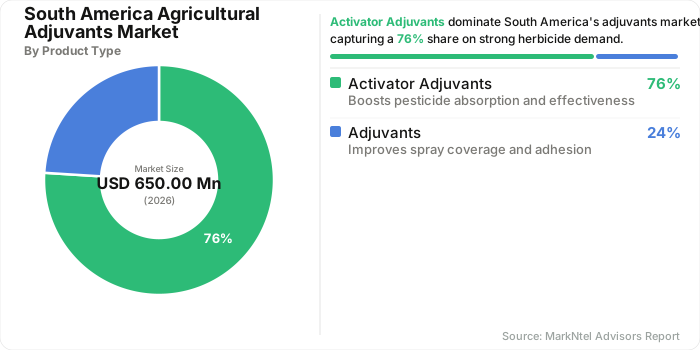
- Activator adjuvants lead the market by product type, accounting for approximately 76% of the overall market revenue in 2026.
- Liquid formulations dominate the market by formulation, representing approximately 88% of the total market revenue in 2026.
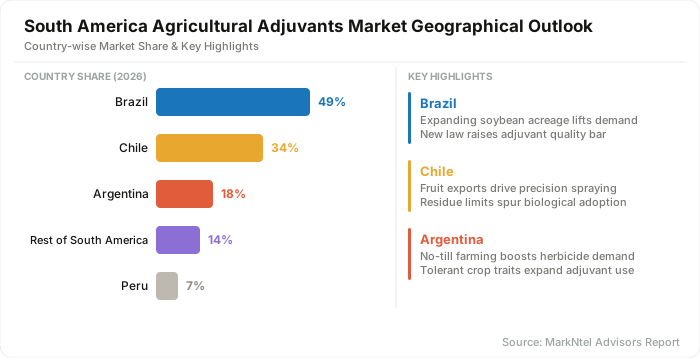
- Brazil dominates the regional market, accounting for approximately 49% of the total market revenue in 2026.
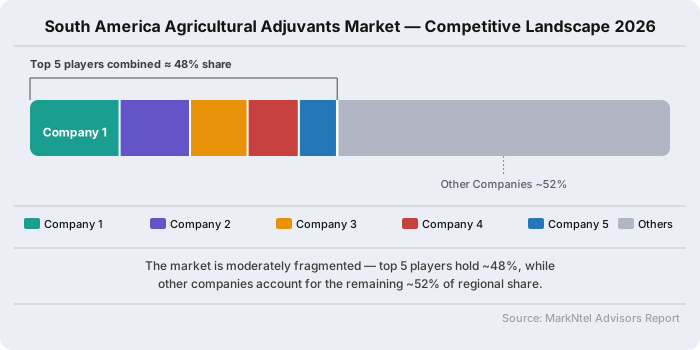
- The market is fragmented, with the top five companies collectively holding approximately 48% of the total market share.
South America Agricultural Adjuvants Market Size and Outlook
The South America agricultural adjuvants market was valued at USD 0.62 billion in 2025 and is projected to reach USD 0.86 billion by 2032, growing at a CAGR of 4.84% during 2026–2032.
Market growth is driven by the region's extensive, high-intensity agricultural production and the widespread use of spray-applied crop protection products, where application efficiency is as critical as the active ingredients themselves. Adjuvants such as surfactants, crop oils, and wetting agents play a vital role in improving spray coverage, enhancing pesticide uptake, and increasing rain-fastness, particularly under the tropical growing conditions prevalent across the region. Reflecting the scale of this opportunity, Brazil cultivated 81.8 million hectares of grains during the 2024/25 season, according to the National Supply Company (Conab), creating sustained demand for high-performance spray additives.
Government support is further accelerating market expansion by strengthening farmers' purchasing power. Under the 2025/2026 Plano Safra, Brazil allocated approximately USD 94.2 billion in subsidized rural credit for commercial producers, alongside an additional USD 89 billion for family farming. These financing programs support both large-scale agribusinesses and smallholder farmers, reinforcing demand for crop protection products and the adjuvants used with them. Similarly, Argentina's 2025 reduction in grain export taxes improved farm profitability, enabling soybean and corn growers to reinvest in advanced crop input technologies, including high-performance spray adjuvants.
Innovation by leading crop protection companies is also supporting long-term market growth. In November 2025, Brazil-based surfactant producer Indovinya launched its SURFOM ETHOS adjuvant line, engineered to improve the stability and field performance of biopesticide applications. Looking ahead, the increasing adoption of precision agriculture, biological crop protection products, and integrated resistance management practices is expected to drive demand for multifunctional, low-drift, and compatibility-enhancing adjuvants.
South America Agriculture Adjuvants Key Indicators
- The USDA Foreign Agricultural Service estimates Brazil's 2025/26 soybean crop at 176 million tonnes on 49.1 million hectares; herbicide-tolerant soybean receives repeated glyphosate and glufosinate passes, forming the region's single largest consumption base for surfactant and oil-based adjuvants.
- According to the USDA Foreign Agricultural Service, Brazil's total grain production is estimated to reach a record 353.76 million metric tons in the current season. This unprecedented output, supported by multiple crop cycles and staggered planting schedules, is expected to sustain year-round demand for spray adjuvants, as growers increasingly rely on them to improve the performance and efficiency of crop protection applications across diverse crops.
South America Agriculture Adjuvants Market Scope
| Category | Segments |
|---|---|
| By Type | Activator Adjuvants, Utility Adjuvants |
| By Application | Herbicides, Fungicides, Insecticides, Others |
| By Crop Type | Cereals & Grains, Oilseeds & Pulses, Fruits & Vegetables, Plantation Crops, Turf & Ornamentals, Others |
| By Formulation | Liquid, Dry (Powder/Granules |
| By Source | Synthetic, Bio-based |
Growth Drivers
Rising Glyphosate-Resistant Weeds Accelerate Demand for Advanced Herbicide Adjuvants
Glyphosate-resistant weeds have become a major agronomic challenge across South America's row-crop sector, driving growers to adopt more complex herbicide programs that increasingly depend on adjuvants to maximize spray performance. As resistant weed populations spread, farmers are shifting from single-active herbicide applications to tank mixes and multiple modes of action, increasing demand for surfactants, compatibility agents, and crop oil concentrates that improve spray coverage, herbicide uptake, and overall efficacy. A 2026 study published in Pest Management Science reports that glyphosate resistance has been confirmed in 31 countries worldwide, with Argentina accounting for 6% and Brazil for 5% of all documented resistance cases.
Supporting this, IntechOpen research shows Brazil's glyphosate-tolerant crop area expanded from 18.6 million hectares in 2009 to 49.2 million hectares by 2018, while the Southern and Central-West regions accounted for 82% of reported resistance cases. As Brazil and Argentina continue to intensify soybean and corn production, the growing adoption of multi-mode herbicide programs is expected to generate sustained demand for high-performance agricultural adjuvants industry that enhance tank-mix compatibility and application efficiency.
Recent Trends
Drone-Based Ultra-Low-Volume Spraying Fuels Demand for Specialized Agricultural Adjuvants
The rapid adoption of agricultural drones is transforming crop protection practices across South America, creating strong demand for specialized adjuvants designed for ultra-low-volume (ULV) spraying. Unlike conventional ground sprayers, drones apply pesticides using much lower spray volumes, making droplet size, evaporation control, spray deposition, and drift reduction critical to application effectiveness. As a result, drift-control, deposition-enhancing, and penetrant adjuvants are becoming essential components of drone-based spraying programs rather than optional additives.
Brazil is leading this transition. According to the Ministry of Agriculture and Livestock (MAPA), the country's agricultural drone fleet expanded from approximately 3,000 units in 2021 to 35,000 units by 2025. MAPA has also introduced dedicated regulations governing the application of pesticides, fertilizers, and adjuvants using remotely piloted aircraft, supporting wider adoption of precision spraying technologies. Reflecting this trend, Rovensa Next advanced its FAUVE research program and launched a Brazil-specific adjuvant in January 2026 based on natural oil derivatives, combining anti-drift, anti-foam, spreading, and penetrant properties for soybean and corn applications. As precision agriculture continues to expand, drone-optimized adjuvants are expected to become a standard component of crop protection programs across South America.
South America Agriculture Adjuvants Market Opportunities and Challenges
Diverging EU–Mercosur Residue Standards Accelerate Demand for Low-Residue and Bio-Based Adjuvants
Stricter European Union pesticide residue regulations are reshaping crop input choices across Mercosur, creating new opportunities for low-residue and bio-based agricultural adjuvants. In January 2026, France issued a decree banning imports of grains, soybeans, fruits, and vegetables treated with five active substances, including glufosinate and mancozeb, when residues exceed the lowest detectable threshold. Separately, the European Commission announced plans in January 2026 to prohibit imports containing residues of three fungicides already banned within the EU. These measures present compliance challenges for exporters, particularly as Brazil had authorized 330 active substances by late November 2025, with approximately 60% lacking EU approval, increasing the risk of trade restrictions for soybean and corn shipments.
The regulatory shift is accelerating innovation in bio-based agricultural inputs. Brazil's Bioinputs Law has simplified registration pathways for biological and bio-based products, encouraging faster commercialization. A November 2025 study published in Commodities found that Brazilian-owned companies accounted for 82.8% of the country's 221 registered agricultural bio-input suppliers in 2024, positioning domestic formulators to meet growing demand for EU-compliant, low-residue solutions.
Reinforcing this trend, in December 2024, Indorama Ventures' Indovinya partnered with UK-based Holiferm to commercialize fermentation-derived biosurfactants under the SURFONIC BIO brand across South America, with commercial launches already underway in Brazil following positive market response. These developments are expected to drive adoption of sustainable, low-residue adjuvants among export-oriented growers.
Segmentation Insights
Herbicide-Driven Demand Keeps Activator Adjuvants at the Forefront
Activator adjuvants account for approximately 76% of the South America agricultural adjuvants industry, driven by their critical role in enhancing the performance of crop protection products across the region's large-scale agricultural sector. Surfactants and oil adjuvants are extensively used with herbicides to improve spray coverage, droplet retention, spreading, and penetration, ensuring effective weed control in soybean, corn, sugarcane, and other major crops. Their widespread adoption is directly linked to the vast treated acreage in Brazil and Argentina, where herbicide applications are frequent throughout the growing season.
Reflecting this strong demand, Stepan Company reported double-digit growth in South American surfactant volumes during Q2 2024, supported by robust agricultural demand in Brazil. To further strengthen its regional presence, the company established a new agriculture laboratory at Parque Tecnológico de Piracicaba in December 2025 to develop crop-specific surfactant and adjuvant formulations. Within this category, surfactants remain the largest sub-segment because they are incorporated into most herbicide tank mixes, making them the primary revenue contributor to the activator adjuvants segment. By product type the market is further segmented into the following sub-categories:
- Activator Adjuvants
- Utility Adjuvants
Ease of Tank Mixing Keeps Liquid Adjuvants at the Forefront
Liquid formulations account for approximately 88% of the South America agricultural adjuvants market, making them the preferred formulation type due to their ease of handling, rapid tank mixing, and compatibility with the crop protection products widely used across the region. Commercial growers cultivating soybean, corn, sugarcane, and cotton rely on liquid adjuvants because they disperse uniformly in spray solutions, enable precise dosing, and support high-capacity boom sprayers and drone-based application systems. Their ability to reduce preparation time and ensure consistent spray performance is particularly valuable during narrow field-application windows. Industry participants continue to strengthen this segment through product innovation.
Vittia, one of Brazil's leading agricultural input companies, markets its Active range of liquid adjuvants designed to improve herbicide, fungicide, insecticide, and foliar fertilizer performance. Meanwhile, Argentina-based Rizobacter operates LEAF (Laboratory for Evaluation of Adjuvants and Formulations), a specialized research facility focused on optimizing adjuvant formulations for regional crop conditions and application technologies. Additionally, increasing adoption of precision agriculture and biological crop protection products across Brazil and Argentina is further accelerating demand for high-performance liquid adjuvants, reinforcing the segment's dominant revenue position. By formulation the market is further segmented into the following sub-categories:
- Liquid
- Dry (Powder/Granules)
South America Agriculture Adjuvants Market Geographical Analysis
Brazil accounted for approximately 49% of the South America agricultural adjuvants market in 2026, supported by its position as the region's largest agricultural producer and the extensive use of crop protection products across commercial farming operations. According to the National Supply Company (Conab), Brazil's soybean production is projected to reach 180.6 million metric tons in the 2025/26 marketing year from 83.5 million hectares of cultivated area, representing the country's largest harvest on record.
Mato Grosso, Brazil's leading grain-producing state, is the largest consumption hub, where intensive soybean–second-crop corn production requires repeated herbicide, fungicide, and insecticide applications throughout the year. As compared to many neighboring markets with a single growing season, Brazil's multi-crop calendar supports continuous demand for spray additives.
The increasing adoption of precision agriculture, drone-based spraying, and integrated resistance management further boosts the use of drift-control and compatibility adjuvants. With Conab forecasting continued expansion in grain production and cultivated area for the 2026/27 season, Brazil is expected to remain the dominant market for agricultural adjuvants across South America.
South America Agriculture Adjuvants Market Competitive Landscape
The South America Agricultural Adjuvants Market is moderately fragmented, with the top five players, BASF SE, Corteva Agriscience, Croda International PLC, Evonik Industries AG, and Clariant AG, collectively accounting for approximately 48% of the total market revenue.
South America Agriculture Adjuvants Market News and Recent Developments
2026: Sipcam Nichino Expands Crop Protection Portfolio with Six New Product Launches in Brazil
In 2026, Sipcam Nichino announced plans to introduce at least six new crop protection products in Brazil, targeting major crops including soybean, sugarcane, corn, cotton, and wheat. The expansion also includes strengthening the company's biostimulant portfolio and extending product registrations for key formulations, reinforcing its presence in one of Latin America's largest agricultural markets. The broader crop protection portfolio is expected to increase the adoption of advanced spray programs that rely on surfactants, compatibility agents, drift control agents, and other agricultural adjuvants to optimize product performance and application efficiency.
Impact Analysis: The expanded product portfolio is expected to increase demand for agricultural adjuvants by supporting more complex tank-mix programs and precision spray applications across high-value field crops. As growers increasingly adopt integrated crop protection solutions, the need for compatibility agents, spreaders, and drift reduction technologies is likely to rise, creating new opportunities for adjuvant manufacturers and intensifying competition within Latin America's crop input market.
2025: UPL Brazil Records Largest Product Rollout, Strengthening Demand for Adjuvant-Based Spray Programs
In 2025, UPL Brazil launched 10 new crop protection products, marking its largest annual product rollout since entering the Brazilian market. The newly introduced portfolio includes herbicides, fungicides, insecticides, and the bio-based product Nuvita, following the approval of registrations that had remained pending for several years. In parallel, UPL Argentina introduced four additional crop protection solutions during the Aapresid Congress, further expanding the company's regional product offering across South America.
Impact Analysis: The expanded crop protection portfolio is expected to accelerate the adoption of advanced spray programs that depend on agricultural adjuvants to improve coverage, deposition, compatibility, and active ingredient uptake. As growers increasingly utilize multiple crop protection products in tank mixes for resistance management and higher application efficiency, demand for activator and utility adjuvants is likely to strengthen, supporting continued growth of the Latin America agricultural adjuvants market.
- Market Segmentation
- Introduction
- Product Definition
- Research Process
- Assumptions
- Executive Summary
- South America Agricultural Adjuvant Market Policies, Regulations, and Product Standards
- South America Agricultural Adjuvant Market Trends & Developments
- South America Agricultural Adjuvant Market Dynamics
- Growth Factors
- Challenges
- South America Agricultural Adjuvant Market Hotspot & Opportunities
- South America Agricultural Adjuvant Market Outlook, 2022-2032
- Market Size & Outlook
- By Revenues (USD Million)
- Market Segmentation & Outlook
- By Type- Market Size & Forecast 2022-2032, USD Million
- Activator Adjuvants
- Utility Adjuvants
- By Application- Market Size & Forecast 2022-2032, USD Million
- Herbicides
- Fungicides
- Insecticides
- Others
- By Crop Type- Market Size & Forecast 2022-2032, USD Million
- Cereals & Grains
- Oilseeds & Pulses
- Fruits & Vegetables
- Plantation Crops
- Turf & Ornamentals
- Others
- By Formulation- Market Size & Forecast 2022-2032, USD Million
- Liquid
- Dry (Powder/Granules)
- By Source- Market Size & Forecast 2022-2032, USD Million
- Synthetic
- Bio-based
- By Country
- Brazil
- Argentina
- Chile
- Colombia
- Peru
- Rest of South America
- By Company
- Competition Characteristics
- Market Share & Analysis
- By Type- Market Size & Forecast 2022-2032, USD Million
- Market Size & Outlook
- Brazil Agricultural Adjuvant Market Outlook, 2022-2032
- Market Size & Outlook
- By Revenues (USD Million)
- Market Segmentation & Outlook
- By Type- Market Size & Forecast 2022-2032, USD Million
- By Application- Market Size & Forecast 2022-2032, USD Million
- By Crop Type- Market Size & Forecast 2022-2032, USD Million
- By Formulation- Market Size & Forecast 2022-2032, USD Million
- By Source- Market Size & Forecast 2022-2032, USD Million
- Market Size & Outlook
- Argentina Agricultural Adjuvant Market Outlook, 2022-2032
- Market Size & Outlook
- By Revenues (USD Million)
- Market Segmentation & Outlook
- By Type- Market Size & Forecast 2022-2032, USD Million
- By Application- Market Size & Forecast 2022-2032, USD Million
- By Crop Type- Market Size & Forecast 2022-2032, USD Million
- By Formulation- Market Size & Forecast 2022-2032, USD Million
- By Source- Market Size & Forecast 2022-2032, USD Million
- Market Size & Outlook
- Chile Agricultural Adjuvant Market Outlook, 2022-2032
- Market Size & Outlook
- By Revenues (USD Million)
- Market Segmentation & Outlook
- By Type- Market Size & Forecast 2022-2032, USD Million
- By Application- Market Size & Forecast 2022-2032, USD Million
- By Crop Type- Market Size & Forecast 2022-2032, USD Million
- By Formulation- Market Size & Forecast 2022-2032, USD Million
- By Source- Market Size & Forecast 2022-2032, USD Million
- Market Size & Outlook
- Colombia Agricultural Adjuvant Market Outlook, 2022-2032
- Market Size & Outlook
- By Revenues (USD Million)
- Market Segmentation & Outlook
- By Type- Market Size & Forecast 2022-2032, USD Million
- By Application- Market Size & Forecast 2022-2032, USD Million
- By Crop Type- Market Size & Forecast 2022-2032, USD Million
- By Formulation- Market Size & Forecast 2022-2032, USD Million
- By Source- Market Size & Forecast 2022-2032, USD Million
- Market Size & Outlook
- Peru Agricultural Adjuvant Market Outlook, 2022-2032
- Market Size & Outlook
- By Revenues (USD Million)
- Market Segmentation & Outlook
- By Type- Market Size & Forecast 2022-2032, USD Million
- By Application- Market Size & Forecast 2022-2032, USD Million
- By Crop Type- Market Size & Forecast 2022-2032, USD Million
- By Formulation- Market Size & Forecast 2022-2032, USD Million
- By Source- Market Size & Forecast 2022-2032, USD Million
- Market Size & Outlook
- South America Agricultural Adjuvant Market Key Strategic Imperatives for Success & Growth
- Competitive Outlook
- Company Profiles
- Corteva Agriscience
- Business Description
- Product Portfolio
- Collaborations & Alliances
- Recent Developments
- Financial Details
- Others
- BASF SE
- Business Description
- Product Portfolio
- Collaborations & Alliances
- Recent Developments
- Financial Details
- Others
- Nufarm Limited
- Business Description
- Product Portfolio
- Collaborations & Alliances
- Recent Developments
- Financial Details
- Others
- Solvay SA
- Business Description
- Product Portfolio
- Collaborations & Alliances
- Recent Developments
- Financial Details
- Others
- Croda International PLC
- Business Description
- Product Portfolio
- Collaborations & Alliances
- Recent Developments
- Financial Details
- Others
- Clariant AG
- Business Description
- Product Portfolio
- Collaborations & Alliances
- Recent Developments
- Financial Details
- Others
- Evonik Industries AG
- Business Description
- Product Portfolio
- Collaborations & Alliances
- Recent Developments
- Financial Details
- Others
- Akzo Nobel N.V.
- Business Description
- Product Portfolio
- Collaborations & Alliances
- Recent Developments
- Financial Details
- Others
- Others
- Business Description
- Product Portfolio
- Collaborations & Alliances
- Recent Developments
- Financial Details
- Others
- Corteva Agriscience
- Company Profiles
- Disclaimer

MarkNtel Advisors follows a robust and iterative research methodology designed to ensure maximum accuracy and minimize deviation in market estimates and forecasts. Our approach combines both bottom-up and top-down techniques to effectively segment and quantify various aspects of the market. A consistent feature across all our research reports is data triangulation, which examines the market from three distinct perspectives to validate findings. Key components of our research process include:
1. Scope & Research Design At the outset, MarkNtel Advisors define the research objectives and formulate pertinent questions. This phase involves determining the type of research—qualitative or quantitative—and designing a methodology that outlines data collection methods, target demographics, and analytical tools. They also establish timelines and budgets to ensure the research aligns with client goals.
2. Sample Selection and Data Collection In this stage, the firm identifies the target audience and determines the appropriate sample size to ensure representativeness. They employ various sampling methods, such as random or stratified sampling, based on the research objectives. Data collection is carried out using tools like surveys, interviews, and observations, ensuring the gathered data is reliable and relevant.
3. Data Analysis and Validation Once data is collected, MarkNtel Advisors undertake a rigorous analysis process. This includes cleaning the data to remove inconsistencies, employing statistical software for quantitative analysis, and thematic analysis for qualitative data. Validation steps are taken to ensure the accuracy and reliability of the findings, minimizing biases and errors.

4. Data Forecast and FinalizationThe final phase involves forecasting future market trends based on the analyzed data. MarkNtel Advisors utilize predictive modeling and time series analysis to anticipate market behaviors. The insights are then compiled into comprehensive reports, featuring visual aids like charts and graphs, and include strategic recommendations to inform client decision-making
FILL THE FORM TO GET THE FREE SAMPLE PAGES
We offer flexible licensing options to cater to varying organizational needs. Choose the pricing pack that best suits your requirements:
Buy Now Inquire Before Buying
 Talk to our Consultant
 Request Customization