

India Sugarcane Market Research Report: Forecast (2026-2032)
India Sugarcane Market - By Type (Chewing Canes, Syrup Canes), By End User (Sugar Production , Ethanol/Biofuel Production, Jaggery Production, Khandsari Sugar Production, Others), ... By Farming Type (Irrigated Sugarcane, Rain-fed Sugarcane, Organic Sugarcane), By Farm Size (Small Farmers (less than 2 hectares), Medium Farmers (2-10 hectares), Large Farmers (more than 10 hectares)) and others Read more
- Food & Beverages
- Nov 2025
- Pages 138
- Report Format: PDF, Excel, PPT
Market Insights & Analysis: India Sugarcane Market (2026-32):
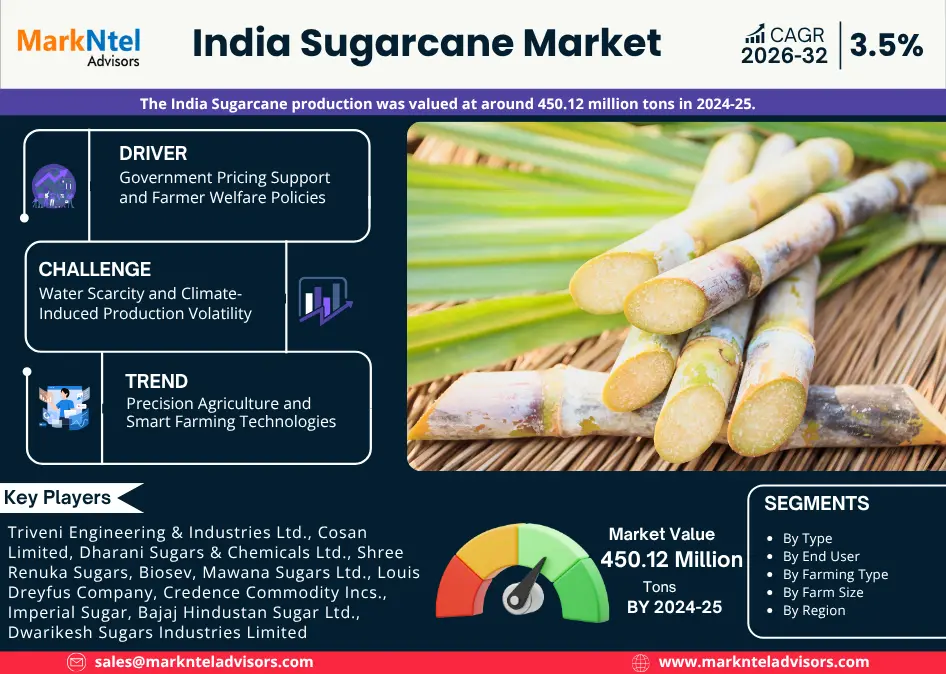
The India Sugarcane production was valued at around 450.12 million tons in 2024-25. The India Sugar Market is estimated to grow at a CAGR of around 3.5% during the forecast period 2026-32.
Sugarcane industry in India represents a pivotal segment of the nation's agricultural landscape, characterized by robust production dynamics and multifaceted growth drivers. The country has established itself as the world's second-largest sugarcane producer, with annual cultivation reaching approximately 450 million metric tons across 5.9 million hectares. Furthermore, this industry directly sustains over 50 million farmers and their dependents while contributing approximately 10% to India's total agricultural output, thereby cementing its socioeconomic significance.
A fundamental growth catalyst stems from India's favorable climatic conditions, wherein the hot and humid tropical environment provides optimal prerequisites for sugarcane cultivation. Specifically, the crop demonstrates peak performance at mean temperatures ranging between 28-32°C coupled with relative humidity levels of 70-85% during critical growth phases, directly contributing to higher cane yields per hectare and improved juice extraction efficiency. Additionally, the tropical climate enables year-round cultivation patterns across major producing states, facilitating superior yields and enhanced sugar recovery rates when complemented by adequate precipitation of 1,500-2,500 mm during growing seasons. This facilitates reducing production costs and enabling multiple cropping cycles that amplify overall industry output. Furthermore, these favorable agro-climatic conditions have positioned India as a competitive global supplier, supporting export capabilities of approximately 6 million tons annually while ensuring domestic food security and industrial raw material availability.
India Sugarcane Market Scope:
| Category | Segments |
|---|---|
| By Type | Chewing Canes, Syrup Canes, |
| By End User | Sugar Production , Ethanol/Biofuel Production, Jaggery Production, Khandsari Sugar Production, Others |
| By Farming Type | Irrigated Sugarcane, Rain-fed Sugarcane, Organic Sugarcane |
| By Farm Size | Small Farmers (less than 2 hectares), Medium Farmers (2-10 hectares), Large Farmers (more than 10 hectares) |
The cultural dimension constitutes another compelling growth driver, as sugar consumption remains deeply embedded within India's social fabric through centuries-old traditions. Notably, the country's rich heritage of sugar refinement, dating back 8,000 years, has positioned sweets (mithai) as indispensable elements of festivals, religious ceremonies, and celebratory occasions. Furthermore, Indians consume approximately 20% more sugar than global averages, with major festivals such as Diwali, Holi, and Raksha Bandhan witnessing consumption spikes of up to 300% across metropolitan regions. Therefore, this cultural affinity translates into consistent year-round demand patterns, effectively insulating the industry from seasonal volatility while creating sustained market opportunities.
India Sugarcane Market Driver:
Government Pricing Support and Farmer Welfare Policies – The Indian government has established robust pricing mechanisms that actively drive sugarcane cultivation expansion. The Fair and Remunerative Price (FRP) stands at Rs 355 per quintal for 2025-26, representing a 105.2% premium over production costs and ensuring guaranteed farmer profitability. Maharashtra has further augmented support with special incentives of Rs 349 per metric tonne above FRP, raising total prices to Rs 3,500 per metric tonne and disbursing Rs 297 crore across 1.25 lakh farmers in 2024-25. Additionally, mechanization subsidies include 40% support (up to Rs 35 lakh) on sugarcane harvesters, addressing labor shortages. The Vasantdada Sugar Institute doubled AI adoption subsidies from Rs 9,250 to Rs 18,250 per hectare for 5,000 farmers. Drip irrigation subsidies reach 100% for small farmers, with 697 hectares equipped in Tamil Nadu during 2024-25. These pricing guarantees eliminate market volatility risks, encouraging farmers to expand cultivation areas and adopt improved agricultural practices, thereby accelerating the growth of sugarcane industry in India.
India Sugarcane Market Opportunity:
Export Market Revival and Value-Added Product Diversification – India's projected sugar surplus of 34.90 million tons in 2025-26 creates substantial export opportunities after two years of government-imposed restrictions. With global sugar prices fluctuating and major producers like Brazil diverting sugarcane to ethanol, India is strategically positioned to capture international market share. The government signaled potential export allocations of 2 million tons for 2025-26, opening revenue channels for sugar mills. Beyond traditional sugar exports, value-added product diversification presents untapped potential, including organic sugar, specialty sugars for pharmaceutical applications, and bioethanol derivatives for industrial use. This co-products market also including molasses for animal feed, industrial alcohol, and bio-based chemicals, remains underdeveloped, representing significant commercial expansion opportunities for integrated sugarcane processing facilities in India.
India Sugarcane Market Challenge:
Water Scarcity and Climate-Induced Production Volatility – Water scarcity and erratic monsoon patterns pose critical challenges to sustainable sugarcane production. Sugarcane demands 1,500-2,000 mm of irrigation water per crop cycle, while conventional flood irrigation exhibits only 30-50% efficiency. Climate variability creates severe production fluctuations, such as Maharashtra experienced reservoir levels dropping to 25%, forcing cultivation reductions, while abundant 2024-25 monsoons restored full capacity. Delayed monsoon onset disrupts critical growth phases, particularly affecting major producing states including Maharashtra, Uttar Pradesh, and Karnataka. Water stress intensifies disease susceptibility; red rot infestations caused significant yield losses during drought conditions. Pest pressures including shoot borers and leaf hoppers escalate during temperature fluctuations, with diseases and pests collectively causing 37% of global agricultural productivity losses, of which 13% is specifically attributed to insect damage. Addressing these challenges requires accelerated adoption of drought-resistant varieties, water-efficient irrigation technologies, and integrated pest management strategies.
India Sugarcane Market Trend:
Precision Agriculture and Smart Farming Technologies – Technological adoption is driving India's sugarcane market expansion by addressing productivity constraints that historically limited cultivation scalability. India's farm mechanization currently stands at 40-45%, enabling farmers to cultivate larger areas with reduced labor dependency, directly supporting the projected growth from 450.12 million tons in 2024-25 to 487 million tonnes in 2025-26. AI applications are revolutionizing yield potential, Baramati's pilot project increased sugarcane yield from 70 to 120 tons per acre for variety 86032 (71% increase), while other varieties improved by over 40%, demonstrating that technology-driven productivity gains can meet growing sugar demand without requiring proportional land expansion
ICAR's development of disease-resistant varieties including CoLk-14201 and CoLk-16202 directly strengthens market stability by mitigating red rot and smut diseases that historically caused 10-15% production losses, thereby ensuring consistent sugarcane availability for mills and reducing supply volatility. Additionally, micro-irrigation systems including drip fertigation are enabling geographic market expansion by achieving 60-200% improvements in water use efficiency. This facilitate profitable sugarcane cultivation in water-stressed regions of Maharashtra and Karnataka that previously depended solely on rain-fed agriculture. Consequently, IoT-based sensors provide predictive analytics for optimal irrigation scheduling, reducing water consumption by 30% while maintaining yields, which permits cultivation area expansion without exhausting regional water resources. This technological transformation collectively supports India's sugarcane sector growth trajectory by simultaneously enhancing per-hectare productivity and enabling cultivation expansion into previously marginal agricultural zones.
India Sugarcane Market (2026-32): Segmentation Analysis
The India Sugarcane Market study of MarkNtel Advisors evaluates & highlights the major trends & influencing factors in each segment & includes predictions for the period 2026–2032 at the global, regional, and national levels. Based on the analysis, the market has been further classified as:
Based on Type:
- Syrup Canes
- Chewing Canes
Syrup Canes are projected to lead and dominate the India sugarcane industry in the upcoming years, driven by multiple converging factors that position this segment for sustained market leadership. Driven by the country's robust demand for crystallized sugar, processed foods, and biofuels, syrup cane varieties benefit from government incentives such as ethanol blending mandates, set to reach 20% by 2025, that further accelerate their leadership in market share and profitability. Additionally, the enhanced processing efficiency, rising industrial consumption, and favorable policy support are expected to sustain syrup canes' leading position, with the segment’s market value projected to grow steadily through 2032.
Based on End User:
- Sugar Production
- Ethanol/Biofuel Production
- Jaggery Production
- Khandsari Sugar Production
- Others
Sugar production will retain its dominant position in India sugarcane industry through 2026-32, accounting for the majority of cane utilization nationwide. Projections indicate India’s sugar production will reach 34.9–35 million metric tons in the 2025-26 season and remain robust, driven by stable demand from the food, beverage, and processed foods sectors. This segment thrives on strong festival-driven consumption, expanding processed food markets, and active export potential, supported by favorable monsoon patterns and improved crop yields. Despite a gradual increase in diversion toward ethanol, sugar production is expected to lead in both volume and consistent value generation, sustaining its long-standing dominance in the market.
India Sugarcane Market (2026-32): Regional Projection
Geographically, the India Sugarcane Market expands across:
- Uttar Pradesh
- Maharashtra
- Karnataka
- Tamil Nadu
- Bihar
- Rest of India
Uttar Pradesh is projected to dominate the Indian sugarcane market during 2026–32, maintaining its position as the top-producing state with over 44% share of total national output. This leadership is driven by extensive cultivated area, favorable subtropical climate, an advanced irrigation network, and continuous government investment in mill expansion and cane development initiatives. Maharashtra and Karnataka will remain significant contributors, but Uttar Pradesh’s robust infrastructure and resilient production, are expected to ensure its continued dominance, supported by increasing ethanol output and progressive farming practices.
India Sugarcane Industry Recent Development:
- 2024: Bajaj Hindusthan Sugar Ltd. partnered with EverEnviro to produce compressed biogas from sugarcane waste in Uttar Pradesh, promoting circular economy practices, diversifying revenues, and supporting India’s clean energy and ethanol integration goals.
Gain a Competitive Edge with Our India Sugarcane Market Report
- India Sugarcane Market Report by MarkNtel Advisors provides a detailed & thorough analysis of market size & share, growth rate, competitive landscape, and key players. This comprehensive analysis helps businesses gain a holistic understanding of the market dynamics & make informed decisions.
- This report also highlights current market trends & future projections, allowing businesses to identify emerging opportunities & potential challenges. By understanding market forecasts, companies can align their strategies & stay ahead of the competition.
- India Sugarcane Market Report aids in assessing & mitigating risks associated with entering or operating in the market. By understanding market dynamics, regulatory frameworks, and potential challenges, businesses can develop strategies to minimize risks & optimize their operations.
*Reports Delivery Format - Market research studies from MarkNtel Advisors are offered in PDF, Excel and PowerPoint formats. Within 24 hours of the payment being successfully received, the report will be sent to your email address.
Frequently Asked Questions
- Market Segmentation
- Introduction
- Product Definition
- Research Process
- Assumptions
- Executive Summary
- India Sugarcane Market Trends & Developments
- India Sugarcane Market Dynamics
- Drivers
- Challenges
- India Sugarcane Market Supply Chain Analysis
- India Sugarcane Market Export-Import Chain Analysis
- India Sugarcane Market Regulations, Policies and Type Standards
- India Vacuum Cleaner Hotspot and Opportunities
- India Sugarcane Market Outlook, 2020-2032F
- Market Size & Analysis
- By Revenues (USD Million)
- By Unit Sold (Thousand Tons)
- Market Size & Analysis
- By Type
- Chewing Canes- Market Size & Forecast 2020-2032, Thousand Tons
- Syrup Canes- Market Size & Forecast 2020-2032, Thousand Tons
- By End User
- Sugar Production - Market Size & Forecast 2020-2032, Thousand Tons
- Ethanol/Biofuel Production- Market Size & Forecast 2020-2032, Thousand Tons
- Jaggery Production- Market Size & Forecast 2020-2032, Thousand Tons
- Khandsari Sugar Production- Market Size & Forecast 2020-2032, Thousand Tons
- Others- Market Size & Forecast 2020-2032, Thousand Tons
- By Farming Type
- Irrigated Sugarcane- Market Size & Forecast 2020-2032, Thousand Tons
- Rain-fed Sugarcane- Market Size & Forecast 2020-2032, Thousand Tons
- Organic Sugarcane- Market Size & Forecast 2020-2032, Thousand Tons
- By Farm Size
- Small Farmers (less than 2 hectares)- Market Size & Forecast 2020-2032, Thousand Tons
- Medium Farmers (2-10 hectares)- Market Size & Forecast 2020-2032, Thousand Tons
- Large Farmers (more than 10 hectares)- Market Size & Forecast 2020-2032, Thousand Tons
- By States
- Uttar Pradesh
- Maharashtra
- Karnataka
- Tamil Nadu
- Bihar
- Rest of India
- By Competition
- Competition Characteristics
- Market Share Analysis
- By Type
- Market Size & Analysis
- India Chewing Canes Market Outlook, 2020-2032F
- Market Size & Analysis
- By Revenues (USD Million)
- By Unit Sold (Thousand Tons)
- Market Share & Analysis
- By End-User- Market Size & Forecast 2020-2032, Thousand Tons
- By Type- Market Size & Forecast 2020-2032, Thousand Tons
- By Farm Size- Market Size & Forecast 2020-2032, Thousand Tons
- Market Size & Analysis
- India Syrup Canes Market Outlook, 2020-2032F
- Market Size & Analysis
- By Revenues (USD Million)
- By Unit Sold (Thousand Tons)
- Market Share & Analysis
- By End-User- Market Size & Forecast 2020-2032, Thousand Tons
- By Type- Market Size & Forecast 2020-2032, Thousand Tons
- By Farm Size- Market Size & Forecast 2020-2032, Thousand Tons
- Market Size & Analysis
- India Sugarcane Market Key Strategic Imperatives for Success & Growth
- Competitive Outlook
- Company Profiles
- Triveni Engineering & Industries Ltd.
- Business Description
- Type Portfolio
- Strategic Alliances or Partnerships
- Recent Developments
- Financial Details
- Others
- Cosan Limited
- Business Description
- Type Portfolio
- Strategic Alliances or Partnerships
- Recent Developments
- Financial Details
- Others
- Dharani Sugars & Chemicals Ltd.
- Business Description
- Type Portfolio
- Strategic Alliances or Partnerships
- Recent Developments
- Financial Details
- Others
- Shree Renuka Sugars
- Business Description
- Type Portfolio
- Strategic Alliances or Partnerships
- Recent Developments
- Financial Details
- Others
- Biosev
- Business Description
- Type Portfolio
- Strategic Alliances or Partnerships
- Recent Developments
- Financial Details
- Others
- Mawana Sugars Ltd.
- Business Description
- Type Portfolio
- Strategic Alliances or Partnerships
- Recent Developments
- Financial Details
- Others
- Louis Dreyfus Company
- Business Description
- Type Portfolio
- Strategic Alliances or Partnerships
- Recent Developments
- Financial Details
- Others
- Credence Commodity Incs.
- Business Description
- Type Portfolio
- Strategic Alliances or Partnerships
- Recent Developments
- Financial Details
- Others
- Imperial Sugar
- Business Description
- Type Portfolio
- Strategic Alliances or Partnerships
- Recent Developments
- Financial Details
- Others
- Bajaj Hindustan Sugar Ltd.
- Business Description
- Type Portfolio
- Strategic Alliances or Partnerships
- Recent Developments
- Financial Details
- Others
- Dwarikesh Sugars Industries Limited
- Business Description
- Type Portfolio
- Strategic Alliances or Partnerships
- Recent Developments
- Financial Details
- Others
- Others
- Triveni Engineering & Industries Ltd.
- Company Profiles
- Disclaimer
MarkNtel Advisors follows a robust and iterative research methodology designed to ensure maximum accuracy and minimize deviation in market estimates and forecasts. Our approach combines both bottom-up and top-down techniques to effectively segment and quantify various aspects of the market. A consistent feature across all our research reports is data triangulation, which examines the market from three distinct perspectives to validate findings. Key components of our research process include:
1. Scope & Research Design At the outset, MarkNtel Advisors define the research objectives and formulate pertinent questions. This phase involves determining the type of research—qualitative or quantitative—and designing a methodology that outlines data collection methods, target demographics, and analytical tools. They also establish timelines and budgets to ensure the research aligns with client goals.
2. Sample Selection and Data Collection In this stage, the firm identifies the target audience and determines the appropriate sample size to ensure representativeness. They employ various sampling methods, such as random or stratified sampling, based on the research objectives. Data collection is carried out using tools like surveys, interviews, and observations, ensuring the gathered data is reliable and relevant.
3. Data Analysis and Validation Once data is collected, MarkNtel Advisors undertake a rigorous analysis process. This includes cleaning the data to remove inconsistencies, employing statistical software for quantitative analysis, and thematic analysis for qualitative data. Validation steps are taken to ensure the accuracy and reliability of the findings, minimizing biases and errors.

4. Data Forecast and FinalizationThe final phase involves forecasting future market trends based on the analyzed data. MarkNtel Advisors utilize predictive modeling and time series analysis to anticipate market behaviors. The insights are then compiled into comprehensive reports, featuring visual aids like charts and graphs, and include strategic recommendations to inform client decision-making
We offer flexible licensing options to cater to varying organizational needs. Choose the pricing pack that best suits your requirements:
Buy Now Inquire Before Buying
 Request Customization
 Talk to our Consultant







