

India Hot Beverage Vending Machine Market Research Report: Forecast (2026-2032)
By Type (Table Top, Free Standing Top), By Consumable Type (Fresh Milk Machines, Premix Machines), By Drink Offered (Tea, Coffee, Others), By Distribution Channel (B2B, B2C (Dealer ... s & Distributors, Online, Others)), By End Users (Corporate Offices, Educational Institutes, Airports, Hospitals, Others), and others Read more
- Food & Beverages
- Apr 2026
- Pages 140
- Report Format: PDF, Excel, PPT
India Hot Beverage Vending Machine Market
Projected 7.97% CAGR from 2026 to 2032
Study Period
2026-2032
Market Size (2026)
USD 65 Million
Market Size (2032)
USD 103 Million
Base Year
2025
Projected CAGR
7.97%
Leading Segments
By Type: Table Top
India Hot Beverage Vending Machine Market Key Takeaways
- India Hot Beverage Vending Machine Market size was valued at USD 58 Million in 2025 and is projected to grow from USD 65 Million in 2026 to USD 103 Million by 2032, exhibiting a CAGR of 7.97% during 2026-2032.
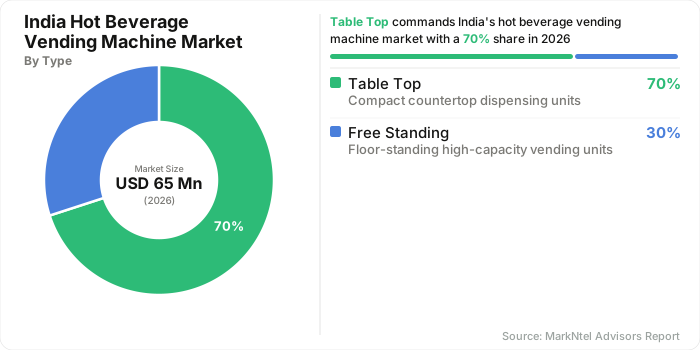
- By type, the table top holds a significant share of about 70%, indicating a strong preference in compact and office-based deployments. It is expected to witness steady expansion, registering a CAGR of around 15% during the forecast period, supported by rising demand for space-efficient and easy-to-operate vending solutions.
- Based on consumables type, Premix machines represent about 64% of the installed base; however, their revenue share is gradually declining due to the increasing shift toward fresh milk-based vending solutions.
- By end user, the corporate sector accounted for a significant share of approximately 46% in the market. The segment is projected to expand at a CAGR of around 15% during the forecast period, driven by increasing adoption of vending solutions across offices to enhance employee convenience and productivity.
- In terms of installed base, corporate offices represented nearly 42% of the total operational vending machines, reflecting their strong penetration and consistent demand within organized workplaces.
- The South region holds a significant 37% market share and is projected to grow at a CAGR of around 14.12%. Within this region, Karnataka leads with nearly 39% share of operational vending machines, indicating its strong regional dominance.
- At the state level, Maharashtra is emerging as the fastest-growing market with a CAGR of approximately 16.98%, supported by rapid urban and corporate expansion.
- Among cities, Pune leads growth with a CAGR of around 17.15%, followed closely by Mumbai at 16.71%, driven by rising workplace consumption and retail penetration.
- In terms of installed base, Delhi NCR remains the largest hub with over 25,000 operational vending machines expected by 2026, followed by Mumbai as the second-largest market.
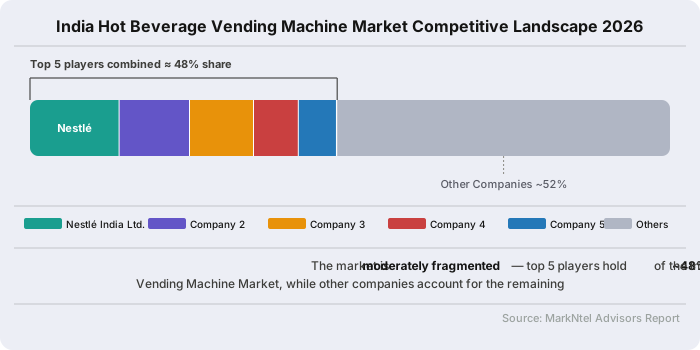
- The industry is moderately fragmented. However, the top five players collectively account for nearly 48% share.
India Hot Beverage Vending Machine Market Size and Outlook
The India Hot Beverage Vending Machine market was valued at USD 58 million in 2025 and is projected to reach USD 103 million by 2032, expanding at a CAGR of 7.97% during the forecast period. The market is estimated to reach USD 65 million in 2026, reflecting steady year-on-year growth.
The strong macroeconomic fundamentals, rapid urbanization, and increasing consumer preference for automated convenience solutions is significantly accelerating the adoption of hot beverage vending machines in India. The country’s rising economic scale plays a foundational role in this growth trajectory. According to the India Brand Equity Foundation, India’s GDP has surpassed USD 3.98 trillion and is projected to exceed USD 5 trillion by 2027, reflecting strong economic momentum, rising disposable incomes, and expanding consumption across urban centers. This economic expansion is directly strengthening demand for automated retail and beverage dispensing systems across commercial environments.
Organized retail infrastructure is also accelerating market penetration. India currently has more than 300 operational malls, creating large high-footfall environments suitable for smart vending machine deployment in beverage and snack categories. Moreover, corporate expansion strategies are further strengthening long-term demand. For instance, Barista Coffee has announced plans to expand its vending machine network to nearly 5,000 units over the next five years, alongside scaling its café footprint to 800–900 outlets by 2030, with a strong focus on Tier II and Tier III cities. This reflects growing penetration beyond metro markets and rising acceptance of automated beverage systems in emerging urban clusters.
The India hot beverage vending machine industry is poised for strong growth, driven by economic expansion, organized retail development, and increasing adoption of contactless, automated beverage solutions. Rising penetration in malls, transit hubs, and Tier II/III cities highlights a clear shift toward scalable, technology-enabled vending ecosystems across the country.
India Hot Beverage Vending Machine Market Key Indicators
- According to the Coffee Board of India under the Ministry of Commerce and Industry, domestic coffee consumption in India increased from 84,000 tonnes in 2012 to 91,000 tonnes in 2023, driven by rising café culture and evolving consumer preferences. This growing adoption of coffee is supporting demand for instant coffee premix formats, particularly across vending machines and institutional consumption settings.
- India’s retail sector is expanding rapidly, with retail space leasing across the top seven cities reaching 5.7 million sq. ft. in H1 2025, up 69% year-on-year. This growth in organized retail infrastructure improves product accessibility and visibility, thereby supporting the availability and sales of beverage premix products and strengthening retail distribution of beverage mixes in India.
- India’s tourism and hospitality sector continues to show strong recovery and growth, with premium hotel occupancy projected at around 72–74% in FY2026, supported by rising domestic and international travel. As travel activity increases, higher hotel occupancy and food service operations are driving demand for beverage premix solutions across hotels, restaurants, and catering services, thereby strengthening HoReCa beverage premix demand and supporting overall market growth.
- According to CBRE, around 85% of companies in India are planning to expand their office portfolios over the next two years, reflecting strong corporate confidence and sustained demand for workspace expansion. This trend highlights continued growth in organized office infrastructure, driven by rising business activity and increasing requirements for modern, scalable corporate infrastructure.
India Hot Beverage Vending Machine Market Scope
| Category | Segments |
|---|---|
| By Type | Table Top, Free Standing Top |
| By Consumable Type | Fresh Milk Machines, Premix Machines |
| By Drink Offered | Tea, Coffee, Others |
| By Distribution Channel | B2B, B2C (Dealers & Distributors, Online, Others |
| By End Users | Corporate Offices, Educational Institutes, Airports, Hospitals, Others |
India Hot Beverage Vending Machine Market Growth Drivers
Increasing Urbanization & Commercial Infrastructure Development
Rapid urbanization in India is emerging as a key structural driver for the hot beverage vending machine market, supported by the expansion of organized commercial infrastructure such as corporate offices, retail malls, metro stations, and transit hubs. Increasing urban concentration is creating a large, time-constrained consumer base that prefers fast, convenient, and automated beverage solutions.
According to the Press Information Bureau, India’s urban population is projected to reach nearly 600 million by 2036, accounting for around 40% of the total population. This significant demographic shift is directly expanding the number of workplaces, commercial complexes, and public service spaces where vending machines can be deployed for instant beverage access.
In addition, India already has over 500 million urban residents, forming a dense and highly active consumer base that supports the adoption of automated convenience-based services, including hot beverage vending machines.
This urban expansion is further reinforced by infrastructure development in mass transit systems. For instance, the Delhi Metro Rail Corporation has deployed vending machines at stations such as Rohini East, offering commuters access to automated snack and beverage dispensing systems, enhancing convenience in high-footfall environments.
Overall, rapid urbanization, expanding commercial infrastructure and increasing demand for time-efficient services are collectively strengthening the adoption of automated hot beverage vending machines across India’s urban ecosystem.
Recent Trends
Increasing Focus on Hygiene & Contactless Solutions
A key trend shaping India’s hot beverage vending machine industry is the rapid shift toward contactless and hygiene-centric vending ecosystems, driven by increasing digital payment penetration and rising consumer expectations for safe, automated consumption. In urban centres such as Delhi, modern coffee vending deployments now function as cashless vending machines India, where users simply scan a QR code, complete UPI-based payment, and receive beverages without any physical interaction with cash or machine surfaces, significantly improving hygiene and convenience.
This evolution is further supported by the expansion of contactless beverage vending solutions, where mobile-first ordering systems replace traditional interfaces, enabling faster and fully touch-free transactions in offices, metro stations, and retail environments. These systems strengthen user trust while reducing contamination risks in shared public spaces.
In parallel, Indian Railways has introduced hygienic tea and coffee vending systems onboard trains, where East Coast Railway has implemented structured dispensing mechanisms with QR-based digital payments. This reduces manual handling and enhances cleanliness and operational consistency in high-footfall transit environments.
Additionally, operators are deploying automated dispensing systems in India with sealed ingredient storage, IoT monitoring, and controlled brewing units, ensuring consistent quality and reduced human intervention. Alongside this, adoption of energy-efficient vending machines is increasing, helping operators optimize electricity consumption and reduce operating costs.
Overall, the convergence of digital payments, automation, hygiene design, and energy efficiency is transforming vending machines into smart, contactless beverage systems, accelerating adoption across India’s urban and semi-urban markets.
India Hot Beverage Vending Machine Market Opportunities and Challenges
High Maintenance Complexity and Operational Inefficiencies Driving Adoption of AI-Based Smart Vending Systems
The operational complexity of hot beverage vending machines in India, particularly frequent breakdowns, delayed servicing, inconsistent ingredient management, and limited real-time visibility, remains a key challenge for operators. These issues become more pronounced in dispersed deployment locations such as corporate offices, metro stations, hospitals, and Tier II/III cities, where immediate technical support is often not available. Consequently, operators face higher downtime, increased maintenance expenditure, and variability in beverage quality, which affects both service reliability and user experience.
This limitation is accelerating the adoption of AI-based smart vending machines integrated with IoT and cloud-based monitoring systems, enabling a shift from reactive maintenance to predictive and automated operations. A notable example was showcased at AAHAR 2025 in New Delhi, where Wendor introduced next-generation vending machines featuring AI-driven automation, real-time inventory tracking, and remote performance monitoring systems. These machines allow operators to track usage patterns, detect early malfunction signals, and manage multiple vending units from a centralized dashboard, reducing dependency on manual servicing.
Such AI-enabled systems also improve operational efficiency by enabling predictive maintenance alerts, automated restocking notifications, and consumption-based analytics, ensuring uninterrupted service in high-footfall environments. This reduces maintenance costs and enhances machine uptime, which is critical for large-scale deployments across commercial and institutional spaces.
In effect, inefficiencies in conventional vending operations are evolving into a strong growth pathway for intelligent, self-regulating vending ecosystems, enabling scalable, efficient, and low-maintenance beverage dispensing networks across India’s expanding market landscape.
Segmentation Insights
Table Top is Widely Preferred in the Hot Beverage Vending Machine Industry
The table top hot beverage vending machine segment holds the dominant position in India’s market with nearly 70% share, primarily driven by its compact design, cost efficiency, and suitability for space-constrained environments. These machines are widely adopted in corporate offices, small retail outlets, educational institutes, and healthcare facilities where floor space optimization is essential. Their relatively lower installation cost compared to free-standing machines makes them more accessible for small and mid-sized enterprises, supporting wider penetration across urban and semi-urban locations.
Another key factor contributing to their dominance is operational flexibility. Table top machines are easier to install, relocate, and maintain, which reduces downtime and servicing complexity. In India, where many workplaces operate in shared or rented office spaces, this flexibility becomes a critical advantage. Additionally, increasing demand for quick-service tea and coffee solutions in office environments has strengthened adoption.
Technological integration such as UPI-based cashless payments, compact brewing systems, and energy-efficient heating modules has further enhanced their appeal. These machines can efficiently dispense both tea and coffee variants using premix and fresh milk options, catering to diverse consumer preferences. Their ability to balance affordability, ease of use, and operational efficiency continues to reinforce their strong market position. Based on type, the scope has been segmented into
- Table Top
- Free Standing Top
Corporate Offices Lead the End-Use Vertical
The corporate offices segment accounts for approximately 46% share, positioning it as the leading end-user category in India’s hot beverage vending machine market. This dominance is supported by the rapid expansion of IT parks, multinational corporations, co-working spaces, and commercial business districts across cities such as Bengaluru, Hyderabad, Pune, and Gurugram. These environments generate consistent demand for efficient, hygienic, and automated workplace beverage solutions designed to serve large employee bases with limited time availability.
Corporate environments increasingly prefer vending machines due to their ability to deliver 24/7 beverage availability with minimal human intervention, reducing dependency on cafeteria infrastructure while improving operational efficiency. Compared to traditional catering systems, vending solutions offer lower maintenance requirements, faster service delivery, and better scalability across large office campuses.
A key example is Roastea’s expansion strategy, where the company plans to install around 5,000 vending machines across corporate offices within the next two years, along with opening approximately 40 cafés as part of its broader beverage ecosystem expansion. This reflects growing corporate adoption of managed vending solutions as part of workplace infrastructure development.
Furthermore, the adoption of cashless payment systems, IoT-enabled monitoring, and automated dispensing technologies is enhancing operational reliability and user convenience. With the rise of hybrid work models, corporate demand for automated beverage infrastructure continues to strengthen, reinforcing this segment’s dominant position. The key end users mapped in the study include
- Corporate Offices
- Educational Institutes
- Airports
- Hospitals
- Others
India Hot Beverage Vending Machine Industry Geographical Outlook
The India hot beverage vending machine industry is predominantly led by the South region, contributing nearly 37% share, driven by a strong concentration of IT hubs, organized corporate infrastructure, and early adoption of automated retail solutions. Key cities such as Bengaluru, Chennai, Hyderabad, and Kochi act as major demand centers due to the presence of large-scale IT parks, multinational companies, and commercial business districts that require efficient workplace beverage solutions.
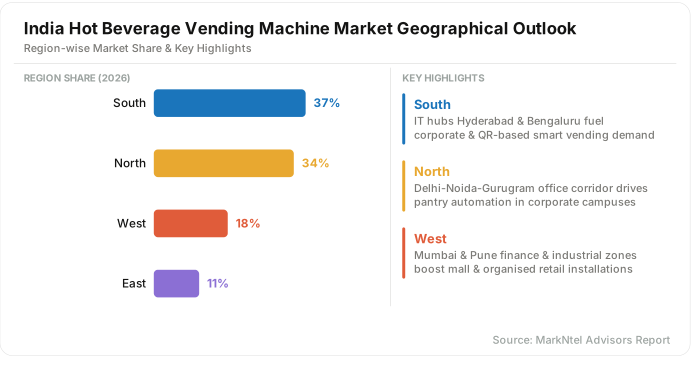
Corporate campuses and technology corridors in Bengaluru’s Electronic City and Whitefield, along with Hyderabad’s HITEC City and Chennai’s OMR belt, have widely adopted vending machines to support continuous employee demand for tea and coffee. Additionally, South India benefits from high digital payment penetration, strong infrastructure development, and early adoption of smart retail technologies, further reinforcing vending machine deployment across both corporate and transit ecosystems.
India Hot Beverage Vending Machine Market Competitive Analysis
The India hot beverage vending machine market is moderately fragmented, with more than 20 players and strong regional participation. The top five companies, including Vending Updates India Pvt. Ltd., Cafe Desire, Godrej & Boyce Manufacturing Company Limited, Nestlé India Limited, and Rhea Vendors Group SpA, collectively account for approximately 48% of the total market share, reflecting a competitive landscape shaped by strong regional presence, service-led deployment models, and segment-specific specialization across corporate, HoReCa, and institutional channels.
Major Companies in Hot Beverage Vending Machine Industry
- Vending Updates India Pvt. Ltd.
- Cafe Desire
- Mountain Trail Food Pvt. Ltd.
- Godrej & Boyce Manufacturing Company Limited
- Georgia
- Nestlé India Limited
- Rhea Vendors Group SpA
- Coffee Day
- Atlantis
- Max Vending
- Others
Frequently Asked Questions
- Market Segmentation
- Introduction
- Product Definition
- Research Process
- Assumptions
- Executive Summary
- India Hot Beverage Vending Machine Market Trends & Developments
- India Hot Beverage Vending Machine Market Dynamics
- Growth Drivers
- Challenges
- India Hot Beverage Vending Machine Market Hotspots & Opportunities
- India Hot Beverage Vending Machine Market Regulations & Policy
- India Hot Beverage Vending Machine Market Outlook, 2022-2032F
- Market Size & Analysis
- By Revenues (USD Million)
- By Operational Machines (Thousand)
- Market Share & Analysis
- By Type
- Table Top- Market Size & Forecast 2022-2032, USD Million & Thousand
- Free Standing Top- Market Size & Forecast 2022-2032, USD Million & Thousand
- By Consumable Type
- Fresh Milk Machines- Market Size & Forecast 2022-2032, USD Million & Thousand
- Premix Machines- Market Size & Forecast 2022-2032, USD Million & Thousand
- By Drink Offered
- Tea- Market Size & Forecast 2022-2032, USD Million & Thousand
- Coffee- Market Size & Forecast 2022-2032, USD Million & Thousand
- Others- Market Size & Forecast 2022-2032, USD Million & Thousand
- By Distribution Channel
- B2B- Market Size & Forecast 2022-2032, USD Million & Thousand
- B2C- Market Size & Forecast 2022-2032, USD Million & Thousand
- Dealers & Distributors- Market Size & Forecast 2022-2032, USD Million & Thousand
- Online- Market Size & Forecast 2022-2032, USD Million & Thousand
- Others- Market Size & Forecast 2022-2032, USD Million & Thousand
- By End Users
- Corporate Offices- Market Size & Forecast 2022-2032, USD Million & Thousand
- Educational Institutes- Market Size & Forecast 2022-2032, USD Million & Thousand
- Airports- Market Size & Forecast 2022-2032, USD Million & Thousand
- Hospitals- Market Size & Forecast 2022-2032, USD Million & Thousand
- Others- Market Size & Forecast 2022-2032, USD Million & Thousand
- By Region
- East
- Bihar
- Assam
- West Bengal
- Jharkhand
- Others
- West
- Gujarat
- Maharashtra
- Rajasthan
- Others
- North
- Uttar Pradesh
- Haryana
- Punjab
- New Delhi
- Others
- South
- Tamil Nadu
- Karnataka
- Telangana
- Kerala
- Others
- East
- By Cities
- Delhi NCR
- Mumbai
- Bangalore
- Chennai
- Hyderabad
- Pune
- Kolkata
- Ahmedabad
- Lucknow
- Chandigarh
- By Company
- Competition Characteristics
- Revenue Shares & Analysis
- By Type
- Market Size & Analysis
- India Table Top Hot Beverage Vending Machine Market Outlook, 2022-2032F
- Market Size & Analysis
- By Revenues (USD Million)
- By Operational Machines (Thousand)
- Market Share & Analysis
- By Drinks Offered- Market Size & Forecast 2022-2032, USD Million & Thousand
- By Distribution Channel- Market Size & Forecast 2022-2032, USD Million & Thousand
- By End Users- Market Size & Forecast 2022-2032, USD Million & Thousand
- By Region
- Market Size & Analysis
- India Free Standing Hot Beverage Vending Machine Market Outlook, 2022-2032F
- Market Size & Analysis
- By Revenues (USD Million)
- By Operational Machines (Thousand)
- Market Share & Analysis
- By Drinks Offered- Market Size & Forecast 2022-2032, USD Million & Thousand
- By Distribution Channel- Market Size & Forecast 2022-2032, USD Million & Thousand
- By End Users- Market Size & Forecast 2022-2032, USD Million & Thousand
- By Region
- Market Size & Analysis
- India Hot Beverage Vending Machine Market Key Strategic Imperatives for Success & Growth
- Competition Outlook
- Company Profiles
- Vending Updates India Pvt. Ltd.
- Business Description
- Product Portfolio
- Strategic Alliances or Partnerships
- Recent Developments
- Financial Details
- Others
- Cafe Desire
- Business Description
- Product Portfolio
- Strategic Alliances or Partnerships
- Recent Developments
- Financial Details
- Others
- Mountain Trail Food Pvt. Ltd.
- Business Description
- Product Portfolio
- Strategic Alliances or Partnerships
- Recent Developments
- Financial Details
- Others
- Godrej & Boyce Manufacturing Company Limited
- Business Description
- Product Portfolio
- Strategic Alliances or Partnerships
- Recent Developments
- Financial Details
- Others
- Georgia
- Business Description
- Product Portfolio
- Strategic Alliances or Partnerships
- Recent Developments
- Financial Details
- Others
- Nestlé India Limited
- Business Description
- Product Portfolio
- Strategic Alliances or Partnerships
- Recent Developments
- Financial Details
- Others
- Rhea Vendors Group Spa
- Business Description
- Product Portfolio
- Strategic Alliances or Partnerships
- Recent Developments
- Financial Details
- Others
- Coffee Day
- Business Description
- Product Portfolio
- Strategic Alliances or Partnerships
- Recent Developments
- Financial Details
- Others
- Atlantis
- Business Description
- Product Portfolio
- Strategic Alliances or Partnerships
- Recent Developments
- Financial Details
- Others
- Max Vending
- Business Description
- Product Portfolio
- Strategic Alliances or Partnerships
- Recent Developments
- Financial Details
- Others
- Others
- Vending Updates India Pvt. Ltd.
- Company Profiles
- Disclaimer
MarkNtel Advisors follows a robust and iterative research methodology designed to ensure maximum accuracy and minimize deviation in market estimates and forecasts. Our approach combines both bottom-up and top-down techniques to effectively segment and quantify various aspects of the market. A consistent feature across all our research reports is data triangulation, which examines the market from three distinct perspectives to validate findings. Key components of our research process include:
1. Scope & Research Design At the outset, MarkNtel Advisors define the research objectives and formulate pertinent questions. This phase involves determining the type of research—qualitative or quantitative—and designing a methodology that outlines data collection methods, target demographics, and analytical tools. They also establish timelines and budgets to ensure the research aligns with client goals.
2. Sample Selection and Data Collection In this stage, the firm identifies the target audience and determines the appropriate sample size to ensure representativeness. They employ various sampling methods, such as random or stratified sampling, based on the research objectives. Data collection is carried out using tools like surveys, interviews, and observations, ensuring the gathered data is reliable and relevant.
3. Data Analysis and Validation Once data is collected, MarkNtel Advisors undertake a rigorous analysis process. This includes cleaning the data to remove inconsistencies, employing statistical software for quantitative analysis, and thematic analysis for qualitative data. Validation steps are taken to ensure the accuracy and reliability of the findings, minimizing biases and errors.

4. Data Forecast and FinalizationThe final phase involves forecasting future market trends based on the analyzed data. MarkNtel Advisors utilize predictive modeling and time series analysis to anticipate market behaviors. The insights are then compiled into comprehensive reports, featuring visual aids like charts and graphs, and include strategic recommendations to inform client decision-making
We offer flexible licensing options to cater to varying organizational needs. Choose the pricing pack that best suits your requirements:
Buy Now Inquire Before Buying
 Request Customization
 Talk to our Consultant







