

By Component (Hardware (Antennas, Transceivers & Radios, Signal Processing Units, Others (Routers, Consumer Devices, Network Equipment, etc.)), Software, Services), By Technology (......Terahertz (THz) Communication, Massive MIMO & Advanced Antenna Systems, AI-Native Networks, Reconfigurable Intelligent Surfaces (RIS), Integrated Sensing & Communication (ISAC), Edge Intelligence & Distributed Computing), By Device Type (Smartphones, Laptops & Tablets, Wearables, IoT & Edge Devices, Network Infrastructure Equipment), By Communication Infrastructure (Fixed Infrastructure, Wireless Infrastructure (Cellular Infrastructure, Terahertz Communication Networks, Satellite-Terrestrial Integrated Networks), Hybrid Infrastructure), By Usage Scenario (Further Enhanced Mobile Broadband (FeMBB), Extremely Reliable Low-Latency Communication (ERLLC), Ultra-Massive Machine-Type Communication (umMTC), Long-Distance & High-Mobility Communications (LDHMC), Extremely Low-Power Communications (ELPC)), By Frequency Band (Sub-Terahertz (100–300 GHz), Terahertz (>300 GHz)), By Application (Multisensory Extended Reality (XR), Network-Enabled Robotics & Autonomous Systems, Integrated Sensing & Communication, Blockchain & Distributed Ledger Technologies (DLT), Smart Cities, Others), By End User (BFSI, Consumers, IT & Telecommunications, Manufacturing, Healthcare, Retail, Media & Entertainment, Others), and others Read more
- ICT & Electronics
- Jun 2026
- 250
- PDF, Excel, PPT
North America 6G Market Key Takeaways
- North America 6G market was valued at USD 0.37 billion in 2025, rising to USD 0.58 billion in 2026 and USD 36.28 billion in 2032.
- The industry is projected to witness steady growth at 99.24% CAGR during the forecast period, i.e., 2026-32.
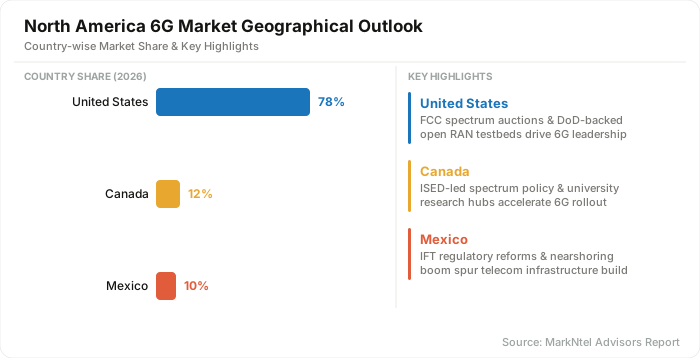
- The United States dominates regional demand, contributing approximately 78% share in 2026.
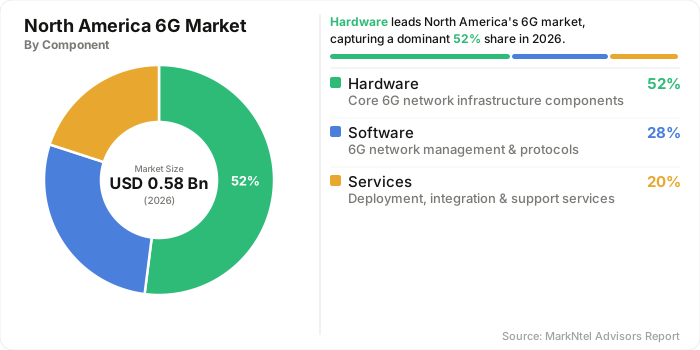
- Hardware leads component segmentation with around 52% share in 2026.
- IT & telecommunications segment captures nearly a 35% share in 2026.
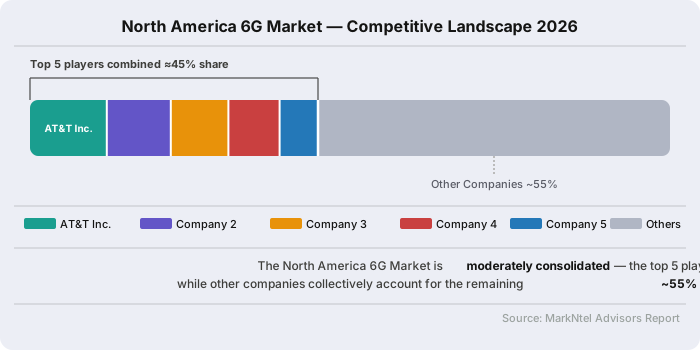
- The industry structure is moderately fragmented, with the top five players collectively holding nearly 45% share, indicating balanced competition between established leaders and emerging innovators.
North America 6G Market Size and Outlook
The North America 6G market size was valued at USD 0.37 billion in 2025 and is estimated to reach USD 0.58 billion in 2026 and further advance to USD 36.28 billion by 2032, reflecting a CAGR of 99.24% during the forecast period. This trajectory indicates a gradual but stable expansion path, underpinned by growing investments in high-speed connectivity and early-stage network innovation. Increasing alignment between infrastructure readiness and evolving digital demand is expected to support sustained adoption of next-generation telecom technologies.
Government-backed semiconductor and infrastructure investments are reinforcing long-term readiness. The U.S. Department of Commerce reported that USD 30.9 billion had been awarded across 40 projects under the CHIPS and Science Act by July 2025, supporting fabrication, expansion, and modernization initiatives. These developments are critical for enabling cloud expansion, strengthening domestic supply chains, and ensuring sufficient computational capacity to meet the performance requirements of future wireless systems and data-intensive applications.
Industry collaboration is further accelerating commercialization pathways and ecosystem alignment. The Alliance for Telecommunications Industry Solutions, through its Next G Alliance, coordinates a National 6G Roadmap involving over 600 experts from 80 organizations spanning industry, academia, and government . This coordinated effort supports enterprise networks evolution, enhances spectrum advocacy, and integrates emerging trends such as satellite-terrestrial convergence while opening new opportunities for scalable deployment and cross-industry innovation models.
Wireless research infrastructure continues to expand, strengthening innovation capacity and long-term competitiveness. NTIA has issued 35 grants exceeding USD 550 million for wireless testing, research, and development, alongside USD 117.4 million awarded to Open RAN-related projects in 2025. These investments create advanced testing environments, accelerate innovation cycles, and enable early validation of next-generation technologies. In summary, sustained funding, collaborative alignment, and infrastructure expansion collectively position the market for resilient, innovation-driven growth through the forecast period.
North America 6G Market Key Indicators
- The rapid expansion of AI workloads is significantly increasing network requirements, positioning advanced connectivity as a core enabler. As per the U.S. Department of Energy, data centers consumed 4.4% of U.S. electricity and are projected to reach 6.7%–12% by 2028, rising to 325–580 TWh. This surge reflects accelerating rising data demand and distributed inferencing needs, directly shaping next-generation network architecture requirements.
- Global standardization milestones are acting as a structural anchor for innovation cycles and vendor roadmaps. The 3rd Generation Partnership Project initiated Release 20 as a 21-month study phase in 2025, with Release 21 expected to formalize specifications by mid-2026. This structured timeline is accelerating alignment across chipset, infrastructure, and software providers while advancing THz spectrum feasibility within early-stage deployments.
- Public funding programs are catalyzing large-scale innovation across wireless ecosystems. The National Telecommunications and Information Administration reported that over 90 applications requested nearly USD 3 billion in 2025 under the USD 1.5 billion Wireless Innovation Fund, alongside USD 1.3 billion in private commitments. This funding momentum is strengthening domestic capabilities in Open RAN and advanced network infrastructure development.
- The transition toward interoperable network architectures are gaining measurable traction across the U.S. telecom ecosystem. In 2024, the National Telecommunications and Information Administration received over 225 applications requesting USD 2.94 billion to support wireless innovation, alongside funding rounds of up to USD 420 million. These developments underscore strong industry alignment around cloud-native telecom infrastructure and software-driven network models.
- Telecom operators are increasingly embedding AI into core network functions, signaling a shift toward intelligent infrastructure. In 2026, T-Mobile US, Inc., alongside Ericsson, Nokia, and NVIDIA, advanced AI-RAN deployments that enable cell sites to operate as distributed compute platforms . This transformation supports low-latency applications such as robotics and digital twins while reinforcing the importance of AI-native networks in future connectivity ecosystems.
North America 6G Market Scope
| Category | Segments |
|---|---|
| By Component | Hardware (Antennas, Transceivers & Radios, Signal Processing Units, Others (Routers, Consumer Devices, Network Equipment, etc.)), Software, Services |
| By Technology | Terahertz (THz) Communication, Massive MIMO & Advanced Antenna Systems, AI-Native Networks, Reconfigurable Intelligent Surfaces (RIS), Integrated Sensing & Communication (ISAC), Edge Intelligence & Distributed Computing |
| By Device Type | Smartphones, Laptops & Tablets, Wearables, IoT & Edge Devices, Network Infrastructure Equipment |
| By Communication Infrastructure | Fixed Infrastructure, Wireless Infrastructure (Cellular Infrastructure, Terahertz Communication Networks, Satellite-Terrestrial Integrated Networks), Hybrid Infrastructure |
| By Usage Scenario | Further Enhanced Mobile Broadband (FeMBB), Extremely Reliable Low-Latency Communication (ERLLC), Ultra-Massive Machine-Type Communication (umMTC), Long-Distance & High-Mobility Communications (LDHMC), Extremely Low-Power Communications (ELPC |
| By Frequency Band | Sub-Terahertz (100–300 GHz), Terahertz (>300 GHz |
| By Application | Multisensory Extended Reality (XR), Network-Enabled Robotics & Autonomous Systems, Integrated Sensing & Communication, Blockchain & Distributed Ledger Technologies (DLT), Smart Cities, Others |
| By End User | BFSI, Consumers, IT & Telecommunications, Manufacturing, Healthcare, Retail, Media & Entertainment, Others |
North America 6G Market Growth Drivers
Federal Funding Accelerates AI-Native Network Development
The North America 6G market is being significantly driven by sustained federal investment programs aimed at strengthening next-generation wireless infrastructure. The National Telecommunications and Information Administration continues to deploy its USD 1.5 billion Public Wireless Supply Chain Innovation Fund, supporting advanced research, testing, and commercialization initiatives . This funding momentum is reinforcing telecom infrastructure development and accelerating innovation cycles.
In January 2025, NTIA awarded USD 117 million to multiple projects focused on wireless innovation, followed by additional grants exceeding USD 273 million to expand capabilities in open and interoperable network systems. These investments are enabling the development of next-generation architectures such as AI-RAN, which integrate artificial intelligence directly into radio access networks.
Beyond funding, the strategic focus on AI-native network capabilities is reshaping technology priorities across operators and vendors. NTIA’s 2026 initiatives emphasize intelligent automation, distributed computing, and software-defined infrastructure, aligning with the growing need for network densification to support high-capacity, low-latency applications . This integrated approach ensures that both hardware and software ecosystems evolve.
Collectively, these funding initiatives and technology advancements are positioning the North America 6G industry at the forefront of global wireless innovation. By enabling scalable infrastructure, fostering ecosystem collaboration, and accelerating AI-driven network transformation, federal programs are creating a strong foundation for sustained growth and early commercialization of 6G technologies across the region.
Recent Trends
Integration of Satellite and Terrestrial Networks
The North America 6G industry is increasingly defined by the convergence of satellite and terrestrial networks, reflecting a shift toward seamless space-air-ground connectivity. This evolution is enabling continuous coverage across urban, rural, and remote environments while supporting next-generation applications. The growing emphasis on satellite integration highlights how operators are rethinking network design to ensure ubiquitous access and improved resilience.
In 2025, T-Mobile US, Inc. initiated the commercial rollout of its T-Satellite service across the United States, enabling smartphones to connect directly to a low-Earth-orbit satellite constellation. The operator indicated coverage across approximately 500,000 square miles of U.S. territory, targeting underserved regions without traditional infrastructure . The service was further expanded to support app-based data services, demonstrating the growing viability of direct-to-cell connectivity.
The broader ecosystem is reinforcing this transition. Verizon Communications Inc., in partnership with AST SpaceMobile, is advancing satellite-based cellular services with commercial deployment expected from 2026. In parallel, the Federal Communications Commission authorized direct-to-device connectivity using licensed spectrum in 2026, supporting scalable hybrid network models and accelerating adoption of NTN networks across the region .
These developments signal a structural transformation in network architecture, where satellite connectivity is no longer a supplementary solution but an integrated layer of telecom infrastructure. As operators continue to operationalize hybrid connectivity models, this trend is expected to redefine coverage economics and establish non-terrestrial integration as a foundational pillar of the North America 6G industry.
North America 6G Market Opportunities and Challenges
Federal Spectrum Constraints Driving Dynamic Sharing Innovation
A major challenge in the North America 6G industry is limited availability of prime mid-band spectrum, particularly the 3.1–3.45 GHz band held by federal users. The National Telecommunications and Information Administration states sharing the 3100–3450 MHz range is not feasible without complex coordination, restricting access to critical capacity needed for future wireless deployments.
This constraint is intensified by reliance of the U.S. Department of Defense on the same band for mission-critical radar systems. As a result, commercial operators face barriers in accessing balanced spectrum resources, increasing dependence on alternatives such as mmWave, which may not deliver optimal coverage and propagation efficiency for wide-area deployment scenarios across diverse geographic conditions.
At the same time, these constraints are creating opportunities for innovation in spectrum sharing technologies. In June 2024, NTIA and the Department of Defense launched the Advanced Dynamic Spectrum Sharing Demonstration targeting the 3.1–3.45 GHz band, enabling real-time coordination, spectrum sensing, coexistence management, and automated interference mitigation to facilitate shared commercial and federal spectrum access models.
The initiative includes prototype development, field testing, and public reporting through 2025, with an objective to bring solutions to market within five years. This supports evolution of advanced telecom systems, where dynamic access can unlock underutilized capacity and enable scalable deployment across the North America 6G industry while maintaining operational integrity for federal users.
Segmentation Insights
Hardware Dominance Driven by Capital-Intensive Network Infrastructure
Hardware contributes approximately 52% of total revenue within the 6G market in North America, reflecting its foundational role in enabling next-generation wireless infrastructure. The segment includes antennas, transceivers and radios, signal processing units, and supporting network equipment such as routers and consumer devices. Rising demand for telecom infrastructure and advanced radio systems continues to reinforce hardware’s leadership, particularly as operators prioritize scalable, high-performance network architectures to support evolving connectivity requirements across the region.
The capital-intensive nature of the radio access layer remains a key factor sustaining this dominance. U.S. wireless operators collectively invested USD 32.4 billion in network capital expenditure in 2024, with the majority allocated to physical infrastructure such as base stations and deployment equipment . These investments are essential to support network densification, enabling capacity expansion, improved coverage, and enhanced performance across increasingly complex and high-demand connectivity environments.
Within the hardware segment, antennas and transceivers play a critical role in enabling high-frequency communication and efficient signal transmission, while signal processing units enhance latency and data handling capabilities. Supporting equipment further strengthens the ecosystem by enabling seamless connectivity across devices. The integration of mmWave technologies within these components is accelerating throughput capabilities, reinforcing hardware’s position as a key enabler of scalable and future-ready wireless network deployment. Based on component, the scope has been classified into:
- Hardware
- Software
- Services
IT & Telecommunications Leading End-Use Adoption
The IT & telecommunications segment accounts for approximately 35% of total revenue, making it the leading end-use industry in the North America 6G ecosystem. This dominance is driven by the sector’s central role in building, deploying, and managing next-generation wireless networks. Increasing demand for enterprise networks and advanced connectivity solutions is further strengthening its position, as telecom operators and IT firms remain primary adopters and enablers of emerging communication technologies.
Operator scale continues to reinforce this leadership. T-Mobile US, Inc. reported service revenue of USD 18.2 billion in the third quarter of 2025, highlighting strong financial capacity and market presence within the U.S. wireless industry . Such performance enables sustained investments in infrastructure expansion and innovation, particularly in areas such as AI telecom networks, which are critical for enhancing operational efficiency and supporting next-generation service delivery.
Beyond IT and telecommunications, the market spans multiple end-user industries including BFSI, consumers, manufacturing, healthcare, retail, and media & entertainment. These sectors are gradually integrating advanced connectivity solutions to support digital transformation and automation initiatives. The growing adoption of cloud telecom capabilities across industries is expected to expand use cases, but telecom operators will continue to lead due to their foundational role in infrastructure ownership and service provisioning. The study considers the following key end-user industries:
- BFSI
- Consumers
- IT & Telecommunications
- Manufacturing
- Healthcare
- Retail
- Media & Entertainment
- Others
North America 6G Market Geographical Outlook
The United States accounts for approximately 78% of total demand within the North America 6G ecosystem, reflecting its dominant position in regional telecom infrastructure and innovation capacity. The country’s leadership is driven by strong investment momentum, early adoption of advanced technologies, and a highly developed digital ecosystem. Increasing demand for high-speed networks and next-generation connectivity solutions continues to reinforce its central role in shaping regional market dynamics.
In 2024, the United States recorded USD 80.5 billion in telecom capital expenditure and generated USD 505.2 billion in industry revenue, representing approximately 27% and 28% of global totals, respectively. This scale highlights the country’s financial strength and its ability to sustain long-term infrastructure investments. Such capital intensity supports network densification, enabling continuous expansion of capacity, improved coverage, and readiness for future 6G deployment.
Beyond investment scale, the U.S. benefits from a robust ecosystem of telecom operators, technology providers, and research institutions that collectively accelerate innovation cycles. Strong collaboration between public and private stakeholders is advancing next-generation capabilities, including AI-driven networks and advanced wireless systems. The growing emphasis on advanced telecom infrastructure ensures that the United States will remain the primary growth engine for 6G development across North America.
North America 6G Market Competitive Analysis
The North America 6G industry is led by five key players, including Qualcomm Incorporated, NVIDIA Corporation, Intel Corporation, Telefonaktiebolaget LM Ericsson, and Nokia Corporation, which collectively account for an estimated 45% market share. The market remains moderately consolidated, with leadership concentrated among technology developers and network equipment providers, while telecom operators and specialized vendors contribute to ecosystem diversity. Strong R&D intensity, patent leadership, and strategic collaborations define competition.
Prominent Companies in North America 6G Market
- AT&T Inc.
- Verizon Communications Inc.
- T-Mobile US, Inc.
- Qualcomm Incorporated
- Intel Corporation
- Cisco Systems, Inc.
- Nokia Corporation
- Telefonaktiebolaget LM Ericsson (Ericsson)
- Samsung Electronics Co., Ltd.
- Keysight Technologies, Inc.
- NVIDIA Corporation
- Ciena Corporation
- Others
North America 6G Industry News and Recent Developments
April 2026: FCC Authorizes AST SpaceMobile to Use AT&T and Verizon Spectrum for Direct-to-Cell Services
the Federal Communications Commission granted AST SpaceMobile authority to use spectrum licensed by AT&T and Verizon for direct-to-cell satellite communications in the United States. The approval enables compatible smartphones to connect directly to satellites without specialized hardware, expanding commercial deployment of non-terrestrial network capabilities. The development represents a significant regulatory milestone for satellite-terrestrial integration and supports broader adoption of direct-to-device connectivity services.
Impact Analysis: The authorization strengthens North America's position in developing future wireless architectures that integrate terrestrial and space-based networks. By enabling commercial use of existing mobile spectrum for satellite connectivity, the decision accelerates deployment of ubiquitous coverage solutions in underserved and remote areas. The approval also validates direct-to-cell technology as a viable extension of conventional mobile infrastructure, encouraging additional investments from operators, satellite providers, and equipment vendors.
October 2025: NVIDIA and Nokia Collaborate on AI-Native Telecom Infrastructure
NVIDIA Corporation and Nokia Corporation announced an expanded collaboration to integrate NVIDIA’s AI computing platform with Nokia’s telecommunications infrastructure portfolio. The partnership focuses on deploying AI-driven capabilities across radio access networks, cloud environments, and network operations. By combining accelerated computing with telecom infrastructure expertise, the companies aim to improve network automation, operational efficiency, and support emerging AI-native wireless architectures expected to underpin future 6G ecosystems.
Impact Analysis: The collaboration highlights the growing convergence of artificial intelligence and telecommunications, a trend increasingly shaping next-generation network development. AI-enabled infrastructure can improve resource allocation, automate network management, and reduce operational complexity while supporting latency-sensitive applications. For North America, the initiative strengthens the region’s innovation ecosystem by advancing commercially deployable AI-RAN and cloud-native networking solutions. The partnership also reinforces industry efforts to transform wireless networks into distributed computing platforms capable of supporting advanced use cases such as digital twins, industrial automation, and autonomous systems.
- Market Segmentation
- Introduction
- Product Definition
- Research Process
- Assumptions
- Executive Summary
- North America 6G Market Policies, Regulations, and Product Standards
- North America 6G Market Ecosystem & Value Chain Analysis
- Value Chain Overview
- Key Ecosystem Participants
- Role of Industry Alliances & Standardization Bodies
- Revenue Flow & Value Capture Analysis
- North America 6G Investment & Funding Landscape
- Public Investments & Government Funding
- Private Sector Investments
- Venture Capital & Startup Ecosystem
- Infrastructure CAPEX Trends
- North America 6G Market Trends & Developments
- North America 6G Market Dynamics
- Growth Factors
- Challenges
- North America 6G Market Hotspot & Opportunities
- North America 6G Market Outlook, 2022-2032F
- Market Size & Outlook
- By Revenues (USD Million)
- Market Share & Outlook
- By Component- Market Size & Forecast 2022-2032, USD Million
- Hardware
- Antennas
- Transceivers & Radios
- Signal Processing Units
- Others (Routers, Consumer Devices, Network Equipment, etc.)
- Software
- Services
- Hardware
- By Technology- Market Size & Forecast 2022-2032, USD Million
- Terahertz (THz) Communication
- Massive MIMO & Advanced Antenna Systems
- AI-Native Networks
- Reconfigurable Intelligent Surfaces (RIS)
- Integrated Sensing & Communication (ISAC)
- Edge Intelligence & Distributed Computing
- By Device Type- Market Size & Forecast 2022-2032, USD Million
- Smartphones
- Laptops & Tablets
- Wearables
- IoT & Edge Devices
- Network Infrastructure Equipment
- By Communication Infrastructure- Market Size & Forecast 2022-2032, USD Million
- Fixed Infrastructure
- Wireless Infrastructure
- Cellular Infrastructure
- Terahertz Communication Networks
- Satellite-Terrestrial Integrated Networks
- Hybrid Infrastructure
- By Usage Scenario- Market Size & Forecast 2022-2032, USD Million
- Further Enhanced Mobile Broadband (FeMBB)
- Extremely Reliable Low-Latency Communication (ERLLC)
- Ultra-Massive Machine-Type Communication (umMTC)
- Long-Distance & High-Mobility Communications (LDHMC)
- Extremely Low-Power Communications (ELPC)
- By Frequency Band- Market Size & Forecast 2022-2032, USD Million
- Sub-Terahertz (100–300 GHz)
- Terahertz (>300 GHz)
- By Application- Market Size & Forecast 2022-2032, USD Million
- Multisensory Extended Reality (XR)
- Network-Enabled Robotics & Autonomous Systems
- Integrated Sensing & Communication
- Blockchain & Distributed Ledger Technologies (DLT)
- Smart Cities
- Others
- By End User- Market Size & Forecast 2022-2032, USD Million
- BFSI
- Consumers
- IT & Telecommunications
- Manufacturing
- Healthcare
- Retail
- Media & Entertainment
- Others
- By Country
- United States
- Canada
- Mexico
- By Company
- Competition Characteristics
- Market Segmentation & Outlook
- By Component- Market Size & Forecast 2022-2032, USD Million
- Market Size & Outlook
- United States 6G Market Outlook, 2022-2032F
- Market Size & Outlook
- By Revenues (USD Million)
- Market Segmentation & Outlook
- By Component- Market Size & Forecast 2022-2032, USD Million
- By Technology- Market Size & Forecast 2022-2032, USD Million
- By Device Type- Market Size & Forecast 2022-2032, USD Million
- By Communication Infrastructure- Market Size & Forecast 2022-2032, USD Million
- By Usage Scenario- Market Size & Forecast 2022-2032, USD Million
- By Frequency Band- Market Size & Forecast 2022-2032, USD Million
- By Application- Market Size & Forecast 2022-2032, USD Million
- By End User- Market Size & Forecast 2022-2032, USD Million
- Market Size & Outlook
- Canada 6G Market Outlook, 2022-2032F
- Market Size & Outlook
- By Revenues (USD Million)
- Market Segmentation & Outlook
- By Component- Market Size & Forecast 2022-2032, USD Million
- By Technology- Market Size & Forecast 2022-2032, USD Million
- By Device Type- Market Size & Forecast 2022-2032, USD Million
- By Communication Infrastructure- Market Size & Forecast 2022-2032, USD Million
- By Usage Scenario- Market Size & Forecast 2022-2032, USD Million
- By Frequency Band- Market Size & Forecast 2022-2032, USD Million
- By Application- Market Size & Forecast 2022-2032, USD Million
- By End User- Market Size & Forecast 2022-2032, USD Million
- Market Size & Outlook
- Mexico 6G Market Outlook, 2022-2032F
- Market Size & Outlook
- By Revenues (USD Million)
- Market Segmentation & Outlook
- By Component- Market Size & Forecast 2022-2032, USD Million
- By Technology- Market Size & Forecast 2022-2032, USD Million
- By Device Type- Market Size & Forecast 2022-2032, USD Million
- By Communication Infrastructure- Market Size & Forecast 2022-2032, USD Million
- By Usage Scenario- Market Size & Forecast 2022-2032, USD Million
- By Frequency Band- Market Size & Forecast 2022-2032, USD Million
- By Application- Market Size & Forecast 2022-2032, USD Million
- By End User- Market Size & Forecast 2022-2032, USD Million
- Market Size & Outlook
- North America 6G Market Key Strategic Imperatives for Success & Growth
- Competitive Outlook
- Company Profiles
- AT&T Inc.
- Business Description
- Product Portfolio
- Collaborations & Alliances
- Recent Developments
- Financial Details
- Others
- Verizon Communications Inc.
- Business Description
- Product Portfolio
- Collaborations & Alliances
- Recent Developments
- Financial Details
- Others
- T-Mobile US, Inc.
- Business Description
- Product Portfolio
- Collaborations & Alliances
- Recent Developments
- Financial Details
- Others
- Qualcomm Incorporated
- Business Description
- Product Portfolio
- Collaborations & Alliances
- Recent Developments
- Financial Details
- Others
- Intel Corporation
- Business Description
- Product Portfolio
- Collaborations & Alliances
- Recent Developments
- Financial Details
- Others
- Cisco Systems, Inc.
- Business Description
- Product Portfolio
- Collaborations & Alliances
- Recent Developments
- Financial Details
- Others
- Nokia Corporation
- Business Description
- Product Portfolio
- Collaborations & Alliances
- Recent Developments
- Financial Details
- Others
- Telefonaktiebolaget LM Ericsson (Ericsson)
- Business Description
- Product Portfolio
- Collaborations & Alliances
- Recent Developments
- Financial Details
- Others
- Samsung Electronics Co., Ltd.
- Business Description
- Product Portfolio
- Collaborations & Alliances
- Recent Developments
- Financial Details
- Others
- Keysight Technologies, Inc.
- Business Description
- Product Portfolio
- Collaborations & Alliances
- Recent Developments
- Financial Details
- Others
- NVIDIA Corporation
- Business Description
- Product Portfolio
- Collaborations & Alliances
- Recent Developments
- Financial Details
- Others
- Ciena Corporation
- Business Description
- Product Portfolio
- Collaborations & Alliances
- Recent Developments
- Financial Details
- Others
- Others
- AT&T Inc.
- Company Profiles
- Disclaimer

MarkNtel Advisors follows a robust and iterative research methodology designed to ensure maximum accuracy and minimize deviation in market estimates and forecasts. Our approach combines both bottom-up and top-down techniques to effectively segment and quantify various aspects of the market. A consistent feature across all our research reports is data triangulation, which examines the market from three distinct perspectives to validate findings. Key components of our research process include:
1. Scope & Research Design At the outset, MarkNtel Advisors define the research objectives and formulate pertinent questions. This phase involves determining the type of research—qualitative or quantitative—and designing a methodology that outlines data collection methods, target demographics, and analytical tools. They also establish timelines and budgets to ensure the research aligns with client goals.
2. Sample Selection and Data Collection In this stage, the firm identifies the target audience and determines the appropriate sample size to ensure representativeness. They employ various sampling methods, such as random or stratified sampling, based on the research objectives. Data collection is carried out using tools like surveys, interviews, and observations, ensuring the gathered data is reliable and relevant.
3. Data Analysis and Validation Once data is collected, MarkNtel Advisors undertake a rigorous analysis process. This includes cleaning the data to remove inconsistencies, employing statistical software for quantitative analysis, and thematic analysis for qualitative data. Validation steps are taken to ensure the accuracy and reliability of the findings, minimizing biases and errors.

4. Data Forecast and FinalizationThe final phase involves forecasting future market trends based on the analyzed data. MarkNtel Advisors utilize predictive modeling and time series analysis to anticipate market behaviors. The insights are then compiled into comprehensive reports, featuring visual aids like charts and graphs, and include strategic recommendations to inform client decision-making
FILL THE FORM TO GET THE FREE SAMPLE PAGES
We offer flexible licensing options to cater to varying organizational needs. Choose the pricing pack that best suits your requirements:
Buy Now Inquire Before Buying
 Talk to our Consultant
 Request Customization