

By Equipment Type (Pumps, Filters, Heaters, Cleaners, Chemical Treatment Equipment, Pool Covers, Lighting Equipment, Automation & Control Systems, Others), By Pool Type (Commercial...... Pools, Residential Pools), By End-User (Hospitality, Residential, Institutional, Municipal), By Distribution Channel (Direct Sales, Distributors & Dealers, Online), and others Read more
- Environment
- Jul 2026
- 155
- PDF, Excel, PPT
Indonesia Swimming Pool Equipment Market Key Takeaways
- The swimming pool equipment market in Indonesia was valued at USD 18.11 million in 2025 and is projected to reach USD 22.39 million in 2026.
- The market is forecast to reach USD 38.28 million by 2032, expanding at a CAGR of 9.35% during the forecast period (2026–2032).
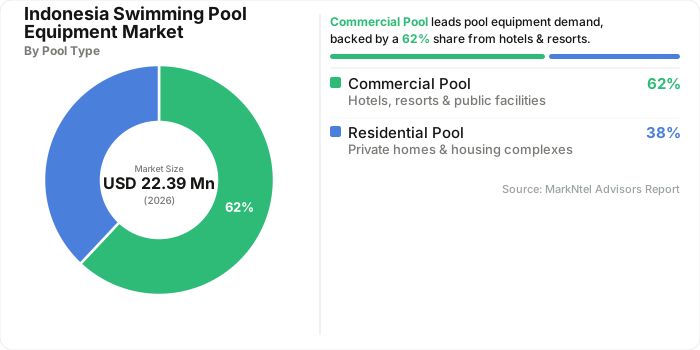
- Commercial pools are the leading pool type, accounting for approximately 62% of the market.
- Hospitality is the largest end-user segment, contributing nearly 48% of total market revenue.
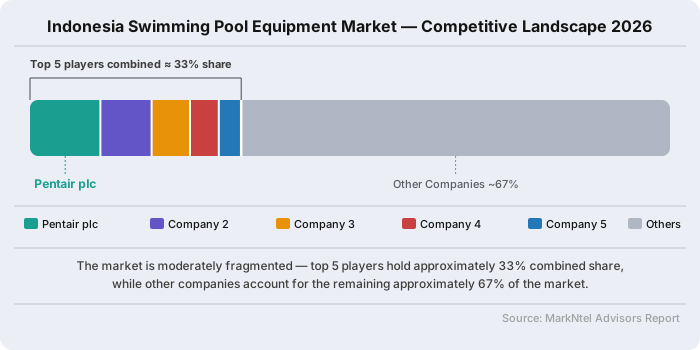
- The Indonesia Swimming Pool Equipment Market is moderately fragmented, the top five companies collectively hold approximately 33% of the market,
Indonesia Swimming Pool Equipment Market Size and Outlook
The swimming pool equipment industry was valued at USD 18.11 million in 2025 and is projected to grow to USD 22.39 million in 2026, reaching USD 38.28 million by 2032 at a CAGR of 9.35% during the forecast period (2026–2032).
Market growth is primarily supported by two long-term demand drivers: the expansion of Indonesia's tourism and hospitality sector and rising foreign-backed residential villa development. Both trends are increasing the installation of new swimming pools while creating recurring demand for filtration, circulation, sanitation, cleaning, and maintenance equipment throughout the asset lifecycle.
The hospitality sector continues to be a major contributor to equipment demand. Indonesia welcomed 15.39 million foreign tourist arrivals in 2025, surpassing the government's target of 14–15 million visitors. At the same time, tourism sector investment realization reached approximately USD 4.38 billion, representing a 56.05% year-on-year increase. This sustained investment is accelerating hotel and resort development across key tourist destinations, driving demand for commercial swimming pool equipment. Reflecting this trend, Jakarta alone had 46 hotel projects comprising 10,159 rooms under active construction at the end of Q4 2025, with each new hospitality project requiring swimming pool filtration, pumping, water treatment, and circulation systems.
In parallel, government policies are stimulating growth in the premium residential segment. Indonesia's Golden Visa framework, introduced under Minister of Law and Human Rights Regulation No. 22 of 2023 and amended by Regulation No. 11 of 2024, grants long-term residency benefits to eligible foreign investors and property buyers. The policy is encouraging investment in luxury villas, particularly in Bali and Lombok, where private swimming pools are a standard feature of high-end residential developments. Consequently, rising villa construction is generating sustained demand for residential swimming pool equipment, including pumps, filters, sanitization systems, automation solutions, and maintenance products.
The growing commercial and residential opportunity has also encouraged greater participation from international manufacturers. For example, PT Fluidra Indonesia, with operations in Jakarta and Bali, supplies swimming pool equipment to both hospitality and residential projects, highlighting the country's expanding importance as a regional market for swimming pool technologies.
Indonesia Swimming Pool Equipment Market Key Indicators
- According to Bank Indonesia's Q3 2025 Residential Property Price Survey, developers financed 77.67% of residential construction capital through internal (non-bank) funding, reducing dependence on mortgage lending and external credit conditions. This financing structure enables villa developments and mid-to-large residential projects to continue progressing even during periods of tighter bank lending. As private swimming pools remain a standard feature in many premium housing and villa developments, sustained project completion supports consistent demand for pool pumps, filtration systems, water treatment equipment, and other swimming pool accessories across Indonesia.
- According to the United Nations Population Division, 60.27% of Indonesia's population is projected to reside in urban areas in 2026, with the urbanization rate expected to continue rising through 2030 and 2032 as migration toward major metropolitan regions, particularly across the Java–Bali corridor, remains strong. Indonesia's total population is also projected to approach 296 million by 2030, adding further momentum to urban residential development. This sustained urban expansion is expected to accelerate the construction of high-rise residential complexes, gated communities, mixed-use developments, and premium housing projects, where shared and private swimming pools are increasingly positioned as lifestyle amenities.
- According to BPS-Statistics Indonesia, the country's economy grew 5.11% in 2025, while the manufacturing sector accounted for 19.07% of GDP, making it the largest contributor to the national economy. A strong manufacturing base supports the domestic production and supply of key swimming pool equipment components, including pumps, filters, pipes, valves, and plastic fittings. This strengthens local supply chains, improves product availability, and reduces dependence on imports, enabling manufacturers and distributors to better meet the growing demand from Indonesia's residential and commercial swimming pool markets.
Indonesia Swimming Pool Equipment Market Scope
| Category | Segments |
|---|---|
| By Equipment Type | Pumps, Filters, Heaters, Cleaners, Chemical Treatment Equipment, Pool Covers, Lighting Equipment, Automation & Control Systems, Others |
| By Pool Type | Commercial Pools, Residential Pools |
| By End-User | Hospitality, Residential, Institutional, Municipal |
| By Distribution Channel | Direct Sales, Distributors & Dealers, Online |
Indonesia Swimming Pool Equipment Market Growth Drivers
State-Backed Mandalika Special Economic Zone Development Driving Swimming Pool Equipment Demand
The Indonesia Tourism Development Corporation (ITDC), the state-owned developer of the Mandalika Special Economic Zone (SEZ) in Lombok, signed a USD 124.45 million land utilization and development agreement with Kleo Mandalika Resort in April 2025 to construct a five-star luxury hotel at Tanjung Aan Beach. As luxury hotels within the SEZ typically include swimming pools, spas, and wellness facilities as standard amenities, each new project generates demand for commercial-grade pool pumps, filtration systems, circulation equipment, disinfection technologies, and automation solutions during the construction phase.
Beyond hospitality projects, cumulative investment in the Mandalika SEZ reached USD 365 million by 2025, supported by both domestic and international investors. In January 2026, an additional USD 3.15 million investment agreement was signed for premium villa development within the zone, further expanding demand for residential swimming pool equipment.
The parallel growth of luxury resorts and private villas is creating sustained opportunities for both commercial and residential pool equipment suppliers. As ITDC continues to attract new hospitality and real estate developments through phased land utilization agreements, the Mandalika SEZ is expected to remain a significant long-term demand center for Indonesia's swimming pool equipment industry.
Recent Trends
Rising Energy Costs Accelerating Adoption of Energy-Efficient and Smart Pool Equipment
Rising operating costs are accelerating the adoption of energy-efficient and digitally connected swimming pool equipment across Indonesia's commercial pool market. According to BPS-Statistics Indonesia, the Ores, Minerals, Electricity, Gas, and Water component of the National Wholesale Price Index (WPI) increased 8.92% year-on-year in May 2026, marking the highest growth among all WPI categories. Increasing electricity costs are encouraging hotels, resorts, sports facilities, and commercial pool operators to replace conventional single-speed pumps with variable-speed pumps, high-efficiency filtration systems, and IoT-enabled pool management solutions that reduce energy consumption and operating expenses.
Reflecting this industry shift, Fluidra, which operates in Indonesia through PT Fluidra Indonesia, partnered with European Aquatics in May 2026 to launch initiatives focused on modernizing aquatic facilities and expanding access to swimming education. The collaboration reinforces the company's broader strategy of advancing connected and energy-efficient pool technologies across global markets. As utility costs continue to rise, Indonesian hospitality operators are increasingly viewing smart pool equipment as a long-term operational efficiency investment, supporting sustained demand for energy-saving pumps, automated filtration systems, and intelligent pool management solutions through the forecast period.
Indonesia Swimming Pool Equipment Market Opportunities and Challenges
Indonesia's TKDN Certification Burden Driving Localized Pool Equipment Manufacturing
Indonesia's local content (TKDN) regulations are reshaping procurement strategies for manufacturers supplying swimming pool equipment. In September 2025, the Ministry of Industry introduced Regulation No. 35 of 2025, replacing the previous 2011 framework with a stricter compliance system that includes continuous audits and a three-tier enforcement mechanism.
Complementing this, Presidential Regulation No. 46 of 2025 requires products participating in government procurement to achieve a combined Domestic Component Level (TKDN) and Company Benefit Weight (BMP) score of at least 40%, including a minimum 25% TKDN threshold to qualify for procurement opportunities. Consequently, manufacturers relying solely on imported pool pumps, filtration systems, water treatment equipment, and heating solutions may face certification challenges and reduced access to government and state-backed tourism infrastructure projects if they fail to meet the prescribed local content requirements.
While these regulations increase compliance requirements for import-dependent suppliers, they also create a significant opportunity for manufacturers willing to localize their operations. Under Regulation No. 35 of 2025, companies establishing manufacturing or assembly facilities in Indonesia and employing predominantly Indonesian workers automatically receive a minimum 25% TKDN score. Additional TKDN credits are available for companies undertaking research and development activities within the country.
As a result, manufacturers that localize the production or assembly of swimming pool equipment, such as pumps, filtration systems, and water treatment components, can improve their eligibility for government and state-owned enterprise contracts while strengthening their long-term competitiveness. The evolving regulatory framework is therefore expected to encourage greater domestic manufacturing, strategic partnerships, and investment in Indonesia's swimming pool equipment industry.
Segmentation Insights
Commercial Pools Lead the Market, Driven by Hospitality Expansion and High Equipment Intensity
Commercial pools account for approximately 62% of the Indonesia swimming pool equipment market, as they require continuous operation, greater water circulation capacity, and strict compliance with water quality and turnover regulations. As compared to the residential pools, facilities in hotels, resorts, sports clubs, and water parks rely on high-performance pool pumps, filtration systems, chemical treatment equipment, and automation systems to maintain safe and consistent water quality under heavy daily usage. Consequently, a single commercial installation typically generates equipment demand equivalent to several residential pools, giving the segment a significantly larger revenue contribution than its share of total pool installations. This trend is further supported by expanding tourism infrastructure.
In May 2025, Hyatt Hotels Corporation announced Samara Lombok, its first Destination by Hyatt property in Southeast Asia, featuring multiple swimming pools, beach clubs, and water sports facilities, creating demand for multi-zone commercial pool equipment. Likewise, Hayward Indonesia continues strengthening its commercial presence through authorized distributors supplying premium pumping and filtration solutions to hotels and large residential developments.
As Indonesia's hospitality sector expands through 2026, commercial pools are expected to remain the primary growth engine for the Indonesia swimming pool equipment market, supported by higher equipment value per project rather than project volume alone. By pool type the market is further segmented into the following sub-categories:
- Commercial Pools
- Residential Pools
Hospitality Leads the Industry with Potential Market Shares
The hospitality segment accounts for approximately 48% of the Indonesia swimming pool equipment industry in 2026, as hotels, resorts, and luxury villas invest significantly more in swimming pool pumps, filtration systems, pool lighting, automation systems, and chemical treatment equipment than any other end user. Unlike residential customers, hospitality operators require multiple pools, including infinity pools, children's pools, spa pools, and recreational water features, each equipped with dedicated circulation and water treatment systems to ensure uninterrupted operation, guest safety, and premium service standards. This results in substantially higher equipment expenditure per property and continuous replacement demand.
In 2025, Marriott International announced plans to add seven new properties across Indonesia, including Bali, Jakarta, Surabaya, Bekasi, Pontianak, and the Riau Islands, with the company targeting 100 hotels in Indonesia within the next three years, directly expanding demand for commercial swimming pool equipment. Additionally, Archipelago International announced 36 new hotel projects across Indonesia during 2024 while introducing smart hotel technologies across selected properties, reinforcing long-term investment in premium hospitality infrastructure.
These developments are increasing demand for high-capacity pool systems, particularly in tourism-driven destinations. As Indonesia continues expanding its hospitality sector, hospitality is expected to remain the largest end-user segment, supported by higher equipment intensity, recurring maintenance requirements, and sustained investment in hotel and resort development. By end user the market is further segmented into the following sub-categories:
- Hospitality
- Residential
- Institutional
- Municipal
Indonesia Swimming Pool Equipment Market Competitive Landscape
The Indonesia swimming pool equipment market is moderately fragmented, with a mix of global manufacturers and regional distributors competing across the commercial and residential segments. The top five companies, Pentair plc, Hayward Holdings, Inc., Fluidra S.A. (AstralPool), Emaux Water Technology Co., Ltd., and Waterco Limited, collectively account for approximately 33% of the Indonesia swimming pool equipment market in 2026.
Major Companies in the Indonesia Swimming Pool Equipment Market
- Pentair plc
- Hayward Holdings, Inc.
- Fluidra S.A. (AstralPool)
- Emaux Water Technology Co., Ltd.
- Waterco Limited
- Davey Water Products
- Aqua Industrial Group S.p.A.
- Laswim Pool Products
- Xylem Inc. (Lowara)
- Behncke GmbH
Indonesia Swimming Pool Equipment Market News and Recent Developments
2024: Grundfos Opens USD 2 Million Submersible Pump Assembly Facility in Jakarta
In November 2024, Grundfos inaugurated a USD 2 million submersible pump assembly facility in Jakarta, Indonesia. The plant received a 29% Domestic Component Level (TKDN) certification from Indonesia's Ministry of Industry, enabling faster local production and significantly reducing equipment delivery times across Indonesia and the wider Southeast Asian region. While the facility primarily manufactures submersible borehole and groundwater pumps for municipal, industrial, and water utility applications, it reflects the company's broader commitment to expanding its local manufacturing footprint and strengthening its pump supply chain within Indonesia.
Market Impact Analysis: Although the facility does not manufacture swimming pool circulation pumps directly, the investment enhances Indonesia's domestic pump manufacturing ecosystem, improves component availability, strengthens technical expertise, and supports the wider pump industry. Over the long term, increased local manufacturing capabilities and supply chain efficiencies could encourage greater adoption of advanced pump technologies, indirectly benefiting the Indonesia swimming pool equipment market, particularly as demand for energy-efficient and locally supported pumping solutions continues to grow.
2026: Fluidra Indonesia Showcases AI-Powered Smart Pool Technologies at ARCH:ID 2026
In April 2026, PT Fluidra Indonesia participated in ARCH:ID 2026, Indonesia's premier architecture and building exhibition held at ICE BSD City, Tangerang, where it unveiled its latest portfolio of smart swimming pool and wellness solutions. The company showcased its AI-powered Positive Pool platform, which recommends the most efficient pool equipment configuration based on project requirements to optimize both investment costs and energy consumption. Fluidra also demonstrated wireless robotic pool cleaners, automated pool management technologies, immersive pool concepts, and advanced wellness products for residential and commercial applications. The exhibition enabled architects, developers, consultants, and hospitality stakeholders to experience connected pool technologies designed to improve operational efficiency and sustainability.
Impact analysis: The introduction of AI-enabled pool management and smart automation technologies reflects Indonesia's growing shift toward intelligent and energy-efficient swimming pool infrastructure. As hotels, resorts, luxury villas, and mixed-use developments increasingly prioritize digital facility management and lower operating costs, demand for connected pool pumps, automation systems, robotic cleaners, and energy-efficient equipment is expected to accelerate, supporting the modernization of the Indonesia swimming pool equipment market.
- Market Segmentation
- Introduction
- Product Definition
- Research Process
- Assumptions
- Executive Summary
- Indonesia YoY Inventory on Total Number of Swimming Pools, 2022-2032
- By Region
- By Pool Size
- Indonesia Swimming Pool Equipment Market Policies, Regulations, and Product Standards
- Indonesia Swimming Pool Equipment Market Trends & Developments
- Indonesia Swimming Pool Equipment Market Dynamics
- Growth Factors
- Challenges
- Indonesia Swimming Pool Equipment Market Hotspot & Opportunities
- Indonesia Swimming Pool Equipment Market Outlook, 2022-2032
- Market Size & Outlook
- By Revenues (USD Million)
- Market Share & Analysis
- By Equipment Type- Market Size & Forecast 2022-2032, USD Million
- Pumps
- Filters
- Heaters
- Cleaners
- Chemical Treatment Equipment
- Pool Covers
- Lighting Equipment
- Automation & Control Systems
- Others
- By Pool Type- Market Size & Forecast 2022-2032, USD Million
- Commercial Pools
- Residential Pools
- By End-User- Market Size & Forecast 2022-2032, USD Million
- Hospitality
- Residential
- Institutional
- Municipal
- By Distribution Channel- Market Size & Forecast 2022-2032, USD Million
- Direct Sales
- Distributors & Dealers
- Online
- By Region
- Java
- Sumatra
- Kalimantan
- Sulawesi
- New Guinea
- Lesser Sunda Islands
- Rest of Indonesia
- By Company
- Competition Characteristics
- Market Share & Analysis
- By Equipment Type- Market Size & Forecast 2022-2032, USD Million
- Market Size & Outlook
- Indonesia Residential Swimming Pool Equipment Market Outlook, 2022-2032
- Market Size & Outlook
- By Revenues (USD Million)
- Market Share & Analysis
- By Equipment Type- Market Size & Forecast 2022-2032, USD Million
- By End-User- Market Size & Forecast 2022-2032, USD Million
- By Distribution Channel- Market Size & Forecast 2022-2032, USD Million
- Market Size & Outlook
- Indonesia Commercial Swimming Pool Equipment Market Outlook, 2022-2032
- Market Size & Outlook
- By Revenues (USD Million)
- Market Share & Analysis
- By Equipment Type- Market Size & Forecast 2022-2032, USD Million
- By End-User- Market Size & Forecast 2022-2032, USD Million
- By Distribution Channel- Market Size & Forecast 2022-2032, USD Million
- Market Size & Outlook
- Indonesia Swimming Pool Equipment Market Key Strategic Imperatives for Success & Growth
- Competitive Outlook
- Company Profiles
- Fluidra
- Business Description
- Product Portfolio
- Collaborations & Alliances
- Recent Developments
- Financial Details
- Others
- Pentair
- Business Description
- Product Portfolio
- Collaborations & Alliances
- Recent Developments
- Financial Details
- Others
- Hayward Holdings
- Business Description
- Product Portfolio
- Collaborations & Alliances
- Recent Developments
- Financial Details
- Others
- Emaux Water Technology
- Business Description
- Product Portfolio
- Collaborations & Alliances
- Recent Developments
- Financial Details
- Others
- Waterco Limited
- Business Description
- Product Portfolio
- Collaborations & Alliances
- Recent Developments
- Financial Details
- Others
- Zodiac Pool Systems
- Business Description
- Product Portfolio
- Collaborations & Alliances
- Recent Developments
- Financial Details
- Others
- Maytronics
- Business Description
- Product Portfolio
- Collaborations & Alliances
- Recent Developments
- Financial Details
- Others
- Poolking
- Business Description
- Product Portfolio
- Collaborations & Alliances
- Recent Developments
- Financial Details
- Others
- Denor Swimming Pool Equipment
- Business Description
- Product Portfolio
- Collaborations & Alliances
- Recent Developments
- Financial Details
- Others
- Foshan Guanya Swimming Pool Equipment
- Business Description
- Product Portfolio
- Collaborations & Alliances
- Recent Developments
- Financial Details
- Others
- Others
- Fluidra
- Company Profiles
- Disclaimer

MarkNtel Advisors follows a robust and iterative research methodology designed to ensure maximum accuracy and minimize deviation in market estimates and forecasts. Our approach combines both bottom-up and top-down techniques to effectively segment and quantify various aspects of the market. A consistent feature across all our research reports is data triangulation, which examines the market from three distinct perspectives to validate findings. Key components of our research process include:
1. Scope & Research Design At the outset, MarkNtel Advisors define the research objectives and formulate pertinent questions. This phase involves determining the type of research—qualitative or quantitative—and designing a methodology that outlines data collection methods, target demographics, and analytical tools. They also establish timelines and budgets to ensure the research aligns with client goals.
2. Sample Selection and Data Collection In this stage, the firm identifies the target audience and determines the appropriate sample size to ensure representativeness. They employ various sampling methods, such as random or stratified sampling, based on the research objectives. Data collection is carried out using tools like surveys, interviews, and observations, ensuring the gathered data is reliable and relevant.
3. Data Analysis and Validation Once data is collected, MarkNtel Advisors undertake a rigorous analysis process. This includes cleaning the data to remove inconsistencies, employing statistical software for quantitative analysis, and thematic analysis for qualitative data. Validation steps are taken to ensure the accuracy and reliability of the findings, minimizing biases and errors.

4. Data Forecast and FinalizationThe final phase involves forecasting future market trends based on the analyzed data. MarkNtel Advisors utilize predictive modeling and time series analysis to anticipate market behaviors. The insights are then compiled into comprehensive reports, featuring visual aids like charts and graphs, and include strategic recommendations to inform client decision-making
FILL THE FORM TO GET THE FREE SAMPLE PAGES
We offer flexible licensing options to cater to varying organizational needs. Choose the pricing pack that best suits your requirements:
Buy Now Inquire Before Buying
 Talk to our Consultant
 Request Customization