

By Type (Epoxy Curing Agents, Polyurethane Curing Agents, Silicone Curing Agents, Acrylic Curing Agents, Rubber Curing Agents, Others), By Chemistry (Amine-Based, Anhydride-Based,......Isocyanate-Based, Phenalkamine-Based, Mercaptan-Based, Others), By Form (Liquid, Solid, Others), By Curing Technology (Ambient Temperature Curing, Heat Curing, UV/Light Curing, Moisture Curing), By Application (Coatings, Adhesives & Sealants, Composites, Encapsulation & Potting, Elastomers, Others), By End User (Building & Construction, Automotive & Transportation, Electrical & Electronics, Industrial Manufacturing, Wind Energy, Aerospace & Defense, Marine, Others), and others Read more
- Chemicals
- Jun 2026
- 150
- PDF, Excel, PPT
India Curing Agent Market Key Takeaways
- India curing agent market size valued at USD 377 million in 2025, rising from USD 405 million in 2026 to USD 778 million by 2032.
- The industry is projected to witness steady growth at a CAGR of 11.49% during the forecast period.
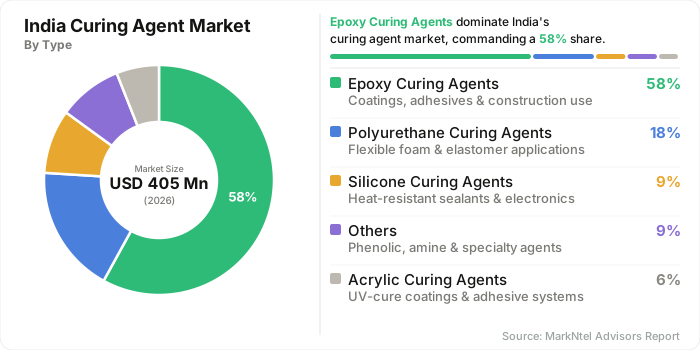
- Epoxy curing agents lead by type, capturing nearly 58% share in 2026.
- Amine-based chemistry dominates the demand with around a 47% share in 2026.
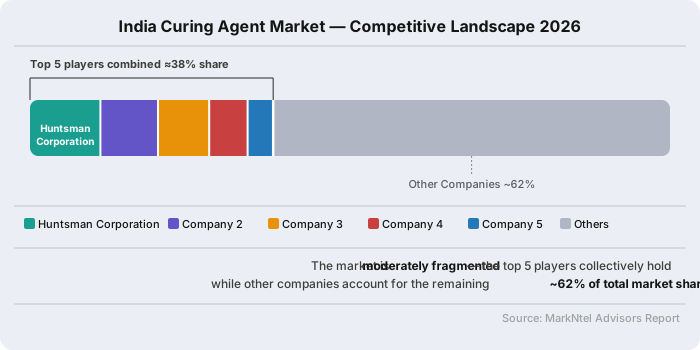
- The industry is moderately consolidated, with the top five players collectively accounting for nearly 38% share, reflecting strong global presence alongside regional competition.
India Curing Agent Market Size and Outlook
The India curing agent market size is projected to expand from USD 377 million in 2025 to USD 778 million by 2032, registering a CAGR of 11.49%. This steady growth is supported by sustained infrastructure investments and rising demand for high-performance materials across construction and industrial sectors. Increasing deployment of protective coatings in highways, bridges, and public infrastructure is reinforcing baseline consumption, supported by large-scale government capital expenditure and long-term asset development programs across India’s expanding urban and industrial landscape.
Housing expansion remains a primary demand driver shaping long-term market growth. Under Pradhan Mantri Awas Yojana–Urban (PMAY‑U) 2.0, the government approved approximately USD 27.6 billion to support housing for 10 million urban families over five years. This scale of development significantly increases the use of coatings, adhesives, and flooring systems that rely on curing technologies. As construction intensity rises across cities, demand for epoxy hardeners is expected to increase steadily across residential, commercial, and public infrastructure applications.
India’s electronics manufacturing expansion is emerging as a high-value growth engine within the market outlook. Investments of around USD 11 billion by Tata Electronics in semiconductor fabrication and over USD 2.7 billion by Micron Technology in assembly and testing facilities are accelerating demand for advanced materials. Semiconductor packaging and encapsulation require high precision curing performance, strengthening the adoption of thermoset curing technologies in high-reliability and miniaturized electronic components across industrial applications.
Urban infrastructure programs further reinforce long-term growth visibility across multiple sectors. Projects worth approximately USD 19.7 billion completed under the Smart Cities Mission by 2025 continue to expand demand for coatings, adhesives, and composite materials. Alongside this, a gradual shift toward advanced chemistries and localized manufacturing is improving supply resilience, reducing import dependence, and creating new opportunities for value-added applications, supporting stable and diversified curing agent industry expansion over the forecast period.
India Curing Agent Market Key Indicators
- India’s cumulative wind capacity surpassed 56 GW in 2025, with a record addition of 6.05 GW in a single year . This expansion directly accelerates demand for epoxy-based composite materials used in turbine blades. Since these blades depend on advanced curing systems for structural integrity, rising installations are significantly increasing the consumption of composites curing agents across domestic renewable energy manufacturing supply chains.
- India produced 149.4 million tonnes of crude steel in 2024, maintaining its position as the world’s second-largest producer . This scale of output requires extensive corrosion protection across infrastructure applications, including pipelines and structural frameworks. Fusion-bonded epoxy coatings used in these applications rely heavily on curing technologies, thereby strengthening demand for corrosion coatings within industrial and construction environments.
- The National Green Hydrogen Mission, with an outlay of approximately USD 2.37 billion, targets 5 million tonnes of annual hydrogen production by 2030. This initiative necessitates advanced composite materials for storage tanks, electrolysers, and transport infrastructure. Such systems rely on durable epoxy formulations, driving new demand for anhydride curing agents in emerging clean-energy applications and next-generation industrial systems.
- India’s real estate sector is projected to reach USD 5.8 trillion by 2047, contributing over 15% to national economic output. This long-term expansion significantly increases the use of coatings, adhesives, and flooring systems across residential and commercial projects. These applications depend on efficient curing systems, thereby reinforcing demand for industrial flooring coatings in both decorative and protective construction segments.
- Indian Railways electrified 7,188 route kilometres in 2023–24 and an additional 2,701 kilometres in 2024–25, nearing full electrification of its broad-gauge network . This transition involves extensive deployment of insulated systems, protective coatings, and composite components. These materials rely on efficient curing mechanisms, thereby supporting consistent demand for epoxy systems in transportation infrastructure modernization initiatives.
- The number of operational airports in India increased from 74 to 159 in 2024, with long-term targets of 350 by 2047. This expansion supports rising demand for aircraft components, terminal infrastructure, and maintenance systems utilizing advanced composites. These applications depend on high-performance curing technologies, thereby boosting demand for polymer curing solutions in aerospace-grade materials and infrastructure.
- In 2025, the government approved a road development plan worth approximately USD 4 billion for Bihar, covering more than 50 highways, bridges, and urban connectivity projects. Such large-scale infrastructure investments require coatings, sealants, and adhesives for durability and protection. These materials depend on curing processes, leading to increased consumption of construction chemicals across regional infrastructure expansion programs.
India Curing Agent Market Scope
| Category | Segments |
|---|---|
| By Type | Epoxy Curing Agents, Polyurethane Curing Agents, Silicone Curing Agents, Acrylic Curing Agents, Rubber Curing Agents, Others |
| By Chemistry | Amine-Based, Anhydride-Based, Isocyanate-Based, Phenalkamine-Based, Mercaptan-Based, Others |
| By Form | Liquid, Solid, Others |
| By Curing Technology | Ambient Temperature Curing, Heat Curing, UV/Light Curing, Moisture Curing |
| By Application | Coatings, Adhesives & Sealants, Composites, Encapsulation & Potting, Elastomers, Others |
| By End User | Building & Construction, Automotive & Transportation, Electrical & Electronics, Industrial Manufacturing, Wind Energy, Aerospace & Defense, Marine, Others |
India Curing Agent Market Growth Drivers
Rapid Infrastructure & Construction Expansion
India’s expanding infrastructure ecosystem is significantly driving demand across the curing agent market, supported by sustained government capital expenditure and industrial development initiatives. The Union Budget 2025–26 allocated approximately USD 130 billion toward infrastructure, alongside USD 18 billion in interest-free loans to states. These investments are accelerating demand for construction chemicals and high-performance coatings used in roads, bridges, and urban development projects.
The expansion of national highways further reinforces this growth trajectory. By 2025, India’s four-lane-and-above highway network had reached 43,512 kilometres, necessitating extensive use of protective coatings on steel structures, bridges, and other exposed infrastructure. These applications rely on advanced curing technologies, particularly within industrial coatings demand, ensuring corrosion resistance and long-term durability across large-scale infrastructure assets.
Additionally, the increasing focus on maintenance and lifecycle extension of infrastructure assets is driving recurring demand for coatings and repair materials. Epoxy-based systems, widely used for protective and structural applications, require efficient curing mechanisms, thereby strengthening the adoption of epoxy systems across both new construction and refurbishment projects.
The sustained public investment, expanding transport infrastructure, and increasing maintenance requirements are collectively reinforcing long-term demand fundamentals. The growing reliance on durable materials and coatings is strengthening the role of curing technologies, ensuring consistent adoption of advanced systems and supporting the continued expansion of industrial applications linked to large-scale infrastructure development activities.
Recent Trends
Shift Toward Advanced Amine and Phenalkamine Chemistries
The India curing agent industry is witnessing a strong transition toward advanced amine and phenalkamine-based chemistries, driven by rising demand for durability, efficiency, and performance in industrial applications. These advanced systems offer faster curing, improved adhesion, and superior resistance to chemicals and environmental stress, making them increasingly suitable for high-performance use cases across infrastructure and industrial sectors.
A key supporting instance is the continued commercialization of phenalkamine-based products such as LAPOX AH-543 by Atul Ltd., designed for room-temperature and low-temperature curing conditions. These formulations demonstrate enhanced moisture tolerance and corrosion resistance, aligning with evolving requirements in protective coatings and flooring systems, thereby reinforcing adoption of phenalkamine curing agents in demanding environments.
Additionally, the ability of these chemistries to perform under high humidity and adverse site conditions is accelerating their use in infrastructure maintenance and industrial coatings. This shift is strengthening demand for advanced amine curing technologies, particularly in applications where conventional hardeners fail to deliver consistent performance under variable operational conditions.
As industries increasingly prioritize efficiency and lifecycle performance, the transition toward specialized formulations is expected to continue. The growing emphasis on reliability and durability is driving sustained adoption of high-performance curing agents, positioning advanced chemistries as a core component of next-generation material systems across multiple end-use industries.
India Curing Agent Market Opportunities and Challenges
Resin Supply Constraints Driving Domestic Manufacturing Expansion
The India curing agent market faces a structural challenge due to its dependence on imported resin feedstocks, particularly epoxy systems used across coatings, adhesives, and composites. The Directorate General of Trade Remedies identified material injury caused by low-priced imports, highlighting persistent pricing pressure and supply vulnerability linked to rising epoxy resin imports, which directly influence downstream production stability.
The DGTR investigation, concluded in August 2025, confirmed that imports from multiple countries caused price undercutting and margin erosion for domestic producers. This has increased cost uncertainty across the value chain, as curing-agent demand is closely tied to resin availability. Such disruptions create operational risks for manufacturers relying on a consistent supply of raw materials for industrial applications.
However, this challenge is simultaneously creating a strong opportunity for domestic manufacturing expansion. In June 2025, Grasim Industries commissioned a resin production facility with a capacity of 22 million litres per annum . This investment strengthens domestic chemical production, reduces import reliance, and improves supply chain resilience within the coatings and specialty chemicals ecosystem.
As domestic resin availability improves, manufacturers can achieve better cost control and production stability. This transition is expected to enhance integration across the value chain, supporting increased utilization of resin hardeners and enabling long-term growth of India curing agent industry.
Segmentation Insights
Epoxy-Based Curing Agents Capture Majority Share Across Key Industries
Epoxy curing agents dominate the India curing agent industry, accounting for approximately 58% of total revenue, supported by their superior mechanical strength, adhesion properties, and chemical resistance. These characteristics make them highly suitable for demanding applications across coatings, electronics, construction, and industrial manufacturing, where durability and long-term performance are critical requirements.
A key driver of this dominance is the rapid expansion of India’s electronics manufacturing sector. According to government data, electronics production reached approximately USD 125 billion in 2024–25, significantly increasing demand for materials used in printed circuit boards, encapsulation, and insulation . These applications rely heavily on epoxy systems and specialized curing technologies for precision and reliability.
Epoxy curing agents are widely used in encapsulants, potting compounds, and PCB laminates, where thermal stability and electrical insulation are essential. The growing complexity of electronic components and miniaturization trends are further strengthening demand for high-performance formulations, supporting increased adoption of electronics curing agents across advanced manufacturing applications.
While other segments such as polyurethane, silicone, acrylic, and rubber curing agents serve niche applications, their overall market share remains comparatively limited. The broad applicability and performance advantages of epoxy-based solutions continue to reinforce their leadership position, further driving demand for amine curing agents in industrial and electronics sectors. The market is classified by type into the following segments:
- Epoxy Curing Agents
- Polyurethane Curing Agents
- Silicone Curing Agents
- Acrylic Curing Agents
- Rubber Curing Agents
- Others
Amine-Based Systems Lead Through Superior Crosslinking Efficiency
Amine-based curing agents hold the leading share in the India curing agent industry, accounting for approximately 55% of total revenue due to their high reactivity and strong crosslinking efficiency. These systems deliver excellent adhesion, mechanical strength, and chemical resistance, making them suitable for a wide range of industrial applications, particularly in coatings, adhesives, and composite materials.
Their versatility across ambient and low-temperature curing conditions further strengthens adoption in infrastructure and industrial coatings. Amine formulations are widely preferred for their ability to ensure rapid curing and consistent performance under variable environmental conditions. This has significantly increased their utilization within polymer curing processes, particularly in applications requiring durability, flexibility, and resistance to harsh operating environments.
Compared to alternatives such as anhydride, isocyanate, and mercaptan-based systems, amine-based variants offer a balanced combination of performance and cost efficiency. Their compatibility with a wide range of formulations continues to drive demand across industrial sectors. As application requirements evolve, the adoption of crosslinking agents based on amine chemistry is expected to expand further, reinforcing their dominant position in the market. The report evaluates the market based on the following chemistry types:
- Amine-Based
- Anhydride-Based
- Isocyanate-Based
- Phenalkamine-Based
- Mercaptan-Based
- Others
India Curing Agent Market Competitive Analysis
The India curing agent industry is moderately fragmented, with global leaders such as Huntsman Corporation, Evonik Industries AG, BASF SE, Olin Corporation, and Cardolite Corporation collectively accounting for an estimated 38% market share. While these players dominate high-performance and specialty segments, strong participation from regional firms such as Atul Limited and Aditya Birla Chemicals (India) Limited intensifies competition.
Leading Companies in India Curing Agent Market
- Huntsman Corporation
- Evonik Industries AG
- BASF SE
- Olin Corporation
- Cardolite Corporation
- Arkema S.A.
- Westlake Corporation
- Mitsubishi Chemical Group Corporation
- Atul Limited
- Aditya Birla Chemicals (India) Limited
- Others
- Market Segmentation
- Introduction
- Product Definition
- Research Process
- Assumptions
- Executive Summary
- India Curing Agent Market Policies, Regulations, and Product Standards
- India Curing Agent Pricing Analysis 2022-2032
- India Curing Agent Pricing Trend 2022-2032
- India Curing Agent Pricing Trend by Type 2022-2032
- Epoxy Curing Agents
- Polyurethane Curing Agents
- Silicone Curing Agents
- Acrylic Curing Agents
- Rubber Curing Agents
- Others
- India Curing Agent Market Dynamics
- Growth Factors
- Challenges
- India Curing Agent Market Import & Export Analysis
- India Curing Agent Market Hotspot & Opportunities
- India Curing Agent Market Outlook, 2022-2032F
- Market Size & Outlook
- By Revenues (USD Million)
- By Quantity Sold (Thousand Tons)
- Market Share & Outlook
- By Type- Market Size & Forecast 2022-2032, USD Million & Thousand Tons
- Epoxy Curing Agents
- Polyurethane Curing Agents
- Silicone Curing Agents
- Acrylic Curing Agents
- Rubber Curing Agents
- Others
- By Chemistry - Market Size & Forecast 2022-2032, USD Million & Thousand Tons
- Amine-Based
- Anhydride-Based
- Isocyanate-Based
- Phenalkamine-Based
- Mercaptan-Based
- Others
- By Form- Market Size & Forecast 2022-2032, USD Million & Thousand Tons
- Liquid
- Solid
- Others
- By Curing Technology- Market Size & Forecast 2022-2032, USD Million & Thousand Tons
- Ambient Temperature Curing
- Heat Curing
- UV/Light Curing
- Moisture Curing
- By Application- Market Size & Forecast 2022-2032, USD Million & Thousand Tons
- Coatings
- Adhesives & Sealants
- Composites
- Encapsulation & Potting
- Elastomers
- Others
- By End User- Market Size & Forecast 2022-2032, USD Million & Thousand Tons
- Building & Construction
- Automotive & Transportation
- Electrical & Electronics
- Industrial Manufacturing
- Wind Energy
- Aerospace & Defense
- Marine
- Others
- By Region- Market Size & Forecast 2022-2032, USD Million & Thousand Tons
- North
- South
- East
- West
- By Company
- Competition Characteristics
- Market Share & Analysis
- By Type- Market Size & Forecast 2022-2032, USD Million & Thousand Tons
- Market Size & Outlook
- India Epoxy Curing Agents Market Outlook, 2022-2032
- Market Size & Outlook
- By Revenues (USD Million)
- By Quantity Sold (Thousand Tons)
- Market Share & Outlook
- By Chemistry - Market Size & Forecast 2022-2032, USD Million & Thousand Tons
- By Form- Market Size & Forecast 2022-2032, USD Million & Thousand Tons & Thousand Tons
- By Curing Technology- Market Size & Forecast 2022-2032, USD Million & Thousand Tons
- By Application- Market Size & Forecast 2022-2032, USD Million & Thousand Tons
- By End User- Market Size & Forecast 2022-2032, USD Million & Thousand Tons
- By Region- Market Size & Forecast 2022-2032, USD Million & Thousand Tons
- Market Size & Outlook
- India Polyurethane Curing Agents Market Outlook, 2022-2032
- Market Size & Outlook
- By Revenues (USD Million)
- By Quantity Sold (Thousand Tons)
- Market Share & Outlook
- By Chemistry - Market Size & Forecast 2022-2032, USD Million & Thousand Tons
- By Form- Market Size & Forecast 2022-2032, USD Million & Thousand Tons
- By Curing Technology- Market Size & Forecast 2022-2032, USD Million & Thousand Tons
- By Application- Market Size & Forecast 2022-2032, USD Million & Thousand Tons
- By End User- Market Size & Forecast 2022-2032, USD Million & Thousand Tons
- By Region- Market Size & Forecast 2022-2032, USD Million & Thousand Tons
- Market Size & Outlook
- India Silicone Curing Agents Market Outlook, 2022-2032
- Market Size & Outlook
- By Revenues (USD Million)
- By Quantity Sold (Thousand Tons)
- Market Share & Outlook
- By Chemistry - Market Size & Forecast 2022-2032, USD Million & Thousand Tons
- By Form- Market Size & Forecast 2022-2032, USD Million & Thousand Tons
- By Curing Technology- Market Size & Forecast 2022-2032, USD Million & Thousand Tons
- By Application- Market Size & Forecast 2022-2032, USD Million & Thousand Tons
- By End User- Market Size & Forecast 2022-2032, USD Million & Thousand Tons
- By Region- Market Size & Forecast 2022-2032, USD Million & Thousand Tons
- Market Size & Outlook
- India Acrylic Curing Agents Market Outlook, 2022-2032
- Market Size & Outlook
- By Revenues (USD Million)
- By Quantity Sold (Thousand Tons)
- Market Share & Outlook
- By Chemistry - Market Size & Forecast 2022-2032, USD Million & Thousand Tons
- By Form- Market Size & Forecast 2022-2032, USD Million & Thousand Tons
- By Curing Technology- Market Size & Forecast 2022-2032, USD Million & Thousand Tons
- By Application- Market Size & Forecast 2022-2032, USD Million & Thousand Tons
- By End User- Market Size & Forecast 2022-2032, USD Million & Thousand Tons
- By Region- Market Size & Forecast 2022-2032, USD Million & Thousand Tons
- Market Size & Outlook
- India Rubber Curing Agents Market Outlook, 2022-2032
- Market Size & Outlook
- By Revenues (USD Million)
- By Quantity Sold (Thousand Tons)
- Market Share & Outlook
- By Chemistry - Market Size & Forecast 2022-2032, USD Million & Thousand Tons
- By Form- Market Size & Forecast 2022-2032, USD Million & Thousand Tons
- By Curing Technology- Market Size & Forecast 2022-2032, USD Million & Thousand Tons
- By Application- Market Size & Forecast 2022-2032, USD Million & Thousand Tons
- By End User- Market Size & Forecast 2022-2032, USD Million & Thousand Tons
- By Region- Market Size & Forecast 2022-2032, USD Million & Thousand Tons
- Market Size & Outlook
- India Curing Agent Market Key Strategic Imperatives for Success & Growth
- Competitive Outlook
- Company Profiles
- Huntsman Corporation
- Business Description
- Product Portfolio
- Collaborations & Alliances
- Recent Developments
- Financial Details
- Others
- Evonik Industries AG
- Business Description
- Product Portfolio
- Collaborations & Alliances
- Recent Developments
- Financial Details
- Others
- BASF SE
- Business Description
- Product Portfolio
- Collaborations & Alliances
- Recent Developments
- Financial Details
- Others
- Olin Corporation
- Business Description
- Product Portfolio
- Collaborations & Alliances
- Recent Developments
- Financial Details
- Others
- Cardolite Corporation
- Business Description
- Product Portfolio
- Collaborations & Alliances
- Recent Developments
- Financial Details
- Others
- Arkema S.A.
- Business Description
- Product Portfolio
- Collaborations & Alliances
- Recent Developments
- Financial Details
- Others
- Westlake Corporation
- Business Description
- Product Portfolio
- Collaborations & Alliances
- Recent Developments
- Financial Details
- Others
- Mitsubishi Chemical Group Corporation
- Business Description
- Product Portfolio
- Collaborations & Alliances
- Recent Developments
- Financial Details
- Others
- Atul Limited
- Business Description
- Product Portfolio
- Collaborations & Alliances
- Recent Developments
- Financial Details
- Others
- Aditya Birla Chemicals (India) Limited
- Business Description
- Product Portfolio
- Collaborations & Alliances
- Recent Developments
- Financial Details
- Others
- Others
- Huntsman Corporation
- Company Profiles
- Disclaimer

MarkNtel Advisors follows a robust and iterative research methodology designed to ensure maximum accuracy and minimize deviation in market estimates and forecasts. Our approach combines both bottom-up and top-down techniques to effectively segment and quantify various aspects of the market. A consistent feature across all our research reports is data triangulation, which examines the market from three distinct perspectives to validate findings. Key components of our research process include:
1. Scope & Research Design At the outset, MarkNtel Advisors define the research objectives and formulate pertinent questions. This phase involves determining the type of research—qualitative or quantitative—and designing a methodology that outlines data collection methods, target demographics, and analytical tools. They also establish timelines and budgets to ensure the research aligns with client goals.
2. Sample Selection and Data Collection In this stage, the firm identifies the target audience and determines the appropriate sample size to ensure representativeness. They employ various sampling methods, such as random or stratified sampling, based on the research objectives. Data collection is carried out using tools like surveys, interviews, and observations, ensuring the gathered data is reliable and relevant.
3. Data Analysis and Validation Once data is collected, MarkNtel Advisors undertake a rigorous analysis process. This includes cleaning the data to remove inconsistencies, employing statistical software for quantitative analysis, and thematic analysis for qualitative data. Validation steps are taken to ensure the accuracy and reliability of the findings, minimizing biases and errors.

4. Data Forecast and FinalizationThe final phase involves forecasting future market trends based on the analyzed data. MarkNtel Advisors utilize predictive modeling and time series analysis to anticipate market behaviors. The insights are then compiled into comprehensive reports, featuring visual aids like charts and graphs, and include strategic recommendations to inform client decision-making
FILL THE FORM TO GET THE FREE SAMPLE PAGES
We offer flexible licensing options to cater to varying organizational needs. Choose the pricing pack that best suits your requirements:
Buy Now Inquire Before Buying
 Talk to our Consultant
 Request Customization