

By Battery Type (Lithium Cobalt Oxide, Lithium Manganese Oxide, Lithium Iron Phosphate, Lithium Nickel Cobalt Aluminum Oxide, Lithium Titanate Oxide, Lithium Nickel Manganese Cobal......t Oxide), By Application (Consumer Electronics, Industrial, Automotive, Energy Storage Systems), By Voltage (Low (upto 12V), Medium (13V to 36V), High (More Than 36V)), By Power Capacity (Less Than 3,000 mAh, 3,000 to Less Than 10,000 mAh, 10,000 to Less Than 50,000 mAh, 50,000 mAh & Above), and others Read more
- Automotive
- Sep 2026
- 155
- PDF, Excel, PPT
Hungary Lithium-Ion Battery Market Key Takeaways
- The Hungary lithium-ion battery market size was valued at USD 9.5 billion in 2025 and is projected to grow from USD 12 billion in 2026 to USD 18 billion by 2032.
- The industry is projected to sustain growth at a steady CAGR of 6.99% during 2026-2032.
- Debrecen holds the largest share of about 55% in 2026.
- By battery type, nickel-manganese-cobalt holds a significant share of about 60% in 2026.
- By application, automotive seized a significant share of about 65% in 2026.
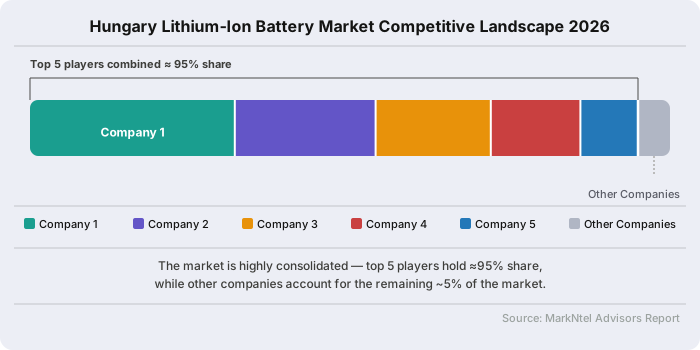
- The industry is highly consolidated. However, the top five players collectively account for nearly a 95% share.
Hungary Lithium-Ion Battery Market Size and Outlook
The lithium-ion battery market size in Hungary was valued at USD 9.5 billion in 2025 and is projected to grow from USD 12 billion in 2026 to USD 18 billion by 2032. Along with this, the market is estimated to grow at a CAGR of around 6.99% during the forecast period, i.e., 2027-33.
The demand for lithium-ion batteries in Hungary is driven primarily by rapid EV adoption, expanding automotive production, and large-scale battery investments from global manufacturers. Government incentives, EU decarbonization targets, and Hungary’s industrial strategy further support battery-cell and component manufacturing. Future opportunities include LFP batteries, battery recycling, energy-storage systems, and localized raw-material and component supply chains. The development of major facilities in Debrecen, Göd, and other industrial hubs is strengthening Hungary’s position within Europe’s battery ecosystem. Rising demand from electric vehicles and grid-scale storage is expected to sustain investment and production expansion. Over the long term, Hungary is positioned to remain a significant European lithium-ion battery manufacturing hub.
Hungary Lithium-Ion Battery Market Key Indicators
- Hungary recorded 11,002 new battery-electric passenger-car registrations in 2025, representing a 28% increase from 8,565 units in 2024. BEVs consequently increased their share of new passenger-car registrations from 7.0% to 8.5%. This expansion directly supports lithium-ion battery demand because passenger EVs remain the principal end-use application. Rising adoption also creates opportunities for battery suppliers, charging infrastructure and aftermarket services
- Hungary attracted approximately USD 30.4 billion of foreign investment into its battery sector, primarily from South Korean and Chinese companies, according to government figures reported in March 2026. The investment base has established Hungary as a major European battery-production location and supports expansion across cells, modules, cathode materials, and related components. Continued foreign capital inflows should increase domestic manufacturing capacity and strengthen the country's battery supply-chain ecosystem.
- CATL's Debrecen project represents an approximately USD 8.55 billion investment and is planned to reach 100 GWh of annual battery-production capacity. The facility is intended to supply European automakers, including BMW, Stellantis and Volkswagen. In 2026, CATL also began battery-module assembly at the site. The project's scale is a major indicator of Hungary's growing lithium-ion manufacturing base and future demand for battery materials, components and manufacturing services.
- EcoPro BM began operations at its Debrecen cathode-material facility in December 2025, establishing its first European manufacturing base. The plant has a planned annual production capacity of 54,000 tonnes of cathode materials, sufficient to supply batteries for approximately 600,000 electric vehicles annually. The facility also includes lithium-processing operations and strengthens Hungary's upstream battery ecosystem by increasing domestic availability of critical lithium-ion battery materials.
- KunlunChem is establishing its first European production base in Szolnok, with an investment of approximately USD 119 million and planned long-term capacity of up to 100,000 tonnes of electrolyte products annually. The company will supply electrolyte materials to CATL and EVE Power battery plants in nearby Debrecen. The project fills an important supply-chain gap and increases Hungary's domestic production of essential lithium-ion battery components.
Hungary Lithium-Ion Battery Market Scope
| Category | Segments |
|---|---|
| By Battery Type | Lithium Cobalt Oxide, Lithium Manganese Oxide, Lithium Iron Phosphate, Lithium Nickel Cobalt Aluminum Oxide, Lithium Titanate Oxide, Lithium Nickel Manganese Cobalt Oxide |
| By Application | Consumer Electronics, Industrial, Automotive, Energy Storage Systems |
| By Voltage | Low (upto 12V), Medium (13V to 36V), High (More Than 36V |
| By Power Capacity | Less Than 3,000 mAh, 3,000 to Less Than 10,000 mAh, 10,000 to Less Than 50,000 mAh, 50,000 mAh & Above |
Hungary Lithium-Ion Battery Market Growth Drivers
Rising EV Adoption and Expansion of Domestic EV Manufacturing Driving Demand for Lithium-Ion Batteries in Hungary
The expansion of electric vehicle adoption and domestic EV manufacturing is a major growth driver for Hungary’s lithium-ion battery market. In 2025, Hungary registered 11,002 new battery-electric passenger cars, a 28% increase from 8,565 units in 2024, while BEVs’ share of new passenger-car registrations increased from 7.0% to 8.5%. By May 2026, Hungary had already recorded 5,932 new BEV registrations, demonstrating continued demand for battery-powered vehicles.
Domestic EV production is further strengthening battery demand. In October 2025, BMW began series production of the all-electric iX3 at its Debrecen plant, with high-voltage batteries manufactured and assembled on-site. The facility is also designed to support production of the Neue Klasse range, creating sustained demand for locally produced lithium-ion batteries.
In addition, CATL’s Debrecen battery plant is planned with 100 GWh of annual production capacity, with the company stating that its first battery cells were scheduled for production in 2025. Together, rising BEV registrations and expanding domestic battery-intensive vehicle production are increasing both immediate battery consumption and Hungary’s local lithium-ion manufacturing requirements, making EV electrification a central market growth catalyst.
Recent Trends
Shift Toward Grid-Scale Battery Energy Storage for Renewable-Energy Integration
Hungary is increasingly shifting toward grid-scale battery energy storage as rapid solar expansion creates a greater need for flexible electricity management. In 2025, solar power generated approximately 33% of Hungary’s electricity, compared with about 14% in 2022. At the same time, battery energy-storage capacity across Hungary, Austria and Romania increased 472% between 2022 and 2025, demonstrating accelerating investment in large-scale storage.
The trend strengthened in 2026 as large renewable-storage projects moved forward. A major project in northeastern Hungary combines 450 MW of solar capacity with 250 MW/1 GWh of battery storage and is supported by a USD 245 million financing package, including approximately USD 82 million from the European Bank for Reconstruction and Development. The integrated system is designed to improve grid flexibility and enable greater utilization of intermittent solar generation.
The importance of storage was further demonstrated in August 2026, when Hungary's Paks nuclear output fell by more than 80% because of low Danube water levels. Solar generation increased nearly 20% year over year, averaging about 1,418 MWh/h, and at times supplied more than 55% of national electricity generation. Growing battery-storage capacity helped stabilize the power system during the disruption.
Hungary Lithium-Ion Battery Market Opportunities and Challenges
Environmental Compliance Challenges Create Opportunities for Battery Recycling and Material Recovery
Hungary’s rapid expansion of lithium-ion battery manufacturing is creating significant environmental and waste-management pressure, making regulatory compliance an important challenge for market participants. In September 2026, Hungary introduced a dedicated environmental watchdog for battery manufacturing, recycling, and decommissioning and increased the maximum environmental fine to USD 16 million. The move followed repeated environmental violations involving battery-sector companies, including Samsung SDI and Semcorp.
However, this challenge is simultaneously creating a strong opportunity for battery recycling and closed-loop material recovery. A particularly relevant instance is SungEel HiTech, which operates battery-recycling facilities in Hungary and received permits in 2025 to significantly expand capacity at both Hungarian sites, demonstrating that recycling infrastructure is already developing alongside battery manufacturing. Hungary’s expanding production base further strengthens this opportunity: the country is expected to have more than 200 GWh of battery-production capacity by 2031, increasing the future volume of manufacturing scrap and end-of-life batteries available for recycling.
The IEA also notes that manufacturing scrap will account for around two-thirds of battery-recycling feedstock in 2030, highlighting the importance of recycling within battery-production ecosystems. Thus, stricter environmental requirements can accelerate investment in recycling, black-mass processing, and recovery of lithium, nickel, and cobalt, supporting further market growth.
Segmentation Insights
Nickel Manganese Cobalt Chemistry Accounts for Approximately 60% Share, Making It the Leading Battery Type
NMC chemistry accounts for approximately 60% of Hungary’s lithium-ion battery market, making it the largest battery type. Its leadership is primarily supported by Hungary’s concentration of automotive battery production from Samsung SDI, SK On and CATL, which have historically focused heavily on nickel-based chemistries. CATL’s Debrecen facility is designed to produce NMC cells, including high-nickel NMC811 chemistry, while Samsung SDI’s Hungarian operations have also focused on high-nickel battery technologies.
European battery production remained predominantly nickel-based in 2025, with NMC accounting for approximately 55% of cell-production capacity and NCA another 15%. This chemistry provides high energy density, making it suitable for premium and long-range electric vehicles manufactured in Hungary and supplied to European automotive OEMs. Although LFP adoption is increasing because of its lower cost and improved thermal stability, Hungary’s established manufacturing infrastructure and existing automotive supply contracts continue to support NMC as the leading chemistry. Based on battery type, the scope has been segmented into:
- Lithium Cobalt Oxide
- Lithium Manganese Oxide
- Lithium Iron Phosphate
- Lithium Nickel Cobalt Aluminum Oxide
- Lithium Titanate Oxide
- Lithium Nickel Manganese Cobalt Oxide
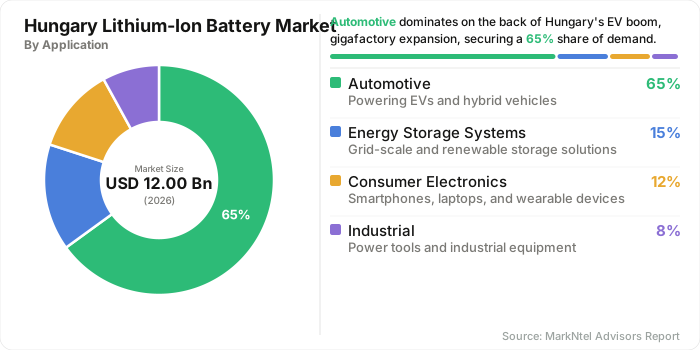
Automotive Holds Approximately 65% Share, Driven by EV Manufacturing Expansion
Automotive accounts for approximately 65% of Hungary’s lithium-ion battery industry, supported by its expanding EV manufacturing ecosystem, large-scale battery investments, and growing electric-vehicle adoption. Hungary hosts major battery projects linked to automotive manufacturers, including CATL’s Debrecen investment, Samsung SDI, SK On and BMW. The government’s research agency identifies automotive and battery investments as central to Hungary’s ambition to become a regional electric-mobility manufacturing hub.
BMW’s expanding presence further reinforces automotive demand, while Hungary’s passenger-car fleet reached 4.37 million vehicles in 2025, according to the Hungarian Central Statistical Office. The country’s extensive automotive export base also supports battery demand, as Hungary exported approximately USD 171 billion of goods in 2025, demonstrating the importance of manufacturing and export-oriented industries to the economy. By application, the scope has been classified into:
- Consumer Electronics
- Industrial
- Automotive
- Energy Storage Systems
Hungary Lithium-Ion Battery Market Geographical Outlook
Debrecen Accounts for Approximately 55% Share, Supported by Concentration of Major Battery and EV Manufacturing Projects
Debrecen accounts for approximately 55% of Hungary’s lithium-ion battery demand, making it the country’s leading battery hub. The city has attracted major investments from CATL and BMW, creating a concentrated battery and electric-vehicle manufacturing ecosystem. CATL is developing a 100 GWh annual-capacity battery facility in Debrecen, significantly increasing local requirements for cells, modules, materials and battery components. In May 2026, CATL also began battery-module assembly at a dedicated facility with 5 GWh of annual capacity, further expanding local production.
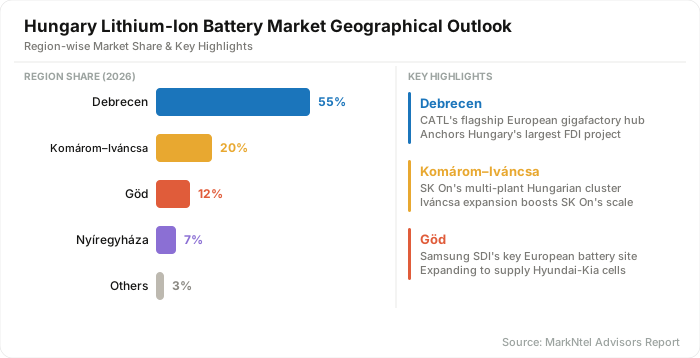
BMW’s Debrecen plant strengthens this ecosystem through production of electric vehicles and integration of high-voltage battery manufacturing, creating direct demand for advanced lithium-ion battery technologies. The clustering of battery production, EV manufacturing and supporting suppliers reduces logistics distances and encourages additional investment in the surrounding supply chain. Consequently, Debrecen has become a major center for Hungary’s lithium-ion battery production and consumption.
Hungary Lithium-Ion Battery Market Competitive Analysis
Top 5 Companies Account for Approximately 95% Market Share
The Hungary lithium-ion battery market is highly consolidated, with leading companies such as Contemporary Amperex Technology Hungary Kft., Samsung SDI Magyarország Zrt., SK On Hungary Kft., EVE Power Hungary Kft., and GS Yuasa Magyarország Kft. collectively accounting for an estimated 95% of the market.
Key Players in Hungary Lithium-Ion Battery Market
- Contemporary Amperex Technology Hungary Kft.
- Samsung SDI Magyarország Zrt.
- SK On Hungary Kft.
- EVE Power Hungary Kft.
- GS Yuasa Magyarország Kft.
- SungEel Hitech Hungary Kft.
- Dongwha Electrolyte Hungary Kft.
- Volta Energy Solutions Hungary Kft.
- LOTTE ALUMINIUM Hungary Korlátolt Felelősségű Társaság
- W-SCOPE Hungary Plant Korlátolt Felelősségű Társaság
- Others
Hungary Lithium-Ion Battery Industry News and Recent Developments
May 2026: CATL Begins Battery Module Assembly in Debrecen
CATL began battery-module assembly at its new Debrecen facility on May 6, 2026, following receipt of the required permits. The new line has an annual capacity of 5 GWh, while the company’s cell factory is awaiting approvals for test production. CATL said the facility is designed to support European automotive customers and expand Hungary’s role in regional battery manufacturing.
Impact Analysis: The launch strengthens Hungary’s downstream lithium-ion battery manufacturing capabilities by adding dedicated module assembly capacity. CATL’s 5 GWh line can improve supply responsiveness for European automotive customers while reducing dependence on imported modules. The facility also deepens Hungary’s integration into regional EV supply chains, potentially attracting component suppliers and supporting higher domestic value addition across battery manufacturing and electric-vehicle production.
May 2026: EcoPro BM Begins Mass Production of Battery Cathode Materials
EcoPro BM began mass production on May 18, 2026, at its Debrecen facility, marking the South Korean company's first European manufacturing base. The plant produces cathode materials used in lithium-ion batteries and has an annual capacity of 54,000 tonnes, sufficient for batteries powering approximately 600,000 electric vehicles. The company also completed its first shipment of finished materials during the production ramp-up.
Impact Analysis: EcoPro BM’s production launch strengthens Hungary’s upstream battery-material ecosystem by establishing large-scale domestic cathode-material manufacturing. With annual capacity of 54,000 tonnes, the facility can support battery production for around 600,000 EVs, improving regional material availability. Local production may reduce logistics dependence, enhance supply-chain resilience, and encourage further investment in Hungary’s battery ecosystem, particularly around cathode materials and EV manufacturing.
September 2025: CATL Launches Shenxing Pro LFP Batteries for Future Production in Hungary
CATL unveiled two Europe-focused Shenxing Pro lithium-iron-phosphate (LFP) batteries at the Munich Motor Show and stated that it plans to manufacture LFP batteries at its Debrecen facility. One version offers up to 758 km of driving range and a 12-year or 1 million km service life, while the fast-charging version can add 478 km in 10 minutes, supporting Hungary's transition toward advanced lithium-ion battery production.
Impact Analysis: The Shenxing Pro launch highlights the growing role of LFP technology within Hungary’s future lithium-ion battery manufacturing landscape. Its extended driving range and rapid charging capabilities could support broader European EV adoption, particularly in cost-sensitive segments. CATL’s intention to manufacture LFP batteries in Debrecen may diversify Hungary’s battery technology base while strengthening local production capabilities for next-generation electric-vehicle applications.
- Market Segmentation
- Introduction
- Product Definition
- Research Process
- Assumptions
- Executive Summary
- Hungary Lithium-Ion Battery Market Trends & Developments
- Hungary Lithium-Ion Battery Market Production Trend (Units) 2022-2032
- Hungary Lithium-Ion Battery Market Production Trend (Units) By Battery Type
- Lithium Cobalt Oxide
- Lithium Manganese Oxide
- Lithium Iron Phosphate
- Lithium Nickel Cobalt Aluminum Oxide
- Lithium Titanate Oxide
- Lithium Nickel Manganese Cobalt Oxide
- Company-Wise Production Plants and Statistics
- Installed Production Capacity
- Actual Production
- Planned Production Target
- Hungary Lithium-Ion Battery Market Production Trend (Units) By Battery Type
- Hungary Lithium-Ion Battery Market Pricing Analysis 2022-2032
- Hungary Lithium-Ion Battery Market Pricing Trend (USD/Units) 2022-2032
- Hungary Lithium-Ion Battery Market Pricing Trend (USD/Units) By Regions 2022-2032
- Debrecen
- Komárom–Iváncsa
- Göd
- Nyíregyháza
- Others
- Hungary Lithium-Ion Battery Market Pricing Trend (USD/Units) By Battery Type 2022-2032
- Lithium Cobalt Oxide
- Lithium Manganese Oxide
- Lithium Iron Phosphate
- Lithium Nickel Cobalt Aluminum Oxide
- Lithium Titanate Oxide
- Lithium Nickel Manganese Cobalt Oxide
- Hungary Lithium-Ion Battery Market Dynamics
- Growth Drivers
- Challenges
- Hungary Lithium-Ion Battery Value Chain Analysis
- Hungary Lithium-Ion Battery Regulations and Policies
- Hungary Lithium-Ion Battery Market Hotspots & Opportunities
- Hungary Lithium-Ion Battery Market Outlook, 2022-2032
- Market Size & Analysis
- By Revenue (USD Million)
- By Quantity Sold (Thousand Units)
- Market Segmentation & Outlook
- By Battery Type- Market Size & Forecast 2022-2032, USD Million & Thousand Units
- Lithium Cobalt Oxide
- Lithium Manganese Oxide
- Lithium Iron Phosphate
- Lithium Nickel Cobalt Aluminum Oxide
- Lithium Titanate Oxide
- Lithium Nickel Manganese Cobalt Oxide
- By Application- Market Size & Forecast 2022-2032, USD Million & Thousand Units
- Consumer Electronics
- Industrial
- Automotive
- Energy Storage Systems
- By Voltage- Market Size & Forecast 2022-2032, USD Million & Thousand Units
- Low (upto 12V)
- Medium (13V to 36V)
- High (More Than 36V)
- By Power Capacity- Market Size & Forecast 2022-2032, USD Million & Thousand Units
- Less Than 3,000 mAh
- 3,000 to Less Than 10,000 mAh
- 10,000 to Less Than 50,000 mAh
- 50,000 mAh & Above
- By Region
- Debrecen
- Komárom–Iváncsa
- Göd
- Nyíregyháza
- Others
- By Company
- Competition Characteristics
- Market Share & Analysis
- By Battery Type- Market Size & Forecast 2022-2032, USD Million & Thousand Units
- Market Size & Analysis
- Hungary Consumer Electronics Lithium-Ion Battery Market Outlook, 2022-2032
- Market Size & Analysis
- By Revenue (USD Million)
- By Quantity Sold (Thousand Units)
- Market Segmentation & Outlook
- By Type - Market Size & Forecast 2022-2032, USD Million & Thousand Units
- Smartphones
- Laptops
- UPS
- Others (Gardening Tools, Games, etc.)
- By Battery Type- Market Size & Forecast 2022-2032, USD Million & Thousand Units
- By Voltage- Market Size & Forecast 2022-2032, USD Million & Thousand Units
- By Power Capacity- Market Size & Forecast 2022-2032, USD Million & Thousand Units
- By Region- Market Size & Forecast 2022-2032, USD Million & Thousand Units
- By Type - Market Size & Forecast 2022-2032, USD Million & Thousand Units
- Market Size & Analysis
- Hungary Industrial Lithium-Ion Battery Market Analysis, 2022-2032
- Market Size & Analysis
- By Revenue (USD Million)
- By Quantity Sold (Thousand Units)
- Market Segmentation & Outlook
- By Type- Market Size & Forecast 2022-2032, USD Million & Thousand Units
- Commercial Aircraft
- Mining Equipment
- Commercial Ships
- Construction Equipment
- Energy Storage
- Others (Automated Mobile Robots, etc.)
- By Battery Type- Market Size & Forecast 2022-2032, USD Million & Thousand Units
- By Voltage- Market Size & Forecast 2022-2032, USD Million & Thousand Units
- By Power Capacity- Market Size & Forecast 2022-2032, USD Million & Thousand Units
- By Region- Market Size & Forecast 2022-2032, USD Million & Thousand Units
- By Type- Market Size & Forecast 2022-2032, USD Million & Thousand Units
- Market Size & Analysis
- Hungary Automotive Lithium-Ion Battery Market Outlook, 2022-2032
- Market Size & Analysis
- By Revenue (USD Million)
- By Quantity Sold (Thousand Units)
- Market Segmentation & Outlook
- By Type- Market Size & Forecast 2022-2032, USD Million & Thousand Units
- Battery Electric Vehicles
- Plug-In Hybrid Electric Vehicles
- By Battery Type- Market Size & Forecast 2022-2032, USD Million & Thousand Units
- By Voltage- Market Size & Forecast 2022-2032, USD Million & Thousand Units
- By Power Capacity- Market Size & Forecast 2022-2032, USD Million & Thousand Units
- By Region- Market Size & Forecast 2022-2032, USD Million & Thousand Units
- By Type- Market Size & Forecast 2022-2032, USD Million & Thousand Units
- Market Size & Analysis
- Hungary Energy Storage Systems Lithium-Ion Battery Market Outlook, 2022-2032
- Market Size & Analysis
- By Revenue (USD Million)
- By Quantity Sold (Thousand Units)
- Market Segmentation & Outlook
- By Type- Market Size & Forecast 2022-2032, USD Million & Thousand Units
- By Battery Type- Market Size & Forecast 2022-2032, USD Million & Thousand Units
- By Voltage- Market Size & Forecast 2022-2032, USD Million & Thousand Units
- By Power Capacity- Market Size & Forecast 2022-2032, USD Million & Thousand Units
- By Region- Market Size & Forecast 2022-2032, USD Million & Thousand Units
- Market Size & Analysis
- Hungary Lithium-Ion Battery Market Key Strategic Imperatives for Success and Growth
- Competition Outlook
- Company Profiles
- Contemporary Amperex Technology Hungary Kft.
- Business Description
- Product Portfolio
- Strategic Alliances or Partnerships
- Recent Developments
- Financial Details
- Others
- Samsung SDI Magyarország Zrt.
- Business Description
- Product Portfolio
- Strategic Alliances or Partnerships
- Recent Developments
- Financial Details
- Others
- SK On Hungary Kft.
- Business Description
- Product Portfolio
- Strategic Alliances or Partnerships
- Recent Developments
- Financial Details
- Others
- EVE Power Hungary Kft.
- Business Description
- Product Portfolio
- Strategic Alliances or Partnerships
- Recent Developments
- Financial Details
- Others
- GS Yuasa Magyarország Kft.
- Business Description
- Product Portfolio
- Strategic Alliances or Partnerships
- Recent Developments
- Financial Details
- Others
- SungEel Hitech Hungary Kft
- Business Description
- Product Portfolio
- Strategic Alliances or Partnerships
- Recent Developments
- Financial Details
- Others
- Dongwha Electrolyte Hungary Kft.
- Business Description
- Product Portfolio
- Strategic Alliances or Partnerships
- Recent Developments
- Financial Details
- Others
- Volta Energy Solutions Hungary Kft.
- Business Description
- Product Portfolio
- Strategic Alliances or Partnerships
- Recent Developments
- Financial Details
- Others
- LOTTE ALUMINIUM Hungary Korlátolt Felelősségű Társaság
- Business Description
- Product Portfolio
- Strategic Alliances or Partnerships
- Recent Developments
- Financial Details
- Others
- W-SCOPE Hungary Plant Korlátolt Felelősségű Társaság
- Business Description
- Product Portfolio
- Strategic Alliances or Partnerships
- Recent Developments
- Financial Details
- Others
- Others
- Contemporary Amperex Technology Hungary Kft.
- Company Profiles
- Disclaimer

MarkNtel Advisors follows a robust and iterative research methodology designed to ensure maximum accuracy and minimize deviation in market estimates and forecasts. Our approach combines both bottom-up and top-down techniques to effectively segment and quantify various aspects of the market. A consistent feature across all our research reports is data triangulation, which examines the market from three distinct perspectives to validate findings. Key components of our research process include:
1. Scope & Research Design At the outset, MarkNtel Advisors define the research objectives and formulate pertinent questions. This phase involves determining the type of research—qualitative or quantitative—and designing a methodology that outlines data collection methods, target demographics, and analytical tools. They also establish timelines and budgets to ensure the research aligns with client goals.
2. Sample Selection and Data Collection In this stage, the firm identifies the target audience and determines the appropriate sample size to ensure representativeness. They employ various sampling methods, such as random or stratified sampling, based on the research objectives. Data collection is carried out using tools like surveys, interviews, and observations, ensuring the gathered data is reliable and relevant.
3. Data Analysis and Validation Once data is collected, MarkNtel Advisors undertake a rigorous analysis process. This includes cleaning the data to remove inconsistencies, employing statistical software for quantitative analysis, and thematic analysis for qualitative data. Validation steps are taken to ensure the accuracy and reliability of the findings, minimizing biases and errors.

4. Data Forecast and FinalizationThe final phase involves forecasting future market trends based on the analyzed data. MarkNtel Advisors utilize predictive modeling and time series analysis to anticipate market behaviors. The insights are then compiled into comprehensive reports, featuring visual aids like charts and graphs, and include strategic recommendations to inform client decision-making
FILL THE FORM TO GET THE FREE SAMPLE PAGES
We offer flexible licensing options to cater to varying organizational needs. Choose the pricing pack that best suits your requirements:
Buy Now Inquire Before Buying
 Talk to our Consultant
 Request Customization