

By Component (Hardware, Software, Services), By Detection Technology (Radar, Radio Frequency (RF), Electro-Optical/Infrared (EO/IR), Acoustic, Remote Identification (Remote ID)), B......y Mitigation Technology (RF/GNSS-Based Mitigation, Drone Capture Systems, Directed-Energy Systems, Other Authorized Mitigation Technologies), By Deployment Mode (Fixed, Mobile (including portable systems)), By Airport Type (Major Commercial Airports, Regional Commercial Airports, General Aviation Airports) Read more
- Aerospace & Defense
- Aug 2026
- 305
- PDF, Excel, PPT
Germany Airport Drone Disruption Management Market Key Takeaways
- The Germany airport drone disruption management market stood at around USD 37 million in 2025 and is anticipated to expand from USD 43 million in 2026 to USD 70 million by 2032.
- The industry is projected to witness steady growth, reflecting a CAGR of 8.46% over the forecast period.
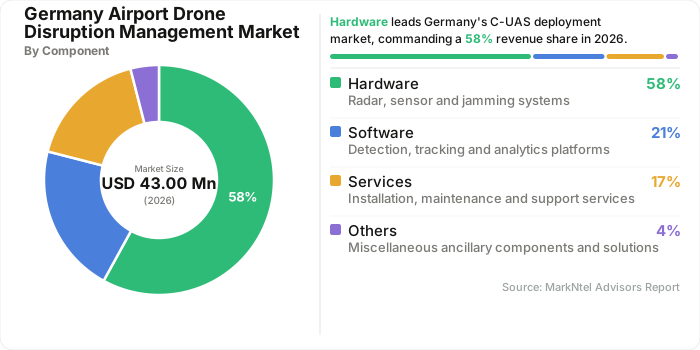
- Hardware led the component segment with a 58% share in 2026.
- Major commercial airports accounted for a 76% share of the airport type segment in 2026.
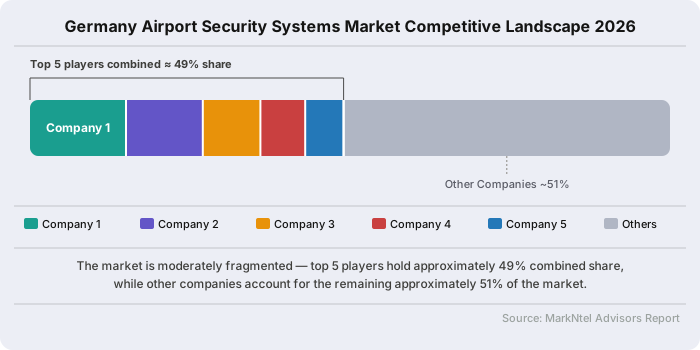
- The industry is moderately concentrated, with the top five leading players accounting for approximately 49% of the total market share.
Germany Airport Drone Disruption Management Market Size and Outlook
The rapid expansion of drone use has created a new vulnerability around German airports, as unauthorized UAS operating near runways can interfere with aircraft movements and trigger delays, diversions, or temporary flight suspensions. As such incidents become more frequent, their operational and financial consequences are increasing, with DLR recording 116 relevant drone disruption incidents across 25 German commercial airports in 2025, causing at least approximately USD 69.6 million in economic damage, particularly affecting major commercial airports. This rising disruption risk is encouraging airports and security authorities to strengthen continuous surveillance and deploy dedicated systems for drone detection, identification, tracking, and mitigation.
As airports move toward more permanent counter-drone infrastructure, multi-sensor detection, automated threat assessment, and faster response capabilities are gaining importance in airport security operations. The need to maintain uninterrupted flight operations and limit disruption-related losses is expected to sustain investment, driving the market from USD 37 million in 2025 to USD 43 million in 2026 and USD 70 million by 2032, representing an 8.46% CAGR.
Germany Airport Drone Disruption Management Market Key Indicators
- Germany’s Bundestag Budget Committee approved USD 58.0 million for Bundespolizei drone-defense capabilities in the 2026 federal budget, including USD 34.8 million for civil airports, creating immediate procurement opportunities for detection and mitigation systems.
- The German government committed USD 116.0 million to establish the Bundespolizei’s dedicated drone-defense unit, operational since December 2025 with 130 personnel, institutionalizing counter-drone capabilities and sustaining demand for equipment, training, maintenance, and services.
- Amendments to Germany’s Air Security Act, passed in February 2026, authorize the Bundeswehr to intercept, jam, or shoot down drones when requested by civilian authorities, expanding deployment opportunities for active mitigation technologies around airports.
- Germany recorded 3.071 million flight movements in 2025, increasing 3.5% from 2.969 million in 2024, while daily traffic exceeded 10,000 flights several times, raising operational exposure to drone disruptions and supporting permanent surveillance investment.
- Germany’s Federal Ministry of the Interior received an approved 2026 budget of USD 18.3 billion, up from USD 17.7 billion in 2025, with drone-defense expansion cited among spending drivers, strengthening public funding for airport security technologies.
Germany Airport Drone Disruption Management Market Scope
| Category | Segments |
|---|---|
| By Component | Hardware, Software, Services |
| By Detection Technology | Radar, Radio Frequency (RF), Electro-Optical/Infrared (EO/IR), Acoustic, Remote Identification (Remote ID |
| By Mitigation Technology | RF/GNSS-Based Mitigation, Drone Capture Systems, Directed-Energy Systems, Other Authorized Mitigation Technologies |
| By Deployment Mode | Fixed, Mobile (including portable systems |
| By Airport Type | Major Commercial Airports, Regional Commercial Airports, General Aviation Airports |
Germany Airport Drone Disruption Management Market Growth Drivers
Escalating Frequency and Economic Cost of Unauthorized Drone Incursions
Unauthorized drone activity near German airports has evolved into a recurring operational threat, with disruptions affecting flight diversions, runway availability, and airport continuity. DLR identified 116 relevant drone incidents across 25 German commercial airports in 2025, while around 70% of approximately 200 drone-related flight diversions were associated with major international hubs such as Munich and Frankfurt. The financial impact is also evident at the airport level, with drone sightings at Munich Airport in October 2025 causing 17 flight cancellations and 15 diversions and affecting nearly 3,000 passengers, highlighting the cost of repeated disruptions.
This growing pressure is encouraging airports to invest in airport counter-drone solutions rather than relying on reactive responses. In April 2026, HENSOLDT was commissioned to supply the Bundespolizei with highly mobile c-UAS detection and verification vehicles for potential use at airports, critical infrastructure sites, and major events. As airports move toward permanent protection, demand for multi-sensor drone detection, verification, tracking, and mitigation capabilities is expected to increase.
Recent Trends
Shift toward Integrated Multi-Sensor Surveillance
The increasing complexity of unauthorized drone threats is moving German airport security from standalone detection toward integrated surveillance that combines complementary sensor technologies. This shift is reflected in DLR’s CUSTODIAN project, which brings together 12 institutes to develop coordinated capabilities for drone detection, tracking, situational assessment, and neutralization, with applications particularly relevant to airports and other sensitive locations. By bringing multiple stages of the counter-drone process together, the initiative demonstrates the growing emphasis on creating a more complete and reliable picture of low-altitude airspace before a response is initiated.
The move toward integrated architectures is also reaching commercial deployment, with Rheinmetall introducing Skyspotter in June 2026 as a multi-sensor early-warning system designed to detect, identify, and continuously track airborne threats around airports. Rohde & Schwarz has similarly introduced THORIS, combining RF, radar, and EO/IR sensing through a unified architecture for real-time detection, tracking, and identification. These developments show how research and commercial innovation are converging around sensor fusion, as airports seek more reliable detection and clearer situational awareness. This shift is expected to increasingly influence procurement toward integrated platforms capable of supporting continuous surveillance and coordinated drone-response operations.
Germany Airport Drone Disruption Management Market Opportunities and Challenges
Airport System Compatibility Challenges Leading to the Development of Interoperable Counter-UAS Platforms
Counter-UAS deployment at German airports faces compatibility challenges because new drone-defense systems must work alongside existing air-traffic control, surveillance, communication, and airport-security infrastructure. Differences in system architecture and operating procedures can complicate deployment and coordination, increasing the need for solutions that communicate reliably across established airport networks. Germany’s development of U-Space services is addressing this challenge by establishing technical and operational frameworks for safer interaction between manned and unmanned aircraft.
This requirement is creating opportunities for interoperable counter-UAS platforms that connect sensors, command systems, and security functions without requiring airports to replace established infrastructure. HENSOLDT’s GUARDION combines sensors, data fusion, command and control, and countermeasures within a common security architecture, demonstrating coordinated counter-UAS capabilities across complex operational environments. DLR and Frequentis are also developing U-Space services at Magdeburg-Cochstedt Airport, covering network identification, geofencing awareness, flight authorization, and traffic information. These developments support opportunities for suppliers offering standardized interfaces, flexible architectures, and interoperable security platforms across Germany’s airport infrastructure.
Segmentation Insights
Hardware Commands Component Segmentation with 58% Share Through the Physical Sensing and Mitigation Layer
Hardware accounts for the largest share of component spending because airport drone disruption management depends on physical equipment to detect, locate, track, and respond to unauthorized UAS. Radar, RF receivers, EO/IR cameras, and authorized mitigation equipment must be deployed across runways, approach areas, perimeters, and other sensitive zones to provide continuous coverage. The geographically distributed nature of airport operations therefore requires substantial investment in field-installed equipment, particularly where multiple detection points are needed to maintain reliable coverage.
This requirement becomes more pronounced as airports strengthen permanent protection against low-altitude drone threats and expand surveillance across operationally critical areas. Physical detection and mitigation equipment must withstand continuous operation, provide adequate coverage, and remain available during periods of high aircraft activity. The need to establish and maintain this physical security layer across extensive airport environments makes equipment deployment a central expenditure requirement, supporting the leading position of hardware within the component structure. Based on component, the market is segmented into:
- Hardware
- Software
- Services
Major Commercial Airports Command Airport Type Segmentation with 76% Share Through Concentrated Passenger and Traffic Exposure
Major commercial airports account for the largest share of airport-type spending because they handle substantial passenger volumes and aircraft movements while serving as critical nodes within Germany’s domestic and international aviation network. Frankfurt Airport handled approximately 63.2 million passengers and 460,272 aircraft movements in 2025, demonstrating the scale of activity concentrated at the country’s leading commercial hub. At airports operating at this scale, a drone intrusion can affect numerous aircraft movements and connecting passenger flows, increasing the operational consequences of even short-duration disruptions.
The concentration of aviation activity also creates a stronger requirement for continuous monitoring around runways, approach corridors, and other sensitive operational areas. Major hubs therefore require extensive surveillance coverage and rapid-response capabilities to protect high-value and highly interconnected flight operations. The combination of heavy traffic, network importance, and significant disruption exposure makes these airports the primary deployment environment for dedicated drone disruption management systems. Based on airport type, the market has been segmented into:
- Major Commercial Airports
- Regional Commercial Airports
- General Aviation Airports
Germany Airport Drone Disruption Management Market Competitive Analysis
The Germany airport drone disruption management market is moderately concentrated, with Dedrone GmbH, HENSOLDT AG, Rohde & Schwarz GmbH & Co. KG, Rheinmetall AG, and Aaronia AG collectively accounting for an estimated 49% share, while other players compete across drone detection, tracking, identification, command-and-control, and mitigation solutions.
Key Players of Airport Drone Disruption Management in Germany
- Dedrone GmbH
- HENSOLDT AG
- Rohde & Schwarz GmbH & Co. KG
- Rheinmetall AG
- Aaronia AG
- Securiton GmbH
- Diehl Defence GmbH & Co. KG
- D-Fend Solutions AD Ltd.
- Thales S.A.
- Airbus SE
- Others
Germany Airport Drone Disruption Management Industry News and Recent Developments
June 2026: Aaronia Launches AARTOS™ Hawk T1 Airborne Drone Detection System
Aaronia AG unveiled the AARTOS Hawk T1 at Eurosatory 2026 in June 2026, introducing a passive RF-geolocation system based on Blind-TDoA that provides real-time drone-detection data from an airborne platform. The payload can be mounted on commercial multirotor or fixed-wing platforms, extending detection beyond stationary ground systems.
Impact Analysis: The launch expands drone-surveillance options by providing an elevated detection perspective that can complement ground-based systems. For airport environments, airborne RF geolocation can help address line-of-sight limitations and strengthen situational awareness across wider areas, supporting the development of more flexible and mobile counter-drone architectures.
October 2025: Rohde & Schwarz and TRUMPF Establish Strategic Counter-Drone Partnership
Rohde & Schwarz and TRUMPF announced a strategic partnership in October 2025 to develop a domestically produced counter-drone solution. The collaboration combines Rohde & Schwarz’s electromagnetic-spectrum and radar expertise with TRUMPF’s high-energy laser technology to detect, track, and neutralize unauthorized drones.
Impact Analysis: The partnership expands Germany’s domestic counter-UAS technology base by combining detection, tracking, and laser-based neutralization within one solution. Its focus on protecting critical infrastructure and sensitive areas supports the development of more comprehensive drone-defense capabilities that can be adapted across different security environments.
- Market Segmentation
- Introduction
- Product Definition
- Research Process
- Assumptions
- Executive Summary
- Germany Airport Drone Disruption Management Market Policies, Regulations, and Product Standards
- Germany Airport Drone Disruption Management Market Trends & Developments
- Germany Airport Drone Disruption Management Market Dynamics
- Growth Factors
- Challenges
- Germany Airport Drone Disruption Management Market Hotspot & Opportunities
- Germany Airport Drone Disruption Management Market Outlook, 2022-2032
- Market Size & Outlook
- By Revenues (USD Million)
- Market Segmentation & Outlook
- By Component- Market Size & Forecast 2022-2032, USD Million
- Hardware
- Software
- Services
- By Detection Technology- Market Size & Forecast 2022-2032, USD Million
- Radar
- Radio Frequency (RF)
- Electro-Optical/Infrared (EO/IR)
- Acoustic
- Remote Identification (Remote ID)
- By Mitigation Technology- Market Size & Forecast 2022-2032, USD Million
- RF/GNSS-Based Mitigation
- Drone Capture Systems
- Directed-Energy Systems
- Other Authorized Mitigation Technologies
- By Deployment Mode- Market Size & Forecast 2022-2032, USD Million
- Fixed
- Mobile (including portable systems)
- By Airport Type- Market Size & Forecast 2022-2032, USD Million
- Major Commercial Airports
- Regional Commercial Airports
- General Aviation Airports
- By Company
- Competition Characteristics
- Market Share & Analysis
- By Component- Market Size & Forecast 2022-2032, USD Million
- Market Size & Outlook
- Germany Airport Hardware Drone Disruption Management Market Outlook, 2022-2032
- Market Size & Outlook
- By Revenues (USD Million)
- Market Segmentation & Outlook
- By Detection Technology- Market Size & Forecast 2022-2032, USD Million
- By Mitigation Technology- Market Size & Forecast 2022-2032, USD Million
- By Deployment Mode- Market Size & Forecast 2022-2032, USD Million
- By Airport Type- Market Size & Forecast 2022-2032, USD Million
- Market Size & Outlook
- Germany Airport Software Drone Disruption Management Market Outlook, 2022-2032
- Market Size & Outlook
- By Revenues (USD Million)
- Market Segmentation & Outlook
- By Detection Technology- Market Size & Forecast 2022-2032, USD Million
- By Mitigation Technology- Market Size & Forecast 2022-2032, USD Million
- By Deployment Mode- Market Size & Forecast 2022-2032, USD Million
- By Airport Type- Market Size & Forecast 2022-2032, USD Million
- Market Size & Outlook
- Germany Airport Services Drone Disruption Management Market Outlook, 2022-2032
- Market Size & Outlook
- By Revenues (USD Million)
- Market Segmentation & Outlook
- By Detection Technology- Market Size & Forecast 2022-2032, USD Million
- By Mitigation Technology- Market Size & Forecast 2022-2032, USD Million
- By Deployment Mode- Market Size & Forecast 2022-2032, USD Million
- By Airport Type- Market Size & Forecast 2022-2032, USD Million
- Market Size & Outlook
- Germany Airport Drone Disruption Management Market Key Strategic Imperatives for Success & Growth
- Competitive Outlook
- Company Profiles
- Dedrone GmbH
- Business Description
- Product Portfolio
- Collaborations & Alliances
- Recent Developments
- Financial Details
- Others
- HENSOLDT AG
- Business Description
- Product Portfolio
- Collaborations & Alliances
- Recent Developments
- Financial Details
- Others
- Rohde & Schwarz GmbH & Co. KG
- Business Description
- Product Portfolio
- Collaborations & Alliances
- Recent Developments
- Financial Details
- Others
- Rheinmetall AG
- Business Description
- Product Portfolio
- Collaborations & Alliances
- Recent Developments
- Financial Details
- Others
- Aaronia AG
- Business Description
- Product Portfolio
- Collaborations & Alliances
- Recent Developments
- Financial Details
- Others
- Securiton GmbH
- Business Description
- Product Portfolio
- Collaborations & Alliances
- Recent Developments
- Financial Details
- Others
- Diehl Defence GmbH & Co. KG
- Business Description
- Product Portfolio
- Collaborations & Alliances
- Recent Developments
- Financial Details
- Others
- D-Fend Solutions AD Ltd.
- Business Description
- Product Portfolio
- Collaborations & Alliances
- Recent Developments
- Financial Details
- Others
- Thales S.A.
- Business Description
- Product Portfolio
- Collaborations & Alliances
- Recent Developments
- Financial Details
- Others
- Airbus SE
- Business Description
- Product Portfolio
- Collaborations & Alliances
- Recent Developments
- Financial Details
- Others
- Dedrone GmbH
- Company Profiles
- Disclaimer

MarkNtel Advisors follows a robust and iterative research methodology designed to ensure maximum accuracy and minimize deviation in market estimates and forecasts. Our approach combines both bottom-up and top-down techniques to effectively segment and quantify various aspects of the market. A consistent feature across all our research reports is data triangulation, which examines the market from three distinct perspectives to validate findings. Key components of our research process include:
1. Scope & Research Design At the outset, MarkNtel Advisors define the research objectives and formulate pertinent questions. This phase involves determining the type of research—qualitative or quantitative—and designing a methodology that outlines data collection methods, target demographics, and analytical tools. They also establish timelines and budgets to ensure the research aligns with client goals.
2. Sample Selection and Data Collection In this stage, the firm identifies the target audience and determines the appropriate sample size to ensure representativeness. They employ various sampling methods, such as random or stratified sampling, based on the research objectives. Data collection is carried out using tools like surveys, interviews, and observations, ensuring the gathered data is reliable and relevant.
3. Data Analysis and Validation Once data is collected, MarkNtel Advisors undertake a rigorous analysis process. This includes cleaning the data to remove inconsistencies, employing statistical software for quantitative analysis, and thematic analysis for qualitative data. Validation steps are taken to ensure the accuracy and reliability of the findings, minimizing biases and errors.

4. Data Forecast and FinalizationThe final phase involves forecasting future market trends based on the analyzed data. MarkNtel Advisors utilize predictive modeling and time series analysis to anticipate market behaviors. The insights are then compiled into comprehensive reports, featuring visual aids like charts and graphs, and include strategic recommendations to inform client decision-making
FILL THE FORM TO GET THE FREE SAMPLE PAGES
We offer flexible licensing options to cater to varying organizational needs. Choose the pricing pack that best suits your requirements:
Buy Now Inquire Before Buying
 Talk to our Consultant
 Request Customization